



Education Journalist | Study Abroad Lead
Kranz anatomy is a special arrangement of cells observed in C4 plants. In the literal sense, ‘kranz’ means ‘wreath’ and is a reflection of the arrangement of cells wherein the tissue equivalent of spongy mesophyll cells form a ring around the bundle sheath cells. In this article, we will discuss the Kranz Anatomy in C4 plants, photosynthesis in Kranz anatomy, and look at some related solved questions.
| Table of Content |
Keyterms: Cell, C4 plants, photosynthesis, mesophyll cells, bundle sheath cells, chloroplasts, Calvin cycle, C3 plants
What is Kranz Anatomy?
[Click Here for Sample Questions]
Kranz Anatomy refers to a densely packed distinct structure wherein the mesophyll cells form a wreath around the bundle-sheath cells. It facilitates the process of photosynthesis in C4 plants.
There are three steps involved in the development of Kranz Anatomy. These are:
- Procambium initiation
- Bundle sheath and mesophyll cell specification, and
- The evolution of chloroplasts and C4 cycle integration
Plants like maize and sorghum have these anatomical structures.
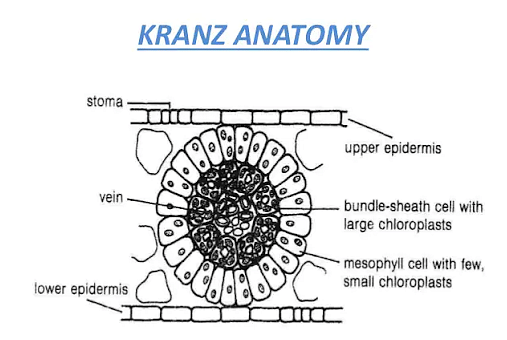
Kranz Anatomy
Read More:
Kranz Anatomy in C4 Plants
[Click Here for Previous Year Questions]
The Calvin cycle and the reactions dependent on light takes place in different locations in the C4 plants to overcome the process of photorespiration, an energy-wasting process that occurs in C3 plants.
New leaf anatomy, metabolic specializations, and gene expression are all part of C4 photosynthesis. Kranz leaf anatomy, which consists of two photosynthetic cell types, is a characteristic of C4 plants. The vascular centers are surrounded by bundle sheath (BS) cells, which are surrounded by mesophyll (M) cells.
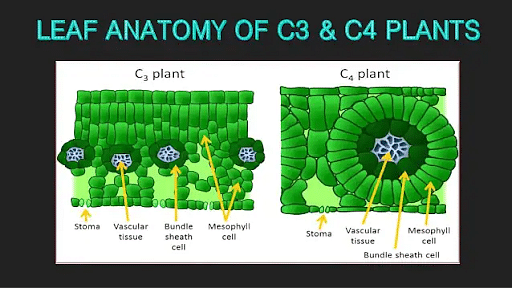
Leaf Anatomy in C3 & C4 Plants
A less common variant involves dimorphic chloroplast compartmentalization within a single cell type. These structural frameworks in C4 leaves act as a functional barrier between two sets of carboxylation and decarboxylation processes.
In C4 plants such as maize, enlarged bundle sheath cells (BS) surround the leaf veins (V), which are then surrounded by mesophyll (M) cells. Each pair of leaf veins is separated by two BS cells and M cells during a V-BS-M-M-BS-V formation. This formation is referred to as Kranz Anatomy.
Development of Kranz Anatomy
[Click Here for Sample Questions]
CO2 is initially fixed into a three-carbon molecule (C3) in the majority of plants, including rice, by the photosynthetic enzyme ribulose bisphosphate carboxylase oxygenase (Rubisco) – this is known as C3 photosynthesis. Rubisco is fundamentally inefficient because it can catalyze a reaction with oxygen, resulting in photorespiration, a wasteful process (rather than photosynthesis).
To compensate for this inefficiency in C4 plants, the C4 pathway goes through the following process:
- It converts ambient CO2 into C4 acids utilizing the enzyme phosphoenolpyruvate carboxylase (PEPcase) which is insensitive to O2 and hence forms oxaloacetate (organic acid).
- This acid is then converted to malate and is transferred to the bundle sheath cells.
- Then, the acid dissociates in the bundle sheath cells which leads to a release of CO2.
- Rubisco then refixes the CO2 and converts it to sugar.
These two steps of the C4 pathway are spatially separated in physically distinct photosynthetic cell types in most C4 plants, allowing for a high concentration of CO2 to accumulate near Rubisco and increased photosynthetic efficiency.
Characteristics of C4 plants
[Click Here for Previous Year Questions]
- They can withstand greater temperatures because they lack a process known as photorespiration.
- They have better water efficiency.
- They have higher biomass productivity.
- They exhibit a response to high intensity.
- It reduces the degree of photorespiration which is an energy-wasting process.
- The existence of the bundle sheath helps in determining the C4's identity.
Read More: Difference between Light Reaction and Dark Reaction
Photosynthesis in Kranz anatomy
[Click Here for Sample Questions]
- Chloroplasts are abundant in the mesophyll cells of the leaves.
- PEP Carboxylase is an enzyme found in the chloroplast of mesophyll cells that can fix Carbon dioxide at low concentrations.
- Light-dependent reactions take place in mesophyll cells, while dark reactions take place in bundle sheath cells.
- Firstly, atmospheric oxygen is fixed and converted into the four-carbon molecule oxaloacetate, which is done by the enzyme PEP carboxylase.
- This oxaloacetate is then converted to Malate and enters the bundle sheath.
- Decarboxylation of Malate occurs in bundle sheath cells, resulting in the release of CO2 and an increase in CO2 concentration in bundle sheath cells.
- In bundle sheath cells, the Rubisco (Ribulose bisphosphate carboxylase oxygenase) enzyme fixes carbon dioxide, which is then converted to sugar.
- Rubisco can also catalyze a reaction with oxygen, resulting in photorespiration, a wasteful process.
- To counteract this, the C4 pathway uses the enzyme phosphoenolpyruvate carboxylase to fix atmospheric carbon dioxide.
- The carbon dioxide is constantly pumped to the bundle sheath cells by the mesophyll cells, resulting in a high carbon dioxide concentration around the rubisco, which decreases photorespiration.
- As a result, the possibility of RuBP oxygenation is eliminated, and photorespiration is not caused.
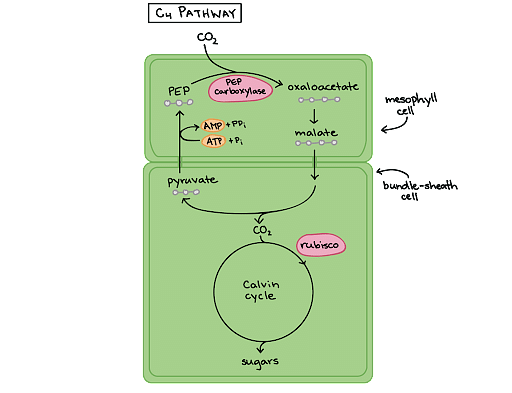
Photosynthesis in Kranz anatomy
Difference Between Mesophyll Cells And Bundle-Sheath Cells
[Click Here for Previous Year Questions]
| Mesophyll cells | Bundle sheath cells |
|---|---|
| Chloroplasts have grana that are large and well-developed. | Chloroplasts have poorly developed or really small grana or the grans are absent. |
| C3 cycle doesn’t occur due to the absence of RuBP carboxylase. | C3 cycle occurs due to the high concentration of RuBP carboxylase. |
| The CO2 acceptor is phosphoenolpyruvate. | The CO2 acceptor is ribulose bisphosphate. |
| Starch grains are absent. | Lots of starch grains are present. |
| Key enzymes that result in starch synthesis are absent. | Key enzymes that result in starch synthesis are present. |
| The CO2 acceptor molecule is present in the cytoplasm. | The CO2 acceptor molecule is present in the stroma of chloroplasts. |
Read More:
CAM Plants
[Click Here for Sample Questions]
Crassulaceae plants use a specific metabolic pathway to minimize photorespiration. These plants divide the activities in time rather than following the C4 pathway, which has light-dependent reactions and the Calvin cycle in different places.
They open their stomata at night to absorb atmospheric CO2, which is transformed to oxaloacetate and later malate or another organic acid. The organic acid is kept in the cell's vacuole. The organic acid is broken down the next day, releasing CO2, which enters the Calvin cycle. These plants can photosynthesize even though their stomata do not open throughout the day. The pathway is known as Crassulacean Acid Methyltransferase and these plants are referred to as CAM plants.

CAM Plants
Things to Remember
- Kranz is a German word that means "wreath" and refers to the way cells are arranged.
- Kranz anatomy is the special structural peculiarity of C4 plants. The leaves of most C4 plants consist of bundle sheath and mesophyll cells arranged in a ring-like formation. The C4 pathway is found in plants that are suited to dry tropical climates.
- Bundle sheath cells are the big cells that surround the vascular bundles in C4 plants, and the leaves with so many layers around the vascular bundles have a large number of chloroplasts, thick walls for gaseous exchange, and no intercellular spaces. Take maize, for example.
- C4 plants are more water-efficient as compared to C3 plants. They survive well under arid conditions, including water stress and high temperatures. They show a response to high intensities and lack the process of photorespiration.
- Understanding the underlying principles of C4 pathway has implications for agricultural production and the development of alternative fuels.
Previous Year Questions
- During light reaction in photosynthesis, the following are formed…
- Energy transfer in photosynthesis occurs as… (JIPMER 2005)
- Anoxygenic photosynthesis is characteristic of… (NEET 2014)
- In photosynthesis, the light-independent reactions take place at… (NEET 2015)
- Law of limiting factor of photosynthesis was proposed by… (Delhi UMET/DPMT 2008)
- During photosynthesis, oxygen in glucose comes from…
- C4 plants are more efficient in photosynthesis than… (NEET 2010)
- In the C cycle, carbon dioxide is first fixed in…
- Stomatal opening or closing is due to… (AMUEEE 2010)
- Calvin cycle takes place in…
- Consider the following statements regarding photosynthesis… (KEAM)
- Synthesis of food in C4 pathway occurs in chloroplasts of… (KCET 2007)
- PAE stands for...(AMUEEE 2014)
- A example of CAM plant is...(AMUEEE 2015)
- Photolysis of water by isolated chloroplasts was demonstrated by...(AMUEEE 2008)
- For every CO2 molecule entering the Calvin cycle, the number of ATP and NADPH required is...(AMUEEE 2010)
- In C3− plants, photosynthesis occurs in….(JKCET 2010)
- In chlorophyll structure four pyrrole rings are united with Mg by their atoms of...(AMUEEE 2009)
- Which of the following is a C4 plant?...(JKCET 2005)
- In C4 pathway, the CO2 fixation in mesophyll cells is carried out by the enzyme .........(KCET 2010)
Sample Questions
Ques. Who proposed the C4 pathway? (1 mark)
Ans. M. D. Hatch and C. R. Slack discovered the C4 pathway in 1966.
Ques. Define Photosynthesis. (1 mark)
Ans. Green plants use sunlight to generate their food, which is known as photosynthesis. As raw ingredients, photosynthesis requires sunlight, chlorophyll, water, and carbon dioxide gas.
Ques. Where does decarboxylation of malate take place? (1 mark)
Ans. Decarboxylation of Malate occurs in bundle sheath cells, resulting in the release of CO2 and an increase in CO2 concentration in bundle sheath cells.
Ques. Give some examples of C3 and C4 plants. (2 marks)
Ans. C3 plants: Rice, Soybean, and all trees.
C4 plants: Sugarcane, Maize, Sorghum
Ques. What is PEP Carboxylase? (1 mark)
Ans. PEP Carboxylase is an enzyme found in the chloroplast of mesophyll cells that can fix Carbon dioxide at low concentrations.
Ques. Give advantages of the C4 cycle over the C3 cycle. (3 marks)
Ans. The advantages are:
(i) The photorespiration is lacking in C4 plants.
(ii) In comparison to C3 plants, the C4 cycle may utilize CO2 in relatively low quantities.
(iii) C4 cycle operates in plants adapted to high integrity of light, high temperature, and low water availability.
Ques. Why are C4 plants more expensive than C3 plants? (1 mark)
Ans. C4 plants are more expensive as they require more energy in synthesizing one molecule of glucose as compared to the C3 plants.
Ques. How do plants with Kranz Anatomy have better water efficiency? (2 marks)
Ans. As C4 plants have minimal photorespiration, they can avoid extra water loss by keeping their stomata closed for longer periods. This increases their water efficiency and helps them survive in hot and dry climates.
Ques. State the advantages of the Double Carbon Fixation in C4 Plants? (3 marks)
Ans. A double carbon fixation offers C4 plants better photosynthetic efficiency. In a hot and dry climate, when excess water vapor diffuses out of the stomata in C3 plants, in C4 plants it’s relatively less due to the C4 cycle taking place within the bundle sheath cells of those plants.
The stomata are going to be closed and therefore the concentration of gases within cells will change. As photosynthesis takes place, CO2 is going to be consumed and oxygen is going to be generated, and eventually, CO2 levels will reduce. However, due to Kranz’s anatomy, the CO2 levels around RUBISCO in Bundle sheath cells will always be more and it'll still fix carbon and not produce photorespiration.
The organic acid breaks down within the bundle sheath cells releasing CO2 which is employed by RUBISCO.
Ques. What are vascular bundles and what do they do? (2 marks)
Ans. In vascular plants, vascular bundles are an element of the transport system. Xylem and phloem are two types of vascular tissues that aid in the movement of water and minerals. Both of these problems can be found in vascular bundles.
Do Check Out:



Comments