



Content Curator
Ladybird beetle or ladybug belong to the Coccinellidae family and the Coleoptera order. They are exceedingly small, round in shape, and up to 8 mm (about 0.31 in) long. Ladybirds are thus a massive family with over 5,000 species worldwide. Ladybirds get their name after the Virgin Mary who was called the “Beetle of Our Lady” in Britain during the Middle Ages. A ladybird does not always have red and black colors, and the colors and patterns on its wings differ from species to species.
The butterfly and the ladybird have similar lifecycles and the lifespan of goes up to 1 year. The lifecycle is broadly divided into four main stages: The Egg, The Larval, The Pupa, and The Adult.
Read More: Toxoplasmosis
| Table of Content |
Key Terms: Lifecycle, Ladybird, Developmental Stages, Egg, Larvae, Pupal, Adult
Ladybird Life Cycle
[Click Here for Sample Questions]
Ladybirds are interesting species known worldwide for their color. They are popularly known as lady beetles, ladybug beetles, or ladybird beetles. The lifecycle of ladybirds occurs through four stages called metamorphosis. The four stages are:
- Embryonic or the Egg Stage
- Larvae or Larval Stage
- Pupae or Pupal Stage
- Adult Beetles or Imaginal Stage
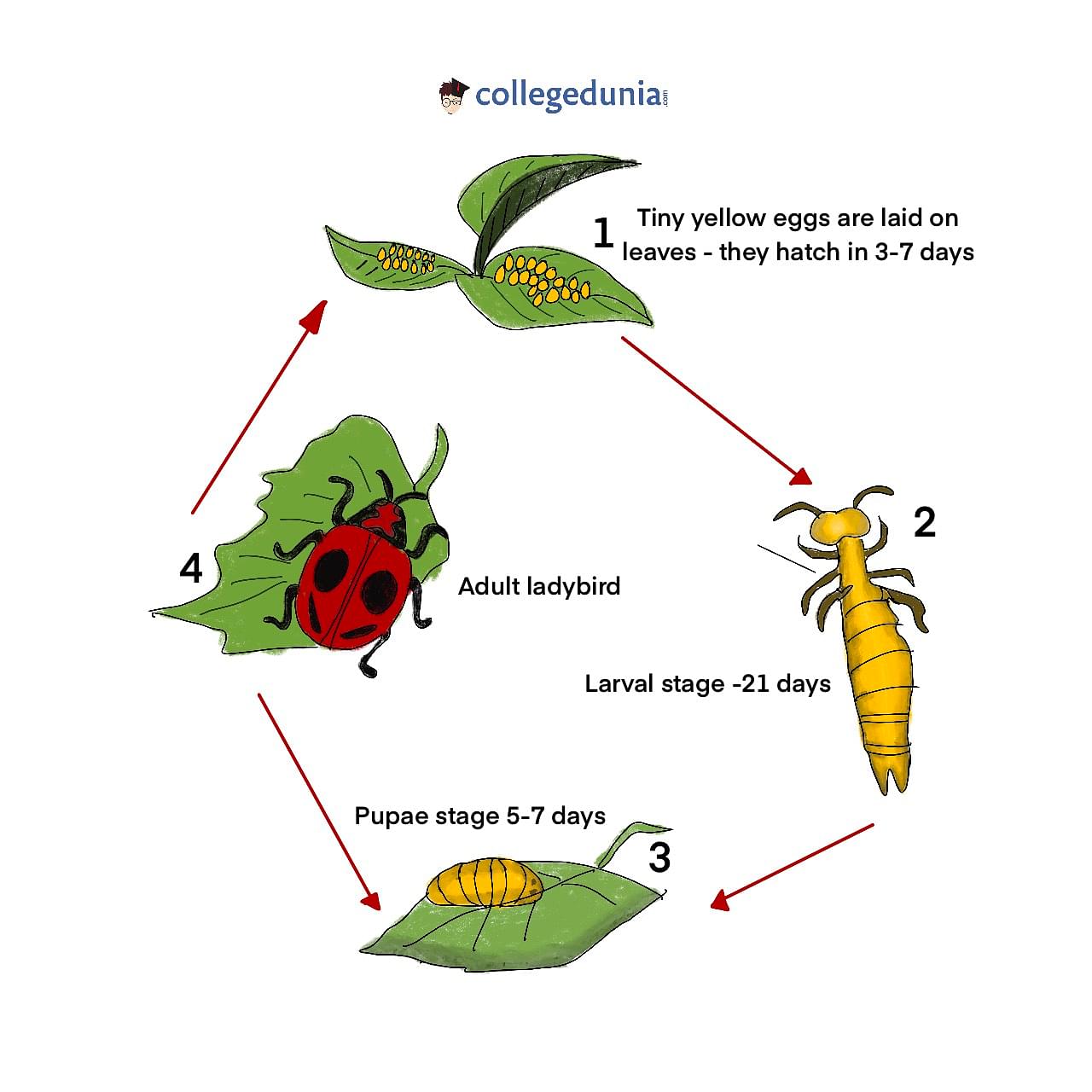
Ladybird Lifecycle
The above four stages and the developmental changes occurring in each stage are discussed further in the article.
Embryonic or The Egg - First Stage
[Click Here for Sample Questions]
Following is the step-by-step development occurring in the Egg stage:
- The female ladybird, to protect her eggs from predators, lays her eggs in the nooks and corners of leaves.
- The female ladybug searches for a safe place with plenty of food for the larvae to feed on when they hatch such as near a colony of delicious aphids or mealbugs.
- On the leaf, the female ladybug lays between 10 and 15 eggs.
- A fertilized female ladybird, on the other hand, can lay between 300 and 1000 eggs during early summer.
- Usually about 10 to 50 eggs in each cluster.
- The time it takes for an egg to hatch varies on a variety of factors, although it seldom takes more than a week and often only a few days.
- Ladybug larvae, which resemble alligators, hatch from the eggs and they start by eating their own eggshells.
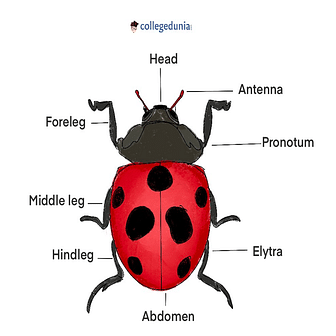
Ladybird Anatomy
Read More: Ant Lifecycle
Larvae or The Larval - Second Stage
[Click Here for Sample Questions]
Following is the step-by-step development occurring in the Larval stage:
- Ladybird larvae are voracious eaters and hence when the eggs hatch, the larvae go on a feeding frenzy, feasting on mites or aphids.
- Aphids are sap-sucking insects that belong to the superfamily Aphididae and are the primary food source for ladybird larvae.
- Ladybugs molt four times throughout their larval stage.
- Instars are the developmental phases that occur between moltings.
- The larvae are in their first instar and can consume up to 400 aphids per day.
- Later, the larva grows large enough to break free from its cuticle, soft shell.
- The larvae enter the second stage of instar after molting.
- The larva goes through four instars before attaching itself to a surface or leaf and pupating.
Read More: Human & Animal Cryptobiosis
Pupae or The Pupal - Third Stage
[Click Here for Sample Questions]
Following is the step-by-step development occurring in the Pupal stage:
- When a ladybird larvae approaches the pupal stage, it resembles yellow or orange with black markings.
- The ladybird is immobile here as it is stuck to a leaf and developing.
- The larva folds up somewhat, and part of the larval skin may still be present.
- The future beetle scrunches up to become more compact, like a ladybug rather than a lizard.
- Histoblasts are specialized cells found in ladybirds.
- Histoblasts are in charge of the metabolic process that converts the larval body into an adult ladybird.
- A ladybug's pupal stage is a period of change.
- To the untrained eye, it appears to be a lot of waiting.
- The process takes about a week and ends when the quiet, compact tiny mass emerges from its pupal skin.
Read More: Lifecycle of Dog
Adult Beetles or Imaginal – Fourth Stage
[Click Here for Sample Questions]
Following is the step-by-step development occurring in the Imaginal stage:
- The freshly born ladybirds have delicate and brittle exoskeletons at this stage.
- They are vulnerable to predators until their skin becomes stiffer.
- Initially, they seem pale yellow, but as time passes, the hues change to crimson and black.
- An adult ladybug occasionally deposits a yellow substance on our palm called hemolymph.
- Hemolymph is the blood secreted by the ladybug from its leg joints as a defense mechanism from external agents.
- Aphids, mealybugs, insect eggs, and pollen are eaten by the adult lady beetle.
- Mating does not commence until after a time of eating.
- They often mate throughout the spring months after which the cycle begins all over again.
Read More: Dragonfly Lifecycle
Things to Remember
- The female ladybug lays its eggs in a safe place with plenty of food for the larvae to feed on when they hatch.
- In the larval stage, the eggs hatch, and feed on the larvae go on a feeding frenzy, feasting on mites or aphids. The larvae are in their first instar and can consume up to 400 aphids per day.
- Ladybugs molt four times throughout their larval stage.
- When a ladybird larva approaches the pupal stage, it resembles yellow or orange with black markings.
- Histoblasts are specialized cells found in ladybirds.
- Ladybirds often mate throughout the spring months
Also Read:
Sample Questions
Ques. What are ladybirds? (2 marks)
Ans: A ladybird beetle or ladybug belongs to the Coccinellidae family and the Coleoptera order. Ladybirds are a massive family with over 5,000 species worldwide. They are ridiculously small, round in shape, and up to 8 mm (about 0.31 in) long. A ladybird does not always have red and black colors, and the colors and patterns on its wings differ from species to species. Ladybirds live up to 1 year.
Ques.How many stages are in the life cycle of a ladybug? Explain each stage. (5 marks)
Ans: A ladybird has four stages in her life cycle. They are-
- The Egg Stage
In this stage the female ladybug lays between 10 and 15 eggs. A fertilized female ladybird, on the other hand, can lay between 300 and 1000 eggs during early summer. usually about 10 to 50 eggs in each cluster. The time it takes for an egg to hatch varies on a variety of factors, although it seldom takes more than a week and often only a few days
- The larvae stage
Ladybird larvae are voracious eaters. When the eggs hatch, the larvae go on a feeding frenzy, feasting on mites or aphids. Aphids are sap-sucking insects that belong to the superfamily Aphididae and are the primary food source for ladybird larvae. Ladybugs moult four times throughout their larval stage.
- The Pupal Stage
When a ladybird larvae approaches the pupal stage, it resembles yellow or orange with black markings. The ladybird is immobile here since it is stuck to a leaf and developing. The larva folds up, and part of the larval skin may still be present. A ladybug's pupal stage is a period of change. To the untrained eye, it appears to be a lot of waiting. The process takes about a week and ends when the quiet, compact tiny mass emerges from its pupal skin.
- The Adult Stage
The freshly born ladybirds have delicate and brittle exoskeletons at this stage and are vulnerable to predators until their skin becomes more stiff. Initially, they seem pale yellow, but as time passes, the hues change to crimson and black. Aphids, mealybugs, insect eggs, and pollen are all on the menu for this adult lady beetle. Mating does not commence until after a time of eating. They often mate throughout the spring months after which the cycle begins all over again.
Ques. Ladybugs lay thousands of eggs. What other insects or bugs can you think of that also lay lots of eggs? (2 marks)
Ans: Ants are well known for laying hundreds or thousands of eggs during their life span. The Queen ant starts a colony by giving birth to hundreds of larvae that form a hierarchy with the Queen at the top and the worker ants at the bottom.
Ques. What do ladybugs eat? (2 marks)
Ans: Ladybugs tend to eat Aphids which are sap-sucking insects that belong to the superfamily Aphididae and are the primary food source for ladybirds. A ladybird also eats mealybugs, insect eggs, and pollen.
Ques. Explain the Adult Stage of the Ladybug. (3 marks)
Ans: The freshly born ladybirds have delicate and brittle exoskeletons at this stage and are vulnerable to predators until their skin becomes stiffer. Initially, they seem pale yellow, but as time passes, the hues change to crimson and black. Aphids, mealybugs, insect eggs, and pollen are all on the menu for this adult lady beetle. Mating does not commence until after a time of eating. They often mate throughout the spring months after which the cycle begins all over again.
Ques. What kinds of insects go through a similar cycle as that of a ladybird? (4 marks)
Ans: Butterflies go through a similar and almost identical life cycle. The Butterflies have four stages in their life cycle. The stages of a butterfly are: -
Stage 1: The egg
All butterflies begin as tiny eggs, roughly the size of a pin, that female butterflies lay in little clusters on foliage.
Stage 2: The Larvae
Butterfly larvae, often known as caterpillars, are more endearing than the majority of their contemporaries.
Stage 3: The pupal
The next stage of a butterfly's life cycle occurs inside a chrysalis, the caterpillar's last exoskeleton manifestation.
Stage 4: The adult
Adult butterflies emerge from their cocoon and fly through the air on their new wings.
Ques. What are Histoblasts? (1 mark)
Ans: Histoblasts are specialized cells found in ladybirds. Histoblasts are in charge of the metabolic process that converts the larval body into an adult ladybird.
Ques. What are instars? (2 marks)
Ans: Ladybugs molt four times throughout their larval stage. Instars are the developmental phases that occur between moltings. The larvae are in their first instar and can consume up to 400 aphids per day.
Also Read:



Comments