



Exams Prep Master
Refractive index is a unitless quantity in physics whose value is calculated by measuring the deviation of light when it passes from one medium to another. It is denoted by µ or n in physics and determines the ratio of speed of light among different mediums.
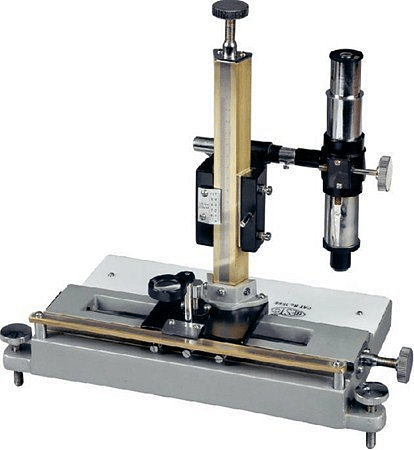
A traveling microscope is an ordinary microscope that is fixed on a stand. It can move in vertical and horizontal directions. In this article, we are going to discuss about various ways to determine the refractive index of a glass slab using a traveling microscope.
What is the Refractive Index?
[Click Here for Sample Questions]
Refractive index is the measure of the deviation of a light ray when it pauses between the two mediums. It is a dimensionless number that is used to decide the speed of light. The refractive index is the ratio of the velocity of the lights. The medium that is decided to calculate the refractive index is called the numerator. The medium for which it is defined as the denominator.
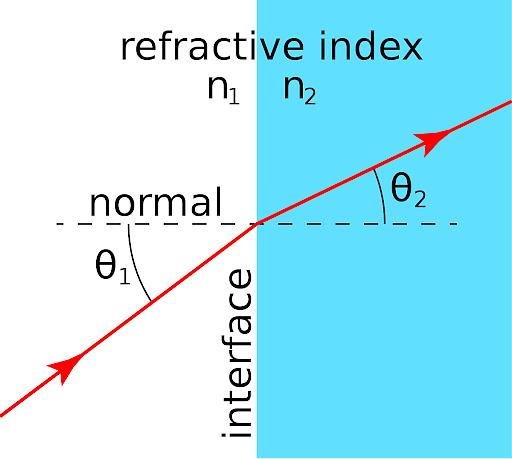
The formula for the refractive index:
n or µ = c/v
Where,
n or µ = refractive index
c = speed of light
V = velocity of light
There are two types of refractive Index:
Absolute Refractive Index: The Absolute Refractive Index can be defined as the ratio of the velocity of light in a vacuum & the velocity of light in the medium.
Relative Refractive Index: The relative refractive index can be defined as the ratio of light between the mediums.
Also Read:
What is a Glass Slab?
[Click Here for Sample Questions]
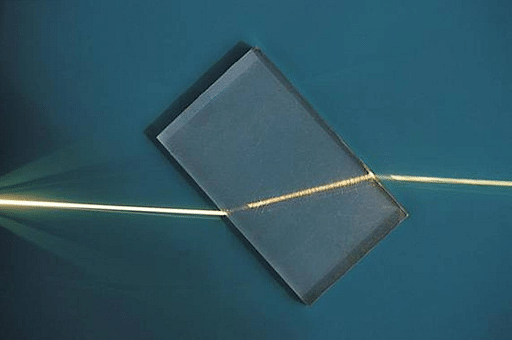
Glass slab is a three-dimensional substance that is made entirely of a glass material. The glass slab has a cuboidal shape. It is used to produce a lateral or displacement into the direction of light.
What is a Traveling Microscope?
[Click Here for Sample Questions]
Travelling microscope is an instrument that is used for measuring the length with the resolution typically in the order of 0.01mm. It can be moved vertically and horizontally according to the needs of the observer. It is a compound, fitted on the vertical scale and can be easily travelled from horizontal to vertical scale. The travelling microscope carries a Vernier scale along with the main scale. It is widely used in laboratories to measure the refractive index of all the flat specimens.
Also check: Simple Microscope
Experiment
[Click Here for Sample Questions]
The experimental procedure to measure the refractive index of a glass slab using a travelling microscope is given below.
Aim
To determine the refractive index of a glass slab using a travelling microscope.
Materials Required
- 3 Glass Slabs, the material should be identical & each of them varies in thickness.
- A Travelling Microscope
- Lycopodium powder microscope
Theory
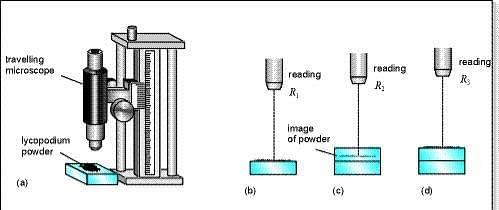
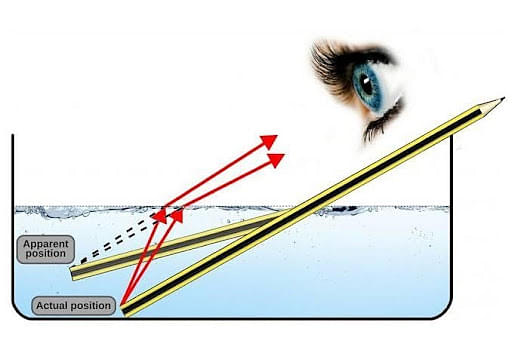
The experiment is based on the fact that if a glass slab is placed on a horizontal surface then, when the bottom surface of the glass is viewed from the top, due to its refraction, it appears to be elevated. We can determine the apparent thickness of the slab by calculating the distance between the apparent bottom & the top.
It can be calculated as below:
n= real thickness of the slab/apparent thickness of the slab.
Procedure
We need to ensure the accuracy in the refractive index and for this, we need to know about the traveling microscope readings. The process can be understood by the following steps:
- First, we need to place a traveling scope. Make sure that it is placed near a light source.
- Now, we need to assure that the base of the traveling microscope is horizontal. For this, we need to adjust the screws.
- Now, position the traveling microscope horizontally and then check the eyepiece that if the cross wires are visible or not.
- Now, we need to check the verifier constant of the scale, during its vertical position.
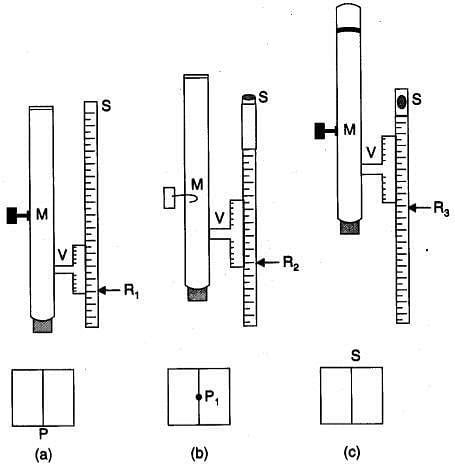
- Now mark at the base of the microscope using a marker and creating a point P.
- Now you need to focus the vertically moved traveling microscope on point, P. Make sure that there is no parallax between point P and the cross wires.
- Note the reading, the Vernier scale readings, and the main scale readings and then consider it as R1.
- Now, choose the thinnest glass slab and place it on point P.
- Now focus on point P1 of the cross-mark and then lift the microscope.
- Now make a note on the vertical scale R2 of times reading.
- Get some lycopodium powder and sprinkle it over the glass slab.
- Again lift the microscope and focus it on the particle near S.
- Make a note on the vertical scale of R3.
- The process is completed now.
- Take these steps into consideration to take the readings of other glass slabs.
Calculation of the refractive index = R3-R1/ R3-R2
Refractive index of Mean= n1+n2+n3/3
Result
Finally, we have successfully determined the refractive index of a glass slab using a traveling microscope because The ratio R3-R1/ R3-R2 is constant.
Precautions
- Make sure that you remove the parallax properly because it is one of the most important parts of the experiment.
- The travelling microscope should be moved in the upward direction to avoid backlash errors.
Source of Error
- Make sure that you use a thicker layer of lycopodium powder on the glass slab.
- The scale that is going to be used in the microscope should not be calibrated in a proper
Things to Remember
- The refractive index is the ratio between light and its speed in a medium.
- The frequency of the light wave remains unchanged in all the mediums.
- Make sure to sprinkle a thicker layer of lycopodium powder while experiencing.
- Make sure that you have removed the parallax from the microscope.
- The scale which you are using should not be calibrated.
Also Read:
Sample Questions
Ques: Define Apparent Shift. (3 marks)
Ans: the perpendicular distance between the emergent ray and the incident with the reference to the refraction of light through a glass slab is called the apparent shift. The parallax is called the apparent shift of the position of an object that is relative to more distant background objects caused by a change in position. In simple words, when an object is placed in a medium & viewed from a different medium then the image seen by the observer lies at some different points.
Ques: Find out the refractive index of the following. (2 marks)
If the speed of the light in the air is 2×98m/s
The speed of the light in glass is 1×98 m/s
If the speed of light in the air is 4×10⁶ m/s
The speed of light in the air is 3×10⁶ m/s
Ans:
- If given, the speed of light in air= 2×98
The speeds of light in the glass= 1×98
The refractive index of glass= the speed of light in air/the speed of light in the lass
RI= 2×98/1×98
RI=2
Thus, the refractive index of the glass is 2.
- If given, the speed of light in the air= 4×10⁶
The speed of light in the glass= 3×10⁶
The refractive index of the glass= the speed of light in air/the speed of light in the glass
RI= 4×10⁶/3×106
RI= 2
Thus, the refractive index of the glass is 2.
Ques: Define the refractive index of a material. (2 marks)
Ans: The refractive index is the value that is calculated with the ratio of light in a vacuum in two mediums. Another name for the refractive index is the index of refraction. It is defined as the treasure of the deviation of a light ray. When a light ray passes from one medium to another one is the measurement of the deviation in both of those is the refractive index of a material. When you measure the angle of the material then you will get its refractive index.
Ques: what are the factors that affect the value of the refractive index? (3 marks)
Ans: Some factors affect the value of the refractive index.
These are as follows;
- Temperature- The temperature is the first factor that affects the refractive index. The value of the refractive index is less when the temperature is high & vice versa.
- The wavelength – the wavelength of the light is the second thing that affects the refractive. Index because the refractive index is directly proportional to the wavelength of the light.
- Optical density- optical density is the third thing that affects the refractive index. The ability of a medium to refract light is the optical density of a medium.
Ques: Create a table of the refractive index of materials. (5 marks)
Ans: The table is given below:
| Material | Refractive Index (n) |
|---|---|
| Air | 1.000 293 |
| Water | 1.333 |
| Vacuum | 1 |
| Ice | 1.31 |
| Diamond | 2.42 |
| Olive oil | 1.47 |
| Helium | 1.000 036 |
| Polycarbonate | 1.58 |
| Carbon dioxide | 1.000 450 |
| Window glass | 1.52 |
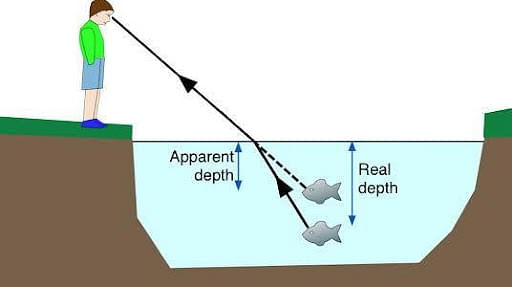
Ques: what is the difference between real and apparent depth? Explain it using a diagram. (2 marks)
Ans: The real depth is the actual depth of an object beneath the surface. On the other side, the apparent depth of an object is the depth that is visible to the human eye, due to the refraction of light.
Ques: If a fish is at the bottom of a pond appears to be 2.1 m from the surface of the water. Find out the depth of the pond? (2 marks)
Ans: As we know that the refractive index of the water is 1.33
Then,
The formula of the refractive index:
n= real depth/apparent depth
1.33= real depth/2.1
1.33×2.1m
2.793m
Thus, the depth of the pond is 2.793m.
Ques: Why do Diamonds sparkle when the white light is directed at them? (4 marks)
Ans: When white light is directed at the diamonds they start sparkling because when the. White light enters, the light is split into the colors of the spectrum. The diamonds have a higher refractive index. The refractive index of diamond is 2.417. Due to its higher refractive index, when the light enters, it separates the colors more than any other substance does. When a light way is directed in a diamond it might internally reflect many times before emerging. And as the result, the colors spread more and more. This is the reason that diamonds sparkle when the white light is directed at them.
For Latest Updates on Upcoming Board Exams, Click Here: https://t.me/class_10_12_board_updates
Check-Out:



Comments