



Education Journalist | Study Abroad Lead
Refraction is the change in the direction of a wave passing from one medium to another. One of the most commonly viewed phenomena is the refraction of light. Other than that, the sound and water waves also undergo refraction. It is due to this refraction that optical instruments such as lenses, prisms, and magnifying glasses exist.
| Table of Content |
Key Terms: Refraction, Refractive index, Rainbow, Mirror, Lenses, Optical Instruments
What is Refraction?
[Click Here for Sample Questions]
Refraction refers to the bending of a wave as it passes from one medium to another. The bending of waves is caused due to the differences in density between the two substances.
Example: Waves travel faster in deep water than in shallow water. When ocean waves approach the beach obliquely, the part of the wave farther from the beach moves faster than the part closer. Thus, the wave will swing around until it moves in a perpendicular direction to the shoreline.
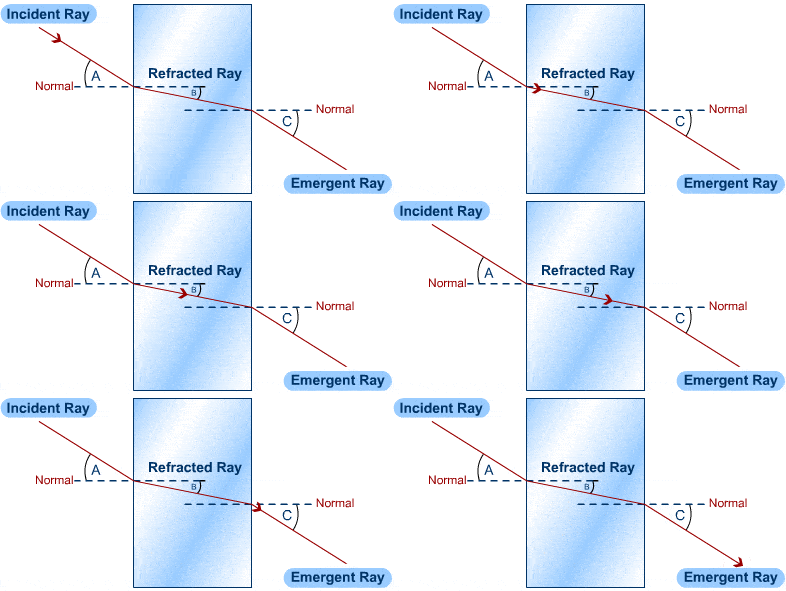
Refraction of Waves
| Frequently Asked Questions Question: Who discovered refraction? Answer: Willebrord Snel van Royen discovered the actual law of refraction in the early 1600s. Since his name in Latin is “Snellius”, the law is also called “Snell's law” instead of “Snel's law”. Question: What are the laws of reflection and refraction? Answer: Laws of Reflection and Refraction are: (i) The incident ray, the reflected ray and the normal at the point of incidence all three lie in the same plane. (ii) The angle of incidence (i) is always equal to the angle of reflection (r). |
Causes of Refraction
[Click Here for Previous Year Questions]
When a light ray travels from one medium to another at an angle into a medium of different refractive index, refraction occurs.
As the speed of the light ray changes, so does the direction of the ray of light. We can take the example of air travelling into water. As the ray continues to travel at a different angle, the speed of light is decreased.
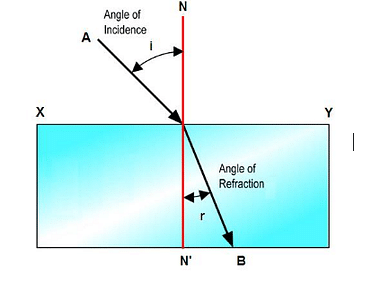
Causes of Refraction
The figure above is an illustration of the refraction of light. When light travels from air to glass, the speed of light is reduced and the direction is changed as the ray enters the glass medium.
When the light travels from a substance with less density to a denser substance, the ray that is refracted is inclined more towards the normal line. If the light wave appears to the boundary of another medium in a perpendicular direction, no refraction occurs to the light ray despite the change in the speed of the light.
Also Read:
Laws of Refraction
[Click Here for Sample Questions]
- The angle of incidence, denoted by ‘i’, is the angle between the incident ray and the normal.
- The angle of refraction, denoted by ‘r’, is the angle between the refracted ray and the normal.
The laws of refraction are as follows:
- The incident ray refracted ray, and the normal to the interface of two media at the point of incidence all lie on the same plane.
- The ratio of the sine of the angle of incidence to the sine of the angle of refraction is a constant.
The second law of refraction is also known as Snell’s law of refraction: sin i / sin r = Refraction
| Solved Example on Laws of Refraction Example 1: Light traveling through an optical fiber (n=1.44) reaches the end of the fiber and exits into the air. If the angle of incidence on the end of the fiber is 30o, what is the angle of refraction outside the fiber? Solution: Since the light is now traveling from the fiber into air, we will call fiber material 1 and air material 2. Thus, n1 = 1.44, n2 = 1.00, and θ1 = 30o. Snell's Law then becomes (1.44) sin 30o = 1.00 sin θ2. sin θ2 = (1.44/1.00) sin 30o = 1.44 (0.500) = 0.720 θ2 = sin-1 (0.720) = 46o. At this time, the angle of refraction is larger than the angle of incidence. The light is bending away from the normal as it enters a rarer material. |
Refractive Index
[Click Here for Previous Year Questions]
The extent to which the light is inclined when the rays enter from one medium to another is known as the refractive index or index of refraction. This can also be described as how fast the light travels from one medium to another medium. The Refractive Index is dimensionless.
This refractive index is denoted by the symbol ‘n’. It is represented by the equation -
n=c/v
where n = refractive index for a medium
c = speed of light in a vacuum
v = velocity of light in any medium
If the light travels from a medium of lower refractive index to that of higher refractive index, it bends towards the normal.
If the light travels from a medium of higher refractive index to that of lower refractive index, it bends away from the normal.
Application of Refraction of Light
[Click Here for Sample Questions]
- Glasses and spectacles that are worn by people with defective vision experience the process of refraction. The glasses are made out of plastic that deliberately bends light in specific ways.
- Peepholes of house doors, movie projectors, cameras, and telescopes also make use of this phenomenon.
- In order to create an image of an object for different purposes, like magnification, the lens uses refraction.
Refraction of Light in Reality
[Click Here for Previous Year Questions]
- Twinkling of the stars - The atmosphere is composed of areas of the thick and thin atmosphere. When one looks at the stars at night, the light passing through these different layers of the atmosphere from the stars reaches our eyes and therefore the stars appear to twinkle.
- As the light travels from the bottom to the top, the light coming from the pool bends due to refraction and thus the swimming pool always looks shallower than it really is.
- Due to the refraction of light, white light when passed through a prism splits into red, orange, yellow, green, blue and violet colours.

Refraction of Light
Also check:
Things to Remember
- Refraction can be defined as, “the change in the direction of a wave passing from one medium to another”.
- When a light ray travels from one medium to another at an angle into a medium of different refractive index, refraction occurs.
- When the light travels from a substance with less density to a denser substance, the ray that is refracted is inclined more towards the normal line.
- The second law of refraction is also known as Snell’s law of refraction.
- sin i / sin r = Refraction
- The extent to which the light is inclined when the rays enter from one medium to another is known as the refractive index or index of refraction.
- Glasses and spectacles that are worn by people with defective vision experience the process of refraction. The glasses are made out of plastic that deliberately bends light in specific ways.
- As the light travels from the bottom to the top, the light coming from the pool bends due to refraction and thus the swimming pool always looks shallower than it really is.
Sample Questions
Ques 1. What is the speed of light in a denser medium of polarising angle 30°? (CBSE 2019)
Ans. If, θ is the polarising angle of incidence and μ is the refractive index
Then they are linked by,
We also know that,
Where, c = the speed of light
v = the speed of light in the medium
Which is greater than the speed of light.
Ques 2. State the conditions for observing a rainbow. Show by drawing suitable diagrams how one understands the formation of the rainbow. ( Comptt. All India 2014)
Ans. The conditions for observing a rainbow are as follows,
i) The sun must appear after the rainfall
ii) The observer must be present in between the sun and the rainbow such that the sun is behind him/her.
Formation of rainbow:

- The ray of light reaches the observer through refraction which is followed by a reflection and refraction.
- The figure shows red light from drop 1 and violet light from drop 2 which are reaching the observer’s eye.
Short Answer Type Questions
Ques 1. What is meant by the wavefront of a travelling wave? Using the Huygens principle, obtain the law of refraction at a plane interface when light passes from a denser to a rarer medium. (CBSE 2020)
Ans. Wavefront is an imaginary surface formed by the locus of all points of a wave having the same phase (having identical path length from the source of that wave).

BC is the distance after time that travel in medium 1 and AE is medium 2.
V1= velocity is medium 1
V2 = velocity in medium 2
From ΔABC,
t/QC
sin i = V1
ΔAEC
sin i/sinr = V1/V2.... (1)
n1 = C/V1
n2= C/V2
V1/V2= n2/n1.... (2)
n1sini = n2 sinr (from (1) and (2))
This represents the law of refraction.
Ques 2. When it is kept in a medium of refractive index 1.4, calculate the radius of a curvature of an equi-concave lens of refractive index 1.5 to have a power of - 5D. (CBSE 2019)
Ans. As we know that the lens makers formula for the concave lens is
1/f= (µ -1) [(1/R1)-(1/R2)]
Where, f = focal length
μ = μ2/ μ1 is the refractive index of material of the lens with respect to the surrounding medium
R1 and R2 = radius of the curvature of two conceive spherical refracting surfaces
Now, as the lens is an equi-convex lens, therefore
R1 = -R2
Hence,

Given, refractive index of lens is μ2 = 1.5
Refractive index of medium is μ1= 1.4
Power of the lens = -5D
Thus, the focal length is,
f= 1/Power =1/(-5)
Or f= 100/(-5) cm =-20cm
Therefore,

The radius of the curvature of an equi-concave lens is 2.857 cm.
Ques 3. What is the “refractive index” of a medium? Verify the Snell’s law of refraction when a plane wavefront is propagating from a denser to a rarer medium. (CBSE 2019)
Ans.

“Refractive index” of a medium is the ratio of the speed of light in vacuum to the speed of light in a medium.
Let us assume the medium 1 which is optically denser than the medium 2
Let the speed of light be V1 in medium 1 and V2in medium 2
It must be noted that v2-v1.
A plane wave AB propagates and hits the interface at an angle and it can be the time taken by wavefront to travel the distance BC
Now, if we want to draw the refracted wavefront, we can draw a sphere of radius V2 with A as centre and let the surface tangent to the sphere passing through point C is the refracted wavefront.
Now,
Let the surface be tangent at the sphere E
In ΔABC
sin i = v1t/AC
In ΔAEC
sin r = v2t/AC
Dividing both the equations, we get
sin i/sin r = v1/v2= (c/v2)/(c/v1)
Thus,
sin i/ sin r = n2/n1
This is verified Snell’s law of refraction.
Ques 4. (a)Show how a concave mirror can be used to obtain an erect and magnified image of an object with the help of a ray diagram.
(b) Obtain the mirror formula and expression for the linear magnification by using the above ray diagram. (CBSE 2018) .
Ans. a)

ΔA’B’F and MFP
A’B/MP = B’F/FP OR A’B’/AB = B’F’/FP (PM=BA)
Likewise, ΔaA’B’P and ABP
B’A/BA = B’F/BP
B’F/FP = B’P/BP
B’F = v+f
BP = u
(v+f)/f = v/u
1 + (v/f) = v/u
Dividing by v and applying sign convention,
1/v - 1/f = (-1)/u
1/f = 1/v + 1/u
This is the mirror equation.
Linear magnification,
From ΔA’B’P and ABP,
B’A’/BA = B’P/BP = -v/u
Long Answer Type Questions
Ques 1. When a final image is formed at infinity, draw a ray diagram of an astronomical telescope. Obtain the expression for the resolving power of the telescope.
(b) An astronomical telescope has an objective lens of focal length 20m and an eyepiece of focal length is 1 cm.
(i) Find the angular magnification of the telescope
(ii) In order to view the Moon, if this telescope is used, find the diameter of the image formed by the objective lens. Given the diameter of the Moon is 3.5 x 10⁶ m and radius of the lunar orbit is 3.8 x 10⁸ m. (CBSE 2020)
Ans. (a)

Resolving the power,
\(= \frac{D}{1.22 \lambda}\)
(b) (i) Angular magnification,
=fo/fe = 20/0.01 = 2000
(ii)D/d = x/fo
d= Dfo/x = (3.5* 106 * 20)/(3.8 * 108) = 0.184m
Ques 2. (a) The phenomenon of total internal reflection of a light observed under what conditions? Write the relation between the critical angle of incidence and the refractive index of the medium.
(b) Three lenses of focal lengths +10 cm, -10 cm, +30 cm are arranged coaxially as shown in the figure below. Find the position of the final image formed by the combination. (CBSE 2019)

Ans. (a) The phenomenon of reflection of light into a denser medium from an interface of this denser medium and a rare medium is called total internal reflection. The conditions for total internal reflections are as follows:-
- An incident ray should travel from a denser medium to a rarer medium
- Angle of incidence i should be greater than the critical angle C for a pair of media in contact.
Critical angle is the angle of incidence in a denser medium to which an angle of refraction is 90° in the rarer medium.
The relation between the critical angle of incidence and refraction index of the medium:
Let us assume that an angle of incidence is equal to the critical angle,
i = c
Thus, the angle of refraction is r = 90°
Now applying the Snell’s law, we get
µd sin C = µr sin r
Where, µd = refractive index of denser medium
µr = refractive index of rarer medium
Therefore,
µd/µr = sin r/sin C = sin 90°/sin C
µ= µd/µr = 1/sin C
µ = 1/ sin C
This shows the required relation between the critical angle of incidence and refractive index of medium.
(b) Let us assume the given lenses to be 1,2 and 3 respectively as shown in the figure.
Focal length of lens 1 = +10 cm
Focal length of lens 2 = -10cm
Focal length of lens 3 = +30cm
By applying lens formula, we get
1/f = 1/v -1/u
For lens 1, we have f =+10, v = x and u = -30cm
1/10 = 1/x - 1/(-30)
=> 1/x = 1/10 - 1/30 = 2/30
=> x = 15 cm
For lens 2, the image of lens 1 at distance x = 15cm is the object.
Thus, f = -10 cm
v = x
u = 10 cm
Hence,
1/-10 = 1/x’ - 1/10
=> 1/x’ = 1/10 -1/10 =0
=> x’ = infinity
Thus, for image 3, lens 2, which is located at infinity, is the object
As we know, for a convex lens, rays coming from infinity converge at the focus and therefore, an image is formed at the focus of lens 3 that is 30 cm. Thus the final image formed by the combination is at 30cm.
Ques 3. (a) Draw a ray diagram showing the image formation by a combination of two thin convex lenses in contact. Write the expression for the power of this combination in terms of the focal lengths of the lenses.
(b) A ray of light passing through an equilateral glass prism from air undergoes minimum deviation when the angle of incidence is 3/4th of the angle of prism. Calculate the speed of light in prism. (CBSE 2017)
Ans. C1 and C2 are the optical centres of the convex lenses L1 and L2

Also, I’ serves as a virtual image object for L2 from the lens formula L2,
1/v - 1/v’ = 1/f2 …(ii)
Adding equations (i) and (ii)
1/v- 1/v’ = 1/f1 + 1/f2
= 1/F
Therefore the focal length of the combination is
1/F = 1/f1 + 1/f2

Ques 4. (a) Draw a labelled diagram illustrating the image formation of a distant object by a refracting telescope. When a final image is formed at infinity, deduce the expression for its magnifying power.
(b) The sum of focal lengths of the two lenses of a refracting telescope is 105 cm. The focal length of one lens is 20 times that of the other. When the final image is formed at infinity, determine the total magnification of the telescope. (Comptt. All India 2015)
Ans. (a)

Magnifying power is defined as the ratio of angle β subtended by the final image on the eye to the angle α subtended by object on the eye.

The limitations of refracting telescope over a reflecting type telescope are,
- Due to refraction, it suffers from chromatic aberration and therefore, the image obtained is multicoloured and blurred.
- As the lens of large apparatus can not be manufactured easily, its light gathers low power and thus, can not be used to view the faint stars.
Previous Year Questions
- A plano convex lens fits exactly into a plano concave lens. Their plane surfaces… [NEET 2013]
- A ray is incident at an angle of incidence i on one surface of a small… [NEET 2020]
- A ray of light travelling in a transparent medium of refractive index μ… [NEET 2010]
- A rod of length 10cm lies along the principal axis of a concave mirror… [NEET 2012]
- A thin prism having refracting angle 10∘ is made of glass of refractive index… [NEET 2017]
- A thin prism of angle 15∘ made of glass of refractive index… [NEET 2011]
- An air bubble in a glass slab with refractive index… [NEET 2016]
- An astronomical refracting telescope will have large angular magnification… [NEET 2018]
- An astronomical telescope has objective and eyepiece of… [NEET 2016]
- When light passes form one medium to another… [KCET 1996]
- Optical fiber works on the principle of… [KCET 1996]
- Which of the following is true for rays coming from infinity… [DUET 2006]
- A point source of light S, placed at a distance L in front of the centre of… [DUET 2000]
- A girl of height 150cm with her eye level at 140cm stands in front of plane… [KCET 2019]
- A given ray of light suffers minimum deviation in an equilateral prism P… [NEET 2001]
- A converging beam of rays is incident on a diverging lens… [NEET 2011]
- A lens having focal length f and aperture of diameter d forms an image of… [NEET 2010]
- A person can see clearly objects only when they lie between… [NEET 2016]
- A red flower seen through a green glass looks… [KCET 1996]
- The aperture of objective lens of a telescope is made large… [KCET 2003]
For Latest Updates on Upcoming Board Exams, Click Here: https://t.me/class_10_12_board_updates
Check-Out:



Comments