



Content Writer-SME
The menstrual cycle is a natural biological process in women that usually begins at the time of puberty. It is marked by vaginal bleeding that occurs at an interval of 28-30 days (every month). This complete cycle is called menstrual cycle or menstruation which is regulated by various menstrual hormones like estrogen, progesterone etc. The age at which a girl gets her first menstruation depends on lifestyle, eating habits and hormones.
Menstrual Cycle
[Click Here for Sample Questions]
In the life cycle of a man, the reproductive age starts from puberty and continues till death. In contrast to this, women have a much shorter reproductive age. A woman can reproduce for a time interval that lies between puberty and menopause. This time period is also called the menstrual age. The process of egg production or ovulation and menstruation in women is called the menstrual cycle.
- The duration of each cycle in a healthy woman is usually 28-30 days. A woman's reproductive age begins after menopause and ends at menopause.
- The onset of period is called menarche that usually takes place at the age of 12-15 years in a girl.
- An egg is released by ovary every month after the completion of one menstrual cycle.
- Typically, between the late 40s and early 50s, ovulation stops in a woman and this stage is called menopause.

Menstrual Cycle
Menstruation
[Click Here for Sample Questions]
The uterus lining sheds when an ovum is not fertilized, and this activates bleeding in vagina, called menstruation. The first day of a menstrual cycle is marked as the first day of bleeding and the time period from one menstrual cycle to reach the other can vary from 28 to 30 days.
Here is a short description of female reproductive organs and systems involved in the menstrual cycle:
| Parts | Role |
|---|---|
| A pair of ovaries | Nourishes, stores and releases ova |
| Cervix | Menstrual blood passes from cervix to vagina |
| Fimbrae | Captures the egg released by ovaries |
| Uterus (womb) | Site for implantation of blastocyst and develoment of fetus. |
| A pair of fallopian tubes | Acts as connecting link between uterus and ovaries |
As a girl reaches puberty, the release of hormones enhances the development and release of one ovum per month. This process continues till the girl reaches the age of menopause.

Phases of Menstrual Cycle
[Click Here for Sample Questions]
The menstrual cycle is divided into four different phases-
1. Menstrual Phase
In this phase, the endometrial fluid of the uterus lining is shed off from the body. The day-1 of periods are marked by this and it generally lasts for 3 to 7 days. The endometrial fluid is composed of the cells, blood from the lining endometrial cells, or of the uterus and mucus. Around 10 ml to 80 ml of blood loss takes place during this phase.
2. Follicular Phase
The ovary produces around 5 to 20 follicles (cysts or tiny nodules) followed by hormonal stimulation, which bead on the surface. Each follicle comprises an immature egg. Among these only one follicle matures into an egg. Finally, from one of the two ovaries, a mature egg follicle releases an egg. For a possible pregnancy, the follicle also secretes a hormone that stimulates the lining of the uterus and helps it to thicken.
3. Ovulatory Phase
This phase starts with the release of a mature egg from the surface of the ovary and is known as the Mid-cycle phase. This stage takes place on the 14th day of the cycle. Through the fallopian tubes, the egg swiftly moves to reach the uterus. If fertilization happens within 24 hours, the egg turns into an embryo. In case if fertilization doesn’t take place the egg dies and disintegrates.
4. Luteal Phase
During the ovulatory phase, the ruptured follicle that remained behind on the surface of the ovary now starts to evolve into a structure called the corpus luteum. For any implantation of a fertilized egg, this layer triggers and releases hormones to thicken the uterine lining.
In the time period of 22-28 days, if pregnancy doesn’t occur, the Corpus luteum starts to disintegrate. The uterus lining starts to fall away due to another hormonal change that causes menstruation. The next cycle initiates after this stage.

Phases of Menstrual Cycle
Menstrual Hormones
[Click Here for Sample Questions]
Menstrual hormones are the The different phases of the menstrual cycle are boosted by a female hormone namely Progesterone, Luteinizing Hormone (LH), Estrogen and Follicle Stimulating Hormone (FSH).
1. Follicle Stimulating Hormone (FSH)
FSH stimulates the ovary to produce egg follicles. It is released by the pituitary gland on signaling from the hypothalamus.
2. Luteinizing Hormone (LH)
LH triggers ovulation thereby releasing the egg into the fallopian tubes. The rising level of this hormone is also prompted by the hypothalamus and it is released by the pituitary gland.
3. Estrogen
The growth of the endometrial lining or uterine lining is prompted by Estrogen.
4. Progesterone
For a possible healthy pregnancy, the corpus luteum releases some amounts of progesterone that thickens the lining of the uterus.
Things to Remember
- A woman can reproduce for a time interval that lies between puberty and menopause. This time period is also called the menstrual age.
- The process of ovulation and menstruation in women is called the menstrual cycle.
- Menstruation is a biofeedback system.
- Any malfunctioning in structure and gland involved during the menstrual phase may lead to an onset of menstrual diseases and problems.
- Various female hormones released during the menstrual phase lead to physical changes and chemical changes in the female body after puberty is reached.
Sample Questions
Ques. Differentiate between major structural changes in the human ovary during the follicular and luteal phases of the menstrual cycle. (All India 2010, 2 Marks)
Ans: The differences between the Follicular Phase and Luteal Phase are given below:
| Follicular Phase | Luteal Phase |
|---|---|
| In the Follicular phase, the primary follicles in the ovary grow to become mature follicles (Graafian Follicle). | In the Luteal Phase, the ruptured Graafian follicle transforms into Corpus Luteum. |
| In a cycle, it extends for about 10-12 days. | It extends for about 13-14 days in a 28-day cycle. |
| Changes in the follicular phase are due to the high levels of FSH, LH and Oestrogen. | In this phase, a large amount of Progesterone is secreted. |
Ques. How and at what stage of the menstrual cycle is corpus luteum formed in females? When does it regress? (Delhi 2010c, 2 Marks)
Ans: After the ovulatory phase (ovulation), the luteal phase starts. In the Luteal phase, the remaining parts of the ruptured Graafian follicle transform as corpus luteum. The corpus luteum secretes a large amount of progesterone which is very important for the maintenance of the endometrium. When the fertilization does not take place, the corpus luteum degenerates causing disintegration of endometrium leading to menstruation.
Ques. Mention the role of gonadotropins in the menstrual cycle. On what day of the menstrual cycle do the gonadotropins reach a peak?(All India 2009)
Ans: Gonadotropins i.e. the level of LH and FSH increase gradually during the follicular phase and secretory phase respectively. FSH regulates follicular development and secretion of estrogens by the growing follicles, while LH stimulates the corpus luteum to secrete progesterone. Both LH and FSH attain a peak level in the middle of the cycle, i.e. about the 14th day of the menstrual cycle.
Ques. Describe how the changing levels of FSH, LH and progesterone during the menstrual cycle induce changes in the ovary and the uterus in females? (Foreign 2011, 3 Marks)
Ans: Menstrual cycle in females is under hormonal control in the following ways:
- The follicular phase is under the influence of FSH from the anterior pituitary.
- The follicular cells of the mature follicles secrete estrogens, which control the growth and maintenance of the secondary sex organs like the uterus, Fallopian tube, etc.
- FSH and LH reach their peak level in the middle of the cycle. The peak level of LH surge causes the rupture of the Graafian follicle and release of the ovum.
- LH influences the remaining parts of the Graafian follicle to transform into the corpus luteum.
- The Corpus luteum secretes a large quantity of progesterone in the luteal phase. Progesterone is required for the growth and maintenance of the endometrium of the uterus for implantation.
- In the absence of fertilization, the high levels of progesterone exert a negative impact on the pituitary. This stops the secretion of LH and corpus luteum degenerates leading to menstruation.
Ques. Name the source of gonadotropins in females. Explain the changes brought about in the ovary by these hormones during the menstrual cycle. (Foreign 2009, 3 Marks)
Ans: The source of gonadotropins in females is the anterior pituitary.
The menstrual cycle is a rhythmic change in the reproductive organs of females. The first menstruation begins at puberty and is called menarche. Average interval of menstruation in females is about 28-29 days. The cycle starts from one menstruation till the next one constitutes the menstrual cycle.
The changes that are brought in the ovary by the hormones during the different phases of the menstrual cycle are classified below:
- Menstrual phase: The levels of hormones LH, FDH, estrogen and progesterone are very less in this phase. It results in the breakdown of the endometrial lining of the uterus.
- Follicular phase: In this phase, the levels of pituitary hormones FSH and LH increase which releases the ovarian hormone estrogen. FSH controls the follicular phase, it stimulates the growth of follicles. Both FSH and LH reach their peak level in the middle of the cycle.
- Ovulatory phase: The level of LH hormones reaches its peak in this phase. It induces the ruptures of mature Graafian follicles and thereby release of ovum
- Luteal phase: The LH and FSH hormones begin to decline. After ovulation, the follicle ruptures and transforms into the corpus luteum which secretes large quantities of progesterone.
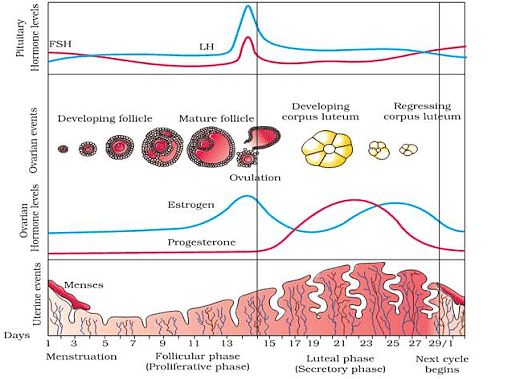
Ques. Explain the ovarian and uterine events that occur during a menstrual cycle in a human female under the influence of pituitary and ovarian hormones, respectively. (Delhi 2014, 5 Marks)
Ans: The menstrual cycle is described as the sequence of events that occur in the females’ body to prepare for the possibility of pregnancy. It comprises four phases which are regulated by both pituitary and ovarian hormones that affect ovaries and uterus, respectively.
The events occurring in a menstrual cycle are:
Menstrual Phase: It is initiated by the reduction in the secretion of LH and progesterone and estrogen. The endometrium breaks down and blood along with unfertilized ovum constitute menstrual flow.
Follicular Phase: The FSH secreted by the anterior pituitary gland regulates the ovarian follicles to secrete estrogen. These estrogens stimulate the proliferation of uterine walls as a result of which endometrium gets thickened.
Ovulatory Phase: Pituitary Hormones LH and FSH reach the highest level in the middle of the cycle. The rapid secretion of LH causes ovulation, thus indicating rupture of Graafian follicle and release of ovum and secondary oocyte.
Luteal Phase: In this phase, the pituitary hormone LH stimulates the remaining cells of ovarian follicles to develop corpus luteum. This corpus luteum secretes a large amount of progesterone necessary for the maintenance of the endometrium as such endometrium is required for implantation of fertilized ovum and pregnancy.
In the absence of fertilization, the levels of the hormone are reduced and endometrium disintegrates and another menstrual cycle starts.
Ques. What is meant by L.H. Surge? Write the role of L.H. (2 Marks)
Ans: There are four phases in a menstrual cycle- menstrual phase, follicular phase, ovulatory phase and luteal phase. In terms of the luteinizing hormone (LH) surge, the ovulatory phase is most important. During the follicular phase, the follicle develops at the beginning of the menstrual cycle. This cycle begins with the shedding of the uterine lining. This shedding cleanses the lining of the uterus for ovulation during the ovulatory phase.
Ques. Give reason for the following :
(a) The first half of the menstrual cycle is called the follicular phase as well as the proliferative phase.
(b) The second half of the menstrual cycle is called the luteal phase as well as the secretory phase. (2 Marks)
Ans: (a) During this phase, primary follicles transform into Graafian follicles under FSH stimulation. Graafian follicles secrete estrogens and regulate the enlargement of the Endometrium of the uterus.
(b) During this phase, the Corpus luteum is fully formed and secretes a large quantity of Progesterone.
Ques. Explain the Follicular Phase in a Menstrual Cycle? (2 Marks)
Ans: The ovary produces around 5 to 20 follicles (cysts or tiny nodules) followed by hormonal stimulation, which bead on the surface. Each follicle comprises an immature egg. Among these only one follicle matures into an egg. Finally, from one of the two ovaries, a mature egg follicle releases an egg. For a possible pregnancy, the follicular growth also stimulates the lining of the uterus and helps it to thicken.
Ques. What do you mean by menstruation? (2 Marks)
Ans: Menstruation is an important phase in the life cycle of a Woman till menopause. In this phase, the lining of the endometrium or uterus is shed. The endometrium prepares itself to nourish a fetus with each monthly cycle. If fertilization does not occur, the progesterone starts to decline in the last stage disrupting the endometrium leading to periods in females. The endometrium, along with mucus and blood from the cervix and vagina make up the menstrual fluid that comes out through the vagina during the period.
Ques. When does menstruation start in a life cycle of a Girl? (1 Mark)
Ans: The cycle of menstruation in a girl initiates from the age of 10 to 15 when she reaches puberty. This starting point of menstruation is referred to as menarche. At the age range of 50, the ending of menstruation takes place and is known as menopause.
The first day of a menstrual cycle is marked as the first day of bleeding and the time period from one menstrual cycle takes 28 to 30 days to reach the other.
Ques. How long is a menstrual cycle? (1 Mark)
Ans: An average menstrual cycle for a menstruating woman lasts 28 days. It ends with the first day of the next menstrual period and initiates with the first day of the last period. Women may have cycles as long as 45 days during the first few years or as short as 21 days. However, the time period ranging outside this may require medical attention.



Comments