



Education Journalist | Study Abroad Lead
Methylene (systematically named methylidene and dihydridocarbon, and is also called carbene) is an organic compound with the chemical formula CH2 (also written [CH. 2. ]). It is a diatomic radical and has a matter structure forming ethers analogous to those of gas. It is a colorless gas that fluoresces in the mid-infrared range and only persists in dilution, or as an adduct. We will discuss the topic in depth along with a few important questions.
| Table of Content |
Keyterms: Methylene, Methylidene, Dihydridocarbon, Carbene, Organic compound, Gas, Diatomic radical, Alcohol, Specific Gravity, Boiling point, Hydrocarbon, Carbene, Methylene radical
What is Methylene?
[Click Here for Sample Questions]
Methylene has a fluid-like appearance and odor and resembles chloroform to a certain extent. It differs from chloroform as it has a specific gravity and different boiling point. Methylene was earlier the second name for methanol, that is wood alcohol. Methe + hyde brought together form the word Methylene wherein hyde means wood in Greek. The other names for it are Hydrocarbon, Carbene, Methylene, Methylene radical.
The video below explains this:
Methylene Detailed Video Explanation:
Read More:
| Related Concepts | ||
|---|---|---|
| Methyl Ethyl Ketone | Oximes | Peroxydisulfuric Acid |
| Gaterman-Koch reaction | Stephen Reaction Mechanism | Reformatsky Reaction |
Physical Properties of Methylene
[Click Here for Sample Questions]
| Methylene | CH2 |
| Density | Has a density of 0.98g/ml at 25? |
| Molecular Weight or Molar Mass | 14.0266 g/mol |
| Boiling Point | Boils at 39.75oC at room temperature and pressure |
| Odor | Is an odorless gas |
| Appearance | Has a fluid-like appearance, colorless gas |
| Covalently bonded unit | 1 |
| Solubility | Soluble in water |
Structure of Methylene
[Click Here for Sample Questions]
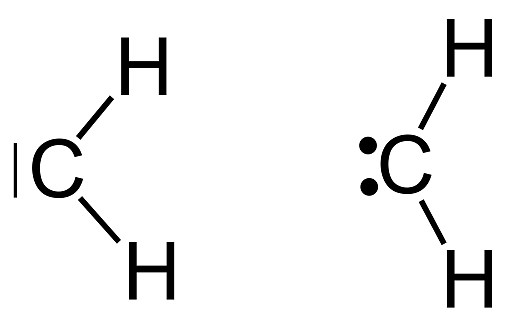
While referring to Methylene in Organic chemistry, it is any part of a molecule that consists of two hydrogen atoms that are bound to a carbon atom. This part of the molecule is then connected to the remainder of the molecule, by two bonds to satisfy the valency of the carbon atom. The group can be represented by CH2<, denoting the two bonds. Another representation could be -CH2-.
Discovery and Preparation
The compound Diazomethane was first produced and spectroscopically characterized by Gerhard Herzberg and Jack Shoosmith. They used Flash photolysis for the discovery.
Under suitable conditions, Methylene can be prepared by decomposition of compounds with a methylidene or methanediyl group, such as ketene (ethenone) (CH2=CO), diazomethane (linear CH2=N2), diazirine (cyclic [-CH2-N=N-]) and diiodomethane (I-CH2-I). The decomposition can be affected by photolysis, photosensitized reagents (such as benzophenone), or thermal decomposition.
Some important chemical reactions of Methylene
[Click Here for Sample Questions]
- The simplest reaction of Methylene is that with atmospheric hydrogen, with which it reacts to form Methane. The reaction is as follows:
CH2 + H2 → CH4
(Methylene) (Hydrogen) (Methane)
- Methylene, being a radical, is extremely reactive. It readily undergoes oxidation to form Carbon monoxide and water. The reaction is as follows:
CH2 + O2 → CO + H2O
(Methylene) (Oxygen) (Carbon Monoxide) (Water)
- Unsolvated, excited methylene forms stable ground state oligomers.
2CH2 → CH2-CH2
(Methylene) (Ethane)
- Methylene is also a common ligand in coordination compounds, such as copper methylene CuCH2. Methylene can bond as a terminal ligand, which is called methylidene, or as a bridging ligand, which is called methanediyl.
Uses of Methylene
[Click Here for Sample Questions]
- Methylene is used to make a chemical called Methylene blue, which is extremely useful in a number of therapeutic and diagnostic procedures in both human and veterinary medicine.
- It finds use in the treatment of drug-induced and some forms of genetic methemoglobinemia.
- Methylene is used to produce Methylene Chloride, which is an active ingredient in paint removers, including commercial and furniture strippers and home paint removers, thus making it a useful household product.
- Methylene has been used as an electroactive probe for cyclic voltammetric detection of chemical DNA.
Types of Methylene
[Click Here for Sample Questions]
There are two types of Methylene. Methylene, or Carbene, exists in two radical forms. Singlet and triplet Carbene. A carbene is a neutral divalent carbon species containing two electrons that are not shared with other atoms. When these two electrons have opposite spins, the carbene is designated a singlet carbene; when they have parallel spins, the carbene is a triplet.
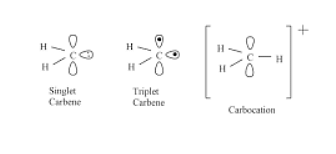
The singlet carbene has lower energy than triplet carbene, which means singlet carbene is the excited state and triplet carbene is a more stable state. So, the singlet carbene is more stable than the triplet carbene when there is a substituent with lone pairs in the singlet carbene.
Things to Remember
- Methylene can be prepared by decomposition of compounds with a methylidene or methanediyl group
- Methylene is used to make a chemical called Methylene blue, which is extremely useful in a number of therapeutic and diagnostic procedures in both human and veterinary medicine.
- It finds use in the treatment of drug-induced and some forms of genetic methemoglobinemia.
- The simplest reaction of Methylene is that with atmospheric hydrogen, with which it reacts to form Methane.
- Methylene is used to make a chemical called Methylene blue, which is extremely useful in a number of therapeutic and diagnostic procedures in both human and veterinary medicine.
- Methylene, or Carbene, exists in two radical forms. Singlet and triplet Carbene.
Read More:-
Sample Questions
Ques. What is an active Methylene group? Give an example to support your answer. (2 marks)
Ans. The group of active methylene is the group that has two -I or -R groups on either side of it. The hydrogen in this group -CH2 is therefore highly acidic. Acetylacetone is a good example of an active methylene group.
Ques. What is the difference between Methyl and Methylene? (3 marks)
Ans. The major difference between a methyl group and a methylene group is that the methylene group is a biradical containing 2 hydrogens bonded to a carbon atom, whereas a methyl group has three hydrogens bonded to a carbon atom. Methylene can exist independently, although for a very short while. A methyl group simply cannot.
Ques. Is Methylene an alkene? (2 marks)
Ans. No. Merely because it has the same ‘ene’ suffix does not make methylene an alkene. In order to be an alkene, the hydrocarbon needs at least a double bond between two carbons. The simplest alkene is ethene, and so, methylene is not an alkene.
Ques. What is methylene hydrogen? (2 marks)
Ans. A methylene group has two hydrogen atoms bonded to a carbon, which is linked by the other two bonds to the rest of the molecule. These two hydrogens are called Methylene hydrogens. This is analogous to the concept of Methyl hydrogens.
Ques. Where is Methylene found? (3 marks)
Ans. It can be found in certain aerosol and pesticide products and is used in the manufacture of photographic film. The chemical may be found in some spray paints, automotive cleaners, and other household products. Methylene chloride does not appear to occur naturally in the environment.
Ques. What is Methylene blue and what are its uses? (3 marks)
Ans. Methylene blue, also known as methylthioninium chloride, is a salt used as a medication and dye. As a medication, it is mainly used to treat methemoglobinemia, both genetic and drug-induced. Specifically, it is used to treat methemoglobin levels that are greater than 30% or in which there are symptoms despite oxygen therapy.
Ques. What can be said about the Radicality of Methylene? (4 marks)
Ans. Many of methylene's electronic states lie relatively close to each other, giving rise to varying degrees of radical chemistry. The ground state is a triplet radical with two unpaired electrons and the first excited state is a singlet non-radical. With the singlet non-radical only 38 kJ above the ground state, a sample of methylene exists as a mixture of electronic states even at room temperature, giving rise to complex reactions.
For Latest Updates on Upcoming Board Exams, Click Here: https://t.me/class_10_12_board_updates
Check-Out:



Comments