



Education Journalist | Study Abroad Lead
Metric System is a standard way of measuring distance, length, volume, weight and temperature. The metric system is based on three basic units that can be used to measure almost everything in the world. The units used in the metric system are Metre, Litre, and Kilogram as base units of length (distance), capacity (volume), and mass (mass). We employ units derived from metric units to measure more diminutive and more significant quantities. The metric units are followed in almost all the places worldwide and are thus also known as SI or the International System of Units.
| Table of Contents |
Key Takeaways: Metric System, Length, Weight, Capacity, Kilogram, Litre, Second, International System of Units, SI Units, Metric System Conversion, Conversion Ratio, Metric Units
What is Metric System?
[Click Here for Sample Questions]
The metric system is an international decimal system of measurement in Mathematics. It is a set of standard units defined to measure length, weight, area, and capacity. The metric system is based on the decimal system as it includes numbers in powers of 10. The metric system is now used in practically every country.
There are 7 base metric units:
| Quantity | SI Unit |
|---|---|
| Length | metre (m) |
| Time | second (s) |
| Amount of substance | mole (mole) |
| Electric current | ampere (A) |
| Temperature | kelvin (K) |
| Luminous intensity | candela (cd) |
| Mass | kilogram (kg) |
Read More: Fundamental and Derived Units of Measurement
Origin of Metric System
[Click Here for Sample Questions]
Hundreds of distinct units of measurement were widely used around the world by the 18th century. For example, the length of an object or between two places can be measured in feet, inches, kilometres, spans, and other units. There was a lot of misunderstanding and significant inefficiencies in trading between countries due to the lack of uniform standards. The French government attempted to solve this challenge around the century by establishing a global measurement system.
The French National Assembly tasked the Academy of Science in 1790 with devising a simple decimal-based system of units; the system they came up with is known as the metric system. The Système International d'Unités (or SI for short) was formally dubbed the metric system in 1960. It is currently used in practically every country. In scientific measurement, the metric system is nearly universally utilised.
Read More: SI Units in Physics
Metric Units
[Click Here for Sample Questions]
In the metric system, there are various metric units used for measuring length, mass, area, and capacity. Millimeters, centimeters, meters, and kilometers are the metric units of the measurement of length while grams and kilograms are the measuring units for weight.
| Purpose | Metric Units | Abbreviation |
|---|---|---|
Length | Millimetre | mm |
| Centimeter | cm | |
| Metre | m | |
| Kilometre | km | |
Weight | Centigram | cg |
| milligram | mg | |
| Gram | g | |
| Kilogram | kg | |
| Tonnes | t | |
Capacity | Millilitre | ml |
| Centilitre | cl | |
| Litre | L | |
| Kilolitre | kl | |
Area | Square millimetre | sq. mm |
| Square centimetre | sq. cm | |
| Square kilometre | sq. km | |
| Hectare | ha |
Here is the detailed information for metric units for length, weight, capacity and time.
- Length
Millimeter (mm), Decimeter (dm), Centimeter (cm), Meter (m), and Kilometre (km) are all units of measurement for length, width, and height. For example, the thickness or length of a debit card, the length of a cloth, or the distance between two cities.

Unit of Length
- Weight
Instruments are used to measure the weight of an object in grams (g) and kilogrammes (kg). Measuring the weight of fruits or our body weight are two examples. Grams, Kilograms, milligrams are all the units used to measure weight.

Unit of Weight
Read More: Measurement of Mass and Weight
- Capacity
Millilitre (ml) and Litre (l) are units of measurement for how much liquid an object can store. Measuring the amount of juice in a juice can or water in a water tank are two examples.

Unit of Capacity
- Time
The standard unit of time is the second. We also use units like hours to measure and define time.
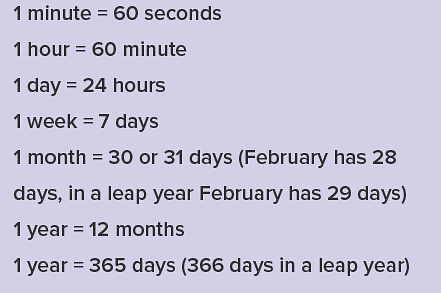
Unit of Time
Read More: Speed, Distance and Time Formula
Some More Units
Apart from the measurement units of length, weight, capacity and time, there are some additional; measurement units too. The metric system also specifies and discusses four more units, including
- Candela- Luminous intensity
- Ampere- Electric Current
- Kelvin- Temperature
- Mole- Material Quantity
Read More: Number of Moles Formula
Metric System Chart
[Click Here for Sample Questions]
The metric system chart involves the important formulas that are used for the conversion of various metric units. This chart helps to convert one unit to another by looking at its multiplying factor. For instance, while observing the metric system chart, we will find that 1 meter = 100 cms. Using this conversion formula, we can easily convert 10 meters to cms by multiplying 10 with 100. Here is the metric system chart:
| Length | Mass/Weight | Capacity |
|---|---|---|
| 1 cm = 10 mm | 1 cg = 10 mg | 1 cl = 10 ml |
| 1 mm = 0.1 cm | 1 mg = 0.1 cg | 1 ml = 0.1 cl |
| 1 m = 100 cm | 1 g = 100 cg | 1 l = 100 cl |
| 1 cm = 0.01 m | 1 cg = 0.01 g | 1 cl = 0.01 l |
| 1 km = 1000 m | 1 g = 1000 mg | 1 l = 1000 ml |
| 1 m = 0.001 km | 1 mg = 0.001 g | 1 ml = 0.001 l |
| 1 kg = 1000 g | 1 kl = 1000 l | |
| 1 g = 0.001 kg | 1 l = 0.001 kl | |
| 1 tonne = 1000 kg | ||
| 1 kg = 0.001 tonne |
Read More: Unit of Distance: SI & CGS Unit, Conversion
Metric System Conversion
[Click Here for Sample Questions]
Metric system conversion refers to the conversion of one metric unit to another. We can convert one unit into another by applying the appropriate conversion formula. The most widely used metric system conversion formulas are given below:
- In order to convert m to cm, multiply by 100
- In order to convert cm to mm, multiply by 10
- In order to convert km to m, multiply by 1000
- In order to convert kg to grams, multiply by 1000
- In order to convert grams to mg, multiply by 1000
- In order to convert liters to kiloliters, divide by 1000
- In order to convert ml to liters, divide by 1000

Conversion Chart for Length
The units immediately to the right of the main unit are smaller. Each unit becomes ten times smaller as we move to the right or one-tenth of the unit to its left. A 'deci' is one-tenth of the base unit, a 'centi' is one-hundredth of the base unit, and a'milli' is one-tenth of a 'deci' or one-thousandth the base unit.
The units to the left of the main unit are larger. Each unit on the left is ten times larger than its right. A 'deca' is ten times the base unit, a 'hecto' is ten times the base unit or 100 times the base unit, and a 'kilo' is ten times the base unit or a thousand times the base unit.
Conversion Ratio
[Click Here for Sample Questions]
The metric conversion ratio is a ratio that is equivalent to 1 in unit measurement. It's sometimes referred to as unit factors. It's used to convert units within the same system and between the metric and English systems. It's built around the idea of equivalent values. A conversion factor, on the other hand, is a number that is used to convert one unit to another by dividing or multiplying equivalent values.
For example, Convert 15 millimetres to centimetres and millimetres.
Because one millimetre equals one-tenth of a centimetre,
As a result, 15 mm = 15/10 = 1.5 cm.
Because 1 mm equals 1/1000 m, 15 mm equals 15/1000 = 0.015 m.
Millimetres (mm) can be converted to centimetres (cm) in the metric system by dividing the provided value by 10. Then cm can be converted to metres (m) by dividing the given value by 100.
Read More: Difference between Pound and Kilogram
Things to Remember
- The metric system is the set of standard units defined to measure length, weight, area, and capacity. It is a decimal system as it includes numbers in powers of 10.
- In the metric system of measurement, the base units for length, weight, and volume are meters, grams, and liters respectively.
- The imperial system of measurement includes units such as inches, feet, pounds, and kilogrammes. This system is used in countries such as the United States, Myanmar, Liberia, and others.
- Throughout the late 1700s, the metric system, also known as the Système International d'unités (SI), was created to standardise units of measurement in Europe.
- The metric system is the most widely used measurement system globally in the field so Mathematics and Science.
- There is a base unit for each sort of measurement, to which prefixes are added to denote multiples of 10.
- With the help of Metric System Conversion, one unit can be converted into other by using the metric system chart.
Sample Questions
Ques. Differentiate between the Metric and Imperial systems. (3 Marks)
Ans. The imperial and metric systems are the two most used weight measurement systems. The metric system employs measurement units such as metres and grammes and prefixes such as kilo, milli, and centi to count orders of magnitude. We use the older imperial system in the United States, measured in feet, inches, and pounds. One has to make sure to double-check each page of the contract drawings, specifications, and even your labour unit bids to ensure that all of the measuring systems you're utilising on the project are compatible. Things can quickly spiral out of control if you don't use the same systems or make a conversion error.
Ques. What is the metric system's conversion ratio? (3 Marks)
Ans. The metric conversion ratio is a ratio that is equivalent to 1 in unit measurement. It's sometimes referred to as unit factors. It's used to convert units within the same system and between the metric and English systems. It's built around the idea of equivalent values. On the other hand, a conversion factor is a number that is used to convert one unit to another by dividing or multiplying equivalent values.
Ques. How can you convert a larger unit into a smaller unit? (3 Marks)
Ans. Move the decimal to the right if you're converting from a larger unit to a smaller one (going down in the table). The amount of decimal places you travel correlates to the number of rows in the table you're crossing. Let's imagine you were told that getting to the grocery shop would need you to walk 8,939.0 millimetres. That appears to be a long walk, but let's convert the distance to metres to see how long it is. The decimal should be moved three spaces to the left because the base unit, metre, is three rows above the millimetre. For instance, 8939.0 mm = 8.939 m
Ques. What is the SI unit of measurement? What is the SI unit of measurement for distance? (3 Marks)
Ans. The SI unit is an abbreviation for Système International, which is a French word. The International System Of Units (SI) is a metric system that is widely used as a measurement standard. The system of SI units is extremely important in scientific and technological research and development. The SI units can be referred to as fractional numbers or as standard multiples.
The SI unit of distance is the metre, according to the International System of Units. It's a distance measuring unit that's more like a conventional unit. We may generate alternative units of various physical characteristics such as volume, area, acceleration, and speed using a metre as a base unit and some formulae.
Ques. What exactly is a metric unit? In CGS and MKS units, what is the metric unit of distance? (3 Marks)
Ans. Metric units are multiples or submultiples of the metre, grams, or second, as well as decimal (power of ten) multiples of these. The decimalized system based on the metre, which had been adopted in France in the 1790s, was supplanted by the metric system. The metric units of distance are formed from the CGS and MKS units of the system.
- The CGS system stands for centimetre, grams, and second.
- MKS stands for metres, kilograms, and second.
Ques. How can we determine the length of really long distances? (5 Marks)
Ans. Metre scales are only useful for short distances. However, we can't use a metre scale to measure great distances like planet to planet or star to star. To measure it, we'll need a greater scale. We use units like the light year, parsec, and astronomical units to measure large distances. The average distance between the earth and the sun is measured in the Astronomical Unit. The average distance between the earth and the sun is approximately 1.496 × 1013 cm.
A light-year is another unit for measuring distance. A light-year is defined as the distance travelled by light in a year.
1 light-year = 9.46 × 1017 cm.
The mean radius of the earth's orbit, measured in parsecs or pcs, is one second of the arc. In astronomy, it is the unit of distance. A parsec is a unit of measurement for distances between stars and galaxies.
1 parsec = 3.26 light-years
Ques. How many decametres are in 0.5 decimetres? (3 Marks)
a) 500
b) 5
c) 0.5
d) 0.005
Ans. The correct answer is (D) 0.005.
Here is the detailed explanation for the above answer.
A) 500
Incorrect. A decameter is larger than a decimeter, so you would expect the number of dekameters in 0.5 decimeters to be smaller than 0.5.
B) 5
Incorrect. A decameter is larger than a decimeter, so you would expect the number of decameters in 0.5 decimeters to be smaller than 0.5.
C) 0.5
Incorrect. Decimeters and decameters are different units of measurement, so you would not expect 0.5 decimeters to equal 0.5 decameters.
D) 0.005
Correct. One decimeter is 100 times smaller than a decameter, so you move the decimal point two places to the left to convert 0.5 decimeters to 0.005 decameters.
Ques. Why can't a pace or a footstep be used as a measurement unit? (3 Marks)
Ans. The length of a person's pace or footsteps differs from one individual to the next. If the length of a person's footsteps is used as a standard unit for measuring length, two measured quantities will not be equal. As a result, footsteps or pace are not a constant quantity and cannot be used as a standard unit of length.
Ques. Is the metric system is based on powers of ten? (3 Marks)
Ans. Yes, the metric system is built on powers of ten, which is useful since a measurement represented by a rational number in the metric system stays a rational number after metric unit translation. (250 mm = 25 cm =.25 m, for example.) Irrational unit systems, such as the English system, lack this attribute (for example, 250 inches = 20.8333, ft = 0.0039457 miles).
Ques. In 45 litres, how many microliters are there? (3 Marks)
Ans. A litre is a unit of measurement for liquids in the metric system. When working with tiny liquids, microliters or millilitres are often used as units of measurement. The result should always be greater when converting from a large measurement quantity like litres to a unit of measurement used to measure a smaller quantity like millilitres. To avoid any misunderstandings, make sure the right unit of measurement is mentioned with the response.
45 litres are equal to 45,000,000 microliters. When converting litres to microliters, consider that a litre contains 1,000,000 microliters. As a result, if you have 45 litres, you will have 45,000,000 microliters.
Check-Out:



Comments