



Content Curator
Multiplication and division of integers are two basic operations performed on integers.
- The symbol for multiplication is “x” and for division, we commonly use the sign “÷”.
- Integer multiplication is equivalent to repeated addition, which involves adding an integer a given number of times.
- For example, 6 × 5 refers to adding 6 five times, resulting in 6 + 6 + 6 + 6 + 6 = 30.
- Division of integers refers to the equal grouping or division of an integer into a certain number of groups.
- For example, 4 ÷ 2 divides 4 into two equal parts, resulting in 2.
| Table of Content |
Key Terms: Multiplication, Division, Rules for multiplication, Rules for Division, Commutative Property, Distributive Property, Integers, Associative property
Arithmetic Operations
[Click Here for Sample Questions]
Arithmetic operations include the addition, subtraction, division, and multiplication of all real numbers, including integers.
- Integers are a type of number that contains negative, positive, zero, and no fractions.
- Arithmetic operations on integers and real numbers are similar; they can be positive or negative.
The four basic arithmetic operations related to integers are:
- Addition of integers
- Subtraction of integers
- Multiplication of integers
- Division of integers
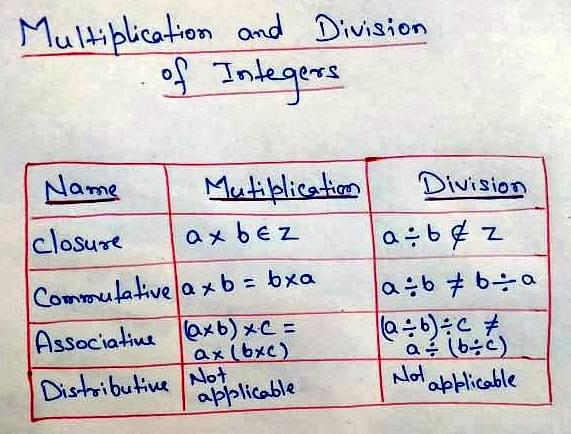
The rules for multiplication and division of numbers are given below.
Also Read:
| Related Articles | ||
|---|---|---|
| Onto Function | Binary Operations | Polynomials |
| Degree of Polynomials | Inverse Trigonometric Functions | Relations and Functions |
Multiplication of Integers
[Click Here for Sample Questions]
Multiplication of integers is the process of repeated addition of numbers. In case of integer multiplication, we must consider the following cases:
- Multiplication of 2 positive numbers
- Multiplication 2 negative numbers
- Multiplication 1 positive and 1 negative number
The multiplication of two integers with similar sign numbers is always positive. This indicates that the product of two positive or negative integers is always positive. The product of a positive number and a negative number (integers with different signs) is always negative.
Rules of Multiplication
Multiply the integers without the sign. Once the product has been obtained, use the multiplication rule shown in the table below to determine the sign.
| Types of Numbers | Operation | Result | Example |
|---|---|---|---|
| Positive x Positive | Multiplication | Positive (+) | 2 x 5 = 10 |
| Negative x Negative | Multiplication | Positive (+) | (-2) x (-5) = 10 |
| Positive x Negative | Multiplication | Negative (-) | 2 x (-5) = (-10) |
| Negative x Positive | Multiplication | Negative (-) | (-2) x 5 = (-10) |
Division of Integers
[Click Here for Sample Questions]
The division is the distribution of numbers. Dividing integers is the opposite of multiplication. However, the rules for dividing integers are the same as for multiplying them. However, the quotient does not be an integer in all situations.
In case of integer division, we must consider the following cases:
- Division of 2 positive numbers
- Division 2 negative numbers
- Division 1 positive and 1 negative number
Rules of Division
We must consider the following rules for the division of integers:
- Rule 1: The quotient of two positive integers is always positive.
- Rule 2: The quotient of two negative numbers is always positive.
-
Rule 3: The quotient of a positive and a negative integer is always negative.
Divide the integers without the sign, and then use the sign from the table. Dividing two integers with similar signs produces a positive quotient, whereas dividing two integers with unlike signs produces a negative quotient.
| Types of Numbers | Operation | Result | Example |
|---|---|---|---|
| Positive ÷ Positive | Division | Positive (+) | 10 ÷ 2 = 5 |
| Negative ÷ Negative | Division | Positive (+) | (-10) ÷ (-2) = 5 |
| Positive ÷ Negative | Division | Negative (-) | 10÷ (-2) = (-5) |
| Negative ÷ Positive | Division | Negative (-) | (-10) ÷ 2 = (-5) |
Properties of Multiplication and Division of Integers
[Click Here for Sample Questions]
When two or more numbers are related by a multiplication or division operation, we can apply the properties of multiplication and division to identify their relationship. There are several properties related to integers multiplication and division.
The following properties apply to integer multiplication and division:
Commutative Property
The commutative property states that changing the position of operands in an operation has no effect on the final result. The commutative property applies to integer addition and multiplication, but not to integer division.
| Operation | Example |
|---|---|
| m × n = n × m | 3 × (–2) and (–2) × 3 = –6 |
| m ÷ n ≠ n ÷ m | 10 ÷ 2 = 5 but 2 ÷ 5 = 1/5 |
Closure Property
The closure property indicates that the set is closed for any given mathematical operation. Integers are closed to addition, subtraction, and multiplication. However, they are not closed by division.
| Operation | Example |
|---|---|
| m × n is an integer | 5 × –3= –15 |
| m ÷ n is not always an integer | –2/5 is a fraction |
Associative Property
The associative property states that changing the integer grouping does not affect the operation's result. The associative property applies to the addition and multiplication of two integers, but not to the division of integers.
| Operation | Example |
|---|---|
| (p × q) × q = p × (q × r) | (2 × –3) × 4 = –24 2 × (–3 × 4) = –24 |
| (p ÷ q) ÷ r ≠ p ÷ (q ÷ r) | (40 ÷ 10) ÷ 2 = 2 but 40 ÷ (10 ÷ 2)= 8 |
Distributive Property
The distributive property states that any statement of the type p (q + r), which implies p × (q + r), operand p can be assigned among operands q and r as (p × q + p × r) i.e., p × (q + r) = p × q + p × r. Integer multiplication is distributive compared to addition and subtraction. The distributive property does not apply to integer division.
| Operation | Example |
|---|---|
| p × (q + r) = (p × q) + (p × r) | 2 × (–3 + 5) = 4 (2 × –3) + (2 × 5) = 4 |
| p × (q - r) = (p × q) - (p × r) | 3 × (4 – 3) = 3 (3 × 4) – (3 × 3) = 3 |
Identity Property
In integer multiplication, the multiplicative identity is 1. There is no identity element when dividing integers.
| Identity Under Addition is 0 | Identity Under Multiplication is 1 |
|---|---|
| For any integer z, z + 0 = 0 + z = z | For any integer z, 1 × z = z × 1 = z |
| Example: 5 + 0 = 0 + 5 = 5 | Example: (– 2) × 1 = 1 × (– 2) = – 2 |
Things to Remember
- Integer multiplication involves adding an integer a given number of times.
- Division of integers refers to the equal grouping or division of an integer into a certain number of groups.
- The product of two integers having positive integer values is always positive.
- The product of negative integers is always positive.
- The product will be negative if one integer is positive and another integer is negative.
- The quotient value of two positive integers will always be a positive integer.
- The quotient value for two negative integers will always be a positive integer.
- The quotient value of one positive integer and one negative integer will always be a negative integer.
Also Read:
Sample Questions
Ques. Solve the given expression by using the division of integers rules: (–20) ÷ (–2) ÷ (–1). (4 Marks)
Ans. We have been given that: (–20) ÷ (–2) ÷ (–1)
In the above equation, we need to divide three integers. We will be solving the equation using the BODMAS rule because there exists more than one operation in the given equation.
First step:
(–20 ÷ –5)
When we divide, -20 by -2, then we would get the answer ‘10’ (positive integer). The resultant value came out to be positive as we all know that after dividing a negative integer by another negative integer, we get a positive quotient.
Now, we have (10 ÷ (-1)), then after dividing 10 by -1, we will get -10 as the quotient. We all know that if a positive integer gets divided by a negative integer, then we get a negative integer.
The answer will be (-10).
Ques. Imagine that a test has 30 questions. If you get a correct answer, it gives you +3 and for an incorrect answer, you get -1. A student attempted all questions but answered 5 questions incorrectly. How many points did the student score? (4 Marks)
Ans. This is kind of a trick question. We need to take into three arithmetic operations, that is, addition, subtraction, and multiplication of integers.
For every correct answer, you get 3 marks, that is +3.
For every wrong answer, you lose 1 mark, which will be -1.
The total number of questions is 30. Out of 30, the correct answers are 25 whereas the wrong ones are 5.
For 25 correct answers, we have-
25 x 3 = 75
For 5 incorrect answers, we get-
5 x (-1) = (-5)
Total marks = correct answer marks + incorrect answer marks
Total marks = 75 + (-5)
Total marks = 75 - 5 = 70
So, the total marks obtained by the student for 25 correct and 5 incorrect answers is 70.
Ques. With the help of one of the properties of multiplication of integers, solve the equation- (25) × (102). (3 Marks)
Ans. We have been given- (25) x (102)
Here, for this equation, we will be using the Distributive formula for solving the equation.
According to the Distributive formula, we have-
A x (B + C) = (A x B) + (A x C)
We can write-
(25) x (102) = (25) x (100 + 2)
(25) x (102) = (25 x 100) + (25 x 2)
(25) x (102) = (2500) + (50)
(25) x (102) = 2550
So, the answer to the value of (25) x (102) will be 2550.
Ques. Evaluate (-55) x (-76) x (-40). (4 Marks)
Ans. We have been given to solve (-55) x (-76) x (-40)
Now, we have three negative integers.
First of all, we will casually multiply all three numbers without thinking about the signs.
55 x 76 x 40 = 167200
We have got the numerical value. Now, we need to consider what sign we would be giving to the answer. There are negative signs-
Negative x Negative x Negative
= (Negative x Negative) x Negative
= (Positive) x Negative [because Negative x Negative = Positive]
= Negative [because Negative x Positive = Negative
So, the value of (-55) x (-76) x (-40) is (-167200).
Ques. Evaluate [20 + (-5)] / [4 + (-9)] (2 Marks)
Ans. We have been given -
[20 + (-5)] / [4 + (-9)]
= [20 -5] / [4 -9] [because negative x positive = negative]
= [15] / [-5]
= -5 [because positive / negative = negative quotient]
So, the answer for [20 + (-5)] / [4 + (-9)] is (-5).
Ques. How to define the multiplication of integers? (2 Marks)
Ans. Multiplication of integers actually corresponds to the repetitive addition of numbers. It means that a number gets added to itself a particular number of times.
Let’s take an example, 5 x 3. In an elaborated way, we would say that 5 is being added to itself 3 times in a row like 5 + 5 + 5 = 5 x 3 = 15 4 is added two times.
Ques. State the properties of the Division of integers. (4 Marks)
Ans. Properties of Division of integers-
- When 0 is divided by a non-zero integer, we will always get 0. For example, 0 ÷ 5 = 0.
- Take an integer and divide it by itself, you will get 1. For example, 5 ÷ 5 = 1.
- Dividend = Divisor × Quotient + Remainder
- Any integer when divided by 1, gets the result as the integer itself. For example, 5 ÷ 1 = 5.
- Let’s consider a,b, and c are non-zero integers and a > b, then we have-
(a ÷ c) > (b ÷ c), if c is positive
(a ÷ c) < (b ÷ c), if c is negative
Ques. What are the properties of the multiplication of integers? (2 Marks)
Ans. The properties of integers are-
- Closure Property
- Commutative Property
- Associative Property
- Distributive Property
- Identity property
Ques. How can you represent division into multiplication? Solve 20 ÷ 5 using multiplication. (2 Marks)
Ans. Any number in the division can be used under multiplication just by replacing the number with its reciprocal.
20 ÷ 5 = 20 x ? = 4
Ques. Find the value of: (4 Marks)
i) [32 + 2 × 17 + (–6)] ÷ 15
ii) (17 + 17) ÷ ( 25 – 42)
Ans:
- We have
[32 + 2 × 17 + (–6)] ÷ 15
= [32 + 34 + (–6)] ÷ 15
= (66 – 6) ÷ 15
= 60 ÷ 15
= 4
Therefore,
[32 + 2 × 17 + (–6)] ÷ 15 = 4
- We have
(17 + 17) ÷ (25 – 42)
=(34) ÷ (–17)
= –2
Therefore,
(17 + 17) ÷ (25 – 42) = –2
Ques. What is the value of any integer when divided by zero? (2 Marks)
Ans. Any integer that gets divided by zero, then the value comes out to be not defined.
For example, 5 ÷ 0 = not defined
Ques. Evaluate the products of (-1) × (-2) × (-3) × (-4) × (-5) (3 Marks)
Ans. We have five numbers of negative integers in the equation, which is an odd number so the product will have a negative sign.
(-1) × (-2) × (-3) × (-4) × (-5)
= - ( 1 × 2 × 3 × 4 × 5 )
= - ( 2 × 3 × 4 × 5 ) [1 × 2 = 2]
= - ( 6 × 4 × 5 ) [2 × 3 = 6 ]
= - ( 24 × 5 ) = -120 [6 × 4 = 24]
For Latest Updates on Upcoming Board Exams, Click Here: https://t.me/class_10_12_board_updates
Also Check:



Comments