


Who found zero?

Jasmine Grover logo

Jasmine Grover

Education Journalist | Study Abroad Lead

The concept of zero as a number was independently discovered by ancient civilizations in several parts of the world, including the Babylonians, Mayans, and Indians.

  • The Indian mathematician and astronomer Brahmagupta is often credited with being one of the first to use zero as a placeholder and to define arithmetic rules for its use in the 7th century.
  • Brahmagupta was a mathematician and astronomer who lived in India during the Golden Age of Indian mathematics.
  • Aryabhatta is credited with the concept of using zero in the decimal system.
  • Brahmagupta is credited for mathematical operations associated with zero such as addition or subtraction.
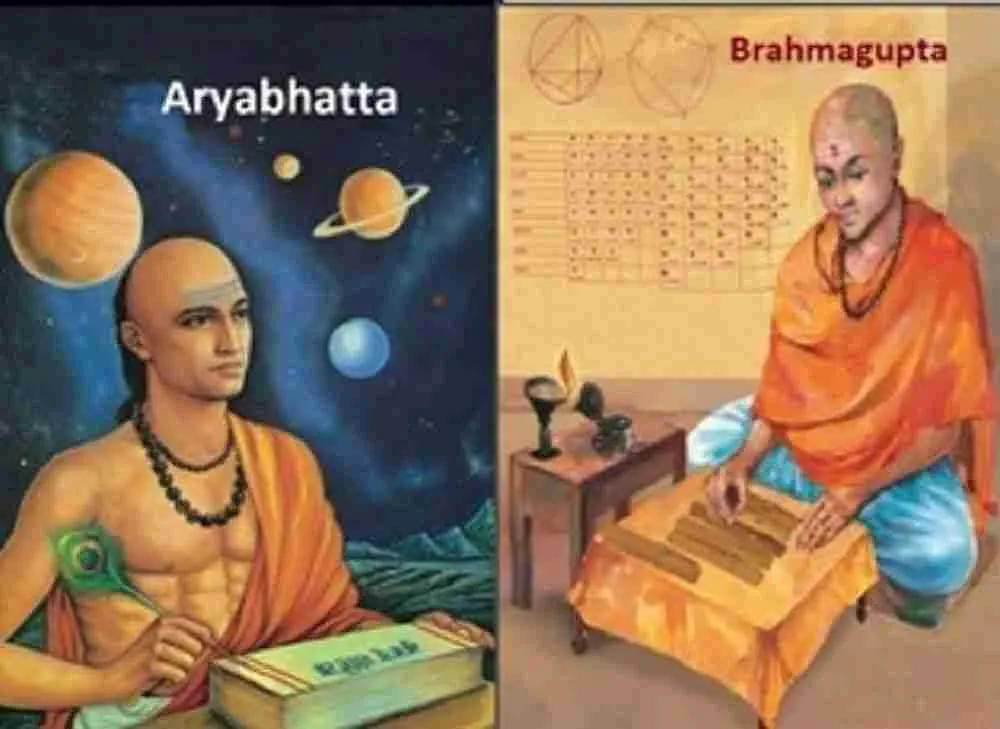
aryabhata and brahmagupta

The invention of zero revolutionized mathematics, allowing for the development of more advanced mathematical concepts and techniques. Today, zero is considered one of the most important numbers in mathematics and science and is used in numerous fields, including engineering, physics, and computer science. 

As Aryabhatta predated Brahmagupta, it is often said that Aryabhatta found zero.

Read More:

CBSE CLASS XII Related Questions

  • 1.
    Using integration, find the area of the region bounded by the curve \( y = x|x| \), the x-axis, and the vertical lines \( x = -2 \) and \( x = 2 \).


      • 2.
        Find:

        The shortest distance between the lines: \[ \vec{r}=(4+\lambda)\hat{i}+(2\lambda-1)\hat{j}-3\lambda\hat{k} \] and \[ \vec{r}=(1+2\mu)\hat{i}+(4\mu-1)\hat{j}+(2-5\mu)\hat{k} \]


          • 3.

            A carpenter needs to design a wooden box in the shape of a cuboid such that the sum of its length and breadth is 3 cm more than its height. Twice of its length, thrice of its breadth and its height add up to 10 cm. Its breadth added to 7 times its height is 1 cm less than 3 times its length. 


              • 4.

                Find:
                Let \(A=[a_{ij}]\) be a \(2\times2\) matrix whose elements are given by \[ a_{ij}=\frac{(2i-j)^2}{3} \] Find the transpose matrix \(A'\).

                  • \(\begin{bmatrix} \frac{1}{3} & 3 \\ 0 & \frac{4}{3} \end{bmatrix}\)
                  • \(\begin{bmatrix} \frac{1}{3} & 0 \\ 3 & \frac{4}{3} \end{bmatrix}\)
                  • \(\begin{bmatrix} \frac{4}{3} & 3 \\ 1 & 0 \end{bmatrix}\)
                  • \(\begin{bmatrix} \frac{4}{3} & 0 1 & \frac{3}{3} \end{bmatrix}\)

                • 5.

                  At a birthday party, children are being served orange juice in conical cups, as shown in the figure. 


                  Each cup is 15 cm deep and has a radius 5 cm. The juice is being poured into this cup at a rate of 0·1 cm3/s.
                  On the basis of the above information, answer the following questions :


                    • 6.
                      Find: \[ \int \frac{x^2}{(x^2-1)(x^2+4)}\,dx \]

                        CBSE CLASS XII Previous Year Papers

                        Comments


                        No Comments To Show
