



Education Journalist | Study Abroad Lead
Nickel acetate is a coordination compound with a chemical formula Ni(CH3CO2)2. The empirical formula for anhydrous nickel acetate is NiC4H6CO4 and for nickel acetate tetrahydrate is NiC4H14O8. Other names for nickel acetate are nickelous acetate, nickel diacetate, and nickel (II) acetate.
- The molecular mass of anhydrous nickel acetate is 176.781 g/mol.
- The molecular mass of nickel acetate tetrahydrate is 248.84 g/mol.
- The density of anhydrous nickel acetate is 1.79 g/cm3.
- The density of nickel acetate tetrahydrate is 1.744 g/cm3.
Read More: Nickel Nitrate Formula
| Table of Content |
Key Terms: Nickel Acetate Formula, Empirical Formula, Coordinate Bond, Carcinogen, Electroplating.
Nickel Acetate Formula
[Click Here for Sample Questions]
The molecular formula representation of nickel acetate is Ni(CH3CO2)2. It is a yellow-green colored solid with a slightly acetic odor. It is a sweet-tasting compound. Nickel acetate in its hydrated form makes a tetrahydrate. The formula for writing nickel acetate tetrahydrate is Ni(CH3CO2)2. 4(H2O). The tetrahydrate form is green in appearance and is the most common form of nickel acetate.
Synthesis of Nickel Acetate
[Click Here for Sample Questions]
Nickel acetate is synthesized by the reaction of nickel carbonate with acetic acid. The chemical reaction is given as
NiCO3 + 2CH3COOH + 3H2O → Ni(CH3CO2)2.4(H2O)+ CO2
Another method is by the reaction of nickel nitrate with sodium acetate. The reaction equation is shown below-
Ni(NO)3 + 2NaCH3COO → Ni(CH3CO2)2 + 2NaNO3
Structure of Nickel Acetate
[Click Here for Sample Questions]
Nickel acetate (anhydrous) is produced when two acetate ions (CH3COO-) bond with nickel metal, forming coordinate bonds. Nickel acetate tetrahydrate attains an octahedral structure. This octahedral structure was observed by X-Ray crystallography. The crystal structure for the compound is monoclinic.
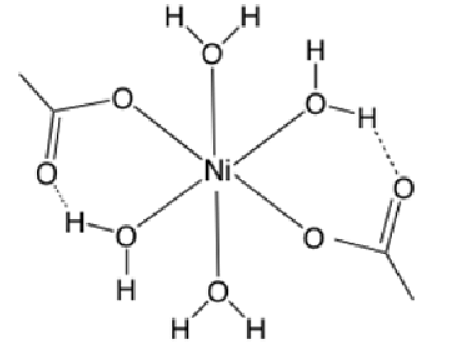
Structure of Ni(CH3CO2)2.4(H2O)
Properties of Nickel Acetate
[Click Here for Sample Questions]
The properties of nickel acetate are-
- Nickel acetate decomposes when heated at 16.6℃.
- Nickel acetate is soluble in water.
- Nickel acetate is soluble in methanol but insoluble in diethyl ether and n-octanol.
- Nickel acetate has a monoclinic crystal structure.
- The lattice volume of nickel acetate is 471.5.
- Nickel acetate is toxic.
- Nickel acetate is a carcinogen.
Uses of Nickel Acetate
[Click Here for Sample Questions]
The uses of nickel acetate are-
- Nickel acetate is widely used in surface treatment, especially for anodizing aluminum.
- It is also employed as a catalyst in chemical reactions.
- It is used in the textile industry as a mediator.
- Nickel acetate is used in electroplating processes.
- It is used in textile dyeing processes.
- It is also employed as an electroless nickel hydrazine coating.
Things to Remember
- The formula for anhydrous nickel acetate is Ni(CH3CO2)2.
- The formula for nickel acetate tetrahydrate is Ni(CH3CO2)2.4(H2O).
- Nickel acetate is combustible when exposed to heat and flame.
- Nickel acetate is classified as a carcinogen.
- Nickel acetate when heated releases toxic flames.
- Nickel acetate decomposes on heating.
- Nickel acetate is a strong electrolyte.
Read More:
| Relevant Topics | ||
|---|---|---|
| Nickel | Nickel Sulfate | Raney Nickel |
| Acetate | Potassium Acetate | Silver Acetate Formula |
Sample Questions
Ques. Write the formulas for anhydrous and hydrated nickel acetate. (1 mark)
Ans. The formula for anhydrous nickel acetate is Ni(CH3CO2)2 and for nickel acetate tetrahydrate is Ni(CH3CO2)2.4(H2O).
Ques. Write the density for anhydrous and hydrated nickel acetate. (1 mark)
Ans. The density of anhydrous nickel acetate is 1.79 g/cm3 and the density of nickel acetate tetrahydrate is 1.744 g/cm3 .
Ques. What is nickel acetate used for? (1 mark)
Ans. The most common uses of nickel acetate are- it is used in electroplating processes, in textile dyeing, as a catalyst intermediate in chemical reactions, etc.
Ques. A solution is made by dissolving 1.362 g of nickel acetate in water to make a 250.0 mL solution. Find the molarity of this solution. (5 marks)
Ans. Given,
Given the mass of nickel acetate= 1.362g
The volume of solution= 250mL= 0.025L
Molecular mass of nickel acetate= 176.78 g/mol
No. of moles of nickel acetate, (n)= given mass/molar mass
n= 1.362/176.78
n= 0.0077 moles
Now, the formula for molarity is,
M= no. of moles of solute/volume of solution in litres
M= 0.0077/0.025
M= 0.308 M
The molarity of the given solution is 0.308M.
Ques. A solution is made by dissolving 2.5 g of nickel acetate in water to make a 250.0 mL solution. Find the molarity of this solution. (5 marks)
Ans. Given,
Given the mass of nickel acetate= 2.5g
The volume of solution= 250mL= 0.025L
Molecular mass of nickel acetate= 176.78 g/mol
No. of moles of nickel acetate, (n)= given mass/molar mass
n= 2.5/176.78
n= 0.0141 moles
Now, the formula for molarity is,
M= no. of moles of solute/volume of solution in litres
M= 0.0141/0.025
M= 5.64M
The molarity of the given solution is 5.64M.
Ques. Is nickel acetate toxic? (2 marks)
Ans. Nickel acetate is a toxic compound. Prolonged exposure to nickel acetate can damage organs. When inhaled, it can cause allergies, asthma, difficulty breathing, and cancer. Nickel acetate, when exposed to heat or flame releases acrid fumes that can irritate the nose and lungs.
Ques. What is a nickel acetate gasket? (2 marks)
Ans. High-purity nickel acetate is used to seal anodic coatings on aluminum and a smutty deposit form on the work. The formation of the smutty deposit is prevented by the addition of a wetting agent such as a specialty dispersant and nickel acetate is suitable for sealing dyed or clear anodized aluminum.
For Latest Updates on Upcoming Board Exams, Click Here: https://t.me/class_10_12_board_updates
Check-Out:



Comments