



Education Journalist | Study Abroad Lead
N2O3 is a chemical formula for Nitrogen Trioxide. It is a combination of Mercury and Chlorine. Sometimes it is also referred to as nitrogen sesquioxide or dinitrogen trioxide. The substance irritates the mucous membranes and is highly poisonous. N2O3 or Nitrogen trioxide is a blue liquid with a strong, unpleasant chemical odour. The chemical is maintained as a liquid by compression because of its low boiling point of 3.5 degrees. It splits into NO and NO2 in part and is a strong irritant to skin, eyes, and mucous membranes. If someone inhales its vapours, then it could be incredibly harmful.
| Table of Content |
Key Terms: Nitrogen Trioxide, Nitrogen Oxygen, Dinitrogen Trioxide, Nitric Acid, Oxidizing Agent, Mucous Membranes
What is Nitrogen Trioxide?
[Click Here for Sample Questions]
Nitrogen Trioxide is a chemical compound formed by nitrogen and oxygen with the chemical formula N2O3. also referred to as dinitrogen trioxide or nitrogen sesquioxide, N2O3 is a highly toxic compound and is a blue liquid in colour and has an unpleasant, sharp odour.
This compound is very irritative for the skin, mucous membranes, and eyes. Chemicals like N2O3 are a component of speciality fuels. The container of N2O3 could violently break and burst out due to prolonged exposure to heat.
Read More:
Structure of Nitrogen Trioxide
[Click Here for Sample Questions]
The length of nitrogen-nitrogen (N-N) bonds is nearly the same as that of hydrazine or 145 pm. However, Dinitrogen Trioxide possesses an unusually long N-N bond of 186 pm. Dinitrogen tetroxide is one nitrogen oxide with lengthy N-N bonds (175 pm). The planar structure of the nitrogen trioxide molecule displays Cs symmetry.
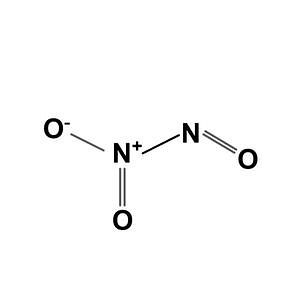
Structure of Nitrogen Trioxide
When combined with water, it creates unstable nitrous acid (HNO2). O=N-O-N=O is an alternate structure for the genuine anhydride, although this isomer is not seen. The nitrous acid that is created breaks down into nitric oxide and nitric acid if it is not soon consumed. When certain bases, such as NaOH, are dissolved in N2O3 solutions, nitrite salts are occasionally formed.
N2O3 + 2 NaOH → 2 NaNO2 + H2O
Read More: Ammonium Nitrite Formula
Properties of Nitrogen Trioxide
[Click Here for Sample Questions]
The properties of Nitrogen Trioxide are as follows:
- The compound nitrogen trioxide, with the chemical formula N2O3, has a density of 1.447 g/cm3 and a molecular weight of 76.012 g/mol.
- It has 0 hydrogen bond donors, whereas there are 4 hydrogen bond donors.
- Nitrogen trioxide has a melting point of -100.7 degrees Celsius and a boiling temperature of 3.5 degrees Celsius, respectively.
Uses of Nitrogen Trioxide
[Click Here for Sample Questions]
There are innumerable uses of Nitrogen Trioxide. Some of them are mentioned below.
- It is a particular fuel because of its very explosive nature.
- It supports combustion and aids in burning; it does not burn itself but could set other things on fire like wood, paper, oil, or clothing.
- It is a strong oxidizing agent.
- To be employed as an oxidizing agent, it is mixed with other chemical substances.
- Additionally, it is utilized in the chemical sector to create things like nylon and colours.
Health Hazards of Nitrogen Trioxide
[Click Here for Sample Questions]
Nitrogen Trioxide is a really very toxic and corrosive compound which can turn out to be fatal if absorbed through the skin or inhaled. When heated, it produces irritating, corrosive, and toxic gases. The compound can cause severe injury and burns when in its liquid form.
Read More: Corrosion Inhibitor
Things to Remember
- Nitrogen Trioxide is a combination of Mercury and Chlorine. This compound is also known as nitrogen sesquioxide or dinitrogen trioxide.
- The compound nitrogen trioxide has the chemical formula N2O3.
- The compound dissociates partially into NO2 and NO.
- It has a density of 1.447 g/cm3 and a molecular weight of 76.012 g/mol.
- Nitrogen Trioxide has a long N–N bond having a bond length of 186 pm. N2O3 is a planar molecule which exhibits Cs symmetry.
- N2O3 is an irritating compound for the skin, mucous membranes, and eyes. Inhalation of its vapours can be very toxic.
Sample Questions
Ques. How is Nitrogen Trioxide used in everyday activities? (3 Marks)
Ans. In nature, Nitrogen Trioxide is recognized as being crucial to the biogeochemical cycle of nitrogen on Earth. In addition to soils, nitrogen can also be found in the atmosphere, oceans, and streams. It is economically used as a nitrating and oxidizing specialist as well as a medium in the production of HNO3. The oxidizer of choice for rocket propellants that can be stored is N2O4. Hydrazine fuels make it hypergolic.
Ques. Is Nitrogen Trioxide paramagnetic or diamagnetic? (3 Marks)
Ans. A molecule is paramagnetic if it contains an odd number of valence electrons, whereas molecules with an even number of valence electrons are diamagnetic.
In N2O3, then
Electronic configuration for N(7) is 2.5.
Electronic configuration: 2,6 for O(8).
Thus, the N2O3 molecule has a total of (25 + 36)=28 valence electrons.
N2O3 is a diamagnetic molecule because 28 is an even number.
Ques. What exactly is Nitrogen Trioxide and is it a compound? (3 Marks)
Ans. Nitrogen Trioxide is a substance with the chemical formula N2O3. One of the binary nitrogen oxides, a compound class that only includes combinations of Mercury and Chlorine, is N2O3. It is a blue liquid with a strong, unpleasant chemical odour and it has a density of 1.447 g/cm3.
Ques. Does Nitrogen Trioxide generally exist? (3 Marks)
Ans. Nitrogen trioxide, sometimes known as N2O3, is a chemical substance formed by mercury and chlorine. It is also known as nitrogen sesquioxide or dinitrogen trioxide. It is a particularly dangerous substance and bothers the mucous membranes. Nitric oxide and nitrogen dioxide (NO, NO2) form the radical pair of pure crystalline dinitrogen trioxide, which assimilates forcefully in the visible region to appear dazzling blue.
Ques. Why is Nitrogen Trioxide less acidic than Nitrogen Pentoxide? (5 Marks)
Ans. As per Lewis's concept, An acid is something that can absorb a pair of electrons, whereas a base is something that can give a pair of electrons to create a coordinate bond. Since nitrogen has one electron pair that can readily be transferred to create a coordinate bond, for instance, NH3 is a Lewis base.
Take any two nitrogen oxides, such as NO2 and N2O5, as an example of an acid. First, note the +4 and +5 oxidation states of nitrogen in these two situations. Since acid is a material that can accept a pair of electrons, Nitrogen Pentoxide is a better acid than Nitrogen Trioxide because nitrogen in a more positive oxidation state will generally accept a pair of electrons more readily.
Ques. List down some important properties of Nitrogen Trioxide. (3 Marks)
Ans. Some of the important properties of Nitrogen Trioxide are as follows:
- Chemical Formula: N2O3
- Molecular Weight: 76.01g/mol
- Density: 1.447 g/cm3
- Boiling Point: 3.5 °C
- Melting Point: −100.7 °C
Ques. What is the oxidation state of nitrogen in the compound N2O3 or Nitrogen Trioxide? (3 Marks)
Ans. Since N2O3 is not a peroxide or F2O, oxygen is in the -2 oxidation state. All that is left at this point is nitrogen in its oxidized state. We can determine where the sum of the charges is 0 by solving a straightforward equation.
x is equal to nitrogen's oxidation state.
2*x + 3*(-2) = 0
2*x - 6 = 0
2*x = 6
x = 6/2
x = 3
In conclusion, the nitrogen in N2O3 is in the +3 oxidation state.
Do Check Out:



Comments