



Exams Prep Master
Nylon is an artificial fibre, which is one of the most commonly used polyamides and is exceptionally strong, hard and water resistant. Nylons are made up of silky material which was first used in toothbrushes. Polyamides are basically used for synthetic fibres in clothing. Moreover, nylons are often used as a substitute for low-strength metals. Let’s have a closer look at the topic along with some important questions.
| Table of Content |
What is Nylon?
Nylon is used in a variety of works, from daily life chores to large scale industries and hence, is the most useful synthetic material. It is a plastic that is often drawn into fibres or films, or moulded into daily products which provide ease in many works. Nylons are pretty much very useful to us and dependable for our entire lives. They are often seen around us as the nylon carpet in your hall, or as a nylon bowl with your meal in it, even our toothbrush has its bristles made out of nylon.
Read more: Nylons Class 12 Chemistry
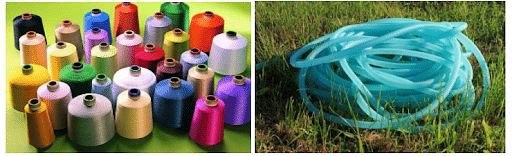
We could use a nylon umbrella over your head to save yourself from getting wet from the rain or a tan from the sunlight. They are used to make Foundation garments, shirts, lingerie, underwear, raincoat, cyclewear, swimwear, parachutes, nets, airbags, ropes, tarpaulins, thread, tents, fishnet, as plastic for manufacturing machine parts, food packaging, powder coat metals, for making rods, sheets or tubes with their resins, or even the strings of the guitar.
Nylon is said to be the first commercially successful synthetic polymer. Its research began in 1927 by an American company named DuPont. Wallace Hume Carothers was the person who first successfully synthesized Nylons, with the use of diamines on 28th February 1935 in the Dupont research Facility. Later, on 29th January 1938, Paul Schlack at IG Farben used caprolactam to develop nylon 6.
Preparation of Nylons
Nylon belongs to a polymer family which is also known as linear polyamides. Nylon for fibre applications can be used in two ways. By the first way, the molecules containing an acidic group (COOH) react with molecules consisting of amino (NH2) groups at each end respectively. The nylon produced is assigned a name considering the number of carbon atoms that separate two amines and two acidic groups. Hence, adipic acid and hexamethylenediamine are popularly known for producing fibres such as nylon 6,6.
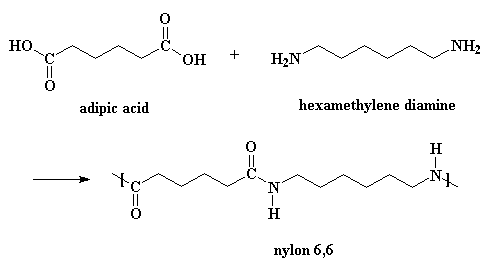
An exact ratio of 1:1 acid to the base is found in the salt formed by two compounds and then this salt is known as nylon. To form the polymer and remove unnecessary water in doing so, we dry the salt under a vacuum.
However, on the other hand, a chain with repeating units of (-NH-[CH2]n-CO-)x is produced by polymerizing a compound that contains an amine and acid at opposite ends. If n is found to be equal to 5 then this nylon is named nylon 6, another common form of this polymer. Open-ring polymerization using caprolactam is used for the commercial production of nylon 6. So, technically in both the methods, polyamide is cooled down and then melted and drawn to obtain the desired characteristics for commercial products or daily use.
Types of Nylons
There are basically 4 types of Nylons.
- Nylon 6 – Paul Schlack synthesized this by forming ring-opening polymerization.
- Nylon 510 – Sebacic and pentamethylene diamine acid are used to obtain this type.
- Nylon 1,6 – Dinitriles along with acid catalysis is used to produce this type.
- Nylon 6, 6 – It was patented by Wallace Carothers with the use of amide.

Uses of Nylon
- It is used for making strings of musical instruments and as a thread in bristles for toothbrushes.
- It is used in the synthesis of artificial fibres.
- It is also used to make fishnet.
- In the industries, nylons are used for making Conveyor and seat belts, parachutes, airbags, nets and ropes, tarpaulins, thread, and tents
Properties of Nylon
- Nylons are Lustrous.
- They are Elastic and are very strong.
- They are Damage resistant to many oils and chemicals.
- Moreover, they are very Resilient and do not absorb water.
- Nylons dry quickly.
- Their Pleats and creases can endure higher heat temperatures.
- Then, they have a more compact molecular structure and at the same time, have better sunlight and water resistance.
- They feel softer in hand.
- They have a high melting point at 256 °C or 492.8 °F.
- And they are great colour fastness.
- Additionally, they are Excellent abrasion-resistant.
- Nylons can be very lustrous, semi-lustrous or dull.
- They are durable as their high tenacity fibres are used for tire cords, seat belts, ballistic cloth, etc.
- They have high elongation and have made easy-care garments possible.
- Nylons also have a high resistance to fungi, insects, animals, mildew, moulds, rot and various kinds of chemicals.
- These artificial fibres are used for making decorative carpets and stockings.
- Moreover, they do not burn, instead, they melt.
- They are used for making many military-grade applications.
- These polyamides have Good Specific Strengths.
- They are also claimed to be transparent to infrared light (if less than 12 dB).
Things to Remember
- The topic “Nylons” is covered in Unit 15 i.e, Polymers of NCERT Class 12 Chemistry.
- The entire Unit 15 i.e, Polymers will have a weightage of 3 marks in the exam.
- The electrical conductivity (σ) of nylon is 10-12 S/m.
- The thermal conductivity of nylon, the artificial fibre, is 0.25 W/(m-K).
- The most important characteristic of nylon is that it can be made into strong fibres.
- Nylon is often used as a substitute for low strength metals.
- It is relatively resistant to abrasion, moisture absorptivity, long-lasting, and resistant to chemicals.
Recommended videos on Nylon-6, 6, 10
Sample Questions of Nylons
Ques: Describe the monomeric repeating units of Nylon-6 and Nylon-6,6. (2 marks)
Ans: Nylon 6 monomer repeat unit is [NH−(CH2)5−CO] derived from Caprolactam. The nylon 6, 6 monomeric repeat complex is [NH−(CH)2)6−NH−CO−(CH2)4−CO], which is derived from diamine hexamethylene and adipic acid.
Ques: For what purpose is Nylon commonly used? (1 mark)
Ans: Nylon being cost-effective and long-lasting, is commonly used to manufacture plastic machine parts.
Ques: Give an advantage to Nylon. (1 mark)
Ans: Nylon has high resistance to corrosion and high insulation.
Ques: How is Nylon made? (2 marks)
Ans: A process of the condensation polymerization reaction is used with appropriate monomers to combine and form a long chain.
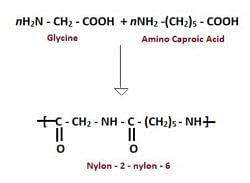
Ques: How is Nylon-2 Nylon-6 produced? State their uses. (3 marks)
Ans: A polyamide copolymerization of aminocaproic acid (H2N−(CH2)5−COOH) and glycine (H2N−CH2−COOH)is done to produce Nylon-2 Nylon-6.
Application/Uses:
- It is used for making strings of musical instruments and as a thread in bristles for toothbrushes.
- It is used in the synthesis of artificial fibres.
Ques: State four the properties of nylon? (4 marks)
Ans: The properties of nylons are:
- Nylons can be very lustrous, semi-lustrous or dull.
- They are durable as their high tenacity fibres are used for tire cords, seat belts, ballistic cloth, etc.
- They have high elongation and have made easy-care garments possible.
- Nylons also have a high resistance to fungi, insects, animals, mildew, moulds, rot and various kinds of chemicals.
Previous Years’ Questions
Ques: What does the designation ‘6,6’ mean in the name nylon- 6, 6? (All India 2010)
Ans: The designation ‘6,6’ in the name nylon- 6, 6 means that both adipic acid and hexamethylenediamine contain six carbon atoms each.
Ques: Give one example of a condensation polymer. (All India 2013)
Ans: The example of a condensation polymer is nylon 6,6.
Ques: How does a homopolymer differ from copolymer? (Comptt. All India 2013)
Ans: Homopolymers are the polymers whose repeating structural units are derived from only one type of monomer units. For example: Polyethene, PVC, teflon.
Copolymers are the polymers whose repeating structural units are derived from two or more types of monomer molecules. For example: Buna-S, Nylon 6, 6.
Ques: Draw the structures of monomers of the following polymers. (All India 2010)
- Bakelite
- Nylon-6
Ans:
- Bakelite: Phenol and formaldehyde → Condensation polymer.
- Nylon-6: The monomeric repeating unit of nylon -6 is:

Ques: Draw the structure of the monomer for each of the following polymers: (Delhi 2012)
(i) Nylon-6
(ii) Polypropene
Ans:
(i) Nylon-6



Comments