



Content Curator
Potassium Carbonate or pearl ash as called in common terms is a chemical compound consisting of Potassium and Carbonate (CO32-) anion. It is an inorganic compound which is extensively used as a base for manufacturing soaps, detergents, glass, fertilizers to increase the yield, as a baking agent and treating hard water. The chemical formula of Potassium Carbonate is K2CO3 where two molecules of Potassium give one electron form their outermost shell and one carbonate ion accepts them to form a stable compound. It appears white and is one of the most soluble chemicals in the water.
Key Takeaways: Potassium Carbonate Formula, Saponification, IUPAC Name, Dutching of Cocoa powder.
What is Potassium Carbonate?
[Click Here for Sample Questions]
Potassium Carbonate is a compound formed by reaction between potassium molecules and carbonate ions. It is a base which is highly water-soluble and is used to neutralize the fatty acids to soaps in a method known as saponification. The IUPAC name is Potassium Carbonate with the chemical formula K2CO3. Other names of Potassium Carbonate are Potash, Pear Ash, Salt of Wormwood and Salt of Tartar.

Potassium Carbonate
Read More:
Preparation of Potassium Carbonate
[Click Here for Sample Questions]
There are mostly three methods of manufacturing Potassium Carbonate:
- Potassium Carbonate is prepared through the method of Engel-Precht. It is the reaction where Potassium Chloride (KCl) and Magnesium Oxide (MgO) reacts with the Carbon Dioxide (CO2) to form MgCO3.KHCO3.4H2O, which is also known as Engel’s Salt. Engel’s Salt is then decomposed and calcined to produce Potassium Carbonate (K2CO3).
KCl + MgO + CO2 → MgCO3.KHCO3.4H2O
- The commercial and most basic preparation of Potassium Carbonate involves the reaction of Potassium Hydroxide with Carbon Dioxide.
2KOH + CO2 → K2CO3 + H2O
- Potassium Chloride is reacted with carbon dioxide (CO2) to give Potassium Bicarbonate (KHCO3) in the presence of an organic amine. The Potassium Bicarbonate is further calcined to get Potassium Carbonate.
2KHCO3 → K2CO3 + H2O + CO2
Read More:
Structure of Potassium Carbonate
[Click Here for Sample Questions]
The structure of Potassium Carbonate includes a Carbonate ion linked with two molecules of Potassium. A Carbonate ion includes a double bond and two single bonds of carbon with oxygen.
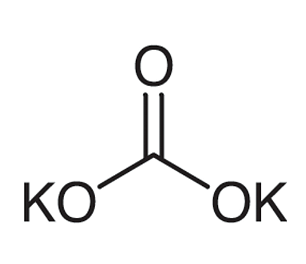
Structure of Potassium Carbonate
Read More:
Chemical Properties of Potassium Carbonate
[Click Here for Sample Questions]
Chemical formula: K2CO3 or CK2O3
Molecular weight: 138.205 g mol-1
Chemical Name: Potassium Carbonate, Dipotassium Carbonate
Solubility: Potassium Carbonate is water-soluble but insoluble in organic compounds like ethanol, acetone and alcohol.
Refractive Index: 1.426, 1.531, 1.541
Read More:
Physical Properties of Potassium Carbonate
[Click Here for Sample Questions]
Odor: Potassium Carbonate is odorless and tastes alkaline.
Appearance: Potassium Carbonate white in color and appears as a wet solid. Characterized as hygroscopic and deliquescent in nature.
Melting Point: Decomposes on boiling soon.
Boiling Point: 891 oC or 1636 oF
Density: 2.43 g/cm3
Parent Compound: Carbonic Acid
Combustibility: Non-flammable
Read More:
Important Chemical Reactions of Potassium Carbonate
[Click Here for Sample Questions]
Some of the important chemical reactions of potassium carbonate are as follows.
Reaction with Water
The reaction of Potassium Carbonate with water is a highly vigorous and exothermic reaction in which potassium carbonate is split into Potassium and Carbonate Ions. The ions then combine together to form Potassium Hydroxide and Carbonic Acid. Carbonic acid being a weak acid and Potassium Hydroxide being a strong base turns the final solution into strongly basic.
K2CO3 + H2O → 2K+ + CO3-2
K+ + OH- ( from water) → KOH (Potassium Hydroxide, a strong base)
2H+ + CO3-2 → H2CO3 (Carbonic Acid, a weak acid)
Reaction with Hydrochloric Acid (HCL)
Potassium Carbonate on being added to Hydrochloric Acid emits carbon dioxide. The reaction is vigorous and causes bubbles in the solution instantly after adding Potassium Carbonate.
This is an example of carbonate acid reaction and also of double displacement reaction.
K2CO3(s) + 2HCl(aq) → 2KCl(aq) + H2O(l) + CO2(g)
Read More: Potassium Hypochlorite
Reaction with Carboxylic Acid
Carboxylic acids react with Potassium Carbonate to give hydrocarbons of potassium, water and carbon dioxide. This reaction will be similar for all carbonates.
- Methanoic Acid + Potassium Carbonate → Potassium Formate + Water + Carbon Dioxide
HCOOH + K2CO3 → HCOOK + H2O + CO2
- Ethanoic Acid + Potassium Carbonate → Potassium Ethanoate + Water + Carbon Dioxide
2CH3COOH + K2CO3 → 2CH3COOK + H2O + CO2
Read More:
Uses and Benefits of Potassium Carbonate
[Click Here for Sample Questions]
- Being hygroscopic in nature Potassium Carbonate absorbs a lot of moisture hence, it is used as a drying agent for ketones, alcohols and amines.
- It is a necessary raw material in the manufacturing of soaps, glasses, dyes, inks etc.
- Used in the name of potash as fertilizers in the field to increase the yield of crops.
- Potassium carbonate is used in the alkalization of the cocoa powder to produce Dutch Chocolate. This process of adding Potassium Carbonate to is known as Dutching, it was first used in 1828 by Dutchman Coenraad Johannes van Houten.

Dutching of Cocoa Powders
Read More:
Safety Measures
[Click Here for Sample Questions]
- On coming in contact with the eye can cause itching, blurred vision and can even harm the retina. In extreme cases, it may permanently damage the eye.
- On contact with the skin, you may experience mild to extreme itching, inflammation and red patches.
- If inhaled the airways may get affected causing a terrible cough and cold. Go outside and inhale fresh air.
Also Read:
Things to Remember
[Click Here for Sample Questions]
- IUPAC name is Potassium Carbonate
- Molecular Formula is K2CO3 or CK2O3
- Molecular Mass or weight is 138.205 g mol-1.
- Melting Point is 891 oC or 1636 oF
- Potassium Carbonate decomposes on boiling.
- Density is 2.43 g/cm3
- Potassium Carbonate will not act as a good drying agent for acidic compounds. It acts as the best drying agent for organic compounds such as alcohols, ketones, amines etc.
Also Read:
Sample Questions
Ques. What is the chemical formula of Potassium Carbonate? Write the IUPAC and common name? (2 Marks)
Ans. The chemical or molecular formula of Potassium Carbonate is K2CO3 or CK2O3. The IUPAC name is Potassium Carbonate and common names are Potash, Pear Ash, Salt of Tartar, Salt of wormwood, Carbonate of Potash and Dipotassium carbonate.
Ques. Discuss the areas where Potassium Carbonate is used? (2 Marks)
Ans.
- Potassium Carbonate is used in the production of soaps, detergents and glass.
- Used in the processing of Dutch chocolate during alkalization.
- Used as a drying agent due to its hygroscopic properties to absorb moisture from the air.
- Potassium Carbonate has been used in the preparation of grass jelly, moon cakes and gingerbread.
Ques. Which is the commercial method of manufacturing Potassium Carbonate? (1 Mark)
Ans. The commercial method of manufacturing Potassium Carbonate includes reaction of Potassium Hydroxide with Carbon Dioxide. The chemical equation for the above reaction is as follows:
2KOH + CO2 → K2CO3 + H2O
Ques. What do when Potassium Carbonate falls on skin? (2 Marks)
Ans. Potassium Carbonate is non-flammable hence you will not receive any burns. But it can surely cause irritation, itching and redness. Wash the affected area with water and expose it to natural air. Go to the doctor if the itching or redness intensifies.
Ques. When does Potassium Carbonate dissociate in its constituent elements? Discuss the reaction clearly. (3 Marks)
Ans. Potassium Carbonate dissociates into Potassium and Carbonate ions when reacted with water. The potassium ions and hydroxide ions react to form Potassium Hydroxide and the carbonate ions react with hydrogen ions to form Carbonic Acid.
The chemical equation for the above reaction is given below:
K2CO3 + H2O → 2K+ + CO3-2
K+ + OH- ( from water) → KOH
2H+ + CO3-2 → H2CO3
Ques. Draw the reaction between Potassium Carbonate with Barium Chloride. (2 Marks)
Ans. Potassium Carbonate reacts with Barium Chloride to form insoluble Barium Carbonate and Potassium Chloride. Barium Carbonate is insoluble and appears a white precipitate whereas Potassium Chloride gets dissolved in the solution.
K2CO3(aq) + BaCl2(aq) → BaCO3 (white precipitate) + 2KCl (aq)
Ques. Discuss a double displacement reaction where Potassium Carbonate is required. (2 Marks)
Ans. The reaction of Potassium Chloride with Hydrochloric Acid is an example of double displacement reaction. It results in the emission of carbon dioxide in the form of bubbles. This is an exothermic reaction and it occurs vigorously, so keep your eye at a safe distance from the test tube.
K2CO3(s) + 2HCl(aq) → 2KCl(aq) + H2O(l) + CO2(g)
Ques. What happens when Potassium Carbonate is heated? (1 Marks)
Ans. When Potassium Carbonate is heated it undergoes thermal decomposition to break down into Potassium Oxide and Carbon Dioxide.
K2CO3(s) →(Heating) K2O(s) (Potassium Oxide) + CO2(g)
Ques. Draw the chemical structure of Potassium Carbonate. (2 Marks)
Ans. 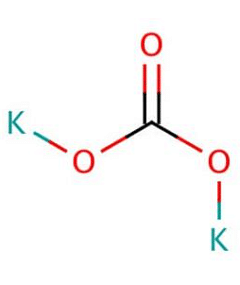
Ques. Why is Potassium Carbonate in the production of soaps? (1 Marks)
Ans. Potassium Carbonate is used in the production of soaps as Potash. Being a highly basic compound it neutralizes the fatty acids to soaps, acting as a thickening agent. This process of conversion of fatty acids into soaps with the use of Potassium Carbonate or an alkali solution is known as saponification.
Also Read:



Comments