



Education Journalist | Study Abroad Lead
ParaDichlorobenzene is a dihaloarene / aromatic compound. Paradichlorobenzene is usually called para crystals or paracide. It can be prepared through the halogenation of benzene in the presence of anhydrous ferric chloride. The molecule consists of a benzene ring with two chlorine atoms (replacing hydrogen atoms) on opposing sites of the ring. These compounds find wide applications in industry as well as in day-to-day life.
| Table of Content |
Keyterms: ParaDichlorobenzene, Dihaloarene, Aromatic compound, Crystals, Paracide, Hydrogen, Atoms, Benzene, Halogenation, Benzene ring, Ferric chloride
What is ParaDichlorobenzene?
[Click Here for Sample Questions]
ParaDichlorobenzene is a dihaloarene/aromatic compound. Paradichlorobenzene is usually called para crystals and paracide. It can be prepared through the halogenation of benzene in the presence of anhydrous ferric chloride. The molecule consists of a benzene ring with two chlorine atoms (replacing hydrogen atoms) on opposing sites of the ring. It is used as solvents for relatively non-polar compounds and as starting materials for the synthesis of a wide range of organic compounds.
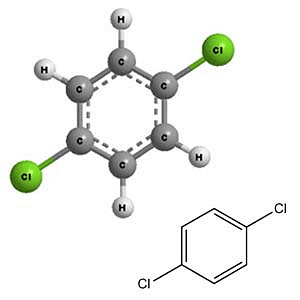
ParaDichlorobenzene
Read More:
| Chapter Related Concepts | ||
|---|---|---|
| Methyl Ethyl Ketone | Oximes | Peroxydisulfuric Acid |
| Gaterman-Koch reaction | Stephen Reaction Mechanism | Reformatsky Reaction |
Physical properties of ParaDichlorobenzene
[Click Here for Sample Questions]
The following are the physical properties of ParaDichlorobenzene
Melting And Boiling Points: Since molecules of organic halogen compounds are generally polar. Greater polarity and higher molecular mass make the intermolecular forces of attraction stronger. Thus, the boiling point of chlorides is comparably higher. The para isomers have a high melting point due to the symmetry that fits the crystal lattice better.

ParaDichlorobenzene
Density: Para dichlorobenzene being a poly chloro derivative of hydrocarbons, are heavier than water due to the increase in the number of carbon atoms and atomic mass of the halogen atoms. Its density is 1.25g/cm3. p-dichlorobenzene is released to the general environment as a vapour. It does not occur naturally.
Solubility: Para dichlorobenzene tends to be slightly soluble in water and highly soluble in an organic solvent.
The physical properties can be summarised as follows.
| Parameters | Properties |
| C6H4Cl2 | Para dichlorobenzene |
| Density | 1.25 g/cm³ |
| Molecular Weight/ Molar Mass | 147.01 |
| Boiling Point | 174 °C |
| Melting Point | 53.5 °C |
| Chemical Formula | C6H4(Cl)2 |
Chemical properties of ParaDichlorobenzene
[Click Here for Sample Questions]
Hybridisation: Para dichlorobenzene shows sp2 hybridisation of carbon atom in C-X bond.
Nucleophilic Substitution: The C-Cl bond length is 169pm. Since it is difficult to break a shorter bond, p-dichlorobenzene is less reactive towards nucleophilic substitution reaction.
Resonance: p-dichlorobenzene alkyl groups release electrons to the other molecules by the delocalization process and hence exhibit a resonance effect.

Isomers of dichlorobenzene
Electrophilic Substitution: Due to resonance, the electron density increases at the para position. Further, the halogen atom because of its -I effect has some tendency to withdraw e- from the benzene ring. Hence, the ring gets somewhat deactivated as compared to benzene and hence the electrophilic substitution reactions occur slowly.
Structure of ParaDichlorobenzene
[Click Here for Sample Questions]
Para dichlorobenzene is essentially a benzene ring with two chlorine atoms oriented at para positions. The carbon attached to these halogen atoms shows sp2 hybridisation while the rest of the carbon atoms have sp3 hybridisation. Its molecular formula is C6H4(Cl)2.
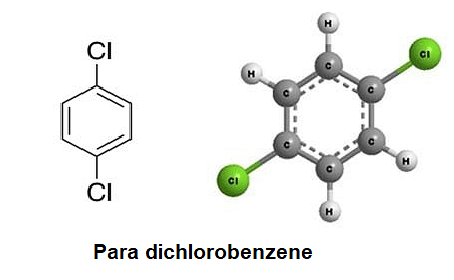
Structure of Para dichlorobenzene
Applications of Para dichlorobenzene
[Click Here for Sample Questions]
- Utilized as a space antiperspirant for latrines and as a fumigant for control of moths and flies.
- Utilized in the control of specific tree-exhausting creepers and subterranean insects.

Mothballs
- Utilized as a crumbling glue for cement and stoneware
- It is used in the manufacturing of ointments.
- It is used as a lubricant in the production of plastics, colours and drugs.
Health Effects of Para dichlorobenzene
[Click Here for Sample Questions]
It is insoluble in water and isn't effortlessly separated by soil organic entities. In the same way as other hydrocarbons, paradichlorobenzene is lipophilic and will aggregate in greasy tissues whenever ingested by an individual or creature. Paradichlorobenzene is "known to cause malignancy".
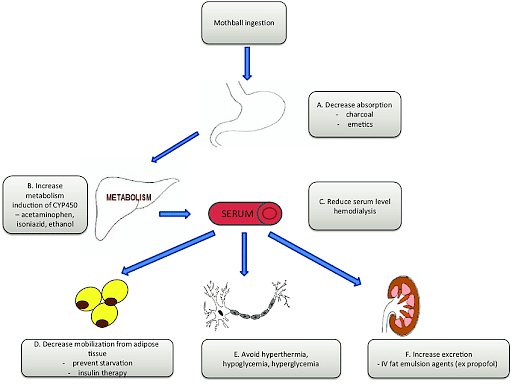
Health hazards of paradichlorobenzene
If ingested or exposed to, paradichlorobenzene causes nausea, vomiting, dizziness, fatigue, and headaches. Long exposure can lead to a burning sensation in the eyes and nasal passages and causes irritation in the skin.
Things to Remember
- ParaDichlorobenzene is a dihaloarene / aromatic compound.
- Paradichlorobenzene is usually called para crystals or paracide.
- Paradichlorobenzene can be prepared through the halogenation of benzene in the presence of anhydrous ferric chloride.
- The molecule consists of a benzene ring with two chlorine atoms (replacing hydrogen atoms) on opposing sites of the ring.
- It is used as solvents for relatively non-polar compounds and as starting materials for the synthesis of a wide range of organic compounds.
- The carbon attached to the halogen atoms shows sp2 hybridisation while the rest of the carbon atoms have sp3 hybridisation.
- The molecular formula of Paradichlorobenzene is C6H4(Cl)2.
- If ingested or exposed to, paradichlorobenzene causes nausea, vomiting, dizziness, fatigue, and headaches and can cause cancer.
Read More:-
Sample Questions
Ques. What are the other names for p-dichlorobenzene? (2 marks)
Ans. Para dichlorobenzene is also known by the name of PDCB, para moth, para crystals, paracide and dichlorocide.
Ques. What is the boiling point of DCB? (1 mark)
Ans. The BP of DCB is experimentally calculated to be 447K.
Ques. Haloarenes are less reactive than haloalkanes and haloalkenes. Explain. (2 marks)
Ans. In haloarenes, the electron pairs on the halogen atom are in conjugation with -electrons of the ring.

C – Cl bond acquires a partial double bond character due to resonance. As a result, the bond cleavage in haloarene is more difficult than haloalkane and therefore they are less reactive towards nucleophilic substitution reaction.
Ques. Why does PDCB have a higher boiling point? (2 marks)
Ans. The para isomer is more closely packed in the crystal lattice than other isomers due to its symmetry. So more energy is needed to break the para isomer.
Ques. Is p-dichlorobenzene soluble in water? (2 marks)
Ans. Para dichlorobenzene is very slightly soluble in water but highly soluble in organic solvents.
Ques. Discuss the role of Lewis acids in the preparation of aryl bromides and chlorides in the dark. (3 marks)
Ans. Aryl chlorides and bromides can be easily prepared by electrophilic substitution of arenas with chlorine and bromine respectively, in the presence of Lewis acid catalysts like iron or iron chloride.
Lewis acid generates the electrophile required for the substitution.

Ques. What is the IUPAC nomenclature of PDCB? (1 mark)
Ans. PDCB is spelled as 1,4 dichlorobenzene.
Ques. Why is the solubility of haloalkanes in water very low? (2 marks)
Ans. The haloalkanes are only slightly soluble in water. In order to dissolve a haloalkane in water, energy is required to overcome the attraction between the haloalkane molecules and break the hydrogen bonds between water molecules. Since less energy is released in the formation of new attractions
between haloalkane and water molecules and these are not very strong as the original hydrogen bonds present in water and hence the solubility of haloalkanes is low.
Ques. What is the formula of PDCB? (2 marks)
Ans. PDCB is C6H4(Cl)2. It is basically a benzene ring with two chlorine atoms attached at opposite sides i.e at para positions.
Ques. Is PDCB known to cause cancer? (1 mark)
Ans. Yes, PDCB has the potential to cause human cancer and severe health issues.
Ques. How does paradichlorobenzene work? (2 marks)
Ans. The fumes of paradichlorobenzene are poisonous to bugs. In people and different creatures, paradichlorobenzene is separated in the body to frame different mixtures that might be harmful to cells or organs like the liver.
Ques. Can paradichlorobenzene affect birds, fish, or other wildlife? (2 marks)
Ans. Paradichlorobenzene is moderate to low in harmfulness to fish, with contrasts in affectability by species. No data was found for the impacts of paradichlorobenzene on honey bees.
Ques. Which of the following is an example of vie-dihalide? (2 marks)
(a) Dichloromethane
(b) 1, 2-dichloroethane
(c) Ethylidene chloride
(d) Allyl chloride
Ans. (b) 1, 2-Dichloroethane is a vic-dihalide since two Cl atoms are present on vicinal carbon atoms (adjacent).

Ques. Which of the carbon atoms present in the molecule given below are asymmetric? (2 marks)

Ans. (b) Carbon has four valencies. If a carbon atom satisfies all of its four valencies with four different groups then it is termed asymmetric/chiral carbon. In the given compound, b and c carbon are bonded to four different groups, so these are asymmetric.
Ques. Alkyl fluorides are synthesized by heating an alkyl chloride/bromide in presence of or (2 marks)
(a) CaF2
(b) CoF2
(c) Hg,F2
(d) NaF
Ans. (b, c) The synthesis of alkyl fluorides is accomplished by heating an alkyl chloride or bromide in presence of metallic fluorides such as AgF, FIg2F2, CoF2, or SbF3. The reaction is known as the Swarts reaction.
Ques. Aryl chlorides and bromides can be easily prepared by electrophilic substitution of arenas with chlorine and bromine respectively in the presence of Lewis acid catalysts. But why does the preparation of aryl iodides require the presence of an oxidizing agent? (2 marks)
Ans. Iodination reactions are reversible in nature. To carry out the reaction in forward direction, HI formed during the reaction is removed by oxidation. HIO3 is used as an oxidising agent.

Ques. Out of o- and p-dibromobenzene, which one has a higher melting point and why? (2 marks)
Ans. p-Dibromobenzenc has a higher melting point than its o-isomer.

It is due to the symmetry of the p-isomer which fits in the crystal lattice better than the o-isomer.
For Latest Updates on Upcoming Board Exams, Click Here: https://t.me/class_10_12_board_updates
Check-Out:



Comments