



Content Curator
A base is a chemical that accepts protons, donates electrons, or releases hydroxide ions in an aqueous solution. In chemistry, a Base is any substance that is slippery to the touch in a water solution, tastes bitter, changes the color of indicators, reacts with acids to form salts, and catalyzes some chemical reactions (base catalysis). Some examples of bases are the hydroxides of alkali and alkaline earth metals and the water solutions of ammonia or its organic derivatives.
Bases are mainly classified as:
- Lewis Base
- Arrhenius Base
- Bronsted-Lowry Base
Also read: Acids, Bases, and Salts
| Table of Contents |
Key Terms: Base, Water solution, Proton, Electron, Ion, Hydroxide ion, Lewis base, Alkali, Alkaline, Metal, Water, Earth, Arrhenius base, Bronsted-Lowry base, Ammonia
Base Meaning
[Click Here for Sample Questions]
A base can be defined as a substance that emits hydroxide ions when diffused in an aqueous medium. Primarily, base substances have a bitter taste (especially alkalis) and are mostly slippery to the touch. Other characteristics of bases are:
- They undertake chemical reactions with acidic substances to formulate salts.
- They possess hydroxide ions that are partially or completely transferable.
- They accept H+ ions/protons from appropriate donor compounds.
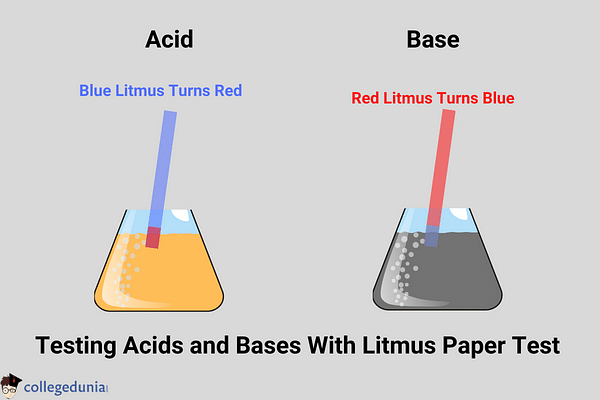
- They are known to change the color of red litmus paper to blue.
When dissolved in water, bases reduce the hydrogen ion activity in the water by altering the autoionization equilibrium of water (which means an equilibrium creates between water molecules, positively charged hydrogen ions in addition to negatively charged hydroxide ions) and that is the reason why the pH of water is relatively raised above the 7.0 mark when bases are dissolved in it.
Acids and Bases
Bases also separate in water like acids, but they produce OH- (hydroxyl ion) in place of H+. When a base is dissolved in water, the same is called an alkali. Some examples of alkali are Calcium Hydroxide, Ammonium Hydroxide, etc. Alkalis are known to become less alkaline when mixed with acids. The pH level of bases ranges from 8-14.
Check out:
Types of Bases
[Click Here for Sample Questions]
There are 5 types of Bases:
- Strong Base: It is a compound that has the ability to remove a proton from a very weak acid. Or they completely dissociate into their ions when in water. Examples are potassium hydroxide (KOH), and sodium hydroxide (NaOH).
- Weak Base: There is incomplete dissociation when in water. The aqueous solution contains both the Weak Base as well as its conjugate acid. Examples are ammonia (NH3), water (H2O), and pyridine (C5H5N).
- Superbase: These bases are better at deprotonation when compared to a strong base. These have very weak conjugate acids. They can be obtained by mixing an alkali metal with its conjugate acid. It can’t sustain in an aqueous solution as it is a stronger base than a hydroxide ion. Examples are sodium hydride (NaH), ortho-di-ethynyl benzene dianion (C6H4(C2)2)2−
- Neutral Base: It forms a bond with a neutral acid and shares an electron pair.
- Solid Base: It is active in solid form. Examples are silicon dioxide and sodium hydroxide mounted on alumina.
Properties of Bases
[Click Here for Sample Questions]
Some of the properties are given below:
- A base will usually always give off a bitter taste.
- The pH level of bases ranges from 8 to 14.
- They are slippery to the touch.
- Bases react with acid to form salt and water and this reaction is called a neutralization reaction.
- Bases are good conductors of electricity.
- Some bases are used as electrolytes such as potassium hydroxide and sodium hydroxide.
- Bases do not react with metals but acids do.
- Very strong bases are usually known for having corrosive effects on organic matter. Great caution must be taken while making use of the same as any form of spillage can result in severe skin burns and irreversible damage to tissue.
Check out a detailed article on: Properties of Bases
What are Alkalis? How Are they Different from Bases?
[Click Here for Sample Questions]
Alkalis are bases that are soluble in water. The term ‘alkali’ is used to refer to alkali metals or ionic salts of alkaline earth metals. Thus, it can be said that alkalis form a subset of all bases. This indicates that all alkalis are bases but not all bases are alkalis.
All alkalis adhere to the Arrhenius definition of basic substances. The Swedish scientist Svante Arrhenius defined bases as substances causing an increase in the concentration of aqueous hydroxide concentration or a drop in aqueous hydronium concentration when it gets dissolved in water.

Acids, Bases, and Alkalis
Some examples of alkali salts are listed below.
- Calcium hydroxide (Ca(OH)2)
- Magnesium hydroxide (Mg(OH)2)
- Sodium hydroxide(NaOH)
- Potassium hydroxide (KOH)
Ammonia (NH3) is excluded from the alkali family despite the fact that it facilitates the formation of hydroxide ions when dissolved in water.
Learn More About: Difference Between Alkali and Base
Classification of Bases
[Click Here for Sample Questions]
Bases are usually characterized based on their Strength, Concentration, and Acidity:
Classification Based on Strength
The strength of bases depends on the number of hydroxyl ions it produces when it gets dissolved in water. A high amount of hydroxyl ion shows a strong base while a low amount signifies a weak base.
- Strong Base dissolves completely or almost completely in water. For example: NaOH, Ca(OH)2, KOH, etc.
| NaOH <—> Na+ + OH- |
- Weak base- A base that doesn’t dissolve wholly is called a weak base. For e.g.- NH4OH, Ma(OH)2
| NH4OH(aq) <—> NH+4(aq) + OH-(aq) |
Classification Based on Concentration
The concentration of the base varies upon the amount of base dissolved in water.
There are two main types of solutions- a) Concentrated and b) Aqueous.
- An aqueous solution that has a comparatively high percentage of base content is a concentrated base. For e.g.- concentrated sodium hydroxide, concentrated ammonium hydroxide, and concentrated potassium hydroxide.
- An aqueous solution that has a low percentage of base content is a dilute base. For e.g.- diluted potassium hydroxide, dilute ammonium hydroxide, etc.
Classification Based on Acidity of the Base
The acidity of the base depends on the number of hydroxyl ions it contains. It also depends on the number of hydrogen ions with which a base can combine as one hydrogen ion combines with one hydroxyl ion. These are primarily of three types- Monoacidic Bases, Diacidic Bases, and Triacidic Bases.
- Monoacidic Base comprises one hydroxyl ion that combines with one hydrogen ion. For e.g.- NaOH, KOH, NH4OH
| NaOH(aq) + HCl(aq) <—> NaCl(aq) + H2O(l) |
- Diacidic Base comprises two hydroxyl ions that combine with two hydrogen ions. For e.g.- Ca(OH)2, Mg(OH)2
| Ca(OH)2(aq) + 2HCl(aq) <—> CaCl2(aq) + 2H2O(l) |
- Triacidic base- The base that comprises three hydroxyl ions combined with three hydrogen ions. For e.g.- Aluminum Hydroxide
| Al(OH)3(aq) + 3HCl(aq) <—> AlCl3(aq) + 3H2O(l) |
Examples of Bases and Their Uses
[Click Here for Sample Questions]
Examples of bases and their uses are tabulated below:
| Bases | Uses |
|---|---|
| Potassium Hydroxide (KOH) | Potassium Hydroxide is used in alkaline batteries. |
| Ammonia (NH3) | Ammonia is used for the synthesis of many products of pharmaceuticals and also used in the manufacture of commercial cleaning products. |
| Sodium Hydroxide (NaOH) | Sodium Hydroxide is used in the production of detergents, liquid gels, and soaps. Primarily used for drain cleaners. |
| Aluminum Hydroxide [Al(OH)3] | Used in the production of antacids and purification of water. |
| Calcium Hydroxide [Ca(OH)2] | Calcium Hydroxide is used in the manufacture of lime water and cement. |
| Barium Hydroxide [Ba(OH)2] | Barium Hydroxide is widely used in laboratories for the titration process of weak acids. |
| Magnesium Hydroxide [Mg(OH)2] | Magnesium Hydroxide is used in the production of deodorants and antacids. |
| Lithium Hydroxide (LiOH) | Lithium Hydroxide is used in the production of Lithium greases. |
| Sodium Carbonate (Na2CO3) | Sodium Carbonate is used as washing soda and also for softening hard water. |
| Sodium Bicarbonate (NaHCO3) | Sodium Bicarbonate is often used as baking soda in cooking. |
Reaction Between Acids and Bases
[Click Here for Sample Questions]
Acids and Bases react with each other in a neutralization reaction. In neutralization, aqueous acid and aqueous base produce an aqueous solution of salt and water. If the salt is insoluble or saturated, it may precipitate out of the solution. Some substances can act as either an acid or a base. In fact, some strong acids can act as bases.
Example of Neutralization Reaction:
| HCl (aq) + NaOH (aq) \(\rightarrow\) NaCl (aq) + H2O (l) |
In the above reaction, sodium chloride is the salt formed by the reaction of hydrochloric acid and sodium hydroxide.
- Acids are chemical compounds that show a sharp taste, and corrosive action on metals (in water).
- Acids can turn certain blue vegetable dyes red.
- Bases are chemical compounds that, in solution, are soapy to the touch and turn red vegetable dyes blue.
- Acids and Bases together neutralize one another and produce salts, substances with a salty taste and none of the characteristic properties of either acids or bases.
Things to Remember
- This is an important portion of Class 10 Chemistry chapter: Acids, Bases and Salts.
- A base is referred to as a substance that emits hydroxide ions when diffused in an aqueous medium. Initially, base substances have a bitter taste (especially alkalis) and are mostly slippery to touch.
- Bases also separate in water like acids, but they produce OH- (hydroxyl ion) in place of H+. When a base is dissolved in water, the same is called an alkali.
- Some of the examples of alkali are Calcium Hydroxide, Ammonium Hydroxide, etc. Alkalis are known to become less alkaline when mixed with acids. The pH level of bases ranges from 8-14.
- basically, alkalis are the bases that are soluble in water. The term ‘alkali’ is used to refer to alkali metals or ionic salts of alkaline earth metals. Thus, it can be said that alkalis form a subset of all bases. This indicates that all alkalis are bases but not all bases are alkalis.
- Strong base can be defined as a base that dissolves wholly or almost wholly in water. For e.g.- NaOH, Ca(OH)2, KOH, etc.
Check out:
Sample Questions
Ques: What is the meaning of base in chemistry? (3 marks)
Ans: A base can be defined as a substance that emits hydroxide ions when diffused in an aqueous medium. Primarily, base substances have a bitter taste (especially alkalis) and are mostly slippery to touch. Other characteristics of bases are the following-
- They undertake chemical reactions with acidic substances to formulate salts;
- They possess hydroxide ions that are partially or completely transferable;
- They accept H+ ions/protons from appropriate donor compounds;
- They are known to change the color of red litmus paper to blue.
When dissolved in water, bases reduce the hydrogen ion activity in the water by altering the autoionization equilibrium of water (which means an equilibrium creates between water molecules, positively charged hydrogen ions in addition to negatively charged hydroxide ions) and that is the reason why the pH of water is relatively raised above the 7.0 mark when bases are dissolved in it.
Ques: Alkalis are which of the following? (1 mark)
(a) Strong acids
(b) Weak bases
(c) Strong bases
(d) Weak acids
Ans: c) Alkalis are water-soluble bases. They completely split into hydroxide ions in aqueous media and hence are strong bases.
Ques: State the chemical properties on which the given uses of baking soda are based on- (2 marks)
(a) As an antacid
(b) To make bread and cake spongy
(c) As a soda acid fire extinguisher
Ans: It is a weak base and naturalizes hyperacidity.
It emits CO2 on heating thereby making bread and cake spongy.
It emits CO2 and H2SO4 which helps to extinguish the fire.
Ques: How is washing soda obtained from baking soda? Support your answer with balanced chemical equations. (2 marks)
Ans: 2NaHCO3 (Heat)→Na2CO3 + CO2 +H2O
Baking soda on heating gives sodium carbonate, which further crystallizes to form hydrated washing soda.
Na2CO3 +10H2O → Na2CO3 .10H2O
Ques: A student detected the pH of four unnamed solutions- A,B,C,D as the following- 11,5,7,2. Predict the nature of the solutions. (1 mark)
Ans: A is basic, B is acidic, C is natural and D is strongly acidic.
Ques: Write the name given to bases that are highly soluble in water. Give examples.
Ans: Alkalis are called highly soluble water bases. Examples- NaOH, KOH
Ques: Is tooth decay related to pH? How can it be prevented? (2 marks)
Ans: Yes tooth decay is related to pH. The lower the pH, the more will be the tooth decay, Acid reacts with Ca3(PO4)2 to cause decay of the tooth. It can be curbed by brushing properly after every meal.
Ques: Why do a bee sting cause irritation and acute pain? Why does rubbing baking soda on the stung area provide relief? (2 marks)
Ans: Bee sting causes pain due to the presence of formic acid. Sodium hydrogen carbonate (baking soda) neutralizes formic acid when rubbed on the stung area thereby providing relief.
Ques: i) Name the compound which is obtained from baking soda and is used to remove the hardness of the water.
ii) Write its chemical formula. (2 marks)
Ans: i) Sodium Carbonate is the compound obtained from baking soda that helps to remove the hardness of the water.
ii) Na2CO3
Ques: The pH of vegetable soup was found to be 6.5. How is the soup likely to taste? (1 mark)
Ans: The vegetable soup will be slightly sour as its pH is less than 7.
Ques: What will be the color of red litmus in a solution of Sodium Carbonate and why? (1 mark)
Ans: The color of red litmus in a solution of sodium carbonate will turn blue as bases tend to cause red litmus paper to turn blue.
Ques: What are monoacidic, diacidic, and triacidic bases? (4 marks)
Ans: A monoacidic base can be defined as a base that produces one hydroxide ion when one of its molecules undergoes complete ionization. For instance, potassium hydroxide and sodium hydroxide. A diacidic base is referred to as a base that produces two hydroxide ions when one of its molecules undergoes complete ionization.
For instance, magnesium hydroxide and barium hydroxide. A triacidic base is a base that produces three hydroxide ions when one of its molecules undergoes complete ionization. For instance, iron (II) hydroxide and aluminum hydroxide
Ques: The pH of a salt used to make tasty and crispy pakora is 14. Identify the salt and write a chemical equation for its formation. List its two uses. (5 Marks) [CBSE 2018]
Ans: The salt is baking soda (sodium hydrogen carbonate.
NaCl + H2O + CO2 + NH3 → NH4Cl + NaHCO3
Uses:
- It is used in soda acid fire extinguishers.
- It is an ingredient of antacids. It neutralizes excess acid in the stomach and provides relief.
Ques: Answer the following:
(a) Mention the pH range within which our body works. Explain how antacid acids give relief from acidity. Write the name of one such acid.
(b) Fresh milk has a pH of 6. How will the pH change as it turns to curd? Explain your answer.
(c) A milkman added a very small amount of baking soda to fresh milk. Why the milk takes a long time to set as curd?
(d) Mention the nature of the toothpaste. How do they prevent tooth decay? (4 Marks) [CBSE 2012]
Ans: Answers are as follows:
(a) Our stomach has a pH equal to 2. Antacids neutralize the excess acid in our body and give relief from hyperacidity. Sodium hydrogen carbonate is one of the antacids.
(b) pH will decrease as it turns to curd because curd is acidic due to the presence of lactic acid.
(c) It takes a longer time to set as curd as bacteria do not work well in presence of sodium hydrogen carbonate that’s why fermentation will take place slowly.
(d) A toothpaste is basic in nature. They neutralize the acids formed in the mouth which causes tooth decay.
Ques: Define water of Crystallisation with two examples. How will you prove their existence in the examples given by you? (3 Marks) [CBSE 2015]
Ans: The number of fixed water molecules associated with one formula unit of a substance is called water of Crystallisation.
Examples:
CaSO4.2H2O and CuSO4.5H2O
(i) Gypsum on heating loses half molecules of water and forms plaster of Paris.
CaSO4.2H2O → CaSO4.½ H2O + 1½ H2O
On adding water, it again converts to gypsum.
(ii) Copper sulphate on heating loses water molecules and is converted to white anhydrous CuSO₄. On adding water to anhydrous copper sulphate, the blue color of copper sulphate is restored.
CuSO4.5H2O → CuSO4 + 5H2O
Ques: What is baking soda chemically called? Give the reaction involved in its preparation. Write one of its uses. (3 Marks) [CBSE 2011]
Ans: Sodium hydrogen carbonate.
NH3 + CO2 + H2O + NaCl → NaHCO3 + NH4Cl
It is used as an antacid.
Ques: Give two examples of a neutralization reaction. (2 Marks) [CBSE 2011]
Ans: The reaction between the acid and base to form salt and water is called a neutralization reaction. Examples can be:
KOH + HNO3 → KNO3 + H2O
2NaOH + H2SO4 → Na2SO4 + 2H2O
Ques: Which bases are called alkalies? Give an example of alkalies. (1 Mark) [CBSE 2010]
Ans: Soluble bases are called alkalis. A solution of a soluble base has a pH greater than 7.0.
Read More:



Comments