



Content Curator
Physical properties of alkanes are a characteristic feature of the single covalent bonds formed between the carbon and hydrogen atoms present in them. Alkanes are the simplest form of hydrocarbons (aliphatic or acyclic) wherein the carbon atoms can make four bonds and hydrogen atoms make one bond. No functional groups can hence be attached to alkanes. Alkanes are represented by the general formula CnH2n+2.
Alkanes are further classified as:
- Linear Straight-Chain Alkanes
- Branched Alkanes
- Cycloalkanes
| Table of Content |
Key Terms: Alkanes, Physical Properties, Chemical Properties, Covalent Bond, Melting, Boiling, Solubility, Van Der Waals Forces, Combustion, Halogenation
Also Read: Unsaturated Hydrocarbons
What are Alkanes?
[Click Here for Sample Questions]
Alkanes are acyclic saturated hydrocarbons, comprising hydrogen and carbon atoms arranged in a tree-like structure such that all the bonds are only sigma bonds. Alkanes have the general chemical formula CnH2n+2. Alkanes can range from simple to really complex molecules starting from the simplest methane (CH4), where n = 1 (sometimes called the parent molecule), to arbitrarily large and quite complex molecules, such as pentacontane (C50H102).

Chemical Structure of Methane CH4
Also Read: IUPAC Nomenclature
Physical Properties of Alkanes
[Click Here for Sample Questions]
The important physical properties of alkanes are:
- Structure of Alkanes
- Solubility of Alkanes
- Boiling Point
- Melting Point
Let us look at each of these properties in detail below.
Structure of Alkanes
Each carbon atom in an alkane is sp3-hybridized forming 4 sigma bonds (either C–C or C–H). The hydrogen atom is bonded to one of the carbon atoms (in a C–H bond). The bond angle between is 109.5° and they exhibit tetrahedral geometry.
The most extended series of linked carbon atoms in any molecule forms the carbon skeleton or carbon backbone. The size of the alkane is defined by the number of carbon atoms present in the compound.

Sp3 Hybridization in Methane
Solubility of Alkanes
- The single covalent bond between the carbon and hydrogen atoms in an alkane makes them highly non-polar in nature. The non-polar nature is due to the very minute difference in electronegativity of carbon and hydrogen atoms.
- In general, we know that ‘like dissolves like’. Thus, all polar molecules are soluble in polar solvents and non-polar molecules are soluble in non-polar solvents. Alkanes being non-polar makes them hydrophobic (insoluble in water).
- When a non-polar alkane is added to a polar solvent, the alkane molecules and water do not attract each other. But, when alkanes are added to an organic solvent (non-polar), they solubilize. This is because the energy needed to overcome the weak Van Der Waals forces and generate new ones is almost the same.

Alkane and Water are not Soluble
Also Read: Phase Changes
Conductivity
Alkanes do not conduct electricity and are not polarized by an electric field. As a result, they do not form hydrogen bonds and are practically insoluble in polar solvents such as water.
Boiling Point
Alkanes experience intermolecular van der Waals forces. The stronger the intermolecular van der Waals force, the greater will be the boiling point of an alkane.
There are two determinants for the strength of the van der Waals forces:
- The number of electrons surrounding the molecule, which increases with the molecular weight of the alkane.
- The surface area of the molecule
Let us look at the boiling point trends for straight-chain, branched-chain, and cycloalkanes:
- A straight-chain alkane will possess a higher boiling point in comparison to a branched-chain alkane because of the greater surface area in contact. Thus, it can be said that they possess greater van der Waals forces between the adjacent molecules.
- Cycloalkanes [cyclic alkanes] tend to possess higher boiling points in comparison to their linear counterparts as a consequence of their locked conformations which results in giving a plane of intermolecular contact.
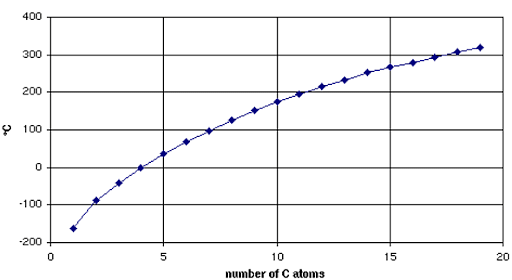
Boiling Point Trend in Alkanes
Melting Point
The melting points of the alkanes also demonstrate a trend similar to the boiling points of alkanes for the same reason as outlined above. The larger the molecule, the higher will be the melting point. Let us look at the significant features of the melting point in alkanes:
- It is observed that solids have a more rigid and fixed structure than liquids that requires energy to break down. Thus, solid structures will require more energy to break apart.
- The odd-numbered alkanes have a lower trend in melting points than even-numbered alkanes. This is because even numbered alkanes pack well in the solid phase in comparison to the loosely packed odd-numbered alkanes, forming a well-organized structure, which requires more energy to break apart.
- Melting point also increases with increasing molecular weight because it is difficult to break the intermolecular forces of attraction between higher alkanes as they are generally solids.
- As even-numbered alkanes have a better packing in the solid phase in comparison to the odd-numbered ones, they form a well-organized structure that is difficult to break, thereby resulting in higher melting points.

Melting Point Trend in Alkanes
Some of the other physical properties of alkanes are listed below:
- Alkanes are colorless and odorless.
- Alkanes contains weak Van Der Waals forces of attraction.
- Alkanes containing 1-4 carbon atoms are predominantly gases, then from 5-17 carbon atoms they are liquid and alkanes having 18 or more carbon atoms exist as solids at the temperature of 298K.
- Alkanes possess a lower density in comparison to water, that is, they float on water.
- Apart from weak Van Der Waals forces, other forces such as the London forces, Dispersion forces, and weak intermolecular forces act between the molecules of alkanes.
Also Read: Change of State
Chemical Properties of Alkanes
[Click Here for Sample Questions]
The following are two important chemical properties of alkanes:
Combustion of alkanes
In the presence of excess oxygen, alkanes readily undergo combustion and thereby produce carbon dioxide gas, water, and energy in the form of heat as well as light.
Alkane + Oxygen → Carbon Dioxide gas + Water + Energy
C4H10(g) + 6½ O2(g) → 4CO2(g) + 5H2O(l) + 2874 KJ mol-1
- The above reaction represents the combustion reaction of butane [4 carbon alkane]. With the increasing molar mass of straight-chain alkane, the energy released also increases.
- Additionally, with the increasing carbon chain length, the combustion energy increases. In the absence of sufficient oxygen, alkanes try to undergo incomplete combustion which produces water and carbon monoxide or carbon.
Also Read: Spontaneous Combustion
Halogenation
Alkanes are less reactive. Without ultraviolet light, they do not react with halogens. In the presence of a UV light, the halogenated alkane is produced. The process is a substitution reaction in which one or more hydrogen atoms are substituted by halogen atoms.
CH3-CH2-CH3 + Br3 → CH3-CH2-CHBr + HBr
Here propane is reacting with bromine. The general substitution reaction equation can be given as
R-H +X2 → R-X + H-X
where R is a carbon chain and X is a halogen.
Also Read: SN2 Reaction Mechanism
Uses of Alkanes
[Click Here for Sample Questions]
Owing to a varied range of chemical and physical properties, listed below are the application of alkanes:
- Propane and butane are the alkanes that are commonly used in propane gas burners and as propellants or aerosol sprays when liquified at low temperatures.
- From pentane to octane, these alkanes act as fuels that are good for internal combustion engines in automobiles.
- From Nonane to hexadecane, these compounds have high viscosity and find multiple uses in diesel as well as the aviation industry as fuel.
- Up to C-35 [carbon number 35] alkanes are used as paraffin wax candles, as anti-corrosive agents, and in lubricating oil.
- Higher alkanes are broken down into smaller alkanes and are then subsequently brought into use.
Also Read: Hydrogen Bonding
Things to Remember
- Hydrocarbons are compounds that are made up of only carbon and hydrogen.
- Hydrocarbons are predominantly obtained from coal and petroleum.
- Open-chained saturated hydrocarbons are called alkanes.
- Important reactions involving alkanes are combustion, oxidation, aromatization, and free radical substitution.
- The carbon atoms in alkanes are described as sp3 hybridized.
- Alkanes are soluble in non-polar solvent only owing to weak Van Der Waals forces
- Even-numbered alkanes have higher melting points in comparison to odd-numbered ones as a consequence of a well-organized structure which is ultimately difficult to break.
- Straight chained alkanes have higher boiling points.
- Alkanes readily undergo combustion and in the presence of UV light undergo substitution reaction to produce a halogenated alkane.
Also Read:
Sample Questions
Ques. Why are alkanes called paraffin? [3 marks]
Ans. Paraffin is taken from the Latin word formed from two words “parum” meaning “little” and “affinis” meaning “reactivity”. This is due to their little affinity towards a general reagent. Some key properties are:
- Alkanes are inert and undergo reactions only under the presence of drastic conditions. This is so because alkanes form only single bonds between carbon and hydrogen atoms which are relatively strong [hydrogen bonds] and are quite difficult to break.
- Carbon and hydrogen have similar electronegativities, which results in giving the molecules a non-polar character. Therefore, alkanes undergo limited reactions, under certain specific conditions only, and are hence called paraffin.
Ques. “Rotation around the carbon-carbon single bond of ethane is not completely free”. Justify the statement. [4 marks]
Ans. Ethane contains a carbon-carbon sigma (σ) bond. The electron distribution of the sigma molecular orbital is symmetrical around the axis of the Carbon-Carbon bond which is not disturbed as a consequence of rotation about its axis. This results in permitting free rotation around the C-C single bond.
However, the rotation around the C – C single bond is not completely free as it is hindered by a small energy barrier because of the weak repulsive interaction between the adjacent bonds. Thus, such a type of repulsive interaction is called a torsional strain.
The staggered conformational form has the least torsional strain and the eclipsed form has the maximum torsional strain. The energy difference between the two forms is of the order of 12.5 kJ mol-1, which is very small. Thus, it has not been possible to separate and isolate different conformational isomers of ethane till now.
Ques. How many carbons are present in the product of a decarboxylation reaction when it is compared with the reactant of the reaction? [2 marks]
Ans. Decarboxylation of either sodium or potassium salt of fatty acids is a decarboxylation reaction. This reaction is used in descending series as the alkane which is obtained has one carbon less than the parent compound. Here quicklime is used as it is more hygroscopic than sodium hydroxide and helps keep sodium hydroxide in a dry state.
Ques. Which reaction is used to increase the length of the carbon chain? [2 marks]
Ans. Wurtz reaction is used to increase the length of the carbon chain. Kolbe’s electrolysis is used when alkanes require an even number of carbon atoms while Clemmensen Reduction and Wolff-Kishner are used for removing water molecules.
Ques. What does the ease of hydrogenation depend on? [2 marks]
Ans. The ease of hydrogenation depends on the steric crowding across multiple bonds, the more the steric crowding, the less is reactivity towards hydrogenation. This basis is used in one of the methods of preparation of alkanes from the process of hydrogenation of alkenes and alkynes.
Ques. In the combustion reaction of alkanes, if Ethane is used, how many moles of oxygen are required? [2 marks]
Ans. The combustion reaction of alkanes has a standard reaction given by,
CnH2n+2 + (3n/2 + 1/2)O2 → nCO2 + (n + 1)H2O
In the case of combustion of ethane, n = 2. That means the number of moles of oxygen required is 3(2)/2 + 1/2 = 3.5
Ques. Is methane a product of aerobic respiration? [2 marks]
Ans. No, methane is the end product of anaerobic decay of plants or organic compounds which occurs due to the breakdown of very complicated molecules present in the compounds.
Ques. The intermediate carbocation formed in the reaction of HI, HBr, and HCl with propane is the same, and the bond energy of HCl, HBr, and HI are 430.5 kJmol−1, 363.7 kJmol−1, and 296.8 kJmol−1, respectively. What will be the order of reactivity of these halogen acids? [3 marks]
Ans. Adding halogen acids to an alkene is an electrophilic addition reaction.
CH3−CH=CH2 + H+ → CH3−CH+−CH3 + X– → CH3−CHX−CH3
As the first step in the reaction is slow, it is also called the rate-determining step. The rate of this step furthermore depends upon the availability of the proton in the reactant. This, in turn, depends upon the bond dissociation enthalpy of the H-X molecule.
The lower the bond dissociation enthalpy of the H-X molecule present in the reaction, the greater the reactivity of halogen halide.
Since the bond dissociation energy decreases in order, HI < HBr < HCl, therefore, the reactivity of the halogen acids decreases from HI to HCl. i.e. , HI > HBr > HCl.
Ques. The relative reactivity of 1°, 2°, and 3° hydrogen towards chlorination is 1: 3.8: 5. Calculate the percentages of all monochlorinated products obtained from 2-methyl butane. [4 marks]
Ans. The possible monochlorinated products obtained from 2-methyl butane are:
- CH2Cl−CH−CH3−CH2−CH3 = (1∘)
- CH3−CH−CH3−CHCl−CH3 = (2∘)
- CH3−Cl−C−CH3−CH2−CH3 = (3∘)
Relative amounts of A, B and C compounds can be calculated as hydrogen multiplied by relative reactivity.
Therefore, The Relative amount of A (1∘) = 9 × 1 = 9
The relative amount of B (2∘) = 2 × 3⋅8 = 7.6
The relative amount of C (3∘) = 5 × 1 = 5
Total amount = 9 + 7⋅6 + 5 = 21⋅6.
Percentage of A =9 / 21.6 × 100 = 41.7%
Percentage of B= 7.6 / 21.6 × 100 = 35.2%
Percentage of C = 5 / 21.6 × 100 = 23.1%
Ques. An unsaturated hydrocarbon “A’ results in adding two molecules of H2 to the compound and on reductive ozonolysis gives butane-1,4-di-al, ethanal, and propanone. Give the structure of ‘A’, write its IUPAC name and explain the reactions involved. [4 marks]
Ans. Two hydrogen molecules add on ‘A’, which shows that ‘A’ is either an alkadiene or an alkyne. In the process of reductive ozonolysis, ‘A’ gives three fragments, one of which is dialdehyde. This demonstrates that the molecule has broken down at two sites of the chain. Therefore, now ‘A’ has two double bonds and it gives the following three fragments: OHC—CH2—CH2—CHO, CH3CHO, and CH3—CO—CH3.
Hence, its structure can be deduced from the presence of the three fragments as follows:

Also Read:
Also Read:



Comments