



Education Journalist | Study Abroad Lead
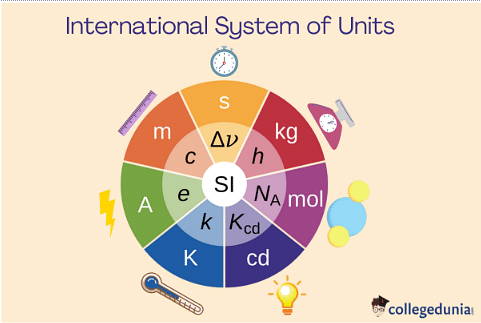
The International System of Units, also known as the SI system, is the system that is widely accepted internationally in the present times for measurement. The system was developed in 1971 by the General Conference on Weights and Measures for international usage for measurement in commercial, technical, scientific, and industrial work. These are a set of seven physical quantities. In this article, we will have a look at the SI system and the seven base units.
| Table of Content |
Keyterms: SI unit, SI system, Measurement, Weights, Metric system, Unit, Length, Mass, Time, Electric Current, Temperature
The International System of Units (SI Units)
[Click Here for Sample Questions]
The SI system refers to a universally existing metric system used for measurement. There are seven base units in it and 22 units are derived out of the same. These units can be expressed either as fractional quantities or as standard multiples and are expressed through multipliers with powers of 10 ranging from 10-24 to 1024. A unit can be defined as a physical well quantity that is well defined and against which quantities are compared during measurement.
Also Read:
| Related Articles | ||
|---|---|---|
| Unit of Mass | Unit of Length | System of Units |
| Unit of Light | Precision of a measurement | Unit of Momentum |
SI Base Units
[Click Here for Previous Year Questions]
The seven fundamental quantities of the SI system are:
- Length
- Mass
- Time
- Electric Current
- Thermodynamic Temperature
- Amount of substance
- Luminous Intensity
Units and Measurements Video Lecture
Length
[Click Here for Sample Questions]
In the SI system, the unit used for measuring length is the meter, also denoted as ‘m’. A meter can be defined as the length traveled by light in a vacuum in 1/299792458th of a second. This number is chosen so that the distance that is traveled by the light in one second is made equal to the value known by us i.e. 1299792458 m.
Mass
[Click Here for Previous Year Questions]
In the SI system, the unit used for measuring mass is kilograms, denoted as ‘kg’. A kilogram can be defined as the mass of a cylinder of Platinum-Iridium which has 10% of Iridium and 90% of Platinum. The diameter and the height of the cylinder are both equal to 39 mm. The Platinum-Iridium cylinder is referred to as the International Prototype Kilogram.
Time
[Click Here for Sample Questions]
In the SI system, the unit used for measuring time is seconds, denoted as ‘sec’ or ‘s’. A second can be defined as the time taken by 9192631770 cycles of the emitted radiation by an atom of Cesium-133 when it is transitioning between two specified states. It also refers to the time that is taken by light in a vacuum to cover a distance of 299792458 m.
Electric Current
[Click Here for Previous Year Questions]
In the SI system, the unit used for measuring an electric current is Ampere, denoted as ‘A’. An Ampere is defined as the constant current that would produce a force of 2×10⁻⁷ N/m between any two conductors, provided if the current is maintained in those two straight conductors that are parallel to each other and infinite in length, a negligible cross-section area, and are placed in a vacuum one meter apart.
Also Read:
Thermodynamic Temperature
[Click Here for Sample Questions]
In the SI system, the unit used for measuring temperature is Kelvin, denoted as ‘K’. A Kelvin is defined as 1/273.16th of the triple point of water’s temperature. Here, the triple point can be understood as the point at which all the three states of substances i.e. solid, liquid, and gas co-exist.
Amount of Substance
[Click Here for Previous Year Questions]
In the SI system, the unit used for measuring the amount of substance is mole, denoted as ‘mol’. A mole can be defined as the amount of a substance that contains as many basic entities as there are atoms in specifically 12 gm or 0.012 kg of Carbon-12. It is also equivalent to the Avogadro’s number which is denoted by NA and has a value of 6.02214179 ×10²³ mol-1.
Luminous Intensity
[Click Here for Sample Questions]
In the SI system, the unit used for measuring the luminous intensity is Candela, denoted as ‘cd’. A candela is defined as the luminous power that is emitted by a point source of light per unit solid angle in a given direction. A common candle has a luminous intensity of 1 Candela.
| Name of the Quantity | SI Unit | Symbol of SI Unit |
|---|---|---|
| Length (l) | Meter | m |
| Mass (m) | Kilogram | kg |
| Time (t) | Second | s |
| Electric Current (I) | Ampere | A |
| Thermodynamic Temperature (Θ) | Kelvin | K |
| Amount of substance (N) | Mole | mol |
| Luminous intensity (J) | Candela | cd |
SI Derived Units
[Click Here for Previous Year Questions]
By performing various operations on the base units, derived units can be formed. Their dimensions are expressed in terms of the base unit’s dimensions. Some of the Derived Units are:
| Unit Name | SI Unit | Expressed in SI Base Unit |
|---|---|---|
| Angle | Radian | m.m-1 |
| Capacitance | Farad | kg−1.m−2.s4.A2 |
| Frequency | Hertz | s-1 |
| Resistance | Ohm | kg.m2.s−3.A−2 |
| Magnetic Flux | Weber | kg.m2.s−2.A−1 |
| Electric Charge | Coulomb | s.A |
| Voltage | Volt | kg.m2.s-3.A-1 |
Read More:
Significance of the International System of Units
[Click Here for Sample Questions]
- An internationally set system of standard units helps everyone stay on the same page while talking about measurements.
- It avoids confusion. The NASA Mars Climate Orbiter was mistakenly destroyed in September 1999 on its trip to Mars due to the miscommunications in the value and units of Forces. This led to failure of the mission and significant time, effort, and cost involved were wasted.
- In order for an experiment to be successful, it is a necessary condition that it could be replicated. Hence, a standard set unit system helps in precise measurements which makes the replication of experiments easier and more reliable.
Things to Remember
- The International System of Units, also known as the SI system, is the system that is widely accepted internationally in the present times for measurement.
- There are seven base units in it and 22 units are derived out of the same.
- The system was developed in 1971 by the General Conference on Weights and Measures for international usage for measurement.
- The seven fundamental quantities of the SI system along with their units are:
- Length: metre (m)
- Mass: kilogram (kg)
- Time: second (s)
- Electric Current: Ampere (A)
- Thermodynamic Temperature: Kelvin (K)
- Amount of substance: mole (mol)
- Luminous Intensity: Candela (cd)
- By performing various operations on the base units, derived units can be formed.
- Their dimensions are expressed in terms of the base unit’s dimensions.
Previous Year Questions
- The orbital angular momentum of a p-electron is given as …
- A body of mass M kg initially at … [AMUEEE 1999]
- Identify the wrong statement … [AMUEEE 2009]
- System shown in figure is in equilibrium and at rest … [JEE Advanced 2006]
- The orbital angular momentum of an electron in 2s-orbital … [JEE Advanced 1996]
- The principle of conservation of linear momentum …
- A rocket is about to launch upwards from its platform … [TS EAMCET 2018]
- The dimension of angular momentum is … [WBJEE 2012]
- A circular disc is rotating about its own axis … [CBSE Class XII]
- A shell of mass 10 kg … [WBJEE 2008]
- The position of both an electron and helium atom … [NEET 1998]
- If a ball of mass 0.1 kg hits …
- The SI unit of velocity is…
- If force (F), work (W) and velocity (V) are taken as fundamental quantities…
- The dimensions of angular velocity, is…
Sample Questions
Ques. What can be referred to as a unit? (1 mark)
Ans. A unit can be defined as a physical well quantity that is well defined and against which quantities are compared during measurement.
Ques. Name a physical quantity that has same unit of measurement both in M.K.S and C.G.S system. (1 mark)
Ans. Time is measured in seconds in both the M.K.S and C.G.S systems of measurement.
Ques. Name a physical quantity that doesn’t have a unit. (1 mark)
Ans. Relative density is a unitless and dimensionless term.
Ques. Define the SI unit of Electric Charge. (2 marks)
Ans. Electric Charge refers to the property of the matter that generates the electrostatic force. It always is conserved and can be both positive and negative. The SI Unit of Electric Charge is Coulomb, denoted by C.
Ques. Name some most popular systems used for measurements. (2 marks)
Ans. Mainly three systems of measurement are followed which are:
- CGS System
- MKSl System
- Sl System
Ques. Derive the unit for linear momentum. (2 marks)
Ans. We know that,
Linear Momentum = mass x velocity
As the unit of mass is kg and the unit of velocity is m/s.
Therefore, the unit for linear momentum is kgms-1
Ques. When and by whom the International System of Units was established? (2 marks)
Ans. The system was developed in 1971 by the General Conference on Weights and Measures for international usage for measurement in commercial, technical, scientific, and industrial work.
Ques. What is the significance of the International System of Units? (3 marks)
Ans. The International System of Units, commonly known as the SI system is important as:
- It is based on a definite and precise unit of measurement.
- The base used for converting is 10. This makes further calculations a lot easier.
- These units can be derived from each other.
- An internationally set system of standard units helps everyone stay on the same page while talking about measurements.
- In order for an experiment to be successful, it is a necessary condition that it could be replicated. Hence, a standard set unit system helps in precise measurements making the process of replication a lot easier.
Ques. What are the 7 fundamental quantities of the SI system using which other units can be derived? (3 marks)
Ans. The seven fundamental quantities of the SI system are:
- Length
- Mass
- Time
- Electric Current
- Thermodynamic Temperature
- Amount of substance
- Luminous Intensity
Ques. What are the fundamental units? (2 marks)
Ans. Fundamental units are the basic units of the SI system which can not be resolved into some more simpler units nor can it be derived.
Check More:



Comments