



Education Content Expert
Puerperium is the period of adjustment after childbirth during which the mother's reproductive system returns to its normal prepregnant state. This period typically lasts for six weeks. Changes caused due to pregnancy, labor, and delivery are resolved six weeks after delivery. Puerperium, often known as the “fourth trimester,” is a term used to describe the time a woman experiences after giving birth. At this point, the physiological changes in the mother’s body brought on by pregnancy goes back to their prior state. The mother is subjected to some dietary restrictions as well as limitations on some activities during the span of Puerperium.
Read More: NCERT Solutions For Class 12 Biology Reproductive Health
| Table of Content |
Key Terms: Puerperium, Postpartum Period, Puerperal Sepsis, Puerperal Infection, Childbirth, Hygiene, Vaginal Discharge, Uterine Cavity
What is Puerperium?
[Click Here for Sample Questions]
Puerperium is the postnatal period that begins immediately after the birth of a child and extends for about six weeks.
- Postpartum is the time after childbirth when a woman's body returns to being non-pregnant.
- Although it usually lasts six weeks, the postpartum period can last up to twelve weeks.
- There are both physical and emotional changes during the postpartum period.
- Physical modifications include exhaustion, breast alterations, bleeding, and uterine modifications.
- Anxiety, despair, and mood swings are emotional changes that occur during this period
- Both the mother and the newborn are recovering throughout the postpartum period.
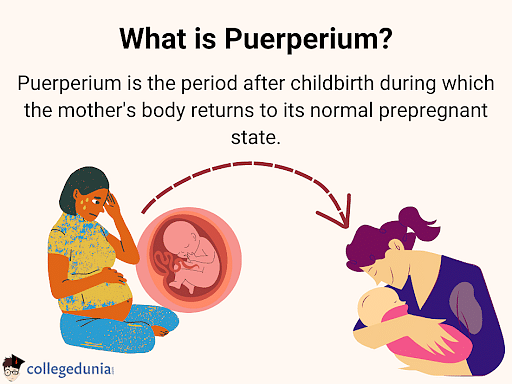
Puerperium
Read More:
| Relevant Concepts | ||
|---|---|---|
| Embryology | Birth Control | Reproductive Health |
| Maternal Mortality Rate (MMR) | Oestrus Cycle | Primary And Secondary Lymphoid Organs |
Puerperal Sepsis
[Click Here for Previous Year Questions]
‘Puerperal Sepsis’ is an infection that occurs after childbirth in the mother and is one of the many indications of puerperium. This is the third most typical issue that a new mother deals with. More than 15% of deaths per year are attributed to this postpartum delivery problem, according to the WHO (World Health Organization). Instead of puerperal sepsis, many doctors use the term puerperal infections.
A woman may get one of three forms of postpartum infections:
- Endometritis: An infection of the uterine lining.
- Myometritis: An infection of the uterine muscle.
- Parametritis: An infection of the uterine cavity.
Read More: Medical Termination of Pregnancy (Induced Abortion)
Symptoms of Puerperal Sepsis
[Click Here for Sample Questions]
A woman infected with Puerperal Infection may have pain while urinating or having sex, as well as a vaginal discharge that may smell bad.
Some other common symptoms of Puerperal infection are:
- Fever
- Pain in Lower Abdomen
- Chills
- Nausea
Although the prevalence of puerperal infections has decreased as a result of the advent of antiseptics, skin germs like Streptococcus or Staphylococcus and others may still end up infecting. After delivery, the infection typically begins in the uterus. It occurs when the amniotic sac is contaminated.
Causes of Puerperal Sepsis
[Click Here for Previous Year Questions]
Puerperal infection can have a variety of different causes, such as
- Poor Hygiene: One of the most frequent causes of puerperal infection is poor hygiene.
- Birth Injuries: If a baby sustains damage after delivery, the chance of a puerperal infection can rise.
- Poor Nutrition: A puerperal infection can significantly raise the risk of development if the mother is undernourished.
- Smoking: Smoking increases your chance of getting an illness during pregnancy.
- Alcoholism: Alcohol abuse can also make a woman more likely to get an infection during pregnancy.
- Stress: Stress can also make it more likely that a puerperal infection would manifest.
- Immune System Deficiencies: A woman is more likely to get a puerperal infection if her immune system is compromised.
- Infections in Other Parts: The mother is more likely to acquire a puerperal infection if she has an illness in another part of her body.
- Improper Antibiotic Use: If Antibiotics are not administered properly, the chance of acquiring a puerperal infection increases.

Causes of Puerperal Sepsis
Read More: What is Gestational Diabetes?
Risk Factors of Puerperal Sepsis
[Click Here for Sample Questions]
In most cases, women are typically at a higher risk of contracting an infection. Some people might get sick, while others might not. The likelihood of getting sick is
- 3 percent during vaginal delivery.
- 15 percent in scheduled cesarean deliveries.
- 20 percent of non-scheduled cesarean deliveries are performed after labor begins.
There are additional factors besides these that may expose women to infection. These are listed below:
- Monitoring of the fetus internally.
- Obesity
- Bacterial Vaginosis.
- Multiple Vagincal exams.
Read More: Contraception
Diagnosis of Puerperal Sepsis
[Click Here for Previous Year Questions]
If there is no clinical inclusion, there are various diagnoses for this potentially fatal infection. These are some of the diagnoses:
- Vomiting
- Rash
- Tachycardia
- Diarrhea
- Abdominal pain and tenderness
Read More:
| Related Topics | ||
|---|---|---|
| Infant Mortality Rate | Depression Symptoms | Cognitive Behavioral Therapy |
| Implantation | Sexually Transmitted Diseases | Women's Health |
Prevention of Puerperium Sepsis
[Click Here for Sample Questions]
Puerperium infection can be prevented by the following measures:
Before and During Delivery
- Using a partograph to avoid prolonged labor.
- Limited vaginal examination.
- Asepsis during delivery
- Washing hands properly
- Maintaining proper hygiene
- HLD gloves, Instruments, and equipment.
After Delivery
- Use clean Sanitary pads.
- Maintain perineal hygiene
Things to Remember
- Puerperium is the time period immediately after childbirth in which the body of the mother regains the normal prepregnant state.
- Puerperium is also referred to as the Postpartum Period.
- The duration of puerperium is around six weeks after childbirth.
- Puerperal Sepsis is an infection that occurs in the mother after childbirth.
- Symptoms of Puerperal Infection include Fever, Vomiting, Abdominal discomfort, Diarrhoea, etc.
- Puerperal Infection may be caused due to birth injuries, poor nutrition, poor hygiene, immune system deficiencies, etc.
- Maintaining proper hygiene during and after delivery help to decrease the chances of Puerperal sepsis.
Previous Years’ Questions
- RCH stands for…
- What is true for an ideal contraceptive…
- Select the correct path of flow of milk during breastfeeding… (KCET 2013)
- Which is present in the urine of pregnant women… (JIPMER 2018)
- Ectopic pregnancies are referred to as… (NEET 2015)
- Given below is an incomplete flow chart showing influence…
- Condoms are barriers that cover…
- Tubectomy is a method of sterilization in which… (AIPMT 2014)
- What is true of natural methods of contraception…
- Tablets to prevent male contraception contain… (NEET 1999)
Sample Questions
Ques. What is Puerperium? (3 Marks)
Ans. Puerperium denotes the postnatal period that begins immediately after the birth of a child and extends for about six weeks. During this time period, the body parts of a woman particularly the genital and the pelvic organs, return to the condition of the pre-pregnancy state of the women. Puerperium continues for about 6 weeks (42 days) from delivery to normal functioning. This period is meant for females to recover and rest.
Ques. How does puerperal infection occur? (2 Marks)
Ans. Puerperal infections result from physiologic and iatrogenic trauma to the abdominal wall and reproductive, genital, and urinary tracts occurring at the time of childbirth or abortion. This allows the introduction of bacteria into these normally sterile environments.
Ques. What are the signs of puerperal sepsis? (3 Marks)
Ans. Symptoms of puerperal sepsis include the following:
- Pelvic Pain
- Abnormal Vaginal Discharge (Presence of Pus)
- Fever
- Abnormal Smell/Foul Odor of Discharge
- Delay in the rate of reduction of the Uterus (Involution)
- Nausea
- Vomiting
- Diarrhea
- Abdominal Discomfort
Ques. Which bacteria cause puerperal sepsis? (2 Marks)
Ans. Most common bacteria like E. coli, staphylococcus, and streptococcus causes puerperal sepsis. Other organisms like Chlamydia, Klebsiella, Clostridium sordellii, Mycoplasma, and coliform bacteria also cause puerperal sepsis.
Ques. What are the causes of puerperal infection? (3 Marks)
Ans. The causes of puerperium infection include
- Poor Nutrition
- Poor Hygiene
- Stress
- Smoking
- Alcoholism
- Improper Use of Antibiotics
- Immune System Deficiency
- Infections In Other Parts of The Body
- Birth Injuries
Ques. In which part of the body, the puerperal infection takes place? (2 Marks)
Ans. Puerperal infection is mostly seen on the raw surface of the interior of the uterus after separation of the placenta, additionally, pathogenic organisms may affect lacerations of any part of the genital tract of the mother.
Ques. What are the three forms of postpartum infection? (2 Marks)
Ans. The three forms of postpartum infection are
- Endometritis: Infection of the uterine lining.
- Myometritis: Infection of the uterine muscle.
- Parametritis: Infection of the uterine cavity.
Ques. What are the risk factors of puerperium infection? (2 Marks)
Ans. Cesarean delivery is the most significant risk for puerperium infection. Females with high blood pressure, diabetes, anemia, obesity, bacterial vaginosis, multiple vaginal exams, and immune system problems are more prone to puerperium infection.
Ques. How can puerperium infection be prevented? (2 Marks)
Ans. Puerperium infection can be prevented or managed by maintaining proper hygiene, washing hands properly, and reducing frequent PV examinations during labor. Early identification and judicious use of antibiotics in the females showing the signs of infection.
Ques. Can Puerperal Infection lead to complications? (3 Marks)
Ans. Though there are rare complications in puerperal infections, there might be a few infections such as
- Abscesses/Pus
- Peritonitis/Inflammation
- Pelvic Thrombophlebitis or Blood Cots in Pelvic Veins
- Sepsis or Septic Shock.
Check-Out:



Comments