



Content Curator
The reproductive health of a person can be defined as physical, emotional, behavioral, and social wellbeing in all aspects of reproduction by WHO. There are a number of programs running keeping in mind the maintenance of reproductive health in India. These programs are also aimed to create awareness, control, and prevention about sexually transmitted diseases. Disease or infections in humans transmitted through sexual intercourse are called sexually transmitted diseases (STDs). Sexually transmitted diseases are also known as Venereal diseases (VD) or reproductive tract infections. Here, we will discuss sexually transmitted diseases in detail.
| Table of Content |
Keyterms: Reproductive health, Reproduction, Disease, Sexually transmitted diseases, Venereal diseases, Reproductive tract infections, Gonorrhea, Chlamydia, Trichomoniasis, Syphilis, Pubic Lice, Herpes, AIDS, HPV
What are Sexually Transmitted Diseases?
[Click Here for Sample Questions]
The incidence of STDs is very high in the age group of 15-24 Years. Sexually transmitted diseases can be transferred to another person in many other ways also apart from sexual contact. Breastfeeding, sharing of infected needles are also responsible for the spread of STDs. Some very common STDs are gonorrhea, genital herpes, syphilis, hepatitis-B, AIDS, etc. Few STDs are curable while few are non-curable.
Curable STDs- Gonorrhea, Chlamydia, Trichomoniasis, Syphilis, Pubic Lice.
Non-Curable STDs- Herpes, AIDS, HPV
Read More: Difference Between HIV and AIDS
Early Symptoms of STDs
[Click Here for Sample Questions]
- Itching
- Fluid Discharge
- Swelling and slight pain etc. in the genital organs.
Infected females are generally asymptomatic, hence detection of disease takes time. Also, most STDs are curable if diagnosed early. Late detection leads to complications in the treatment, sometimes late detection and late treatment also lead to complications such as pelvic inflammatory disease, abortions, and stillbirths, ectopic pregnancies, infertility, or even cancer.
Also Read: Medulla Oblongata
Common STDs and Their Symptoms
[Click Here for Sample Questions]
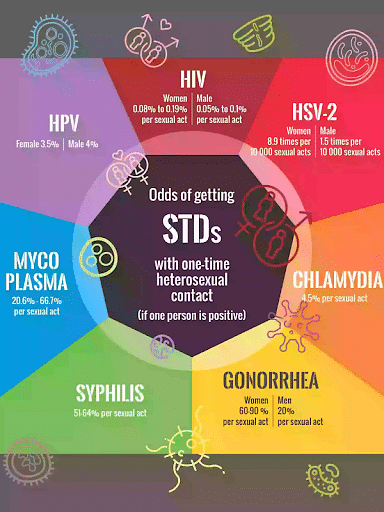
Common STDs and Their Symptoms
AIDS
The most common and chronic sexually transmitted disease is AIDS. Its causative agent is HIV (Human Immunodeficiency Virus). This is a non-curable disease. In AIDS, the immune system is completely destroyed by HIV and the body becomes weak and susceptible to various other diseases.
Symptoms- Headache, swollen lymph nodes, rashes, fever, chill, nausea.
Gonorrhea
This disease is caused by the bacteria Neisseria Gonorrhoeae. The infected person can be male or female. Gonorrhea is transmitted through direct sexual contact. The urogenital pathway, including the urethra, cervix, and rectum are mostly infected due to this virus.
Symptoms- Discharge of pus from penis, burning sensation during urination in males and similarly in females discharge of pus from vagina, pelvic and abdominal pain.
Syphilis
The causative agent of syphilis is the bacteria Treponema pallidum. This bacterium enters the body through various wounds. Syphilis is also transmitted to newborns through infected mothers.
Symptoms- The early symptom is a ‘Chancre’ or a sore. Headache, weight loss, fatigue, rashes, and fever are the many other symptoms. Loss of vision, heart disease, stop mental growth are the other symptoms that can be noticed in the later stages.
HPV (Human Papillomavirus)
HPV is a non-curable disease, no treatment has been found for this disease till now. The causative agent for HPV is Virus as the name suggests.
Symptoms- The common symptoms include warts on the buccal cavity, throat, and external genitals. If these warts are left untreated, they may lead to diseases like cervical cancer, rectal cancer, etc.
Chlamydia
Chlamydia is a disease caused by bacterium Chlamydia trachomatis. Chlamydia is a disease transferred to the newborn from the mother and causes complications like blindness, pneumonia, etc.
Symptoms- This disease can not be diagnosed in the early stage but in later stages symptoms such as pain during urine discharge, yellow discharge from the penis or vagina. If this disease is left untreated it may cause inflammation of the pelvic girdle.
Read More: Lysosomal Storage Disease
Herpes
Herpes is caused by the virus named Herpes Simplex Virus (HSV). Two strains of this virus are found, HSV-1 and HSV-2. The Virus HSV-1 is responsible for oral herpes and HSV-2 is responsible for genital herpes.
Symptoms- The common symptoms are sores around the genital areas. The pregnant lady can pass congenital herpes to their child.
Also Read: Hypothyroidism
Preventions from STDs
[Click Here for Sample Questions]
- Avoid sex with unknown partners/multiple partners.
- Always use some protection during coitus.
- Consult a physician for early detection and treatment of disease.
- Don’t leave any STD untreated, visit a doctor immediately for treatment
STDs are a major threat to our healthy societies as people do not want to talk about them, lack of awareness causes complications in later stages. India was among the first countries to start reproductive health programs for awareness about reproductive health.

Preventions from STDs
Infertility and its Treatment
[Click Here for Sample Questions]
The reason for infertility can be physical or congenital. Infertility is the inability to produce children in spite of unprotected sexual practices.
Infertility can be treated by Assisted Reproductive Technologies such as IVF, GIFT, ICSI, AI.
Also Read: Human Bacterial Diseases
Things to Remember
- Disease or infections in humans transmitted through sexual intercourse are called sexually transmitted diseases (STDs).
- Few STDs are curable while few are incurable. Curable STDs are Gonorrhea, Chlamydia, Trichomoniasis, Syphilis, and Pubic Lice, while Non-Curable STDs- Herpes, AIDS, and HPV.
- Infected females are generally asymptomatic, hence detection of disease takes time.
- Late detection can lead to complications such as pelvic inflammatory disease, abortions, and stillbirths, ectopic pregnancies, infertility, or even cancer.
- India was among the first countries to start reproductive health programs for awareness about reproductive health.
Also Read:
Sample Questions
Ques. What are the most common sexually transmitted diseases? (2 marks)
Ans: Diseases that are transmitted through sexual intercourse with an infected person are known as sexually transmitted diseases. A few common sexually transmitted diseases are herpes, hepatitis, AIDS, Gonorrhea.
Ques. What does reproductive health mean? (3 marks)
Ans: The term reproductive health simply means healthy reproductive organs with normal functions. It also refers to a society with people having physically and functionally normal reproductive organs and normal social and emotional interaction between them in all sex-related aspects can be called reproductively healthy society.
Ques. Is there any program running to prevent sexually transmitted diseases? (4 marks)
Ans: In India, there are a number of programs running about the maintenance of reproductive health. India was among the first few countries in the world which initiated the programs to talk about reproductive health. These programs create awareness about the various sexually transmitted diseases, mode of transmission, and how to prevent these diseases. Many governments and non-government agencies are working with the help of audio-visuals and print media towards creating awareness about the prevention programs for reproductive health.
Ques. Name the STDs which can be transmitted through contaminated blood? (2 marks)
Ans: Acquired ImmunoDeficiency Syndrome (AIDS) is transmitted through contaminated blood. The causative agent of AIDS is the virus.
Ques. What are the other names of STDs? (2 marks)
Ans: Sexually transmitted diseases are also known as Venereal diseases (VD) or reproductive tract infections
Ques. What is HPV? (2 marks)
Ans: HPV is a non-curable disease, no treatment has been found for this disease till now. It is caused by the virus of the same name, HPV (Human Papillomavirus).
Ques. Why is it important to treat STDs at the earliest? (2 marks)
Ans: Late detection and late treatment of STDs lead to complications such as pelvic inflammatory disease, abortions, and stillbirths, ectopic pregnancies, infertility, or even cancer.
Ques. How are STDs transmitted? (2 marks)
Ans: Sexually transmitted diseases can be transferred to another person in many other ways also apart from sexual contact. Breastfeeding, sharing of infected needles are also responsible for the spread of STDs.
For Latest Updates on Upcoming Board Exams, Click Here: https://t.me/class_10_12_board_updates
Check-Out:



Comments