



Education Journalist | Study Abroad Lead
Quota Sampling can be defined as the event when samples are gathered within a group based on their specific characteristics or behaviors, depending upon their population size. The two most essential words in statistics are sample and population. A sample is a subset of the population on which computations are conducted and the results are evaluated, whereas a population is the whole research area. Sampling is the process of determining and selecting an appropriate sample for the study. The sampling method entails selecting a collection of data from a statistical population in order to characterize the entire population. There are a variety of sampling techniques available, one of which is Quota Sampling. Quota Sampling is a non-probability sampling method that is essential in making a sample for researchers, based on the general features of a given population.
Key Terms: Quota Sampling, Sampling, Sample, Population, Statistics, Sampling Method, Controlled Quota Sampling, Uncontrolled Quota Sampling
Definition of Quota Sampling
[Click Here for Sample Questions]
Quota Sampling refers to the process of gathering samples from a group based on their unique features or habits, as well as their population size. The quota sampling method is a non-probability sampling approach that may be used to create a sample for researchers based on the general characteristics of a community.
Assume you've been tasked with conducting a study of females' color preferences for a fashion designer. To gain a complete picture of the facts, you'll need to gather information from a variety of people of all ages. If you do this at random, it might be a challenging process because the samples for each group are located in various places. Teenagers hang out in quite different settings than seniors, and their tastes are heavily influenced by their age. To make things easier, divide the sample size into various fractions and allocate each one to a different portion of the population.
Quota sampling aids in sample selection by giving critical information about how many samples are required for each target group in order for them to be proportional to the original population.

Quota Sampling
Read More: Sampling Error Formula
Types of Quota Sampling
[Click Here for Sample Questions]
Overall, there are two forms of quota sampling- Controlled Quota Sampling and Uncontrolled Quota Sampling.
- Controlled Quota Sampling
When a researcher or surveyor is confined to only a few sample options, this is referred to as Controlled Quota Sampling. For example, a school bag manufacturer would wish to conduct a wide survey of kids' preferences for school bags. The research would be confined to students who were in school at the time.
- Uncontrolled Quota Sampling
An uncontrolled Quota Sample is any circumstance in which the researcher or analyst has no limits or limitations for the sampling procedure. A study undertaken by medical personnel to understand the total public health and well-being in a nation-state at regular intervals is an example of uncontrolled quota sampling. The research would include samples from people of all ages, places of residence, gender, and other factors in the general population.
Process of Quota Sampling
[Click Here for Sample Questions]
To produce meaningful samples, probability sampling procedures may often be broken down into numerous parts. Because quota sampling is a non-probability sampling method, it necessitates a number of stages in the sample selection process. They are as follows:
Step 1: Analyze the Data and Divide It into Subgroups
This step is also known as Stratified Sampling. The researcher divides the population into mutually exhaustive subgroups depending on the attributes of
- Age Group
- Height
- Gender
- Educational Qualification
- Area of Belonging
Step II: Calibrating the Weightage of SubGroups
After the researcher has determined the subgroups, he or she must compare the proportions of the subsets to the population. This procedure aids in calculating the number of samples required for further analysis from each group.
The proportions will be calculated using the following formula:

The number of samples obtained from a group is equal to the number of items in the group multiplied by (the total sample to be taken/ the total item in the population)
Read More: Sample Mean Formula & Solved Examples
Step III: Selection of Appropriate Sample
The researcher must now choose the total size of the samples in accordance with the proportions determined in the previous phase.
Step IV: Survey Underway According to Set Quotas
The final step is to guarantee that the sample obtained is representative of the entire population and that the researcher is able to investigate features and attributes.
Uses of Quota Sampling
[Click Here for Sample Questions]
The following are some of the most important applications of quota sampling:
- In quota sampling, the sample decision is made based on convenience or a predetermined quota. It's utilized when the researcher's decision on which samples to use is definitive.
- The researchers employ quota sampling because it allows them to choose a subset as a sample that is particularly interesting to explore.
- When a researcher wants to figure out how the subgroups are related, they employ this approach.
- When there is a time constraint, the quota sampling approach should be used.
Also Read:
Advantages and Disadvantages of Quota Sampling
[Click Here for Sample Questions]
Quota sampling may be a beneficial strategy provided it is handled carefully and an appropriate strata-division method is used. In sampling, we always want a method that saves time, is less expensive, and is simple to use with a high rate of accuracy.
Advantages of Quota Sampling
- Because of its numerous advantages, quota sampling is now commonly used. The following are some of the benefits:
- Quota sampling is a cost-effective procedure. It saves both time and money by informing us about how many samples of each group we need to gather.
- The additional data expedites the sampling procedure.
- Because quota sampling is a scientific method with a well-defined process, we can achieve a high degree of accuracy.
Disadvantages of Quota Sampling
Nothing can be completely positive. Quota sampling offers both advantages and disadvantages. The downsides of this approach are mostly related to its non-random character since it establishes criteria for selecting samples. The following are some of the drawbacks:
- Because quota sampling is a non-random sample approach, finding the sampling error is difficult.
- Because the surveyor might choose to omit some crucial traits for ease of access and cost savings, there is always the risk of sample bias. For example, if the surveyor selects samples from art institutions solely, although meeting the quota based on the proportion of age, the survey may be biased since colour choices may have been influenced by academic background as well.
- Some concerns connected to goods that don't fit well into any of the categories are underestimated.
Read More: Population Mean Formula
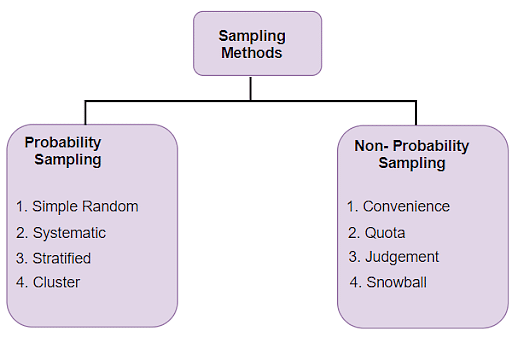
Sampling Methods
Things to Remember
- Quota sampling is a non-probability sampling strategy that is dependent on the researcher's discretion.
- Quota sampling is when you take a highly specific sample that is proportional to a population's characteristics or attributes.
- One may divide a population depending on where they live, their income or education level, or their gender, for example.
- To satisfy a quota, the population is split into groups (also known as strata) and samples are gathered from each category. The proportions are carefully maintained to ensure that they are reflective of the population.
- Controlled quota sampling is defined as sampling that places constraints on the researcher's/choice statisticians of the sample. The researcher can choose from a restricted number of samples using this strategy.
- Uncontrolled quota sampling is defined as sampling that does not place any constraints on the researcher's or statistician's choice of sample. The researcher might choose the samples that are of interest to them throughout this procedure.
Sample Questions
Ques. When should you use quota sampling in your research? (3 Marks)
Ans. In a situation where it is necessary to monitor any relationships between other samples in the study, quota sampling is judged appropriate for use in research.
It's also effective for data analysis that doesn't require pinpoint precision and may produce relevant findings even with a data model that's near to reality. Quota sampling is the best technique to acquire excellent findings for study projects with time and financial restrictions. Quota sampling is utilised in a variety of settings, from medical experts to manufacturing firm owners. Non-probability sampling methods like these also offer the finest application cases for theoretical contribution and explanation.
Ques. Is quota sampling intentional? (3 Marks)
Ans. Purposive sampling refers to any procedure that contains more than one set of subgroups and was developed for a specific purpose. Purposive sampling can refer to a variety of different sampling techniques, including quota sampling. In such instances, researchers must arrive at predetermined samples faster and collect opinions or preferences from subgroups based on population proportions.
Purposive sampling can be used to discover diversity or similarity, as well as to reach out to certain target groups that might otherwise be overlooked. Purposive sampling also refers to other procedures, such as snowball sampling.
Ques. Give an example of Quota Sampling. (5 Marks)
Ans. To further grasp the idea of quota sampling, consider the following example:
Let's pretend we need to know what university students want to do with their lives. More specifically, the disparities in career objectives amongst freshmen, juniors, and seniors will be investigated. Assume that the concerned university has 10,000 students, which may be used to represent our population.
Now we must split our 10,000-strong student body into groups such as freshmen, juniors, and seniors. Assume there are 3000 freshmen (30%), 2500 junior students (25%), and 2000 seniors (20 percent). These proportions must be present in our sample. This indicates that if we choose a sample of 1000 students, we must take into account 300 freshmen, 250 juniors, and 200 seniors. Finally, depending on our percentage, we may begin collecting samples from these pupils.
Ques. What is quota sampling and how does it work? (5 Marks)
Ans. In order to construct samples using probability sampling techniques, the researcher must follow a number of guidelines. There are no formal guidelines for officially constructing samples since quota sampling is a non-probability sampling approach. A quota sample is usually formed in four phases. The steps are as follows:
- Subdivide the population in the sample into subgroups: The researcher divides the total population into mutually exhaustive subgroups via stratified sampling, in which the elements of each subgroup become a part of just one of those subgroups. The researcher uses random selection in this case.
- Calculate the weighting of subgroups: The proportion of subgroups in the population is assessed by the researcher. He/she keeps this percentage in the sample chosen using this way of sampling.
- Choose a suitable sample size: The researcher should choose the sample size in the third stage while keeping the proportion determined in the previous phase in mind. The researcher can choose a sample of 50 items from a population of 500.
- Conduct surveys in accordance with the established quotas: You gain truly actionable results and make sure to stay to the specified quotas. Focus on completing surveys for each quota rather than surveying quotas that are already filled.
Ques. What benefits does quota sampling provide? (3 Marks)
Ans. The following are the top four benefits of quota sampling.
- Because a quota is used to create samples, the sampling procedure is quick and easy.
- Using quota sampling and proper research questions, evaluating information, and survey results is a far more convenient procedure for a researcher.
- Accurate representation of the population of interest: This sampling approach successfully represents a population. This sampling approach allows researchers to investigate the population using defined quotas, so there is no possibility for over-representation.
- The budget needed to carry out this sampling approach is quite low.
Ques. What are some of the uses of quota sampling? (5 Marks)
Ans. The following are examples of when quota sampling is utilized.
- It facilitates the selection of subgroups in instances when researchers have specified criteria for doing research, making it incredibly straightforward for researchers to acquire desired findings. Subgroup creation can be filtered by a trait or attribute.
- When the researcher is short on time, he or she will adopt this strategy. Using quotas, the researcher may quickly get a sense of the whole population of interest.
- When a researcher's funding is limited, quotas are used. Instead of investigating a huge population, the researcher saves money by relying on a small number of quotas to acquire a complete picture of the population.
- Due to the nature of the study topic, certain research investigations may not necessitate pinpoint precision. It's suitable for quota sampling in these types of investigations.
Ques. What different types of quota sampling are there? (3 Marks)
Ans. Controlled quota sampling and uncontrolled quota sampling are two types of quota sampling. This is what they imply:
- Controlled quota sampling: Controlled quota sampling limits the number of samples a researcher can choose. The researcher's options are restricted in this situation.
- Uncontrolled quota sampling: With uncontrolled quota sampling, the researcher's choice of samples is unrestricted. The researcher selects the sample members at his or her discretion.
Check-Out:



Comments