



Education Journalist | Study Abroad Lead
Sexual Reproduction is a procedure that occurs when the sperm from the male parent fertilizes an egg from the female parent and produce an offspring that is genetically different from both the parent. The entire process of reproduction is very crucial because it avoids extinction of the specific species and it helps in the continuation of the species in future generations. The process of reproduction can also be stated as the main feature or reason for life on earth.
Key Terms: Reproduction, Sexual Reproduction, Asexual Reproduction, Stages Of Sexual reproduction
Define Reproduction?
[Click Here for Sample Questions]
Reproduction is a biological process which enables an individual to reproduce a new individual organism i.e., an offspring. Reproduction embodies a fundamental feature of all known life due to which each individual organism exists.
Read Also: How do Organisms Reproduce?
Types Of Reproduction
[Click Here for Sample Questions]
There are two types of reproduction:
- Asexual reproduction
- Sexual reproduction

Asexual Reproduction
Asexual reproduction is that reproduction in which the fusion of gametes or the change in the number of chromosomes is not involved. The offspring that is produced by an asexual reproduction inherits the genes of their single parent. In simple words asexual reproduction is the type of reproduction where only a single parent is involved or a single organism is involved in producing a new offspring.

Asexual Reproduction
The offspring that are produced by asexual reproduction are not very diverse in nature. Asexual reproduction is mostly practiced by unicellular organisms, the process of mating is not involved in asexual reproduction which promotes rapid population growth. As there is no genetic diversity involved the organism is more prone to diseases and nutritional deficiencies.

Asexual reproduction can be further divided into the following -
- Binary fission
- Budding
- Fragmentation
- Sporogenesis
Read More:
Sexual Reproduction
Sexual reproduction occurs in both animals and plants. In a sexual reproduction genetically diverse organisms or of sphinx are produced this happens when two individual of different sex are combined.
The offspring produced by sexual reproduction are genetically diverse in nature and can involve themselves in accordance to the climate and other adaptable conditions many multicellular organisms practice sexual reproduction.
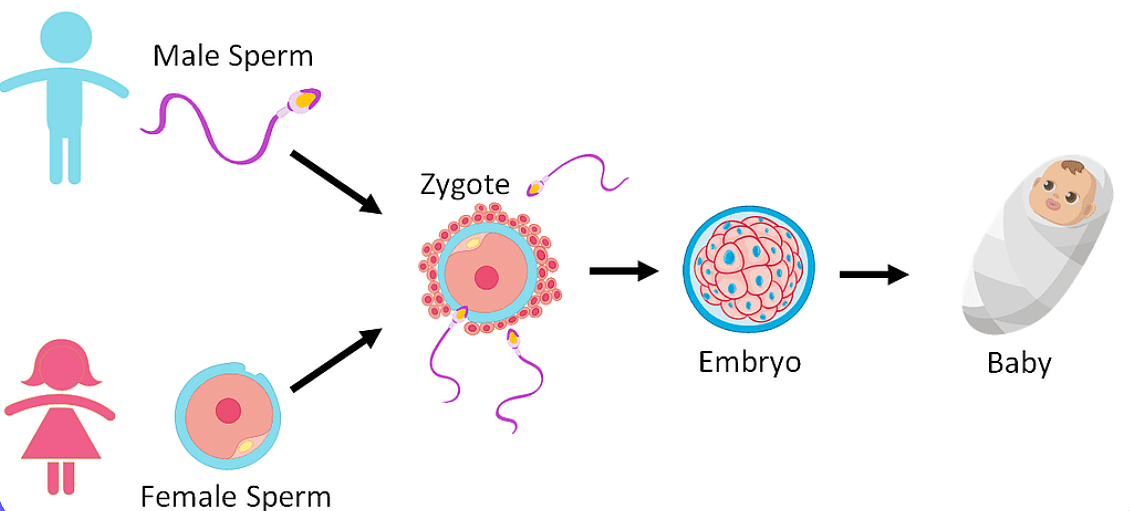
Sexual Reproduction
Sexual reproduction have 4 types, the name of the stages are mentioned below-
- Allogamy
- Internal fertilization
- External fertilization
- Autogamy
Read More About Sexual and Asexual Reproduction
Stages of Sexual Reproduction
[Click Here for Sample Questions]

- Pre-fertilization
Pre fertilization is a stage before fertilization in which two processes -- gametes formation and transfer of gametes take place. In this stage the male gamete which is the sperm and the female gamete Which is the egg are involved. As the female gamete is immobile the male gamete is transferred to female gamete for fertilization.
- Fertilization
Fertilization is the second stage in the process of sexual reproduction in this stage the haploid of male and female gametes are fused together to form a zygote. This process is known as syngamy of fertilization. The process of fertilization can occur externally or inside the body thus it's also known as external and internal fertilization.
- Post-Fertilization
After fertilization happens and zygote is formed, the zygote divides and transforms into an embryo; the entire process of zygote developing into an embryo is known as embryogenesis. During the process of embryogenesis the cell of the body differentiates and modifies itself accordingly, the development of the zygote is dependent on the offspring and its life cycle.
Oviparous animals lay eggs and the zygote develops outside their body viviparous animals give birth thus the zygote develops inside their body. In case of angiosperms or flowering plants the zygote forms into the ovary and the ovary later transforms into the fruit, in the meanwhile the ovules develop into seeds.
Read More:
| Related Topics | |
|---|---|
| Micropropagation | Heredity and Evolution |
| Heredity | Sex Determination |
Sample Questions
Ques. Specify the role of oestrogen in the human body? (2 marks)
Ans. Estrogen or Oestrogen is a female sex hormone responsible primarily for the development and regulation of the female reproductive system and also controls secondary sex characteristics. Oestrogen helps control the menstrual cycle in females and is also important for child bearing. It has other important functions too, such as keeping cholesterol in control and protecting bone health in both male and females.
Ques. Which of these hormones is responsible for the development of male secondary sexual characteristics? (2 marks)
Ans. Testosterone is responsible for the development of male secondary sexual characteristics.It also regulates features that stimulate male development characteristics such as facial hair growth and voice change with the advent of puberty. Also, it plays a key role in reproduction and maintenance of bone and muscle strength.Testosterone is produced in males by the Leydig cells.
Ques. Name one sexually transmitted disease each caused due to bacterial infection and viral infection. How can these be prevented? (2 marks)
Ans. Sexually transmitted disease caused due to
(i) Bacterial infection is gonorrhoea, and
(ii) Viral infection is AIDS (Acquired Immune Deficiency Syndrome). These diseases can be prevented by responsible sexual behaviour such as use of condom during intercourse, etc.
Ques. What is sexual reproduction and its role in the human body? (2 marks)
Ans. Sexual reproduction is an important process as a result of which genetically diverse offsrings come into existence.In this process,genetic information of two individuals of different sex is combined and a new individual is created.The different types of sexual reproductions are listed as :(i)Allogamy (ii)Internal fertilization (iii)External fertilization (iv)Autogamy.The role of sexual reproduction is multiple, as follows, (i) creation of new organisms (ii) producing variation in progeny and (iii)Prevention of extinction of a species.
Ques. What is fertilization in reproduction? (2 marks)
Ans. Notably, fertilization is one of the most significant events in the process of sexual reproduction and is also called syngamy.It is essentially the process in which male and female gametes fuse or combine to form a diploid zygote.Typically, fertilization occurs either inside(internal fertilization) or outside the body of an organism(external fertilization).
Ques. What is a Zygote and its significance in the cycle of reproduction in humans? (2 marks)
Ans. A Zygote is the union of the sperm cell in and the egg cell.Also known as a fertilized ovum, the zygote begins as a single cell but divides rapidly through the process of mitosis in the days following fertilization. The zygote is endowed with the genes from two parents, and thus it is diploid(carrying two sets of chromosomes). Zygote serves as a vital link ensuring species continuation from the present to the next generation.
Ques. Write any four modes of asexual reproduction. (2011) (2 marks)
Ans. The foure modes of asexual reproduction are binary fission in amoeba, fragmentation in spirogyra, regeneration in planaria and budding in hydra.
Ques. Write one genetically different feature between sperms and eggs of humans. What is its consequence? (2012) (2 marks)
Ans. The sex chromosome of human male is XY and the sperm of human male carries either an X chromosome or an Y chromosome. Whereas, the sex chromosome of human female is XX chromosome and for which the egg always carry X chromosome. Now, if a sperm carrying an X chromosome fertilises an egg that carries X chromosome, then the offspring will be a girl. If a sperm carrying Y chromosome fertilises an egg that carries X chromosome, then the offspring will be a boy.
Ques. Define reproduction. What is the importance of DNA copying in reproduction. (2 marks)
Ans. Reproduction is the process by which new individuals takes birth of the same species by existing organisms of a species i.e., parents.
The importance of DNA copying in reproduction are as follows,
- DNA copying is called DNA replication in which one copy each of replicated DNA will be passed to daughter cells.
- During DNA copying, variations may be introduced. This inbuilt tendency for variation during reproduction forms the basis of evolution.
Ques. (a) Name the parts labelled A, B, C, D and E.
(b) Where do the following functions take place?
(i) Production of an egg
(ii) Fertilization
(iii) Implantation of a zygote
(c)What happens to the lining of uterus when:
(i) before release of a fertilised egg
(ii) if no fertilization occurs. (5 marks)
Ans. (a)

A – Oviduct or Fallopian tube
B – Ovary
C – Uterus
D – Cervix
E – Vagina
(b) (i) Production of an egg – Ovaries
(ii) Fertilization – Fallopian tube
(iii) Implantation of a zygote – lining of the uterus.
(c)(i) The lining of the uterus becomes before release of a fertilised egg
(ii) The lining of the uteruc slowly breaks and comes out via vigani as blood and mucous if no fertilization occurs.
For Latest Updates on Upcoming Board Exams, Click Here: https://t.me/class_10_12_board_updates
Also check:



Comments