



Content Curator
Transverse waves are stimulated by vibration and the particles of the medium vibrate in a direction perpendicular to the direction of the propagation of the wave. Mechanical wave is produced when energy transfer takes place via a medium due to oscillation. Mechanical waves are simply of types, Transverse Waves and Longitudinal Waves.
There are several examples of transverse waves, including:
- Electromagnetic Waves
- Secondary Waves of an Earthquake
- Ocean Waves
When we move a string, the disturbance travels from the free end to the fixed end. In doing so, each particle of the string vibrates in a direction at a right angle to the direction of the start of the wave. One similar example of transverse waves would be ripples on the surface of the water in a pond or river. The movement of ripples in the water can be categorized as a form of transfer of kinetic energy.
| Table of Content |
Key Terms: Transverse Waves, Wave, Crest, Trough, Amplitude, Frequency, Wavelength, Kinetic Energy
What are Transverse Waves?
[Click Here for Previous Year Questions]
Transverse waves occur when the particles of a medium vibrate perpendicular to the direction of the propagation of the wave. It travels in a medium in the form of Crests (c) and Troughs (t). The distance between 2 successive crests or 2 successive troughs is known as the Wavelength (λ).
- Crest is the highest point in the region of elevation of a medium through which a wave travels.
- Trough is the lowest point in the region of depression of a medium through which the wave travels.
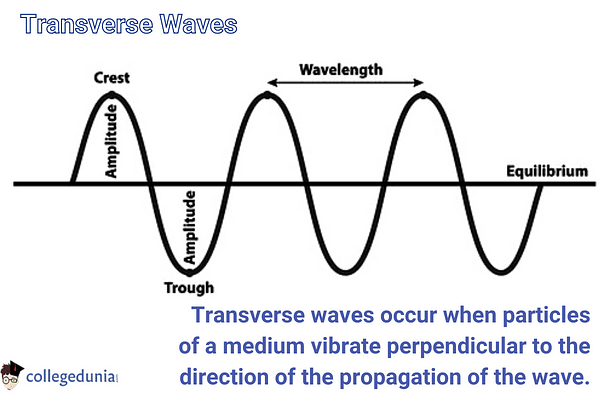
Transverse Waves Diagram
- Water waves are perfect examples for understanding Transverse waves.
- As we can see that the waves travel from left to right and the vibrations are in an upward and downward motion.
- The vertical vibrations are symmetrical around the centerline.
- The maximum distance the wave covers in a particular direction away from the wave is called Amplitude.
- The power of the wave is directly proportional to the square of the amplitude.
Speed of a Transverse Wave
Transverse waves are generally made up of peaks and troughs. The peak is known to be the top point of the wave, while trough is the bottom point of it.
Some of the very important terms to know here are:
- Amplitude – A particle’s maximum displacement from its equilibrium position.
- Wavelength – The distance covered from one peak to the next one, or one trough to the next trough.
- Period – Period is the time taken by two successive peaks to pass via a fixed point.
- Frequency – In a second, the number of wavelengths that pass via a given point.
The Speed of Transverse waves majorly depends on two factors:
- Wave
- What the Wave is travelling through
Reflection of Transverse Waves
The way by which a transverse wave can be seen to reflect depends on whether it is fixed at both ends.

Reflection of Transverse Waves
The image above exhibits a transverse wave reflected from a fixed end. When a transverse wave is seen to meet a fixed end, the wave is gets reflected back, yet in an inverted manner, thus replacing the peak with troughs and the troughs with peaks.
The image now shows a transverse wave on a string that further meets a free end. The wave, here, is reflected, not inverted, unlike a transverse wave that has a fixed end.

Reflection of Transverse Waves (Not inverted)
Frequently Asked Questions about Transverse WavesQues. What is the major difference between Transverse Waves and Longitudinal Waves? (2 marks) Ans. Transverse wave can be defined as a wave wherein the particles move perpendicular to the direction of the propagating wave. Whereas, a longitudinal wave can be defined as a wave where particles move in a direction that is parallel to the wave propagation. Ques. “Light is a transverse wave.” Justify the statement. (3 marks) Ans. Transverse waves are those waves where the particles oscillate perpendicular to the direction of the propagating wave. Light, too, is considered a wave wherein an electric field is seen to propagate in vacuum. Every electromagnetic wave, including light, is considered a transverse wave due to the fact that it vibrates energy in a direction that is perpendicular to the direction the wave is travelling. |
Also Read: Wave Optics
Characteristics of Transverse Waves
[Click Here for Sample Questions]
There are various characteristics of Transverse waves. Some of them include:
- In Transverse waves, particles of the medium vibrate perpendicular to the velocity of the wave. Vp ⊥ Vw
- When the transverse waves travel through a medium, it is divided into alternate Crests and Troughs.
- The length of the wave is a complete wave cycle or distance between two consecutive points is known as the Wavelength (λ).
- The time taken for one complete oscillation of a particle is called its Time Period (T)
- The number of complete oscillations of a particle in a second is called its Frequency (f)
- The speed of a transverse wave is dependent on the medium and the frequency it possesses.
- The speed of a wave on a string is determined by its wavelength and frequency.
- The propagation of transverse waves takes place only in Solid compounds and these waves are slow in nature.
- The speed of a wave of a vibrating string is proportional to the square root of the tension in the string and inversely proportional to the square root of the string's linear density.

- Wavelength and time period increase with a decrease in Velocity. They are inversely proportional.
- Wavelength and time periods are directly proportional to each other.
- Energy and velocity are directly proportional to each other.
- The index of refraction is inversely proportional to velocity and wavelength.
- When transverse waves in a string coincide or meet at one end, they are reflected.
- Interference in a string happens when the incident and reflected wave meet.
- Interference can be divided into two parts: Constructive (amplitude of the wave increases due to the amplitude of the wave reinforcing each other), and Destructive (amplitude of the wave decreases due to the waves repelling each other).
Read More:
| Important Concept Related Topics | ||
|---|---|---|
| Progressive Wave | Transverse and Longitudinal Waves | Intensity Formula |
| Waves MCQ | Gravity Waves | Laplace Correction |
| Sound Waves | Unit of Vibration | Pulse Amplitude Modulation |
Examples of Transverse Waves
[Click Here for Previous Year Questions]
Some of the practical examples of Transverse Waves include:
- Lightwaves: In these waves, particles travel at right angles to the direction of these waves. They are sometimes visible to the naked eyes and are responsible for our sense of sight.
- Guitar: When the guitar strings are plucked, they move in an upward and downward direction, thus forming a transverse wave.
- Earthquakes: When there is movement in the earth's crust due to tectonic plates, the waves that are formed are called Seismic Waves. These waves create a rolling effect while traveling on the surface of the earth and causing destruction depending on their magnitude.
- Tsunamis: These huge water waves start as Transverse waves underwater due to the earthquakes and are later converted to Longitudinal waves over the surface of the water creating huge water waves.
- X-Rays: These have shorter wavelengths in comparison to UV rays and are able to spot broken fractures and treat tumour cells. They are also used in scanning luggage, and astronomy for the study of open space, stars, and black holes.
Also Read: Oscillations
Transverse Waves Formula
[Click Here for Sample Questions]
There are several important formulas of Transverse Waves. Some of them are:
- Speed = Distance x Time
- Speed of a transverse Wave = Frequency (Hertz) x wavelength (meters)
V (meter per second) = f x λ, [here, c = 3x10⁸ m/sec] - Frequency = Cycles/Time
- Angular Frequency of a wave ( ω ) = 2 x \(\pi\) x f
Time period (T) - 1/f - Energy = Planck's constant x frequency, E = h x f, [here, Planck's constant= 6.626x10⁻³⁴ J/sec]
- Speed of a wave on a vibrating string: v= \(\sqrt{\frac {T}{\mu}}\)
- Speed of light in a different material (V) = Speed of light in a vacuum/ Index of refraction (V= c/n)
Index of refraction differs from medium to medium. For example, the most common index of refraction is of water, 1.3. - Constructive inference = d sin θ = mλ
for m = 0,1,-1,2,-2 - Destructive inference = d sin θ = (m+0.5)λ for m = 0,1,-1,2,-2
Solved Example of Transverse WavesQues. Assume that the distance between two troughs of water surface waves is 20 m. An object is seen to stay afloat on the water surface, causing it to experience the vibration motion. Considering that the time to travel one vibration is roughly around 4 seconds, determine the velocity of the wave. (3 marks) Ans. As per the given question, the following data can be found: Ques. Calculate the speed of a wave on a string. Ans. The velocity of a wave can be estimated by dividing the travelled distance by the time consumed to travel that distance. In the case of waves, it is calculated by dividing the wavelength by the period. Thus, \(v=\frac{\lambda }{T}\) We can consider the inverse proportionality to the period and frequency. After applying, \(v=\frac{\lambda }{T}\) ⇒ \(\begin{array}{l}v=\lambda \frac{1}{T}\end{array}\) ⇒ \(\begin{array}{l}v=\lambda\,f\end{array}\) Speed of a Wave on a Vibrating String Musical instruments, like a guitar, are seen to use vibrating strings to generate music. The speed of a wave here is proportional to the square root of the tension in the string, while it is inversely proportional to the square root of the linear density of the string. It can further be showed as: ⇒\(\begin{array}{l}v=\sqrt{\frac{T}{\mu}}\end{array}\) |
Also Read:
Previous Year Questions
- For a plane electromagnetic wave propagating in x-direction … [NEET 2021]
- The magnetic field in a travelling electromagnetic wave has a peak value … [VITEEE 2018]
- For sky wave propagation of 10 MHz signal … [JCECE 2007]
- A hollow cylinder with both sides open generates a frequency f in air … [WBJEE 2008]
- If the amplitude of sound is doubled and the frequency reduced to one fourth … [NEET 1989]
- A wave travelling along a string is described by the equation … [MHT CET 2008]
- In a hall, a person receives direct sound waves from a source … [BHU UET]
- Which of the following electromagnetic radiations have the longest wavelength … [NEET 1989]
- 4.0 g of a gas occupies 22.4 litres at NTP … [NEET 2015]
- A standing wave having 3 nodes and 2 antinodes … [NEET 1998]
- A vehicle, with a horn of frequency n is moving with a velocity … [NEET 1998]
- With the propogation of a longitudinal wave through a material medium … [NEET 1992]
- The frequency of sinusoidal wave y … [NEET 1992]
- For production of beats the two sources must have … [NEET 1992]
- A siren emitting a sound of frequency 800 Hz … [NEET 2016]
- A tuning fork of frequency 512 Hz … [NEET 2010]
Things to Remember
- Transverse waves move in an upward-downward motion.
- The oscillation of the wave is perpendicular to the propagation of the wave.
- Energy transportation is from left to right.
- The highest part of the wave is a trough and the lowest part is the crest.
- Transverse waves can only propagate in solids.
- They travel slower than longitudinal waves.
Sample Questions
Ques. What is a node in a wave? (1 Mark)
Ques. The velocity of sound in a tube containing air at 27°C and a pressure of 76 cm of mercury is 330 ms-1. What will be the velocity of sound when pressure is increased to 100 cm of mercury and the temperature is kept constant? (1 Mark)
Ans. At a given temperature, the velocity of sound in a gas is independent of pressure. Hence the velocity of sound in the tube will remain 330 ms-1.
Ques. Why is Frequency the most fundamental property of waves? (1 Mark)
Ans. When a wave passes through a medium, velocity and wavelength change but the frequency does not change.
Ques. What is node in waves? (1 mark)
Ans. Considering a standing wave, a node can be defined as a point where the amplitude is 0, causing it to be stable at that point.
Ques. What is a Transverse Wave? (1 mark)
Ans. Transverse waves occur when the particles of a medium vibrate perpendicular to the direction of the propagation of the wave.
Ques. Cite two characteristics of Transverse Waves. (2 marks)
Ans. Two major characteristics of Transverse waves are:
- Particles, in transverse waves, of the medium vibrate perpendicular to the velocity of the wave. Vp ⊥ Vw
- When the transverse waves travel through a medium, it is divided into alternate Crests and Troughs.
Ques. How is energy transmitted in wave motion? (2 Marks)
Ans. The adjacent oscillating parts of the medium are bounded together through elastic forces. When a wave is in motion, a part of it is set into oscillation and this momentum is transmitted to the other part of the medium and so on. Thus, energy is transmitted in a wave motion.
Ques. Can transverse waves be produced in the air? (2 Marks)
Ans. No. Transverse waves travel in the form of crests and troughs. This changes the shape of the wave and it has elasticity. As air or gaseous state has no elasticity of shape, there will be no formation of transverse waves.
Ques. A hospital uses an ultrasonic scanner to locate tumours in a tissue. What is the wavelength of sound in the tissue in which the speed of sound is 1.7 km? The operating frequency of the scanner is 4.2 MHz. (3 Marks)
Ans. Speed of sound, v=1.7 km/s= 1.7x10³ m/s
Frequency of the scanner, V=4.2 MHz= 4.2x10⁶ Hz
Wavelength \(\frac{1.7 \times 10^3}{4.2 \times 10^5}\) = 4.1 x 10⁻⁴ m
Ques. If string wires of the same material of length l and 2l vibrate with frequencies 100HZ and 150 HZ. Find the ratio of their frequencies? (4 Marks)
Ans. Frequency of vibrating string = f
Tension in the string= T
\(f = \frac{1}{2l}\sqrt{\frac{T}{M}}\)
Let for first case, f1 = 100HZ ; l1 = l ; T1 = Initial Tension
For second case, f2 = 150HZ ; l2 = 2l ; T2 = Final Tension
\(f_1 =\frac{1}{2l_1}\sqrt{\frac{T_1}{m}}\)
\(100 = \frac{1}{2l}\sqrt{\frac{T_2}{m}}\) → (1)
and \(f_2 = \frac{1}{2l_2}\sqrt{\frac{T_2}{m}}\)
\(150 = \frac{1}{2_1 l} \sqrt{\frac{T_2}{m}} \) → (2)
Dividing equation 1 by 2,
\(\frac{100}{150} = \frac{\frac{1}{2l}\sqrt{\frac{T_1}{m}}}{\frac{1}{4l}\sqrt{\frac{T_2}{m}}}\)
\(\frac{1}{3} = \sqrt{\frac{T_1}{T_2}}\) → Squaring both sides
or \(\frac{1}{9} = \frac{T_1}{T_2}\)
Hence, The ratio of tension is 1:9.
Read More:



Comments