



Content Curator
Tyrannosaurus Rex known as T Rex is a genus of large theropod dinosaurs. This species had a huge body, and very sharp teeth with jaws that were enough to crush metal material like cars, and bikes.
| Table of Content |
Key Terms: Tyrannosaurus, Species, Carnivorous, Fossils, Extinct, Dinosaur, Scientific Names
What Is T Rex?
[Click Here for Sample Questions]
The Tyrannosaurus Rex represented T Rex as the most ferocious and dangerous animal on earth. The dangerous carnivorous species that lived on earth around 68 million years back were found in western North America near forested river valleys of the place.
The size of T Rex was about 40 feet and weight around eight tons, with a powerful body species was enough to rule.

Tyrannosaurus Rex
Scientific Name Of T Rex
[Click Here for Sample Questions]
The scientific name of T rex is Tyrannosaurus Rex. Tyrannosaurus means tyrant lizard and rex means king. The T-Rex is a prehistoric animal whose height is 40 feet long and 12 feet long. T Rex was a carnivorous species. It is one of a few organisms that is known by its scientific name.
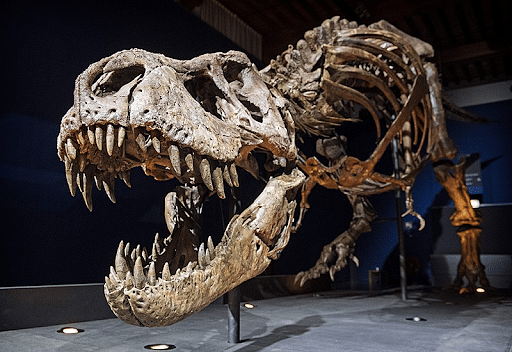
Fossil Of T Rex
Also Check:
| Content Related To T-Rex | ||
|---|---|---|
| Extinction | What are Fossils? | Types of Fossils |
Physical Appearance Of T Rex
[Click Here for Sample Questions]
T-Rex had a very strong appearance specified below:
Dentition And Skull
The T-Rex has thick skull bones braced to one another. The tyrannosaur resists the biting forces from others. The longest skull of the tyrannosaur known to mankind is 4 feet long which is 1.3 meters.
The T-Rex had 60 teeth which were 6 feet long. The front teeth are small and U-shaped and the side teeth are larger in size. And in adult tyrannosaurs, the side teeth are cross-section and D shaped.
Tails And Legs
The tyrannosaur had a unique tail structure. The tail was an extension to the leg muscles and provided support to the legs. The tyrannosaur had a faster gait and longer stride, and the structure of the tail and leg made them an expert in terms of speed and agility.
Arms
The T-Rex has tiny perplexing arms. The tiny arms were muscular and powerful. The two-finger had large menacing claws. The research says that T-Rex suffered from stress fractures.
Types Of T Rex
[Click Here for Sample Questions]
The types of T-Rex are:
- Lynthronax Argestes
- Teratophoneus Curriei
- Nanotyranosaurus Lancensis
- Nanuqsaurus Hoglundi
- Yutyrannus Huali
- Tarbosaurus Bataar
- Tyrannosaurus Rex
- Bistahieversor Sealeyi
- Daspletosaurus Torosus
Also Check:
| Chapter Related Topic | ||
|---|---|---|
| Living Fossil | Biological Evolution and Evidence Paleontology Anatomy Embryology | Paleontology |
Things To Remember
- T Rex is a genus of large theropod dinosaurs.
- The most ferocious and dangerous animal on earth.
- T Rex was a carnivorous species.
- The longest skull of the tyrannosaur known to mankind is 4 feet long which is 1.3 meters.
- T-Rex suffered from stress fractures.
Sample Questions
Ques. What is the scientific name of T-Rex? (1 Marks)
Ans. The scientific name of T rex is Tyrannosaurus Rex. Tyrannosaurus means tyrant lizard and rex means king. The T-Rex is a prehistoric animal whose height is 40 feet long and 12 feet long. T Rex was a carnivorous species. It is one of a few organisms that is known by its scientific name.
Ques. What is T-Rex? (2 Marks)
Ans. The Tyrannosaurus Rex represented T Rex as the most ferocious and dangerous animal on earth. The dangerous carnivorous species that lived on earth around 68 million years back were found in western North America near forested river valleys of the place. Tyrannosaurus Rex known as T Rex is a genus of large theropod dinosaurs. This species had a huge body, and very sharp teeth with jaws that were enough to crush metal material like cars, and bikes.
The size of T Rex was about 40 feet and weight around eight tons, with a powerful body species was enough to rule.
Ques. What is the physical appearance of the T-Rex? (4 Marks)
Ans. T-Rex had a very strong appearance specified below:
Dentition And Skull: The T-Rex has thick skull bones braced to one another. The tyrannosaur resists the biting forces from others. The longest skull of the tyrannosaur known to mankind is 4 feet long which is 1.3 meters.
The T-Rex had 60 teeth which were 6 feet long. The front teeth are small and U-shaped and the side teeth are larger in size. And in adult tyrannosaurs, the side teeth are cross-section and D shaped.
Tails And Legs: The tyrannosaur had a unique tail structure. The tail was an extension to the leg muscles and provided support to the legs. The tyrannosaur had a faster gait and longer stride, and the structure of the tail and leg made them an expert in terms of speed and agility.
Arms: The T-Rex has tiny perplexing arms. The tiny arms were muscular and powerful. The two-finger had large menacing claws. The research says that T-Rex suffered from stress fractures.
Ques. List five types of T-Rex. (2 Marks)
Ans. The types of T-Rex are:
- Lynthronax Argestes
- Teratophoneus Curriei
- Nanotyranosaurus Lancensis
- Nanuqsaurus Hoglundi
- Yutyrannus Huali
Ques. Did T-Rex live in the Jurassic period? (1 Mark)
Ans. T.rex did not live in the Jurassic Period. The period of T-Rex was the late Cretaceous Period around 85 – 65 million years ago.
Ques. What makes the arms of T-Rex different from others? (1 Mark)
Ans. The T-Rex has tiny perplexing arms. The tiny arms were muscular and powerful. The two-finger had large menacing claws. The research says that T-Rex suffered from stress fractures.
Ques. What was the speciality in the teeth of T-Rex? (2 Marks)
Ans. The teeth of the T-Rex were similar to the steak knife. Observation of scientists says that tooth tissue, which seems damaged to them was the impact of grab and tear feeding. Later, it turned out to be an internal fold. The tissues in each tooth were arranged in an order which improved their efficiency and function.
Ques. State the population of T-Rex? (2 Marks)
Ans. According to an estimation the population of adult Tyrannosaurs might have been 20 thousand individuals at any given time. Whereas, the estimations even say, that the numbers have never been less than 1300 but never increased 328000.
Ques. When was the first skeleton of the T-Rex was formed? (1 Marks)
Ans. The first skeleton of a tyrannosaur popularly known as the T-Rex was found in 1900 in Wyoming and was discovered by Barnum Brown.
Also Check:



Comments