



Content Curator
Sequence and Series formulas include the many types of sequence and series in math. Sequence and Series is the arrangement of numbers in a particular order and sum of the elements in the sequence.
- A series is the expansion of the multitude of terms of a sequence.
- Sequences and series are like sets, and the difference between them is that in a sequence, terms can occur multiple times in different positions.
- The length of a sequence is similar to the number of terms, which can be either limited or endless.
- The formula for a sequence and series is a way to find the nth term or the sum of the nth term in sequence and series.
Read More: Geometric Progression
Key Terms: Sequence, Series, Numbers, Arithmetic progression, Geometric Progression, Fibonacci Sequence
Sequence and Series Definition
[Click Here for Sample Questions]
A series is the total of all elements, whereas a sequence is an ordered group of elements in which repetitions of any kind are permitted. One example of a series or a sequence is an arithmetic progression.
- A sequence can be defined as an arrangement of objects or a set of numbers in a specific order followed by some rule.
- If a1, a2, a3, a4,… represent the terms of a sequence, then 1,2,3,4,…..will represent the position of the term.
- A sequence depends on the number of terms, which means it is either finite sequence or infinite sequence.
- In case a1, a2, a3, a4,… is a sequence, then the corresponding series can be denoted by:
| Sn = a1 + a2 + a3+ ……..+ an |
Note: The series is finite or infinite based on whether the sequence is finite or infinite.
The video below explains this:
Sequence and Series Detailed Video Explanation:
Read more:
Types of Sequence and Series
[Click Here for Previous Year Questions]
The many types of Sequence and Series include:
- Arithmetic Sequences
- Geometric Sequence
- Fibonacci Sequence
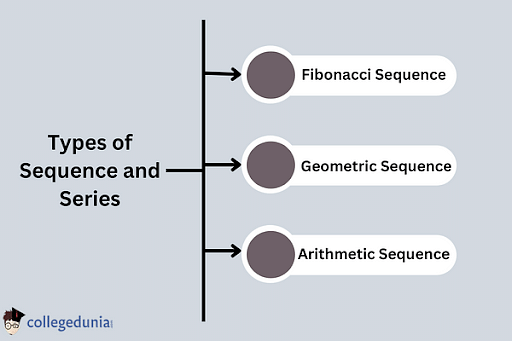
Sequence and Series Types
Arithmetic Sequence
Arithmetic Sequences are sequences wherein the difference between each progressive term is consistent.
This means that going further up in the sequence, the numbers continue to increase by a constant value. If we need to create the next number, we just add this constant value again to the last number of the grouping and get another number to expand the succession.
Example: 3, 6, 9, 12, 15, 18, 21…
Here, the difference between the two progressive terms is 3.
In the above example, we can see that a1 =3 and a2 = 6. The difference between the two progressive terms is
- a2 - a1 = 3
- a3 - a2 = 3
In a sequence, the first term is a1 and the normal difference is "d", the nth term of the grouping is given by:
an= a1+(n−1) d
| Ques: Find the common difference for the following AP: 10, 20, 30, 40, 50. Ans: Given AP: 10, 20, 30, 40, 50 Common difference: d = 20 – 10 = 10 d = 30 – 20 = 10 d = 40 – 30 = 10 d = 50 – 40 = 10. Hence, the common difference for the sequence, 10, 20, 30, 40, 50 is 10. |
Geometric Sequences
A sequence wherein each progressive term has a constant ratio between them is called Geometric Sequence.
The constant ratio tells that between every two quantities of the geometric sequence, there is a constant number, which is multiplied by the last number of the sequence to get the following number.
Example:
- 1, 4, 16, 64…
Here,
- a1 =1
- a2 = 4 = a1(4)
- a3 = 16 = a2(4)
Here, we are multiplying it by 4 every time to get the following term. The ratio here is 4.
The ratio is meant by "r".
a = an-1⋅r or
or, a = a1⋅rn-1
or, an=an-1×r
Using the above formula, we can decide quite a few in any given mathematical grouping.
Solved ExampleQues: Find the sum of geometric series if a = 3, r = 0.5 and n = 5. Ans: Given: a = 3; r = 0.5; n = 5 sn = a(1-rn)/1-r The sum of five terms is given by S5= 3(1-(0.5)5)/1 - 0.5 = 5.8125 |
Fibonacci Sequence
The Fibonacci succession is named after Leonardo Fibonacci, an eminent Italian mathematician. The Fibonacci sequence is a form of series in which each number is the sum of the two numbers that come before it.
The Fibonacci sequence is well-known since a similar example can be seen in many natural wonders such as flower petals, egg states, and so on.
- Fibonacci sequence is used to determine the golden ratio, which is significant in design and photography.
- The golden ratio is the ratio of any two Fibonacci sequence numbers.
- The golden ratio inspires the rule of thirds in photography and visual communication.
Example:
- 0, 1, 1, 2, 3, 5, 8, 13, 21, 34, 54, 88, 142 …
In the above grouping, we can see
- a1 =0, a2 = 1
- a3 = a2 + a1 = 0 + 1 =1
- a4 = a3 + a2 = 1 + 1 =2, etc.
Thus, the Fibonacci Sequence formula is
a = an-2 + an-1, n > 2
This is called the Recursive Formula.This equation can be used to calculate different Fibonacci Sequence.
Sequence and Series Formulas
[Click Here for Sample Questions]
The general basic formulas regarding sequence and series are listed below:
| Type | Arithmetic Progression | Geometric Progression |
|---|---|---|
| Sequence | a, a+d, a+2d,……,a+(n-1)d, | a, ar, ar2,….,ar(n-1) |
| Common Difference or Ratio | Successive term – Preceding term Common difference = d = a2 – a1 | Successive term/Preceding term Common ratio r = ar(n-1)/ar(n-2) |
| General Term (nth Term) | an = a + (n-1)d | an = ar(n-1) |
| nth term from the last term | an = l – (n-1)d | an = l/r(n-1) |
| Sum of first n terms | sn = n/2(2a + (n-1)d) | sn = a(1 – rn)/(1 – r) if |r| < 1 sn = a(rn -1)/(r – 1) if |r| > 1 |
Difference Between Sequences and Series
[Click Here for Previous Year Questions]
The differences between Sequence and Series include:
| Sequence | Series |
|---|---|
| A collection of elements with a pattern | Sum of elements of the sequence |
| Order of elements is important | Order of elements is not so important |
| Finite sequence: 10,15,20,25,35 | Finite series: 10+15+20+25+30 |
| Infinite sequence: 11,22,33,44,…… | Infinite Series: 11+22+33+44+…… |
Mean of Sequence and Series
[Click Here for Sample Questions]
Below is an explanation of how we can calculate the mean of different types of sequences and series.
Arithmetic Mean
The Arithmetic mean is normal for two numbers. Two numbers n and m, we can include a number in the middle of these numbers so the three numbers form a math succession, similar to n, A, m.
All things considered, the number A is the arithmetic mean of the numbers n and m.
Arithmetic Mean can be used to compute the central tendency or the surmised focus point of an arithmetic sequence.
The arithmetic mean for an arithmetic sequence can be estimated using the formula.
A = (n+m)/2
Geometric Mean
Geometric Mean is the normal of two numbers in a mathematical grouping. In the event that p and q are the two quantities of the grouping, the mathematical mean will be
GM=√pq
Geometric mean, like arithmetic mean, is used to work out the central tendency or the estimated mid component of some random geometric sequence.
Harmonic Mean
By the harmonic mean definition, the harmonic mean is the reciprocal of the arithmetic mean
Harmonic Mean(H) = n/[(1/x1)+(1/x2)+(1/x3)......(1/xn)]
Where n is the total number of terms and
x1, x2, x3,…, xn are the values up to nth terms.
Read More:
Things To Remember
- Let a1, a2, a3, ... be the series, then the total shown by a1 + a2 + a3 + ... is called series. A series is called limited series if it has a limited number of terms.
- An A.P is a series where terms increase or decrease by a difference. This increase or decrease is called the common difference of the A.P.
- A succession is supposed to be a G.P. if the ratio term to its former term is the same all through.
- The mathematical sequence can generally be represented as a, a+d, a+2d, a+3d,...
- In a geometric progression, each succeeding term is obtained by multiplying the previous term by the common ratio.
- an = arn-1 is the formula for the nth term of a geometric progression with a first term and a common ratio of r.
- Sn = a/(1-r) is the formula for the infinite GP's sum, where |r|<1.
Previous Year Questions
- If g1, g2 are two geometric means and a1is the arithmetic mean…
- For a sequence, {an}, a1 = 2 and…
- If the first and the (2n - 1)th term of an AP, GP, and HP… (JEE Advanced - 1988)
- Let a1, a2, a3, ...........be the sequence, then the sum expressed…
- If the sum of the first ten terms of the series… (JEE Main - 2016)
- The coefficient of x3 in the infinite series expansion of… (WBJEE - 2014)
- If m is a root of the equation (1 - ab)...
- In a G.P. of an even number of terms, the sum of all terms…
- In a geometric progression consisting of positive terms, each term… (AIEEE - 2007)
- The sum of the first 10 terms of a G.P. is equal to 244 times…
Sample Questions
Ques: What is one difference Between Sequence and Series Formulas? (1 mark)
Ans: The sequence formulas would advise how to track down the nth term of a sequence while the series equations would let us know how to track down the total (series) of a succession.
Ques: What is Geometric Mean? (1 mark)
Ans: Geometric Mean can be defined as the normal of two numbers in a mathematical grouping. In case p and q are the two quantities of the grouping, the mathematical mean is going to be: GM = √pq.
Ques: What is the Sum of a Harmonic Series Using Sequences and Series Formulas? (1 mark)
Ans: For a consonant grouping 1/a, 1/(a+d), 1/(a+2d), 1/(a+3d), 1/(a+4d), ...., the amount of its first 'n' terms can be tracked by using the equation Sn = 1/d , [ (2a + (2n - 1) d]/(2a - d) ].
Ques: In the problem that 1, 3, 5, 7, 9… … is a succession, Find Common difference, nth term, 21st term. (3 marks)
Ans: Given succession is, 1, 3, 5, 7, 9… …
- a) Common difference = 3 - 1 = 2
- b) The nth term of the arithmetic series is given by the term Tn and is given by Tn = a + (n-1)*d,
- c) 21st term as: T21= 1 + (21-1)2 = 1+40 = 41.
Ques: What will be the sixth number of the succession assuming the fifth term is 12 and the seventh term is 24? (2 marks)
Ans: As the two numbers are given, the sixth number will be the math mean of the two given numbers.
AM = 12 + 24/2
= 36/2
= 18
Thus, the sixth term will be 18.
Ques: Find the mathematical mean of 2 and 18. (2 marks)
Ans: Formula to work out the mathematical mean.
p = 2 , q = 18
GM = √pq
= √(2×18)
= √36
= √6
Ques: What is the 9th term of the mathematical succession, 3, 6, 12, 24, ...? (2 marks)
Ans: Given the first term is 3.
Normal ration=6/3=2
9th term a9=ar8=3x28
=3x256
=768.
Ques: What is the sum of the first ten terms of the mathematical succession 5, 15, 45, ...? (2 marks)
Ans: From a given series, we can see that the first term is 5.
Normal ratio= 3
Equation to find amount of n terms = a1(rn-1)/r-1
=5(310-1)/3-1
=(5*59048)/2
=147620
Ques: Track down the 10th and nth terms of the G.P. 5, 25,125,.... (2 marks)
Ans: Here a = 5 ,r = 5. In this way, a10 = 5(5)10-1 = 5(5)9 = 510
, a = arn-1 = 5(5)n-1 = 5n .
Ques: Which term of the G.P., 2,8,32, ... up to n terms is 131072? (2 marks)
Ans: Let 131072 be the nth term of the given G.P. Here a = 2 , r = 4.
131072 = a = 2(4)n-1 or 65536 = 4n - 1
This gives 48 = 4n - 1.
So n-1 = 8, i.e., n = 9. Consequently, 131072 is the ninth term of the G.P.
Ques: Find the sum of all odd integers from 1 to 1001. (3 marks)
Ans: We get the first term a = 1, common difference d = 2 and last term l = 1001
Let n odd numbers be there from 1 to 1001. Then,
Tn = a + (n -1)d = 1 + (n – 1) 2 = 1001
⇒ -1 + 2n = 1001
⇒ 2n = 1002
⇒ n = 501
Therefore, sum of 501 terms is
S501 = 501/2[1 + 1001] = 251001
Check-Out:



Comments