



Education Journalist | Study Abroad Lead
Geometric Distribution model is used to show the probability of achieving success after N number of failures. This distribution is a set of probabilities that presents the chance of success after zero failures, one failure, two failures and so on. The geometric distribution in a sequence of independent trials with the same chance of success p, the probability that the first success will occur at the kth trial is. The geometric distribution can be defined as a probability distribution of the number X of Bernoulli trials needed to get one success, supported on the set {1, 2, 3, ...}. The geometric distribution is typically used to model the number of failures before the first success, but it has other applications as well. The geometric distribution is a discrete probability distribution that shows the probability of success in a sequence of Bernoulli trials. You can check the geometric distribution when you have an equal chance of success or failure at each trial and when the number of successes or failures is not fixed.
| Table of Content |
Key Terms: Geometric Distribution, Mean, Variance, Standard Deviation, Probability, Probability Distribution, Bernoulli Trials, Trials, Events, Probability Mass Function, Cumulative Distribution Function
Definition of Geometric Distribution
[Click Here for Sample Questions]
The geometric distribution is one of the probability distributions that have a role in predicting the outcomes of continuous events. The geometric distribution looks back over a sequence of Bernoulli trials to see how long it takes to get a single success.
The Geometric Distribution is one of the most important discrete distributions as it is used in many places to calculate problems of probability. In a geometric distribution, X is the number of Bernoulli trials required to get one success.
A geometric distribution is a discrete probability distribution of a random variable “x”, and has the following conditions:
- a phenomenon that has a series of trials,
- each trial has only two possible outcomes – either success or failure and
- probability of success is the same for each trial
Read More: Types of Events in Probability
Geometric Distribution Formula
[Click Here for Sample Questions]
The geometric distribution is that probability distribution that calculates the probability of first success after k number of trials. Using the geometric formula, we can also find out the probability of getting x success in k trials.
A geometric distribution can be calculated by both the probability mass function (pmf) and the cumulative distribution function (CDF).

Geometric Distribution Formula
Elaborated below are the formulas for the pmf and CDF of a geometric distribution.
-
Geometric Distribution PMF
The probability mass function (pmf) can be described as the probability that a discrete random variable X will be exactly equal to some value x. The geometric distribution pmf formula is as follows:
P(X = x) = (1 - p)x - 1p
where, 0 < p ≤ 1
-
Geometric Distribution CDF
The cumulative distribution function of a random variable X, which is evaluated at a point x, can be described as the probability that X will take a value that is lesser than or equal to x. Geometric Distribution CDF is also known as the distribution function. The geometric distribution CDF formula is as follows:
P(X ≤ x) = 1 - (1 - p)x
Read More: Uniform Distribution
Mean of Geometric Distribution
[Click Here for Sample Questions]
The mean of geometric distribution is considered to be the expected value of the geometric distribution. It can be defined as the weighted average of all values of random variable X. The mean of a geometric distribution can be calculated using the formula:
E[X] = 1 / p
Read More: Geometric Mean Formula
Variance of Geometric Distribution
[Click Here for Sample Questions]
Variance refers to the measure of dispersion that checks how far the data in a given distribution is spread out with respect to the mean of the data. The variance of a geometric distribution is calculated using the formula:
Var[X] = (1 - p) / p2
Standard Deviation of Geometric Distribution
[Click Here for Sample Questions]
As we know, the standard deviation is defined as the square root of the variance. The standard deviation provides us with the deviation of the distribution with respect to the mean. The standard deviation of a geometric distribution can be calculated using the formula which is as follows:
S.D. = \(\sqrt{V ar[X]}\)
S.D. = \(\frac{\sqrt{1-p}}{p}\)
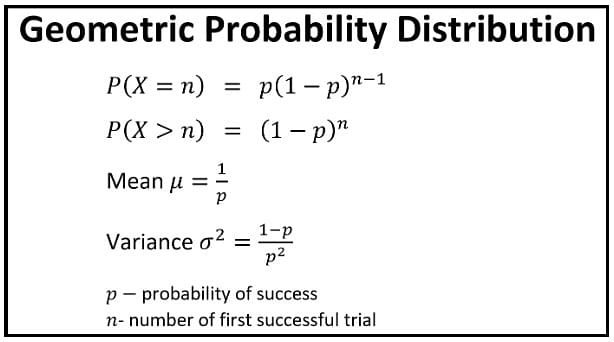
Geometric Probability Distribution
Read More: Difference Between Variance and Standard Deviation
Applications of Geometric Distribution
[Click Here for Sample Questions]
- Geometric distribution has a wide range of applications in real life. The geometric distribution can be applied on an intuitive level in our daily lives, regularly. We all have been there when we are trying to reach our destination and all the traffic lights are red. The geometric distribution can help us find the probability of getting to the green light before reaching the destination.
- Geometric distribution can help find the probability of how many red lights are needed to get to a green light before reaching a destination
- In real-world applications, the geometric distribution is used to examine the possibility of success given a limited number of trials, where the probability of success is small. Some examples are identifying an infected person who caused an epidemic in a ward containing 100 patients or estimating the mean number of coin flips required to obtain heads for the first time.
- The geometric distribution is an important statistical concept that is applied in various fields such as baseball, time management, and cost-benefit analysis.
- The geometric distribution is used to model things like the probability of flipping a coin until you get heads or the probability of throwing a die until you get a six. It can also be used to model the probability of birth control working per month.
Read More: Mean and Variance of Random Variable
Properties of Geometric Distribution
[Click Here for Sample Questions]
The geometric distribution is basically a discrete probability distribution and this distribution help to determine the number of trials before getting the first success. The mean, mode and variance are the three values that are generally used for geometric distribution whereas the median is not generally determined.
- A geometric distribution is a discrete probability distribution that shows the probability of a certain number of events with a certain probability before another event occurs.
- The mean of geometric distribution shows the expected value of the distribution
- The mode is the highest occurrence for a given set of data.
- Generally, mean, mode and variance are used for geometric distribution whereas the median is not computed.
- The expected value of the geometric distribution is the number of trials needed to get success. For example, if the odds of “success” are 1:3, the average number of trials is 3. Another way to think about this is that we would expect to see the desired outcome one out of every three times.
- The geometric distribution also known as the negative binomial distribution is a discrete probability distribution. It's most commonly associated with the number of trials required to get the first success in a sequence of Bernoulli trials.
Read More: Coefficient of Variation Formula
Things to Remember
[Click Here for Sample Questions]
- We can define the geometric distribution as a discrete probability distribution of a random variable x which satisfies some of the conditions.
- The geometric distribution conditions are - A phenomenon that has a series of trials, Each trial has only two possible outcomes - either success or failure and the probability of success is taken to be the same for each trial.
- In a series of trials, if you assume that the probability of either success or failure of a random variable in each trial is the same, geometric distribution gives the probability of achieving success after N number of failures.
- The geometric distribution, in essence, is a set of probabilities that present the chance of success after the ‘n’ number of failures.
- An example of this can be flipping a coin 5 times and considering, “the number of failures before we get heads” as our random variable X and 4 as the number of tails we get before we land on heads
Sample Questions
Ques. Calculate the probability density of geometric distribution if the value of p is 0.42; x = 1,2,3,…….., also find out the mean and variance. (3 Marks)
Ans. Given that, p = 0.42 and the value of x is 1,2,3,……………
Formula for the probability density of geometric distribution function,
P(x) = p(1−p)x−1; x = 1,2,3,…
P(x) = 0; otherwise
P(x) = 0.42(1−0.42)x−1
P(x) = 0 otherwise
Mean = 1/p= 1/ 0.42= 2.380
Variance = 1−p/p2
Variance = 1−0.42/(0.422)2
Variance = 3.288
Ques. If a patient is waiting for a suitable blood donor and the probability that the selected donor will be a match is 0.2, then calculate what will be the expected number of donors who will be tested until a match is found including the matched donor. (3 Marks)
Ans. As we are looking for only one success this is a geometric distribution.
p = 0.2
E[X] = 1 / p = 1 / 0.2 = 5
Thus, the expected number of donors who will be tested until a match is found is 5 (inclusive of the donor).
Ques. Suppose you are playing a game of darts. The probability of success is 0.4. Calculate what will be the probability that you will hit the bullseye on the third try? (3 Marks)
Ans. We are looking for the first success, thus, geometric distribution has to be used.
p = 0.4
P(X = x) = (1 - p)x−1p
P(X = 3) = (1 - 0.4)3-1(0.4)
P(X = 3) = (0.6)2(0.4) = 0.144
Probability (you will hit the bullseye on the third try)= 0.144
Ques. A light bulb manufacturing factory finds 3 in every 60 light bulbs defective. Calculate what will be the probability that the first defective light bulb with be found when the 6th one is tested? (3 Marks)
Ans. As the probability of the first defective light bulb needs to be determined hence, this is a geometric distribution.
p = 3 / 60 = 0.05
P(X = x) = (1 - p)x−1p
P(X = 6) = (1 - 0.05)6-1(0.05)
P(X = 6) = (0.95)5(0.05)
P(X = 6) = 0.0386
Probability (first defective light bulb is found on the 6th trial) is 0.0368.
Ques. If the probability of breaking the pot in the pool is 0.4, find the number of breaks before success and the corresponding variance and standard deviation. (3 Marks)
Ans. Here, X ∼ geo(0.4)
Hence, e(x) = 1/0.4 = 2.5
Here, We can expect to pot off the break after 2.5 goes.
Var (x) = 0.6/0.4²= 3.75
Hence, standard deviation ( σ) = 1.94
Ques. Which of the following statements is not true about the geometric distribution?
1)Trails should be fixed
2)The probability of success should be 0.5
3)Events should be independent
4)Their distributions are approximately symmetric. (3 Marks)
Ans. Events should be independent
Geometric distribution describes a sequence of independent and identically distributed Bernoulli trials before the first success.
Ques. Matthew is a high school basketball player and a 75% free throw shooter. Calculate what will be the probability that Matthew makes his first free throw on his fifth shot? (3 Marks)
Ans. The distribution we are working with is a geometric distribution with a success probability of 0.75, or X~G(0.75).
Using the probability formula:
P(X=5)=(1−0.75)5-1(0.75)=(0.25)4(0.75)=0.00293≈0.003
The probability that the first success is on the third trial is approximately 0.003.
Ques. A ball has been thrown at a circular bin in such a manner that it will land randomly over the area of the bin. Find the probability that it lands closer to the centre than to the edge? (3 Marks)
a) 51%
b) 25%
c) 72%
d) 34%
Ans. 25%
The set of outcomes is all of the points on the bin, which make up an area of where is the radius of the circle. The points which are closer to the centre than to the edge are those that lie within the circle of radius around the centre. Hence, the area of the successful outcomes is π(r/2)2 = πr2/4. Thus, P(closer to center than edge)=(area of the desired outcome)/(area of the total outcome) = πr2/4 /πr2 = 1/4 = 0.25 = 25%.
Also Read:



Comments