



Content Curator
A simple pendulum is a system that consists of a small mass (known as the bob) that is attached to a light inextensible string and suspended from a fixed support.
- When the bob is displaced from its equilibrium position and released, it will oscillate back and forth around that position due to the force of gravity.
- The length of a simple pendulum, denoted by L, refers to the vertical distance from the point of suspension to the center of mass of the suspended body when it is in its mean position.
- This type of pendulum operates on a resonant system that has a single resonant frequency.
Key Terms: Oscillations, Simple Harmonic Motion, Simple Pendulum, Time Period, Potential energy, Physical pendulum
Simple Pendulum Definition
[Click Here for Sample Questions]
A simple pendulum is a system of a weight known as bob suspended from a fixed point with a light inextensible string so that it can swing freely.
- When the bob of a simple pendulum is displaced sideways from its equilibrium point, a restoring force develops due to gravity that will accelerate the bob back toward the equilibrium point.
- The restoring force acting on the bob of the pendulum causes it to oscillate about the equilibrium point, swinging back and forth.
- The time taken by the bob to complete one cycle, a left swing, and a right swing, is called the time period of the simple pendulum.
- The time period depends on the length of the pendulum.

Simple Pendulum
Important Terms Related To Simple Pendulum
[Click Here for Sample Questions]
Some important terms related to simple pendulum are
- The Oscillatory motion of a Simple Pendulum: It refers to a repetitive back-and-forth motion around a central point or position. In this type of motion, the object or system oscillates or vibrates about an equilibrium position, moving back and forth in a regular pattern.
- Time Period of a Simple Pendulum: The time period of a pendulum refers to the time it takes for the pendulum to complete one full oscillation, and it is denoted by the symbol 'T'.
- The amplitude of a Simple Pendulum: The amplitude of a pendulum refers to the maximum displacement of the pendulum from its equilibrium position, and it is usually measured in meters.
- Length of a Simple Pendulum: The length of a pendulum is the distance between the pivot point and the center of mass of the pendulum, and it is also usually measured in meters.
Time Period of Simple Pendulum
[Click Here for Sample Questions]
The time period of a simple pendulum is the time taken for the pendulum to complete one full oscillation, which includes the motion from its maximum displacement on one side to the maximum displacement on the other side and back to the starting point. It is denoted by T.
To calculate the time period of a simple pendulum following assumptions are taken into consideration:
- There is negligible friction from the surroundings.
- The arms of the pendulum do not bend or compress and are massless.
- The pendulum moves along a straight plane without any deviation, and the gravitational force acting on it remains constant.
Derivation of Time Period of Simple Pendulum
[Click Here for Sample Questions]
Consider a simple pendulum. A bob of mass m is tied to an inextensible massless string of length L. The other end of the string is fixed on the ceiling with support.
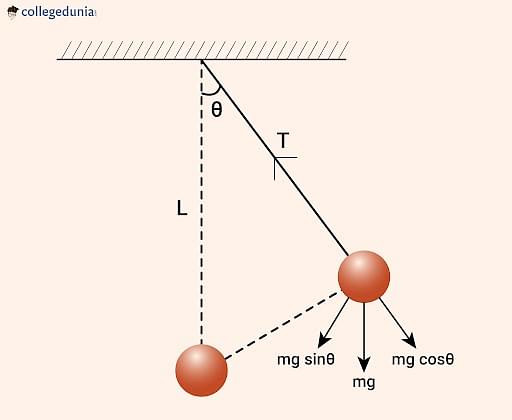
Simple pendulum
Let θ be the angle at which the string makes the vertical. The various forces acting on the bob are
- The tension T along the string, and
- The vertical force due to gravity (mg)
The vertical force (mg) can be resolved into:
- mgcosθ along the string
- mgsinθ perpendicular to the string
The tangential acceleration of the bob is provided by (mgsinθ) and the radial acceleration (∏2L) is provided by net radial force (T - mgcosθ).
The torque about the support is given by
τ = - L(mg sinθ)
This is restoring torque that tends to reduce angular displacement. Hence negative sign is used.
By Newton’s law of rotational motion:
τ = Iα
Where
- I is the moment of inertia of the system
- α is angular acceleration
Hence,
Iα = - L(mg sinθ)
⇒ α = - L(mg sinθ) / I
When θ is very small then, sinθ ≅ θ
⇒ α = – \(\frac{mgL}{I}\)θ
Now the expression for angular acceleration in simple harmonic motion is given by
α = - ω2θ
Comparing it with the above equation, we get
ω2 = mgL / I
⇒ ω = \(\sqrt{\frac{mgL}{I}}\)
But angular frequency, ω = 2π/T
Where T is time period of the simple pendulum.
On substituting the value, we get
\(\frac{2 \pi}{T}\) = \(\sqrt{\frac{mgL}{I}}\)
Therefore, the time period of the simple pendulum is given by
\(T = 2 \pi \sqrt{\frac{I}{mgL}}\)
Also, we have the moment of inertial, I = mL2
Therefore,
\(T = 2 \pi \sqrt{\frac{L}{g}}\)
The above expression is only valid, when the support of the pendulum is at rest and effective acceleration (aeffective) of the pendulum is the acceleration due to gravity (g).
We can also represent the time period of a simple pendulum as
\(T= 2 \pi \sqrt{\frac{L}{a_{effective}}}\)
Time Period of Simple Pendulum When Support is Accelerated
[Click Here for Sample Questions]
Let the support be accelerating with an acceleration a at an angle θ with the vertical.
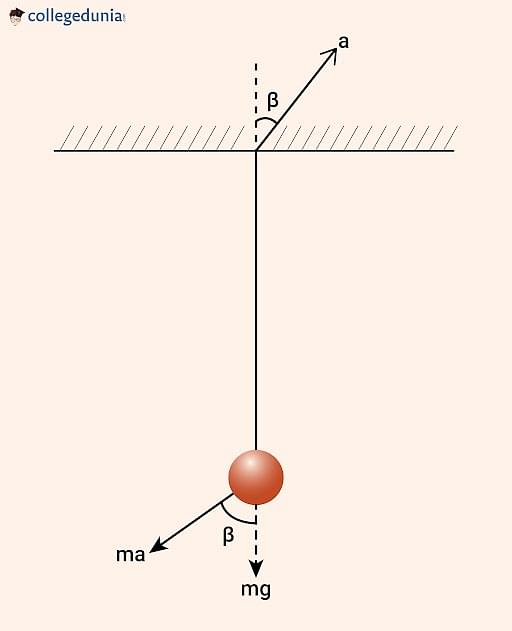
Simple pendulum accelerated with acceleration a
From the figure, the effective acceleration of the pendulum is the resultant of a and g.
Therefore,
aeffective = \(\sqrt{a^2+g^2+2agcos \beta}\)
Hence, the time period of the simple pendulum is given by
\(T = 2 \pi \sqrt{\frac{L}{a_{effective}}} = 2 \pi \sqrt{\frac{L}{\sqrt{a^2+g^2+2agcos \beta}}}\)
Special Cases:
- If the support is moving upward (in a lift) with an upward acceleration a, then β = 0
Therefore,
T = 2π \(\sqrt{\frac{L}{\sqrt{a^2+g^2+2agcos0}}}\) = 2π \(\sqrt{\frac{L}{(a+g)^2}}\)
T = 2π \(\sqrt{\frac{L}{(g + a)}}\)
- If the support is moving downward with a downward acceleration a, then β = 180
Therefore,
T = 2π \(\sqrt{\frac{L}{\sqrt{a^2+g^2+2agcos180}}}\) = 2π \(\sqrt{\frac{L}{(g-a)^2}}\)
T = 2π \(\sqrt{\frac{L}{(g - a)}}\)
- If the support is moving on a horizontal road with acceleration a, then β = 90
Therefore,
T = 2π \(\sqrt{\frac{L}{\sqrt{a^2+g^2+2agcos90}}}\) = 2π \(\sqrt{\frac{L}{(g^2 +a^2)}}\)
T = 2π \(\sqrt{\frac{L}{(g^2 + a^2)^\frac{1}{2}}}\)
Energy of Simple Pendulum
[Click Here for Sample Questions]
The total energy of a simple pendulum, also known as mechanical energy is the sum of its potential energy and kinetic energy.
Potential Energy
We know that the potential energy of a body of mass m at height h is given by,
P.E = mgh
Where
- m = mass of the object
- g = acceleration due to gravity, and
- h = height of the object.
In a simple pendulum, the height of the string is written in terms of the angle and length of the string.
Therefore, height, h = L(1 – cosθ)
The pendulum is considered to be at its highest point when θ = 90°
As cos90° = 0, and h = L, therefore
P.E.= mgL
The pendulum is considered to be at its lowest point when θ = 0°,
As Cos0° = 1, and h = L(1 – 1) = 0, then P.E. = 0
Therefore, P.E. at all points is given as,
P.E. = mgL (1 – cosθ)
Kinetic Energy
The kinetic energy of a simple pendulum, is given by
K.E. = 1/2mv 2
Where
- m is the mass of the bob of pendulum
- v is the velocity of the bob.
The kinetic energy of the pendulum is maximum at the lowest point, and it is minimum i.e. equal to zero at the highest point.
Mechanical Energy of the Pendulum
The mechanical energy of the simple pendulum is conserved, and it is given by the sum of kinetic energy and potential
Total Energy (E) = Kinetic Energy (K.E) + Potential Energy (P.E)
E = (1/2)mv2 + mgL(1 – cosθ) = constant
Torsional Pendulum
[Click Here for Sample Questions]
A torsional pendulum is much like a simple pendulum except that it exhibits rotational motion instead of translational motion.
A body is connected by a metallic wire which is pivoted from a rigid support as shown in the figure is an example of a torsional pendulum.

Torsional Pendulum
Let the body be turned by an angle θ. Restoring torque developed in the wire is given by
τr = – Cθ
Where C is called the torsional constant.
Restoring toque is also given by
τr = Iα
Where
- I = moment of inertia of the rotating body
- α = angular acceleration
Equating both equations we get
α = – (C/I) θ
Now the expression for angular acceleration in simple harmonic motion is given by
α = - ω2θ
Comparing it with the above equation, we get
ω2 = C/I
⇒ ω = \(\sqrt{\frac{C}{I}}\)
But angular frequency, ω = 2π/T
Where T is time period of the torsional pendulum.
On substituting the value, we get
2π/T = \(\sqrt{\frac{C}{I}}\)
Therefore, the time period of the torsional pendulum is given by
T = 2π\(\sqrt{\frac{I}{C}}\)
Physical Pendulum
[Click Here for Sample Questions]
A rigid body suspended from a fixed point is called the physical pendulum. It is also known as the Compound pendulum.
- A simple pendulum is an idealized mathematical model of a pendulum. It is not achievable in reality.
- But the physical pendulum is a real pendulum, i.e. they are subject to friction and air drag, so the amplitude of their swings declines.
Also Check Out:
Time Period of Physical Pendulum
[Click Here for Sample Questions]
Let a body be hinged at O and it is free to rotate in the vertical plane. The mass of the body is m and the distance of its center of mass from point O is d, as shown in the figure.

Physical pendulum
For small angular displacement θ,
Restoring torque, τ = - mgx
From the figure, we can observe, x = d sinθ
Since θ is very small, we can write sinθ ≅ θ
Therefore, restoring torque, τ = - mgdθ
Restoring toque is also given by
τ = Iα
Where
- I = moment of inertia of the rotating body
- α = angular acceleration
Equating both equations we get
α = – (mgd/I) θ
Now the expression for angular acceleration in simple harmonic motion is given by
α = – ω2θ
Comparing it with the above equation, we get
ω2 = mgd/I
⇒ ω = \(\sqrt{\frac{mgd}{I}}\)
But angular frequency, ω = 2π/T
Where T is time period of the torsional pendulum.
On substituting the value, we get
2π/T = \(\sqrt{\frac{mgd}{I}}\)
Therefore, the time period of the torsional pendulum is given by
T = 2π \(\sqrt{\frac{I}{mgd}}\)
Uses of Simple Pendulum
[Click Here for Sample Questions]
Some uses of a simple pendulum is given below:
- It was earlier used in seismometers for measuring Earth tremors where the pendulum was not vertical but horizontal.
- Simple pendulum based on Schuler tuning principle is used in inertial guidance systems in ships and aircraft that operate on the surface of the Earth.
- The motion of the pendulum can also be seen in religious ceremonies. An example of a pendulum is a swinging incense burner called a censer, also called a thurible.
- It is used for time measurement.
- A pendulum is used extensively in science education to teach the principles of dynamic motion and oscillation.
- It was first used by Galileo Galilei to study the properties of pendulums.
Things to Remember
- A system that consists of a small mass (known as the bob) that is attached to a light inextensible string and suspended from a fixed support is called a Simple pendulum.
- The time period of a simple pendulum is given by
T = 2π \(\sqrt{\frac{L}{g}}\)
- The total energy of a simple pendulum at any instant of time is conserved and it is given by
E = (1/2)mv2 + mgL(1 – cosθ)
- The variation in the temperature of the environment impacts the time period of a pendulum since the time period is directly linked to the length of the pendulum.
- A simple pendulum is typically situated in a non-inertial frame of reference.
- A physical pendulum or compound pendulum is a rigid body suspended from a fixed point.
Sample Questions
Ques. How will you define a simple pendulum? (2 Marks)
Ans. A simple pendulum is a basic mechanical system consisting of a mass (known as the bob) suspended by a light string or rod, which is fixed at a pivot point. The motion of the pendulum is periodic and follows a regular pattern, making it a useful tool for measuring time.
Ques. What is a second’s pendulum? (2 Marks)
Ans. It is that simple pendulum whose time period of vibrations is two seconds. The bob of the such pendulum while oscillating passes through the mean position after every second i.e., it beats seconds.
Ques. What is the frequency of oscillation of a simple pendulum mounted in a cabin that is freely falling under gravity? (1 Mark)
Ans. We know that gravity disappears for a man under free fall, so frequency is zero.
Ques. What will be the time period of a second’s pendulum if its length is doubled? (2 Marks)
Ans. We know that the time period of a second’s pendulum is 2 seconds
i.e. T = 2π √l/g = 2 seconds
If length l becomes doubled, then a new time period is given by
T’ = 2π √2l/g
⇒ T’ = √2 x 2π √l/g
⇒ T’ = √2 x 2 = 2.828 s
Ques. A body weighing 10 kg has a velocity of 6.0 ms-1, after one second of starting from the mean position If the time period is 6 seconds, find K.E, P.E., and total energy. (3 Marks)
Ans. Here we have
- m =10 kg
- V = 6.0 ms-1
- t = 1 s
- T = 6s
We know that K.E. = 1/2 m V2 = 1/2 x 10 x 62 = 180 J
Velocity of a particle executing simple harmonic motion is given by
V = aω cos ωt = aω cos (2π/T) t
⇒ aω = V/ cos (2π/T) t
Where a is the amplitude of the oscillation
On substituting the values, we get
aω = 6 / (cos 2π/6) x 1
aω = 6/(1/2) = 12
Total energy of a particle executing SHM is given by
T.E. = 1/2 m ω2a2 = 1/2 x 10 x (12)2 = 720 J
Therefore P.E. = T.E. – K.E. = 720 – 180 = 540 J
Ques. A spring balance has a scale that reads from 0 to 50 kg. The length of the scale is 20 cm. A body suspended from its spring, when displaced and released, oscillates with a period of 0.6 s. What is the weight of the body? (3 Marks)
Ans. Here we have
- Maximum mass, the scale can read, M = 50 kg
- Maximum displacement of the spring, (l) = length of the spring = 20 cm = 0.2 m
- T = 0.6 s
Maximum Force
F = Mg = 50 x 9.8 N = 490 N
Spring constant, K = F/l = 490/0.2 = 2450 Nm-1
When a body of mass m is suspended from balance, then
Time period, T = 2π √(m/k)
⇒ √(m/k) = T/ 2π
⇒ m/k = T2/4π2
⇒ m = (T2/4π2) k
⇒ m=0.6243.1422450=22.36 kg
Weight of the body = mg = 22.36 x 9.8 = 219.1N
For Latest Updates on Upcoming Board Exams, Click Here: https://t.me/class_10_12_board_updates
Check-Out:



Comments