



Education Journalist | Study Abroad Lead
Sodium hypochlorite, also known as sodium oxychloride, is one of most widely used ionic chemical compounds. The formula for sodium hypochlorite is exactly the same as that of the sodium oxychloride. Sodium Hypochlorite is used for several purposes but the most common use of it is as a bleaching agent and a disinfectant. It generally exists in pentahydrate state as its anhydrous form is unstable. Sodium Hypochlorite is basically a sodium salt with hypochlorite as a counter ion. It is represented as NaOCl and sometimes as NaClO.
Key Terms: Ions, Chemical Compound, Bleaching Agent, Chlorine, Sodium, Salt, Sodium Oxychloride
What is Sodium Hypochlorite?
[Click Here for Sample Questions]
Sodium hypochlorite is a chemical compound that is widely used in chemical laboratories. It is best known to be used as a bleaching agent and a disinfectant. Sodium hypochlorite is capable of decomposing chlorine and then liberating it. Its chemical formula is NaOCl and sometimes it can also be represented as NaClO. In its anhydrous form it is found unstable and it decomposes at a faster rate. Some other names given to sodium hypochlorite are bleach, antiformin, chloride or soda etc. When diluted it is known as Carrel- Dakin solution, Modified Dakin solution or Surgical chlorinated soda solution.
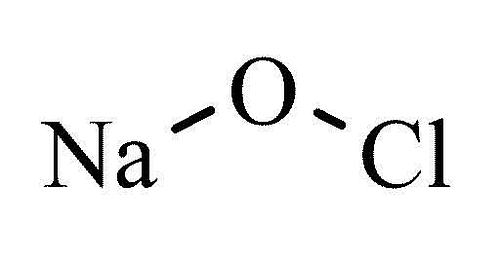
Formula of Sodium Hypochlorite
Also Read:
| Related Articles | ||
|---|---|---|
| Sodium Chlorate | Cannizzaro Reaction | Copper Chemical Formula |
| Sodium Percarbonate | Chlorate formula | Hypochlorous Acid |
Structure and Formula of Sodium Hypochlorite
[Click Here for Sample Questions]
Sodium hypochlorite comprises sodium or Na+ cation and a hypochlorite or ClO- anion. It is represented by the formula NaClO or it is sometimes represented by the formula NaOCl. By looking at the formula itself, we get to know that one molecule of sodium hypochlorite comprises one sodium atom, one oxygen atom and one chlorine atom. These ions are bonded ionically. Sodium hypochlorite immediately decomposes into chlorine and liberation of chlorine takes place. It is a salt that contains one sodium or Na+ cation and one OCl- or hypochlorite anion.

Chemical Structure of Sodium Hypochlorite
Production of Sodium Hypochlorite
[Click Here for Sample Questions]
Sodium hypochlorite is produced through different methods, some of which are mentioned below:
1) Chlorination: In this preparation method, aqueous sodium hydroxide reacts with chlorine which yields sodium chloride, water and sodium hypochlorite. The chemical reaction is:
Cl2 + 2NaOH \(\rightarrow\) NaCl + NaOCl + H2O
2) Ozonolysis: In this reaction, sodium chloride reacts with ozone and gives sodium hypochlorite and oxygen. The chemical reaction is:
NaCl + O3 \(\rightarrow\) NaOCl + O2
3) Electrolysis: In this reaction, sodium hypochlorite is extracted by the electrolysis of brine. Here, brine is a highly concentrated solution of sodium chloride in water. This method is known as the Chlor Alkali method.
4) Calcium Hypochlorite: Sodium hypochlorite is also produced by the reaction of calcium hypochlorite and sodium carbonate. The chemical reaction is:
Na2CO3 + Ca(OCl)2 \(\rightarrow\) CaCO3 + NaOCl
Properties of Sodium Hypochlorite
[Click Here for Sample Questions]
The general properties of sodium hypochlorite are:
- The melting and boiling point of sodium hypochlorite are 18°C and 101°C respectively.
- Sodium hypochlorite has a density of 1.11 g/cm3 whereas its molar mass is 74.4g/mol.
- It is usually found as a greenish yellow-colored crystal and has a sweet chlorine-like smell.
- The solubility in water of sodium hypochlorite is 29.3 g/100 ml.
- It generally exists in liquid state whereas in solid state, it forms pentahydrate structure.
- It is a highly unstable compound and decomposes easily.
- The acidity level is 7.51 whereas basicity level is 6.48.
Uses of Sodium Hypochlorite
[Click Here for Sample Questions]
Sodium hypochlorite is taken for several purposes and uses. However, the top amongst them all is as a bleaching agent. Its diluted formulas are used as a good disinfectant as well. Other than this, some other important uses of sodium hypochlorite are:
- Sodium hypochlorite is used to prevent and treat skin infections that could result from cuts and scrapes.
- It is also used for wastewater treatments because it is easy to handle and effective in areas of water that are not turbid.
- It is the best disinfectant because of its lower cost than any other disinfectant.
- It also comes in use as a nerve agent utilizer to remove blister marks from personal protection equipment.
- It is used for cleaning. For example removing dental stains, stains on crockery, mould stains and so on.
- It is used as a household bleach which contains 3-8% of sodium hypochlorite due to its oxidation and hydrolysis.
Things to Remember
- Sodium hypochlorite is also known by the name of sodium oxychloride , and is written as NaOCl as well.
- It is a well-known disinfectant, a bleaching agent, endodontic, a nerve agent utilizer, for cleaning and so on.
- It has a very unstable nature and easily decomposes into both chloride and chlorate and the product always contains a bit of sodium hydroxide.
- Its molecular weight is 74.442 g/mol and its density is 1.11 g/cm3.
- It is a sodium salt with sodium or Na+ cation and hypochlorous or ClO- anion and it is a compound made up of chlorine and sodium hydroxide.
Also Read:
Sample Questions
Ques. Can sodium hypochlorite be toxic to people? (2 marks)
Ans. Yes, Sodium hypochlorite can be toxic if consumed directly. It causes severe stomach pain, coughing, burning sensations, and also vomiting. In case if it comes in contact with the skin it can cause rashes, irritation, blisters, and so much more. The skin of the affected gets extra sensitive.
Ques. What is the correct temperature at which the sodium hypochlorite should be stored? (2 marks)
Ans. Sodium hypochlorite should be stored in an airtight container with a temperature less than 68°F. Being a good Bleaching agent, it should be kept away from any acids, reducing agents or organic chemicals. Other than that the chlorine concentration should be less than 12.5% as it loses its potency if kept in warmer places for a longer time.
Ques. What changes can be seen in the pH level on the addition of water in sodium hypochlorite? (2 marks)
Ans. On the introduction, the pH level of water rises due to the presence of caustic soda in sodium hypochlorite. When sodium hypochlorite dissolves in water, it forms two compounds that help it in the process of oxidation and disinfection, which are hypochlorous acid and a hypochlorite ion. The compound hypochlorous acid is used to lessen the pH whereas the sodium hypochlorite is used to raise it.
Ques. What are the advantages of filtered sodium hypochlorite? (3 marks)
Ans. The advantages are as follow:
- The sodium hypochlorite can be made using any kind of sodium hydroxide which gives the vendors many options and reduces the manufacturing cost for them.
- The filtered sodium hypochlorite is good quality, so it can be supplied in less quantity for more price.
- The filtration of sodium hypochlorite reduces the production of oxygen, which increases the product safety in turn allowing the vendors to sell it without letting their containers expand due to the oxygen released.
Ques. Are sodium hypochlorite and bleach the same? (2 marks)
Ans. The sodium hypochlorite compound is a combination of sodium hydroxide and chlorine but when this compound is reacted with water it forms bleach. However, sodium hypochlorite is often called as bleach because liquid bleach is one of the widest and most common uses of it.
Ques. What are the demerits of sodium hypochlorite? (2 marks)
Ans. Several issues need to be taken care of while coming in contact with the chemical sodium hypochlorite. If came in direct contact it can cause irritation, rashes, skin damage, and blisters as well. It may prove to be a toxic compound if treated irresponsibly.
Ques. Discuss the reaction of nitromethane and H2O2 with sodium hypochlorite. (3 marks)
Ans. When the sodium hypochlorite reacts with nitromethane it gives chloropicrin along with sodium hydroxide. The reaction is:
H3CNO2 + 3NaOCl \(\rightarrow\) Cl3CNO2 + 3NaOH
When the sodium hypochlorite reacts with H2O2 it produces oxygen along with sodium chloride and water as other products. The reaction is:
NaOCl + H2O2 \(\rightarrow\) NaCl + H2O + O2
Ques. Discuss the reaction of sodium hypochlorite with dichloramine and monochloramine. (3 marks)
Ans. Reaction of Sodium hypochlorite with dichloramine is as follows:
NaOCl + NH2Cl \(\rightarrow\) NCl3 + NaOH
Reaction of sodium hypochlorite with monochloramine :
NH2Cl + NaOCl \(\rightarrow\) NHCl2 + NaOH
Ques. Discuss the decomposition and oxidation reactions of sodium hypochlorite. (3 marks)
Ans. The decomposition and oxidation reactions of sodium hypochlorite are as follows:
Oxidation reaction with metals:
NaOCl + Mg \(\rightarrow\) MgO + NaCl
NaOCl + Cu \(\rightarrow\) CuO + NaCl
Decomposition reaction: It composes easily into sodium chlorate and sodium chloride at high temperatures.
NaOCl (aq) \(\rightarrow\) 2NaCl (aq) + NaClO3 (aq)
Ques. Discuss the reaction of sodium hypochlorite with ammonia. (2 marks)
Ans. Reaction of Sodium hypochlorite with ammonia is as follows:
NaOCl + NH3 \(\rightarrow\) NH2Cl + NaOH
For Latest Updates on Upcoming Board Exams, Click Here: https://t.me/class_10_12_board_updates
Check-Out:



Comments