



Education Journalist | Study Abroad Lead
Sweating, also known as perspiration, is a counteraction from the body in order to balance the temperature and provide a cooling effect to the body. Sweating basically plays two important roles, the first one is thermoregulation and the second is providing grip function to our limbs. However, excessive or enhanced sweating is clinically termed sweat hyperhidrosis. Sweat hyperhidrosis is a common disorder where excessive sweating from hands, armpits, feet, and groins begins disrupting normal activities and causing a lot of unhappiness.
| Table of Contents |
Key Terms: Sweating, Sweat, Hyperhidrosis, Thermoregulation, Hypothalamus, Sweat Glands, Focal Hyperhidrosis, Secondary Hyperhidrosis
What is Sweating?
[Click Here for Sample Questions]
Sweating simply means the release of liquid from the body. It is the counter mechanism of the body for regulating the temperature of the body or providing grip to our palms and feet. Sweating is a normal and important physiological mechanism of the body that helps in cooling the body. Sweating is mainly controlled by the hypothalamus of the brain.
Generally sweating is classified as thermoregulatory sweating and emotional sweating.
- Thermoregulatory Sweating helps in lowering the overall temperature of the body by releasing moisture and occurs due to heat or hot climate, sun, humidity, heavy exercise, physical hard work, spicy food, heavy medications etc.
- Emotional Sweating happens due to certain kinds of stress, fear, nervousness or shock. Hands, palms, souls of feet, and underarms are the principal organs participating in emotional sweating.

Sweating
- Sweat Glands
Sweat is released from sweat glands present in deep underlying tubular layers of skin called the dermis. The amount of sweating depends upon the total number of active sweat glands in the body irrespective of the total number of sweat glands present in the body. In general mammals as a result of evolution approximately 2-4 million sweat glands from which sweat is released via sweat pores present on the skin. Armpits, soles of feet, harms, and hairy areas of the body such as the groin, and scalp have comparatively more active sweat glands.
Eccrine and Apocrine are the two different types of sweat glands present in the body. Eccrine glands are widely distributed all over the body and usually, secret water & electrolytes, whereas apocrine glands additionally contribute to oily & greasy substances such as lipids, fats or steroids released from the hairy region of the body. Apocrine glands also control emotional sweating.
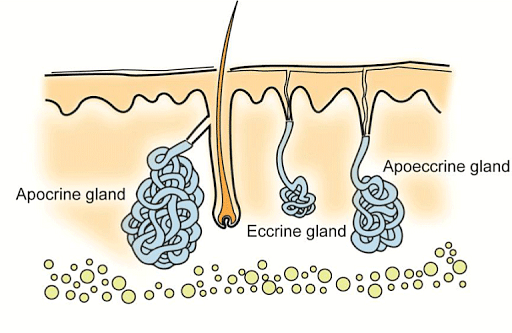
Sweat Glands
Read More: Exocrine Glands
- Sweat
Primirally sweat is composed of 99 per cent of water, and the remaining 1 per cent contributes to electrolytes, salts, amino acids, urea etc. The stinky smell from the sweat can be due to the reasons of bacteria or hormones. Some characteristic odours from the sweat might indicate certain diseases like metal poisoning.
What is Hyperhidrosis?
[Click Here for Sample Questions]
Sweat Hyperhidrosis is a type of excessive or enhanced abnormal sweating which is not related to heavy exercise or heat. Hyperhidrosis can be bifurcated as generalized or focal. Focal hyperhidrosis is most common and can be seen in arms, feet, axillae etc. On the contrary secondary or generalised sweating occurs due to the dysfunctionality of some centres in the peripheral or central nervous system.

Hyperhidrosis
Symptoms of Hyperhidrosis
[Click Here for Sample Questions]
Usually people sweat more and excessively when they exercise or exert themselves, are in a hot environment, or are anxious or under stress. However, in the case of sweat hyperhidrosis, there is quite excessive sweating that exceeds normal sweating.
The affected must visit the doctor in case of the given symptoms:
- One starts sweating more than usual.
- Sweating is constantly disrupting the daily routine.
- There is emotional or social distress and withdrawal due to excessive sweating.
- Experiencing night sweats for no particular or specific reason.
Read More: Difference between Sweat and Sebum
Causes of Hyperhidrosis
[Click Here for Sample Questions]
Hyperhidrosis can be classified into two types basically:
- Focal Hyperhidrosis
- Secondary Hyperhidrosis
Focal Hyperhidrosis
The most basic form is called primary focal (essential) hyperhidrosis. In this kind of sweat hyperhidrosis, the nerves responsible for signalling the sweat glands become overactive, despite the fact that they have not been triggered by high temperature or any physical activity. The palms, soles and sometimes the face are the most affected in this case.
Such kind of Hyperhidrosis has no medical cause and may have a hereditary component.
Secondary Hyperhidrosis
This kind of hyperhidrosis occurs when excessive sweating is caused due to a medical condition and this kind is less common. Most of the body sweats in this case. Some of the causes of this kind of sweating are
- Diabetes
- Nervous system disorders
- Infections
- Menopause hot flashes
- Thyroid problems
- Low blood sugar
- Cancer
- Heart attack
Complications of Hyperhidrosis
[Click Here for Sample Questions]
The major complications of sweat hyperhidrosis are as follows:
- Infections: Excessive sweating can make a person more prone to skin infections.
- Social and Emotional Distress: Profuse Sweating can cause embarrassment and may affect the social and emotional well-being of a person.
Read More: Infectious Diseases
Treatment of Hyperhidrosis
[Click Here for Sample Questions]
Some of the treatments advised for sweat hyperhidrosis are as follows:
- Aluminum-based antiperspirants
- Clinical wipe clothes
- Oral medications
- Lifestyle changes
Read More: Human Health and Diseases
Things to Remember
[Click Here for Sample Questions]
- Eccrine and Apocrine are the two types of sweat glands present in the human body.
- The clinical terminology associated with normal sweating is diaphoresis and sweat hyperhidrosis for abnormal sweating.
- Hyperhidrosis is a disorder that involves excessive sweating that's not necessarily related to heat or exercise.
- Hyperhidrosis disrupts normal daily activities and can cause social anxiety and embarrassment.
- There are two kinds of sweat Hyperhidrosis- Focal hyperhidrosis which is more common and Secondary hyperhidrosis, which is less seen among people.
- Anhyperhidrosis is a condition in which the person is unable to sweat, and the person might develop heat stroke due to overheating.
Read More: NCERT Solutions for Class 6 t 12
Sample Questions
Ques. Write down the composition of Sweat? (3 Marks)
Ans. The percentage composition for sweat is:
- Water – 62%
- Minerals –3% eg. sodium, potassium, calcium, magnesium
- Trace metals – 2% eg. zinc,chromium,copper, lead
- Protein-16%
- Fat – 16%
- Carbohydrate-1%
Ques. How many different types of sweat glands are present in our body. also, mention their functions? (3 Marks)
Ans. Eccrine and Apocrine are the two different types of sweat glands present in the body. Eccrine glands are widely distributed all over the body and usually, secret water & electrolytes, whereas apocrine glands additionally contribute to oily & greasy substances such as lipids, fats or steroids released from the hairy region of the body. Emotional sweating is also controlled by apocrine glands.
Ques. How hyperhidrosis is diagnosed by a physician? (3 Marks)
Ans. Hyperhidrosis can be diagnosed through blood and urine tests to check whether the presence of any underlying disease contributes to excessive sweating. Iodine tests & paper tests can be used to determine the weight of sweat or the amount of sweat released from the body. Iodine turns blue in presence of sweat.
Ques. Write a short note on the treatment of hyperhidrosis? (3 Marks)
Ans. Oral medication is one of the most commonly prescribed treatments. Other treatments are aluminium-based antiperspirants and clinical-grade cloth wipes. Aluminium antiperspirants work by sealing sweat glands and sweat pores. whereas, clinical-grade cloth wipes contain glycopyrronium tosylate and help in minimizing sweat from armpits.
Ques. Differentiate between causes of normal and abnormal sweating? (3 Marks)
Ans. Sweating occurs due to heat or hot climate, sun, humidity, heavy exercise, physical hard work, spicy food, heavy medications etc. On the other hand, emotional sweating happens due to certain kinds of stress, fear, nervousness or shock.
Hyperhidrosis or abnormal sweating may be caused due to Diabetes, Menopause, Infections, Cancer, CNS disorders, and Thyroid.
Ques. What are the normal and abnormal sweating clinically called? (1 Mark)
Ans. Normal sweating is also called diaphoresis, whereas abnormal sweating is clinically called sweat hyperhidrosis.
Ques. Does sweat have any odour? Give a reason for your answer? (3 Marks)
Ans. The stinky smell from the sweat can be due to bacteria or hormones. Some characteristic odours from the sweat might indicate certain diseases like metal poisoning. For example, a garlic-like odour is observed in case of arsenic poisoning. It might also indicate that the person is under heavy medications or drugs. Some amount of alcohol also gets digested from our body as sweat.
Ques. How is sebum different from sweat? (3 Marks)
Ans. Sebum and sweat are released from the layers of the skin. Both of them are part of the secretion mechanism of the body. Sebum is oily & greasy secretions which protect our skin by forming a barrier on the other hand sweat is plain water and electrolytes helping in cooling the body.



Comments