



Content Curator
Urine can be tested to detect the presence of urea in it. It can be detected by performing either Sodium hypobromite test or urease test. The kidney eliminates the waste from blood stream and the waste leaves the body through urine. The production of urea takes place in the body naturally during disintegration of proteins. The urea moves from liver to kidney and the kidney eliminates it from the body.
| Table of Content |
Key Terms: Urine, Urea, Urease, Test tube, Kidney
Aim of Test
[Click Here for Sample Questions]
Detection of presence of urea in the urine sample by performing a test.
Urine and Human Urine
[Click Here for Sample Questions]
Urine is a liquid waste that the body needs to eliminate. It is produced by the kidney. The wastes in the bloodstream are eliminated by the kidney and such waste turns into Urine. Human Urine is a liquid that is generally yellowish in color and contains water and a few other chemical components such as urea, hormones, uric acid, carbohydrates, and traces of enzymes.
Also Read: Urine Infection
Production of Urea
[Click Here for Sample Questions]
Urea is produced by the body naturally. The production of urea takes place during disintegration of proteins when amino acids eliminate the amino groups of the proteins. The liver converts these eliminated amino groups into very toxic ammonia and then later into urea. The urea is eliminated from body by the kidneys once it moves from liver to kidneys.
Also Read: Kidney Function Test
Detection of Urea
[Click Here for Sample Questions]
To detect the urea in urine, a test is performed. Urease test helps in determining the presence of urea in urine. The urea is decomposed and converted into ammonia and carbon dioxide by an enzyme called Urease. When an alkaline substance is added to urease, it turns into an alkaline solution. A commonly used alkaline solution is ammonium carbonate.
Also Read: Test for Presence of Albumin in Urine
Types of Urine Test
[Click Here for Sample Questions]
There are two tests which can detect the presence of urine in urea. These are:
- Urease Test
- Sodium Hypobromite Test
Urease Test
[Click Here for Sample Questions]
Materials Required:
- Dropper
- Urine Sample
- Spatula
- Urease powder
- Measuring cylinder
- 2% of Na2CO3.
- 1% acetic acid
- Phenol red indicator
Procedure:
- Clean and dry a test tube.
- Add a urine sample of 5ml into the test tube with the help of a measuring cylinder.
- Add 4 to 5 drops of phenol red indicator to the same sample test tube using a dropper.
- Add drops of 2% Na2CO3 solution dropwise with the help of another dropper, until the test tube starts developing the pink color.
- Add a few drops of 1% acetic acid using another dropper. Keep adding acetic acid drop wise until the pink color disappears.
- Into the urine sample test tube, add a little urease powder with the help of a spatula.
- Now mix the urease powder by shaking the test tube slowly.
- Observe the changes
Conclusion
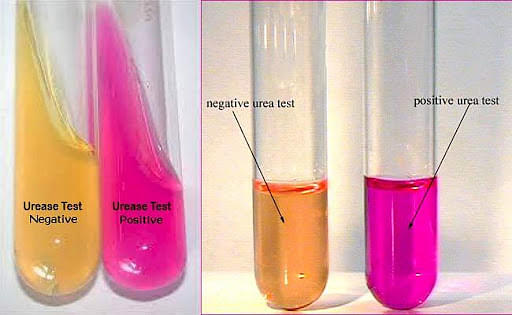
When a pink or red color appears in the solution, it indicates the existence of urea in the urine sample.
Sodium Hypobromite Test
[Click Here for Sample Questions]
Materials Required:
- Urine Sample
- Dropper
- Sodium hypobromite solution
- Test Tube
- Measuring cylinder
Procedure:
- Clean and dry a test tube.
- Add a urine sample of 2ml into the test tube with the help of a measuring cylinder.
- Add 2 to 3 drops of sodium hypobromite to the same test tube using a dropper.
- Thoroughly mix the solution.
- Observe the changes that take place in the sample
Conclusion:
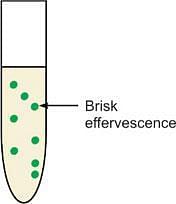
The presence of brisk effervescence of nitrogen around the test tube indicates the presence of urea in the given urine sample.
Things to Remember
[Click Here for Sample Questions]
- Urine is liquid waste that is generally yellow in colour and contains water and other chemical components such as uric acid, carbohydrates, enzymes, urea and hormones.
- During disintegration of proteins, the body produces toxic ammonia that later converts into urea.
- The presence of urea in urine can be determined using Urease test or Sodium hypobromite test.
- In urease tests, the presence of urea in urine is indicated by an appearance of pink or red colour in the solution.
- In sodium hypobromite test, the presence of urea in urine is indicated by the presence of brisk effervescence of nitrogen.
Sample Questions
Ques. What is Urea? (5 marks)
Ans. Urea is formed in the liver. It is a nitrogenous compound. Urea is also known as Ureophil or Carbamide. The chemical formula for urea is CH4N2O. After the protein metabolism takes place, urea is produced. It is a waste material that is eliminated by kidney through urine. Urea is colourless and dissolves in water. Urea is not toxic. It is used in fertilizers and few other industries as a raw material.
Ques. What is difference between Urea and Urine? (3 marks)
Ans. Urea is a waste product produced in the bodies of most living organisms. It is commonly known as carbamide. Urine is the liquid waste which urea is part of. When amino acids disintegrate, ammonia is formed, which is converted into urea and then exits the body as a part of urine.
Ques. What is Micturition? (3 marks)
Ans. The process of discharge of urine from urinary bladder is called Micturition. In humans and animals, elimination of waste products takes place through excretory system and urinary bladder is part of that excretory system. When the bladder is full, the urge to urinate increases and micturition takes place.
Also Read: Micturition
Ques. Explain the Micturition process. (5 marks)
Ans. There are two phases in the micturition process:
- a) Storage phase
The urinary bladder is an organ that stores the urine. The urethra allows the urine to pass through it to get excreted.
- b) Voiding phase
When the bladder is full, the urge to urinate occurs due to a trigger in the nerves. The receptors send a signal to nervous system and the central nervous system causes contraction of the bladder. The urine passes through urethra.
Ques. What are Proteins? (3 marks)
Ans. Proteins comprise amino acids arranged into various groups. There are two types of proteins: Globular protein and Fibrous proteins. There are four types of protein structures: primary structure, secondary structure, tertiary structure and quaternary structure.
Ques. What are Amino Acids? (5 marks)
Ans. Amino acids are known as the building components of proteins. They are organic components that combine to form proteins. Amino acids are essential for development and growth of human beings and are part pf various chemical and biological functions in the body. The basic components of amino acids are carboxyl groups and amino groups. Proteins are made up of twenty amino acids.
Ques. What are some functions of Amino Acids? (5 marks)
Ans. Some functions of amino acids:
- They promote muscle growth.
- Amino acids such as phenylalanine boosts memory.
- Some amino acids promote growth hormone.
- Formation of antibodies in the body is promoted by an amino acid named Lysine.
- Amino acids play an important role in production of thyroid hormone.
- Amino acids also play a part in removal of toxins from the body.
Ques. Write a note on uses of Urea. (5 marks)
Ans. Some uses of urea:
- It acts as a fertilizer, specifically nitrogen release.
- Melamine manufacturing includes use of urea.
- It can rehydrate skin so it is used in ointments or creams.
- It is used as a raw material during production of hair removal cream.
- It acts as an important reagent in lanthanide chemistry.
Ques. What are some problems associated with Micturition? (3 marks)
Ans. The three main problems associated with micturition are:
- Urinary Retention: The inability to completely empty the bladder is urinary retention.
- Spinal Cord Trauma: Major injuries to spinal cord can cause such trauma and effect micturition.
- Detrusor Instability: This condition leads to urinary incontinence.
Also Read: Disorders of the Excretory System
Ques. Write a note on management of Micturition disorders. (3 marks)
Ans. Micturition disorder management:
- The urinary tract should be intact.
- The urine flow shouldn’t come across any obstruction
- The capacity of bladder to hold urine should be normal.
Also read:



Comments