



Education Journalist | Study Abroad Lead
Theoretical Yield is the amount of product obtained as the result of a chemical reaction in which the limiting reactant is completely converted. In the real world, chemical reactions don't usually go as intended on paper. Many factors contribute to the development of fewer products than expected during the course of an experiment. Aside from spills and other experimental errors, losses are frequently experienced as a result of incomplete reactions, unwanted side reactions and so on. Chemists require a metric to determine how successful a reaction has been.
- The theoretical yield is calculated using stoichiometry, which involves balancing the chemical equation and using mole ratios to convert the amount of one substance to the amount of another substance.
- Theoretical yield is the maximum amount of product that can be obtained in a perfect or ideal reaction.
- The actual yield is the amount of product obtained in a real experiment, and it is usually less than the theoretical yield.
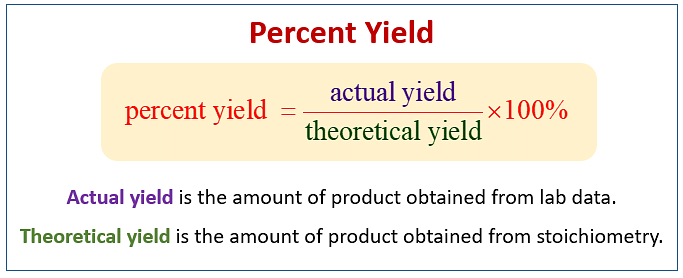
- The ratio of actual yield to theoretical yield is called the percent yield, which is a measure of the efficiency of the reaction.
-
The theoretical yield formula is as – (mass of limiting reactant x molar mass of product) / (molar mass of limiting reactant) x (stoichiometric coefficient of product)
Key Terms: Chemical Reaction, Percentage Yield, Limiting Reagent, Reactant, Moles, Mass, Weight, Theoretical Yield
What is Theoretical Yield?
[Click Here for Sample Questions]
The amount of a product obtained from the complete conversion of the limiting reactant in a chemical process is known as theoretical yield.
- It is the amount of product produced by a flawless (theoretical) chemical reaction, which isn't the same as the amount you'll receive from a lab reaction.
- Theoretical yield is often measured in grams or moles.
- The actual yield, as opposed to the theoretical yield, is the amount of product produced by a reaction.
- As few chemical reactions are 100% efficient due to loss of the product and because other reactions may be occurring that lower the product, the actual yield is frequently lower.
- Because of a subsequent reaction that provides more products or because the recovered product contains impurities, an actual yield may be higher than a theoretical yield.
It represents the maximum amount of product obtained assuming that the reaction is complete, all reactants consumed, and there are no losses.
Read More:
Theoretical Yield Formula
[Click Here for Sample Questions]
To calculate the per cent yield, stoichiometry must first be used to establish how much of the product should be created. This is referred to as the theoretical yield, which is the highest amount of product that can be made from the given amount of reactants. When a reaction is carried out in the lab, the actual yield is the amount of product that is produced.
The formula for calculating the theoretical yield is:
| Theoretical yield = \((mass\ of\ limiting\ reactant) \times (molar\ mass\ of\ product) \over (molar\ mass\ of\ limiting\ reactant) \times (stoichiometric\ coefficient\ of\ product)\) |
where:
- The mass of the limiting reactant is present in the reaction.
- The molar mass of the product is the mass of one mole of the product.
- The molar mass of the limiting reactant is the mass of one mole of the limiting reactant.
- The stoichiometric coefficient of the product is the coefficient that appears in front of the product in the balanced chemical equation.
The theoretical yield formula helps in finding the maximum amount of product obtained from the reaction assuming that all reactants are consumed and the reaction proceeds to completion without any side reactions or losses.
Percent Yield
A percent yield is the most common way to express the ratio between actual and theoretical yield. It represents the efficiency of the reaction and is calculated using the following formula:
| Percent yield = Mass of Actual Yield / Mass of Theoretical Yield x 100 |
The actual yield is the amount of product obtained from the reaction in a real experiment. It is always less than the theoretical yield due to incomplete reactions, side reactions, impurities, and losses during separation and purification.
- A percent yield of 100% indicates that the actual yield is equal to the theoretical yield.
- This means that the reaction proceeded perfectly without any losses.
- A percent yield of less than 100% indicates that the actual yield is less than the theoretical yield, and there were losses or inefficiencies in the reaction.
Limiting Reactant
A limiting reactant is a reactant that is completely consumed in a chemical reaction. It helps to determine the maximum amount of product that can be produced. The other reactants, present in excess, are called excess reactants. The reactant that produces the least amount of product is the limiting reactant.
Theoretical Yield Formula Solved ExampleSuppose we want to determine the theoretical yield of the reaction between 10 grams of hydrogen gas (H2) and 20 grams of oxygen gas (O2) to produce water (H2O). Solution: The balanced chemical equation for the reaction is: Calculate the number of moles of each reactant: Determine the limiting reactant: Calculate the amount of product that can be produced: 2 mol H2O / 1 mol O2 x 0.625 mol O2 = 1.25 mol H2O Convert the amount of product to grams: 1.25 mol H2O x 18.015 g/mol = 22.5 g H2O Therefore, the theoretical yield of water in this reaction, based on the given amounts of H2 and O2, is 22.5 grams of H2O. |
Read Also:
Calculation of Theoretical Yield
[Click Here for Sample Questions]
The limiting reactant of a balanced chemical equation is identified to determine theoretical yield. To calculate the theoretical yield of a chemical reaction:
- If the equation is unbalanced, the first step is to balance it.
- Convert the amount of each reactant to moles, using the molecular weight or molar mass of each compound.
- Determine which reactant is the limiting reactant by comparing the mole ratios of the reactants.
- Because the limiting reactant isn't found in abundance, the reaction can't continue once it's used up.
- Calculate the amount of product that can be produced from the limiting reactant, using the stoichiometric coefficients in the balanced chemical equation.
- Convert the amount of product from moles to grams, using the molecular weight or molar mass of the product
For finding the limiting reactant
- Convert the results to grams if the quantity of reactants is given in moles.
- Subtract the reactant's mass in grams from its molecular weight in grams per mole.
- Alternatively, you can multiply the amount of a reactant solution in millilitres by its density in grams per millilitre for a liquid solution. Then divide the result by the molar mass of the reactant.
- Multiply the mass obtained by the number of moles of reactant in the balanced equation using either technique.
- You now know how many moles each reactant has. To determine which is accessible in excess and which will be used up first, compare this to the molar ratio of the reactants (the limiting reactant).
- Multiply the moles of the limiting reactant by the ratio between the moles of the limiting reactant and the product from the balanced equation once you've identified the limiting reactant.
- This tells you how many moles each product has.
- Multiply the moles of each product by its molecular weight to get the grams of the product.
Also Read:
Things to Remember
- The limiting reagent is the first reactant to be consumed in a chemical reaction, limiting the amount of product that can be created.
- The theoretical yield is what you get when you use a balanced chemical process to determine the yield.
- In a chemical reaction, the actual yield is always lower than the predicted yield.
- The actual yield/theoretical yield ratio is used to calculate the percent yield.
- Both theoretical and actual yields have a crucial role to play. Without computing yield, evaluating the efficiency of reactants would become impossible.
- The theoretical yield is derived by multiplying the product's number of moles by the product's molecular weight after determining the number of moles, the limiting reagent, and the ratio.
Solved Questions
Ques. Salicylic acid (C7H6O3) and acetic anhydride (C4H6O3) are combined to make aspirin (C9H8O4) and acetic acid (C4H6O3) (HC2H3O2). This reaction has the following formula: (5 marks)
C7H6O3 + C4H6O3 → C9H8O4 + HC2H3O2
To create 1000 1-gram aspirin pills, how many grams of salicylic acid are required? (Assume a yield of 100%) .
Ans. The stepwise mechanism is mentioned below:
- Step 1: Determine the aspirin and salicylic acid molar masses. We know that,
Molar Mass of C = 12 g
Molar Mass of H = 1 g
Molar Mass of O = 16 g
MM of Aspirin = (9 x 12 g) + (8 x 1 g) + (4 x 16 g) = 108 g + 8 g + 64 g = 180 g
MM of Salicylic Acid = (7 x 12 g) + (6 x 1 g) + (3 x 16 g)
MM of Salicylic Acid = 84 g + 6 g + 48 g
MM of Salicylic Acid = 138 g
- Step 2: Calculate the mole ratio of aspirin to salicylic acid: One mole of salicylic acid was required for every mole of aspirin produced. As a result, the mole ratio of the two is one.
- Step 3: Calculate how many grams of salicylic acid you'll need: The number of tablets is the first step in fixing this problem. The amount of grammes of aspirin is calculated by multiplying this by the number of grammes per tablet. The number of moles of aspirin produced is calculated using the molar mass of aspirin.
- Step 4: Calculate the amount of moles of salicylic acid required using this number and the mole ratio.
- Step 5: Calculate the required grammes using the molar mass of salicylic acid.
Putting all this together:
Grams of Salicylic Acid = 1,000 tablets x 1 g aspirin/1 tablet x 1 mol aspirin/180 g of aspirin x 1 mol sal/1 mol aspirin x 138 g of sal/1 mol sal
Grams of salicylic acid = 766.67
Hence, to make 1000 1-gram aspirin pills, 766.67 grams of salicylic acid are required.
Ques. To produce water, 10 grams of hydrogen gas are burned in the presence of excess oxygen gas. What is the total amount of water produced? The reaction that produces water when hydrogen gas and oxygen gas combine is: (5 marks)
H2(g) + O2(g) → H2O(l)
Ans. The stepwise mechanism is mentioned below:
- Step 1: Check to see if your chemical equations are balanced. Hence, the equation becomes after balancing:
2 H2(g) + O2(g) → 2 H2O(l)
- Step 2: Calculate the mole ratios of the reactants and products: This value serves as a link between the reactant and the finished product. The stoichiometric ratio between the quantity of one chemical and the amount of another compound in a reaction is known as the mole ratio. Two moles of water are created for every two moles of hydrogen gas utilised in this reaction. The mole ratio between H2 and H2O is 1 mol H2/1 mol H2O.
- Step 3: Calculate the reaction's theoretical yield: There is now sufficient data to calculate the theoretical yield.
- To convert grammes of reactant to moles of reactant, use the molar mass of the reactant.
- To convert moles reactant to moles product, use the mole ratio between reactant and product.
- To convert moles of product to grammes of product, use the molar mass of the product.
In the equation formed: grams product = grams reactant x (1 mol reactant/molar mass of reactant) x (mole ratio product/reactant) x (molar mass of product/1 mol product). Here, theoretical yield of the reaction is calculated by using:
Molar mass of H2 gas = 2 g
Molar mass of H2O = 18 g
Grams of H2O = grams H2 x (1 mol H2/2 grams H2) x (1 mol H2O/1 mol H2) x (18 g H2O/1 mol H2O)
As, we had 10 grams of H2 gas, so:
grams H2O = 10 g H2 x (1 mol H2/2 g H2) x (1 mol H2O/1 mol H2) x (18 g H2O/1 mol H2O)
Except for grammes H2O, all units cancel out, leaving:
Grams of H2O = (10 x 1/2 x 1 x 18) g H2O
Grams of H2O = 90 g H2O
Theoretically, ten grams of hydrogen gas and extra oxygen will make 90 grams of water.
Ques. The following reaction Na2S (aq) + 2 AgNO3 (aq) → Ag2S(s) + 2 NaNO3 (aq). When 3.94 g of AgNO3 and an excess of Na2S are combined, how many grams of Ag2S are produced? (5 marks)
Ans. Finding the mole ratio between the product and the reactant is the key to solve this type of problem.
- Step 1: Determine the atomic weight of AgNO3 and Ag2S. We know that,
Atomic weight of Ag = 107.87 g
Atomic weight of N = 14 g
Atomic weight of O = 16 g
Atomic weight of S = 32.01 g
Atomic weight of AgNO3 = (107.87 g) + (14.01 g) + 3(16.00 g)
Atomic weight of AgNO3 = 107.87 g + 14.01 g + 48.00 g
Atomic weight of AgNO3 = 169.88 g
Atomic weight of Ag2S = 2(107.87 g) + 32.01 g
Atomic weight of Ag2S = 215.74 g + 32.01 g
Atomic weight of Ag2S = 247.75 g
- Step 2: Calculate the mole ratio of the product to the reactant: The total number of moles required to complete and balance the reaction is given in the reaction formula. Two moles of AgNO3 are required for this reaction to yield one mole of Ag2S. The mole ratio is 1 mol Ag2S/2 mol AgNO3 in this case.
- Step 3: Determine the quantity of product produced.
Because of the excess Na2S, the entire 3.94 g of AgNO3 will be utilised to complete the reaction.
Grams of Ag2S = 3.94 g AgNO3 x 1 mol AgNO3/169.88 g AgNO3 x 1 mol Ag2S/2 mol AgNO3 x 247.75 g Ag2S/1 mol Ag2S
Note the units cancel out, leaving only grams Ag2S
Grams of Ag2S = 2.87 g Ag2S
So, 2.87 g of Ag2S will be produced from 3.94 g of AgNO3.
Ques. How to calculate percent yield in 4 steps? (4 marks)
Ans. Calculate the percent yield using the instructions below:
- Find theoretical yield - Theoretical yield is significant because it reveals the possible results or product of a process when it is operating at optimum efficiency.
- Recording the actual yield: It reflects the true amount of product produced by the reaction.
- Divide actual yield by theoretical yield: Dividing actual yield by theoretical yield yields the decimal percent yield.
- Multiply by 100 to convert to a percentage: To discover the percent yield and calculate a complete percentage, multiply the decimal values from the previous step by 100. This is the percent yield of a chemical reaction, which aids in producing the most products with the least waste while also indicating the method's efficiency.
Ques. 5 g of methanol (CH3OH, formula mass = 32 g) reacts with additional ethanoic acid (CH3COOH) for producing 9.6 g of methyl ethanoate (CH3OOCH3, formula mass = 74 g). Find the percentage yield. (5 marks)
Ans. The actual yield (9.6 g) is given. So, first, find the theoretical yield. One mole of methanol can generate one mole of methyl ethanoate, according to the below-balanced equation.
CH3OH + CH3COOH = CH3OOCH3 + H2O
1mole → 1mole
When the numbers of moles are replaced with their equal formula masses, the following results are obtained:
32g of CH3OH = 74g of CH3OOCH3
5g of CH3OH = 532 × 74 =11.56 g
Theoretical yield = 11.56 g
Actual yield = 9.6 g
Percentage Yield = Actual yield / Theoretical yield × 100
= 9.611.56 × 100
= 83%
Ques. When 32.18 g of sulphuric acid interacts with excess sodium hydroxide to produce 37.91 g of sodium sulphate, calculate the percent yield of sodium sulphate. (3 marks)
H2SO4 (aq) + 2NaOH (aq) → 2H2O (l) + Na2SO4 (aq)
Ans. In the question, it is mentioned that sodium hydroxide is the excess reagent. Whenever there is excess reactant mentioned, you can ignore it. So sulphuric acid is the limiting reagent and you need to calculate the theoretical yield:
(32.18 g H2SO4) (1 mol H2SO4 / 98.08 g H2SO4) (1 mol Na2SO4/1 mol H2SO4) (142.04 g Na2SO4/ 1 mol Na2SO4)
= 46.59 g Na2SO4
According to theory, if the reaction goes exactly and completely, 46.59 g of sodium sulphate will be produced. However, the question states, the real output is 37.91 g sodium sulphate. Using the percent-yield formula and these two pieces of information, you can compute the percent yield:
Percent Yield = (37.91 g/46.59 g) x 100
= 81.37%
Ques. Find the percent yield of the following reaction if 60 g of CaCO3 is heated to provide 15 g of CaO? (5 marks)
CaCO3 → CaO + CO2
Ans. The first step is to verify whether the equation is balanced. Then, convert to moles on the basis of the amount of CaCO3.
60 grams CaCO3 x 1 mole CaCO3/100 g CaCO3 x 1 mole CaO/1mole CaCO3
= 0.6 mole CaO
In terms of grams,
0.6 mole CaO x 56 gms CaO/1 mole CaO
= 33.6 g CaO
Therefore, 33.6 grams of CaO needs to be produced in this reaction. This is the theoretical yield. But, in the question it is mentioned, only 15 grams were produced. So, 15 grams is the actual yield. Therefore, percentage yield is:
15 gms CaO / 33.6 g CaO
= 0.446 = 44.6%
Ques. 5.00 g of NaOH reacts with 5.00 g of HCl, what is the theoretical yield of NaCl? Balanced Chemical Equation: NaOH (s) + HCl (aq) → NaCl (s) + H2O (l). (3 marks)
Ans. Calculating limiting reagent
5.00 g NaOH × 1 mol NaOH/40 g NaOH = 0.125 moles NaOH
5.00 g HCl × 1 mol HCl/36 g HCl = 0.139 moles HCl
Next we will find the moles of product from each reactant
0.125 moles NaOH × 1 mol NaCl/1 mol NaOH = 0.125 moles NaCl
0.139 moles HCl × 1 mol NaCl/1 mol HCl = 0.139 moles NaCl
Final step is to calculate theoretical yield of NaCl
0.125 moles NaCl x 58.4 g NaCl/1 mol NaCl = 7.3 g NaCl
Ques. Potassium chlorate gets decomposed upon little heating in the presence of catalyst according to the mentioned reaction: (5 marks)
2KClO3(s) →2KCl(s) + 3O2 (g) 2KClO3(s) → 2KCl(s) + 3O2 (g) During the experiment, 40.0 g KClO3 is heated until it totally decomposes.
Find the theoretical yield of oxygen gas? The oxygen gas is collected and its mass is 14.9 g. So, determine the percent yield for the reaction.
Ans. The first step is to find the theoretical yield on the basis of stoichiometry
Step 1: We know that mass of KClO3 = 40.0 g
Molar Mass of KClO3 = 122.55 g/mol
Molar Mass of O2 = 32.00 g/mol
Applying stoichiometry for converting from the mass of a reactant to the mass of a product:
(g) KClO3 → mol KClO3 → mol O2 → (g) O2g KClO3 → mol KClO3 → mol O2 → (g) O2
Step 2: 40.0 g KClO3 × 1 mol KClO3/122.55 g KClO3 × 3 mol O2/2 mol KClO3 × 32.00 g O2/1 mol O2 = 15.7 g O2. The theoretical yield of O2 is 15.7 g.
Step 3: The mass of oxygen gas should be lesser than the 40.0 g of decomposed potassium chlorate. Now, apply the actual yield and the theoretical yield to find the percent yield.
Actual yield = 14.9 g; Theoretical yield = 15.7 g
Percent Yield = Actual Yield / Theoretical Yield × 100
= 14.9 g / 15.7 g × 100
= 94.9%
Ques. How does actual yield differ from theoretical yield? (4 marks)
Ans. Since few reactions are actually complete (i.e., aren't 100 percent efficient) or because not the entire product in a reaction is collected, the real yield is usually lower than the theoretical yield. If you're recovering a precipitate product, for example, you might lose some of it if it doesn't totally fall out of the solution. Some products may remain on the filter or make their way through the mesh and wash away if you filter the solution through filter paper. Even if the substance is insoluble in that solvent, if you rinse it, a little bit of it may be lost due to dissolving in the solvent.
It can also be possible that the actual yield exceeds the theoretical yield. This is most likely to happen if the solvent is still present in the product (incomplete drying), if the product was weighed incorrectly, or if an undetected ingredient in the process functioned as a catalyst or caused product formation. Another reason for the increased yield is that the result is impure because another ingredient than the solvent is present.
Do Check Out:



Comments