



Content Writer-SME
DNA transcription in molecular biology is a process through which genetic information from DNA is utilised to make RNA. The full form of DNA is deoxyribonucleic acid and ribonucleic acid is the full form of RNA. Transcription and translation are the two major processes involved in protein synthesis.
- The main enzyme responsible for transcription of DNA is RNA Polymerase.
- The complementary strand of DNA is synthesized from a single DNA strand by the help of RNA polymerase enzyme.
- The process of transcription occurs in both eukaryotic and prokaryotic cell.
Definition of Transcription
[Click Here for Sample Questions]
Transcription of DNA is the first step of gene expression. In the process of transcription, mRNA is the place where the genetic information is stored which later helps in encoding a protein. The DNA strand acts as a template strand for the synthesis of complementary mRNA. The structure of RNA differs from DNA in terms of nitrogenous bases. Uracil is present in the structure of RNA in place of thymine. The process of transcription was first explained by the central dogma theory of molecular biology.
Central Dogma
The Central Dogma helps us in the understanding the process involved in protein synthesis. It is proceeded in three stages, replication, transcription and translation. Once the process has been completed and the DNA has replicated itself into two strands, the information is utilized to make RNA through the process called transcription.

Central Dogma
RNA Polymerase in Transcription
[Click Here for Sample Questions]
The main enzyme required in the DNA transcription process is RNA polymerase. The enzyme uses a single strand of DNA to synthesize a complementary RNA strand. The RNA polymerase helps to bind to the promoter and then catalyzes the polymerization in the 5’ to 3’ direction on the template strand. Once the terminal sequence has been reached, the process ends and a freshly synthesized RNA strand is released.
Types of RNA
[Click Here for Sample Questions]
Ribonucleic acids are categorized into three types: mRNA, tRNA, and rRNA.
- Messenger RNA (mRNA)- It carries the genetic information to make proteins.
- Transferring RNA (tRNA)- It helps to read the genetic code and transfers Amino acid synthesized from protein synthesis.
- Ribosomal RNA (rRNA) - It has a catalytic and structural role in the process of proteins synthesis.

RNA variants
Transcription Unit
[Click Here for Sample Questions]
The transcription unit is a set of freshly synthesized RNA molecules that has been transcribed from DNA. The purpose is to encode at least one gene. A protein that has been encoded with a DNA transcription unit may have a coding sequence. Transcription has a lower copying fidelity rate when compared to DNA replication.
Stages of Transcription
[Click Here for Sample Questions]
The process of transcription is involves three steps:
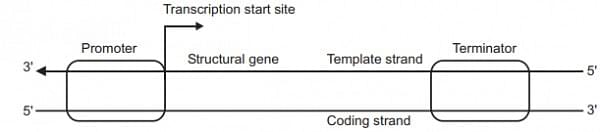
Transcription unit
- Initiation
- Elongation
- Termination
Initiation
The RNA polymerase attaches itself to the DNA molecule and then starts moving along the DNA strand until it identifies a promoter sequence. These points are known as transcription starts sites. The double helix structure of the DNA then unwinds and all the bases that are present on the DNA strands are exposed. This acts as a simple guideway for a new mRNA strand.
Elongation
In the elongation step of DNA transcription, ribonucleotides are added.
Termination
As the process continues, the RNA polymerase encounters a terminal sequence and the transcription automatically stops. The RNA polymerase then releases the DNA template.
Processing of RNA
[Click Here for Sample Questions]
Go through the link here for a better knowledge on Processing of RNA
After the process, the transcribed RNA is known as the pre-mRNA.
This mRNA is then processed more to convert it into a mature RNA. The process of RNA includes:
- Capping
- Polyadenylation
- Splicing
Capping
To protect the newly synthesized mRNA, a methylated guanine cap is added. It involves:
- The addition of methylated guanine
- It occurs at the 5’ end of the mRNA transcript.
- Capping helps to protect the mRNA from degradation
Polyadenylation
For the protection of the mRNA from degradation, the poly-A tail is also present. It involves:
- At a specific sequence, the endonucleases cleave the mRNA.
- The enzyme poly-A polymerase helps in the addition of many adenine nucleotides.
Splicing
- In the non-coding sequence, that is the introns are removed with the help of spliceosome excision.
- The exons of the coding sequences are joined together by ligation.

Processing of RNA
Thus, with the help of this process, several proteins can be made from a single pre-mRNA. At the end of the process of transcription, a mature mRNA is obtained.
For an example, if the sequence of the coding strand is 5’ - T A C G T A C G T A C G T A – 3’, then the sequence of the transcribed RNA is 5’ - U A C G U S C G U A - 3' The RNA would be having the same sequence as the recording strand, except thymine would be in the place of uracil.
Sample Questions
Ques. What is the process of transcription in biology? (1 mark)
Ans. The process in which a DNA sequence is transcribed into an RNA molecule using the help of an enzyme RNA polymerase is transcription. A DNA strand is used as a template to make a complementary RNA strand.
Ques. In a transcription, where is the promoter unit located? (1 mark)
Ans. The location in the gene where the RNA polymerase would be binding and initiating the process of transcription is called the promoter sequence. They are always located upstream at the 5- end of the transcription initiation site.
Ques. Where does the transcription process start and terminate? (1 mark)
Ans. The transcription process starts at the 5 - end of the DNA sequence.
Ques. What is the end product of transcription process? (1 mark)
Ans. A mature RNA transcript is a result or the by-product of transcription. Any type of RNA can be formed such as rRNA, mRNA, non-coding RNA or tRNA.
Ques. What is the difference between prokaryote mRNA and eukaryote mRNA? (1 mark)
Ans. There is a huge difference between the mRNA molecules of a eukaryote and a prokaryote. The prokaryotes have polycistronic mRNA. On the other hand, eukaryotes have a monocistronic mRNA.



Comments