



Education Content Expert
Translatory Motion is a type of motion in which all the points present on the moving body move uniformly in the same direction. If a body undergoes translatory motion, there is no change in its orientation with respect to a fixed point. A body is said to be in a translatory motion if the object moves in such a manner that all the particles in the object move parallel to each other. In translatory motion,
- The magnitude of velocity and acceleration of each particle are the same and in the same direction.
- All the points of objects have identical trajectories.
- All the points of a body move with uniform speed in the same direction or line.
- Translatory motion is also known as translation motion.
- Examples of Translatory motion are a moving train on a track, a person walking on a road, flying birds in the sky, and moving coins on a carrom board.
Read More: NCERT Solutions for Class 11 System of Particles and Rotational Motion
Key Terms: Motion, Translatory Motion, Rectilinear Motion, Curvilinear Motion, Uniform Motion, Direction, Path
What is Translatory Motion?
[Click Here for Sample Questions]
Translatory Motion is experienced by a body when it is shifted or moved from its initial position to another position. If a body moves such that all the particles in that body move parallel to each other, then this motion is termed as pure Translational Motion.
Consider an example to understand the concept of translatory motion.
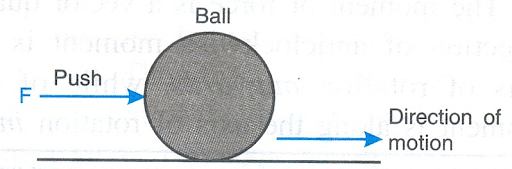
Translatory Motion
In the above diagram, a ball is placed on a plane surface. A force F is applied to it. Because of its circular shape, it will experience rotational motion. Since a uniform force is applied to it, all particles of the ball will have the same velocity, and acceleration and be in the same direction. Hence this motion is translatory motion.
Based on the movement of objects, Translatory motion can be classified into two types. The two types of translatory motion are as follows:
- Rectilinear Motion
- Curvilinear Motion
Read More:
Translatory Motion Example
[Click Here for Sample Questions]
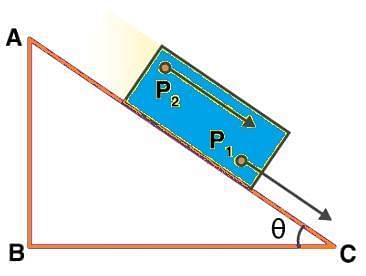
The core concept of Translatory Motion can be explained with the help of examples. Consider a solid rigid body i.e. a block is present on the slanting edge of the right-angled triangle. As soon as the solid block slides down the edge of the right-angled triangle, it can be easily seen that all the points present on the rectangular block experience the exact change in position with respect to time. This change in position with respect to time is known as displacement. All the points of the solid rectangular block experience the same velocity at all points of time.
Translatory Motion Example
As shown in the below image, both points P1 and P2 of the rectangular box experience the same translatory motion. This image displays an example of the translatory motion in the real life.
Read More: System of Particles & Rotational Motion Important Questions
Rectilinear Motion
[Click Here for Sample Questions]
Rectilinear Motion is a kind of Translatory motion in which the moving object moves along a straight line. The motion is said to be a rectilinear motion if an object moves in translatory motion along a straight line.
Examples of Rectilinear Motion are
- A vehicle moving in a straight line.
- A bullet fired from the gun.
- A ball or wheel falling from a cliff.
In the above examples, each point of an object moves in the same direction.
Curvilinear Motion
[Click Here for Sample Questions]
Curvilinear Motion is a kind of Translatory Motion in which the motion of an object is along a curved path. It is a kind of motion in which the object or body follows a fixed or known path of motion. A body moving in a curvilinear motion also moves forwards in a straight line along with its movement in the curved path.
Examples of Curvilinear Motion are
- The movement of a roller coaster.
- A coin tossed into the air.
- A car turning on a road is an example of curvilinear motion.
In the above examples all the points present on the object move in such a way that it follows a fixed curve path.
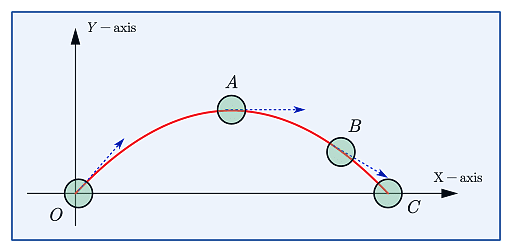
Curvilinear Motion
Consider the diagram above, a ball is thrown from point O to point C, without spinning it. As observed, a ball follows a trajectory path. The velocity of the ball may vary, but orientation does not change. It is an example of curvilinear motion.
Difference between Rectilinear and Curvilinear Motion
[Click Here for Sample Questions]
The difference between the Rectilinear and Curvilinear Motion is as follows:
| Rectilinear Motion | Curvilinear Motion |
|---|---|
| Rectilinear motion is a straight-line path of motion. | Curvilinear motion is a curved line path of motion. |
| In rectilinear motion, all particles in the motion move the same distance in a parallel straight line. | In the curvilinear motion, the orientation of the body remains the same while the trajectories of the individual particles are curved, not straight. |
| Example: The use of elevators in public places is an example of rectilinear motion. | Example: The movement of a train on a curved track is an example of curvilinear motion. |
Check More:
Things to Remember
- Translatory Motion is a motion in which all the points present on the moving object, move in the same direction with the same velocity.
- Translatory Motion is also known as Translational Motion.
- There are two types of Translational Motion namely Rectilinear Motion and Curvilinear Motion.
- In Rectilinear Motion, all the points of the body move in the same direction.
- In the Curvilinear Motion, all the points of the body move along a fixed curved path.
- An example of Rectilinear Motion is the movement of a train in a straight path.
- An example of Curvilinear Motion is the movement of a train in a fixed circular path.
Sample Questions
Ques. What is Translatory Motion? What are the types of Translatory Motion? (3 Marks)
Ans. Translatory Motion is a type of motion in which the object moves with uniform motion in the same direction. In this type of motion, all the points of the object move in a parallel direction. In this type of motion, the orientation of the body does not change. Some of the well-known examples of Translatory Motion are a football moving in a parabolic path and a boy on a cycle cycling on a straight road.
Translatory motion can be classified in two types:
- Rectilinear Motion
- Curvilinear Motion
Ques. Explain in detail the various types of Translatory Motion with examples. (5 Marks)
Ans. The various types of Translatory motion are as follows:
Rectilinear Motion
It is a type of motion in which the body moves along a straight line. It is a type of translatory motion that moves in one single direction. An object is said to be moving in rectilinear motion if the two objects are moving parallel in a straight line. Some of the well-known examples of Rectilinear motion are as follows:
- The motion of an aeroplane in the sky is an example of rectilinear motion.
- Box sliding down from a Triangular slide.
- The acting of Gravitational force on any object that results in free fall.
Rectilinear Motion is further divided into the following three types:
- Uniform Rectilinear Motion
- Uniformly Accelerated Rectilinear Motion
- Rectilinear Movement with Non-uniform Acceleration
Curvilinear Motion
It is a type of motion in which the body moves along a curved path. The object or body in a curvilinear motion follows a fixed curve path. The Curvilinear motion is a kind of motion in which any particle traverses the distance from one point to another in a curved path. Some of the well-known examples of Curvilinear motion are as follows:
- The planet’s motion around the sun is an example of curvilinear motion.
- Turning off any car from left to right and vice versa.
- The curved trajectory travelled by the ball on throwing it at an angle from the ground.
Ques. What is Motion? (2 Marks)
Ans. In Physics, motion is defined as the change in the position or the orientation of the body with respect to time. All types of motion are relative to one or another frame of reference. The motion of the body in a line or a curve is known as translational motion. On the other hand, if the motion changes the orientation of the body then it is known as Rotational motion.
Ques. What is the difference between translatory and linear motion? (3 Marks)
Ans. The differences between translation and linear motion are as follows
| Linear Motion | Translatory Motion |
|---|---|
| When an object/ body moves in a straight line, then the motion is called linear (rectilinear) motion. | In translatory motion all the points of a body move in the same direction and cover an equal amount of distance at the same time. |
| In linear motion, the body has to move in a straight direction or line. | In translatory motion, a body does not need to move in a straight line |
| Linear motion is a one-dimensional motion. | Translatory motion can be 2-dimensional or 3-dimensional. |
Ques. What is the basic difference between rectilinear and curvilinear motion? (1 Mark)
Ans. In rectilinear motion, all the points of a moving body cover the same distance in a parallel straight line. While in curvilinear motion, the trajectories of each point of a body are curved and not a straight line.
Ques. Write some examples of translatory motion seen in daily life. (3 Marks)
Ans. Some examples of translatory motion observed in daily life are:
- A vehicle like a bike or a car moving with uniform speed in the same direction.
- A ball is thrown into the sky without giving it a spin.
- Walking at a uniform speed.
- Children sliding down from a slide.
Ques. Which of the following(s) is/are not an example of translatory motion? (2 Marks)
(a). A car moving in a straight line.
(b). A Satellite revolving around the earth.
(c). The motion of the Ferris wheel about an axis of rotation.
(d). A ball is thrown from a horizontal surface at an angle θ.
Ans. (c) The motion of the Ferris wheel about an axis of rotation.
Explanation: When the Ferris wheel is in motion along any axis of rotation, all the particles of the wheel do not have the same velocity, acceleration, and displacement. The motion of the Ferris wheel is an example of rotational motion.
Ques. What is Rectilinear Motion? Give examples of rectilinear motion. (3 Marks)
Ans. Rectilinear Motion means the word “straight ” in geometry. It is a kind of Translatory motion in which the body travels in a straight line. All the points of the object in the rectilinear motion move in the same direction parallelly. All the points of the object have the same velocity.
Some of the well-known examples of rectilinear motion are
- The motion of a vehicle on a straight road,
- The running of a person on a straight path, and
- The Sliding of an object, etc.
Ques. What is Curvilinear Motion? Give some examples of curvilinear motion. (3 Marks)
Ans. Curvilinear Motion is a type of Translatory motion in which the object moves on a fixed curve. All the points on the object move along the curved path. Some examples of Curvilinear Motion are:
- Movement of a Snake
- Movement of a Roller Coaster
- Movement of a car on a circular road
Ques. Why is the motion of the bullet fired from a gun an example of Rectilinear Motion? (3 Marks)
Ans. The motion of the bullet fired from a gun is an example of Rectilinear motion due to the following reasons:
- All particles of the bullet move in the same direction.
- The velocities of all the particles of the bullet are the same.
- All the particles of the bullet travel parallel after it is fired from the gun.
Ques. What are various types of Motion? (3 Marks)
Ans. Motion is categorized based on the nature of the movement of the object. There are three types of motion:
- Linear Motion: It is also known as rectilinear motion. Linear motion is one-dimensional in a straight line. This motion can be described mathematically by the use of only one spatial dimension.
- Rotatory Motion: Rotatory Motion is defined as a kind of Motion in which the object rotates on its own axis.
- Oscillatory Motion: Oscillatory Motion is a kind of motion in which the move to and fro about its fixed position.
Ques. What is Circular Motion? Give some examples of circular motion. (3 Marks)
Ans. Circular Motion is a kind of motion in which a body moves while rotating along a circular path. There are mainly two types of Circular motion namely: Uniform Circular Motion and Non-Uniform Circular Motion. It is a type of motion of an object along the circumference of a circle or rotating along a circular path.
Some examples of Circular Motion are as follows:
- A car moving around a roundabout.
- The moon orbiting around the earth or the earth revolving around the sun.
Check More:



Comments