



Content Curator
Chemical processes which involve organic molecules are known as organic reactions. The fundamental types of organic chemistry reactions include photochemical reactions, redox reactions, pericyclic reactions, elimination processes, and substitution reactions. In the process of creating new organic compounds, organic reactions are used. Many man-made chemicals, including medicines, plastics, food additives, and textiles, are produced through organic interactions. Combustion of organic fuels and the saponification of fats to produce soap are the two earliest organic reactions.
Key Terms: Organic Reaction, Elimination Reaction, Substitution Reaction, Addition Reaction, Radical Reaction
What are Organic Reactions?
[Click Here for Sample Questions]
Organic Reactions are chemical processes in which organic materials transform inorganic substances. By creating a relationship between the two types, one type in this reaction that has unrelated or bound electrons "donates" an electron pair to another type that is lacking in electrons.The factors that control chemical reactions are largely the same for organicc reactions as well.
The stability of reactants and products is determined by factors particular to organic processes, including aromaticity, hyperconjugation, and conjugation, as well as the presence and stability of reactive intermediates like free radicals, carbocations, and carbanions.
Pharmaceutical manufacturing relies on organic processes. In a 2006 review, it was estimated that alkylations on nitrogen and oxygen atoms accounted for 20% of chemical conversions, protective group addition and removal accounted for another 20%, and the synthesis of new carbon-carbon bonds for 11%, and functional group interconversions accounted for 10%.
The video below explains this:
Types of Organic Reactions Detailed Video Explanation:
Types of Organic Reactions
[Click Here for Sample Questions]
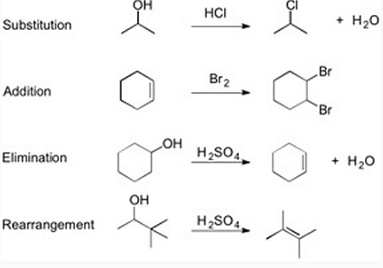
There are mainly five types of organic reactions-
- Substitution Reaction
- Addition Reaction
- Elimination reaction
- Oxidation-reduction reaction
- Radical Reaction
Substitution reaction
When one active group in a chemical structure is replaced by another active group, this is referred to as a reaction. Depending on the reagent used, the exchange reaction of a living chemical is categorized as either nucleophilic or electrophilic.
- The nucleophile must possess a pair of electrons and have a stronger attraction for electropositive species than the initial environment to react to a nucleophilic Substitution.
- Example of a substitution reaction is halogenation. When chlorine gas (Cl-Cl) is exposed to radiation, some of the molecules split into two chlorine radicals (Cl), each of which has a strong affinity for nucleic acids.
- A weak covalent link between one of them and hydrogen is broken, and the proton that is released is taken to create the electrically neutral H-Cl. The second radical alteration forms a covalent connection with the CH3 to create CH3Cl (methyl chloride).
![Substitution Reaction]()
Substitution Reaction

Addition reaction
When two or more reactants combine to generate a product without losing any of the atoms present in the reactants, this is known as an addition reaction. Compounds with unsaturated C-C bonds, such as double (alkene) and triple (alkyne) bonds, frequently undergo addition reactions. Two new, stronger ties are formed out of the weaker one.
- A composite reaction is one in which multiple carbon-carbon bonds are strengthened by the addition of components A and B.
- Methylene chloride is produced when ethylene and hydrogen chloride are combined in the reaction described below.
HCl+CH2=CH2→CH3CH2Cl
- These reactions can only occur in a small number of chemical compounds with many bonds, such as molecules having triple bonds (alkynes), carbon-carbon bonds, double bonds (alkenes), or imine (C=N) groups.
There are two types of addition reactions-
|
Elimination Reaction
A certain reaction occurs in which neighboring atoms are either removed or removed. Following the formation of these many connections, tiny molecules are released as by-products.
- A reaction that prevents the transformation of ethyl chloride into ethylene is:
CH3CH2Cl→CH2=CH2+HCl
- These Reactions include the one- or two-step removal of two substituents from a molecule. The "E2 Reaction" refers to the one-step mechanism, while the "E1 Reaction" to the two-step mechanism
- However, bimolecular and unimolecular kinetics of the Reaction separately, the numbers do not have to do with the number of steps in the mechanism.
- The third type of Reaction, E1CB, happens when a molecule can produce an anion but has a weak leaving group. Eventually, an "internal" elimination mechanism known as the Ei mechanism is employed to carry out the pyrolysis of xanthate and acetate esters.

Elimination Reaction
Oxidation Reduction Reaction
Redox reactions are oxidation-reduction chemical processes in which the oxidation states of the reactants change. Redox is a shortened version of reduction-oxidation.
- Two distinct processes—a reduction process and an oxidation process—can be used to describe all redox reactions. The redox reaction, also known as the oxidation-reduction reaction, always involves simultaneous oxidation and reduction reactions.
- In a chemical reaction, the material that is being reduced is referred to as the reducing agent, while the substance that is being oxidized is the oxidizing agent.
![Oxidation Reduction Reaction]()
Oxidation Reduction Reaction

Radical Reaction
A radical substitution reaction is one in which one or more of the atoms or groups present in the substrate are replaced by new atoms or groups through the use of a free radical mechanism. A radical chain reaction's initiation step is the point at which a free radical is created for the first time.
- When two radicals interact in some way to prevent the chain from continuing, this is known as the termination stage of a radical chain reaction.
- While radical halogenation of relatively simple alkanes can be a successful synthetic technique, it cannot be used to produce particular alkyl halides from bigger, more complex alkanes because radical reactivity invariably results in mixes of single- and multiple-halogenated species.
Read More:
Things to Remember
- Organic Reactions are used In the process of creating new organic compounds.
- There are mainly five types of organic reactions- Substitution Reaction, Addition Reaction,Elimination reaction, Oxidation-reduction reaction and Radical Reaction.
- Two or more reactants combine to generate a product without losing any of the atoms present in the reactants, this is known as an addition reaction.
- There are two types of addition reactions- Electrophilic addition reaction and Nucleophilic addition reaction
- Oxidation reduction chemical processes in which the oxidation states of the reactants change.
- A radical reaction is in which more than one group of atoms are present in the substrate and are replaced by new atoms or groups through the use of a free radical mechanism.
Sample Questions
Ques. Alkene addition reactions: why do they occur? (2 marks)
Ans. Alkenes have a strong sigma bond (397 kJ mol-1), which is made up of two molecules, and a weak pi bond (284 kJ mol-1), which is made up of one molecule. Alkenes undergo addition reactions because of the slackly held pi electrons.
Ques. Which substances all undergo addition reactions? (2 marks)
Ans. Alkene, alkyne, and carbonyl are examples of substances that exhibit electrophilic addition reactions and nucleophilic addition reactions, respectively.
Ques. Name the reaction that results in the production of the intermediate carbocation. (1 mark)
Ans. An intermediate in the Wagner-Meerwein rearrangement is the carbocation.
Ques. Name a process in which a free radical is involved. (1 mark)
Ans. A free radical mechanism is involved in the Anti-addition Markovnikov's of HBr, the peroxide effect, or the Khara Sach effect.
Ques. Is an intermediate of the electrophilic substitution of the aromatic benzene, uranium, formed? (2 marks)
Ans. The sigma complex/arenium ion is not aromatic because of the sp3 hybridized carbon. Complex loses H+ from the sp3 hybridized carbon to regain its aromatic property.
Ques. What factors affect elimination reactions? (2 marks)
Ans. Factors affecting elimination reactions that influence E1 elimination reactions are-
- The stability of the carbocation
- The form of the leaving group
- The solvent type
Ques. What is a nucleophilic elimination reaction? (2 marks)
Ans. Nucleophilic substitution is a fundamental class of reactions in which an electron-rich nucleophile selectively binds or attacks the positive or partially positive charge of an atom or group of atoms as a substitute for a so-called leaving group.
Ques. What is Substitution Reaction? (2 marks)
Ans. Substitution reaction is a reaction in which the functional group of one chemical compound is substituted by another group or as a reaction which involves the replacement of one atom or a molecule of a compound with another atom or molecule.
Do Check Out:



Comments