



Education Content Expert
Valency Chart is a representation of the valency of different elements in the modern periodic table. Valency is the capacity of an element to combine with other elements.
- Valency refers to the number of electrons gained or lost to attain a stable electron configuration.
- Electrons in an atom are present in different shells represented as K, L, M, N, etc.
- The number of electrons in the outermost shell of an element is known as ‘Valence Electrons’.
- The valence electrons take part in any chemical reaction as they are in the outermost shells and are unstable.
According to the Bohr-bury scheme, the outermost orbit of an atom can hold up to 8 electrons. If the outermost orbit is completely filled then it is considered very stable and little to no chemical activity is observed in the particular element. Their reaction rate is negligible or zero.
Read More: NCERT Solutions for Class 9 Science Atoms and Molecules
| Table of Content |
Key Terms: Valency, Atoms, Elements, Valence Electrons, Electronic Configuration, Periodic Table, Outermost Shell
What is Valency?
[Click Here for Sample Questions]
Valency is defined as the combining capacity of an element.
- Valency of an element is the measure of electrons in the outer shell.
- Elements in the same group of the periodic table possess the same valency.
- It helps to formulate a chemical compound of different elements.
- It helps to determine how many atoms of an element are capable of combining with another element to form a new chemical compound.
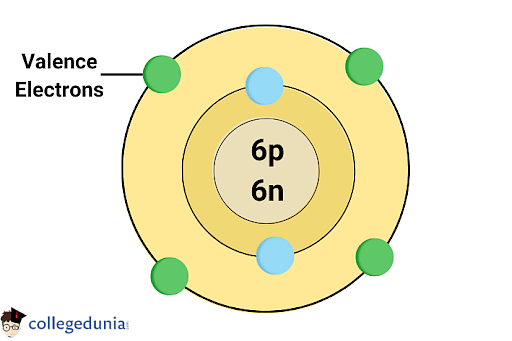
Valency
Read More:
| Relevant Topics | ||
|---|---|---|
| Structure of Atom | Atomic Mass of Elements | Electronegativity Chart of Elements |
| Difference Between Element and Compound | Periodic Properties of Elements | Atomic and Molecular Masses |
Valency and Oxidation State
[Click Here for Sample Questions]
Electrons found in the outermost shell are known as Valence Electrons. The number of valence electrons determines the valency of an atom.
- The valency of s-block elements and p-block elements in the periodic table is determined as the number of valence electrons or eight minus the number of valence electrons.
- The d-block and f-block elements have different valency levels depending on whether they have cation or anion orbitals.
- The d and f-block elements generally have a valency of 2 and 3.
Read More: Atoms & Molecules
Valency of First 30 Elements
[Click Here for Sample Questions]
Given below is the valency of the first 30 elements of the periodic table:
| Element | Atomic Number | Valency |
|---|---|---|
| Hydrogen (H) | 1 | 1 |
| Helium (He) | 2 | 0 |
| Lithium (Li) | 3 | 1 |
| Beryllium (Be) | 4 | 2 |
| Boron (B) | 5 | 3 |
| Carbon (C) | 6 | 4 |
| Nitrogen (N) | 7 | 3 |
| Oxygen (O) | 8 | 2 |
| Fluorine (F) | 9 | 1 |
| Neon (Ne) | 10 | 0 |
| Sodium (Na) | 11 | 1 |
| Magnesium (Mg) | 12 | 2 |
| Aluminium (Al) | 13 | 3 |
| Silicon (Si) | 14 | 4 |
| Phosphorus (P) | 15 | 3 |
| Sulphur (S) | 16 | 2 |
| Chlorine (Cl) | 17 | 1 |
| Argon (Ar) | 18 | 0 |
| Potassium (K) | 19 | 1 |
| Calcium (Ca) | 20 | 2 |
| Scandium (Sc) | 21 | 3 |
| Titanium (Ti) | 22 | 4 |
| Vanadium (V) | 23 | 5,4 |
| Chromium (Cr) | 24 | 2 |
| Manganese (Mn) | 25 | 7, 4, 2 |
| Iron (Fe) | 26 | 2, 3 |
| Cobalt (Co) | 27 | 3, 2 |
| Nickel (Ni) | 28 | 2 |
| Copper (Cu) | 29 | 2, 1 |
| Zinc (Zn) | 30 | 2 |
Check out Important Question on: Valency to Copper and Iron
Periodic Trends in the Oxidation States of Elements
[Click Here for Sample Questions]
There are certain trends that are followed in the oxidation state of elements periodically. The periodic trends in the oxidation states of elements are as follows:
Variation of Oxidation State along a Period
- The number of valency electrons in an element increases and changes between 1 and 8.
- When elements are combined with H or O first, the valency of the elements increases from 1 to 4, and then it decreases to zero.
Consider two compounds containing oxygen Na2O and F2O.
- In F2O, the F atom has more electronegativity than oxygen.
- Hence, each F atom will attract one electron from oxygen i.e. F will show a -1 oxidation state, and O will show a +2 oxidation state.
- Whereas, Na2O is much more electronegative than O2, which makes it a better choice for water storage.
- So when there is an oxygen atom in a molecule, it will attract one electron away from the sodium atom, and the sodium atom will have a +1 oxidation state.
Variation of Oxidation State within a Group
The number of valence electrons stays the same in a group. The elements in a particular group have the same value.
Read More: Difference Between An Atom And A Molecule
Oxidation State Rules
[Click Here for Sample Questions]
Here are a few characteristics that can help us to assign oxidation states to various elements.
- The oxidation state of elements like O2, S8, H2, P4, Fe, etc is zero.
- Though oxygen has an oxidation state of -2, it has -1 as its oxidation state in its peroxides like Na2O2 and H2O2.
- Similarly, hydrogen has an oxidation state of +1, however, it is -1 in metal hydrides, such as NaH, LiH, etc,
- Halogens have a -1 oxidation state except when they form a compound with one another or Oxygen.
- Alkali Metals such as Na, K, Rb, Li, and Cs have a +1 oxidation state.
- Alkali Earth Metals such as Mg, Ca, Ba, Be, Sr, etc. have a +2 oxidation state.
Check More:
Things to Remember
- Valency is the ability of an element to combine with other elements to form a new compound.
- The number of electrons in the outermost shell of an atom is called Valence Electrons.
- Elements in the same group of the periodic table have the same valency.
- Oxidation state is the number of electrons lost or gained by an atom.
- Valency helps to formulate a chemical compound of different elements.
- The valency of the Group 18 elements or Noble Gases is Zero.
Sample Questions
Ques. What is Valency? (2 Marks)
Ans. Valency is the capacity of an element to combine with another element and can be defined as the number of electrons gained or lost to attain a stable electron configuration. For instance, one atom of carbon combines with 2 atoms of oxygen which have 2 valence electrons to form carbon dioxide gas. Thus, the valency of nitrogen is 4.
Ques. What is the valency of Calcium? (1 Mark)
Ans. The valency of calcium is 1 and one atom of calcium can make one bond.
Ques. What is Octet Rule? (2 Marks)
Ans. The octet rule is followed if the valency of a molecule can not be determined using the periodic table. This rule states that atoms of an element or chemical will tend to gain or lose electrons in their outermost orbit in any way that they are combined. The outermost orbit of an element can hold up to 8 electrons. The presence of 8 electrons in the outermost shell indicates that the atom is stable.
Ques. What is the valency of Oxygen? (1 Mark)
Ans. The atomic number of oxygen is 8. The number of valence electrons in oxygen is 2 and it needs to gain 2 electrons in the outermost orbit to attain an octet. Hence, the valency of oxygen is 2.
Ques. What is Tetravalency? (2 Marks)
Ans. Elements that have a valency of four are called tetravalent elements and are capable of bonding with four other atoms of the same element or with some other element. This property of elements is known as tetravalency.
Ques. Determine the valencies of Ne, P, and S. (3 Marks)
Ans. The given elements are Neon (Ne), Phosphorus (P) and Sulphur (S).
(a) Atomic Number of Neon = 10
Electronic configuration of Neon = 2, 8
Therefore, Valency = 8-8 = 0
(b) Atomic Number of Phosphorus = 15
Electronic configuration of phosphorus= 2, 8, 5
Therefore, Valency of Phosphorus = 8-5 = 3
(c) Atomic Number of Sulphur =16
Electronic configuration of Sulphur = 2, 8, 6
Therefore, Valency pf Sulphur = 8-6 = 2
Ques. What is the valency of Fluorine? (2 Marks)
Ans. The atomic number of Fluorine is 9. The electronic configuration of Fluorine can be written as 2, 7. 2, 7 electrons are distributed in the shells K, and L, respectively. Therefore, the valence electron in fluorine is 7 and it needs to gain 1 electron from the outermost orbit to attain an octet. Hence, the valency of chlorine is 1.
Ques. Does Valency have a charge? (2 Marks)
Ans. Charge refers to the value which is attained when an atom loses or gains electrons. It happens to satisfy the octet rule of valency. Valency is calculated for elements while the charge is defined for loss. Thus, we can not relate valency to charge.
Ques. What is the valency of Noble Gases? (2 Marks)
Ans. Noble gases are present in the Group 18 of the modern periodic table. They contain the highest valence electrons in their outer shell. The outermost shell of noble gases has zero valency and no electrons.
Ques. Can valency have a negative value? (2 Marks)
Ans. The atom charge is defined as the loss or gain of an electron. The charge has positive and negative signs. The positive charge is gained by donating an electron while the negative charge is obtained by gaining an electron. However, valency has no sign.
Ques. How to calculate Valency? (2 Marks)
Ans. If the number of electrons in the outer shell is four or less, then the valency of an atom is equal to the number of electrons in the outer shell. Else, the valency is equal to eight minus the number of electrons in the outer shell. Once the number of valence electrons is equal, the valency can be calculated easily.
Check-Out:



Comments