



Content Curator
Light year is defined as the distance travelled by light in one year. It is denoted by the symbol “ly”. This unit is used in astrophysics to measure the distance between two astronomical objects. One light year is equal to 9,500,000,000,000 kilometres. Thus,
- Value of One Light Year = 9.4607 × 10¹² km.
- 1 light-year in miles = 5.88 × 10¹² miles
- 1 light-year in the Astronomical unit = 63241 au.
For example, the distance between the sun and earth can be measured in light-years. Even though a light-year might seem like a unit of time, it is not. It is a unit of distance just like a meter, kilometre, inch, and mile. When measuring the distance between astronomical bodies, these commonly used units of distance seem smaller. That’s why a larger unit like a light-year and the astronomical unit is needed.
Read More: Black Hole
| Table of Contents |
Key Terms: Light Year, Astronomical Unit, Celestial Body, Parsec, Galaxy, Milkyway Galaxy, Spiral Galaxy, Andromeda Galaxy, Light Minute
What is Light Year?
[Click Here for Previous Year Questions]
A light-year is a unit of measurement for calculating distances between astronomical bodies. Light Year can be defined as:
| “A light-year is a unit of distance and the distance travelled by light in a year. As per International Astronomical Union (IAU), light-year is the distance a light photon travels in the vacuum in one Julian year (365.25 days).” |
- Light Year is denoted by the symbol ly.
- The value of one light-year is typically constant.
- Usually, a light-year is usually used in astrophysics in order to measure the distance between two astronomical objects.
- The velocity of Light is about 300,000 kilometres (km) per second.
- It is able to travel almost 10 trillion km.
- To measure the distance between astronomical bodies in the universe, we need larger units.
- For example, the distance between the Milkyway galaxy and the nearest galaxy, which is the Andromeda Galaxy, is 21 quintillion km.
- So, for the distances of objects within our solar system, we use the astronomical unit (au).
- Astronomers use light-years or parsecs to measure distances to other parts of the Milky Way galaxy.
Distance Between Sun and Earth
Earth is the third planet from the sun in our solar system. The distance between the Earth and the sun is almost about 147.14 million km. Thus, in light-years, this distance is said to be 1.55 × 10⁻⁵. To be more precise, the Sun is at a distance of 15.54795 × 10⁻⁶ light-years from the Earth.
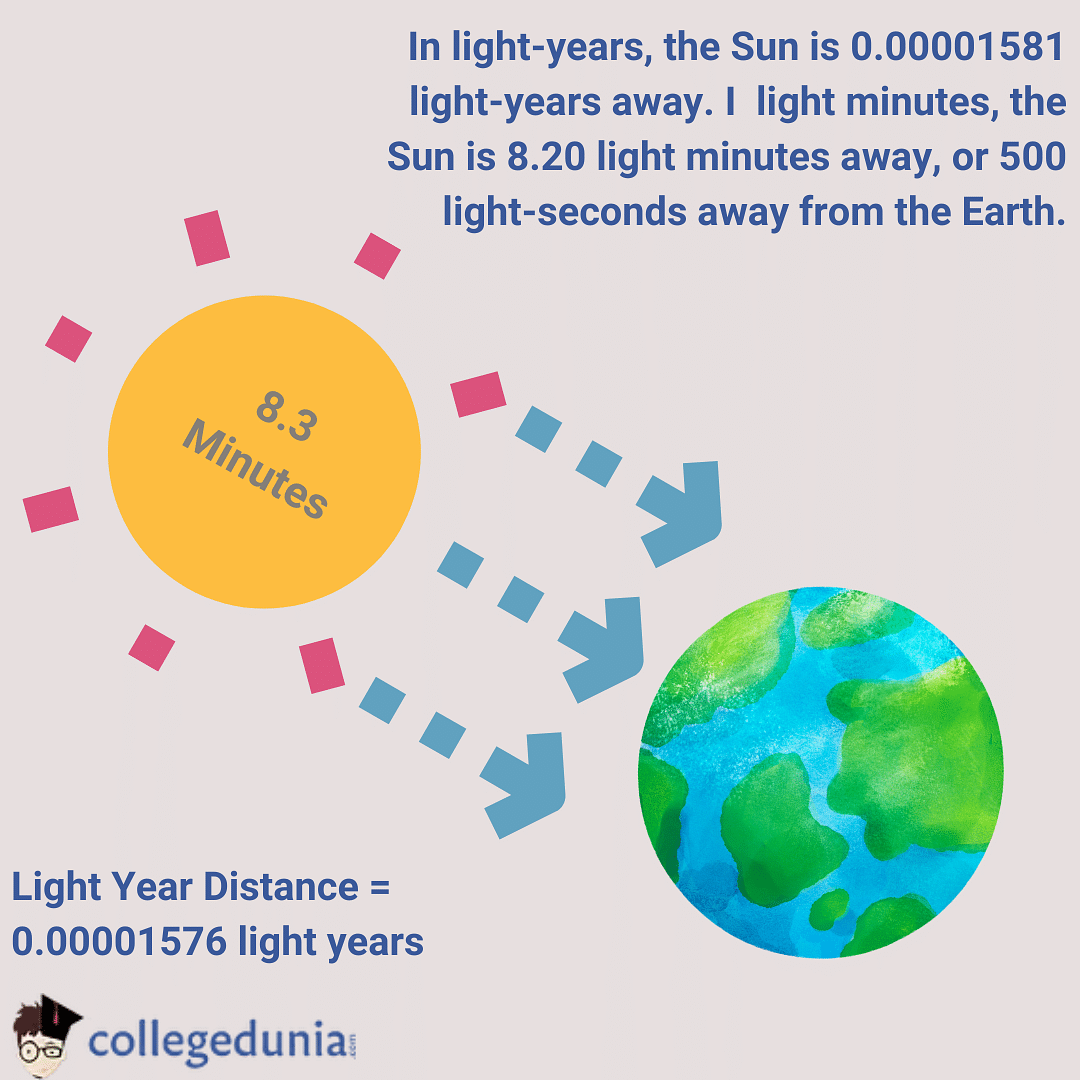
Distance Between Sun and Earth
Read More:
| Topic Related Concepts | ||
|---|---|---|
| Constellations | Unit of Length | Speed of light |
What is Julian Year?
[Click Here for Sample Questions]
The Julian year typically corresponds to the years in a Julian calendar.
- It functions as a way to measure or define a year.
- However, note that Julian year is not a unit of measurement but a SI Unit in astronomy.
- A Julian Year consists of 365.25 days.
- The value of light year as per the SI unit metrics is equal to: 9.4607\(\times\)1015 m = 9.4607 Pm (1 Pm or Petameter = 1015 m)
Planets’ Distance from the Sun
The distance of various planets from the sun is tabulated below:
| Planet | Distance (in years, minutes and hour) |
|---|---|
| Mercury | 0.0000053475 light-years or 3.3 light minutes |
| Venus | 0.000011409 light-years or 6 light minutes |
| Earth | 0.00001582002493716235 light-years or 8.3 light minutes |
| Mars | 0.000024155306893301653 light-years or 12.7 light minutes |
| Jupiter | 0.000078342 light-years or 43 light minutes |
| Saturn | 0.0001505453985955772 light-years or 1.3 light-hours away |
| Uranus | 0.00031111 light-years or 2.7 light-hours away |
| Neptune | 0.00047289 light-years or 4.2 light-hours |
Light Year Conversion
[Click Here for Previous Year Questions]
Converting light-year into SI unit (meter) and other units can be done as:
- 1 light-year = 9.4607 × 10¹⁵ m
- 1 light-year = 9.4607 Pm (1 Petameter or 1 Pm = 1015 m)
- 1 light-year = 9.4607 × 10¹² km = 9.4607 trillion km
- 1 light-year = 5.878 × 10¹² miles = 5.878 trillion miles
- 1 light-year = 63241 au
Frequently Asked QuestionsQues. How many Light Years away is the Sun from Earth? Ans. The Sun is approximately at a distance of 149.6 million kilometres away from the earth. If expressed in terms of the light-year, the same distance approximates about 15.54795 × 10⁻⁶ light year. Hence, the Sun is at a distance of 15.54795 × 10⁻⁶ light-years from Earth. Ques. Show the value of one light-year in kilometres. Ans. One light year = 9.4607 × 10¹² km. |
Age of a Celestial Body using Light Year
[Click Here for Sample Questions]
Using light-year as the unit of measurement for distance also helps to determine the age of a celestial body.
- Say, a star is 1 million light-years away.
- Then, the light coming from it, travelling at the speed of 3 × 10⁸ m/s, reaches us 1 million years later.
- So, the light of this star that we see in the present day is from a star illuminated 1 million years ago and how it looked back then.
- Similarly, the sun is 8.317 light minutes away from the earth.
- So, it takes around 8 minutes for the sunlight to reach us.
One Light-Year
One light-year is equal to 5,878,625,370,000 miles. Thus, in order to show the same, the following can be represented:
In a vacuum, light is observed to travel at a speed of 1,079,252,849 km/h.
Hours (in a year) = 8766 hours
Thus, Distance = Speed × Time = s × t …(i)
Hence, in order to determine the distance of a light year, we are required to multiply this speed by the number of hours in a year.
According to the given data,
- s = 1,079,252,849 km/h
- t = 8766 hours
Replacing s and t by the given value in eq(1), we can obtain:
Distance = 1,079,252,849 x 8766
Therefore, one light year = 5,878,625,370,000 miles.
Check out:
Use of Light Year
[Click Here for Previous Year Questions]
Miles and kilometers feel smaller when having to measure the distance between astronomical objects. Here, the light-year, which is a larger unit to measure distance, is quite helpful. It can be used to measure the distance between the sun and the earth, the distance between two stars, etc.
- For example, the distance between the star, Orion Nebula, and the Earth is 7,861,000,000,000,000 miles.
- This, when represented in light-years, is 1300 light-years.
- This also helps astronomers determine how far back in time they are viewing.
- Since light takes time to travel and reach our eyes, certain events happening at a farther distance in the sky may have already happened.
- So, when something that we view is at a light-year distance, it means we see it at the present time as it was a year ago.
- The nearest spiral galaxy to us is the Andromeda galaxy, which is 2.5 million light-years away. So, it means this galaxy appeared 2.5 million years ago.
Did You Know?
|
Things to Remember
- Light-year is defined as the distance travelled by light in a year and is denoted by ly.
- The nearest star to the sun, Proxima Centauri, is 4.2 light-years away from Earth.
- Light-year is a unit of distance and not time.
- Light-year is a bigger unit of measurement and is helpful in measuring the distance between astronomical bodies.
- Sometimes, astronomers might use parsecs as an alternative unit to measure distances in space.
- Proxima Centauri, the nearest star to us, is 4.2 light-years away.
- Light travels at a speed of 3000 km per second.
Read More: Difference between Stars and Planets
Previous Year Questions
- A planet is revolving around the Sun as shown in the figure… [AP EAPCET]
- The distance of two planets from the sun are… [NEET 1994]
- A satellite is revolving in a circular orbit at a height… [JEE Main 2016]
- A satellite of mass M is in a circular orbit of radius R about the centre of… [JEE Main 2019]
- Assuming the sun to have a spherical outer surface of radius r… [NEET 2007]
- If the mass of the Sun were ten times smaller and the universal gravitational… [NEET 2018]
- Earth is revolving around the sun. If the distance of the earth…
- A comet orbits around Sun in an elliptical orbit… [KEAM]
- A satellite in force-free space sweeps stationary interplanetary… [NEET 1994]
- A planet moving around the sun sweeps the area… [KCET 2012]
Sample Questions
Ques: What is a light-year? [2 marks]
Ans: Light year is the distance travelled by light in a year. It is denoted with the symbol ly. The IAU defined a light year as the distance travelled by light in one Julian year in a vacuum. A light year, even though it seems like a unit of time, is actually a unit of distance. When measuring distances between astronomical bodies, astronomers need a larger unit of measurement for distance. So, they use light-years instead of kilometers and miles.
Ques: Calculate the distance in light years if the distance between two stars is 5.89 × 10⁵ au. [2 marks]
Ans: distance in au = 5.89 × 10⁵ au
1 light year = 63241 au
63241 au = 1 light year
5.89 × 10⁵ au = ? light year
distance = (5.89 × 10⁵) / 63241 light year = 0.931 light year
So, the distance between those two stars is 0.931 light years.
Ques: Calculate the distance of the star from our solar system in parsecs. This distance in light years is 4.29. [2 marks]
Ans: Distance in light-year = 4.29 light-year
1 light-year = 9.4608 × 10¹⁵ m
distance = 4.29 × 9.4608 × 1015 m
1 parsec = 3.08 × 10¹⁶ m
distance = (4.29 × 9.4608 × 1015) / (3.08 × 10¹⁶) parsec = 1.317 parsec
So, the distance of that star from our solar system in parsecs is 1.317 parsecs.
Ques: How many kilometres are there in a light-year? Calculate. [3 marks]
Ans: Speed of light = 3 × 10⁸ m/s = 3 × 10⁵ km/s
Now, one light year is the distance light can travel in one year.
distance = speed × time
1 light year = 3 × 10⁵ km/s × 1 year
1 light year = 3 × 10⁵ km/s × 365 days
1 light year = 3 × 10⁵ km/s × 365 × 24 hours
1 light year = 3 × 10⁵ km/s × 365 × 24 × 60 minutes
1 light year = 3 × 10⁵ km/s × 365 × 24 × 60 × 60 seconds
1 light year = 9.4608 × 105 × 107 km
1 light year = 9.4608 × 10¹² km
Thus, one light year is equal to 9.4608 × 10¹² kilometres.
Ques: How can the age of a celestial object be measured with the help of light-year? [3 marks]
Ans: A light-year is a unit of measurement for distance, but it can help to determine the age of celestial objects. Sunlight takes about 8 minutes to reach the earth, as the distance between the sun and the earth is around 8 light minutes. Similarly, the light of a star that is 1 million light-years away from us reaches us 1 million years later. This means that the light we observe is from the star’s illumination 1 million years ago. And if we continue to see this star’s light every day, then it can be said that the star is at least 1 million years old.
Ques: What is the light year used for? [3 marks]
Ans: A light-year is a unit of measurement for distance just like meter, kilometre, and mile. As astronomical objects in our galaxy and beyond are very far away, these smaller units of distance become tedious to manage. So, the light-year is a larger unit for the measurement of distance. It is quite helpful to measure the distance between astronomical objects. For example, it can be used to measure the distance between the sun and the earth.
With the light year, astronomers can also know how far back in time they are seeing. Certain occurrences and objects might be farther away than they might seem. So, it helps them determine events that have already happened and how far back they are dated.
Ques: Derive the value of 1 light-year and then calculate the distance between the sun and the earth in light-years. (Distance between sun and earth = 147.14 million km) [4 marks]
Ans: The speed of light is 3 × 10⁸ m
distance = speed × time = 3 × 10⁸ m/s × 1 year
= 3 × 108 × 365 × 24 × 60 × 60 m
= 9.4608 × 10¹⁵ m
This is the distance travelled by light in 1 year,
1 light year = 9.4608 × 10¹⁵ m
Now, the distance between the sun and the earth is 147.14 million km.
9.4608 × 10¹⁵ m = 1 light year
1.4714 × 10¹¹ m = 1 light year
d = (1.4714 × 10¹¹) / (9.4608 × 10¹⁵ m) = 1.55 × 10⁻⁵ light year
So, the distance between the sun and the earth is 1.55 × 10⁻⁵ light years.
Read More:



Comments