



Education Content Expert
Wasps are predatory insects that belong to the suborder Apocrita of the order Hymenoptera. Wasps, like ants and bees in the Apocrita suborder, sting prospective predators. Wasps have a sleek appearance, with a smooth exoskeleton, hairless legs, and wings. They have antennae and biting mouthparts. Wasps have around 10,000 distinct species. They are divided into two types namely solitary wasps and social wasps, with solitary wasps being the most prevalent. Social wasps fall under the family Vespidae, while solitary wasps fall under the superfamilies Chrysidoidea, Apoidea, and Vespoidea. Wasp Life Cycle includes four stages that begin with the queen wasp laying eggs and end with the decline of the wasp colony.
Read More: Bird and Insect Life Cycle
| Table of Content |
Key Terms: Wasp, Queen Wasp, Larvae, Eggs, Hibernation, Worker Wasps, Drones, Nest, Mating, Spermatheca, Wasp Colony
Life Cycle of Wasp
[Click Here for Sample Questions]
Wasp life cycle begins in early spring with the birth of a new queen wasp and concludes in winter with the death of the colony's Queen. Each wasp colony has the same caste structure, which consists of one egg-laying queen wasp, sterile female worker wasps, and male wasps.
There are four stages in the life cycle of wasp:
- Stage 1: Queen Lays Eggs
- Stage 2: Nest Building and Expansion
- Stage 3: Colony Expansion
- Stage 4: Colony Declination
Read More:
| Chapter-Related Links | ||
|---|---|---|
| Cockroach Life Cycle | Dragonfly Life Cycle | Flea Life Cycle |
| Ascariasis | Bed Bug Life Cycle | Plasmodium Life Cycle |
Stage 1: Queen Lays Eggs
[Click Here for Sample Questions]
In the spring, the queen wasp emerges from hibernation. After a brief period of eating and exploring, she begins to construct a nest in a dark and dry location.
- She prefers a warm location, generally on a sunny bank, but sometimes in attics, house roofs, eaves, or walls.
- She constructs a honeycomb-like cell structure using wood fiber.
- Wood fibers are chewed and bonded together with wasp saliva to create a paper mâché substance.
- The Queen then lays a single egg in each cell of the new nest, which hatches into a larva in 58 days.
- To feed the larvae, the Queen collects sweet substances and captures other insects.
- After about 15 days, each larva spins a silken cover over the cell and then pupates.
- Before an adult worker wasp emerges, pupation takes 8-18 days.
- The time it takes from egg to adult is typically 28-48 days, while the length of time spent in each stage is governed by environmental factors.
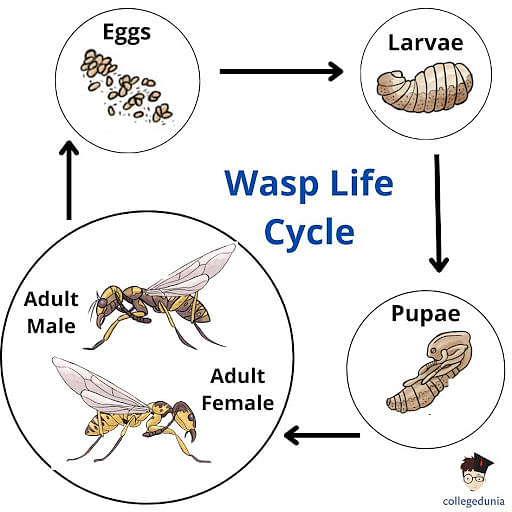
Wasp Life Cycle
Read More: Entomology
Stage 2: Nest Building and Expansion
[Click Here for Sample Questions]
As the nest grows downwards, successive layers of the comb are added beneath the current ones. Sometimes up to 20 layers of the comb are created, separated by pillars just high enough to let workers enter in between and feed the developing larvae.
- The nest envelope is stretched to encompass fresh comb, and pockets generated inside it trap air to insulate and warm the nest.
- Wasp nests are active at temperatures of 31°C.
- New worker wasps stay in the nest for the first three or four days after they emerge to help feed the growing larvae.
- Wasps spit water onto the area to be expanded and mix it with the waste material to make pellets.
- The pellets are subsequently transported away from the nest.
- After a spell of nest-building, the worker wasps shift to food collection.
- Then, the worker wasps return to spending the majority of their time in the nest as guard wasps near the nest entrance.
- Almost all worker wasps die before reaching the age of three weeks.
Read More: Lizard and Moth Life Cycle
Stage 3: Colony Expansion
[Click Here for Sample Questions]
During the summer and fall, the wasp nest begins to generate fertile wasps known as 'gyns.' Males (drones) often hatch from worker cells around two weeks before the queens. Drones are fertile males who only appear in the late summer or fall. The queens are generated in specifically expanded cells in the nest's comb near the bottom.
- A typical wasp nest produces between 1000 and 2000 queens every season.
- The queens may remain in the nest while storing fat for the winter.
- The drones will stay in the nest until the queens compel them to leave.
- They then stay away from the nest and eat while waiting for a chance to mate with the queens.
- Drones that have abandoned the nest like to congregate near trees or visible objects on high terrain.
- They constantly circle such items and rush to mate with any queen that flies into the mating swarm.
- The Queen stores the male's sperm in a tiny sac (called a spermatheca) in her reproductive system until it is needed to fertilise eggs for a new nest in the spring.
Read More:
| Related Links | ||
|---|---|---|
| Parasitism | Parasitic Symbiosis | Ant Life Cycle |
| Metamorphosis | Fungus Life Cycle | Grasshopper Life Cycle |
Stage 4: Colony Declination
[Click Here for Sample Questions]
After mating, the Queen seeks a dark, dry spot to hibernate for the winter.
- When queens hibernate, they tuck their antennae neatly between their legs and nibble the substrate to stay alive.
- Hibernation consumes very little of its stored fat, and the majority of queens survive this period of rest.
- The group of worker wasps feeds on the sugar solution provided by the larvae.
- Once all the larvae have pupated, the worker wasps are left without food and go outside the nest looking for food items.
- As winter approaches, the food sources are over and the new hibernating queen wasps die.
- After the queens and drones have been created, most wasp nests die out in late fall.
- The whole cycle repeats again at the beginning of spring.
Read More: Termite Life Cycle
Things to Remember
- Wasp is an insect of the suborder Apocrita of the order Hymenoptera.
- The life cycle of a wasp includes four main stages.
- In the first stage, the queen wasp wakes up from hibernation, looks for a preferred location and lays eggs.
- In the second stage, the nest is expanded and it grows bigger as more wasps join the colony.
- The third stage involves the expansion of the wasp colony as the reproduction process begins again after the birth of male and female wasps.
- The last stage is the colony declination. The nest is the biggest and all the larvae have pupated at this stage.
- As all the food sources are over, the new hibernating queen wasps die and the worker wasps move out to look for food.
Sample Questions
Ques. How long do Wasps live? (3 Marks)
Ans. A queen wasp may survive for around a year. The next year, a freshly emerging queen hibernates and creates a new colony. In normal conditions, she will die once the next generation of queens has been produced and the colony has reached its end. On the other hand, worker wasps have a lifespan of 12 to 22 days, with males having a somewhat shorter lifespan. The new queens are the colony's only survivors until the following year.
Ques. Are wasps helpful in any manner? (3 Marks)
Ans. Wasps are frequently seen as frightening insects that bite humans on purpose. Wasps, on the other hand, play a crucial role in the ecosystem. Wasps have a good life cycle in the garden because they kill immature aphids and caterpillars that devour crops in the spring and help pollinate plants.
Farmers are increasingly attempting to harness wasps to help them fight agricultural pests. They will consume certain delicate fruits, but there are ways to prevent wasps without killing them - remember, the colony only lasts a season.
Ques. What is the difference between a bee and a wasp? (3 Marks)
Ans. Wasps come in a variety of shapes and sizes. The wasp tree has a lot of branches. Bees are a branch of the wasp tree, but since they are so specialized, they are not classified as wasps. Wasps have a pointed lower abdomen and pointed waist called a petiole that separates the abdomen from the thorax. Wasps are more aggressive in nature compared to bees. Wasps are able to sting several times, whereas a bee can sting only once.
Ques. What happens if we kill a wasp? (2 Marks)
Ans. If one comes across a wasp and plans to kill it, one should not do it. A wasp when killed releases a chemical that signals the rest of the wasp clan to become alert. As a result, the other wasps might also get more aggressive at this point, so it is best to leave wasps alone.
Ques. Does wasps sting bees? (3 Marks)
Ans. Wasps will occasionally assault bee nests, mainly in search of invertebrate debris to feed the wasp larvae. Bees can generally resist a single wasp, but repelling a huge number of wasps would be difficult - and this would only happen later in the season when a wasp colony has at least a significant number of active workers.
To combat wasps at the beehive, beekeepers might employ a wasp trap. The greatest method to aid bees, in general, is to cultivate bee-friendly plants in the yard and avoid using dangerous pesticides.
Ques. When do Wasps die? (3 Marks)
Ans. Male wasps, or drones as they are commonly known, die off in the winter because they lack food and struggle to live in cold temperatures. Queen wasps hibernate during the winter, but this does not protect them from predators that devour them, such as spiders. An unusually mild winter may also stimulate the Queens to emerge from hibernation earlier, albeit a shortage of food may cause famine, and they will die out.
Ques. Is it common for wasps to nest in the same place? (3 Marks)
Ans. The 'Queen' wasps hibernate during the winter before emerging in the spring to choose a suitable location to establish a new nest, depending on the species. Old wasp nests from prior years are not reused. However, the Queen has been found to establish her new nest near to or 'inside' an old nest.
Furthermore, multiple Queens who survived the winter - often all from the same previous nest - may begin construction of their new nests in close proximity to one another. The queens begin by gathering wood, which they then chew up with their saliva to create a type of paper Mache or wood pulp from which to build their nest.
Ques. Where do Wasps construct their nests? (3 Marks)
Ans. Wasps construct their nests at places with the following features:
- They love regions that are dark, dry, and isolated.
- Anywhere away from potential disturbance.
- Somewhere away from the rain and moisture.
Ques. What should you do if you notice wasps around your property? (5 Marks)
Ans. The sight of wasps flying around your property may cause you to believe that a nest is close; nevertheless, wasps will naturally come into your yard or house to hunt for food, water, nest-building material, and so on.
- Avoid putting sweet-smelling plants near doors and windows. Wasps are drawn to the honey and sap produced by these plants.
- Do not establish fruit trees too close to your house; these trees, once again, attract wasps.
- Keep bins and exposed trash away from your home; ensure that bin lids fit and that any damage or holes are sealed.
- Look for 'white tramlines' on wooden garden furniture, which may signal that a queen wasp is exploiting it to scrape wood for nest-building material.
- Treat wooden furniture using a store-bought wood treatment solution or a teak oil mixture of eucalyptus, menthol, and citronella.
Ques. What distinguishes a wasp from a hornet? (3 Marks)
Ans. The size and colour of wasps and hornets identify them. Wasps range in size from one-third of an inch to one inch (two and a half centimeters). The Hornets are bigger. Wasps have black and white rings, but hornets have black and yellow rings.
The size of a flying stinger should be the first hint in determining if it is a wasp or a hornet. You're probably dealing with a hornet if the insect is enormous- larger than a fingernail. If it's significantly smaller and has a longer central part, it's probably a wasp.
Check-More:



Comments