



Exams Prep Master
Metabolism is the chemical reaction that enables organisms to transform the chemical energy stored in molecules into energy that can be used for cellular processes. There are two phases in metabolism namely anabolism and catabolism. In terms of the anabolic pathway where the complex molecule is produced from simple molecules, for example, amino acids become proteins. Whereas in catabolism where the more complex structure is broken down into simple molecules. Glycolysis is an example of catabolism where a more complex 6-C glucose molecule is reduced to 3-C pyruvic acid.
Key Terms: Metabolism, Energy, Bioenergetics, Catabolism, Anabolism, Enzyme, Excretion, Food, Starch, Sugar, Cellulose
What is Metabolism?
[Click Here for Sample Questions]
Metabolism it is the chemical process that allows organisms to convert the chemical energy stored in molecules into energy that can be used for cellular functions. There is a vital processes in living organisms such as nutrition, respiration, digestion, transportation and excretion.
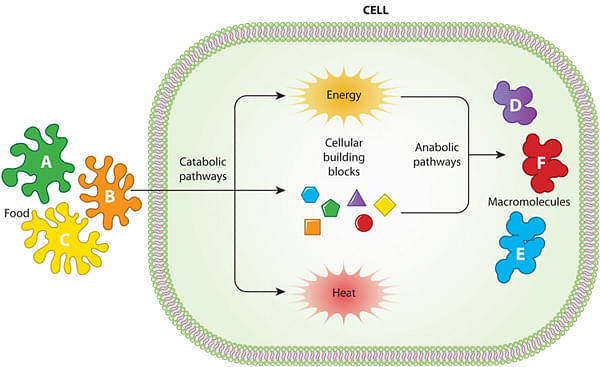
The process of metabolism helps in growth and reproduction. It also helps in maintaining the structures of living organisms. The organisms respond to the surrounding environment. All these chemical reactions occur in living organisms from digestion in human beings to transportation of substances from cell to cell for the requirement of energy.
Types of Metabolism
[Click Here for Sample Questions]
There are two types of metabolism:
- Anabolism
- Catabolism

Types of Metabolism
Anabolism: It is the process that involves building up or synthesizing compounds from complex molecules and is produced from simple molecules. Ex: synthesis of sugar from CO2, synthesis of large proteins from amino acid building blocks and the synthesis of new DNA strands from nucleic acid building blocks.
Catabolism: This process is mainly involved in breaking down larger organic complex structure is broken down into simple molecules. Ex: Other energy-storing molecules, such as lipids, are also broken down through similar catabolic reactions to release energy and make ATP.
Read More:
Cellular Respiration
[Click Here for Sample Questions]
It is the process through a set of metabolic reactions and processes in the cells and cells convert sugars into energy.
Examples of different pathways for how organisms break down sugars are illustrated below:

The equation for aerobic respiration shows glucose being combined with oxygen and ADP to produce carbon dioxide, water, and ATP:
C6H12O6 (glucose)+ 6O2 + 36 ADP (depleted ATP) + 36 Pi (phosphate groups) → 6CO2 + 6H2O + 36 ATP
Carbohydrates in Metabolism
[Click Here for Sample Questions]
Carbohydrates are supplied in the following forms:
- Starch
- Sugar
- Cellulose
Cellulose and Starch are some forms of identical polymers that have the same repeat units dependent on glucose.
Read More: Breathing in Other Animals
Proteins in Metabolism
[Click Here for Sample Questions]
These are very important for building tissues, maintaining the structure of the cells, their functions, the formation of haemoglobin, and several other body functions. There are the following amino acids that include:
- Lysine
- Tryptophan
- Methionine
- Isoleucine
- Leucine
- Phenylalanine
- Valine
- Threonine
Read More: Difference Between Respiration and Combustion
Things to Remember
[Click Here for Sample Questions]
- The breakdown of glucose in living organisms is utilized to produce energy and is described by the equation: C6H12O6+6O2→6CO2+6H2O+energyC6H12O6+6O2\(→\)6CO2+6H2O+energy.
- The photosynthetic process plants utilize to synthesize glucose is described by the equation: 6CO2+6H2O+energy→C6H12O6+6O26CO2+6H2O+energy\(→\)C6H12O6+6O2.
- The glucose which is consumed is used to make energy in the form of ATP that can be further used to perform work and power chemical reactions in the cell.
- During photosynthesis, plants convert light energy into chemical energy that is used to build molecules of glucose.
Sample Questions
Ques. What is systematics? (2 Marks)
Ans. Systematic is the study of the diversification of living forms, in the past as well as in the present, and the relationships among living things through time.
Ques. What is ATP? (2 Marks)
Ans. These are in cellular respiration, where oxidation of organic compounds takes place in the cell cytoplasm that produces energy in the form of ATP. The energy so produced helps the cell to perform all metabolic activities.
Ques. What are amino acids and their organic formula? (2 Marks)
Ans. The organic compounds contain an amino group and one carboxyl group (acid group) and these groups are attached to the same carbon called as α carbon.
These are further divided into acidic, Neutral and Basic.
Ques. What is an enzyme? (2 Marks)
Ans. Enzymes are proteins that help speed up metabolism, or the chemical reactions in our bodies.
Ques. What are the different types of Carbohydrates? (2 Marks)
Ans. There are three types of carbohydrates as Starch, Sugar and Cellulose.
Ques. How to Increase Metabolism? (3 Marks)
Ans. Metabolism can be increased in the following ways:
One needs to keep himself or herself fit and healthy, which can be done by avoiding calorie intake and losing extra pounds. Having a properly balanced diet which will boost your body's metabolism and keeps us energetic throughout the day. As if you skip your meals or do extreme dieting it will only lead to weight loss which will lead to muscle mass and not fat mass as this will also lead to poor metabolic energy.
Ques. Explain the types of Metabolites. (5 Marks)
Ans. There are two types of Metabolites such as:
- Primary Metabolites
- These have a key role in growth, development and reproduction.
- These are formed during the growth phase as a result of energy metabolism.
- Secondary Metabolites
- These have no role in growth, development and reproduction.
- These are formed towards the end of the growth phase.
- Ecological importance (drugs, toxins, pigments etc).
Ques. What is the different structure of Proteins? (3 Marks)
Ans. There are two structures of proteins such as:
Primary Structure
- The linear sequence of amino acids in a polypeptide.
- This sequence is determined by genes and hereditary material, DNA. The correct sequence is important for proper functioning.
Secondary Structure
- Primary structure does not make a protein functional
- Due to interactions with immediate neighbours, polypeptides tend to fold into pleats or wrap into coils forming the Secondary structure
- Polypeptides folding into coils form an alpha-helix structure
- Polypeptides folding into plates form a beta-plated structure. This structure is less stable than the alpha-helix structure.
Ques. What is the classification of proteins? (2 Marks)
Ans. There are the following types of protein:
- Fibrous Proteins
- These are polypeptide chains that run parallel & are held together by hydrogen and disulphide bonds, and then a fibre, rod or wire-like structure is formed.
- They are shaped in fibres; hence called Fibrous protein
- Globular Proteins
- These are structures that have chains of polypeptides coiled around to give a spherical shape.
- They are shaped like a globe; hence called Globular protein
Check-Out:



Comments