




SNAP 2026 Exam pattern has been revised this year with the addition of the Ethics, Morality and Values section. The revised SNAP paper pattern now comprises four sections instead of three, while the total marks and exam duration remain unchanged.
- SNAP 2026 is a CBT mode exam comprising 60 MCQ questions.
- SNAP total marks are 60, without any sectional time limit.
- The four sections in SNAP 2026 exam pattern are General English, Quantitative, Data Interpretation & Data Sufficiency, Analytical & Logical Reasoning, and Ethics, Morality and Values.
SNAP Exam Pattern 2026 Latest Update: The section-wise number of questions in the SNAP paper pattern has been revised with the introduction of the Ethics, Morality and Values section.
- SNAP General English questions reduced from 15 to 10.
- SNAP Analytical & Logical Reasoning questions decreased from 25 to 20.
- Quantitative, Data Interpretation & Data Sufficiency section remains the same with 20 questions.
- Ethics, Morality and Values section carries 10 questions in total
- Solve PYQs from important topics such as arithmetic, geometry, coding-decoding, arrangements, syllogisms, and grammar to score well in SNAP 2026.
As per SNAP marking scheme, each answer is worth 1 mark, with a deduction of 0.25 marks for each wrong answer. According to the exam pattern of SNAP, candidates need to answer 60 questions in 60 minutes.
Related Articles:
- SNAP Syllabus: Check Exam Syllabus, Download PDF and Topic-wise Weightage
- SNAP RC Passage Types Handwritten Notes PDF Download 2026
Key Summary
- As per the SNAP 2026 paper pattern, out of the four options, only one will be correct.
- There is negative marking in SNAP, so attempt all questions only if you are confident about them.
- The SNAP 2026 exam dates are on December 13, 19 and 26, 2026.
- You can attempt all three tests, but the higher score will be considered for the final percentile calculation, and there will be no normalisation.
- Analytical and Logical Reasoning and Quantitative Data Interpretation account for 40 questions in total, as per the exam pattern of SNAP.
SNAP Exam Pattern 2026 (Revised): Key Highlights
Here are the key highlights of the revised SNAP exam pattern for 2026 outlined in the table below:
| Particular | Key Details of SNAP Paper Pattern |
|---|---|
| Exam Mode | Online (CBT) |
| Duration | 60 minutes |
| Medium of Exam | English |
| Question Type | MCQs (4 options, 1 correct) |
| Total Questions | 60 |
| Total Marks | 60 |
| Marking Scheme |
|
| Total Sections |
|
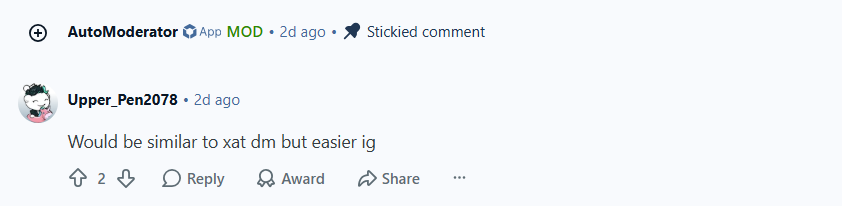
On discussion forums like Reddit, users shared that the introduction of the Ethics, Morality and Values section in SNAP 2026 exam pattern will be similar to XAT’s Decision Making section. It is expected that this section will be comparatively easier than XAT DM.

Source: Reddit
Related Articles:
- SNAP 2026 Exam Pattern Revised at snaptest.org; Check New Ethics Section Details
- SNAP 2026 Exam Date: Expected Schedule, Registration and Important Dates
Ques. How many questions are asked based on the exam pattern of SNAP 2026?
Ans. SNAP 2026 has 60 questions in total: 10 in General English, 20 in Analytical & Logical Reasoning, 20 in Quantitative, Data Interpretation & Data Sufficiency and 10 in Ethics, Morality and Values. Every question carries 1 mark, for a total of 60 marks.
Section-wise SNAP Exam Pattern 2026
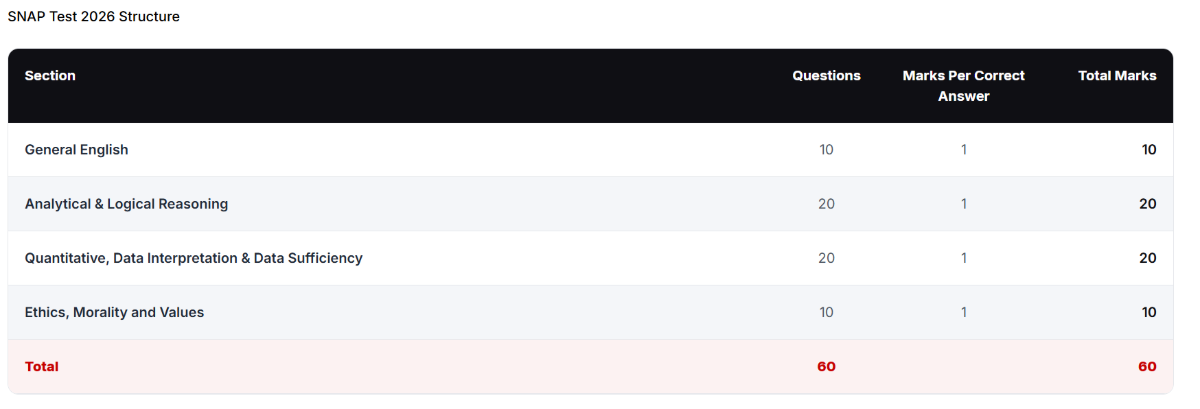
The exam pattern of SNAP has four sections now. Each section comprises MCQ-type objective questions with four options. Check out the latest SNAP exam pattern and section-wise question distribution for 2026 below:
| Section | Revised Section-wise Question Distribution | Revised Section-wise Total Marks |
|---|---|---|
| General English | 10 | 10 |
| Analytical & Logical Reasoning | 20 | 20 |
| Quantitative, Data Interpretation & Data Sufficiency | 20 | 20 |
| Ethics, Morality and Values (New) | 10 | 10 |
| Total | 60 | 60 |
Source: snaptest.org
Watch the YouTube video by “MBA Wallah” for complete details on the SNAP Paper pattern 2026, key dates and latest changes in SNAP 2026.
Related Links:
- SNAP Question Paper- Download SNAP Previous Year Papers PDF(2025-2006)
- SNAP Eligibility Criteria 2026: Graduate with 50% Marks, Age Limit, and Final Year Students
Ques. What is the duration of the SNAP 2026 exam?
Ans. The SNAP 2026 exam is 60 minutes long. There is no sectional time limit; you manage the full 60-minute window across all three sections.
SNAP Exam Pattern 2026: Trends Over the Years
The SNAP exam pattern has remained the same over the years. But in the 2026 exam, there is an addition of Ethics, Morality and Values section and changes to the sectional number of questions.
| Particular | 2026 | 2025 | 2024 | 2023 |
|---|---|---|---|---|
| Duration | 60 Minutes | 60 Minutes | 60 Minutes | 60 Minutes |
| Total Questions | 60 | 60 | 60 | 60 |
| Marking Scheme | +1 for correct answerNegative marking: deduction of 0.25 marks | +1 for correct answerNegative marking: deduction of 0.25 marks | +1 for correct answerNegative marking: deduction of 0.25 marks | +1 for correct answerNegative marking: deduction of 0.25 marks |
| Number of Sections | 4 | 3 | 3 | 3 |
| Sections | General EnglishQuantitative, Data Interpretation & Data SufficiencyAnalytical & Logical Reasoning Ethics, Morality and Values (New) | General EnglishQuantitative, Data Interpretation & Data SufficiencyAnalytical & Logical Reasoning | General EnglishQuantitative, Data Interpretation & Data SufficiencyAnalytical & Logical Reasoning | General EnglishQuantitative, Data Interpretation & Data SufficiencyAnalytical & Logical Reasoning |
| Section-wise Questions | General English- 10 (Revised) | General English- 15 | General English- 15 | General English- 15 |
| Quantitative, DI & DS- 20 | Quantitative, DI & DS- 20 | Quantitative, DI & DS- 20 | Quantitative, DI & DS- 20 | |
| Analytical & Logical Reasoning- 20 (Revised) | Analytical & Logical Reasoning- 25 | Analytical & Logical Reasoning- 25 | Analytical & Logical Reasoning- 25 | |
| Ethics, Morality & Values- 10 (New) | - | - | - |
Related Links:
- SNAP Sample Papers: Last 5 Years PYQs PDF Download and Subject Wise Weightage
- SNAP Registration 2026 Starts August 21: Registration Fees, Process, Eligibility, Documents Required
Ques. What is the SNAP 2026 marking scheme?
Ans. SNAP 2026 awards +1 mark for each correct answer and deducts -0.25 marks for each wrong answer. Unattempted questions carry 0 marks. All 60 questions are MCQs with four options, and each question carries equal weight of 1 mark, with no partial marks or bonus points.
SNAP Marking Scheme 2026
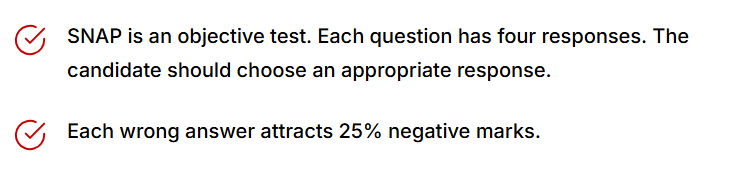
According to the SNAP exam pattern 2026, the total marks are 60. The SNAP marking scheme makes it a little more competitive, as there is a deduction of 0.25 marks for each incorrect answer. You should be cautious while attempting questions.
| Question Type | Marking Scheme |
|---|---|
| Correct Answer | +1 mark |
| SNAP Negative Marking | Deduction of 0.25 marks |
| Unanswered Questions | 0 marks |
Source: snaptest.org
Does SNAP have Negative Marking?
Yes, SNAP have negative marking. As per SNAP negative marking, you will lose 25% of the marks for every incorrect response. Thus, you should be very careful when answering questions, as it will affect your overall SNAP percentile.
SNAP Total Marks for 2026
The SNAP total marks are 60. Candidates need to attempt 60 questions worth 1 mark. As per official updates, a candidate can appear for upto three tests for SNAP 2026. If a candidate appears for more than one test, the higher score will be considered for the final percentile calculation, and there will be no normalisation.
Related Links:
- SNAP Quant, DI and DS Sample Papers: Last 5 Years PYQs PDF Download and Topic Wise Weightage
- SNAP Analytical and Logical Reasoning Sample Papers: Last 5 Years PYQs PDF Download
Ques. Can I appear in SNAP 2026 more than once?
Ans. Yes. SNAP 2026 is conducted in up to three sessions in December 2026. You can register for and appear in one, two, or all three sessions. Your highest score across all sessions is used for percentile calculation; there is no averaging or normalisation between sessions.
SNAP Time with No Sectional Limit
The SNAP time is 60 minutes. You will have to answer 60 MCQs comprising 4 sections.
- Within this total time allotted, you can attempt any question at any point in time.
- Unlike CAT, SNAP has no sectional time limit.
SNAP Exam Dates 2026
The SNAP exam dates 2026 are tabulated below:
| Particulars | Dates (Confirmed) |
|---|---|
| SNAP Test 2026: 01 | December 13, 2026 (Sunday) |
| SNAP Test 2026: 02 | December 19, 2026 (Saturday) |
| SNAP Test 2026: 03 | December 26, 2026 (Saturday) |

Source: snaptest.org
Ques. In which mode is SNAP 2026 conducted?
Ans. SNAP 2026 is conducted as a Computer-Based Test (CBT). You will attempt all 60 questions on a computer screen at an authorised test centre.
SNAP Exam Pattern 2026: Important Topics Based on Last 5 Years' Analysis
The SNAP important topics, based on the number of questions for each section in the last 5 years' trends, are discussed below. Check out to prepare and score well in SNAP 2026.
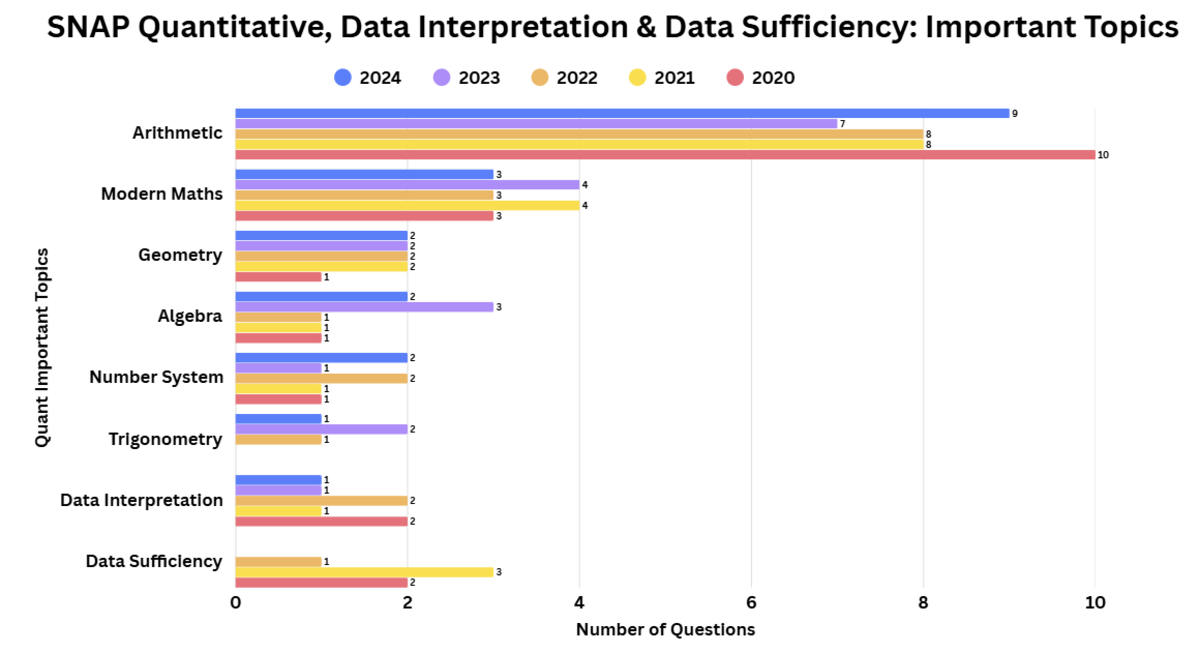
SNAP Syllabus: Important Topics of Quantitative, Data Interpretation & Data Sufficiency for 20 Marks
Focus more on Arithmetic, Geometry, Modern Maths and Number System, as questions are consistent from these topics in SNAP Quant.
| Quant Important Topics | 2024 | 2023 | 2022 | 2021 | 2020 |
|---|---|---|---|---|---|
| Arithmetic | 9 | 7 | 8 | 8 | 10 |
| Modern Maths | 3 | 4 | 3 | 4 | 3 |
| Geometry | 2 | 2 | 2 | 2 | 1 |
| Algebra | 2 | 3 | 1 | 1 | 1 |
| Number System | 2 | 1 | 2 | 1 | 1 |
| Trigonometry | 1 | 2 | 1 | - | - |
| Data Interpretation | 1 | 1 | 2 | 1 | 2 |
| Data Sufficiency | - | - | 1 | 3 | 2 |
| Total Questions | 20 | 20 | 20 | 20 | 20 |
Also Check:
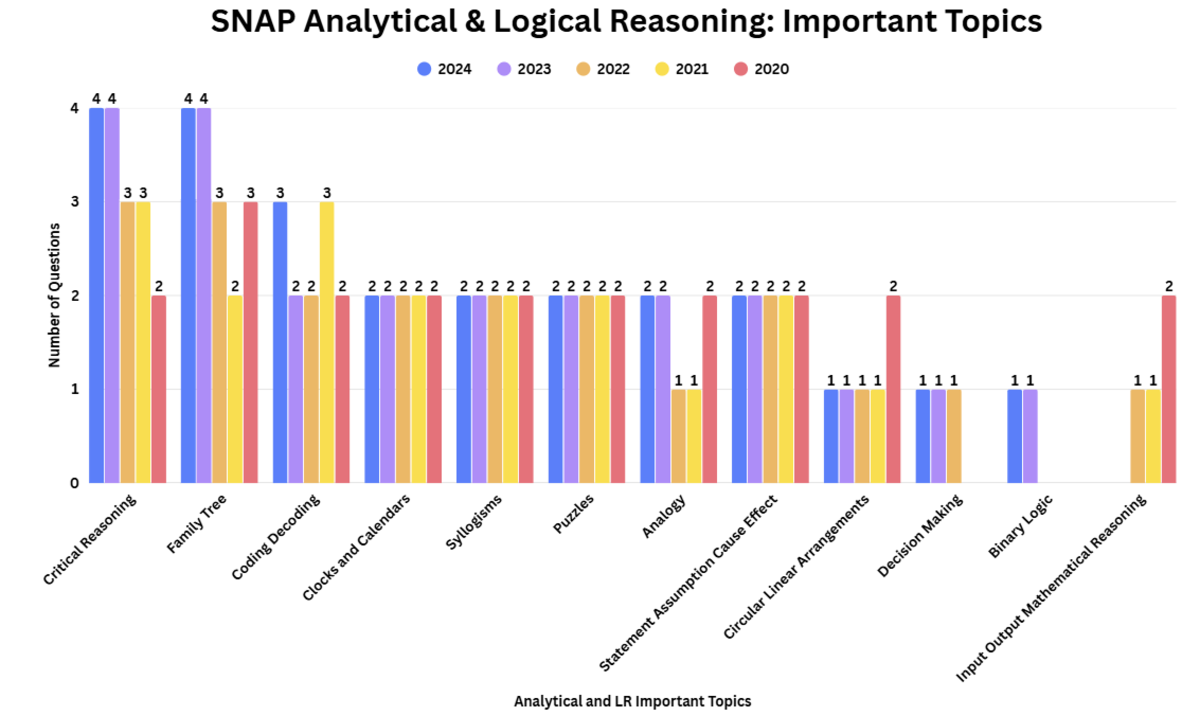
SNAP Syllabus: Important Topics of Analytical & Logical Reasoning for 20 Marks
Critical Reasoning, Family Tree, Coding, Decoding, and Syllogism should be in your everyday practice, as they have been consistent in the last 5 years' SNAP analysis.
| Analytical and Logical Reasoning Important Topics | 2024 | 2023 | 2022 | 2021 | 2020 |
|---|---|---|---|---|---|
| Critical Reasoning | 4 | 3- 4 | 3 | 2- 3 | 2 |
| Family Tree | 4 | 3- 4 | 2- 3 | 2 | 2- 3 |
| Coding Decoding | 2- 3 | 2 | 2 | 2- 3 | 2 |
| Clocks and Calendars | 2 | 2 | 2 | 2 | 2 |
| Syllogisms | 2 | 2 | 2 | 2 | 2 |
| Puzzles | 2 | 2 | 2 | 2 | 2 |
| Analogy | 1- 2 | 1- 2 | 1 | 1 | 2 |
| Statement Assumption Cause Effect | 2 | 2 | 2 | 1- 2 | 1- 2 |
| Circular Linear Arrangements | 1 | 1 | 1 | 1 | 2 |
| Decision Making | 1 | 1 | 1 | - | - |
| Binary Logic | 1 | 1 | - | - | - |
| Input Output Mathematical Reasoning | - | - | 1 | 1 | 2 |
Also Check:
SNAP Series Number Letter and Figure Previous Year Questions
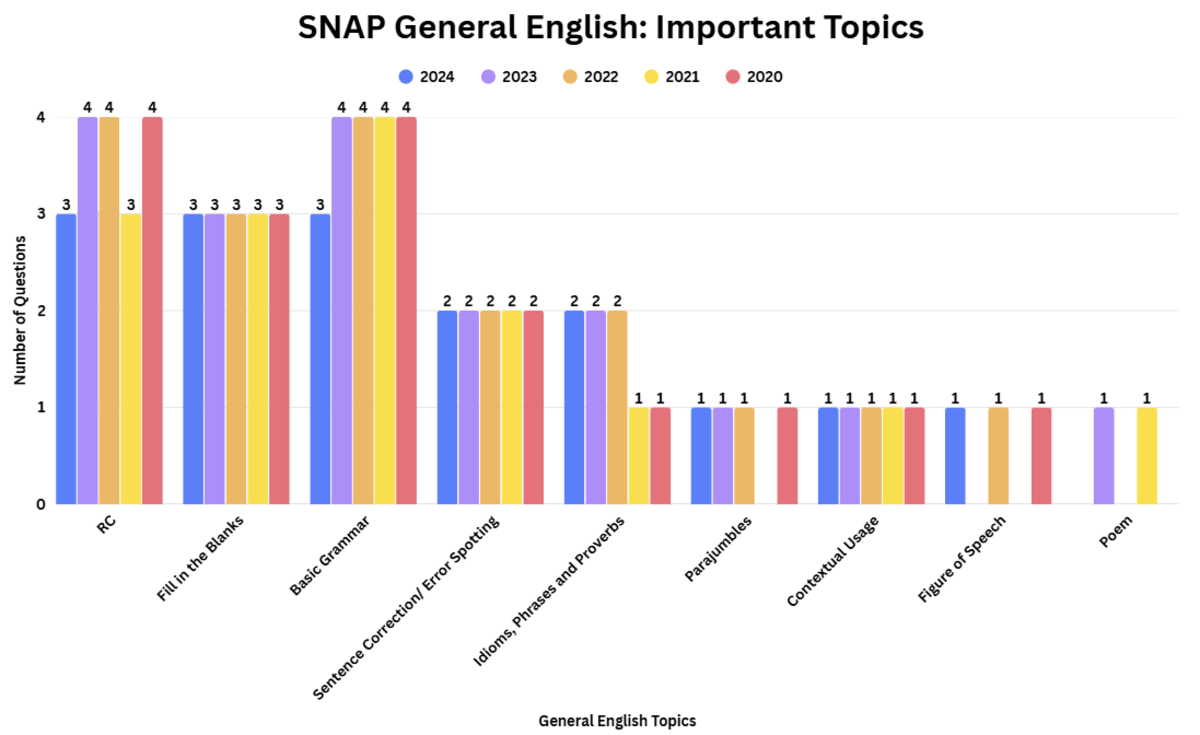
SNAP Syllabus: Important Topics of General English for 10 Marks
Practice basic grammar, vocabulary building, idioms and proverbs to score well in this section, as it is easier than other sections.
| General English Important Topics | 2024 | 2023 | 2022 | 2021 | 2020 |
|---|---|---|---|---|---|
| RC | 3 | 3- 4 | 3- 4 | 3 | 3- 4 |
| Fill in the Blanks | 3 | 2- 3 | 2- 3 | 3 | 2- 3 |
| Basic Grammar | 3 | 3- 4 | 3- 4 | 4 | 3- 4 |
| Sentence Correction/ Error Spotting | 2 | 1- 2 | 2 | 2 | 1- 2 |
| Idioms, Phrases and Proverbs | 1- 2 | 1- 2 | 1- 2 | 1 | 1 |
| Parajumbles | 1 | 1 | 1 | - | 1 |
| Contextual Usage | 1 | 1 | 1 | 1 | 1 |
| Figure of Speech | 1 | - | 0- 1 | - | 1 |
| Poem | - | 1 | - | 1 | - |
Related Link:
- SNAP 2026 General English Mock Test: Topic Wise, Free Test Series
- SNAP RC Passage Types and Approach Notes PDF Download 2026
SNAP Exam Pattern 2026: Topics for Ethics, Morality and Values
Ethics, Morality and Values is the new section added in SNAP 2026. As this is newly introduced, much information regarding the topics is not available. But you can refer to the following topics, as this section will test your decision-making skills, as in XAT.
| SNAP Syllabus for Ethics, Morality, and Values | Key Topics Covered |
|---|---|
| Fundamental Concepts | Ethics, Morality, Values, Attitude, Emotional Intelligence and Decision-Making Anchors |
| Ethical Theories | Consequentialism, Deontology, Virtue Ethics, Ethical Egoism, Ethical Relativism, Justice-Based Approach |
| Business and Corporate Ethics | Corporate Governance Principles, CSR, Conflict of Interest, Ethical Leadership, Sustainability and Business Code of Conduct |
| Personal and Professional Values | Integrity, honesty, Accountability, Work Ethic, managing bias, Diversity, Equity |
| Applied Ethics/ Case Judgement | Workplace Ethics, Short-term gain vs. long-term integrity, Social Dilemmas, Resource Allocations |
Also Check: SNAP 2026 Mock Test: Official Mock Test, Free Test Series, Test Pattern
Ques. Has the SNAP 2026 exam pattern changed from 2025?
Ans. Yes, the SNAP exam pattern 2026 has changed. It comprises four sections, with total number of question is 60, which need to be answered in 1 hour. Ethics, Morality and Values section is the new addition, which comprises 10 questions. SNAP General English questions reduced from 15 to 10. Analytical & Logical Reasoning questions decreased from 25 to 20. The Quant section is unaffected.
SNAP vs XAT vs NMAT vs CAT
The table below gives you a comparative analysis of SNAP with other MBA entrance examinations:
| Particulars | SNAP | CAT | XAT | NMAT |
|---|---|---|---|---|
| Total Questions | 60 | 68 | 95 | 108 |
| Number of Sections | 4 | 3 | Part 1(3 section) + Part II (GK) | 3 |
| Question Type | MCQ | MCQ and TITA | MCQ | MCQ |
| Marking Scheme | +1 for a correct answer; 0.25 marks deducted for an incorrect response | +3 Marks; - 1 for an incorrect answer, and no negative marking for TITA questions | +1 for a correct answer; 0.25 marks deducted for an incorrect response for Part 1 and no negative marking for Part II | +3 for a correct answer and no negative marking |
| Total Marks | 60 | 204 | 95 | 36 to 360 |
| Difficulty Level | Moderate | Difficult | Moderate to Difficult | Moderate |
| Time Duration | 60 minutes with no sectional time limit | 120 minutes with 40 minutes per section | 180 minutes (Part I- 170 minutes and Part II- 10 minutes) | 120 minutes( 28 minutes for LS, 52 minutes for QS and 40 minutes for LR) |
Related Link: SNAP Exam Analysis 2025 Tests 1, 2 & 3: Check Section-Wise Analysis, Difficulty Level, and Good Attempts
SNAP Preparation Tips Based on Latest Exam Pattern 2026
The following are some preparation tips that you should take into consideration while preparing for SNAP 2026:
- Focus equally on General English, Analytical & Logical Reasoning, Quantitative, Data Interpretation & Data Sufficiency, and Ethics, Morality & Values.
- Build speed and accuracy to attempt the complete paper within the 60-minute duration.
- Revise Arithmetic, Algebra, Geometry and basic mathematical concepts.
- Practise puzzles, series, arrangements, coding-decoding and logical reasoning questions.
- Work on vocabulary, grammar, reading comprehension and verbal ability.
- Understand ethical situations, moral principles and value-based questions.
- Regularly solve full-length SNAP mocks to improve speed and time management.
- Review incorrect and skipped questions after every mock.
- Solve previous-year SNAP questions to understand the question pattern and difficulty level.
- With negative marking, prioritise accuracy over blind guessing.
Also Check:
SNAP Exam Pattern 2026 FAQs
Ques. Is SNAP harder than CAT?
Ans. No, SNAP is generally not tougher than CAT. CAT features deeper, more complex analytical and conceptual problem-solving. In contrast, SNAP ask more direct questions but requires extreme speed to answer 60 questions in just 60 minutes.
Ques. Can I crack SNAP in three months?
Ans. Yes, you can crack SNAP in three months if you already have basic clarity on core concepts or are actively preparing for other management tests like CAT. SNAP ask easier questions in a fast 60-minute format with 60 multiple-choice questions.
Ques. Is 37 a good score in SNAP?
Ans. A score of 37 out of 60 in SNAP is a decent and competitive score, generally translating to 90 to 95 percentile. This range is usually enough to secure calls from good mid-tier colleges.
Ques. How many times can we give SNAP in a year?
Ans. You can take the SNAP exam a maximum of three times per year. If a candidate appears for more than one test, the higher score will be considered for the final percentile calculation, and there will be no normalisation.
Ques. Does the SNAP exam pattern ask GK?
Ans. No, the current SNAP exam pattern does not ask for General Knowledge (GK) or General Awareness. It comprises General English, Quantitative, Data Interpretation & Data Sufficiency, Analytical & Logical Reasoning and Ethics, Morality and Values.
Ques. How long is the SNAP exam?
Ans. The SNAP time is 60 minutes (1 hour). It is a fast-paced, computer-based test with no individual sectional time limits, meaning you can move freely between sections during the hour.
Ques. How to prepare for SNAP?
Ans. To prepare for SNAP effectively, you must balance core concept clarity with high-speed practice, as time management is more critical than deep theoretical derivation. Solve PYQs and attempt mock tests, and analyse them to understand your strengths and weaknesses.



Comments