



Study Abroad Expert | Updated On - Sep 7, 2026
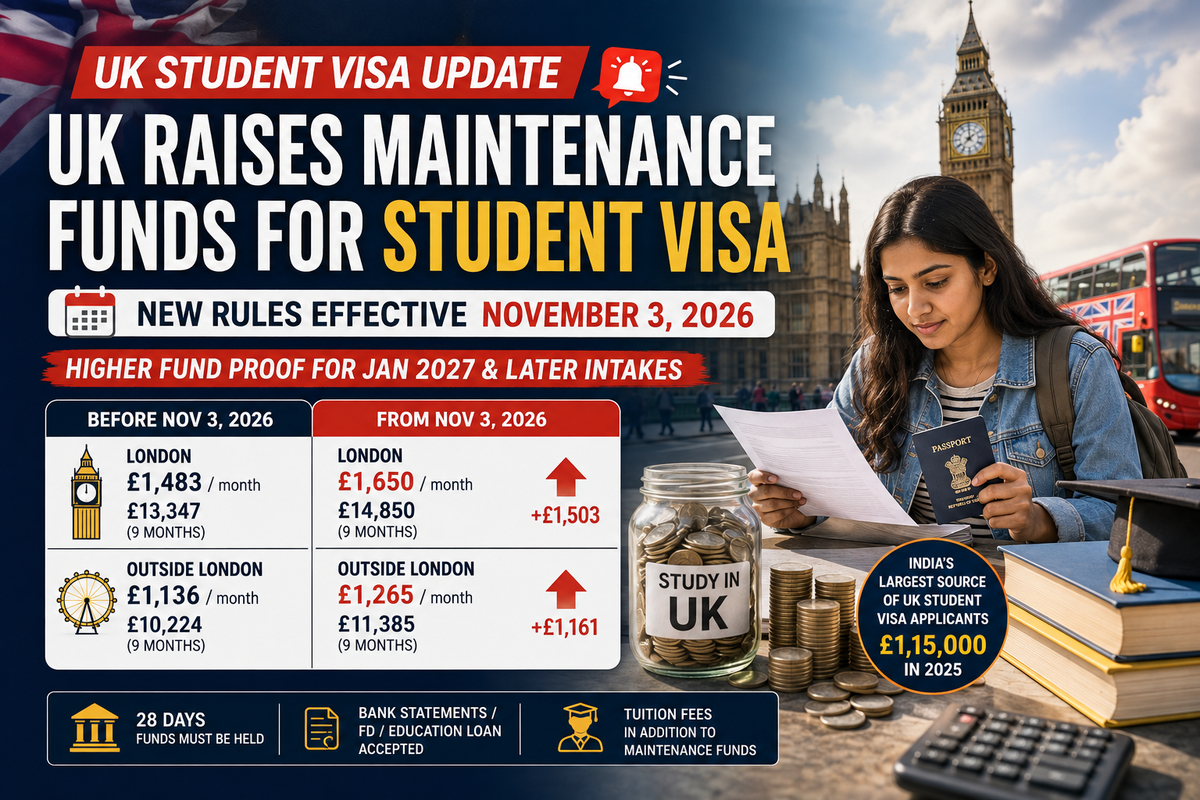
The UK Home Office confirmed on September 7, 2026 that Student Visa applicants must show higher maintenance funds from November 3, 2026. The change hits Indian students filing for January 2027 and later intakes at UK universities. The Home Office published the update in a Statement of Changes to the Immigration Rules laid before Parliament today. The move ends the six-year freeze on maintenance rates that had held since 2020.
- Indian nationals filed 1,15,000 Student Visa grants for UK study in 2025, making India the largest source cohort, per Home Office quarterly data.
- The London monthly rate rises from £1,483 to £1,650 (₹1.89 Lakhs – ₹2.11 Lakhs), and the outside-London rate rises from £1,136 to £1,265 (₹1.45 Lakhs-₹1.61 Lakhs), both applied over a nine-month cap.
- The Home Office says the update reflects the Office for National Statistics rent index rise between 2020 and 2026.
The maintenance requirement is the bank balance a Student Visa applicant must prove for 28 consecutive days before filing. It sits alongside the tuition fee proof and is a hard refusal ground on any shortfall.
Also Read: UK Student Visa
What Exactly Changes on November 3, 2026?
The Home Office has raised the two monthly maintenance figures used to calculate the total fund proof. The nine-month cap on the calculation continues unchanged. So does the rule that the money must sit in the applicant’s or a parent’s account for 28 straight days.
| Item | Before Nov 3, 2026 | From Nov 3, 2026 |
|---|---|---|
| London monthly rate | £1,483 (₹1.89 Lakhs) | £1,650 (₹2.11 Lakhs |
| Outside London monthly rate | £1,136 (₹1.45 Lakhs) | £1,265 (₹1.61 Lakhs) |
| Nine-month total (London) | £13,347 (₹17.04 Lakhs) | £14,850 (₹18.96 Lakhs) |
| Nine-month total (outside London) | £10,224 (₹13.05 Lakhs) | £11,385 (₹14.53 Lakhs) |
| Consecutive days held | 28 | 28 |
At today’s rate of ₹112 to the pound (Reserve Bank of India reference, September 2026), the London nine-month proof now works out to about ₹16.6 lakh. The outside-London proof lands near ₹12.7 lakh. That is on top of the first-year tuition fee, which the Home Office also asks applicants to show unless already paid.
Key Insight: The Home Office did not change the nine-month cap, which is the ceiling on how many months of funds you need to prove even for a two-year Master’s. The rate goes up, the length does not.
Who Is Affected and Who Is Not
The new rate applies to Student Visa applications filed on or after November 3, 2026. Applications already submitted before that date will be decided at the old rate. In-country extensions from a Student Visa to a Student Visa filed after the switch date also fall under the new figures.
- Fresh January 2027 intake applicants: file at the new rate.
- Fall 2026 CAS holders who file before November 3: file at the old rate.
- Differential Evidence Requirement nationals: India remains on this list, so bank statements or loan letters are still asked for by default.
- Doctorate Extension Scheme applicants: covered by a separate short-course rule and unaffected today.
Sponsored students on named schemes are the sole exemption. If a UK government body, the applicant’s own government, an international scholarship agency, or a listed university is funding the course, only a letter from that sponsor is needed in place of the bank proof.
How Does This Compare With Other Study Destinations?
The UK is not the only country moving on proof-of-funds. Canada raised its cost-of-living threshold to CAD 22,895 in January 2024, then indexed it annually. Australia lifted its Genuine Student savings evidence to AUD 29,710 in May 2024. The UK’s move now brings it closer to those benchmarks on a monthly basis.
| Country | Annual proof of funds (INR, September 2026) |
|---|---|
| UK (London, new) | ₹16.6 lakh over 9 months |
| UK (outside London, new) | ₹12.7 lakh over 9 months |
| Canada | ₹14.2 lakh per year |
| Australia | ₹16.4 lakh per year |
| USA (I-20 estimate) | Varies by university, typically ₹18-25 lakh |
What it means for Indian Students: A London-based Master’s now needs roughly ₹1.5 lakh more in the sealed 28-day account than last year. Families using education loans for the maintenance portion will need the disbursement letter dated at least a month before the visa filing.
How Do Indian Students Prepare the New Proof?
The Home Office accepts bank statements, fixed deposit letters, and formal education loan sanction letters from listed Indian financial institutions. Digital-only wallet balances and crypto holdings continue to be rejected. Statements must show the full 28-day window and the closing balance must not dip below the required amount on any day in that window.
- Confirm your CAS lists course location as London or outside London. The postcode on the CAS decides the rate.
- Calculate the maintenance amount using the nine-month cap or the actual course length, whichever is shorter.
- Park the funds in a personal or parent’s account by early October 2026 if you plan to file in early November.
- Ask your bank for a statement in the Home Office-accepted format, on letterhead, dated within 31 days of filing.
- If using an education loan, get the sanction letter reissued in your name after the new rate publishes.
The November 3, 2026 switch gives Indian applicants under eight weeks to adjust their fund proofs. Anyone with a CAS in hand and enough money already parked should consider filing before the switch date to lock in the old £1,483 and £1,136 monthly rates. The rest should rebuild their 28-day window at the higher amount before the January 2027 intake filing rush.
Next Key Date for January 2027 Applicants: The new maintenance rates take effect on November 3, 2026. Any Student Visa application filed on or after that date will be assessed against the higher £1,650 (London) and £1,265 (outside London) monthly figures.



Comments