




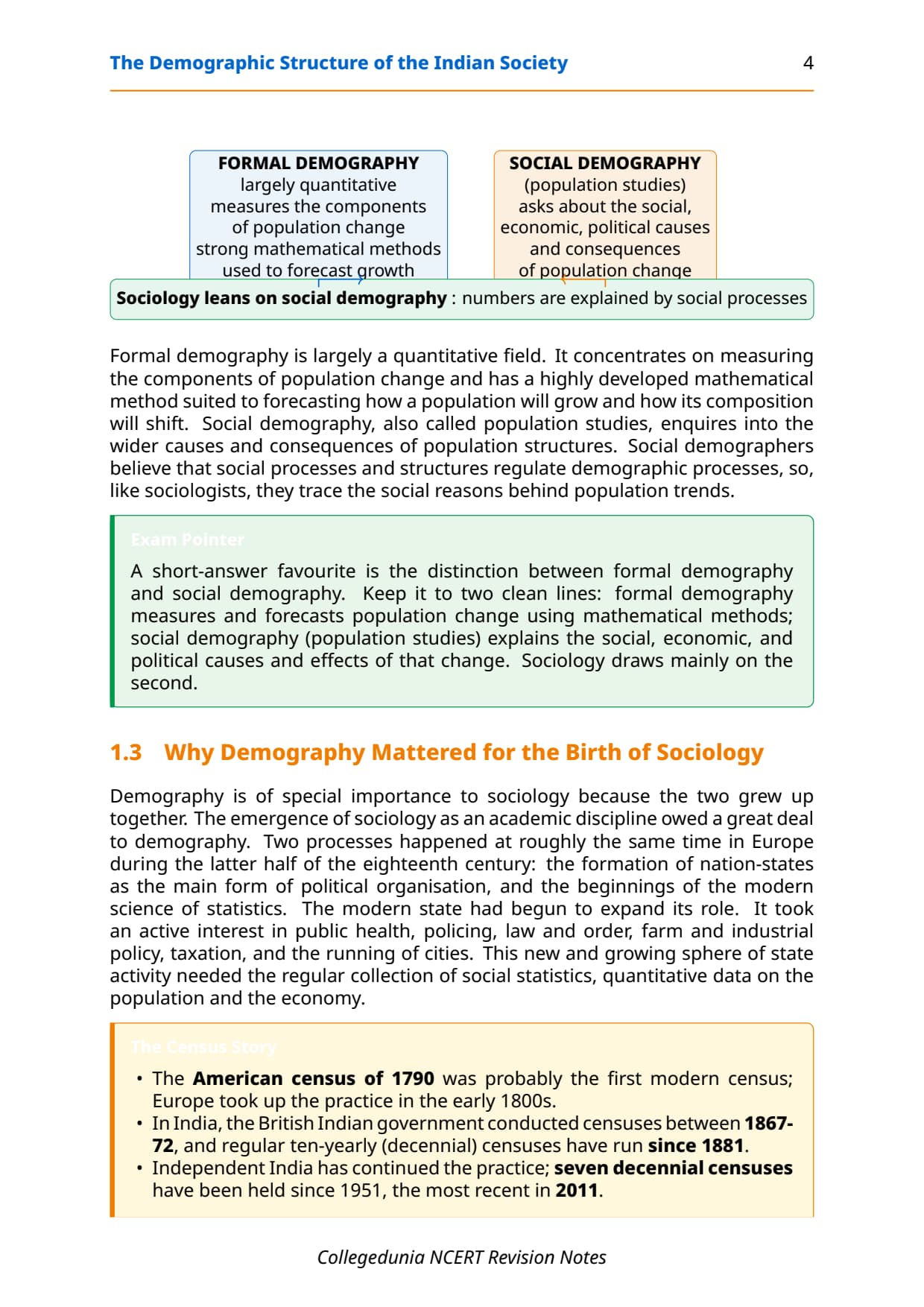
These Class 12 Sociology Chapter 2 The Demographic Structure of the Indian Society Notes give a clear, quick-revision summary of demography, the Malthusian theory, the theory of demographic transition, and India's population profile, set to the 2026-27 CBSE syllabus. The notes turn a fact-heavy chapter into short points, tables and definitions that students can revise in one sitting.
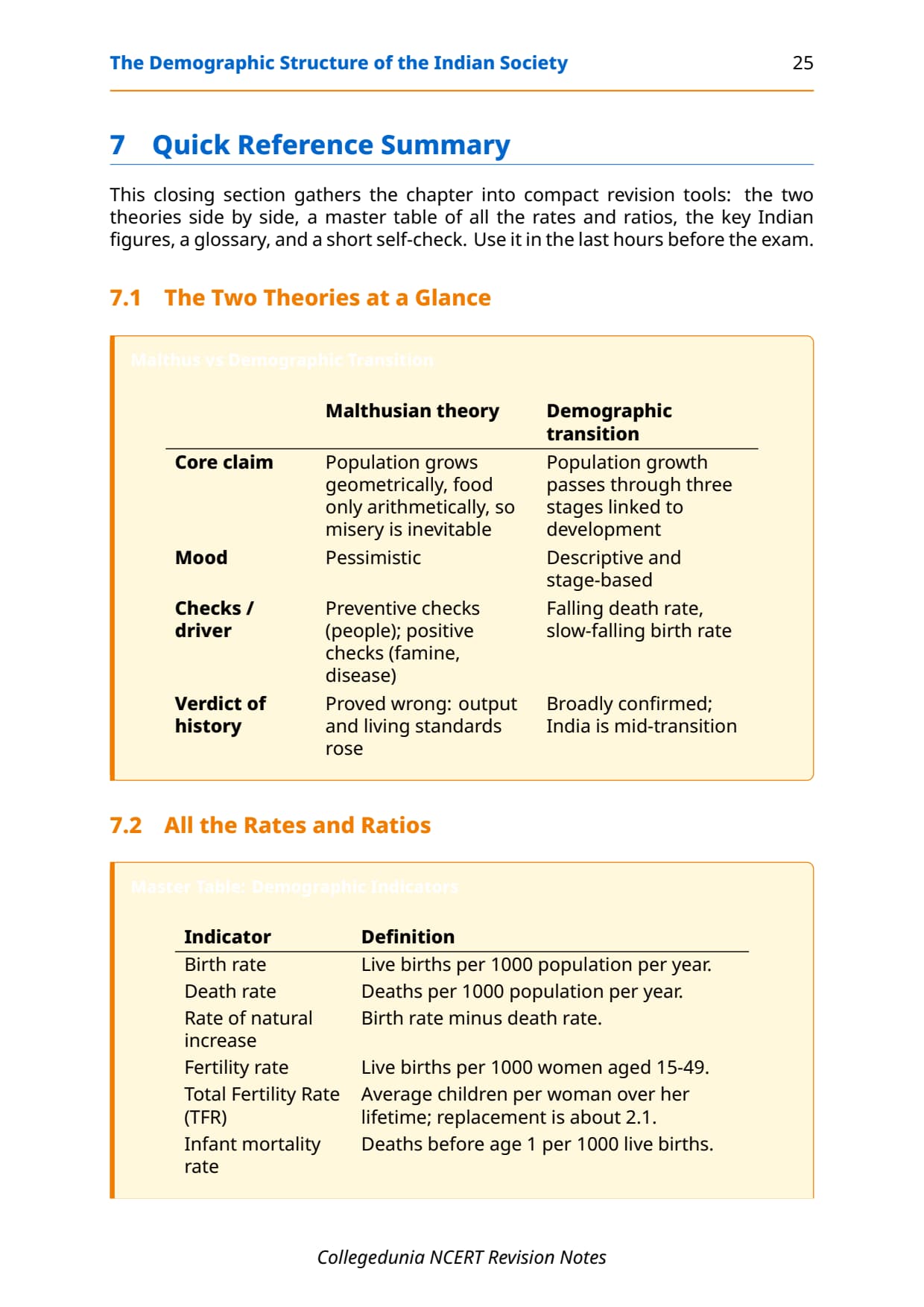
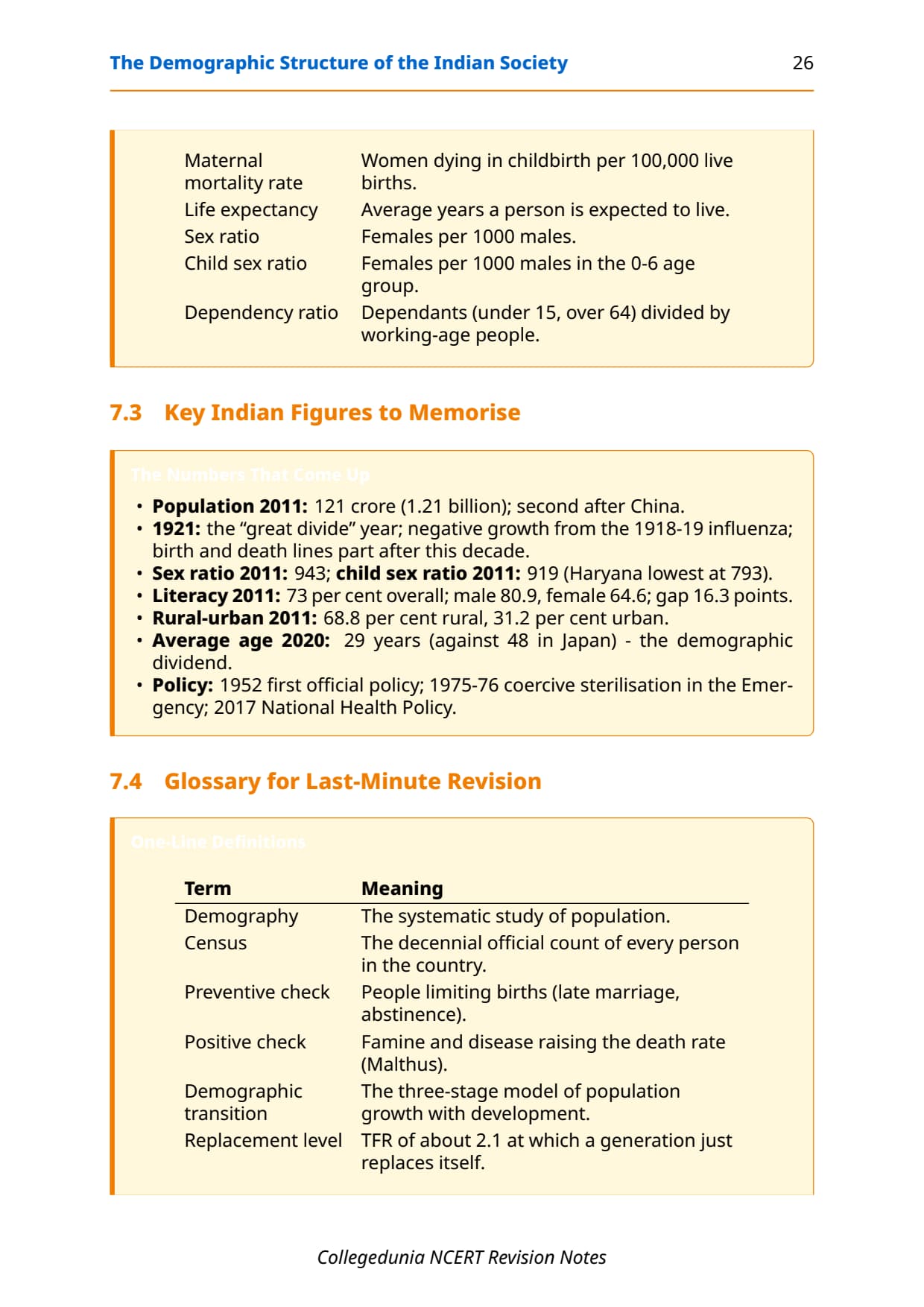
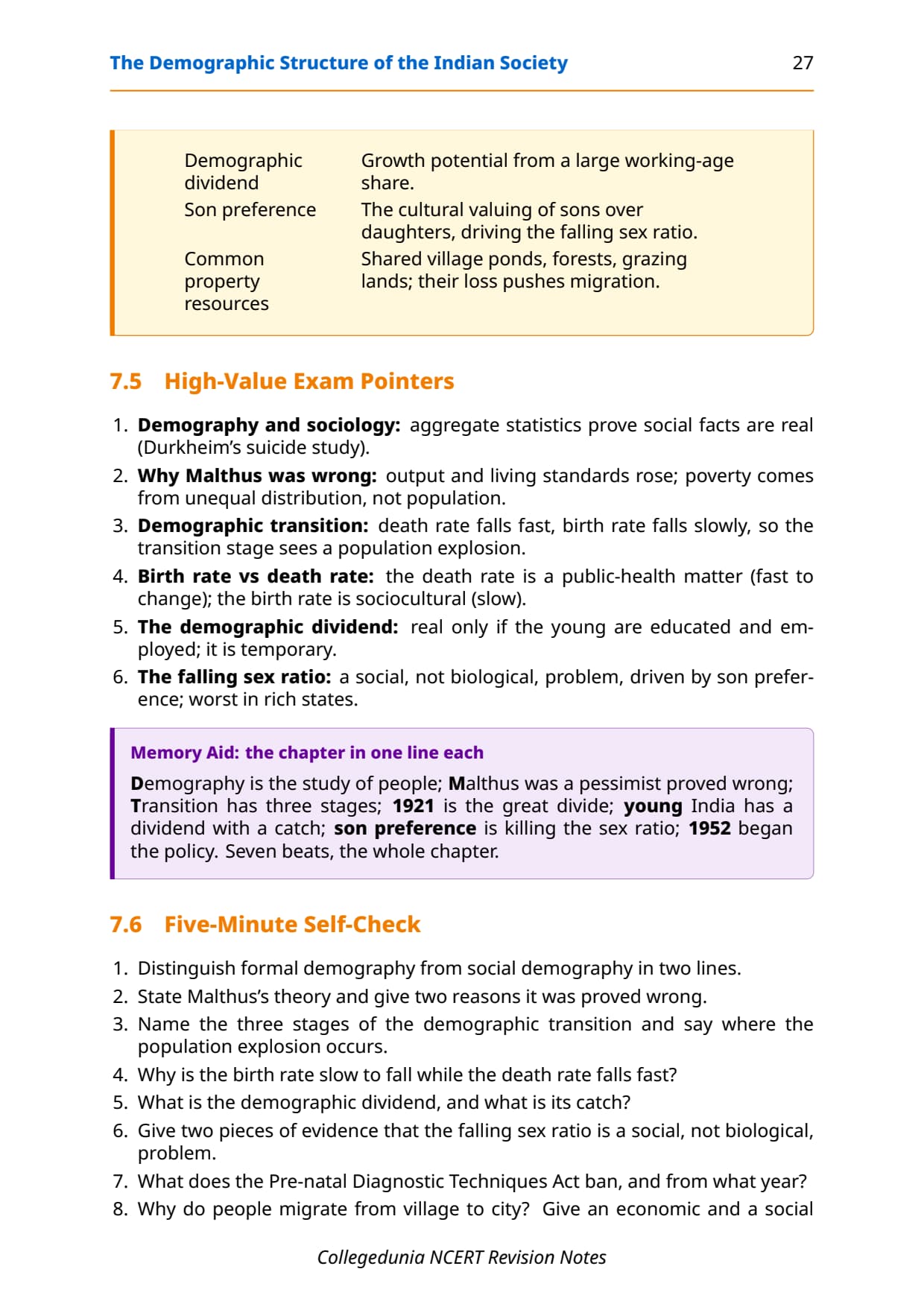
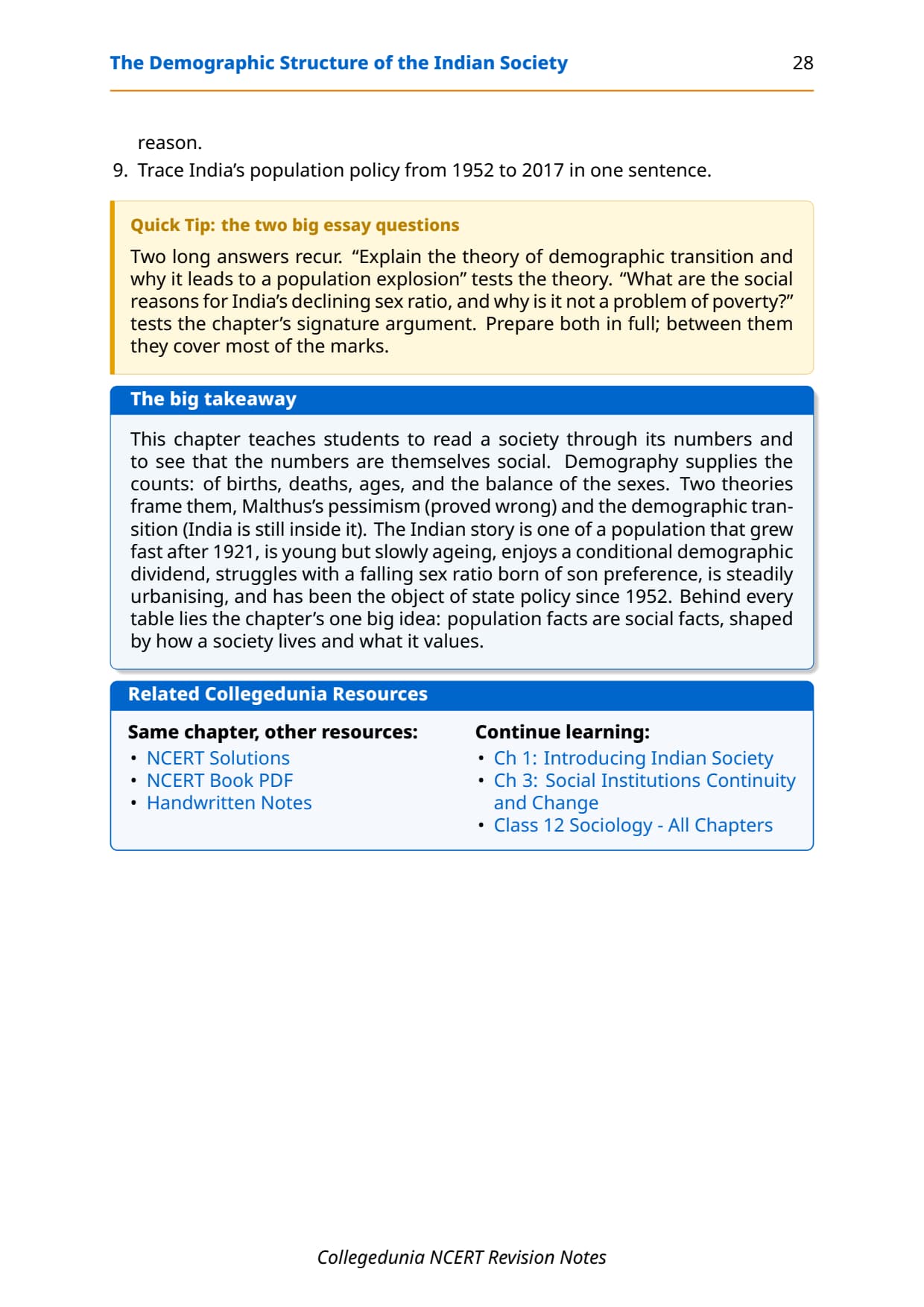
- One-page summary of both population theories plus every key term you need to write full answers.
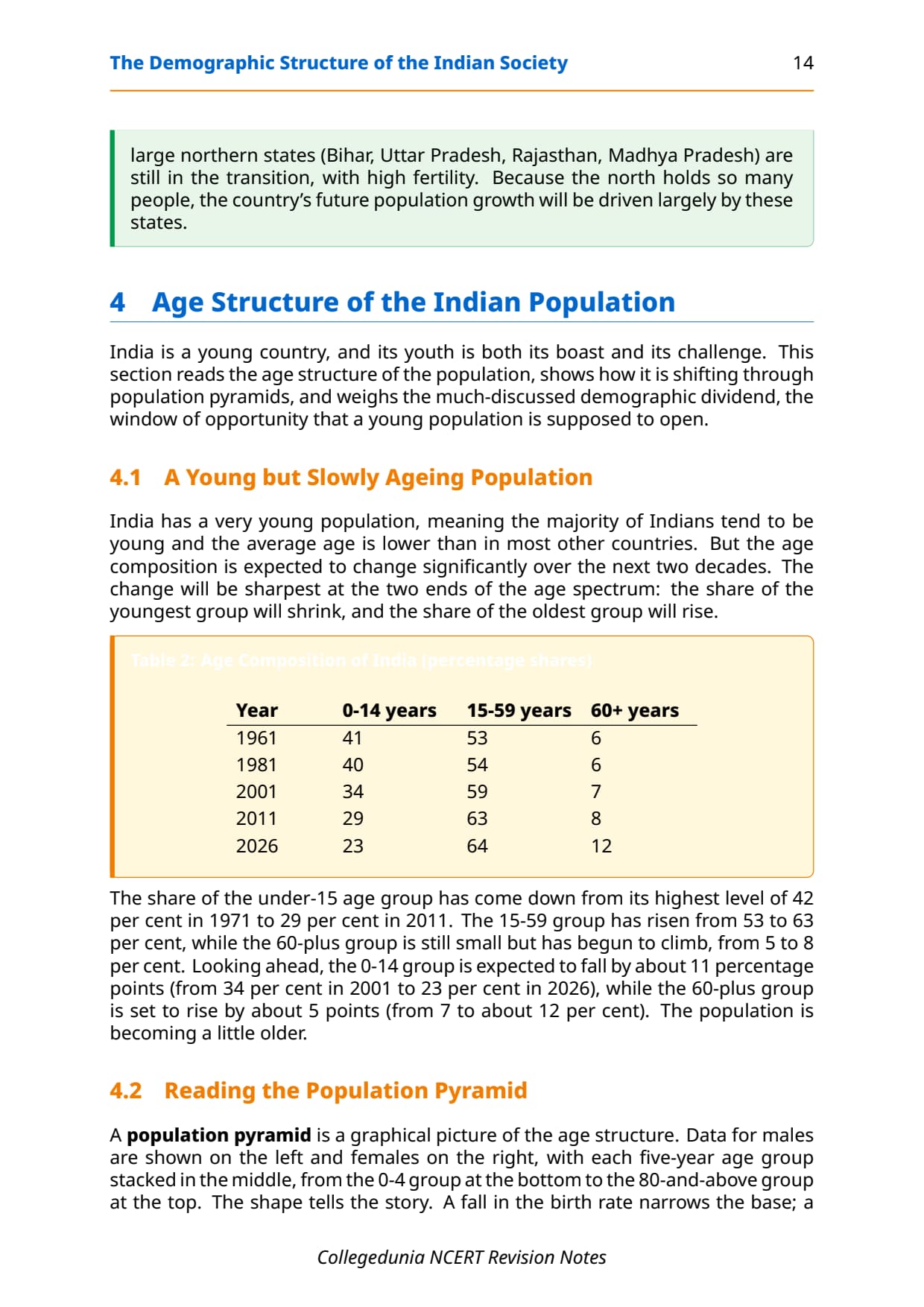
- A quick India snapshot: sex ratio, age structure and the demographic dividend.
- Pairs with the NCERT Solutions, Handwritten Notes and Book PDF linked lower on this page.
These Class 12 Sociology Chapter 2 revision notes are prepared by subject experts from the official NCERT Indian Society textbook and matched to the 2026-27 CBSE syllabus.
Student Feedback: In a Collegedunia poll of 7,820 Class 12 Sociology students, 74% of students said a one-page table of birth rate, death rate, sex ratio and age structure was the single most useful revision tool for this chapter. Most students revised these notes the night before the exam.
Source: 2026-27 Class 12 Sociology student poll. Sample of 7,820 students from CBSE schools across 12 states.
The Demographic Structure of the Indian Society Class 12 Notes Overview
The Demographic Structure of the Indian Society is the second chapter of Indian Society. It opens the door to demography, the systematic study of population, and shows that the size and make-up of a people is shaped by social forces, not chance. These notes break the chapter into the parts students must remember.
The chapter has four clear blocks, and your revision should follow the same order:
- What demography is and why it counts as a social science.
- Two theories of population growth: Malthus and the demographic transition.
- The core concepts: birth rate, death rate, growth rate, sex ratio and age structure.
- India today: the demographic dividend, the falling sex ratio and regional gaps.
Keeping these four blocks separate makes the chapter feel small. A student who can name the blocks in order will rarely get lost in The Demographic Structure of the Indian Society class 12, because every exam question sits inside one of them.
Key Terms and Definitions for Quick Revision
This chapter is built on a handful of terms, and almost every mark in the exam rests on getting them right. The table below is the fastest way to lock them in before the paper. Read it twice and you can attempt any objective question.
| Term | Definition |
|---|---|
| Demography | The systematic study of population: its size, growth, structure and distribution. |
| Birth rate | Live births per 1,000 people in a year. |
| Death rate | Deaths per 1,000 people in a year. |
| Rate of natural increase | Birth rate minus death rate. |
| Fertility rate | Number of live births per 1,000 women in the child-bearing age group. |
| Sex ratio | Number of females per 1,000 males in a population. |
| Age structure | The share of children, working-age adults and the elderly in a population. |
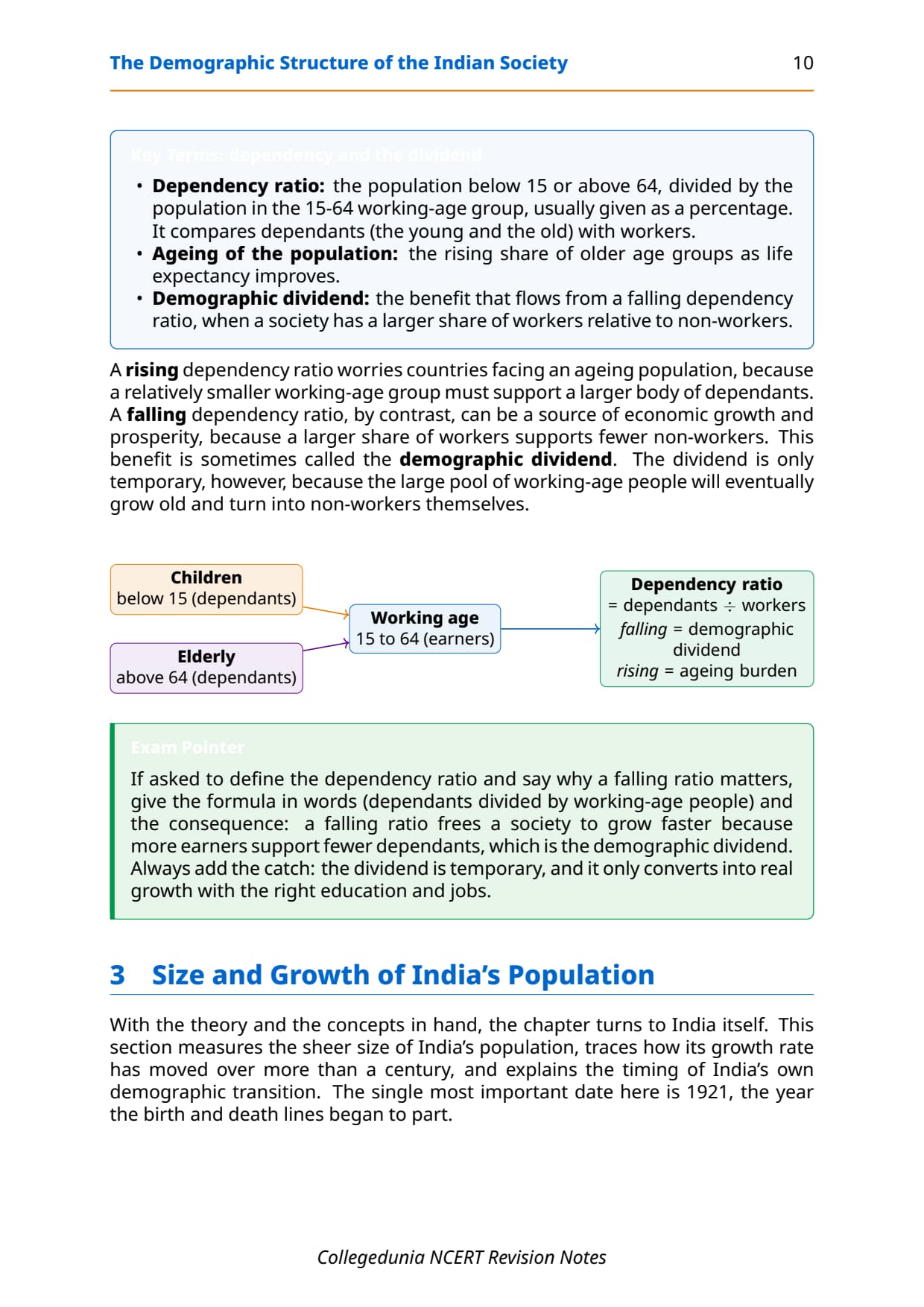
| Dependency ratio | The ratio of dependents (young and old) to the working-age population. |
A key revision tip: always state the unit, "per 1,000", when you define a rate. Examiners deduct marks for a definition that drops the unit. Note too that the sex ratio is females per 1,000 males, not the other way round, the most common slip in this chapter.
The Two Theories of Population Growth
The chapter sets two theories side by side, and students often mix them up in the exam. These notes keep them apart with a one-line summary of each, then a table that shows the contrast. Learn the difference and half the chapter is done.
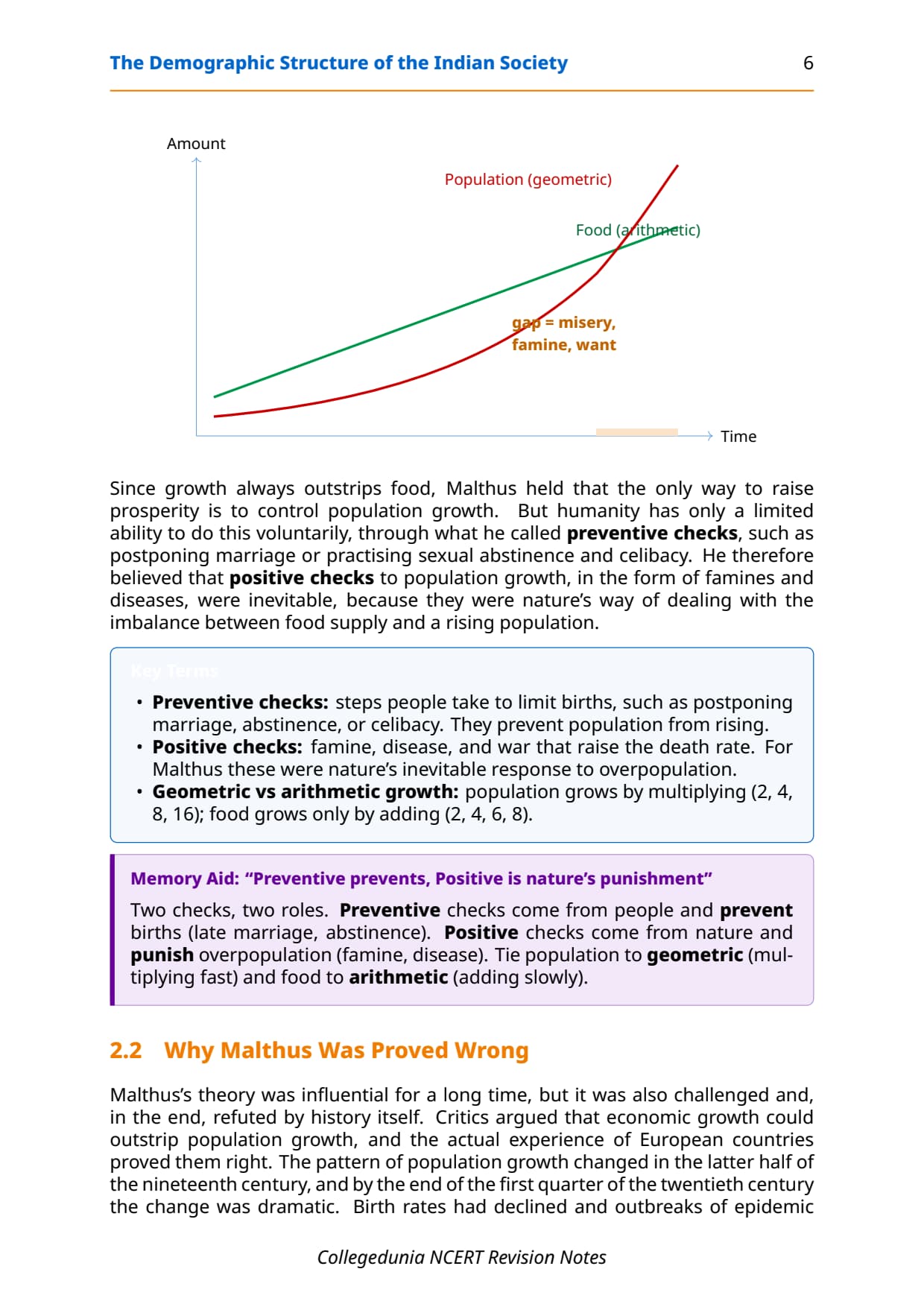
- Malthusian theory: population grows faster than food, so famine and disease are inevitable brakes. A gloomy, pre-modern view.
- Theory of demographic transition: population growth passes through three stages as a society develops, ending in slow growth. A modern, hopeful view.
| Feature | Malthusian theory | Demographic transition |
|---|---|---|
| Core idea | Numbers outrun food supply | Growth changes with development |
| View of the future | Catastrophe is unavoidable | Growth slows as society develops |
| The brake on growth | Famine, disease, war (positive checks) | Falling birth rates in stage three |
| Mood | Pessimistic | Optimistic |
The honest exam point is that Malthus was proved largely wrong because he did not foresee birth control, rising food output or the social changes that cut birth rates. The demographic transition fits the real world better, which is why it is the theory the board tests most.
The Theory of Demographic Transition in Three Stages
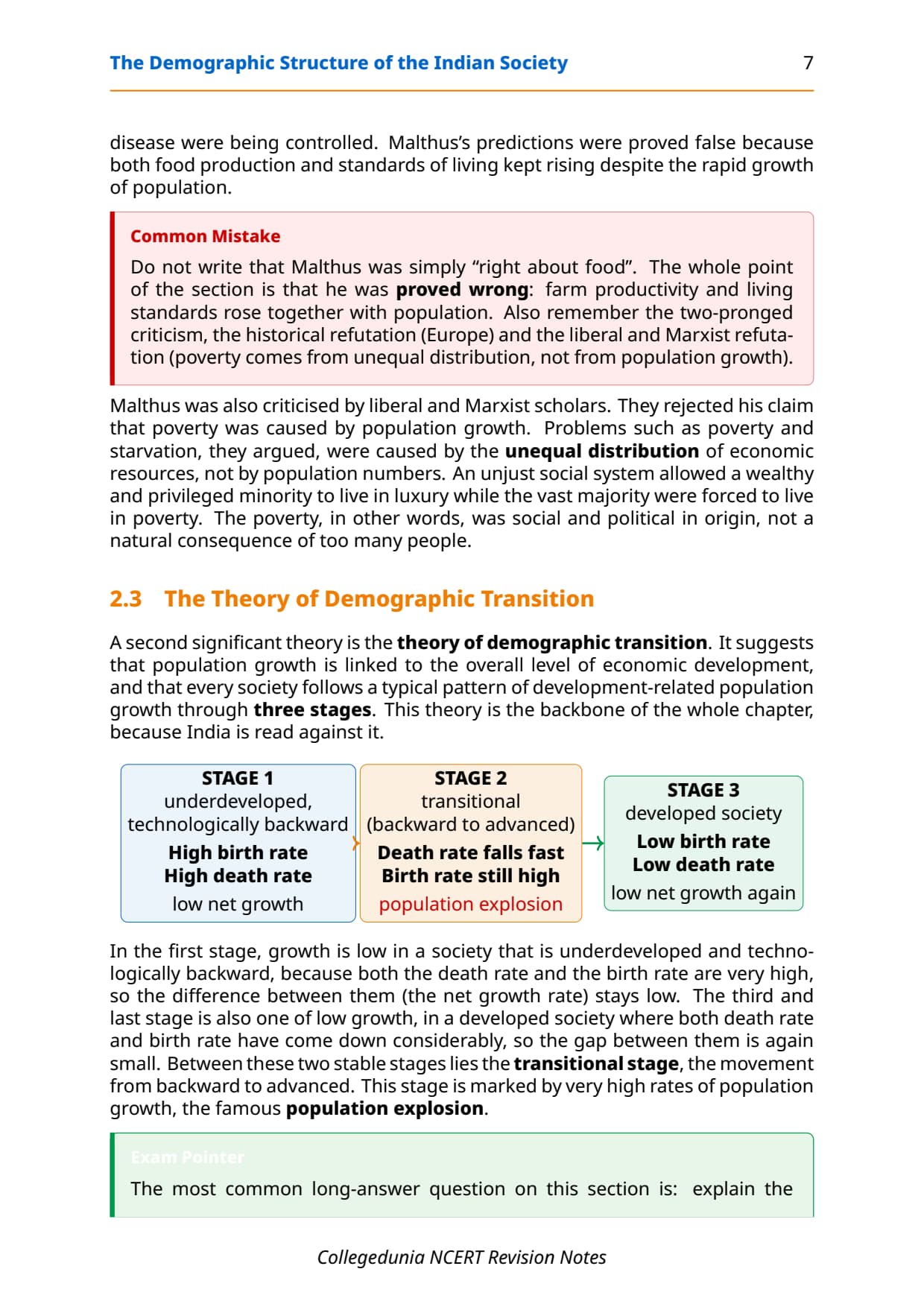
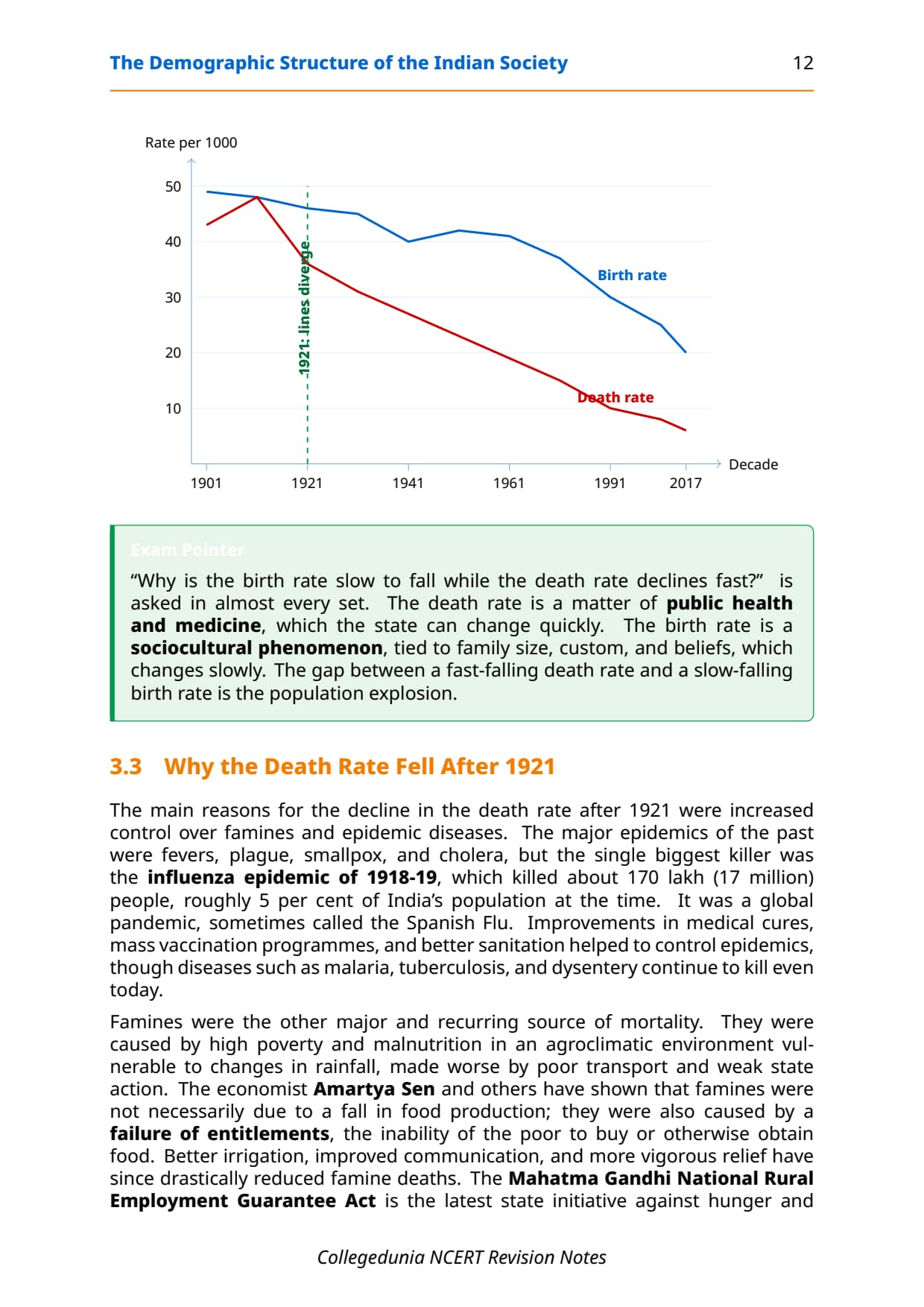
This is the single most-tested idea in the chapter, so the notes give it its own block. The theory links population growth to a society's level of development through three clear stages. Picture two lines, birth rate and death rate, moving over time.
- Stage 1 (low growth): both rates are high and roughly equal, so the population grows slowly. This is an underdeveloped, agrarian society.
- Stage 2, the transition (high growth): the death rate falls fast due to better food, health and sanitation, but the birth rate stays high. The gap is the population explosion.
- Stage 3 (low growth): the birth rate finally falls to meet the low death rate, so the population grows slowly again. This is a developed society.
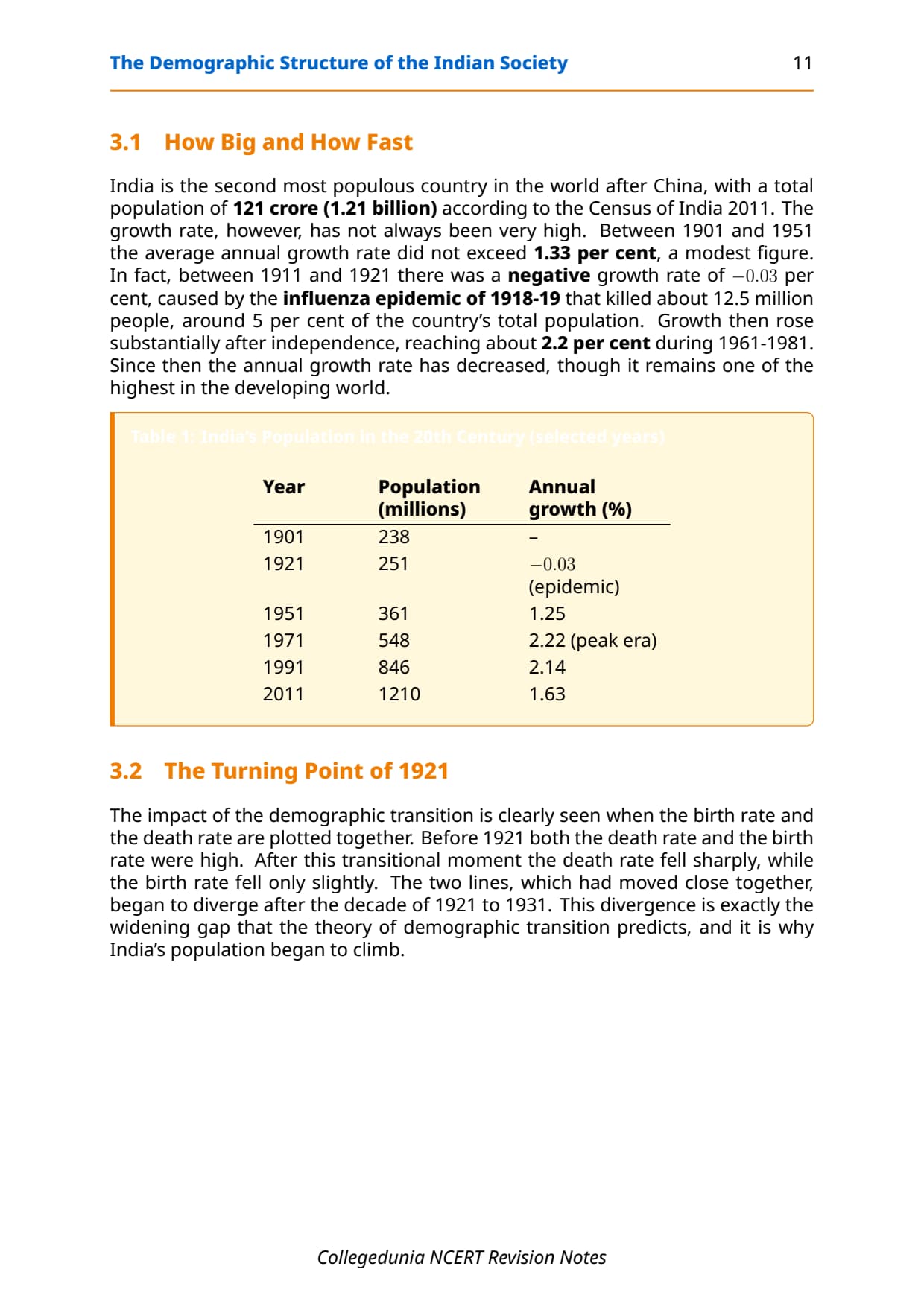
The key revision line is that India is in the transitional stage right now. Our death rate has fallen, but the birth rate is still catching up, so the population keeps rising even as the growth rate slows. That is why the transition is the part of the chapter most worth memorising.
India's Population Profile and the Demographic Dividend
The last block of the chapter is about India itself. These are the facts that turn a theory question into a real-world answer, so students should keep them ready. The points below sum up where India stands today.
- A young population: a large share of Indians are of working age, which can power growth, the demographic dividend.
- The catch: the dividend pays off only with schooling, skills and jobs. Without them a young population becomes a burden.
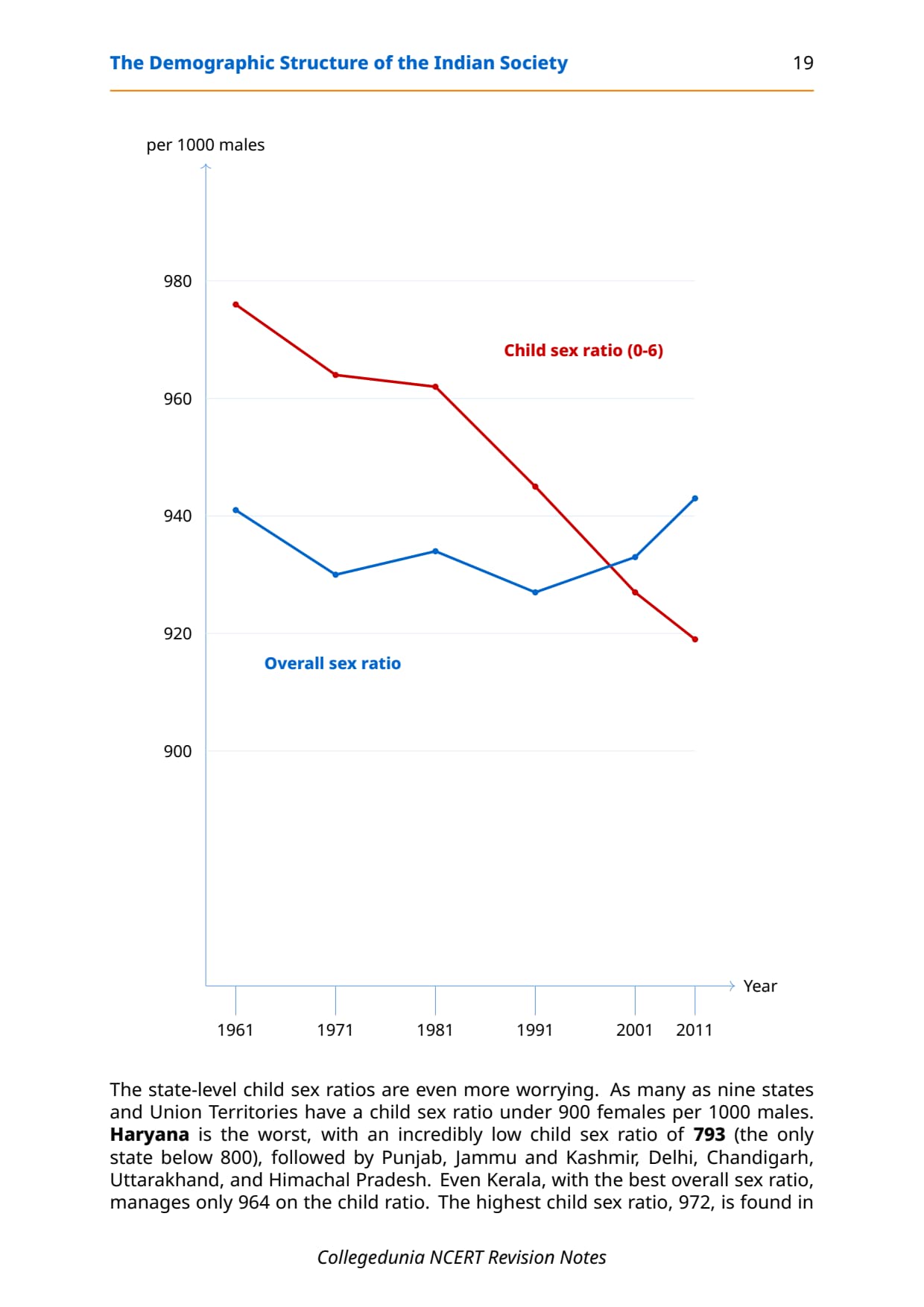
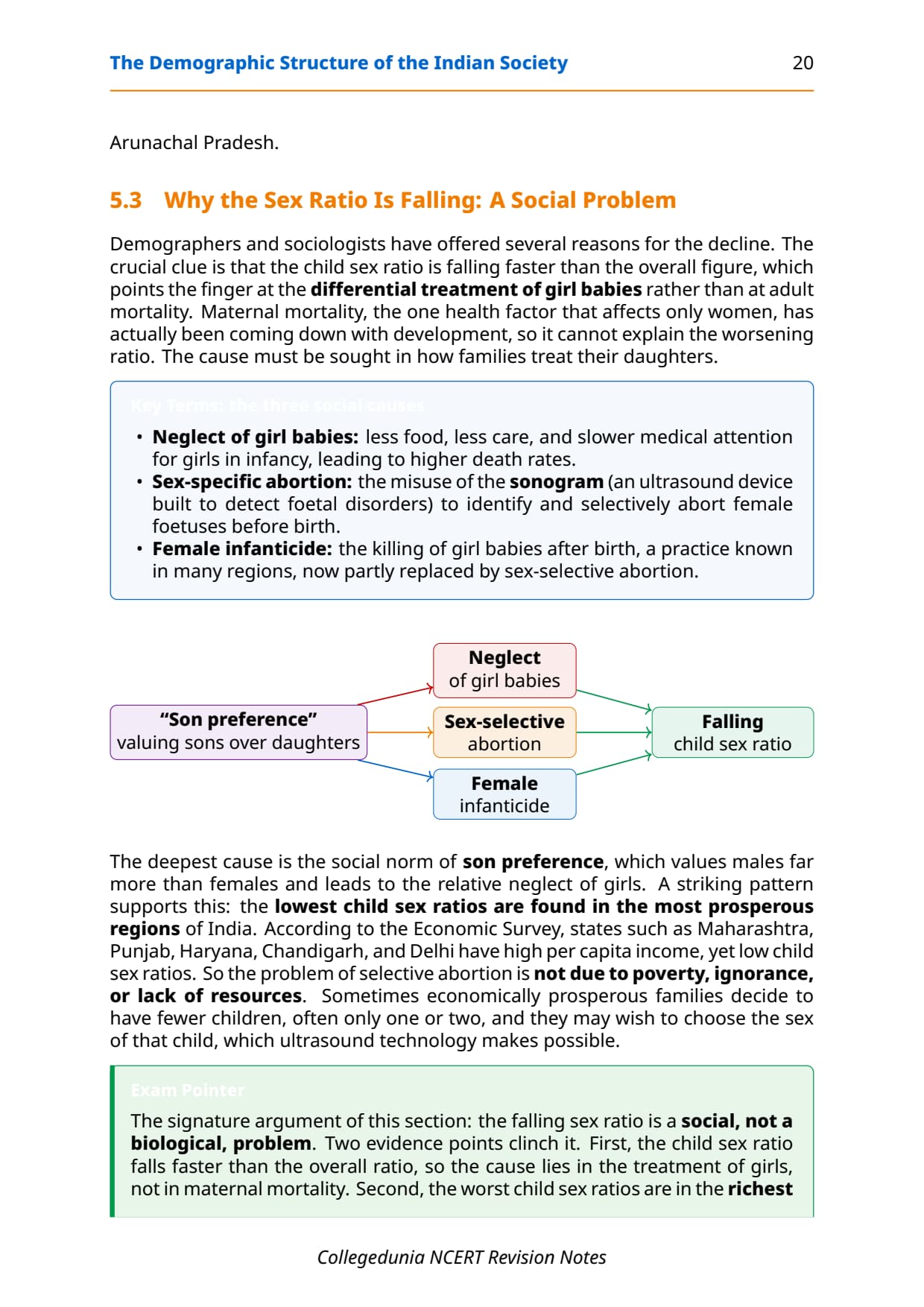
- Falling sex ratio: the share of females per 1,000 males has dropped, driven by son preference and sex-selective abortion.
- Regional gaps: Kerala and Tamil Nadu have low growth and high literacy; Bihar and Uttar Pradesh still grow fast.
The big takeaway is that numbers in India always tie back to society. Literacy, the status of women and the value placed on a girl child explain the sex ratio and the regional gaps far better than any natural cause. An answer that makes this link scores higher than one that only quotes figures.
The Demographic Structure of the Indian Society Revision Table
For a last-minute scan, this table pulls the whole chapter into one place. Students can cover the right column and test themselves, then check their recall. It is the quickest way to confirm you are exam-ready.
| Topic | One-line recall |
|---|---|
| Demography | Social science that studies population |
| Malthus | Population outruns food; famine and disease are inevitable |
| Demographic transition | Three stages: low, then high, then low growth |
| Population explosion | Death rate falls fast, birth rate lags in the transition |
| Demographic dividend | Growth boost from a large working-age group |
| Sex ratio | Females per 1,000 males; falling due to son preference |
Run down this table once a day in the week before the exam. Active recall beats re-reading, so cover the answers and say them aloud before you check. This single habit lifts retention more than any amount of highlighting.
How These Notes Pair with the Solutions and Book PDF
These notes summarise the chapter. To finish your prep, use them with the other resources for the same chapter, all linked in the table below.
| Resource | Best used for |
|---|---|
| The Demographic Structure of the Indian Society Class 12 NCERT Solutions | Full point-wise answers to all 6 exercise questions |
| The Demographic Structure of the Indian Society Class 12 Handwritten Notes | One-shot revision in a scanned notebook style |
| The Demographic Structure of the Indian Society NCERT Book PDF | Reading the original NCERT chapter text and data boxes |
Tip: read these notes first to get the big picture, then attempt the NCERT Solutions on your own. The notes give the map; the solutions give the practice.
All NCERT Notes for Class 12 Sociology
The table links the Notes for every chapter in both Class 12 Sociology books, so students can revise across the course in one place. The Demographic Structure of the Indian Society is highlighted.
| Chapter | NCERT Notes |
|---|---|
| Indian Society | |
| Chapter 1 | Introducing Indian Society |
| Chapter 2 | The Demographic Structure of the Indian Society |
| Chapter 3 | Social Institutions - Continuity and Change |
| Chapter 4 | The Market as a Social Institution |
| Chapter 5 | Patterns of Social Inequality and Exclusion |
| Chapter 6 | The Challenges of Cultural Diversity |
| Social Change and Development in India | |
| Chapter 1 | Structural Change |
| Chapter 2 | Cultural Change |
| Chapter 3 | The Constitution and Social Change |
| Chapter 4 | Change and Development in Rural Society |
| Chapter 5 | Change and Development in Industrial Society |
| Chapter 6 | Globalisation and Social Change |
| Chapter 7 | Mass Media and Communications |
| Chapter 8 | Social Movements |
FAQs on The Demographic Structure of the Indian Society Class 12 Notes
The Demographic Structure of the Indian Society Class 12 Sociology Notes Common Questions
Ques. What are the most important topics in class 12 sociology chapter 2 notes?
Ans. The most important topics are the theory of demographic transition, the Malthusian theory, the meaning of birth rate, death rate and sex ratio, and India's demographic dividend. These notes cover each in short, exam-ready points.
Ques. What is demography in simple words?
Ans. Demography is the systematic study of population, its size, growth, structure and distribution. It is treated as a social science because social forces, like education and the status of women, shape how a population changes.
Ques. What is the difference between the Malthusian theory and the demographic transition?
Ans. Malthus said population outruns food, so famine and disease are inevitable, a pessimistic view. The demographic transition says growth passes through three stages and slows as a society develops, a more optimistic and accurate view that fits the modern world.
Ques. Why is India said to be in the transitional stage?
Ans. India's death rate has fallen due to better food, health and sanitation, but the birth rate has not fallen to the same extent. This gap keeps the population growing even as the growth rate slows, which is the mark of the transitional stage.
Ques. Are these class 12 sociology chapter 2 notes enough for the board exam?
Ans. Yes, these notes cover the full NCERT chapter in revision form. For exam practice, pair them with the NCERT Solutions linked on this page so you can write out full answers to all 6 exercise questions.



Comments