




These Class 12 Sociology Chapter 1 Introducing Indian Society Notes give a clear, quick-revision summary of what makes sociology a distinct subject, self-reflexivity, the sociological imagination, common sense, and how colonialism gave rise to nationalism, set to the 2026-27 CBSE syllabus. The notes turn an idea-heavy opening chapter into short points, tables and definitions that students can revise in one sitting.
- One-page summary of the sociological point of view plus every key term you need to write full answers.
- A quick map of the chapter: discipline, method, the sociological imagination and history.
- Pairs with the NCERT Solutions, Handwritten Notes and Book PDF linked lower on this page.
These Class 12 Sociology Chapter 1 revision notes are prepared by subject experts from the official NCERT Indian Society textbook and matched to the 2026-27 CBSE syllabus.
Student Feedback: In a Collegedunia poll of 7,640 Class 12 Sociology students, 72% of students said a one-page map of the chapter, the discipline, the method, the imagination and the history, was the single most useful revision tool. Most students revised these notes the night before the exam.
Source: 2026-27 Class 12 Sociology student poll. Sample of 7,640 students from CBSE schools across 12 states.
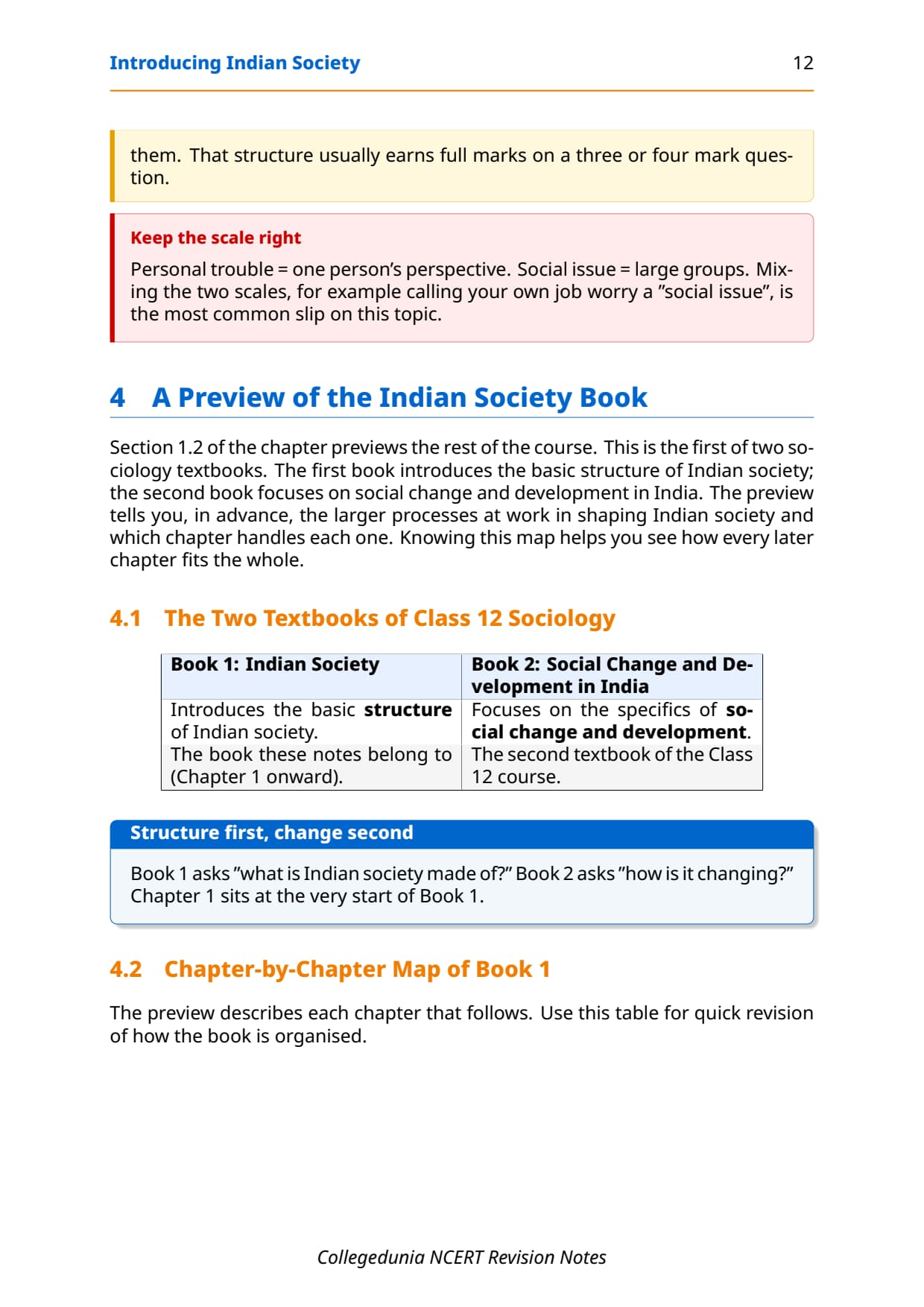
Introducing Indian Society Class 12 Notes Overview
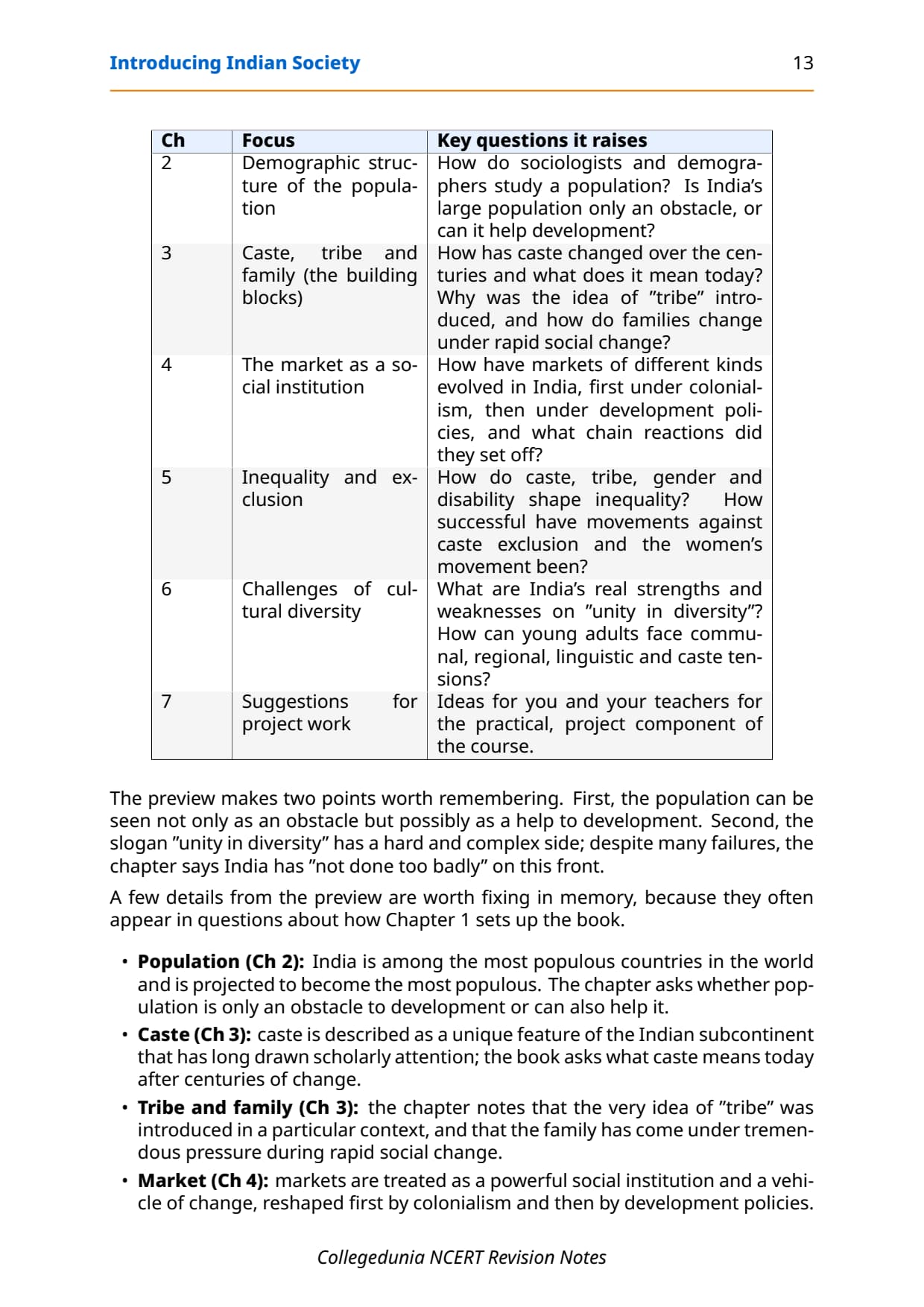
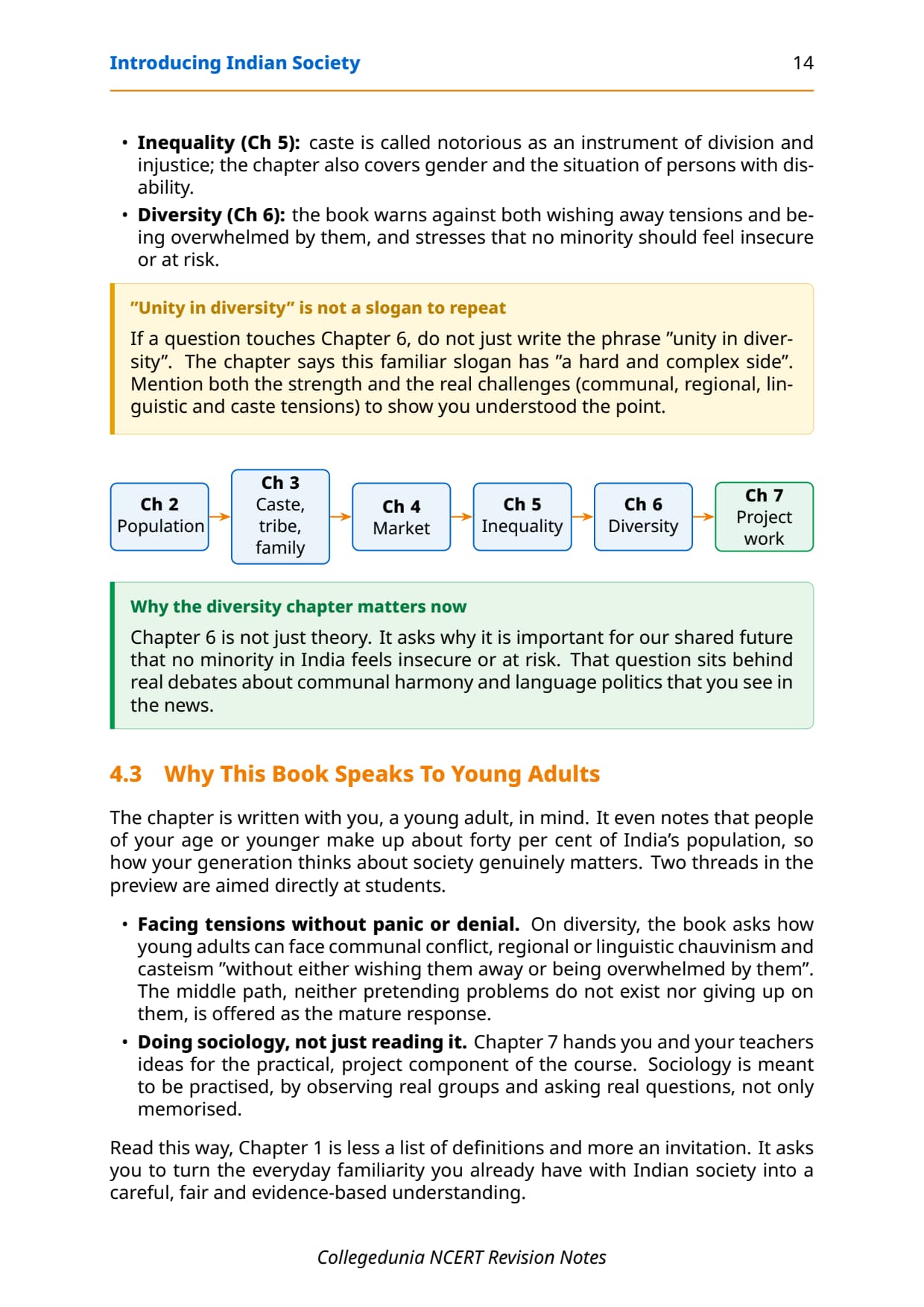
Introducing Indian Society is the first chapter of Indian Society, and it is written differently from the rest: no summary boxes, no glossary. It asks students to read on their own and build the sociological point of view they will use through the book. These notes break the chapter into the parts students must remember.
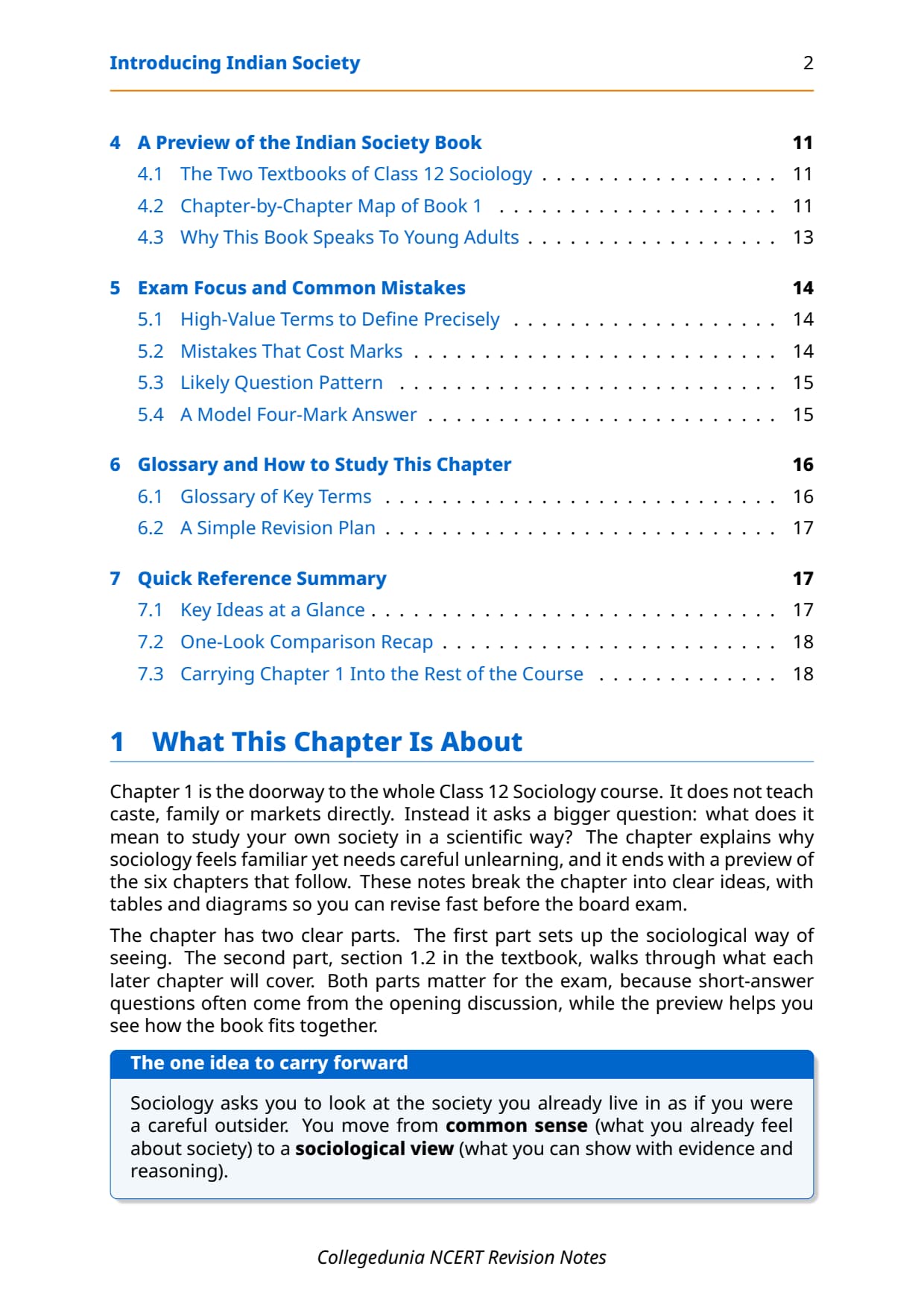
The chapter has four clear blocks, and your revision should follow the same order:
- The discipline: what makes sociology distinct from every other subject.
- The method: self-reflexivity, unlearning, and why common sense is only partial.
- The imagination: the link between personal troubles and social issues.
- The history: how colonialism shaped modern India and gave rise to nationalism.
Keeping these four blocks separate makes the chapter feel small. A student who can name the blocks in order will rarely get lost in Introducing Indian Society class 12, because every exam question sits inside one of them.
Key Terms and Definitions for Quick Revision
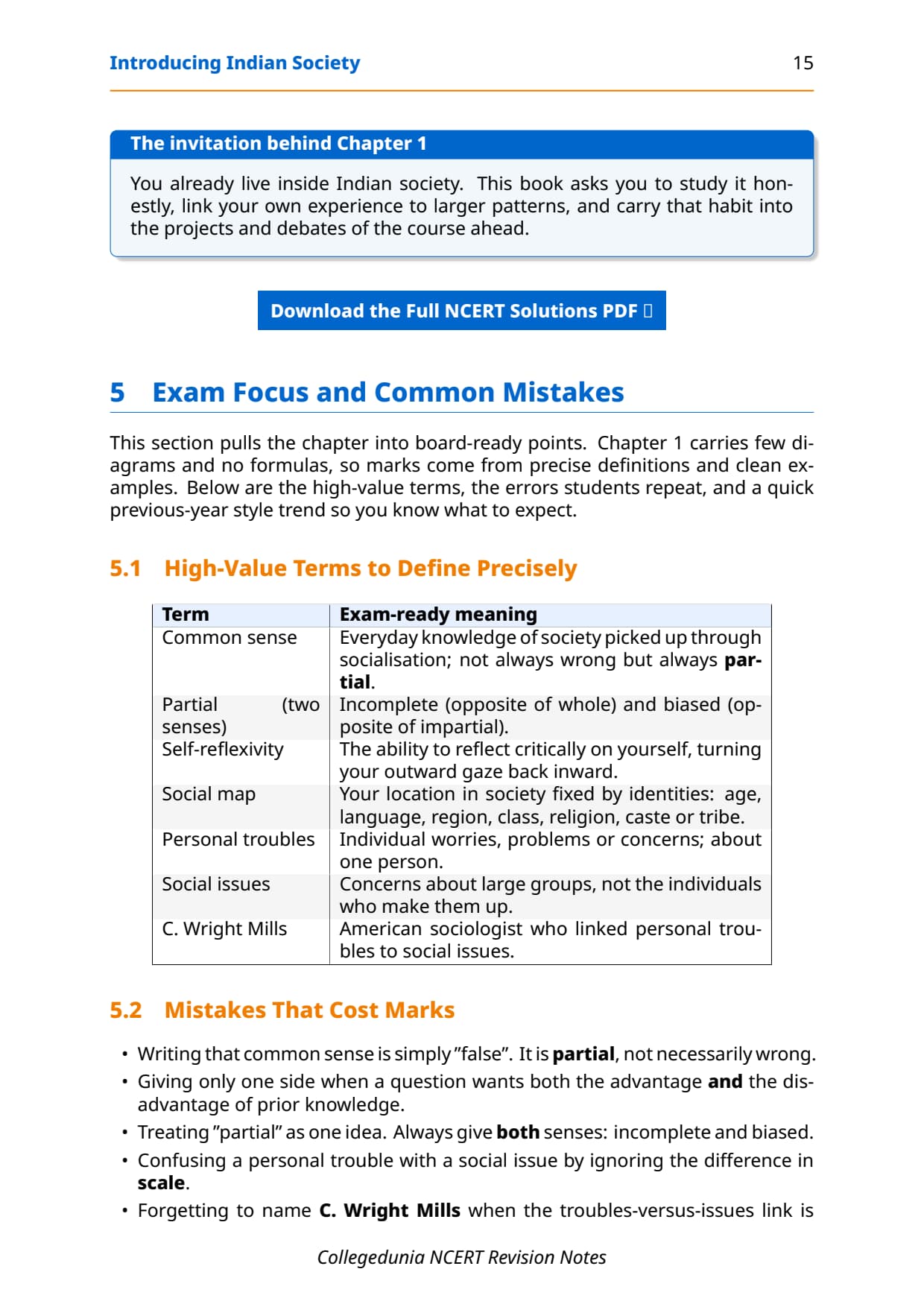
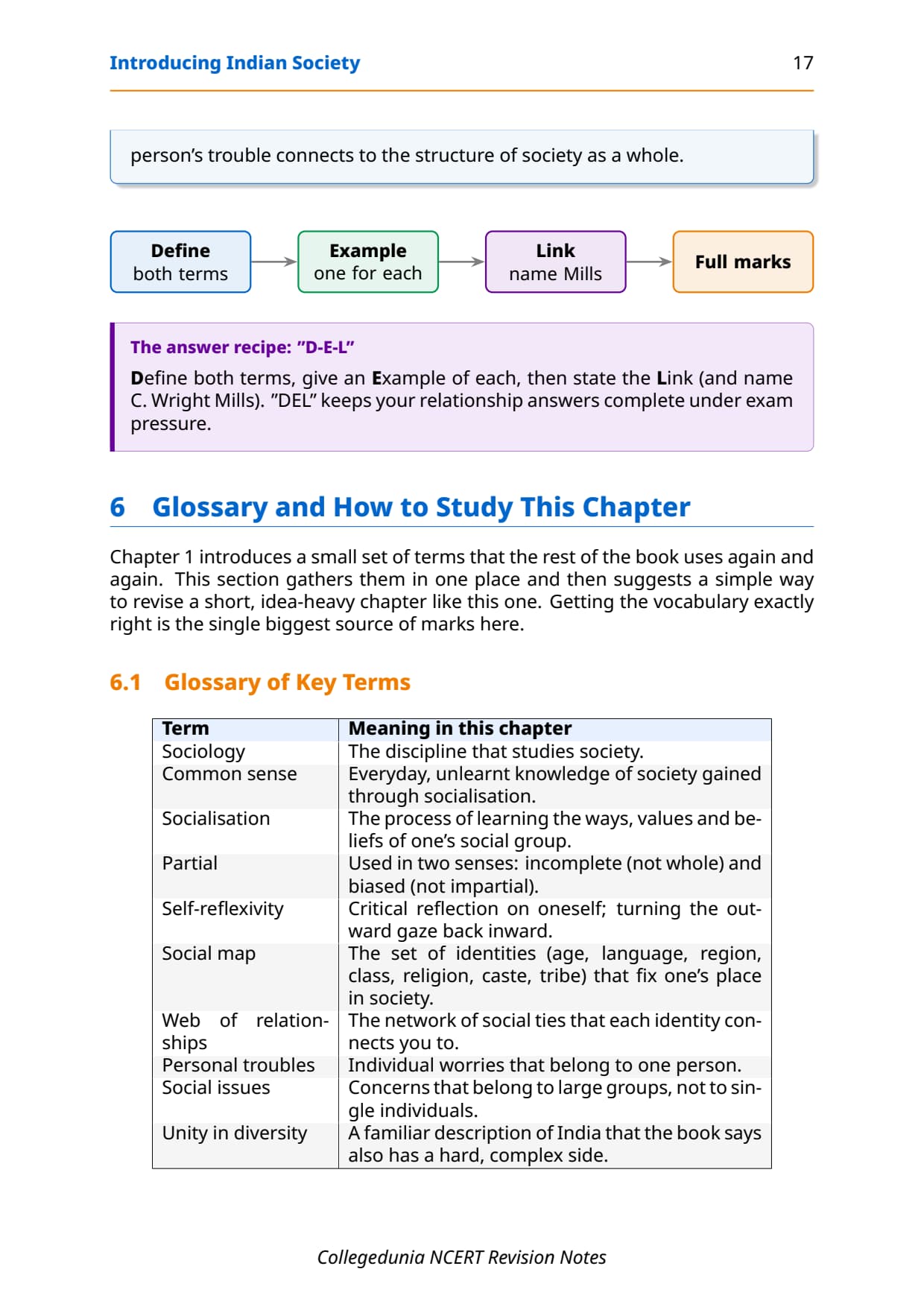
This chapter is built on a handful of ideas, and almost every mark in the exam rests on getting them right. The table below is the fastest way to lock them in before the paper. Read it twice and you can attempt any objective question.
| Term | Definition |
|---|---|
| Sociology | The systematic study of human society and the relationships within it. |
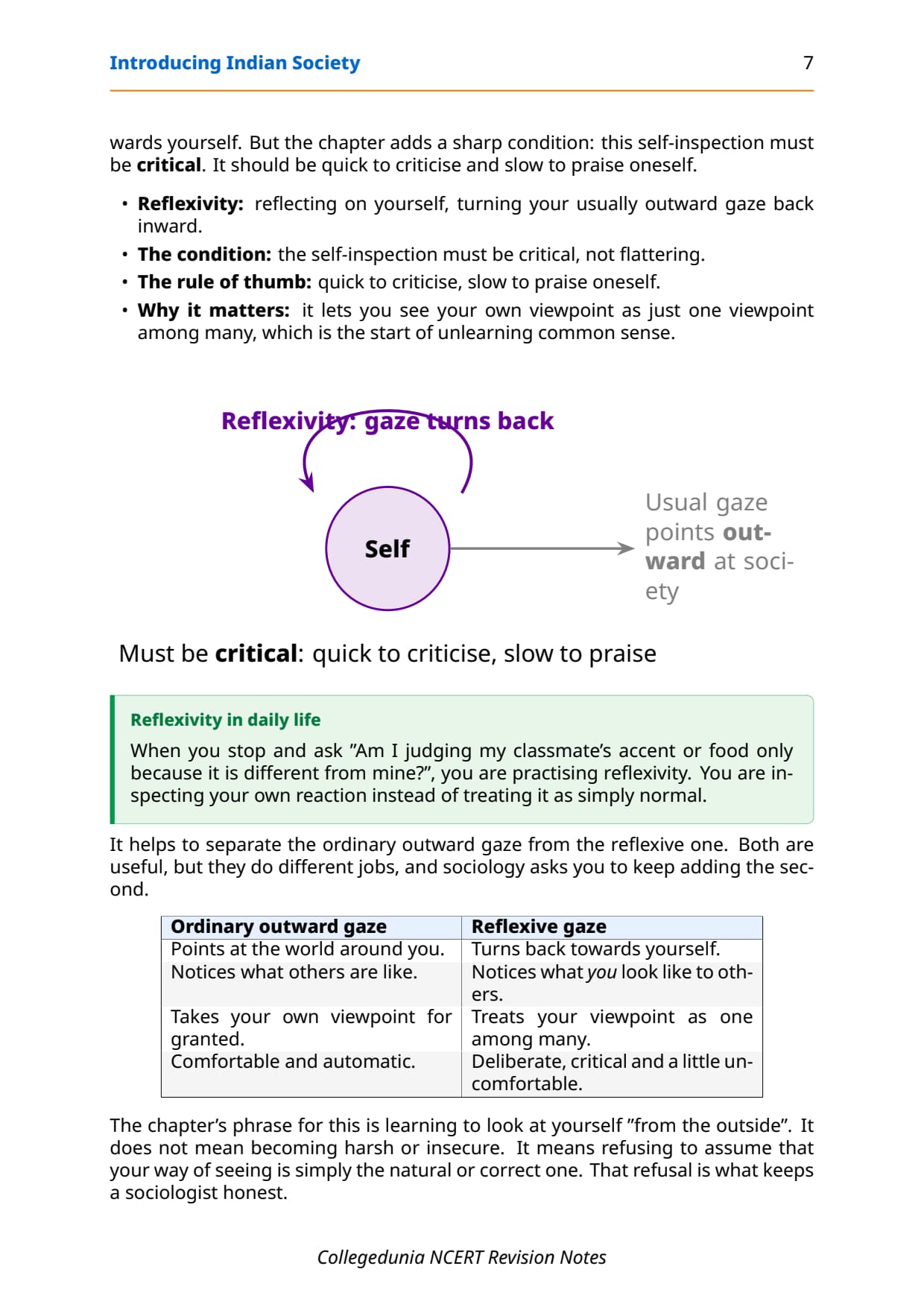
| Self-reflexivity | The constant self-questioning of our own ideas, biases and social position. |
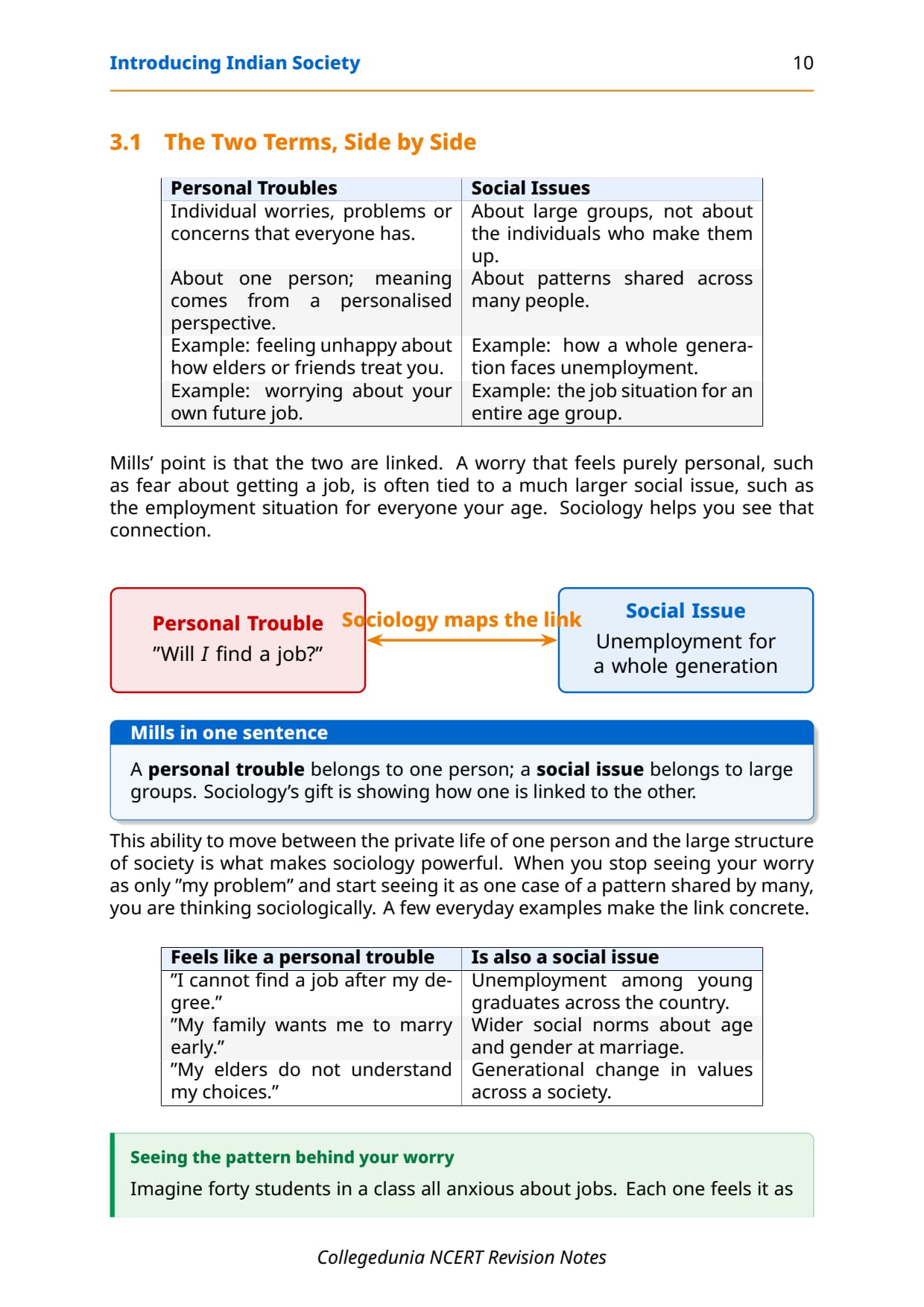
| Sociological imagination | The skill of linking a person's private life to wider public forces. |
| Common sense | Everyday, taken-for-granted knowledge that sociology tests rather than trusts. |
| Personal troubles | Private matters felt by one person within their own life. |
| Social issues | Public matters that affect large groups and arise from how society is organised. |
| Socialisation | The process by which we learn the norms and values of our society. |
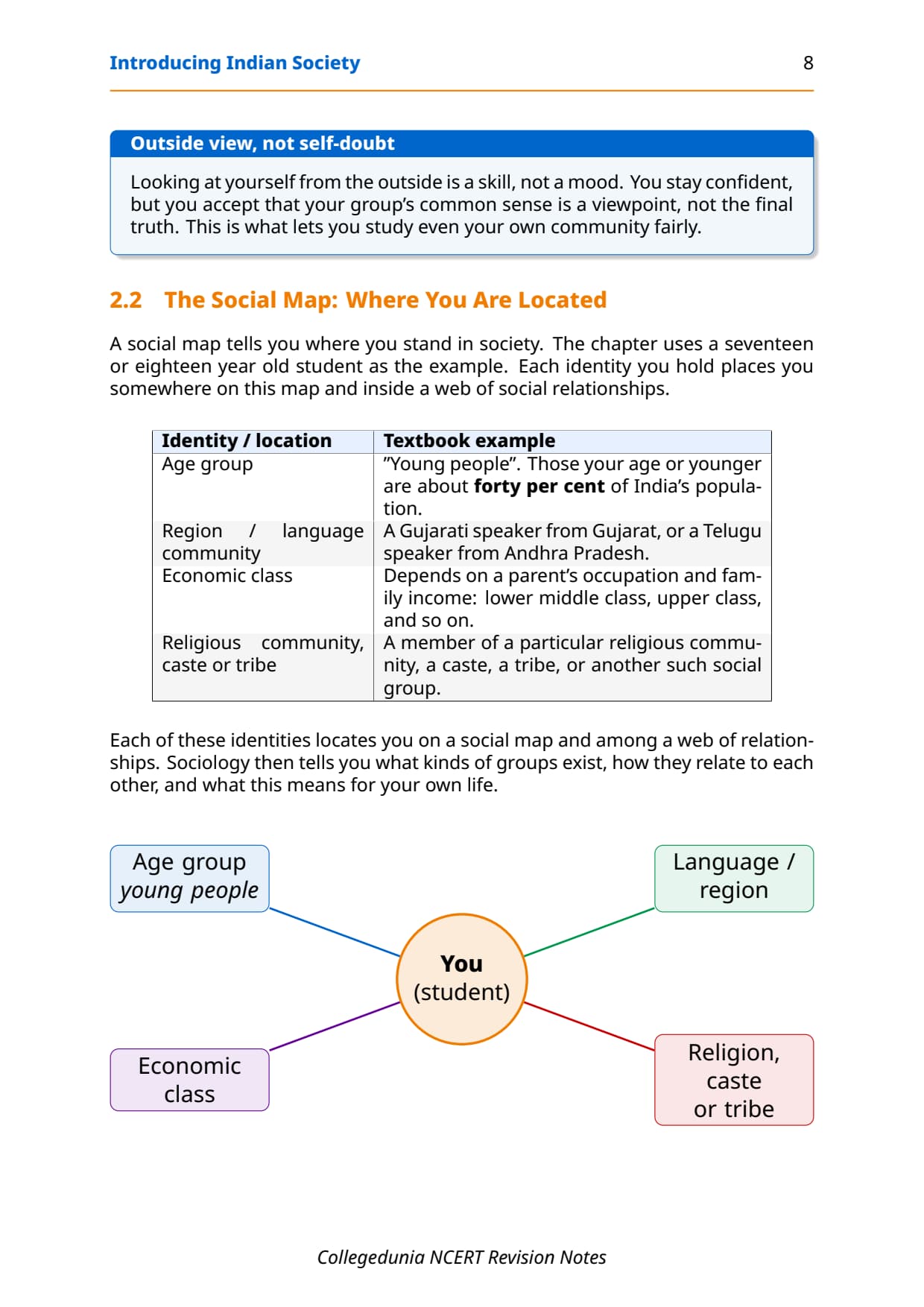
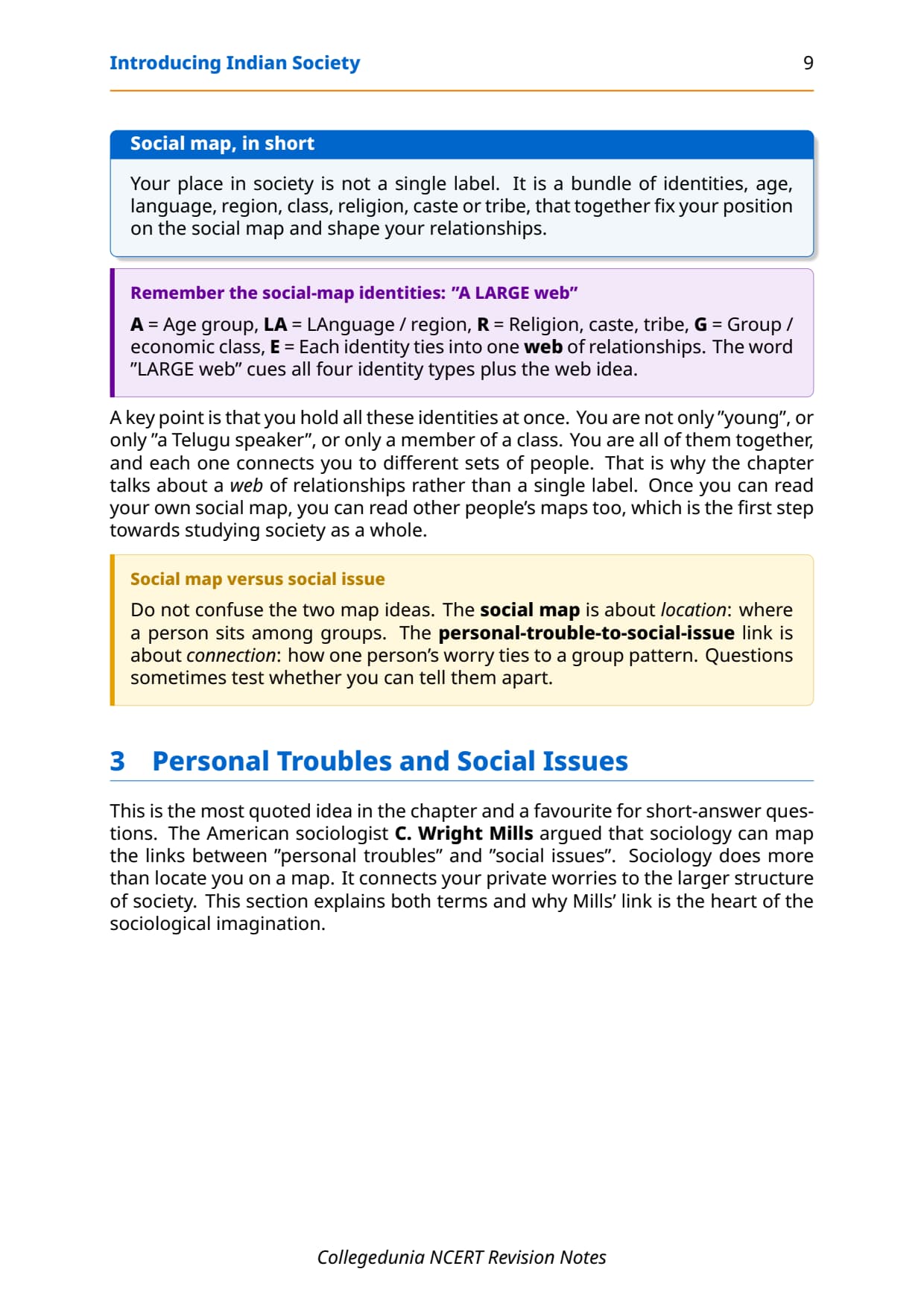
| Social map | The picture of where an individual stands within the wider structure of society. |
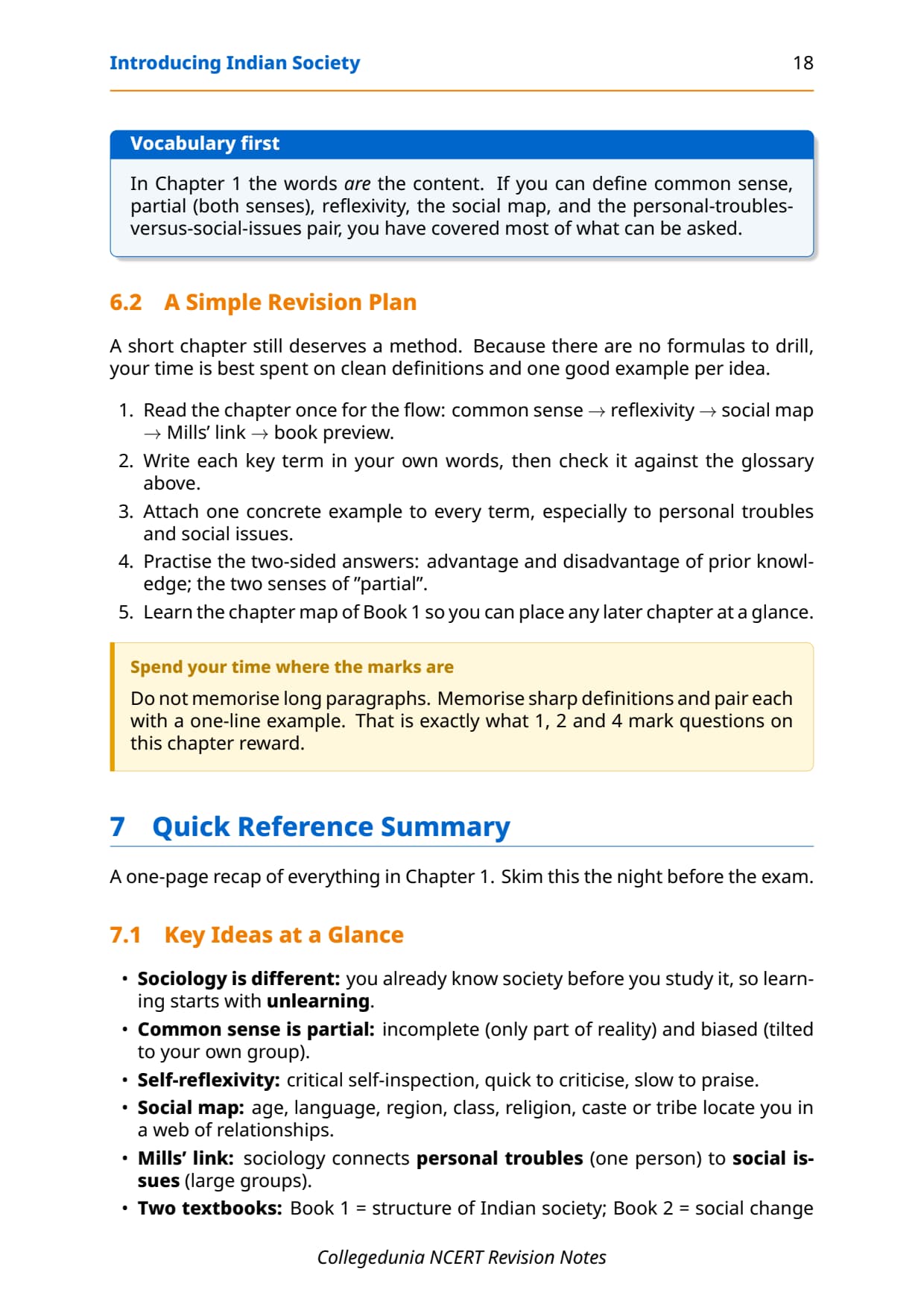
A key revision tip: learn each pair as a contrast, not in isolation. Personal troubles sit against social issues, common sense sits against the sociological view. Examiners reward an answer that shows the contrast, so storing the terms in pairs makes recall faster and your answers sharper.
The Sociological Point of View in Short
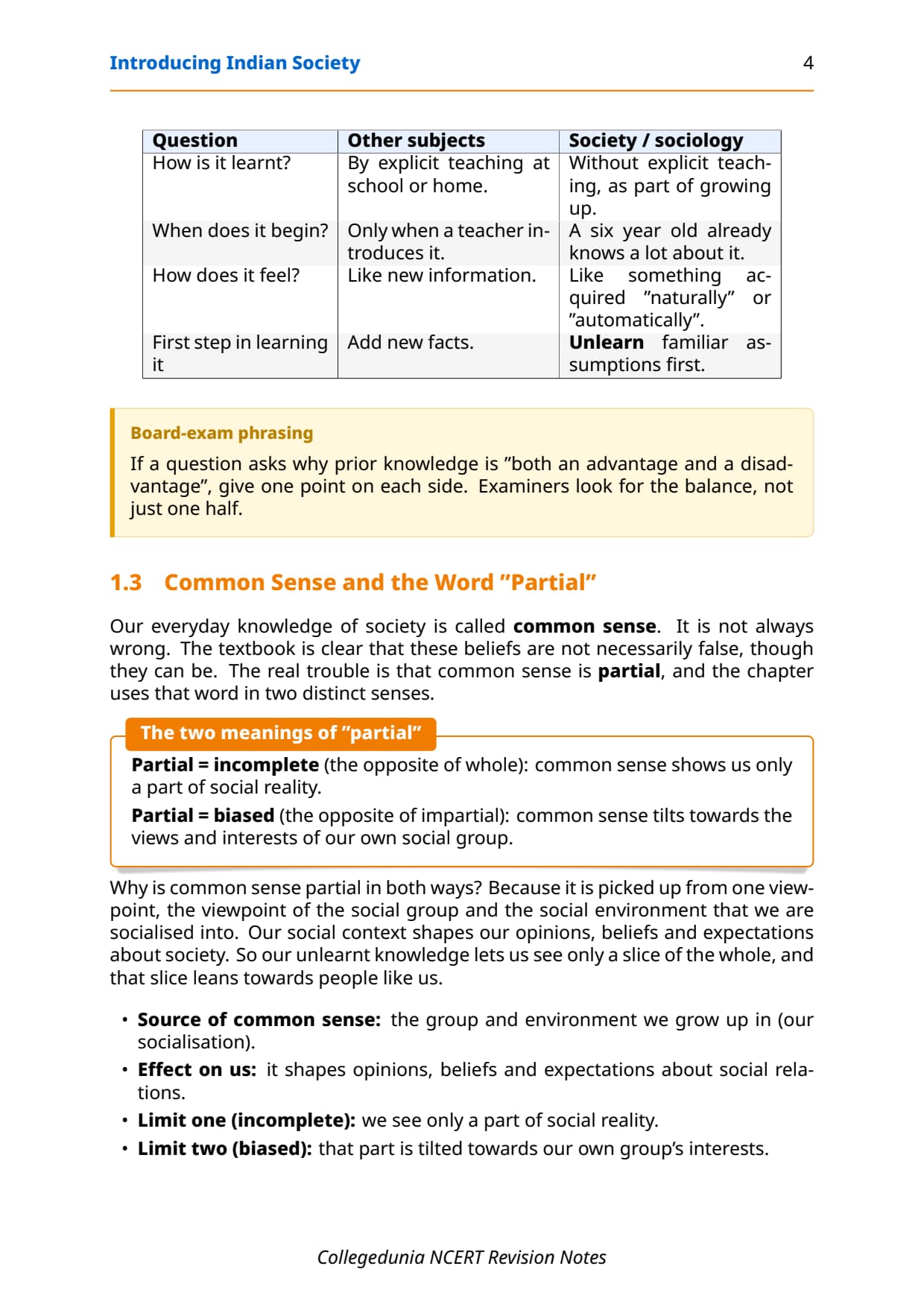
The heart of the chapter is a new way of looking at society. These notes set the sociological view against everyday common sense, the contrast the board tests most. Learn the difference and half the chapter is done.
- Sociology studies society itself: unlike subjects that take one slice of life, it studies the whole web of social relationships.
- The observer is inside the subject: we study a society we already belong to, so self-reflexivity is essential.
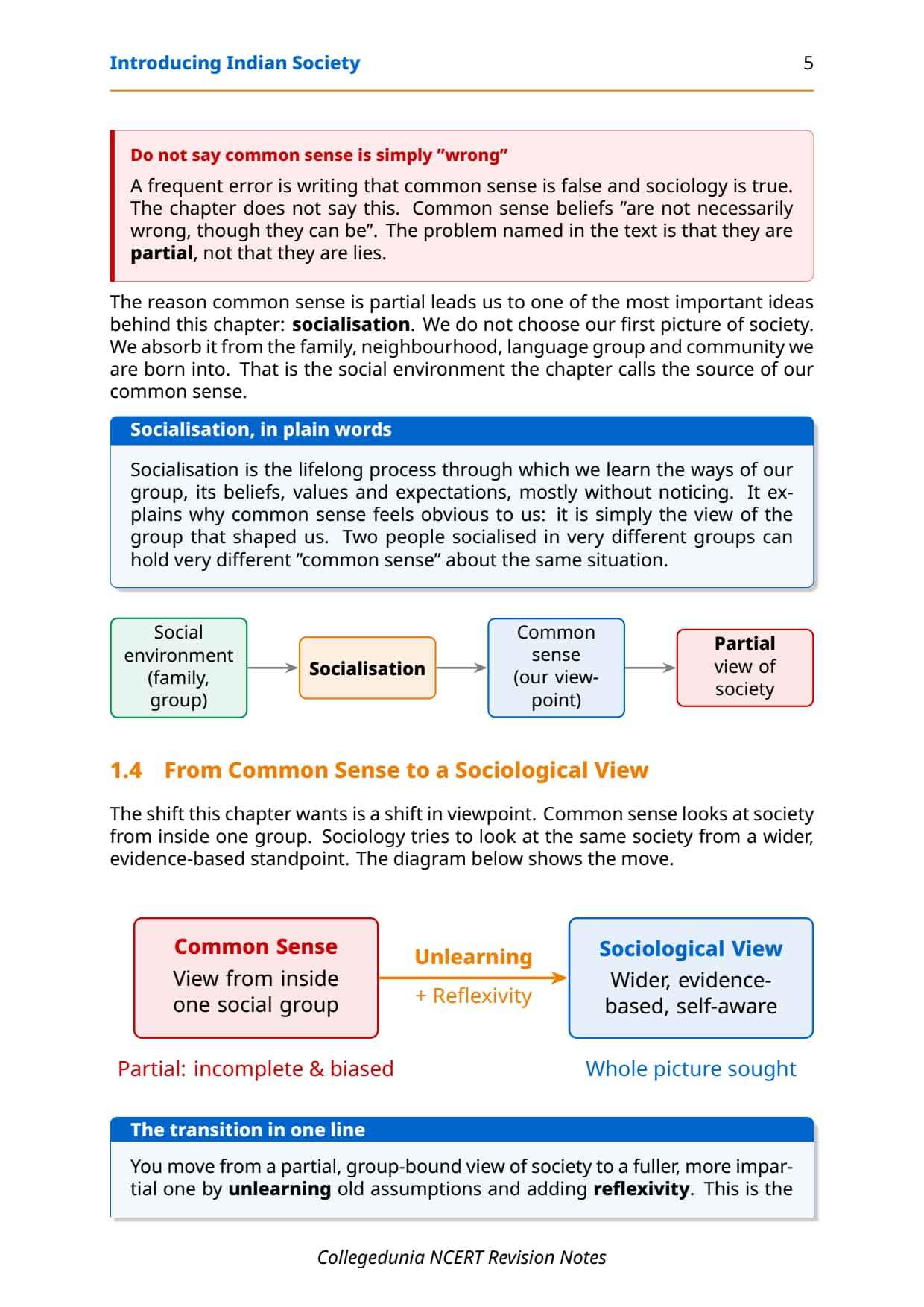
- Common sense is only partial: it is useful but untested, and it often blames a person for what is really a social pattern.
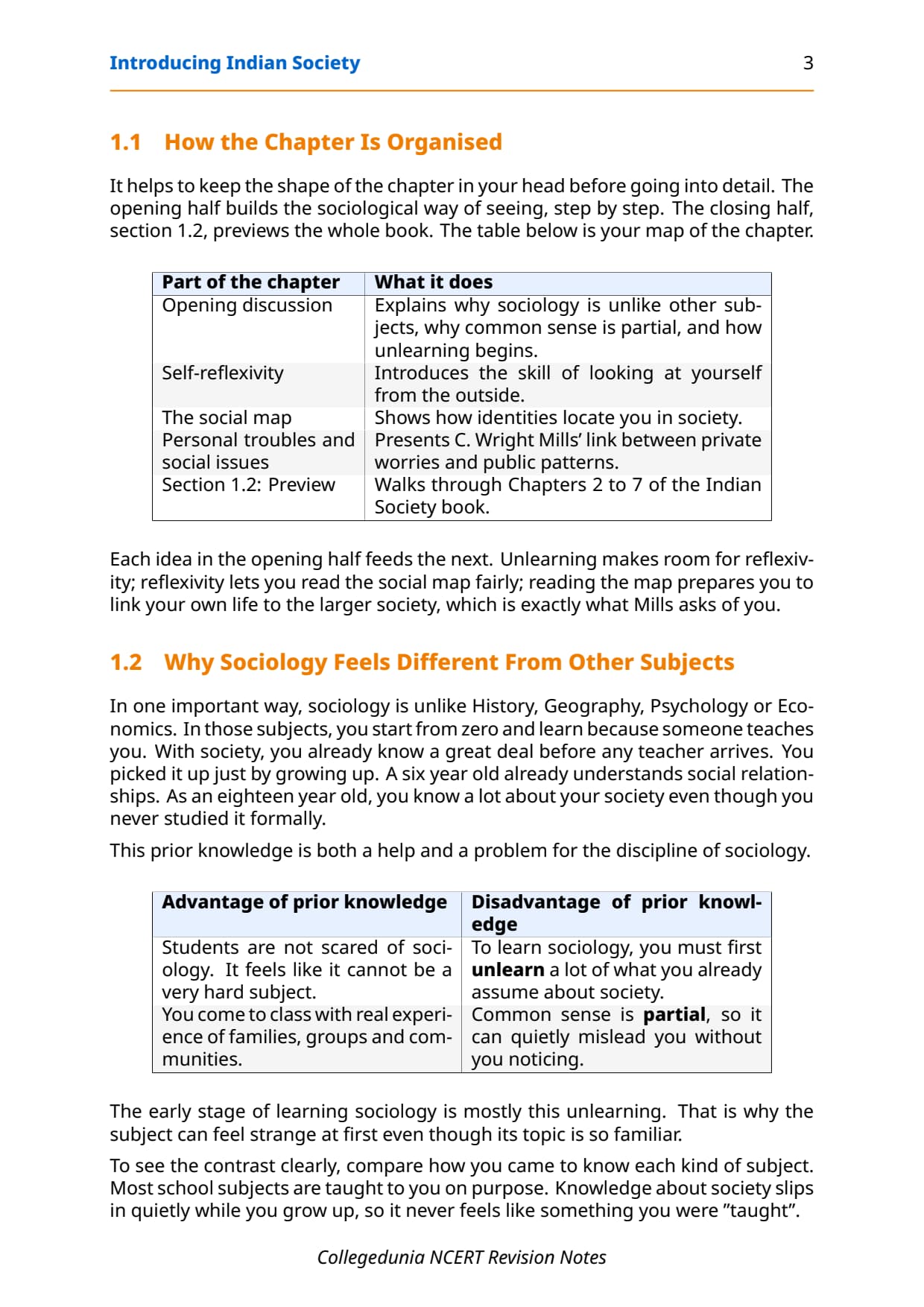
| Feature | Common sense | Sociological view |
|---|---|---|
| Source | Taken for granted | Systematic observation and method |
| Explanation | Individual nature or fate | Social structures and forces |
| Questioning | Rarely asks where ideas come from | Always asks how and whose interest |
| Scope | Partial, incomplete | Critical, fuller picture |
The honest exam point is that common sense is a starting point, not an answer. Sociology does not throw it away; it tests it and completes it. This is why "unlearning" comes first: students must set aside ready-made opinions before they can see society clearly.
The Sociological Imagination: Troubles and Issues
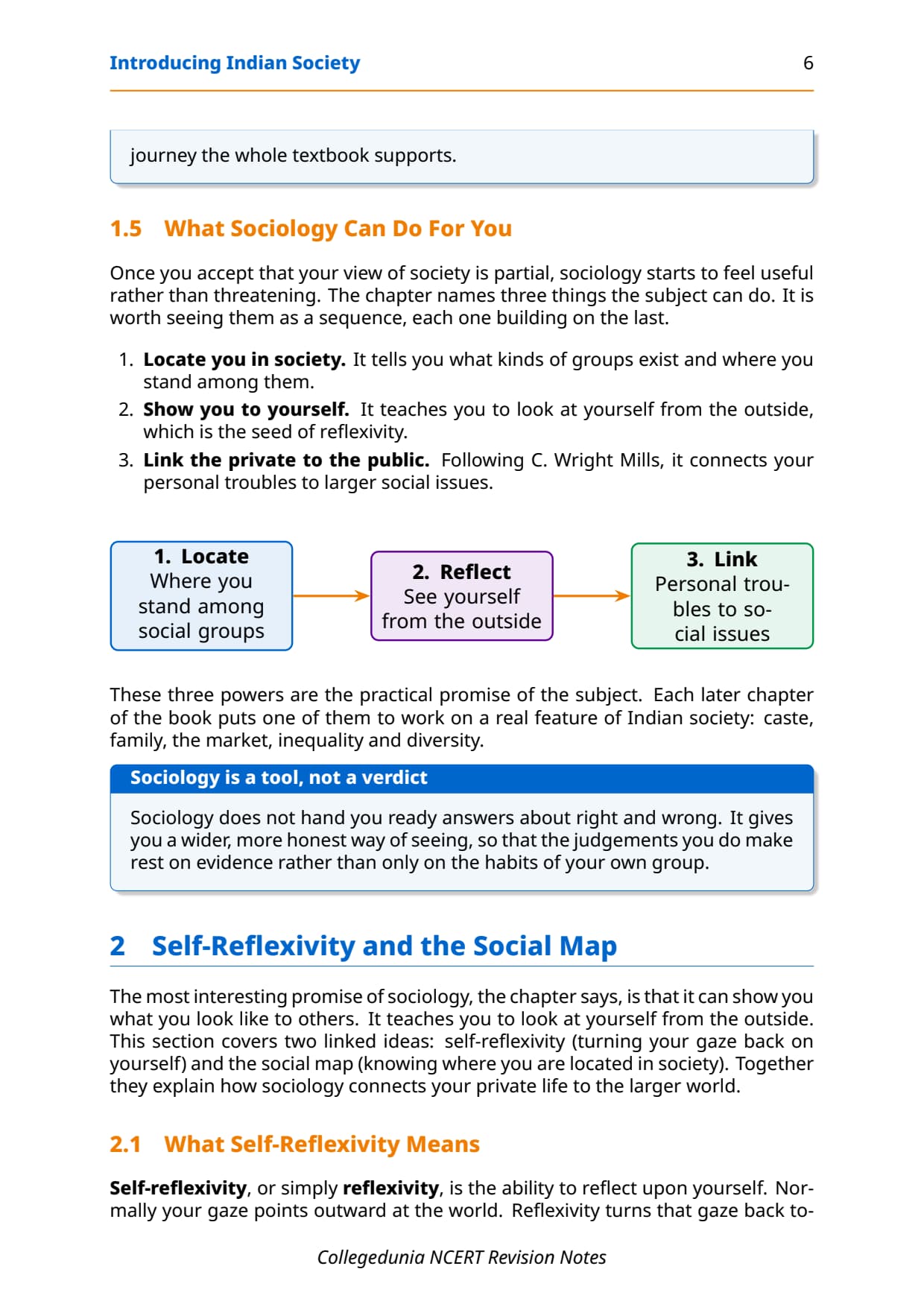
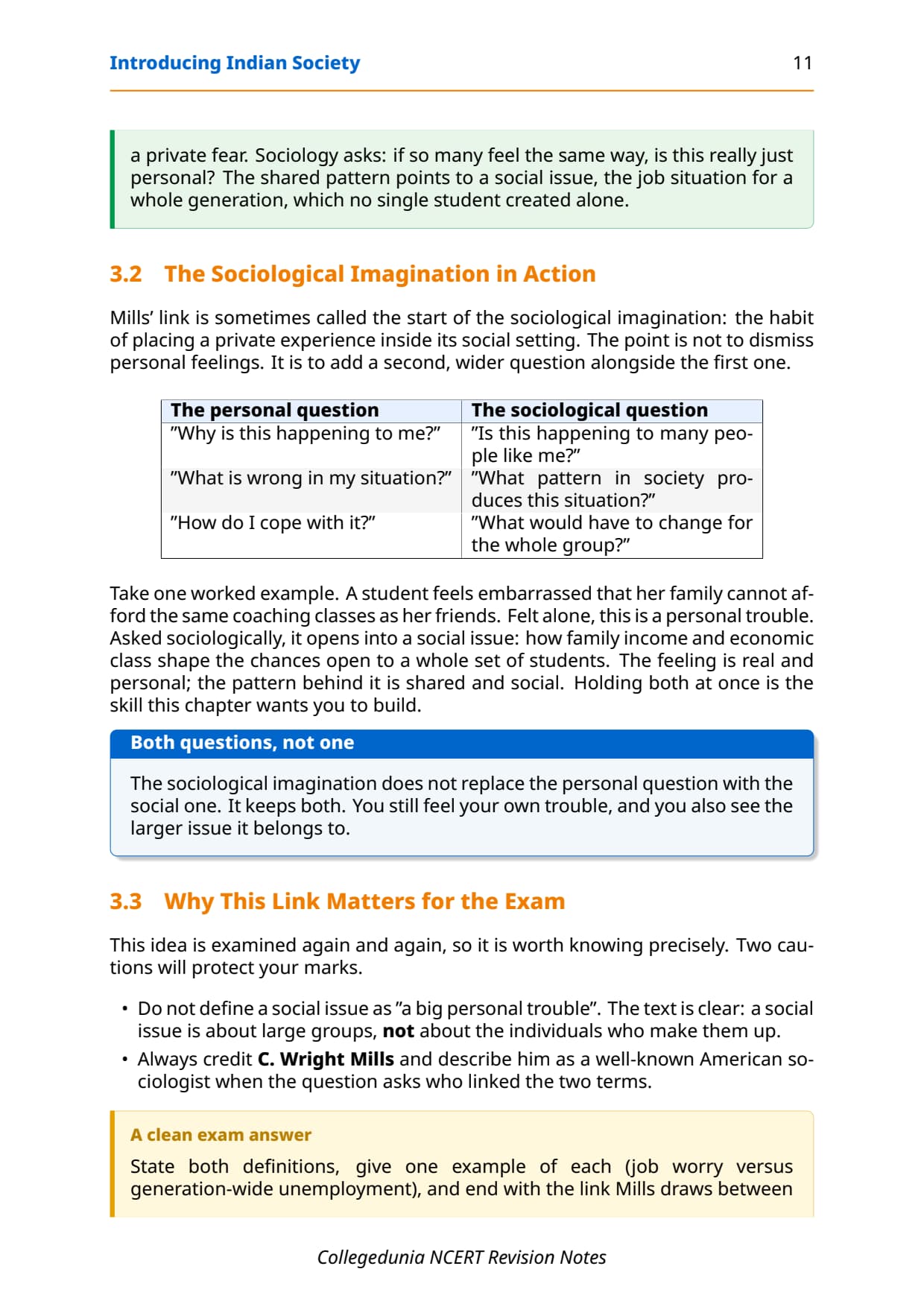
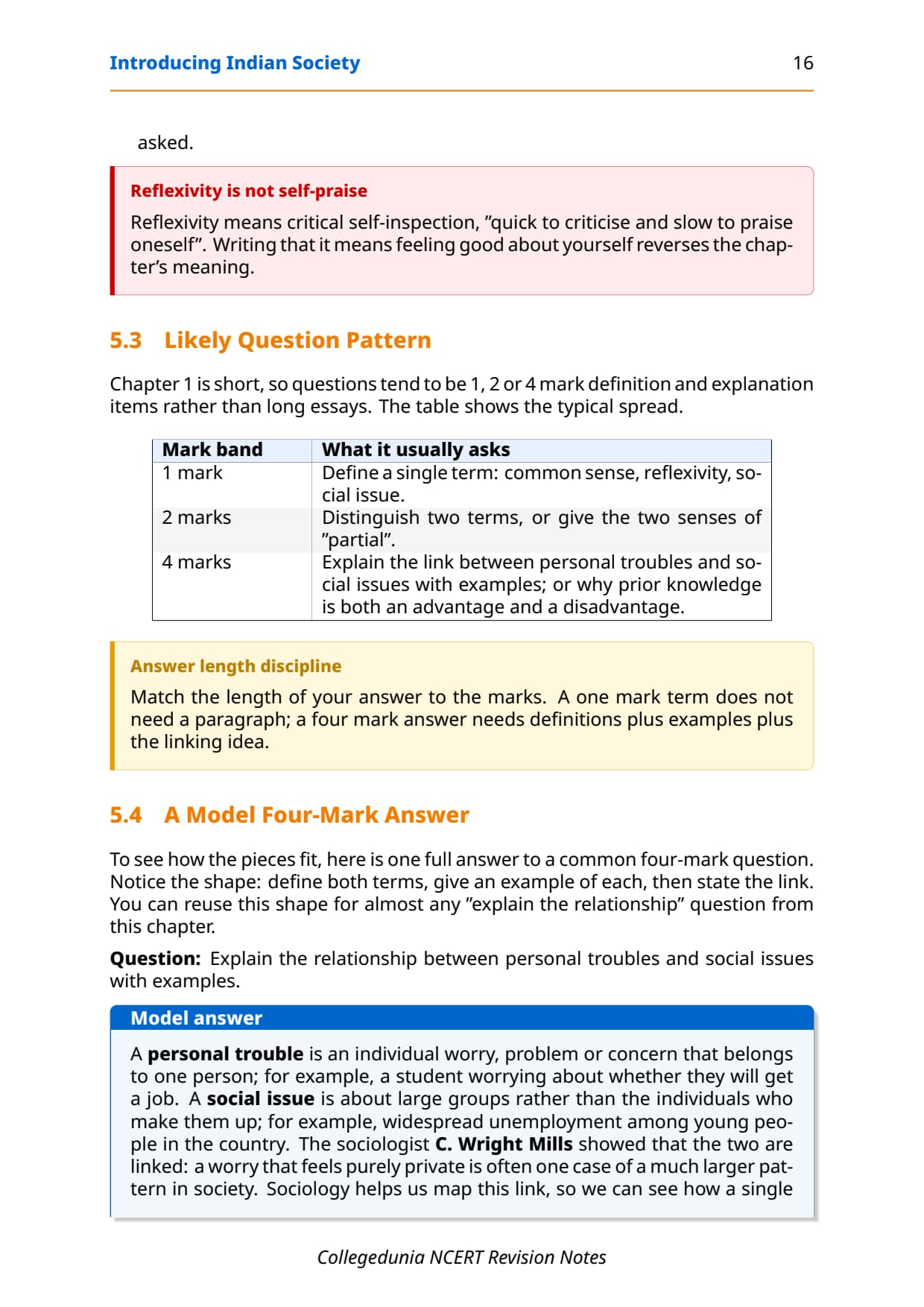
This is the single most-tested idea in the chapter, so the notes give it its own block. Drawn from C. Wright Mills, the sociological imagination links a person's private troubles to the public issues that shape them. Picture one private problem and ask how many others share it.
- Personal troubles: private matters felt by one person, like a single individual losing one job.
- Social issues: public matters that affect large groups, like mass unemployment in a recession.
- The bridge: many private troubles are really public issues in disguise, so the cause lies in society, not just the person.
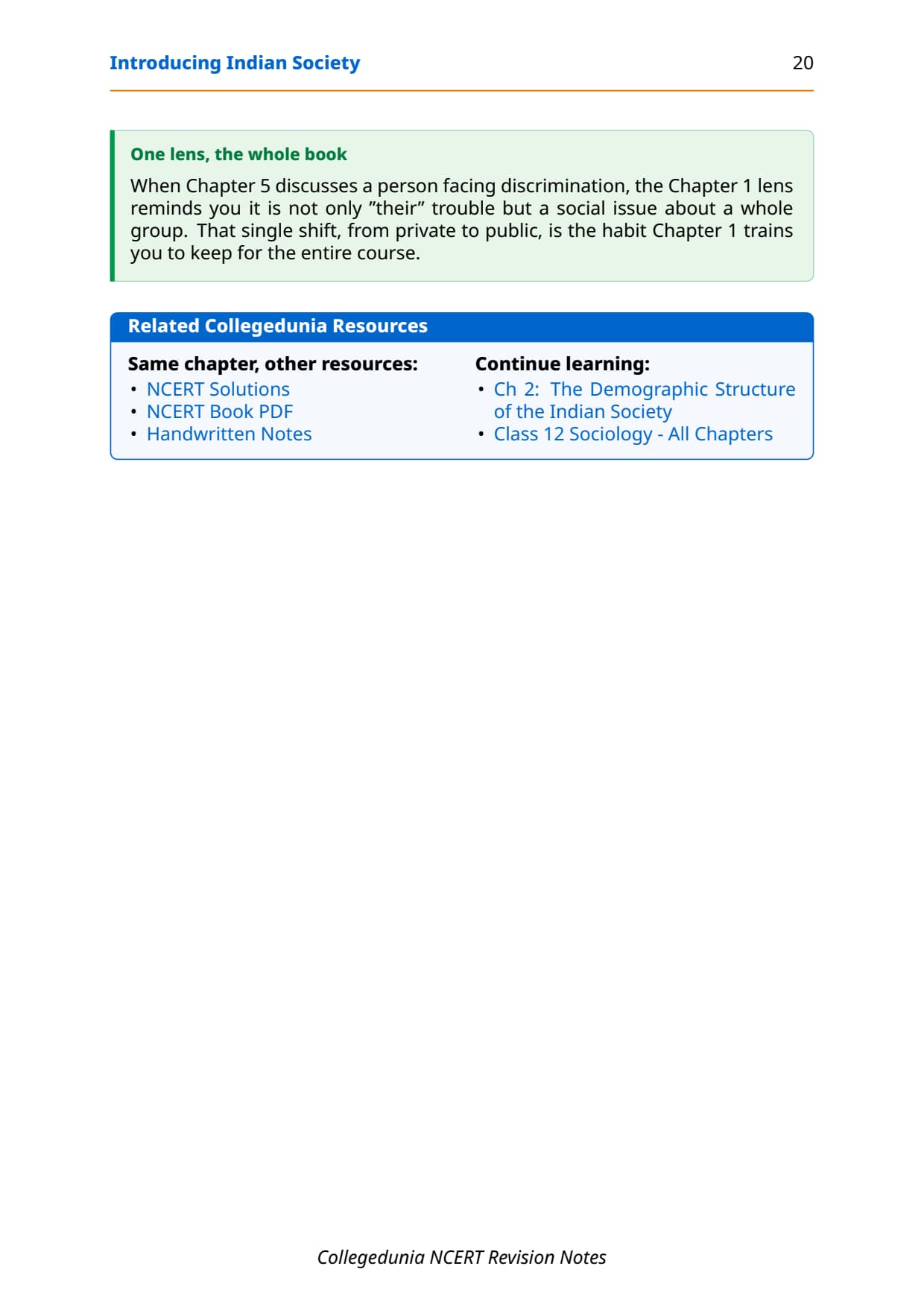
The key revision line is that the same fact can be a private trouble for one and a public issue for society. One jobless worker may be a personal trouble; millions out of work is a social issue rooted in the economy. That shift, from the personal to the social, is the move every long answer in this chapter rewards.
Colonialism, Nationalism and Modern India
The last block of the chapter ties sociology to history. These are the facts that turn an abstract idea into a real answer about India, so students should keep them ready. The points below sum up how modern India took shape.
- Colonialism reshaped the economy: it tied India to world markets and changed how people earned a living.
- It brought new forces: railways, cities, a press and Western education changed society from within.
- It was deeply unequal: the gains flowed to the colonial power, which bred resentment across regions.
- It provoked nationalism: a shared struggle against colonial rule united diverse people into one nation.
The big takeaway is that nationalism grew out of the very forces colonialism set in motion. New communications, education and a sense of shared injustice let people across India imagine themselves as one nation. So modern India is best understood as a product of both colonial change and the national response to it.
Introducing Indian Society Revision Table
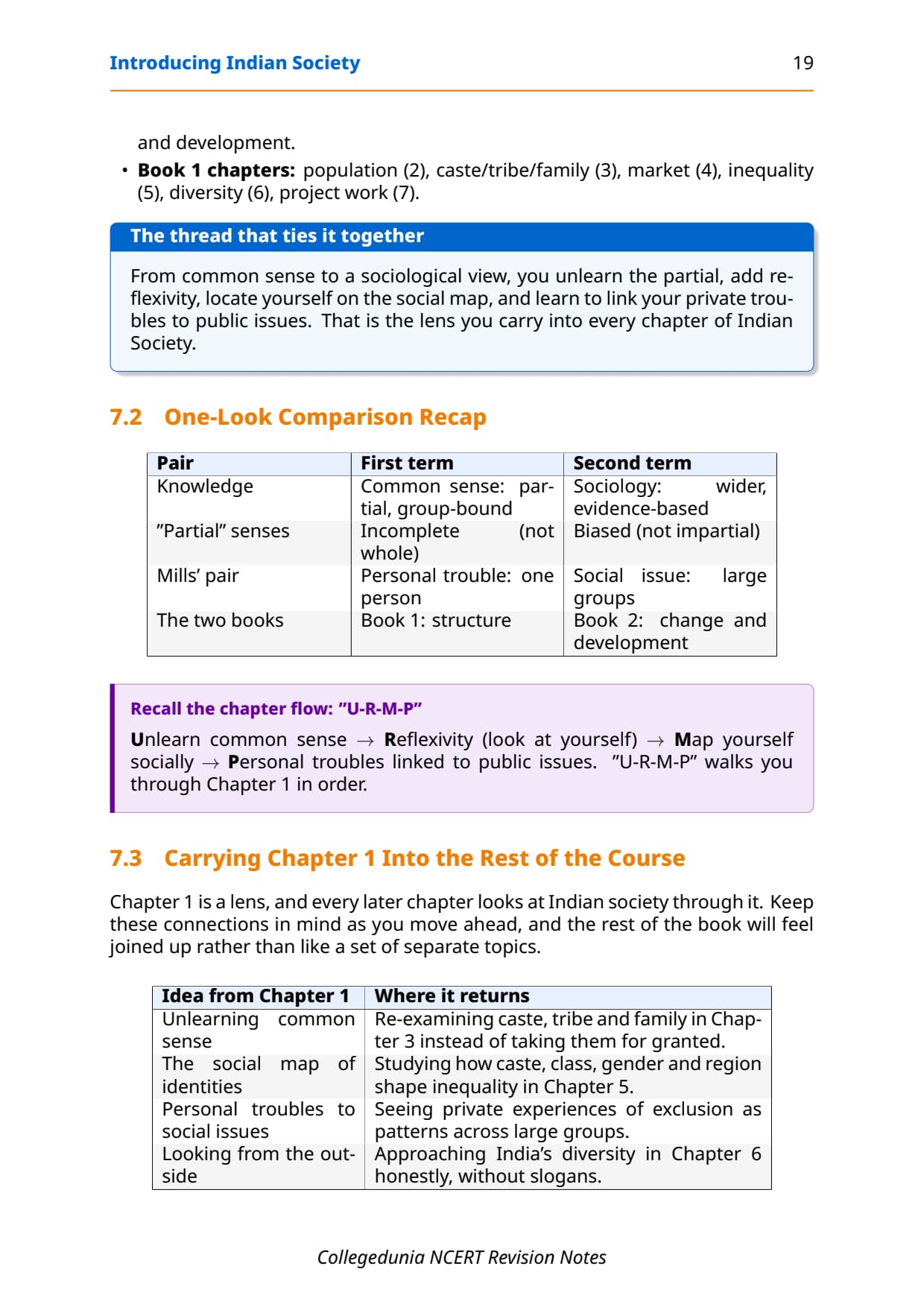
For a last-minute scan, this table pulls the whole chapter into one place. Students can cover the right column and test themselves, then check their recall. It is the quickest way to confirm you are exam-ready.
| Topic | One-line recall |
|---|---|
| Why sociology is distinct | It studies the society we live in, by us |
| Self-reflexivity | Constant questioning of our own biases |
| Common sense | Useful but partial; sociology tests it |
| Sociological imagination | Links personal troubles to social issues |
| Unlearning | Set aside ready-made ideas before learning |
| Colonialism and nationalism | Colonial change provoked the national response |
Run down this table once a day in the week before the exam. Active recall beats re-reading, so cover the answers and say them aloud before you check. This single habit lifts retention more than any amount of highlighting.
How These Notes Pair with the Solutions and Book PDF
These notes summarise the chapter. To finish your prep, use them with the other resources for the same chapter, all linked in the table below.
| Resource | Best used for |
|---|---|
| Introducing Indian Society Class 12 NCERT Solutions | Full point-wise answers to all 13 exercise questions |
| Introducing Indian Society Class 12 Handwritten Notes | One-shot revision in a scanned notebook style |
| Introducing Indian Society NCERT Book PDF | Reading the original NCERT chapter text and its preview of the book |
Tip: read these notes first to get the big picture, then attempt the NCERT Solutions on your own. The notes give the map; the solutions give the practice.
All NCERT Notes for Class 12 Sociology
The table links the Notes for every chapter in both Class 12 Sociology books, so students can revise across the course in one place. Introducing Indian Society is highlighted.
| Chapter | NCERT Notes |
|---|---|
| Indian Society | |
| Chapter 1 | Introducing Indian Society |
| Chapter 2 | The Demographic Structure of the Indian Society |
| Chapter 3 | Social Institutions - Continuity and Change |
| Chapter 4 | The Market as a Social Institution |
| Chapter 5 | Patterns of Social Inequality and Exclusion |
| Chapter 6 | The Challenges of Cultural Diversity |
| Social Change and Development in India | |
| Chapter 1 | Structural Change |
| Chapter 2 | Cultural Change |
| Chapter 3 | The Constitution and Social Change |
| Chapter 4 | Change and Development in Rural Society |
| Chapter 5 | Change and Development in Industrial Society |
| Chapter 6 | Globalisation and Social Change |
| Chapter 7 | Mass Media and Communications |
| Chapter 8 | Social Movements |
FAQs on Introducing Indian Society Class 12 Notes
Introducing Indian Society Class 12 Sociology Notes Common Questions
Ques. What are the most important topics in class 12 sociology chapter 1 notes?
Ans. The most important topics are why sociology is a distinct subject, self-reflexivity, the sociological imagination linking personal troubles to social issues, common sense versus the sociological view, and how colonialism gave rise to nationalism. These notes cover each in short, exam-ready points.
Ques. What is the sociological imagination in simple words?
Ans. The sociological imagination is the skill of linking a person's private troubles to the wider public issues that shape them. It shows that many problems that feel personal, like one person without a job, are really shared social patterns.
Ques. Why does sociology treat common sense as partial?
Ans. Common sense is useful but untested and incomplete. It is taken for granted and often blames an individual for what is really a social pattern. Sociology completes the picture by asking why the pattern exists across many people, the step common sense skips.
Ques. How did colonialism give rise to nationalism in India?
Ans. Colonialism reshaped India's economy and brought railways, cities, a press and Western education. These new forces, along with a shared sense of injustice under unequal rule, let diverse people imagine themselves as one nation, which grew into Indian nationalism.
Ques. Are these class 12 sociology chapter 1 notes enough for the board exam?
Ans. Yes, these notes cover the full NCERT chapter in revision form. For exam practice, pair them with the NCERT Solutions linked on this page so you can write out full answers to all 13 exercise questions.



Comments