




These Class 12 Sociology Chapter 5 Patterns of Social Inequality and Exclusion Notes give a clear, quick-revision summary of social inequality, social stratification, prejudice, discrimination, social exclusion, caste, untouchability, the OBCs, adivasis, the women's movement and disability, set to the 2026-27 CBSE syllabus. The notes turn a long, concept-heavy chapter into short points, tables and definitions that students can revise in one sitting.
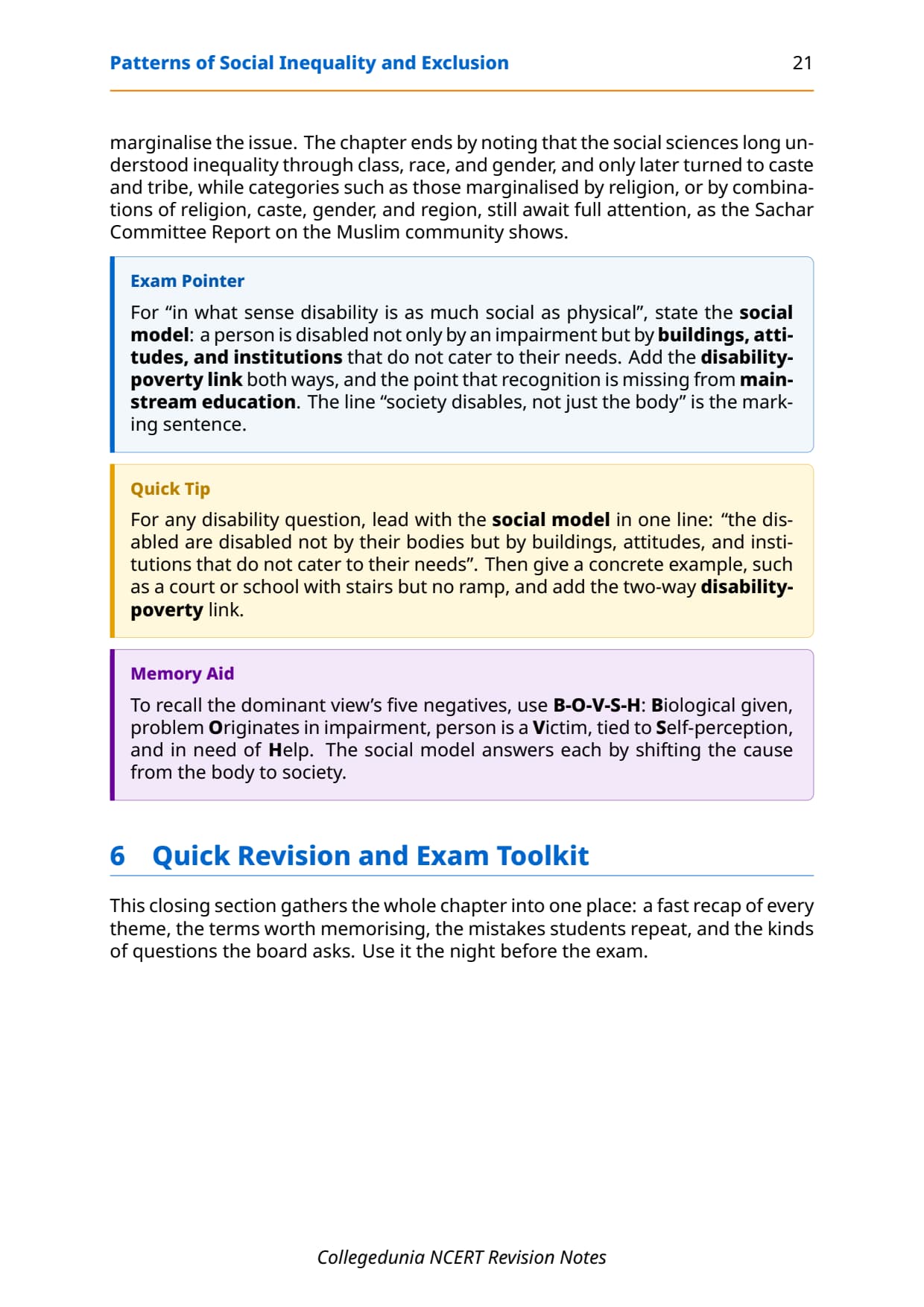
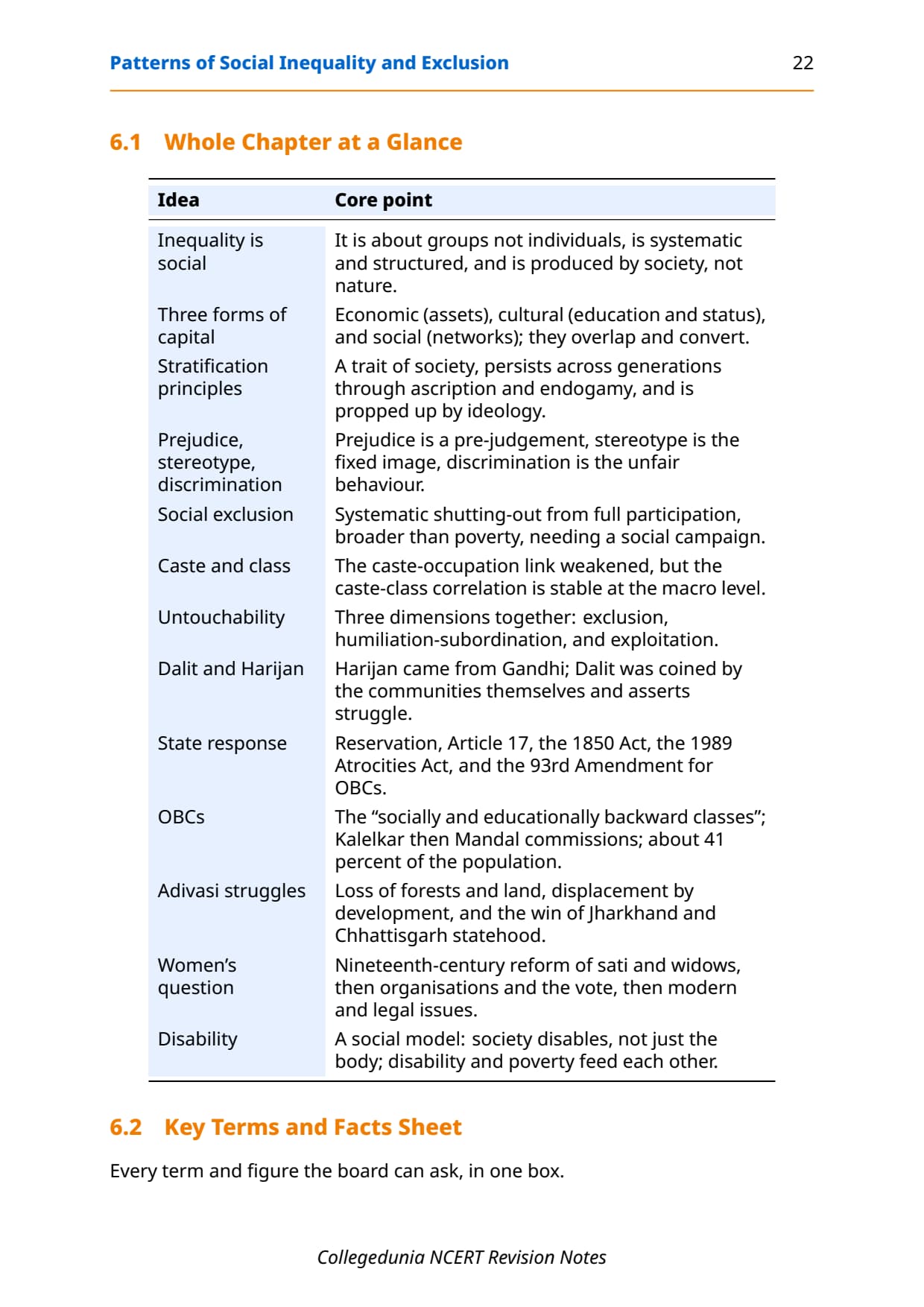
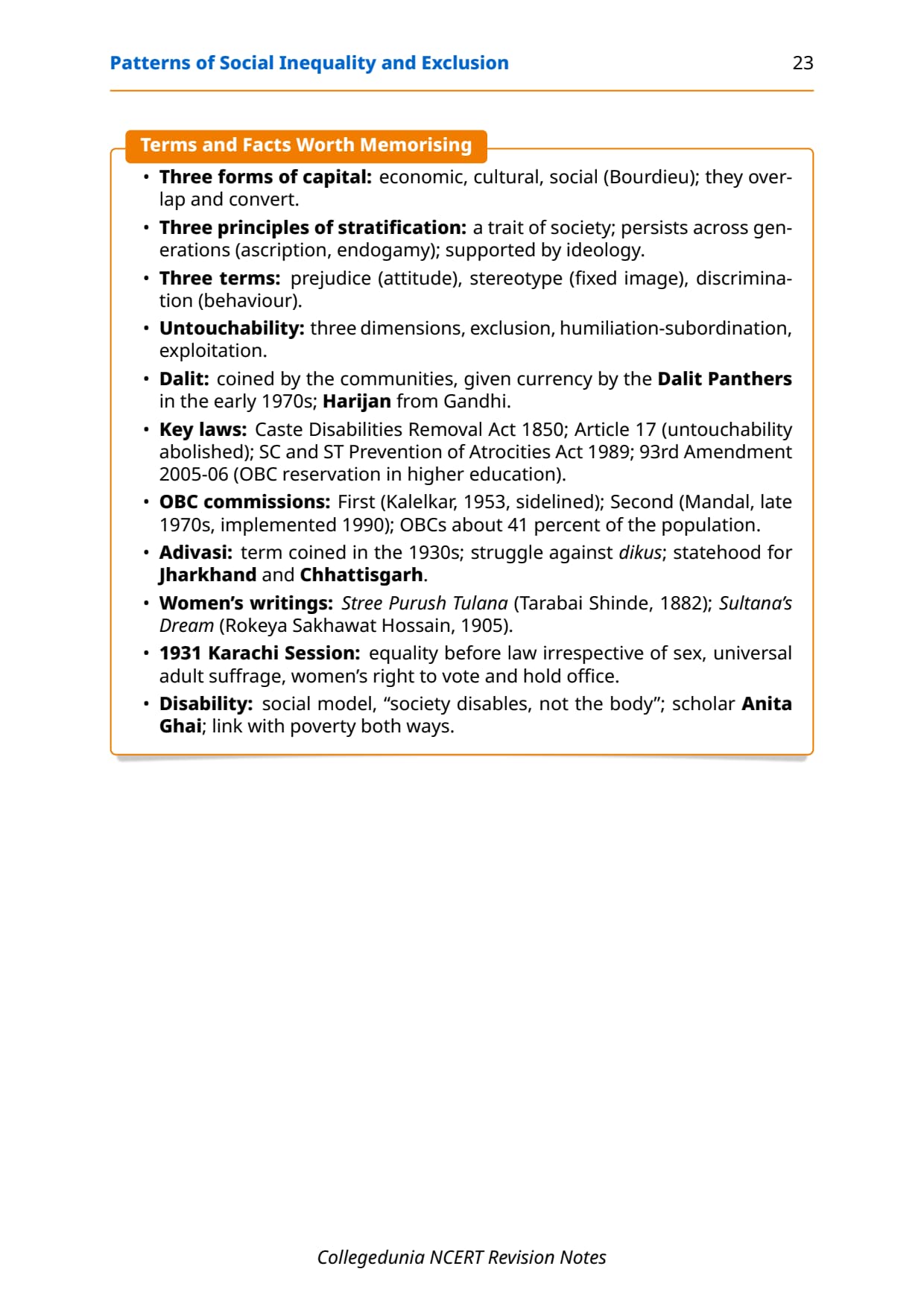
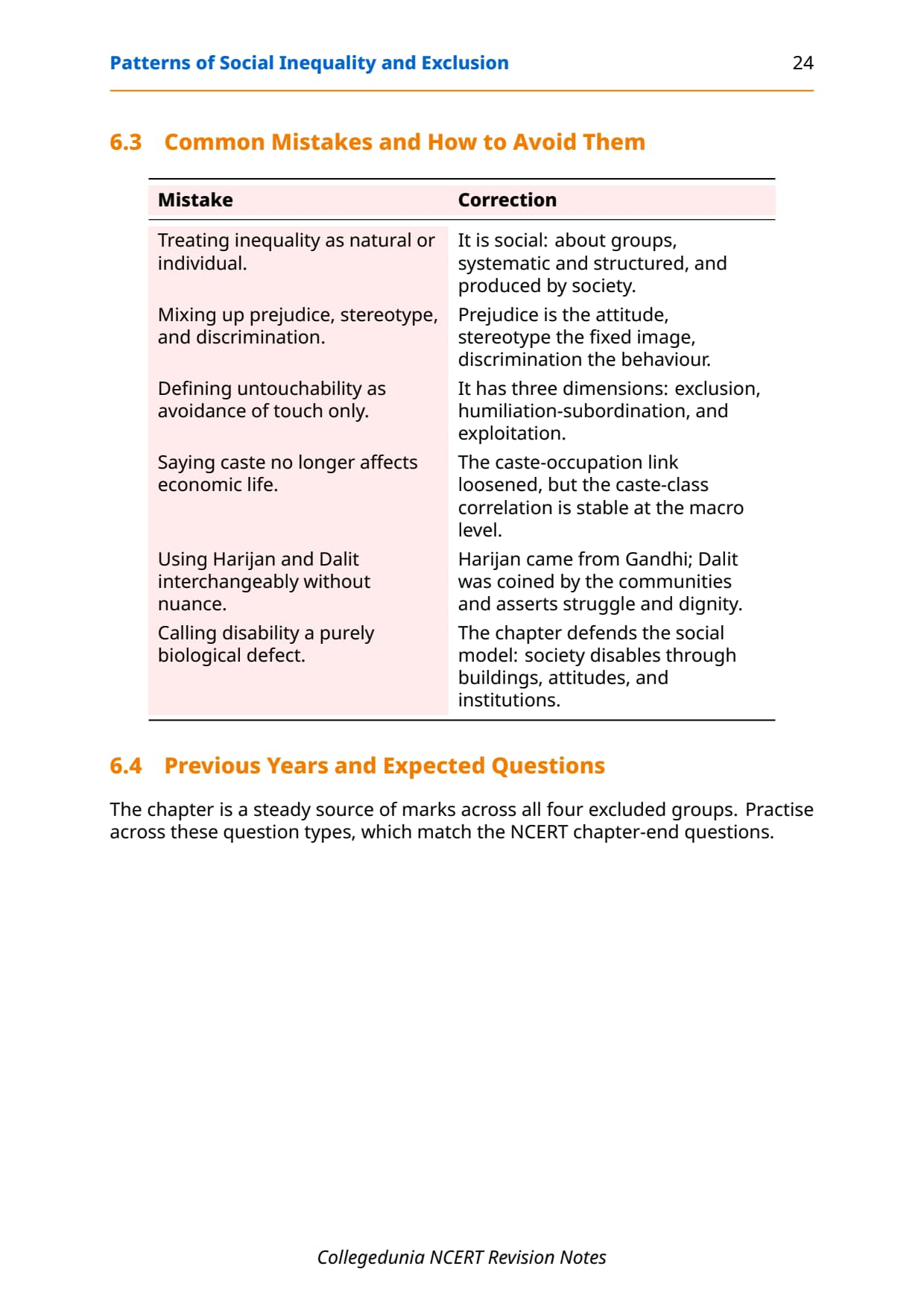
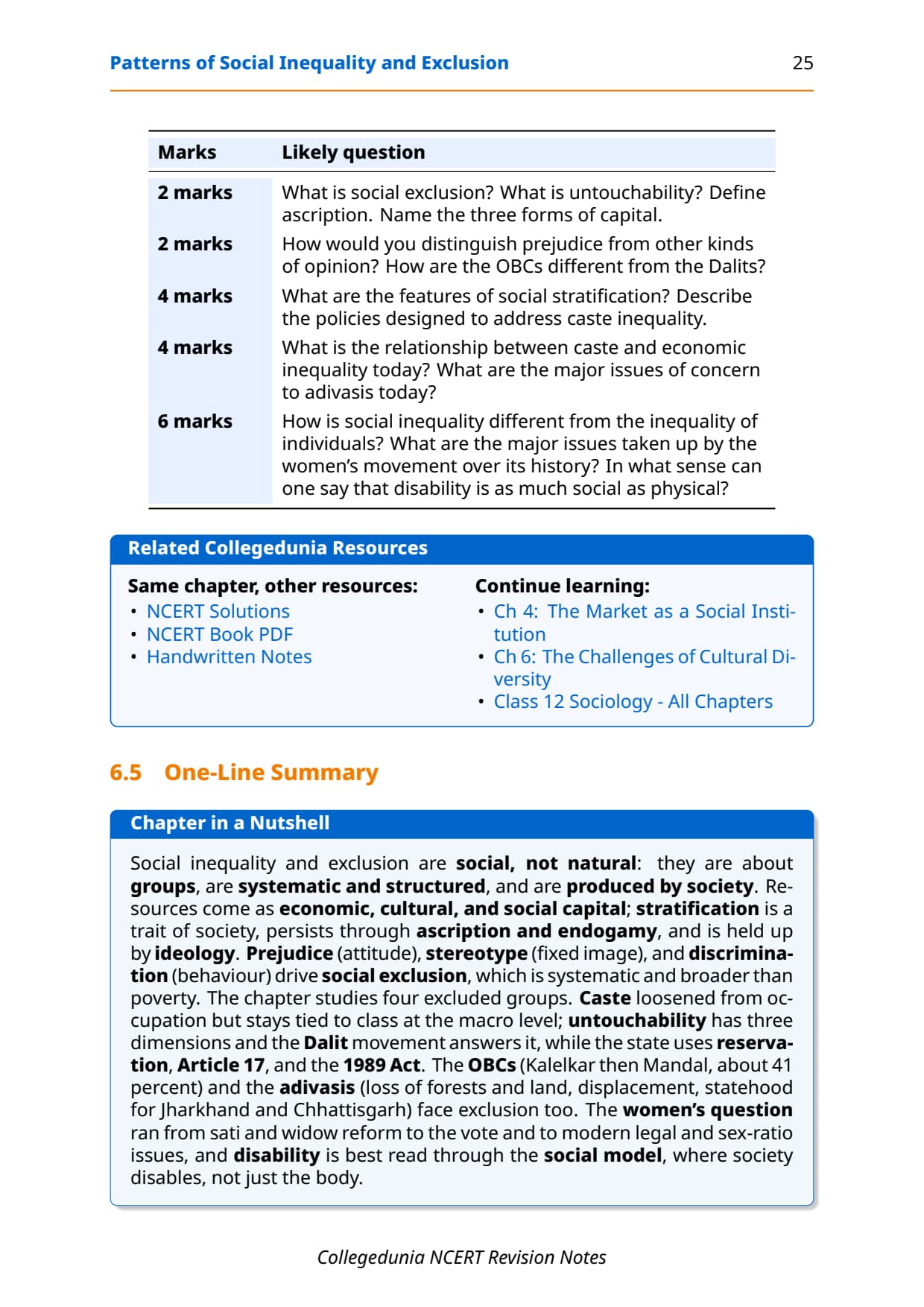
- One-page summary of every key term and excluded group you need to write full answers.
- A quick policy snapshot from the 1850 Removal Act to the 93rd Amendment of 2005.
- Pairs with the NCERT Solutions, Handwritten Notes and Book PDF linked lower on this page.
These Class 12 Sociology Chapter 5 revision notes are prepared by subject experts from the official NCERT Indian Society textbook and matched to the 2026-27 CBSE syllabus.
Student Feedback: In a Collegedunia poll of 8,140 Class 12 Sociology students, 76% of students said a one-page table of the four excluded groups and the caste-policy timeline was the single most useful revision tool for this chapter. Most students revised these notes the night before the exam.
Source: 2026-27 Class 12 Sociology student poll. Sample of 8,140 students from CBSE schools across 13 states.
Patterns of Social Inequality and Exclusion Class 12 Notes Overview
This chapter from Indian Society makes one big correction and then builds on it: inequality is social and group-made, not natural or individual. Once that is clear, the rest of the chapter studies how whole groups are kept out of resources, and what the state and social movements do about it.
The notes are organised around three threads that hold the whole chapter together:
- Concepts: social inequality, stratification, prejudice, stereotype, discrimination and social exclusion.
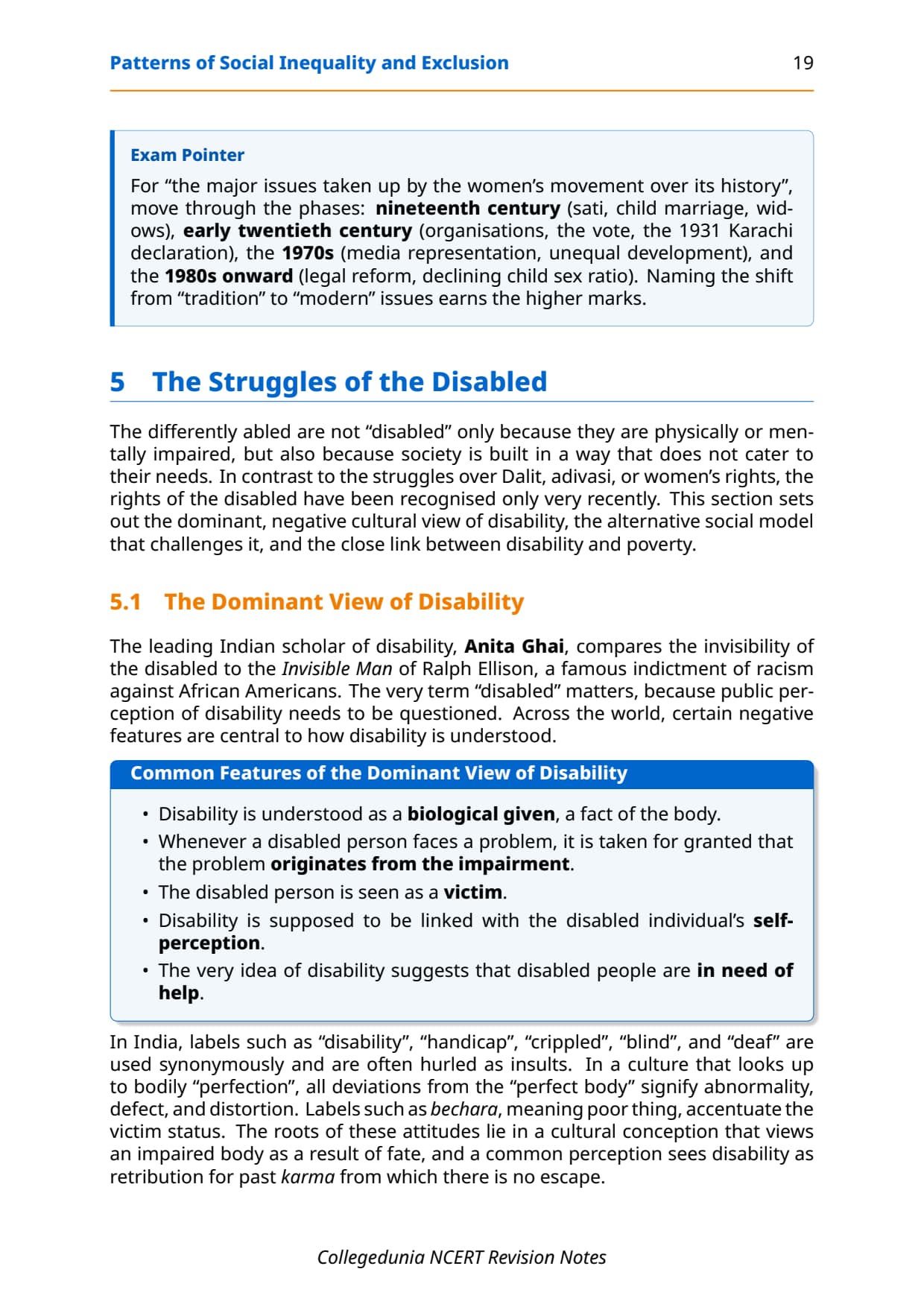
- Excluded groups: Dalits and caste, adivasis, women and persons with disability.
- Responses: reservation, anti-discrimination law and the social movements that carry the change.
Students who label each fact under "concept", "group" or "response" can revise the entire chapter in one pass, which is exactly how these patterns of social inequality and exclusion notes are arranged.
Key Terms and Definitions for Quick Revision
Most answers in this chapter lean on a short list of terms. Learn these first, because a precise definition is often worth a full mark on its own. The table keeps each term next to a one-line meaning for fast recall.
| Term | Meaning in one line |
|---|---|
| Social inequality | Patterned, unequal access of whole groups to valued resources. |
| Social stratification | A system that ranks categories of people in a hierarchy. |
| Ascribed status | A social position fixed by birth, not earned. |
| Endogamy | Marriage within the group, which keeps caste lines sharp. |
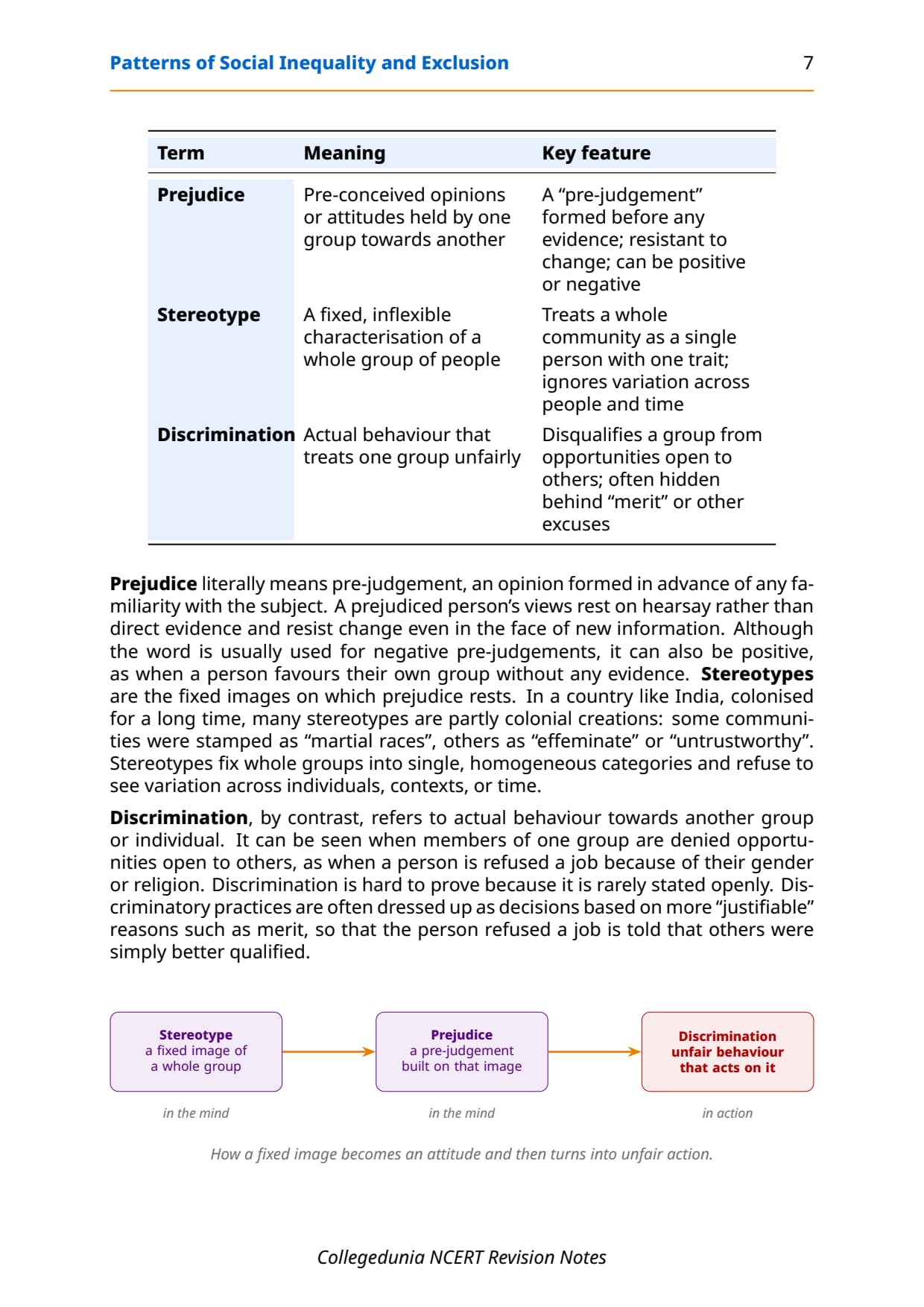
| Prejudice | A pre-judgement about a group, formed before evidence. |
| Social exclusion | Being systematically cut off from full involvement in society. |
The key revision point is that prejudice is an attitude while discrimination is an action. Prejudice is what people think; discrimination is what they do, like denying a job on caste grounds. Keep the two apart and the short-answer questions become easy marks.
Social Stratification and Its Features
Social stratification is the spine of the whole chapter, so the notes give it a clear three-part summary. The text lists three key principles, with endogamy as the bridge that holds the second one together.
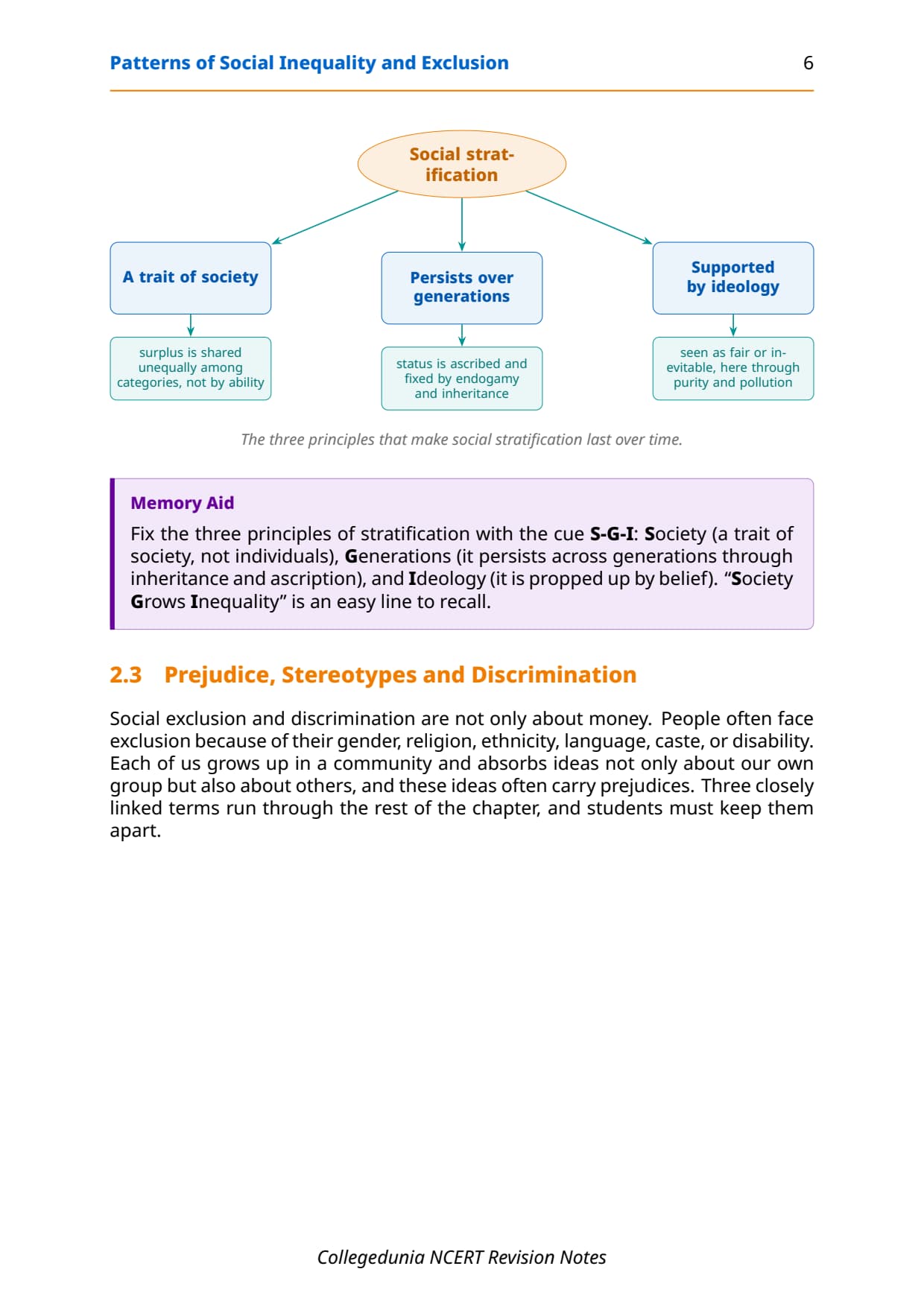
- It is society-wide: stratification ranks categories of people, not lone individuals, and needs a social surplus to exist.
- It persists over generations: status is ascribed and inherited through the family, and endogamy keeps the ranks from blurring.
- It rests on ideology: a belief makes the ranking look fair, like purity and pollution in the caste system.
The honest exam point is that those with the most privilege defend the system hardest, while those at the bottom are the most likely to challenge it. The same logic of society-wide ranking, inheritance and legitimising belief reappears in the apartheid example of race in South Africa, which shows the three features travel across caste and race alike.
The Four Excluded Groups in One Place
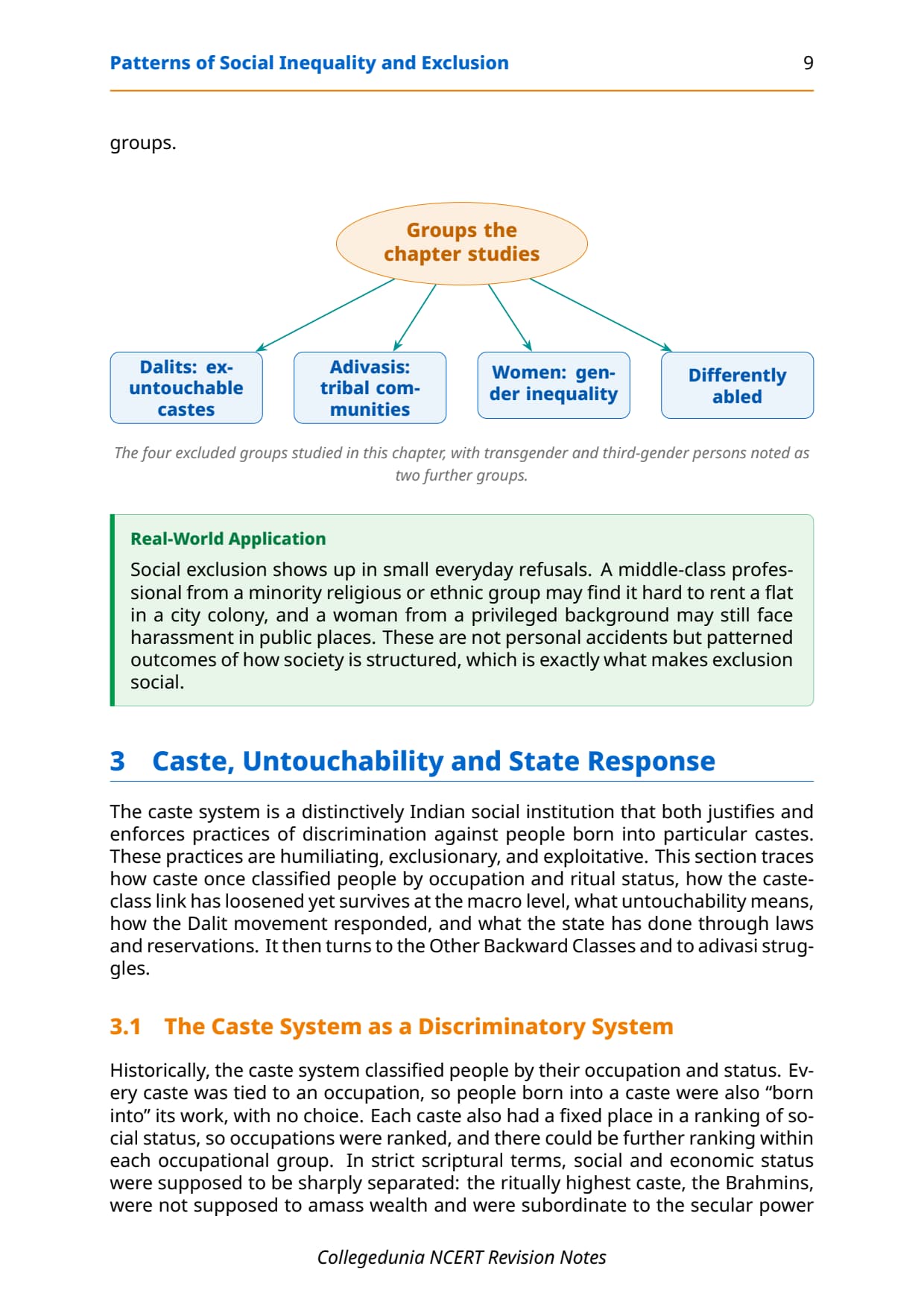
The chapter studies four groups as case studies of systematic, structural exclusion. The notes hold them in one table so students can compare the kind of inequality each faces and what is done about it.
| Group | Core issue | Response |
|---|---|---|
| Dalits | Untouchability: exclusion, humiliation and exploitation | Article 17, reservation, Atrocities Act, Dalit movement |
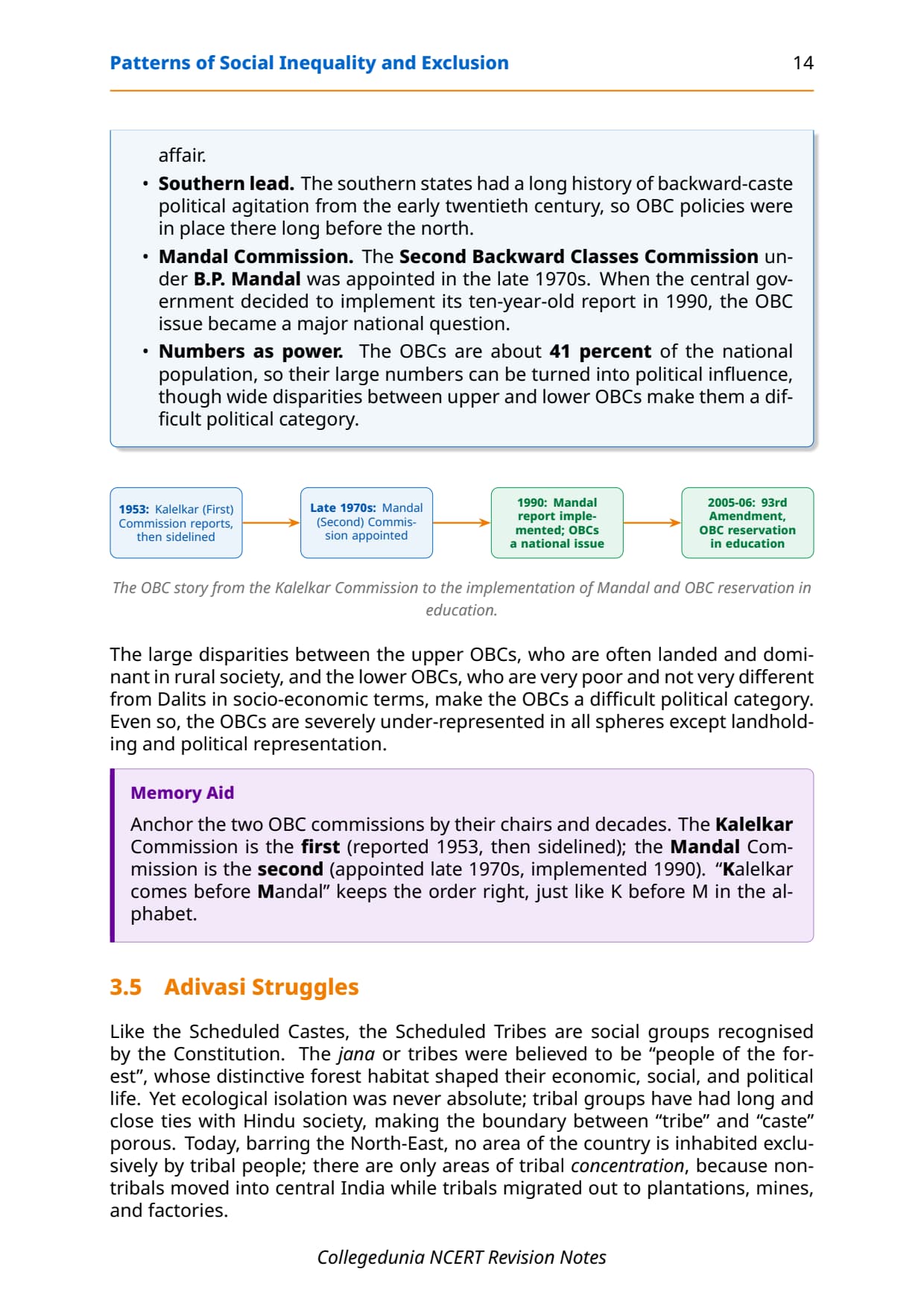
| OBCs | Discrimination short of untouchability | Reservation extended from the 1990s, 93rd Amendment |
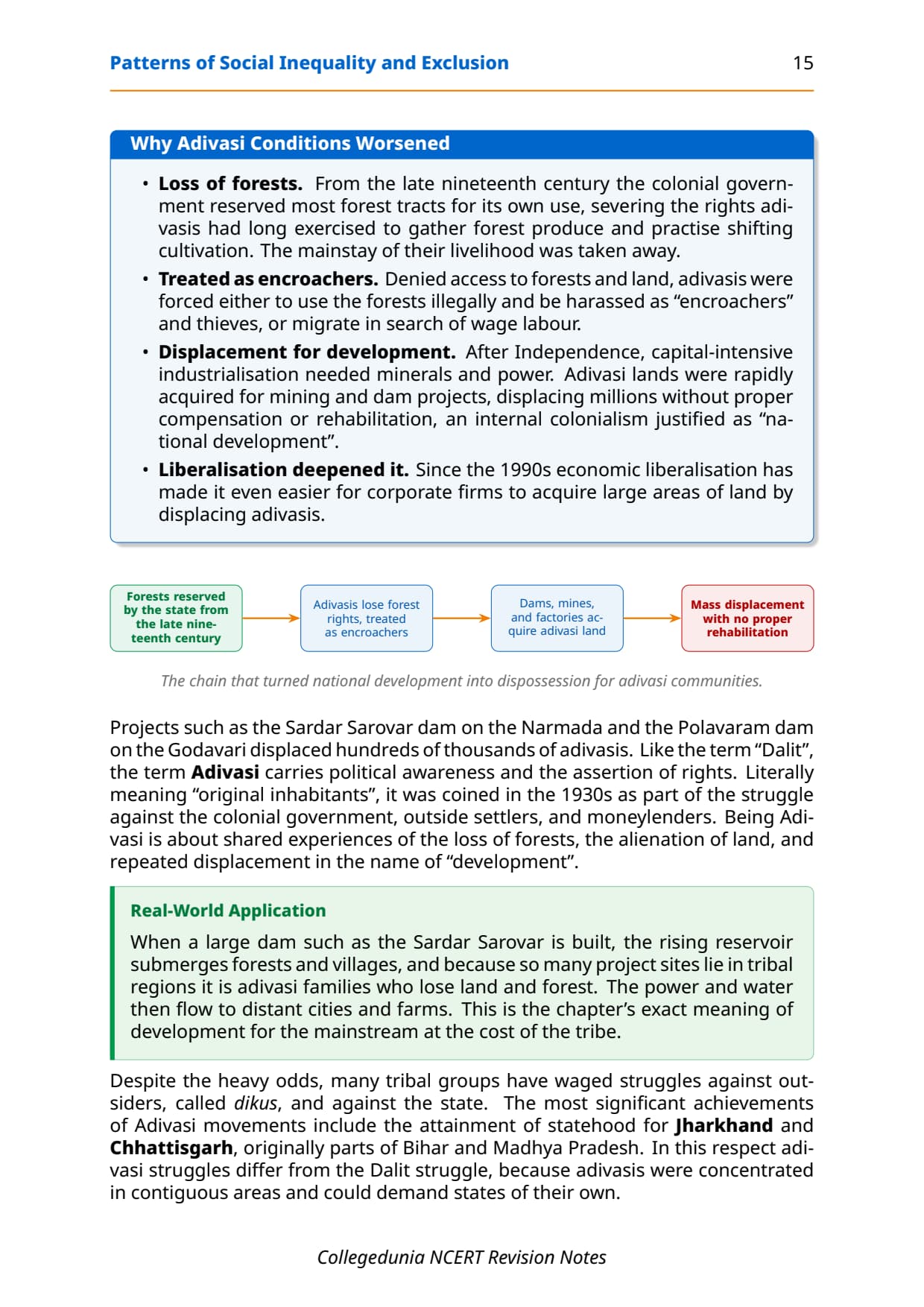
| Adivasis | Displacement, loss of forest rights, debt, identity | Schedules, forest rights, tribal movements |
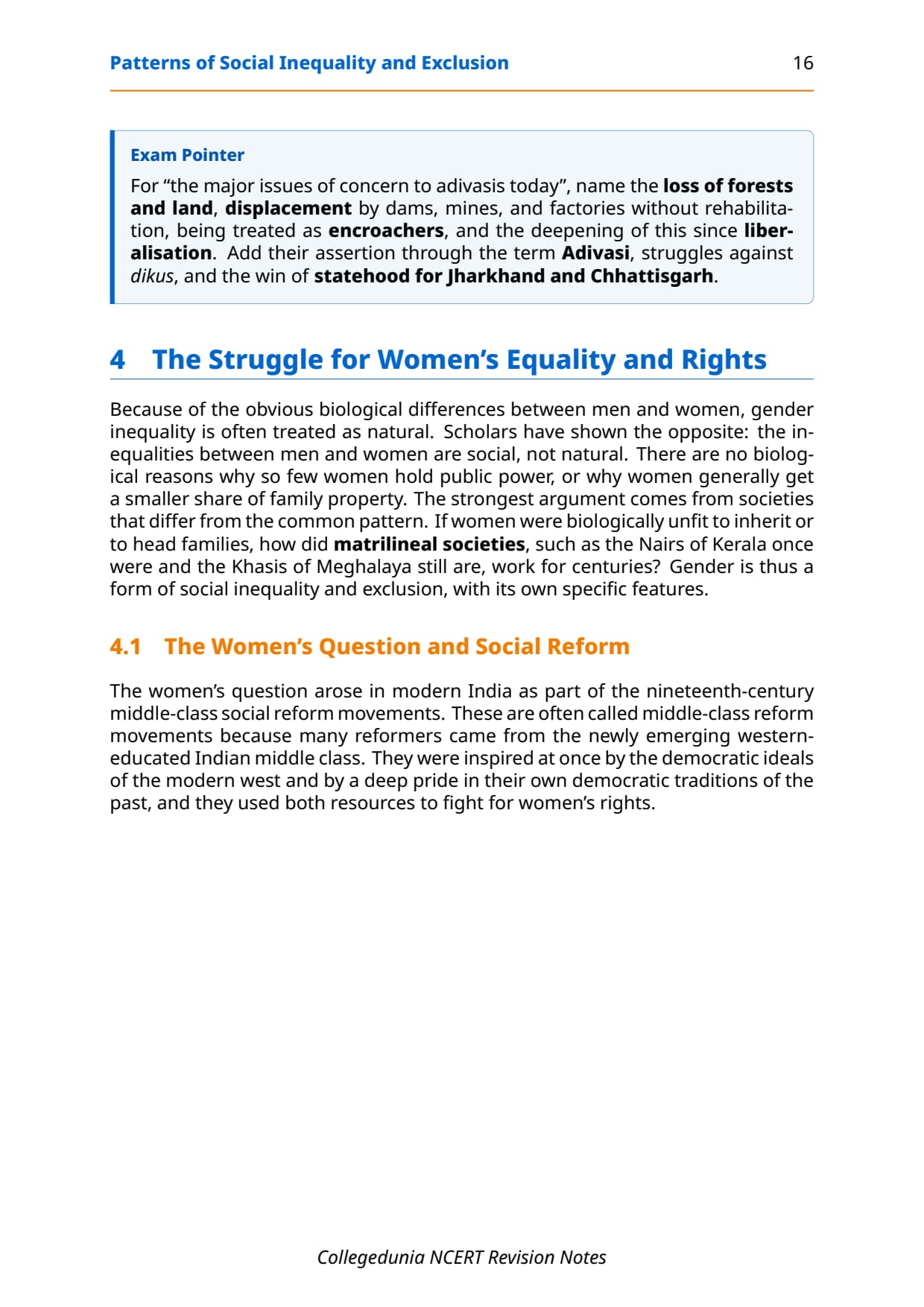
| Women | Patriarchy, dowry, violence, unequal land rights | The women's movement across reform and rights phases |
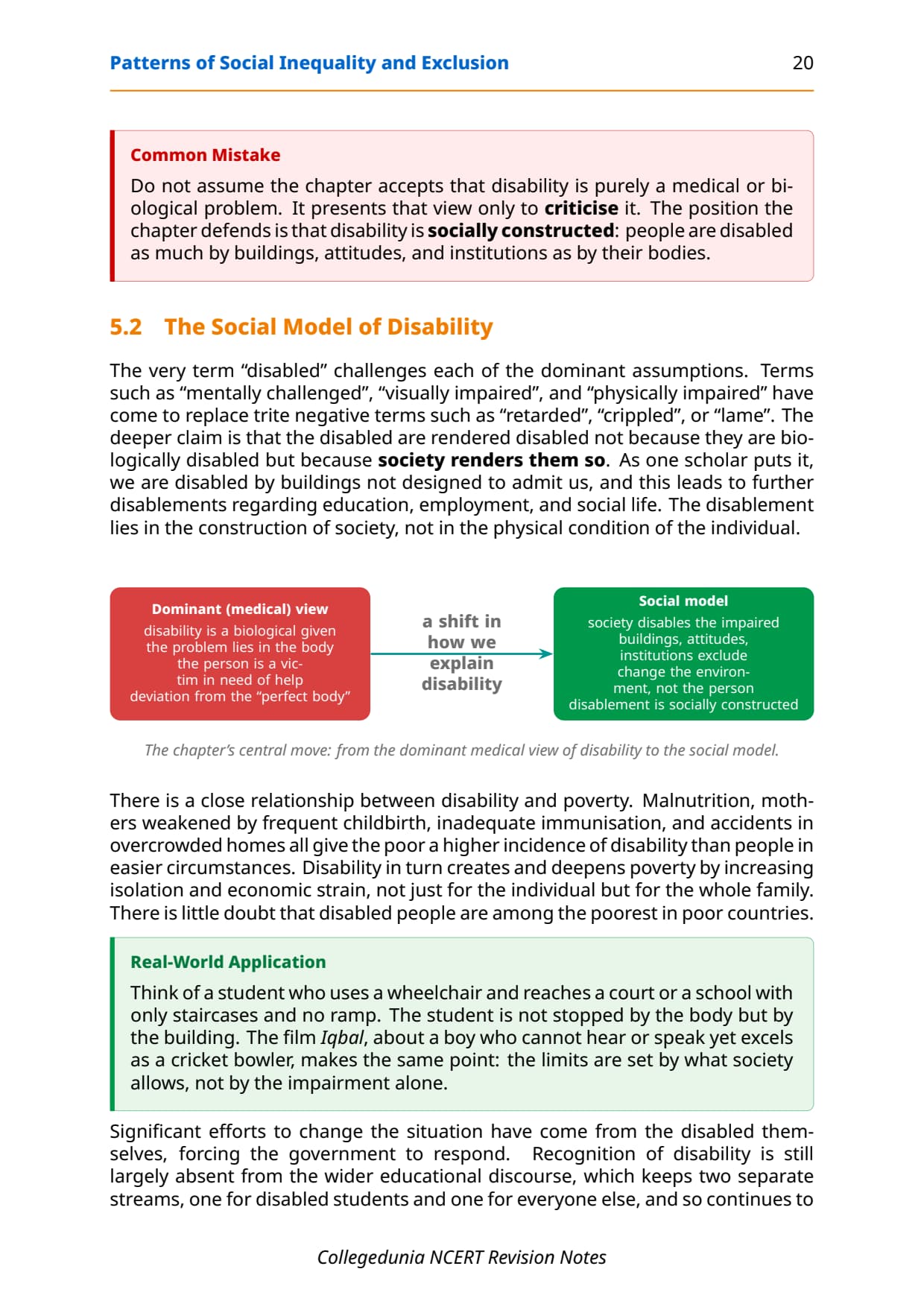
| Persons with disability | Social barriers and stigma, not only the body | Seeing disability as a social, changeable perception |
The point to carry into the exam is that each group is a case study in the same kind of exclusion: systematic and structural, not accidental. A privileged person can still be excluded on grounds of gender or religion, which is why exclusion runs deeper than poverty alone.
Caste Policy Snapshot from 1850 to 2005
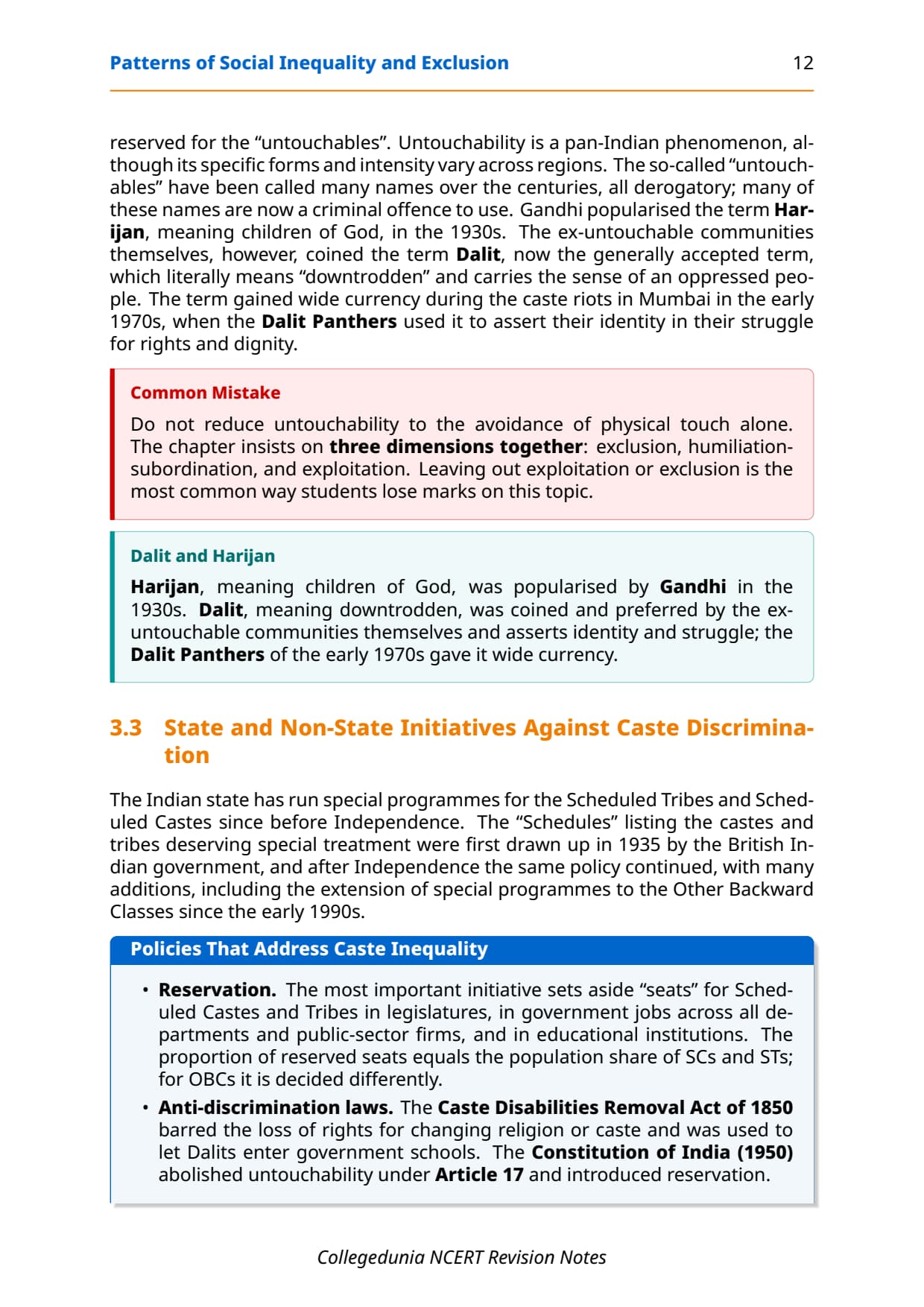
The state's response to caste inequality runs on two tracks: reservation and a body of anti-discrimination law. The notes give a quick timeline so students can recall the dates in order, which is the easiest way to score on a list question.
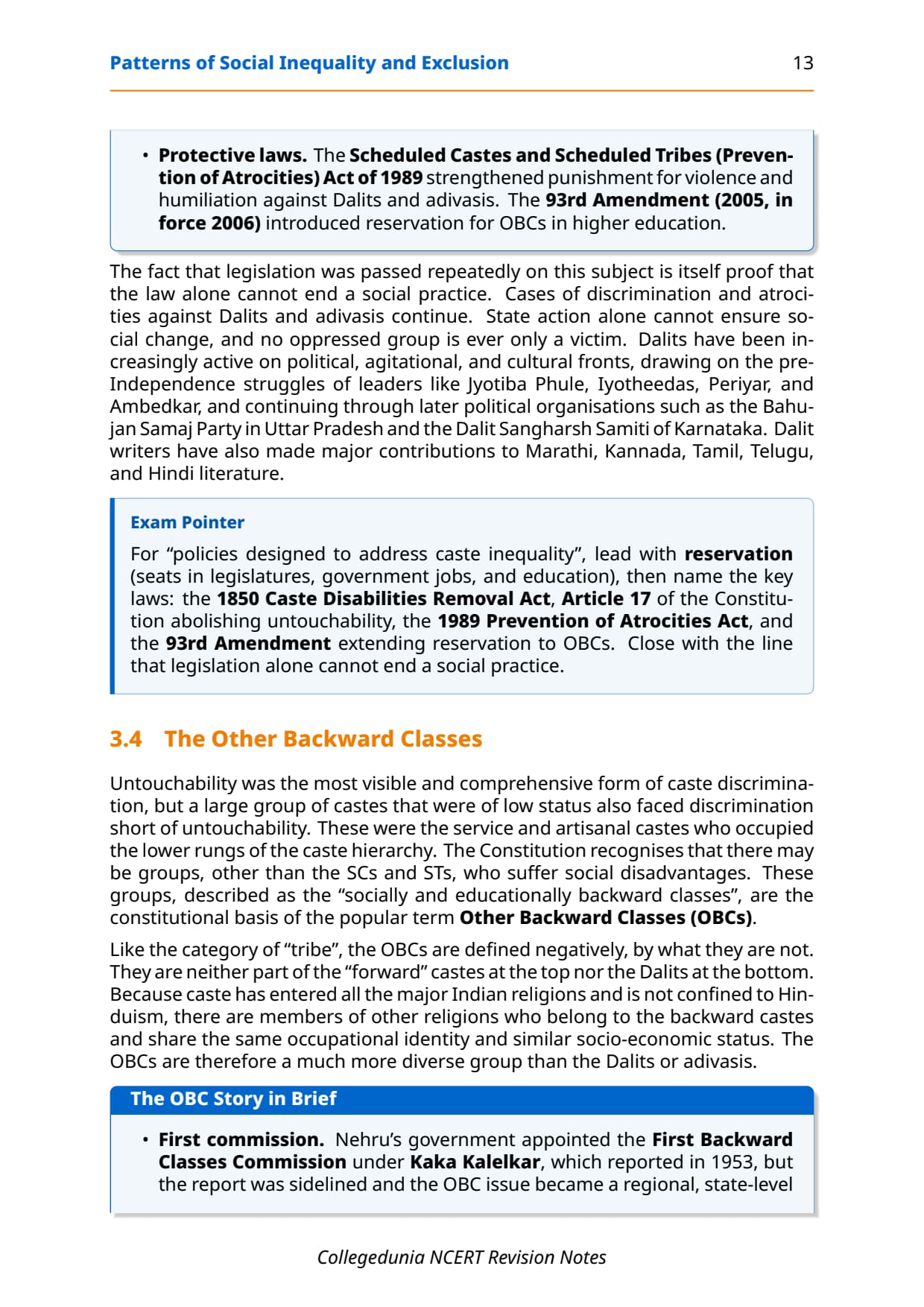
- 1850: the Caste Disabilities Removal Act opened government schools to Dalits.
- 1935: the British government drew up the Schedules of castes and tribes.
- 1950: the Constitution abolished untouchability under Article 17 and brought in reservation.
- 1989: the Prevention of Atrocities Act strengthened punishment for violence against Dalits and adivasis.
- 2005: the 93rd Amendment introduced OBC reservation in higher education.
The deeper revision point is that repeated lawmaking is itself proof that law alone cannot transform society. The state sets the frame, but the Dalit, adivasi and women's movements carry the real change, from Phule, Periyar and Ambedkar to today.
Patterns of Social Inequality and Exclusion Revision Table
This master table gathers the whole chapter into one screen, so students can self-test before the exam. Cover the right column and try to recall each point from the left.
| Theme | What to remember |
|---|---|
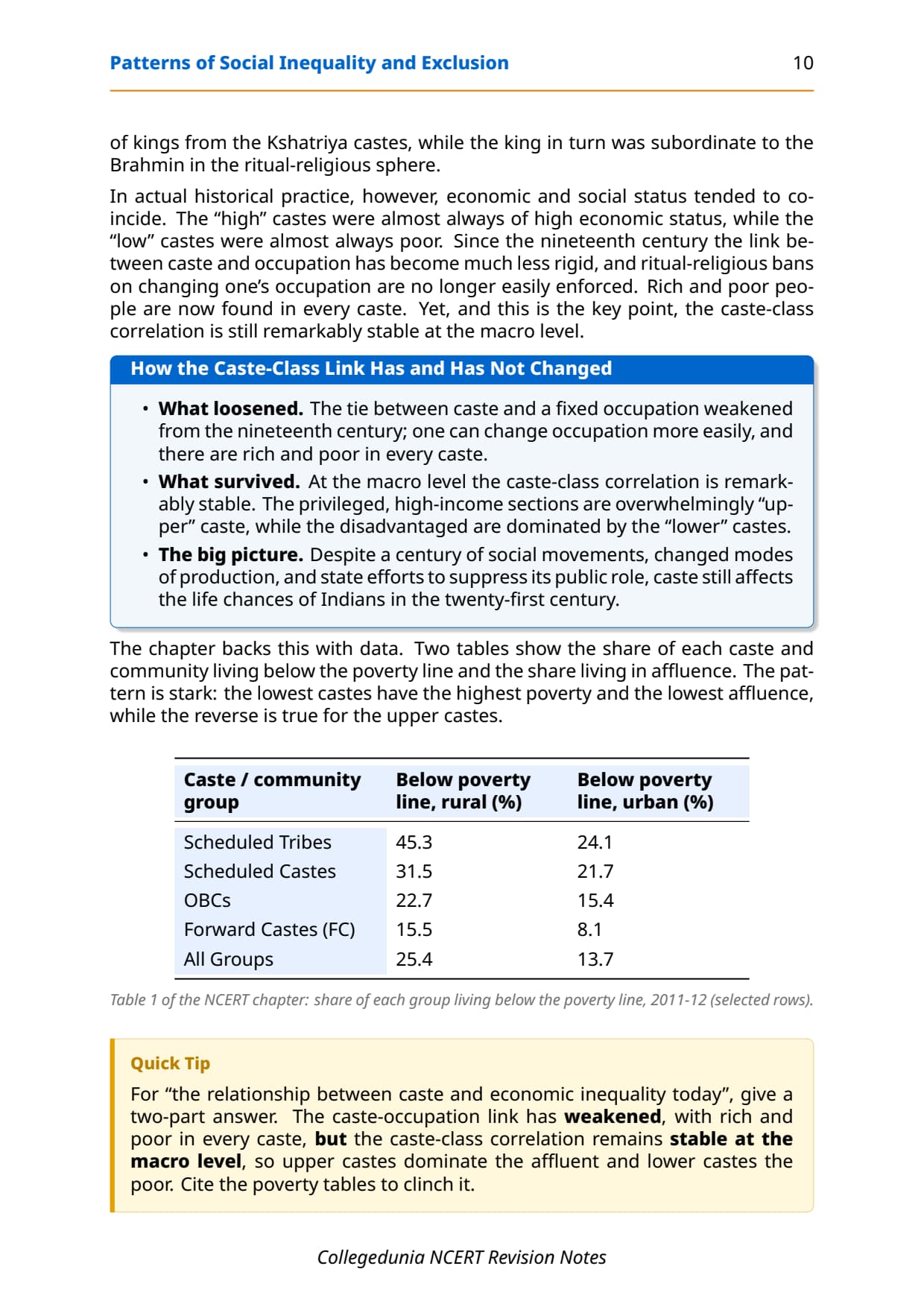
| Nature of inequality | Social, group-based, society-made and patterned across generations. |
| Three terms | Prejudice (attitude), stereotype (fixed label), discrimination (action). |
| Social exclusion | Systematic, structural, wider than poverty, and forced not chosen. |
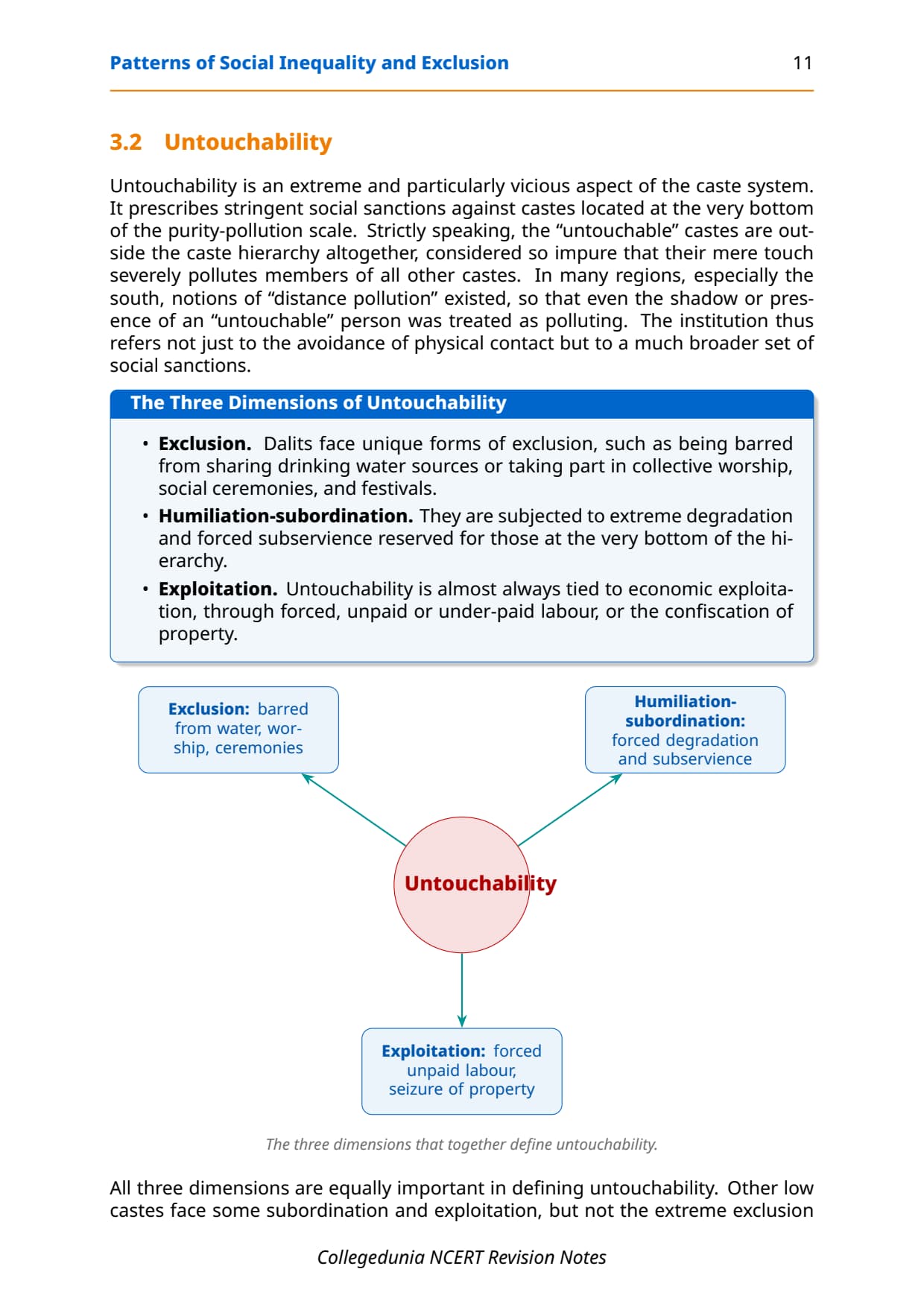
| Untouchability | Exclusion, humiliation-subordination and exploitation. |
| OBCs vs Dalits | OBCs faced discrimination short of untouchability; defined negatively. |
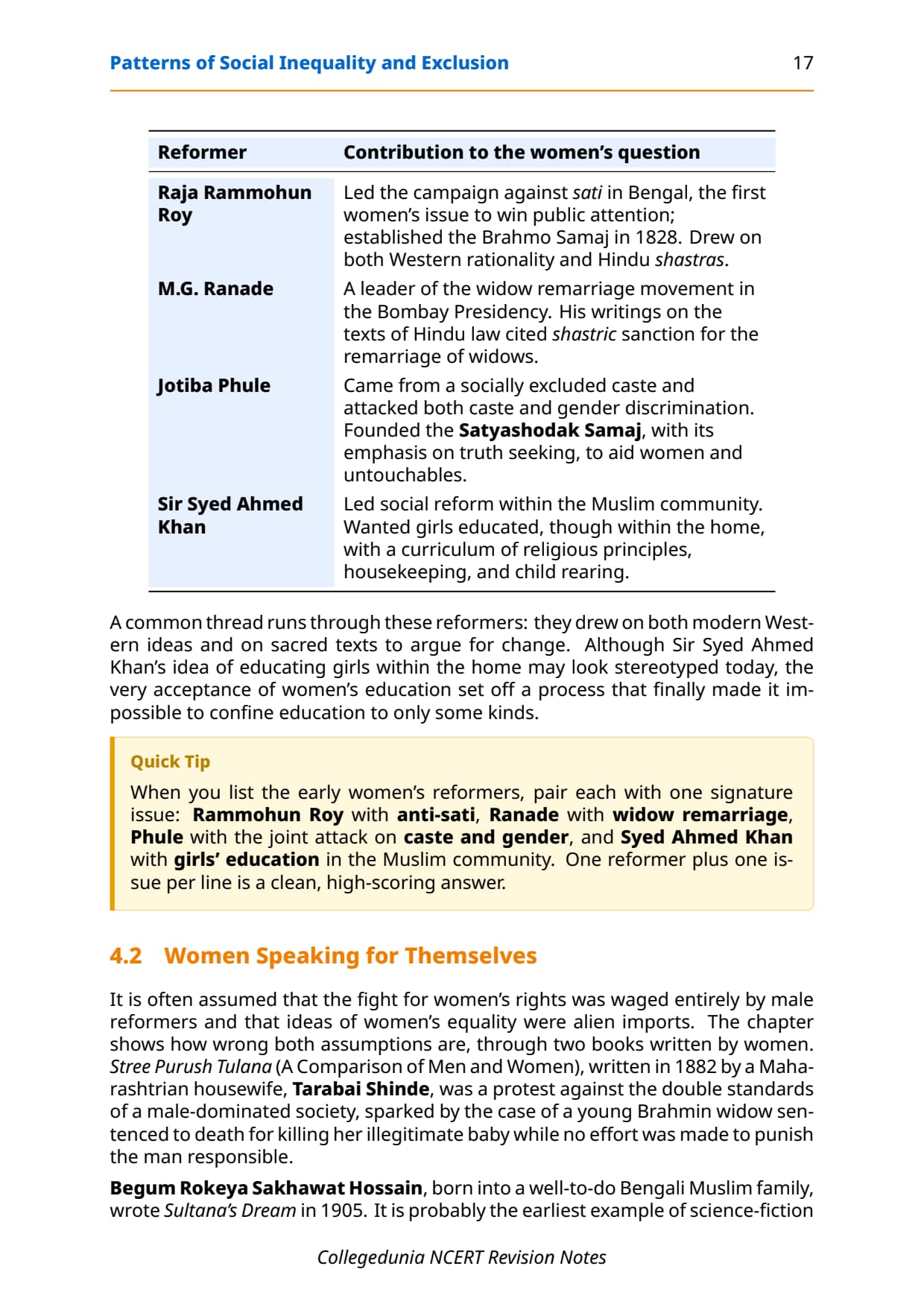
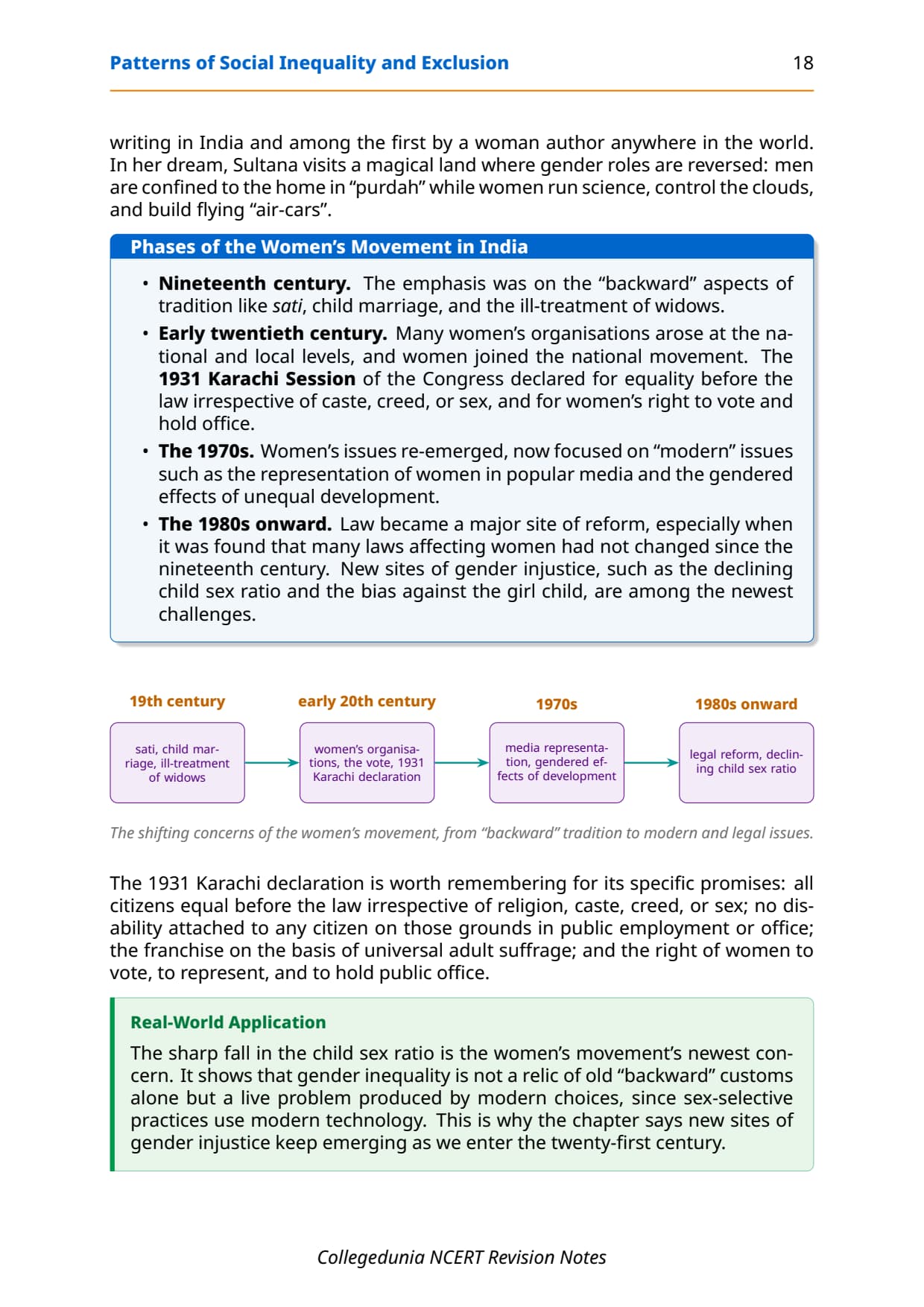
| Women's movement | Shifted from 19th-century reform to dowry, violence, land and representation. |
Students preparing patterns of social inequality and exclusion class 12 important questions should test themselves on stratification, untouchability and the women's movement first, since these are the most repeated long answers.
Common Mistakes These Notes Help You Avoid
A few slips cost marks every year in this chapter. The notes flag them so students can fix the error before the exam, not in it.
- Calling inequality natural or deserved - it is social and society-made.
- Treating prejudice as only negative - it can be positive and it resists evidence.
- Mixing prejudice with discrimination - one is an attitude, the other an action.
- Forgetting the three dimensions of untouchability - exclusion, humiliation, exploitation.
- Saying OBCs faced untouchability - they faced discrimination short of it.
Fixing these five points is the quickest way to move from average to high marks, because the exam rewards answers that tie every disadvantage to a social cause.
How These Notes Pair with the Solutions and Book PDF
These Notes summarise the chapter. To revise fully and practise answers, students should use them alongside the other resources for the same chapter, all linked in the table below.
| Resource | Best used for |
|---|---|
| Patterns of Social Inequality and Exclusion Class 12 NCERT Solutions | Step-by-step answers to all 11 back-exercise questions |
| Patterns of Social Inequality and Exclusion Class 12 Handwritten Notes | Last-minute, one-shot revision in a scanned notebook style |
| Patterns of Social Inequality and Exclusion NCERT Book PDF | Reading the original NCERT chapter text, boxes and case studies |
Tip: read these notes first, then attempt the solutions on your own, and only then check the model answers. That order builds memory faster than reading answers straight away.
All NCERT Notes for Class 12 Sociology
The table links the Notes for every chapter in both Class 12 Sociology books, so students can move across the course in one click. Patterns of Social Inequality and Exclusion is highlighted.
| Chapter | Notes |
|---|---|
| Indian Society | |
| Chapter 1 | Introducing Indian Society |
| Chapter 2 | The Demographic Structure of the Indian Society |
| Chapter 3 | Social Institutions - Continuity and Change |
| Chapter 4 | The Market as a Social Institution |
| Chapter 5 | Patterns of Social Inequality and Exclusion |
| Chapter 6 | The Challenges of Cultural Diversity |
| Social Change and Development in India | |
| Chapter 1 | Structural Change |
| Chapter 2 | Cultural Change |
| Chapter 3 | The Constitution and Social Change |
| Chapter 4 | Change and Development in Rural Society |
| Chapter 5 | Change and Development in Industrial Society |
| Chapter 6 | Globalisation and Social Change |
| Chapter 7 | Mass Media and Communications |
| Chapter 8 | Social Movements |
FAQs on Patterns of Social Inequality and Exclusion Class 12 Notes
Patterns of Social Inequality and Exclusion Class 12 Sociology Notes Common Questions
Ques. Where can I download the class 12 sociology chapter 5 notes PDF?
Ans. You can download the Patterns of Social Inequality and Exclusion Class 12 Sociology Notes PDF free from this page. The notes follow the 2026-27 NCERT and summarise every term, excluded group and policy in short points and tables.
Ques. What are the main topics in Patterns of Social Inequality and Exclusion?
Ans. The chapter covers social inequality and stratification, prejudice and discrimination, social exclusion, caste and untouchability, caste policy, the OBCs, adivasis, the women's movement and disability as a social construct.
Ques. What are the features of social stratification in short?
Ans. Three features: it is society-wide and needs a surplus; it persists over generations through ascribed status and endogamy; and it rests on an ideology, like purity and pollution, that makes the ranking look fair.
Ques. What is the difference between prejudice and discrimination?
Ans. Prejudice is an attitude, a pre-judgement about a group formed before evidence. Discrimination is the action that follows, actually denying a group jobs, housing or services. In short, prejudice is what people think and discrimination is how they behave.
Ques. Are these notes enough for the board exam?
Ans. These notes cover the full chapter for fast revision, but pair them with the NCERT Solutions to practise full answers. Learn the stratification features, the three dimensions of untouchability and the women's movement issues for the long answers.



Comments