




These Class 12 Sociology Chapter 4 The Market as a Social Institution Notes give a clear, quick-revision summary of the invisible hand, the sociological view of markets, the weekly haat, caste and kin trade, colonialism, commoditisation, globalisation and liberalisation, set to the 2026-27 CBSE syllabus. The notes turn an example-heavy chapter into short points, tables and definitions that students can revise in one sitting.
- One-page summary of the sociology of markets plus every key term you need to write full answers.
- A quick India snapshot: the weekly haat, caste trade networks and the 1991 liberalisation.
- Pairs with the NCERT Solutions, Handwritten Notes and Book PDF linked lower on this page.
These Class 12 Sociology Chapter 4 revision notes are prepared by subject experts from the official NCERT Indian Society textbook and matched to the 2026-27 CBSE syllabus.
Student Feedback: In a Collegedunia poll of 7,820 Class 12 Sociology students, 73% of students said a one-page table of the key terms and Indian examples was the single most useful revision tool for this chapter. Most students revised these notes the night before the exam.
Source: 2026-27 Class 12 Sociology student poll. Sample of 7,820 students from CBSE schools across 12 states.
The Market as a Social Institution Class 12 Notes Overview
The Market as a Social Institution is the fourth chapter of Indian Society. It opens the idea that a market is a social institution, like family or caste, and not just a place to trade. These notes break the chapter into the parts students must remember.
The chapter has four clear blocks, and your revision should follow the same order:
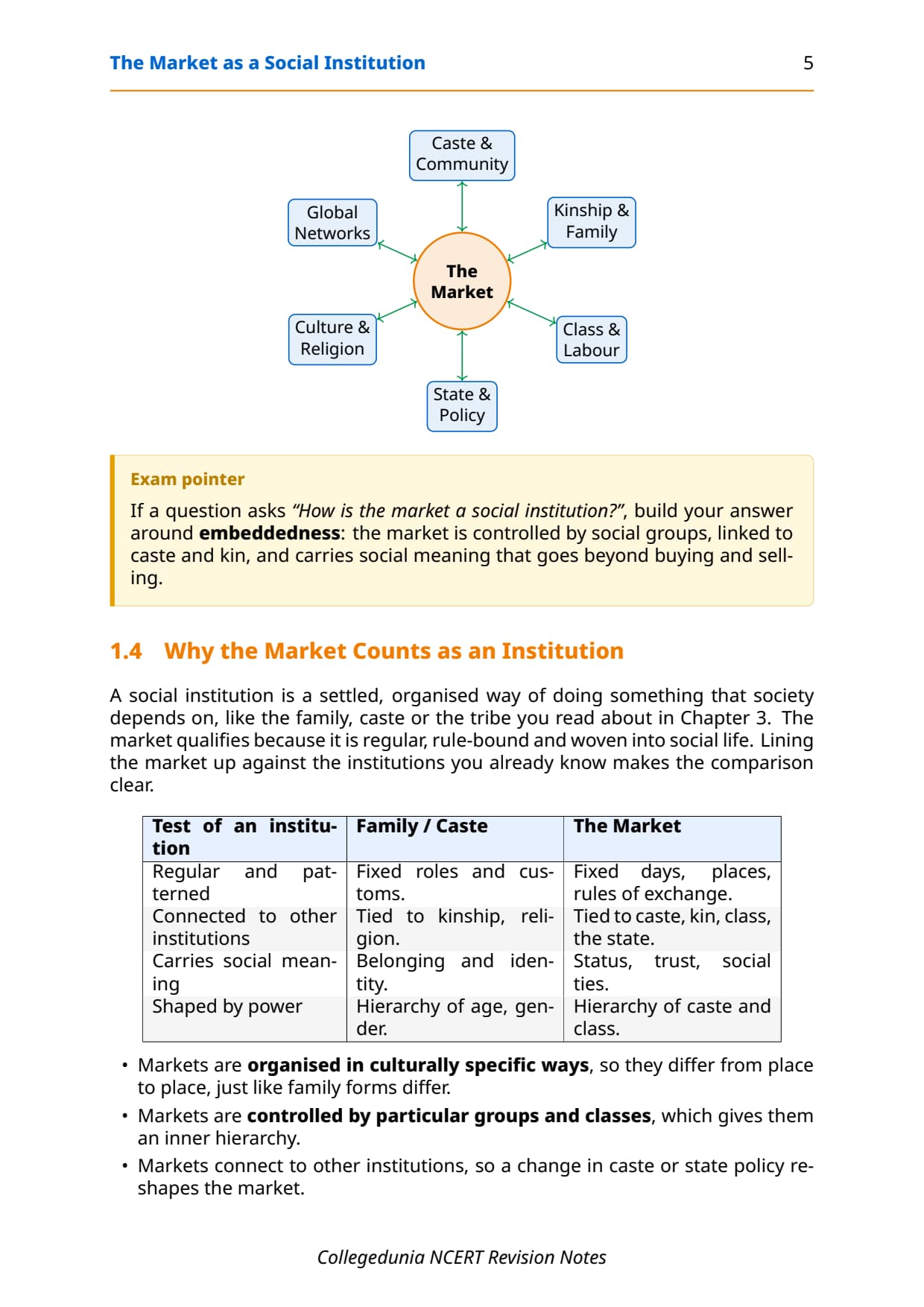
- The sociology of markets: the invisible hand and the idea that the economy is socially embedded.
- Markets in India: the weekly haat, caste and kin trade, and the effects of colonialism.
- The global economy: commoditisation, consumption and the status symbol.
- Liberalisation: globalisation, the 1991 reforms and the debate around them.
Keeping these four blocks separate makes the chapter feel small. A student who can name the blocks in order will rarely get lost in The Market as a Social Institution class 12, because every exam question sits inside one of them.
Key Terms and Definitions for Quick Revision
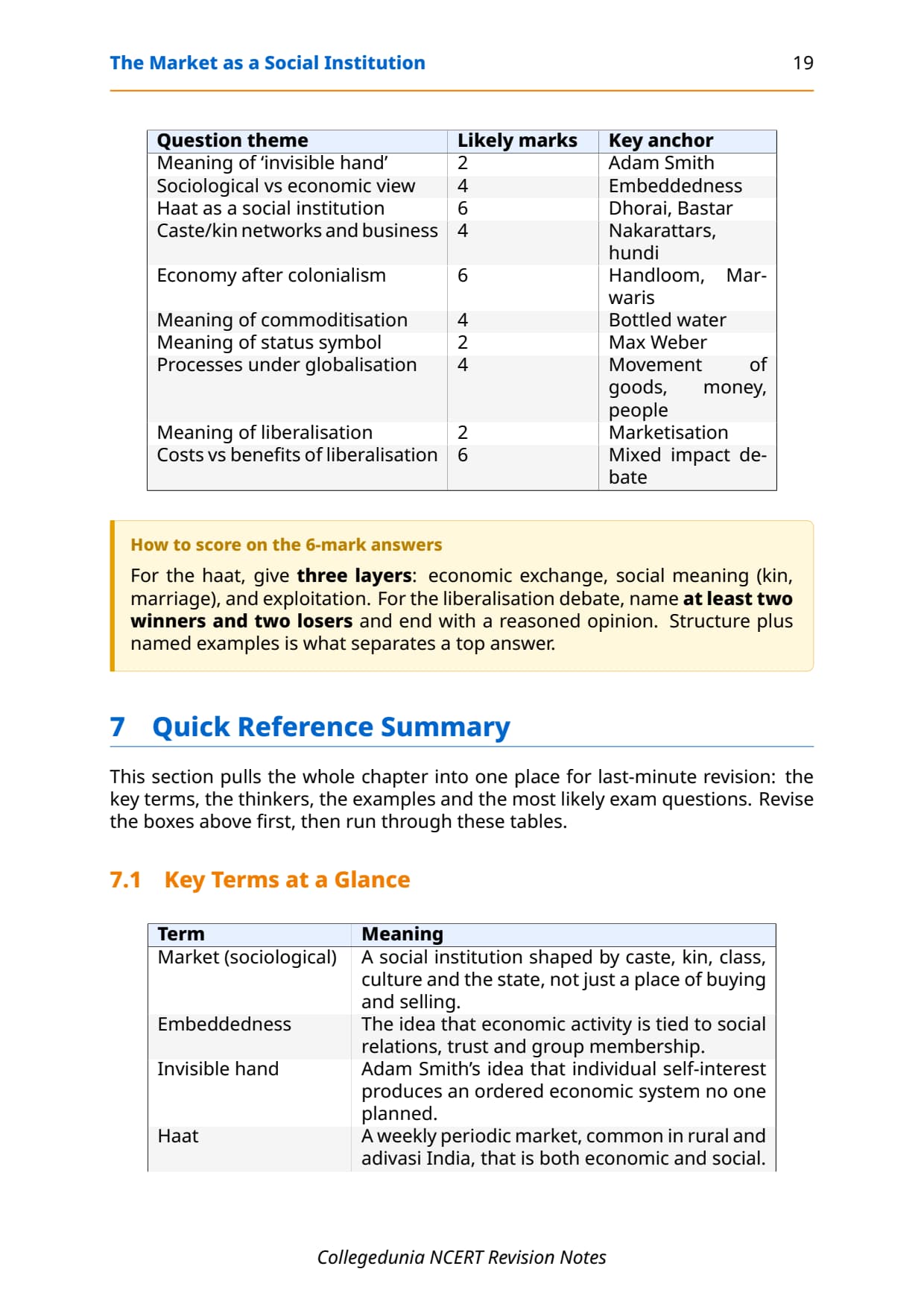
This chapter is built on a handful of terms, and almost every mark in the exam rests on getting them right. The table below is the fastest way to lock them in before the paper. Read it twice and you can attempt any objective question.
| Term | Definition |
|---|---|
| Invisible hand | Adam Smith's idea that a free market organises itself through self-interested exchanges. |
| Social institution | An established set of relationships that meets a society's needs, like family or caste. |
| Embeddedness | The view that the economy is tied into the wider social world. |
| Haat | A weekly periodic village market that links many villages. |
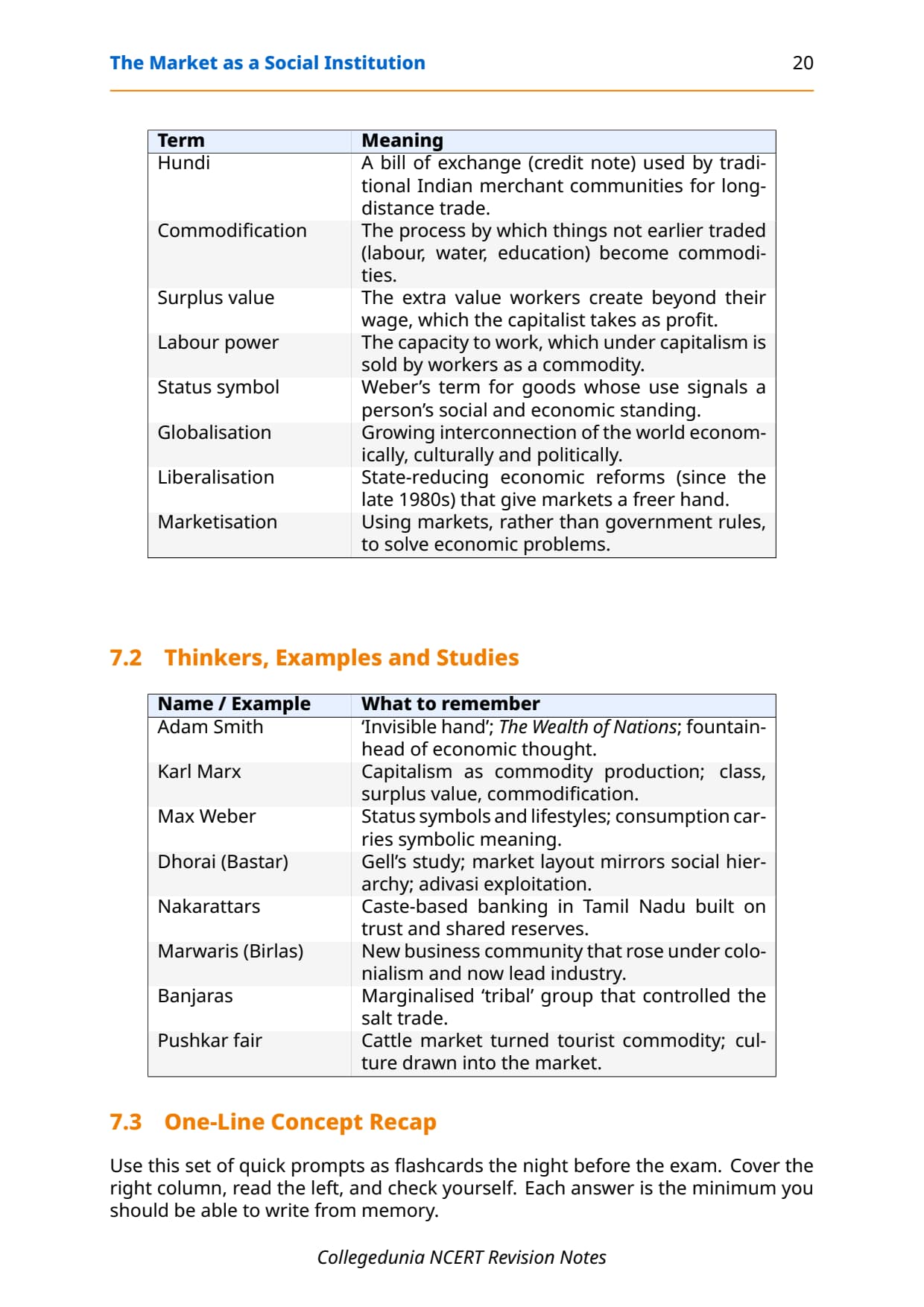
| Commoditisation | When things or services not earlier sold become items for sale. |
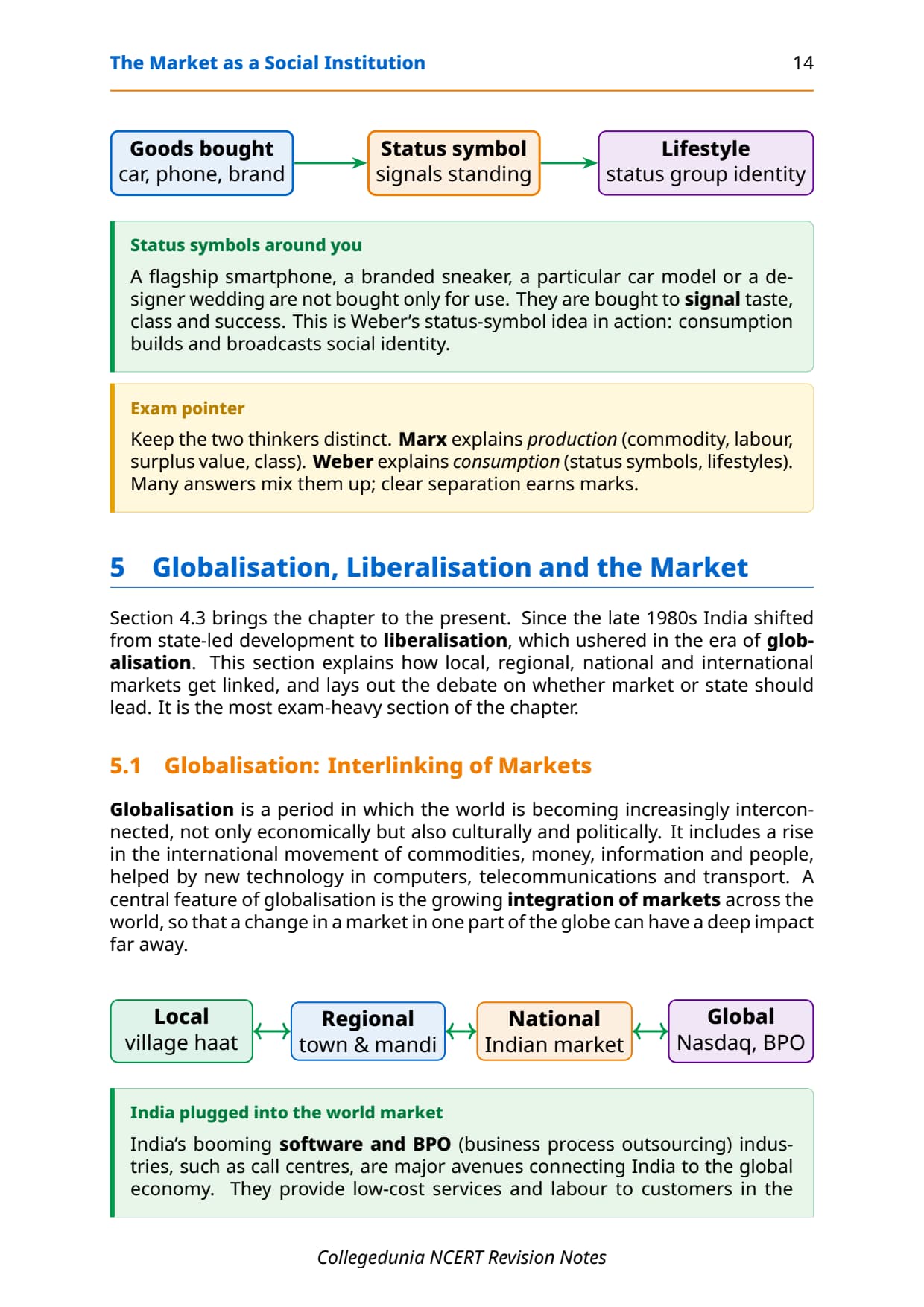
| Status symbol | A good bought to signal social standing, an idea linked to Max Weber. |
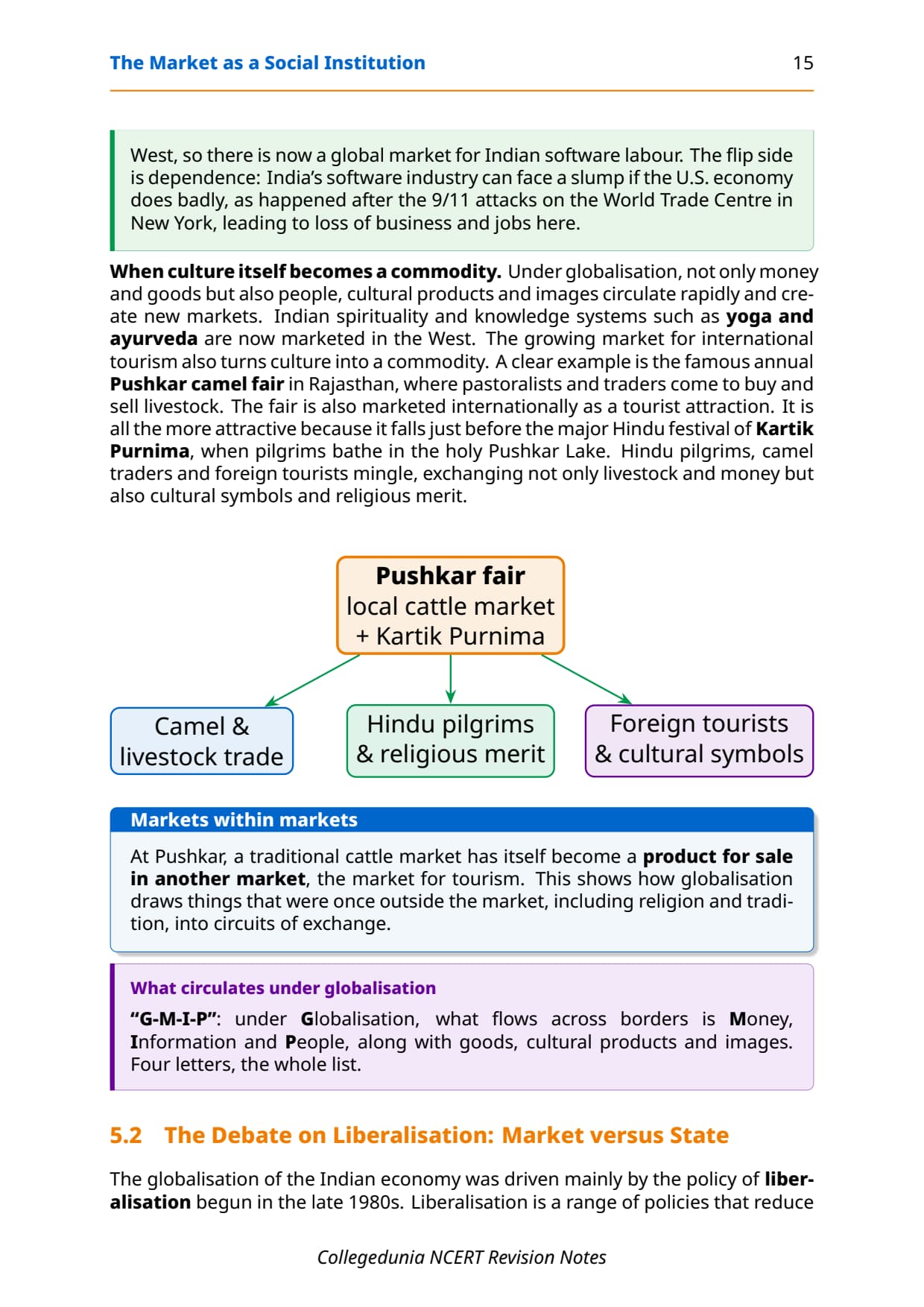
| Globalisation | The growing links and flows that join economies and cultures worldwide. |
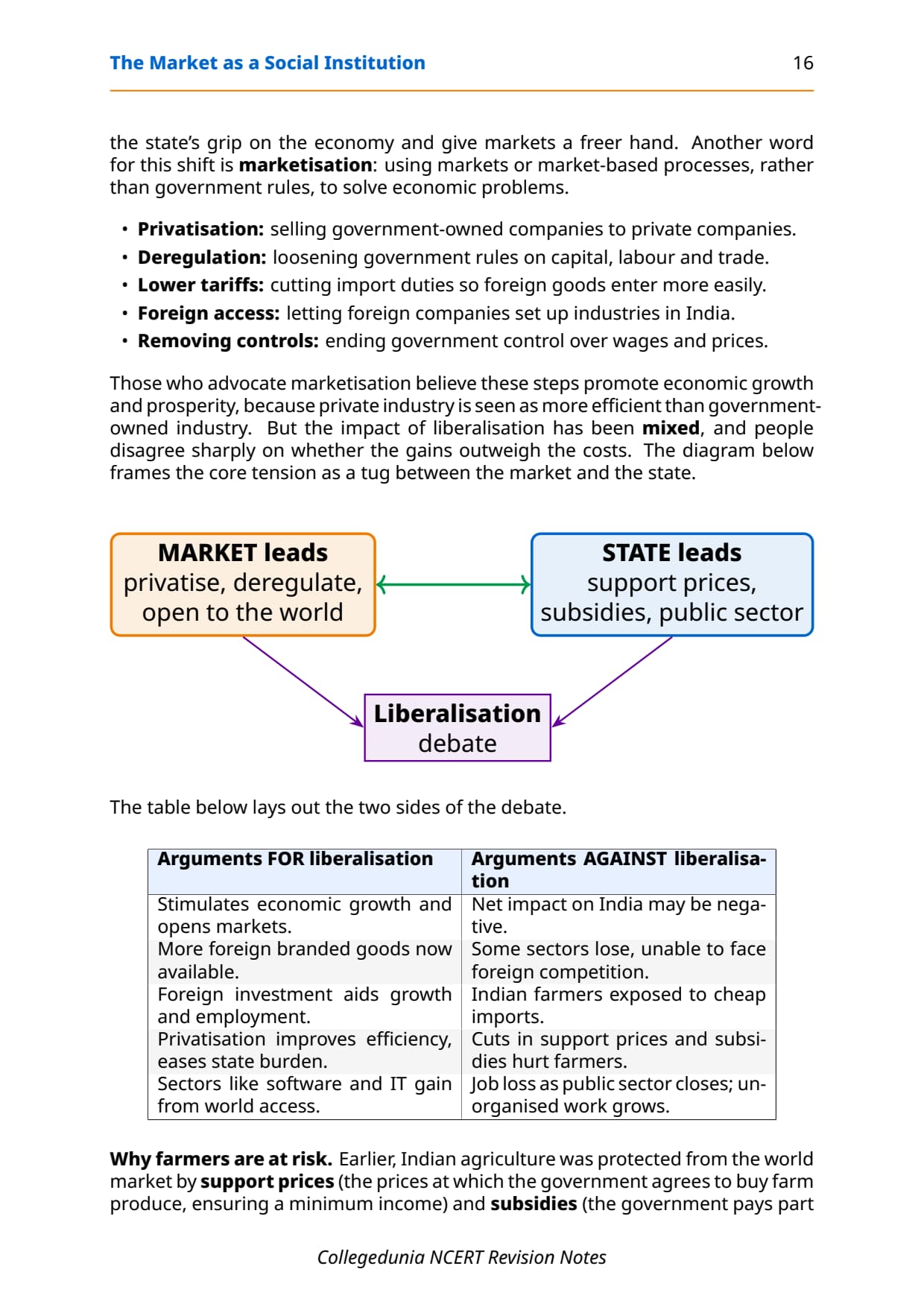
| Liberalisation | Government stepping back so the market plays a bigger role. |
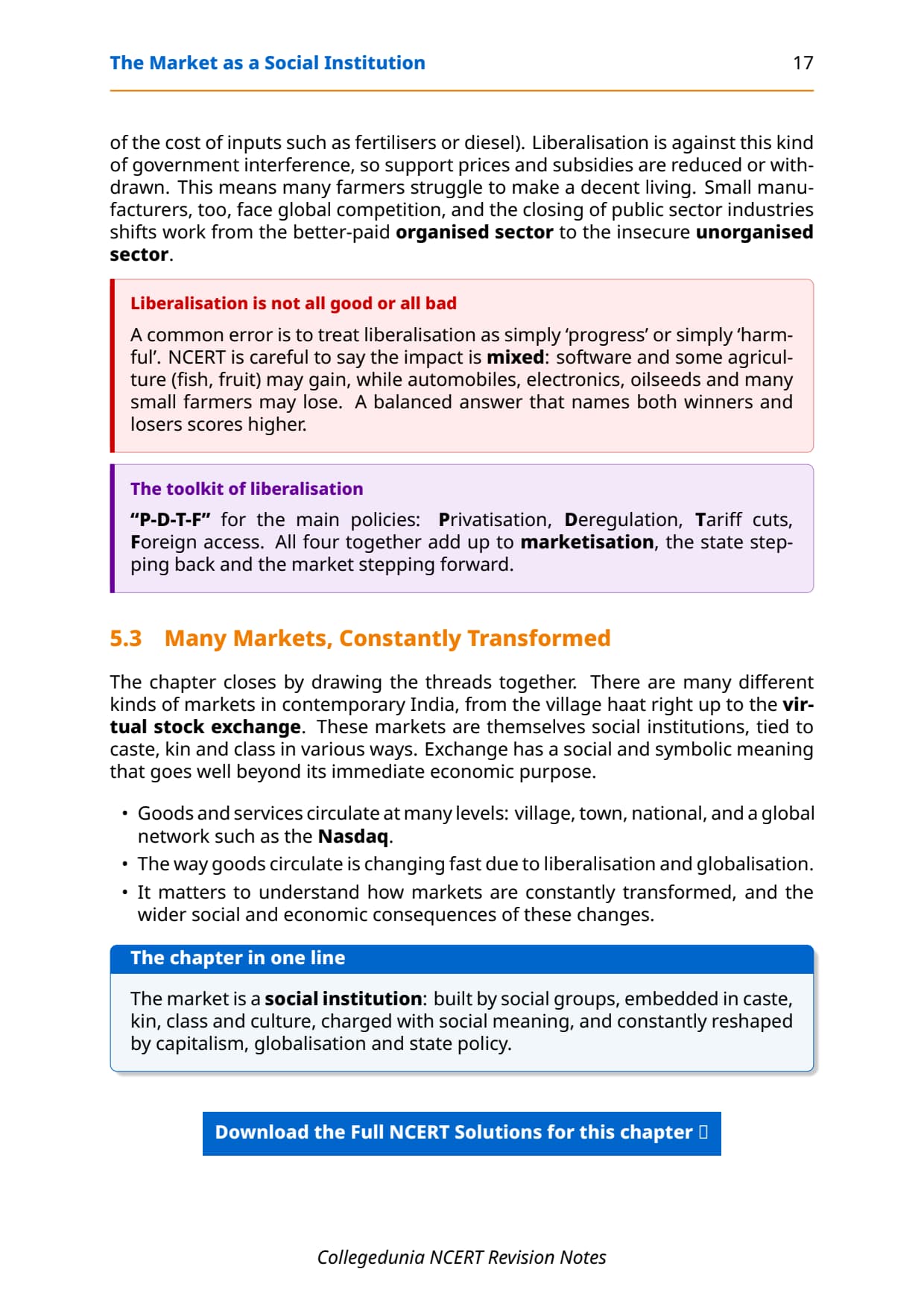
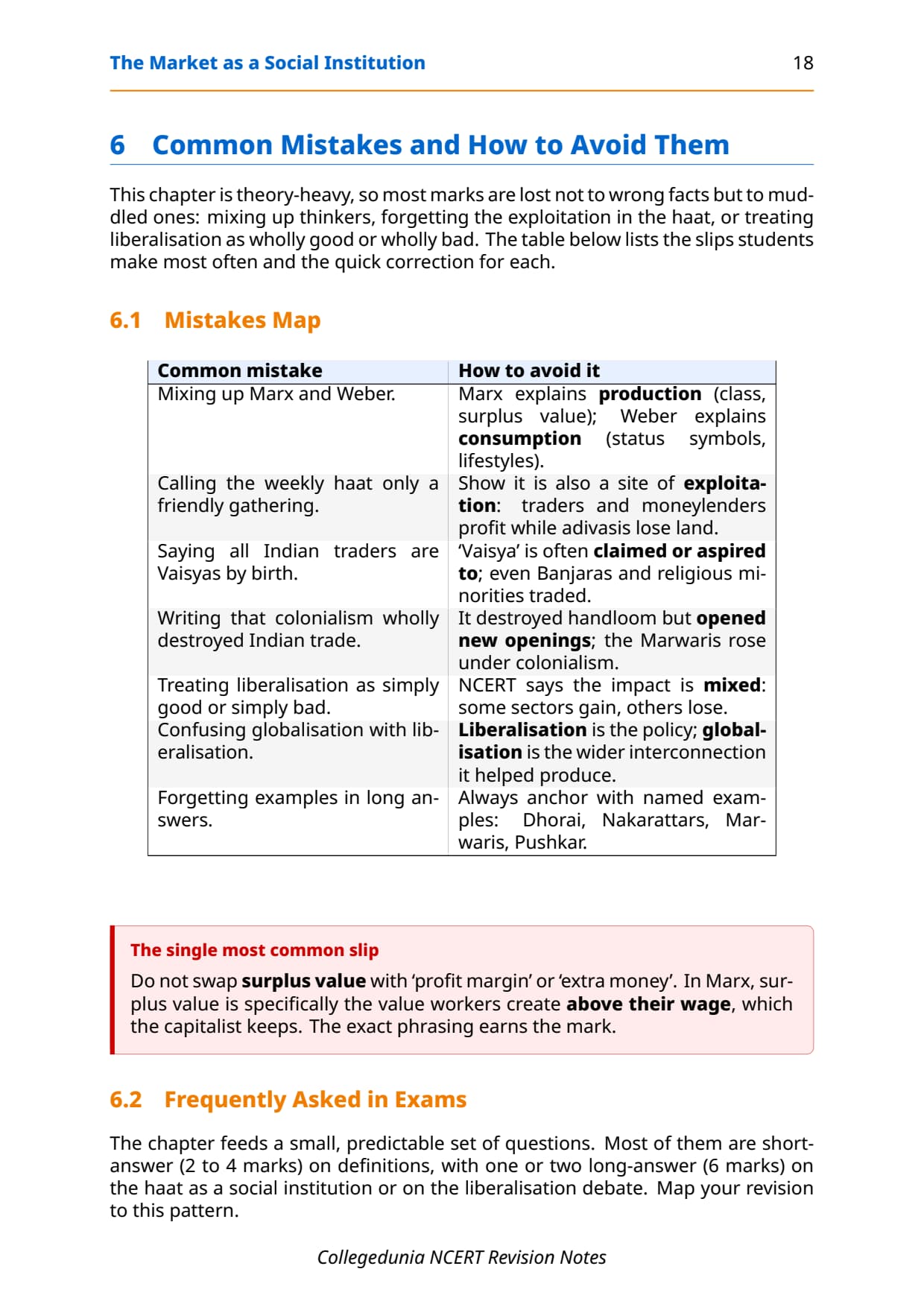
A key revision tip: always tie each term to a named example. Examiners reward an answer that links the invisible hand to Adam Smith, caste trade to the Nakarattars, and liberalisation to the 1991 reforms, not just the bare definition.
The Sociology of Markets and the Invisible Hand
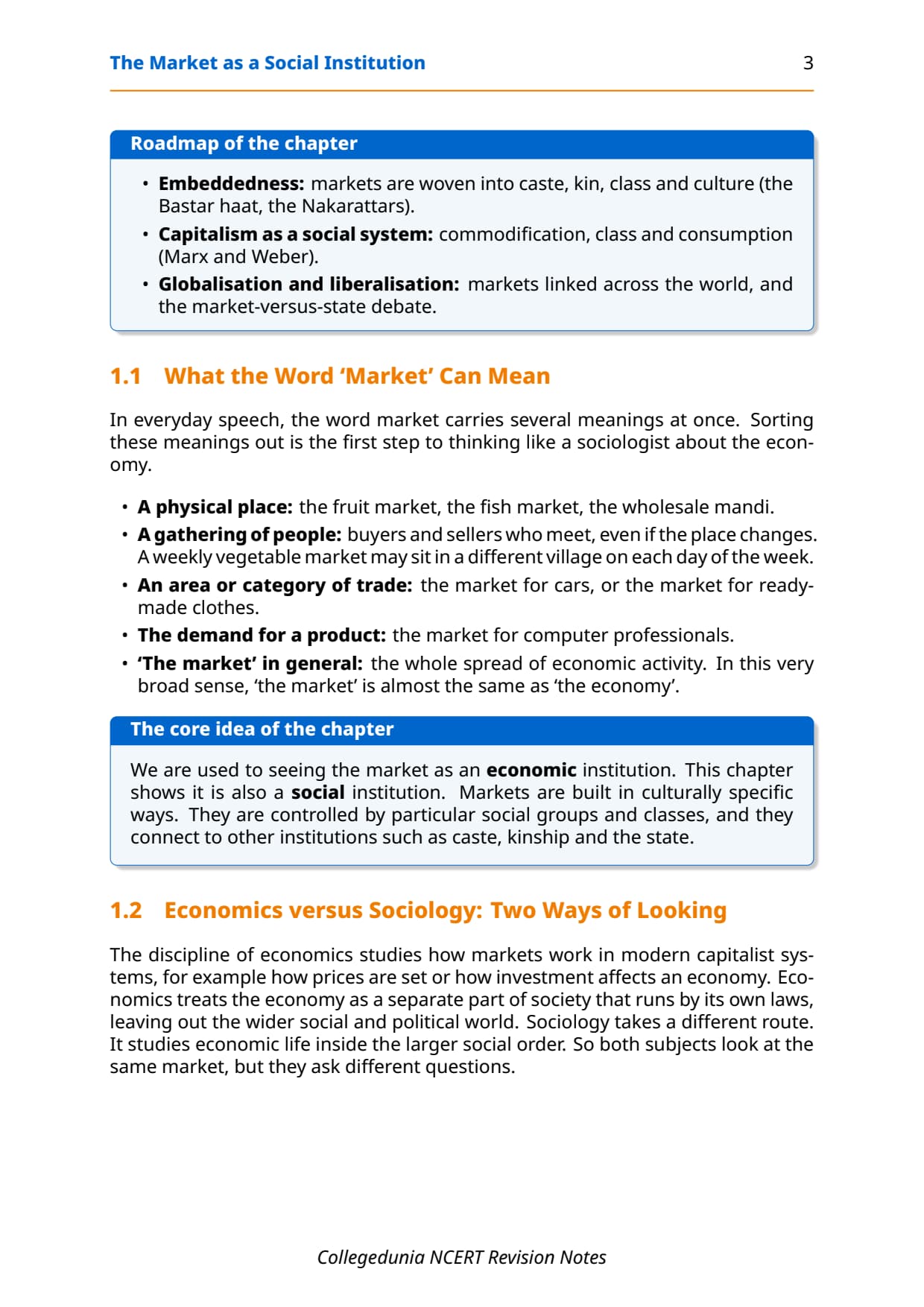
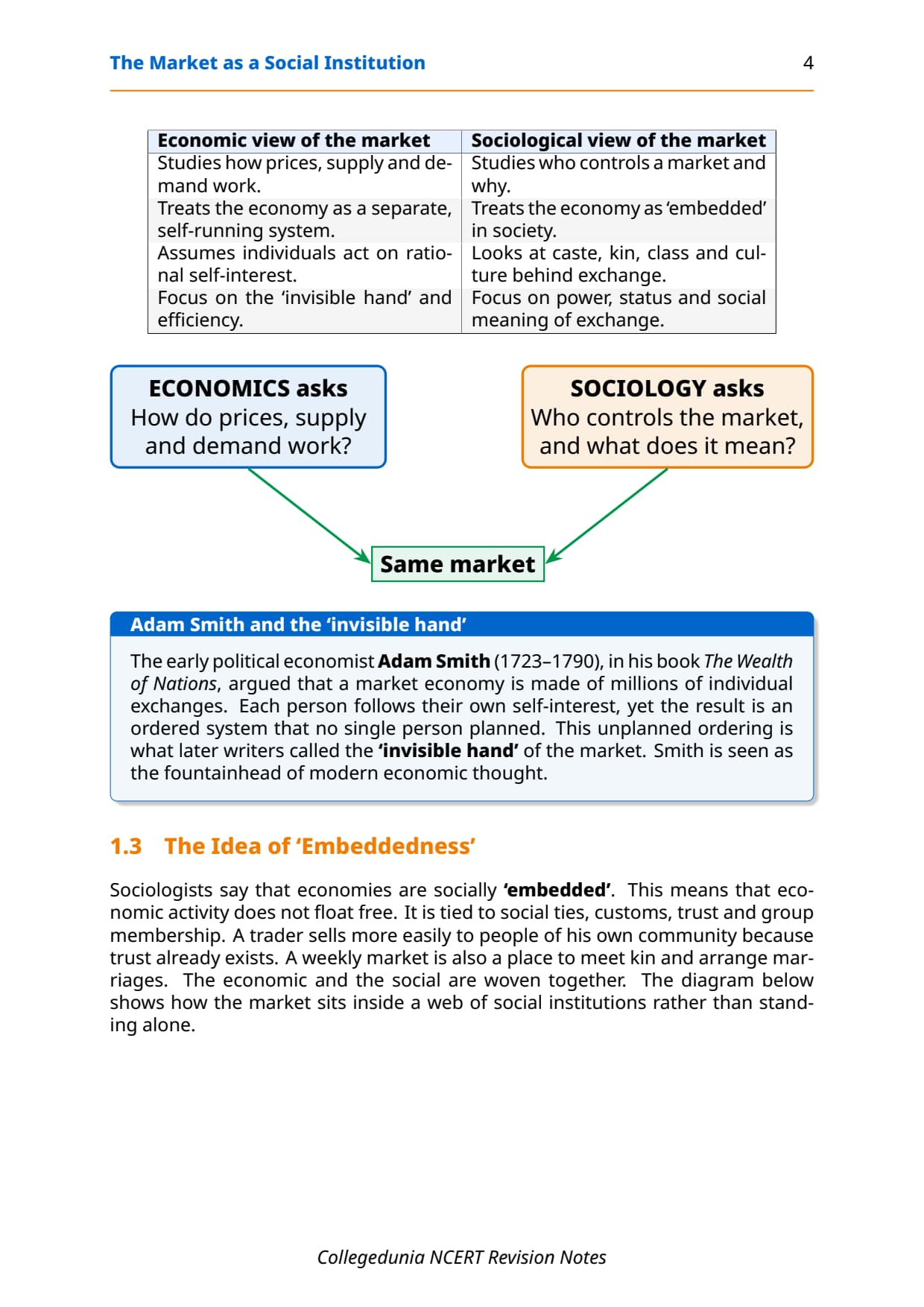
The chapter opens with two ways of seeing a market, and students often mix them up. These notes keep them apart with a one-line summary of each, then a table that shows the contrast. Learn the difference and a big part of the chapter is done.
- The invisible hand: Adam Smith's claim that a free market runs itself. Self-interested deals add up to an orderly system nobody planned.
- The economic view: treats the market as a pricing mechanism that works by its own laws, separate from society.
- The sociological view: sees the market as a social institution that is socially embedded, shaped by caste, class and culture.
| Feature | Economic view | Sociological view |
|---|---|---|
| Core question | How does the mechanism work? | Who controls it and what does it mean? |
| What the market is | A pricing machine | A social institution |
| Link to society | Economy is separate | Economy is embedded |
| What it studies | Supply, demand, investment | Caste, class, trust, culture |
The honest exam point is that no market floats free of society. Even Adam Smith's self-running market sits inside social rules, which is exactly what the sociological view adds. This contrast is the spine of the whole chapter.
Markets in India: Haat, Caste Trade and Colonialism
This block holds the Indian examples that prove the market is social. These are the facts that turn a theory question into a real-world answer, so students should keep them ready. The points below sum up the key cases.
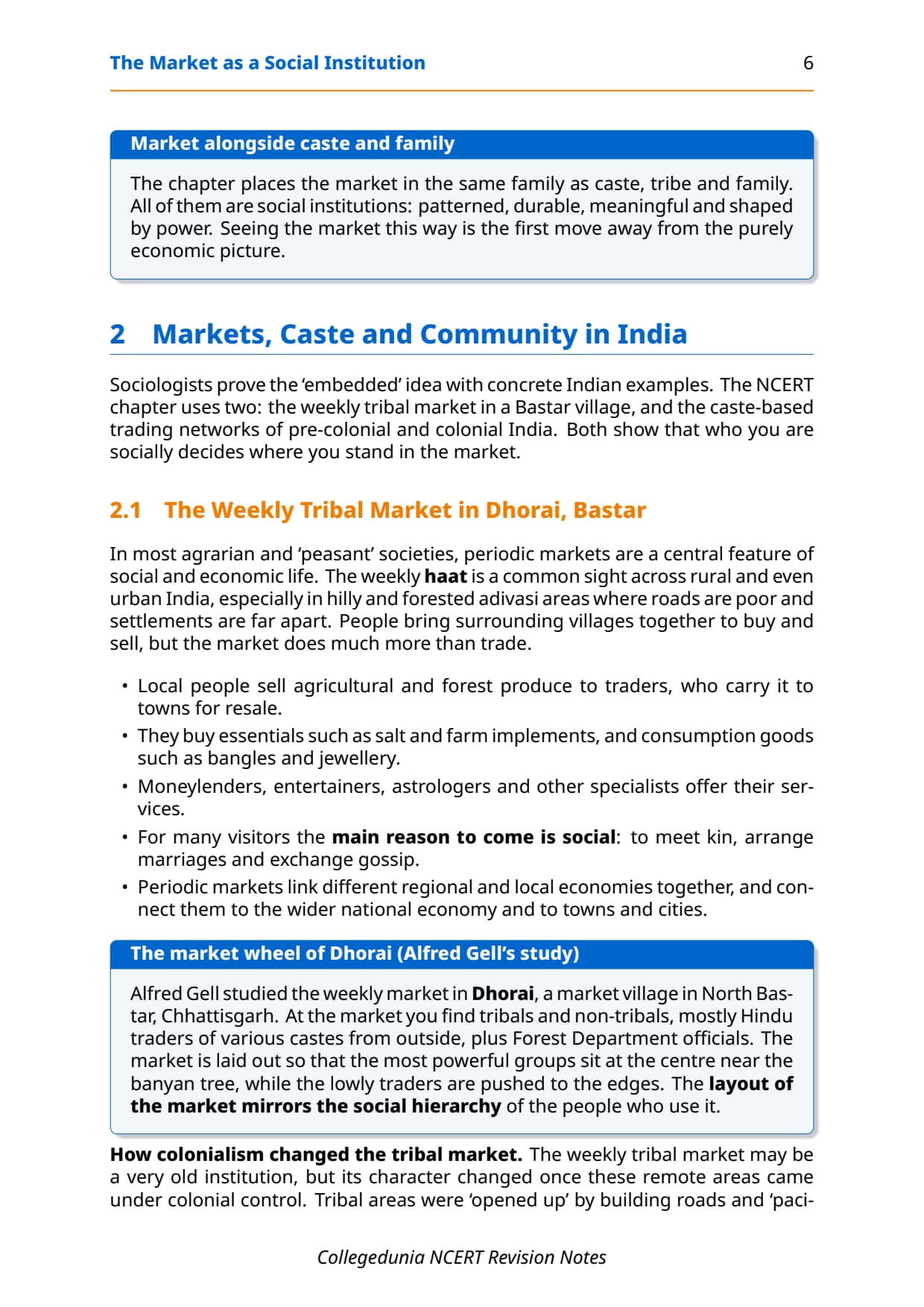
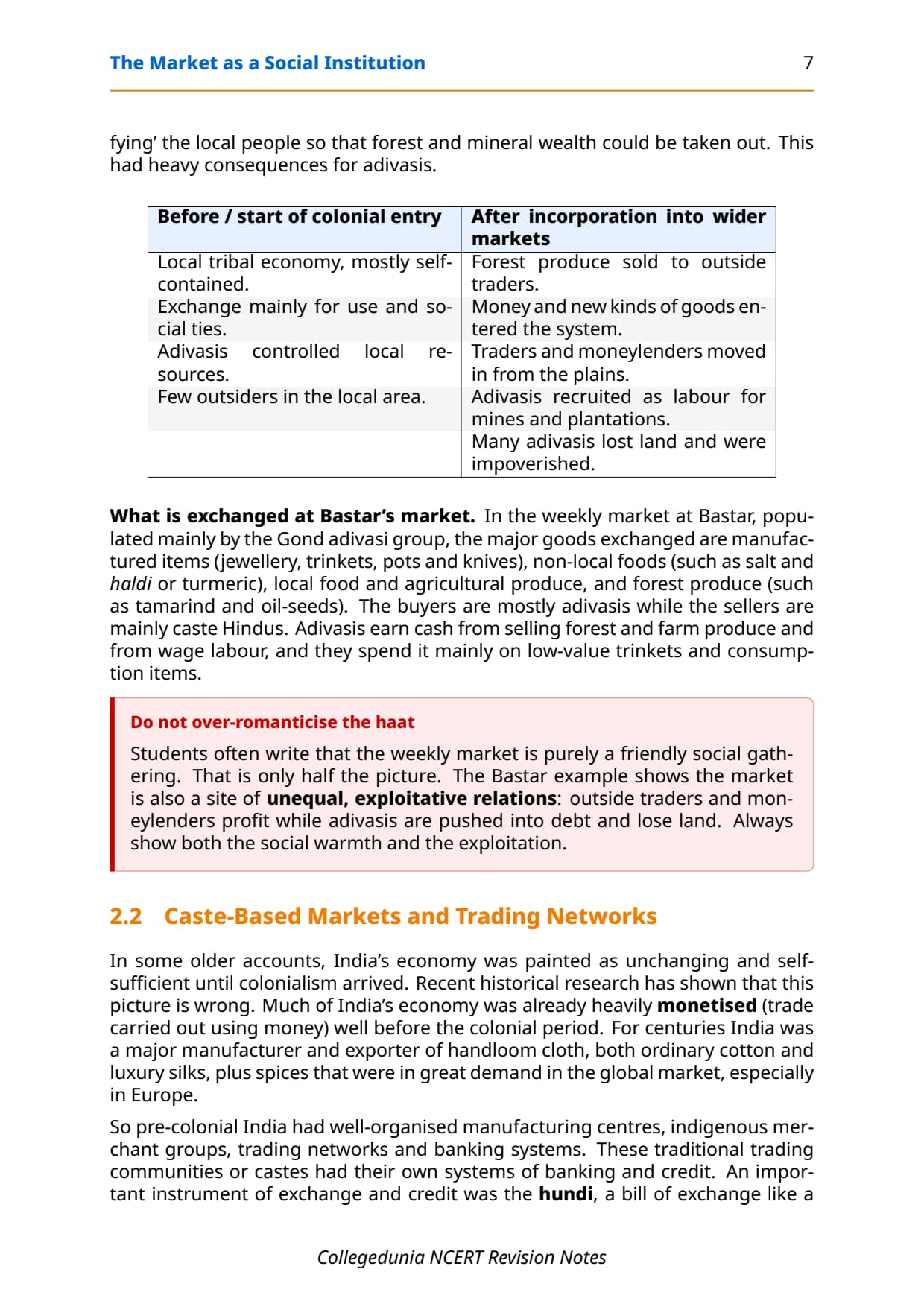
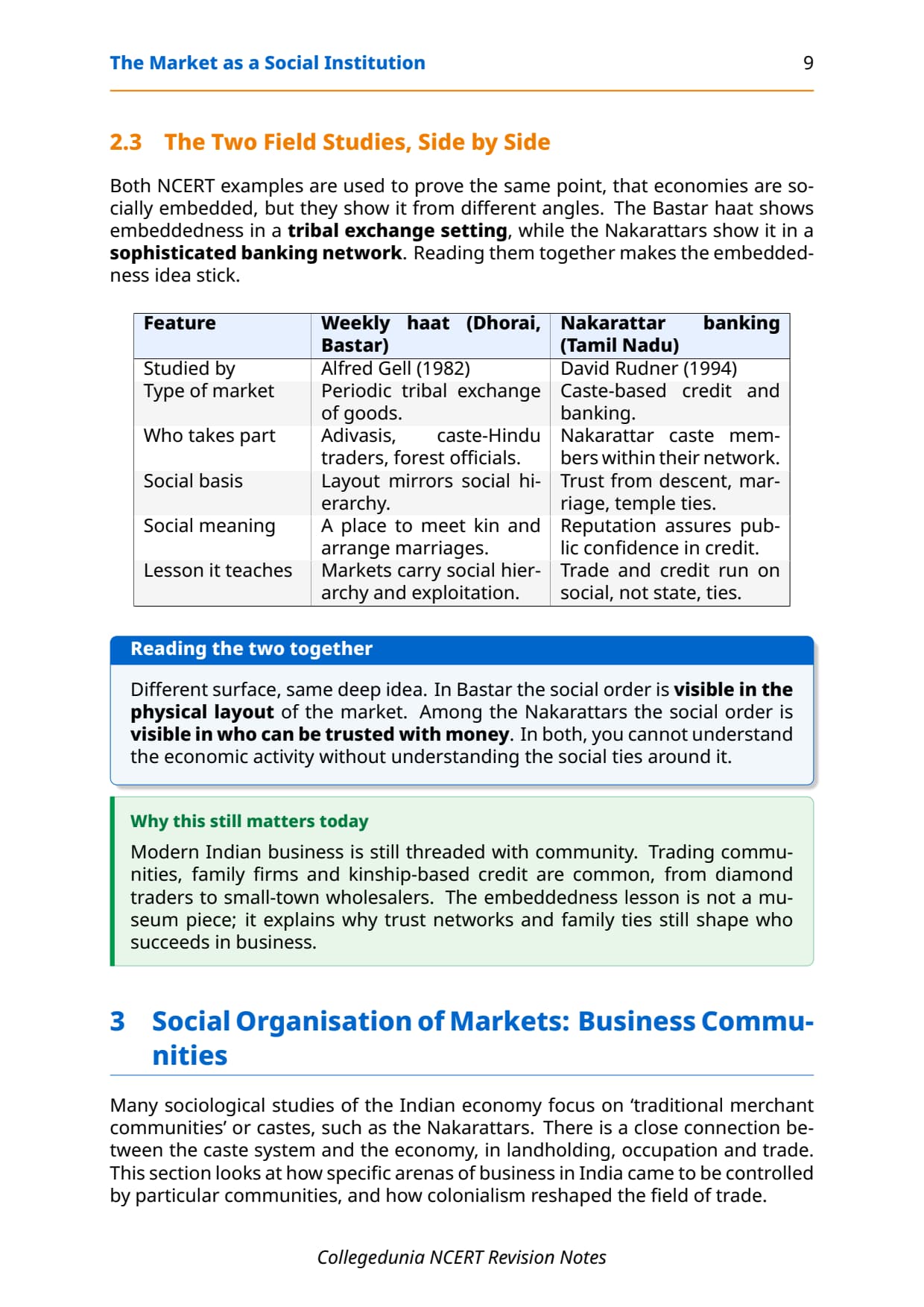
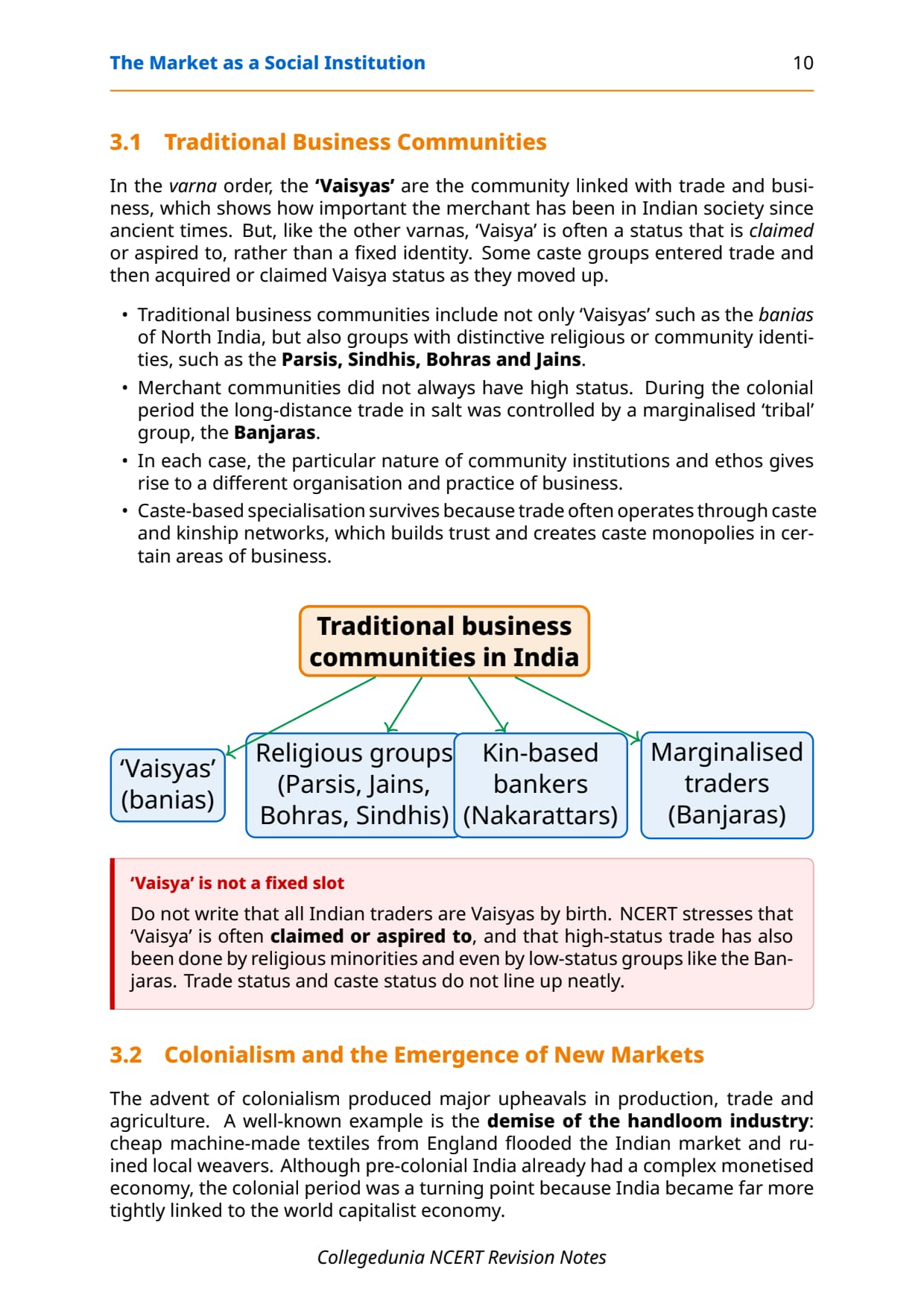
- The weekly haat: a periodic market that links many villages, gathers a region for social life, and in Bastar is organised along caste lines.
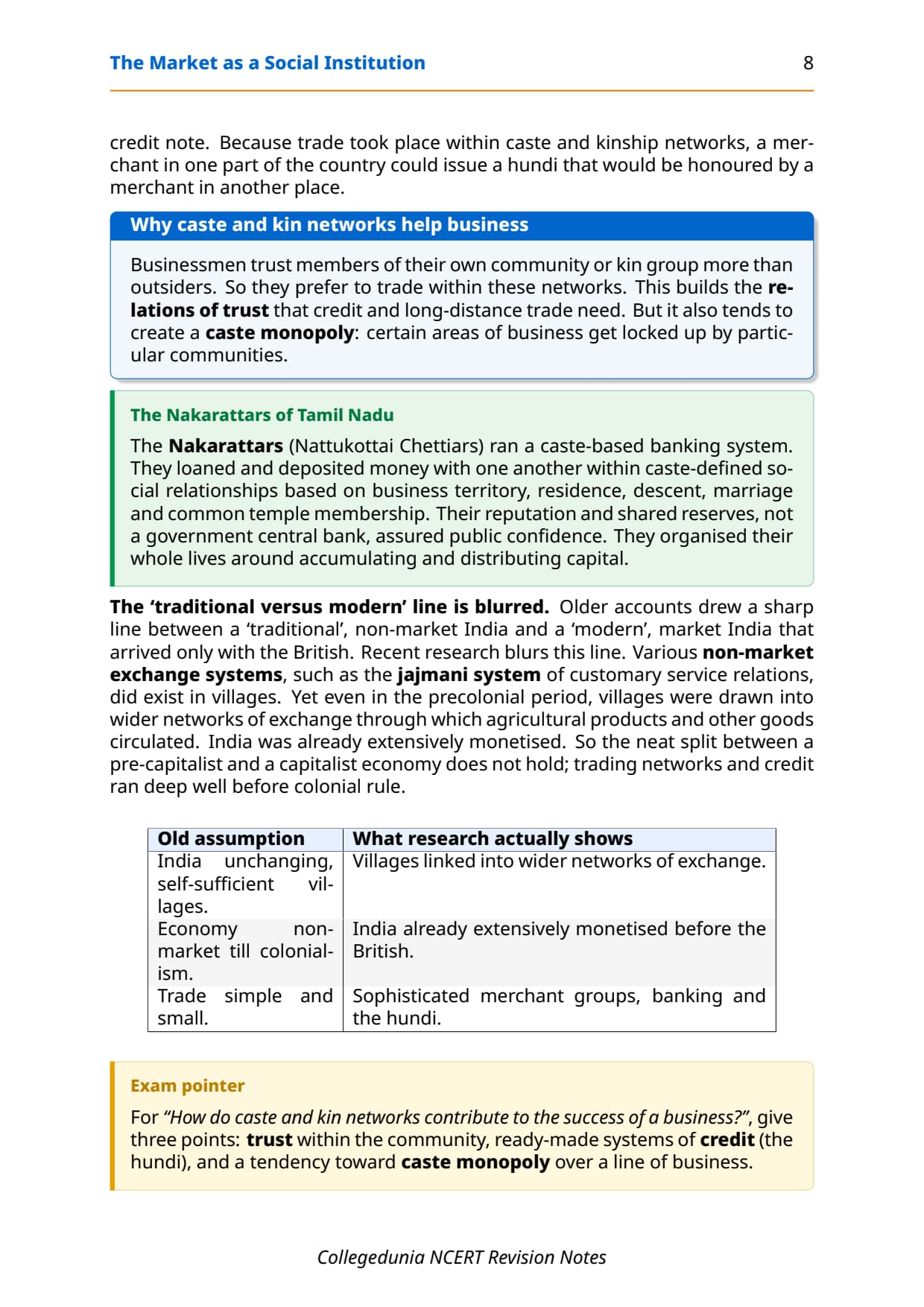
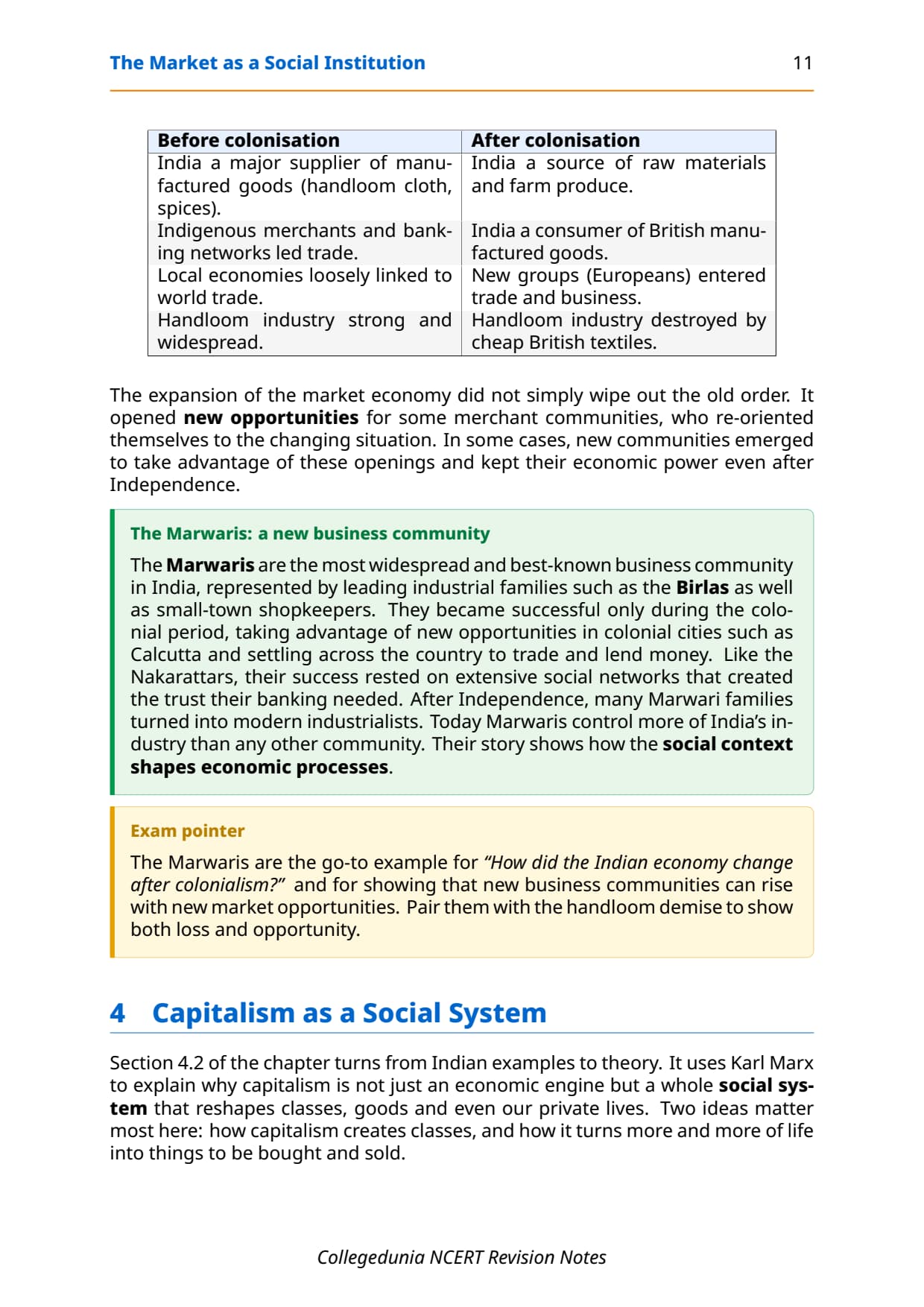
- Caste and kin trade: the Nakarattars ran community banking on descent and marriage; the Marwaris used social networks to seize colonial opportunities.
- The hundi: a bill of exchange that worked because trust ran through caste and kinship networks.
- Colonialism: the handloom industry declined, and India shifted from a maker of goods to a supplier of raw materials.
The big takeaway is that trust is the engine of trade. Caste and kin ties create trust cheaply, and trust is what credit, banking and long-distance trade all run on. An answer that names the Nakarattars and Marwaris scores higher than one that only states the idea.
Globalisation, Liberalisation and Status Symbols
The last block of the chapter is about the modern economy. These ideas link India to the wider world, so students should keep them ready. The points below sum up where the chapter ends.
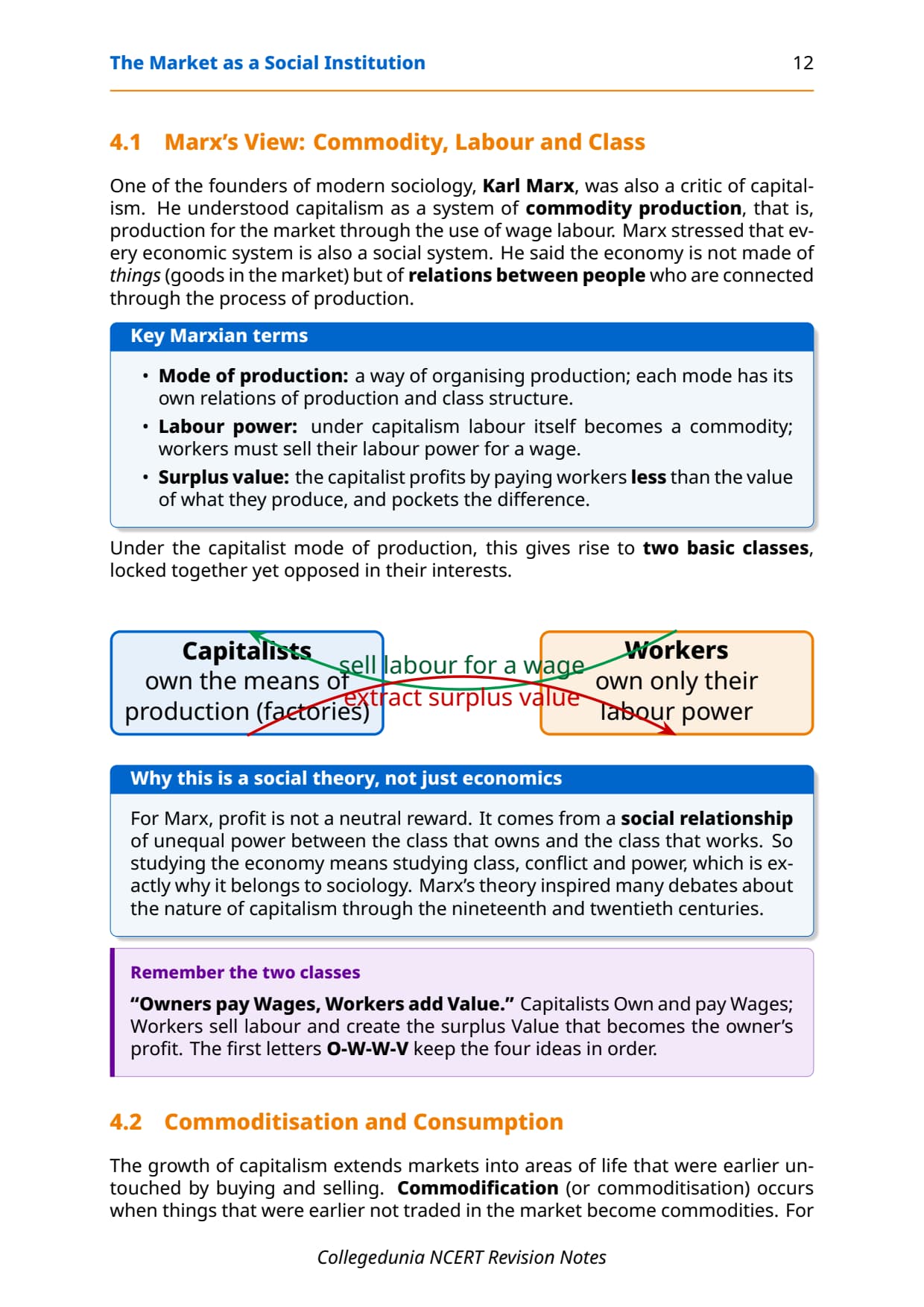
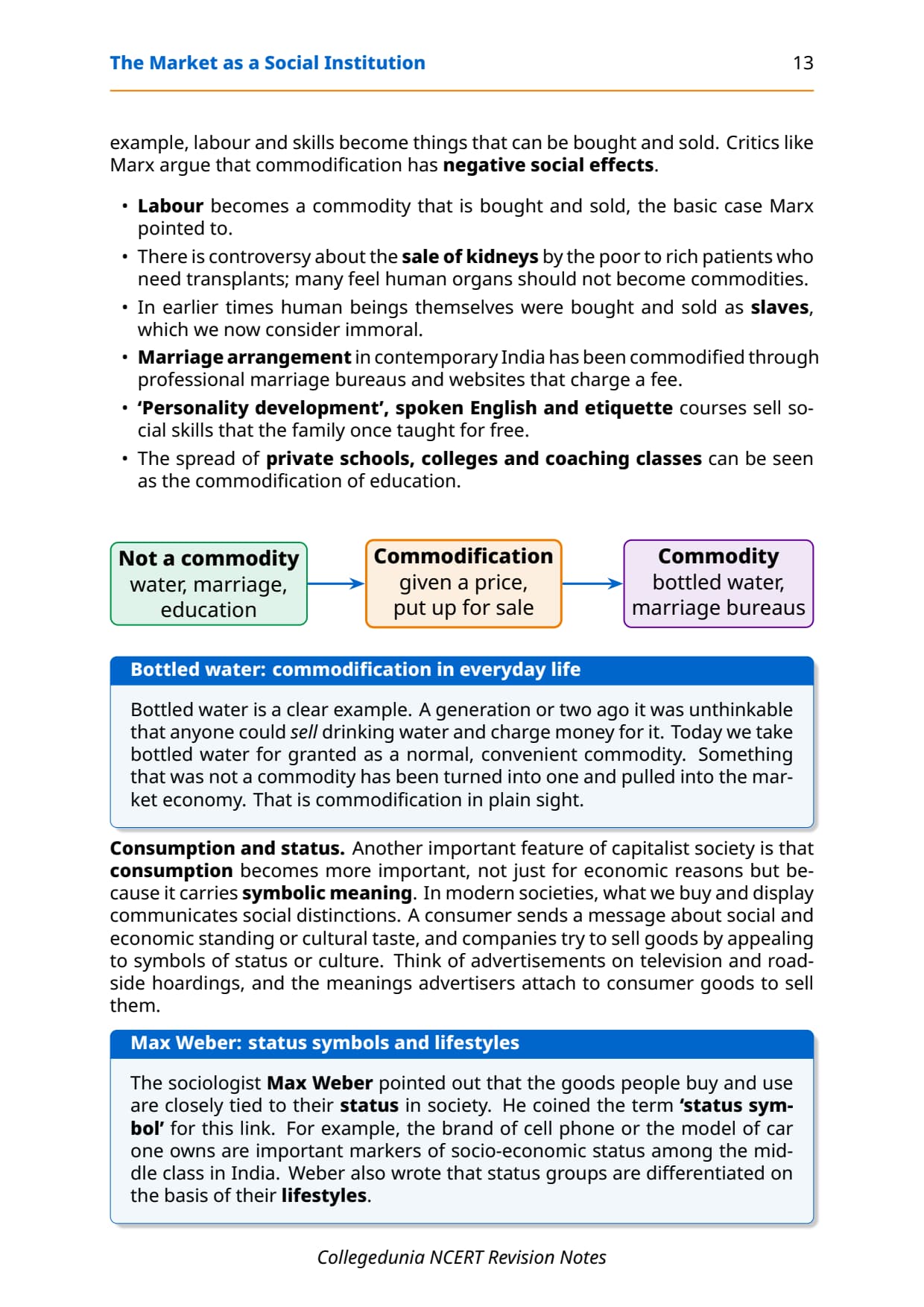
- Commoditisation: things and services not earlier sold, like labour or water, become items for sale. Some of this is seen as socially troubling.
- Status symbols: following Max Weber, goods are bought to signal social standing, so consumption is about meaning, not only need.
- Globalisation: the growing links and flows that join economies and cultures through trade, investment and media.
- Liberalisation: the government steps back so the market expands, the core of India's 1991 reforms, with both supporters and critics.
The key revision line is that liberalisation has winners and losers. A balanced answer weighs the claimed benefits, like investment and choice, against the costs for small farmers and protected industries, then gives a clear view. That is the part of the chapter most worth practising.
The Market as a Social Institution Revision Table
For a last-minute scan, this table pulls the whole chapter into one place. Students can cover the right column and test themselves, then check their recall. It is the quickest way to confirm you are exam-ready.
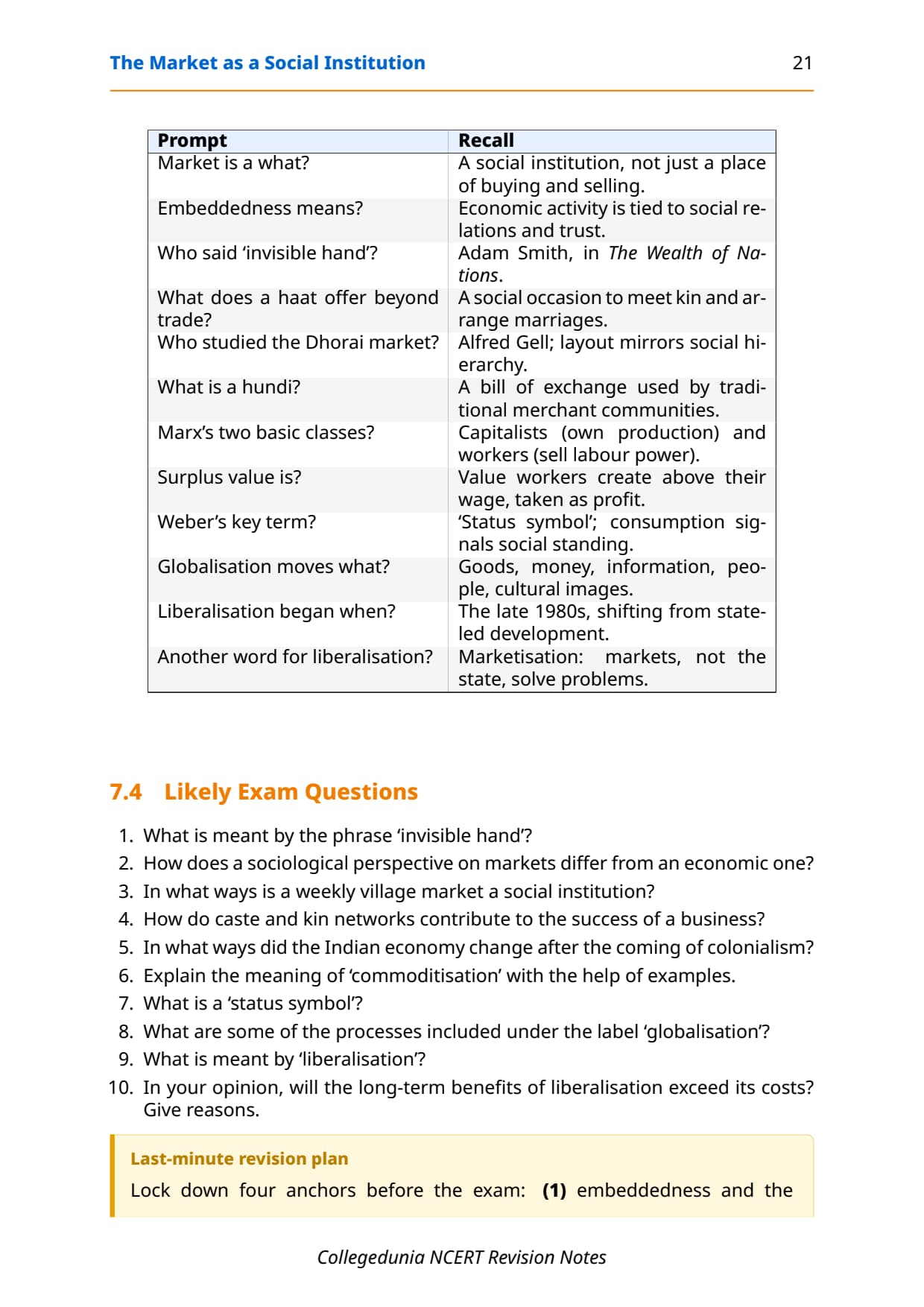
| Topic | One-line recall |
|---|---|
| Invisible hand | Adam Smith: a free market runs itself |
| Sociological view | Market is a social institution, embedded in society |
| Weekly haat | Links villages, gathers a region, mirrors caste |
| Caste and kin trade | Trust powers credit and banking (Nakarattars, Marwaris) |
| Commoditisation | Non-market things become items for sale |
| Liberalisation | Government steps back; 1991 reforms; debated |
Run down this table once a day in the week before the exam. Active recall beats re-reading, so cover the answers and say them aloud before you check. This single habit lifts retention more than any amount of highlighting.
How These Notes Pair with the Solutions and Book PDF
These notes summarise the chapter. To finish your prep, use them with the other resources for the same chapter, all linked in the table below.
| Resource | Best used for |
|---|---|
| The Market as a Social Institution Class 12 NCERT Solutions | Full point-wise answers to all 10 exercise questions |
| The Market as a Social Institution Class 12 Handwritten Notes | One-shot revision in a scanned notebook style |
| The Market as a Social Institution NCERT Book PDF | Reading the original NCERT chapter text and examples |
Tip: read these notes first to get the big picture, then attempt the NCERT Solutions on your own. The notes give the map; the solutions give the practice.
All NCERT Notes for Class 12 Sociology
The table links the Notes for every chapter in both Class 12 Sociology books, so students can revise across the course in one place. The Market as a Social Institution is highlighted.
| Chapter | NCERT Notes |
|---|---|
| Indian Society | |
| Chapter 1 | Introducing Indian Society |
| Chapter 2 | The Demographic Structure of the Indian Society |
| Chapter 3 | Social Institutions - Continuity and Change |
| Chapter 4 | The Market as a Social Institution |
| Chapter 5 | Patterns of Social Inequality and Exclusion |
| Chapter 6 | The Challenges of Cultural Diversity |
| Social Change and Development in India | |
| Chapter 1 | Structural Change |
| Chapter 2 | Cultural Change |
| Chapter 3 | The Constitution and Social Change |
| Chapter 4 | Change and Development in Rural Society |
| Chapter 5 | Change and Development in Industrial Society |
| Chapter 6 | Globalisation and Social Change |
| Chapter 7 | Mass Media and Communications |
| Chapter 8 | Social Movements |
FAQs on The Market as a Social Institution Class 12 Notes
The Market as a Social Institution Class 12 Sociology Notes Common Questions
Ques. What are the most important topics in class 12 sociology chapter 4 notes?
Ans. The most important topics are the sociological view of markets, the invisible hand, the weekly haat, caste and kin trade networks, commoditisation, status symbols and liberalisation. These notes cover each in short, exam-ready points.
Ques. What does it mean to call the market a social institution?
Ans. It means the market is more than a place to buy and sell. Like family or caste, it is an established set of relationships shaped by society. It is embedded in caste, class, community and culture, and carries social meaning beyond price.
Ques. What is the difference between globalisation and liberalisation?
Ans. Globalisation is the growing links and flows that join economies and cultures worldwide. Liberalisation is a policy choice, where the government steps back so the market plays a bigger role, as in India's 1991 reforms. Liberalisation is one driver of globalisation.
Ques. Why are caste and kin networks useful in business?
Ans. They create trust cheaply, and trust is what credit, banking and long-distance trade run on. The Nakarattars ran community banking on descent and marriage, and the Marwaris used social networks to seize colonial opportunities.
Ques. Are these class 12 sociology chapter 4 notes enough for the board exam?
Ans. Yes, these notes cover the full NCERT chapter in revision form. For exam practice, pair them with the NCERT Solutions linked on this page so you can write out full answers to all 10 exercise questions.



Comments