



This is the full printed Chapter 14 from Exploring Society: India and Beyond for the 2026-27 session. It carries the Kauṭilya quotation, the three sector definitions, the AMUL dairy cooperative story from Anand district and the pulp-to-textbook illustration, with nothing shortened or reworded.
- 14-page official file: Chapter 14 runs from printed page 195 to printed page 208 of the Class 6 textbook.
- Covers the two section heads The Classification of Economic Activities into Economic Sectors and Interdependence Among Sectors.
- Carries 3 LET'S EXPLORE boxes, 2 THINK ABOUT IT boxes, 3 DON'T MISS OUT boxes, 13 glossary terms, Fig. 14.1 and 3 end questions.
This is the unedited NCERT chapter file for the 2026-27 print run, checked page by page against the official Exploring Society: India and Beyond release before it was put on this page.
Student Feedback
What 13,460 students told us about the Economic Activities Around Us chapter, in a Collegedunia poll taken during the 2026-27 session.
- 71% of students put construction in the wrong sector on the first try.
- Most-confused pair: secondary and tertiary, mixed up by about 6 in 10 students surveyed.
- Students reported that drawing the AMUL milk flow as one arrow line fixed the interdependence question for good.
Source: 2026-27 Class 6 Social Science student poll. Sample of 13,460 students from CBSE schools across 21 states.
What the Economic Activities Around Us Class 6 PDF Contains, Page by Page
The file is the printed chapter in full, not a summary sheet. It opens with the Kauṭilya's Arthaśhāstra quotation on printed page 195 and closes with the three end questions on printed page 208. Use the table below to jump straight to the part you need.
| Section in the PDF | Printed pages | What is on these pages |
|---|---|---|
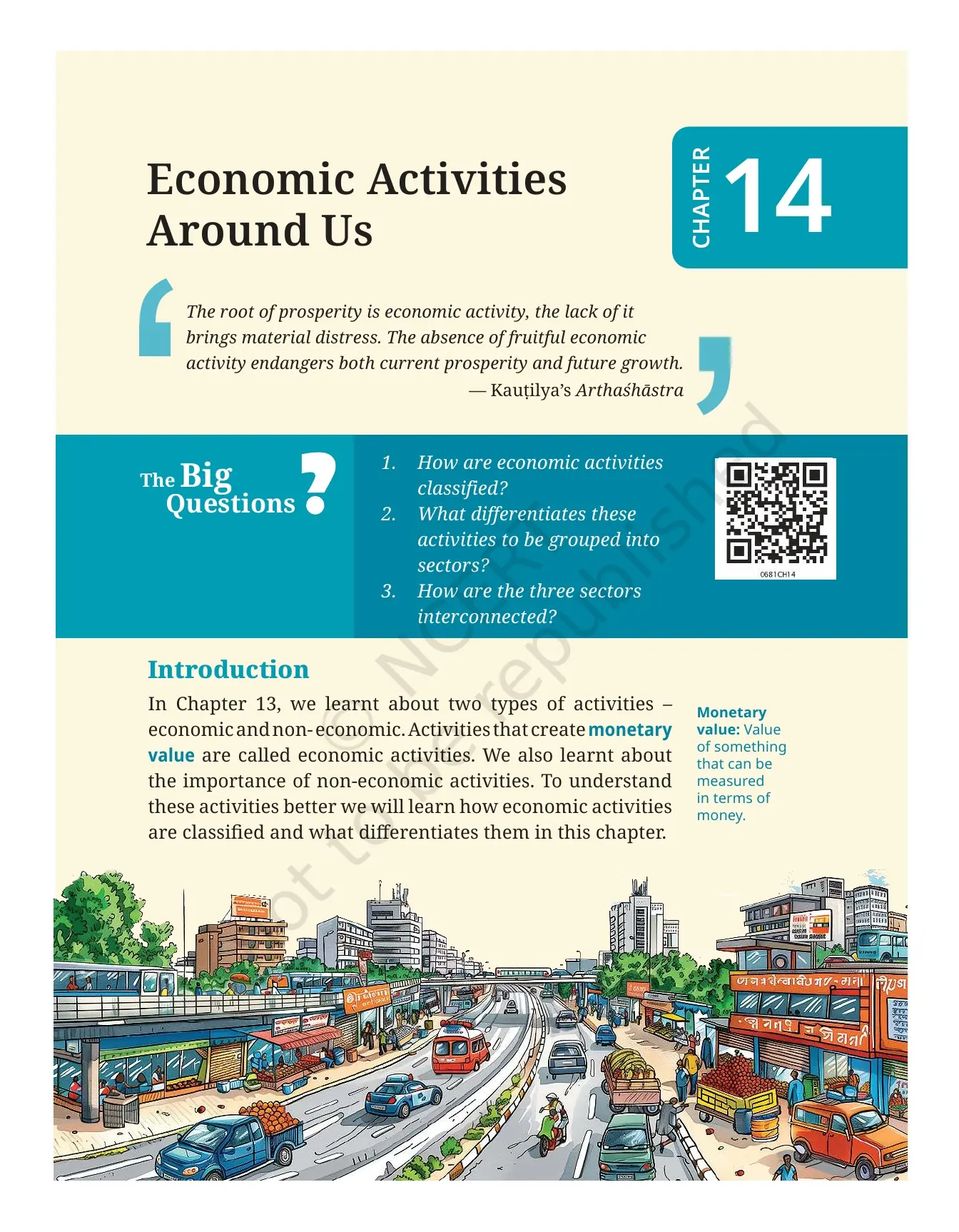
| Chapter opener | 195 | The Kauṭilya's Arthaśhāstra quotation, the three Big Questions, the Introduction that links back to Chapter 13, and the Monetary value glossary |
| Why activities are classified | 196 | How economic activities have grown over the decades, the section head on classification, the Economic Sectors glossary, and the start of primary activities |
| The full-page sector illustration | 197 | Fifteen labelled pictures sorted into a primary, a secondary and a tertiary column |
| Primary activities in pictures | 198 | Examples of primary work and five captioned photographs: greenhouse farming, mining, fish farming, forestry and raising livestock |
| Secondary activities begin | 199 | The first THINK ABOUT IT box, the definition of secondary activities, the Secondary sector glossary, and photographs of an automobile factory and a textile factory |
| The automobile table | 200 | Photographs of a pharmaceutical factory and a furniture production unit, the DON'T MISS OUT table of automobiles made in India, and the first LET'S EXPLORE box |
| Tertiary activities | 201 | The definition of tertiary activities, the Tertiary Sector and Warehouses glossary boxes, and photographs of software development and restaurant service |
| Interdependence begins | 202 | Photographs of airport services and retail stores, the section head on interdependence, the Dairy glossary and the start of the AMUL story |
| Sardar Patel and the cooperative | 203 | The middlemen problem, Sardar Vallabhbhai Patel's advice, the Cooperative and Middlemen glossary boxes, and AMUL being set up in 1946 |
| The factory in Anand | 204 | The Pasteurisation, Factory, Retail and Export glossary boxes, the growth of the cooperative, and why milking cows is a primary activity |
| All three sectors inside AMUL | 205 | Milk turned into powder, ghee, cheese and butter, the transport and retail paragraph, and the DON'T MISS OUT box of other milk cooperatives |
| Fig. 14.1 | 206 | The illustrated process that turns pulp into paper and then into the textbooks you study from |
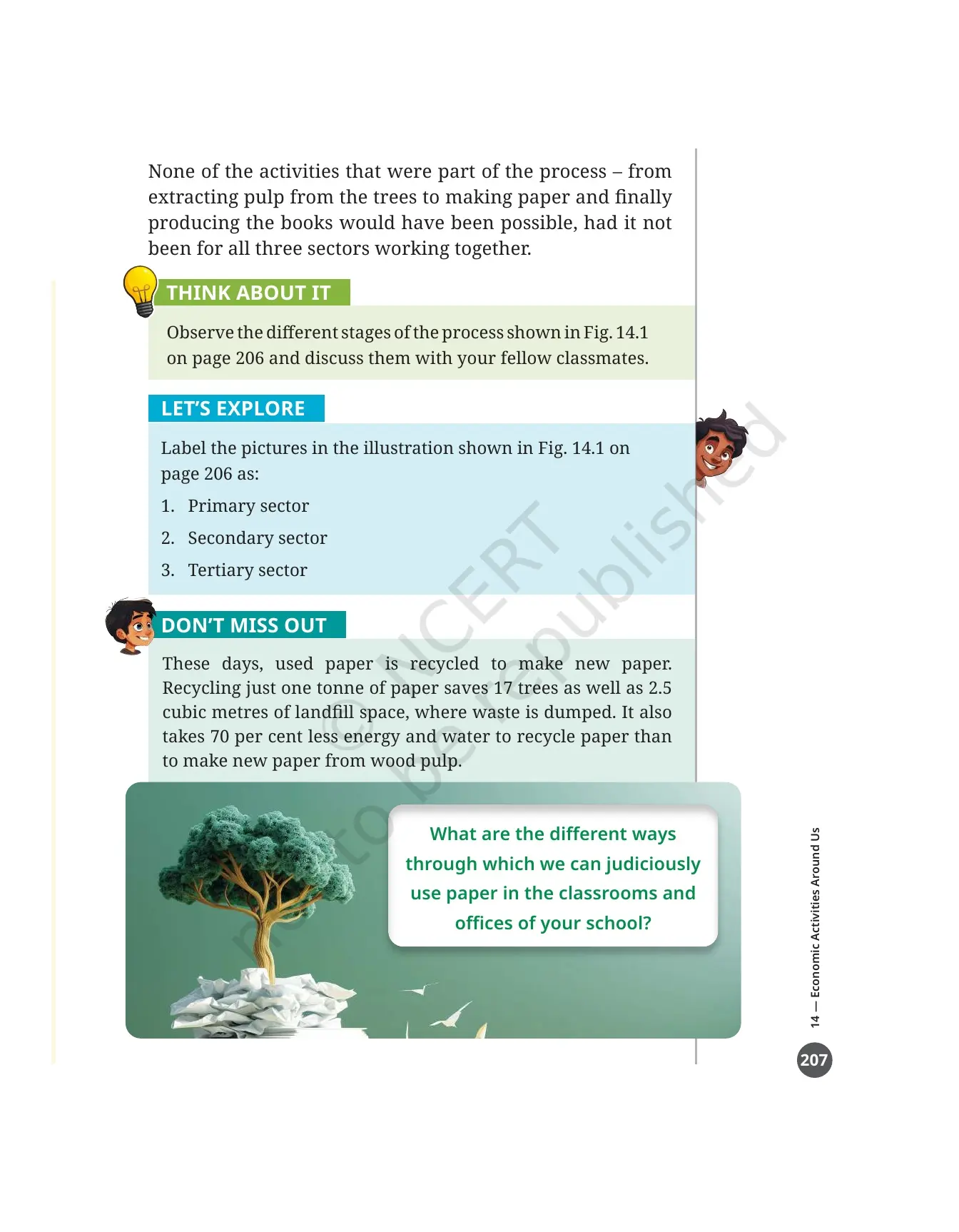
| Paper, recycling and the boxes | 207 | The line about all three sectors working together, the second THINK ABOUT IT box, the second LET'S EXPLORE box and the DON'T MISS OUT box on paper recycling |
| Recap and questions | 208 | The third LET'S EXPLORE box, the 'Before we move on ...' recap and all 3 end questions |
Also Check:
- Economic Activities Around Us Class 6 NCERT Solutions
- Economic Activities Around Us Class 6 Revision Notes
The Kauṭilya Quotation and the Three Big Questions on Page 195
This chapter opens with a line from Kauṭilya's Arthaśhāstra, not with a definition. Three Big Questions are printed beside it. All three are answered inside the file, so learning them first gives you a map of the whole chapter.
- What the quotation says: the root of prosperity is economic activity, and the lack of it brings material distress. The absence of fruitful economic activity endangers both current prosperity and future growth.
- Big Question 1: how are economic activities classified? Answered by the primary, secondary and tertiary pages, 196 to 201.
- Big Question 2: what differentiates these activities to be grouped into sectors? Answered by the three sector definitions in the margins.
- Big Question 3: how are the three sectors interconnected? Answered by the AMUL story and by Fig. 14.1.
The Introduction below the quotation is short but it is examinable. It reminds you that Chapter 13 taught economic and non-economic activities, and it repeats the one-line test: activities that create monetary value are called economic activities.
Why the Chapter Says the Number of Economic Activities Has Grown
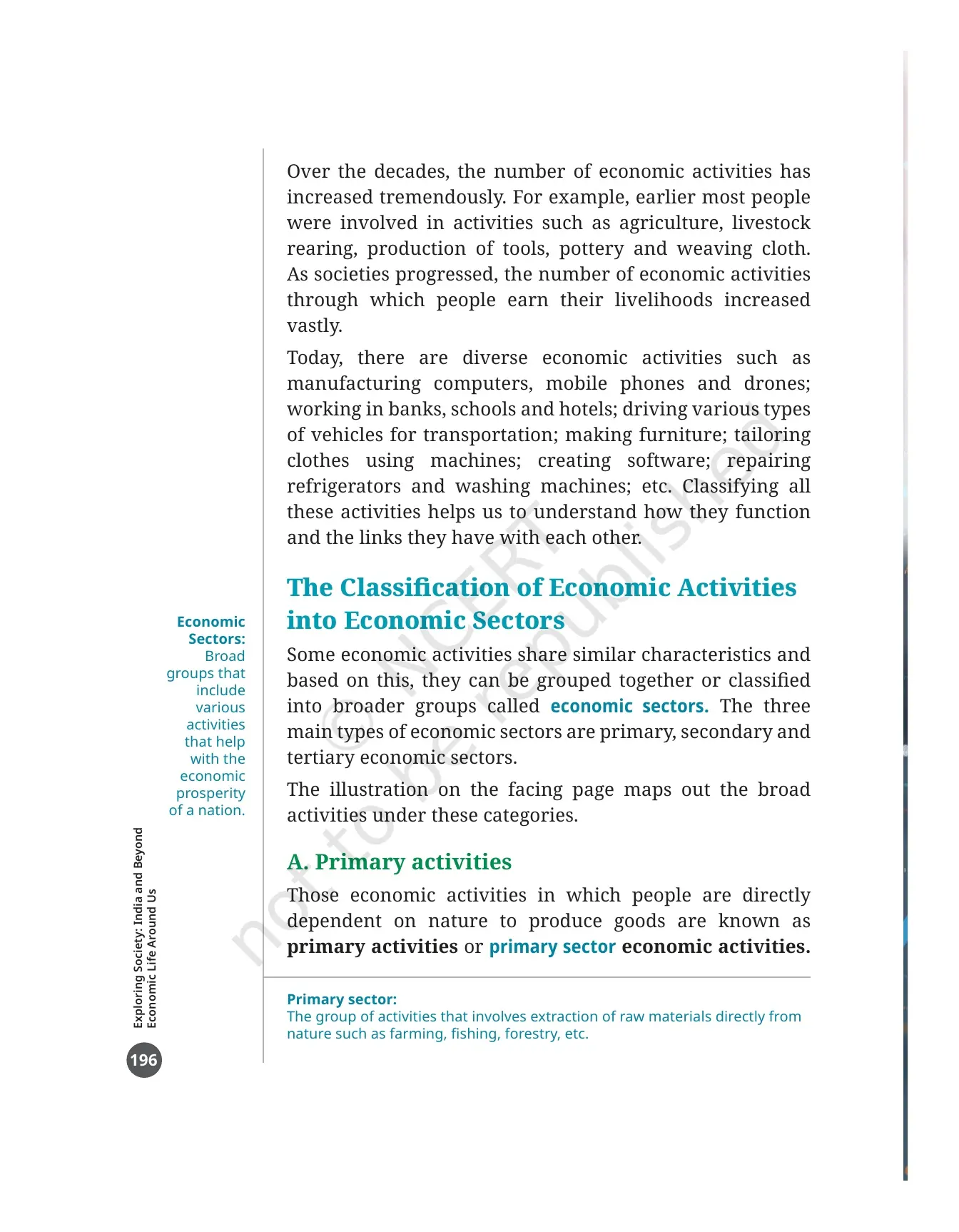
Printed page 196 opens with a before and after comparison. It is an easy two-mark question because the book gives you both lists in full. Learn one example from each side and you can answer it in three lines.
| Earlier, most people were involved in | Today, people also work in |
|---|---|
| Agriculture | Manufacturing computers, mobile phones and drones |
| Livestock rearing | Working in banks, schools and hotels |
| Production of tools | Driving vehicles for transportation |
| Pottery | Making furniture and tailoring clothes using machines |
| Weaving cloth | Creating software, and repairing refrigerators and washing machines |
The book then gives the reason for the whole chapter in one sentence. Classifying all these activities helps us to understand how they function and the links they have with each other. That sentence is the safest opening line for any long answer in this chapter.
Economic Activities Around Us Chapter Overview on Video
Source: Magnet Brains on YouTube
The Three Economic Sectors and the Definitions the Chapter Gives
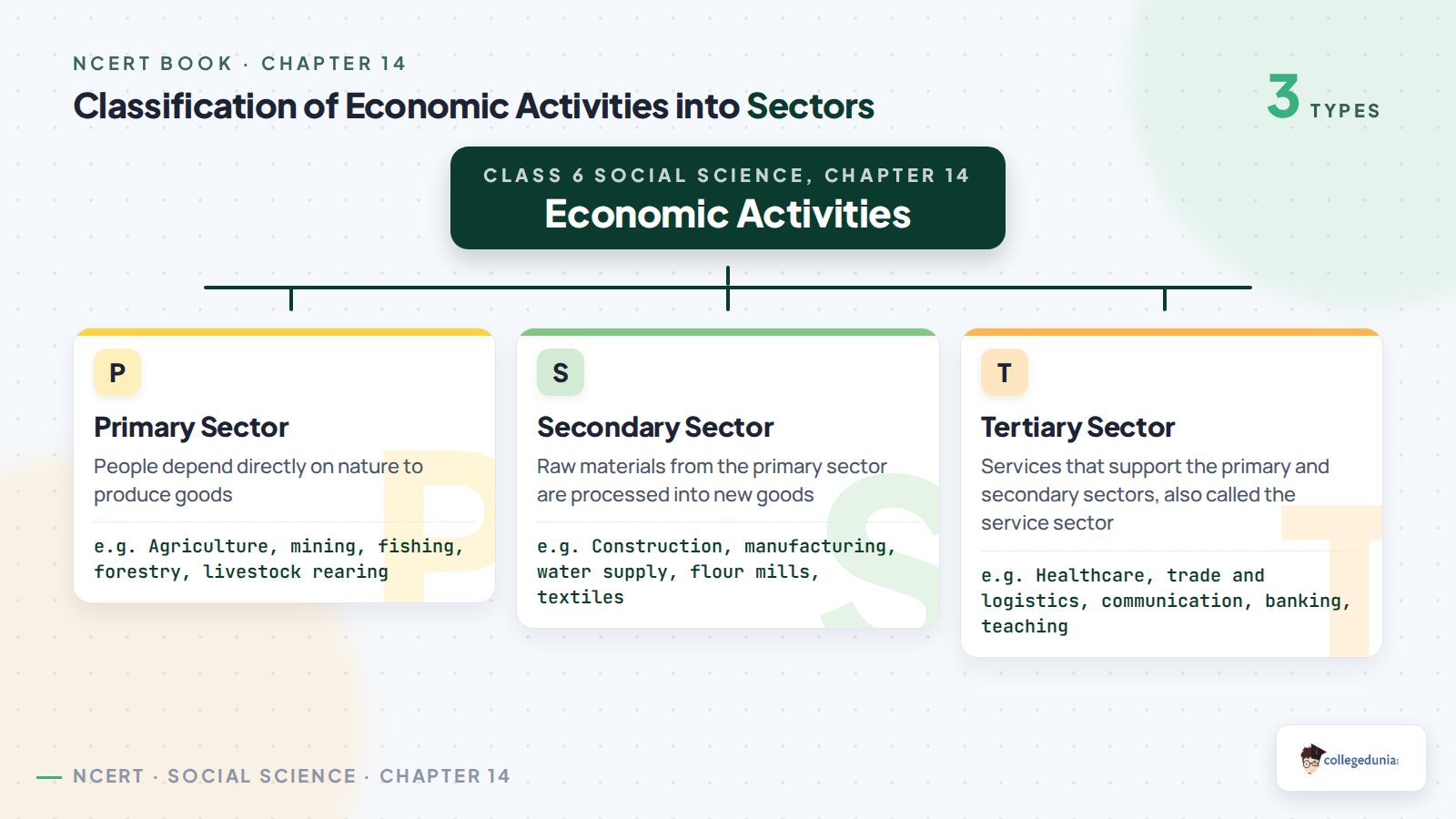
Some economic activities share similar characteristics, so the book groups them into economic sectors. There are three of them, and each one has a printed definition in the margin. Write the definition first and the example second, in that order.
- Primary sector, printed page 196. Those economic activities in which people are directly dependent on nature to produce goods. The margin adds that it involves the extraction of raw materials directly from nature, such as farming, fishing and forestry.
- Secondary sector, printed page 199. Activities in which people depend on the outputs of the primary sector and transform them to produce goods. The margin calls it the processing of raw materials from the primary sector into products for sale or consumption.
- Tertiary sector, printed page 201. All those economic activities that provide support to people involved in primary and secondary activities. The margin adds that these services complement both other sectors, such as transportation, banking and management of business.
One line from page 201 is worth memorising on its own. The tertiary sector is also called the service sector. The book prints that sentence, and a one-mark question can ask for nothing else.
The Page 197 Illustration: Fifteen Activities Sorted into Three Columns
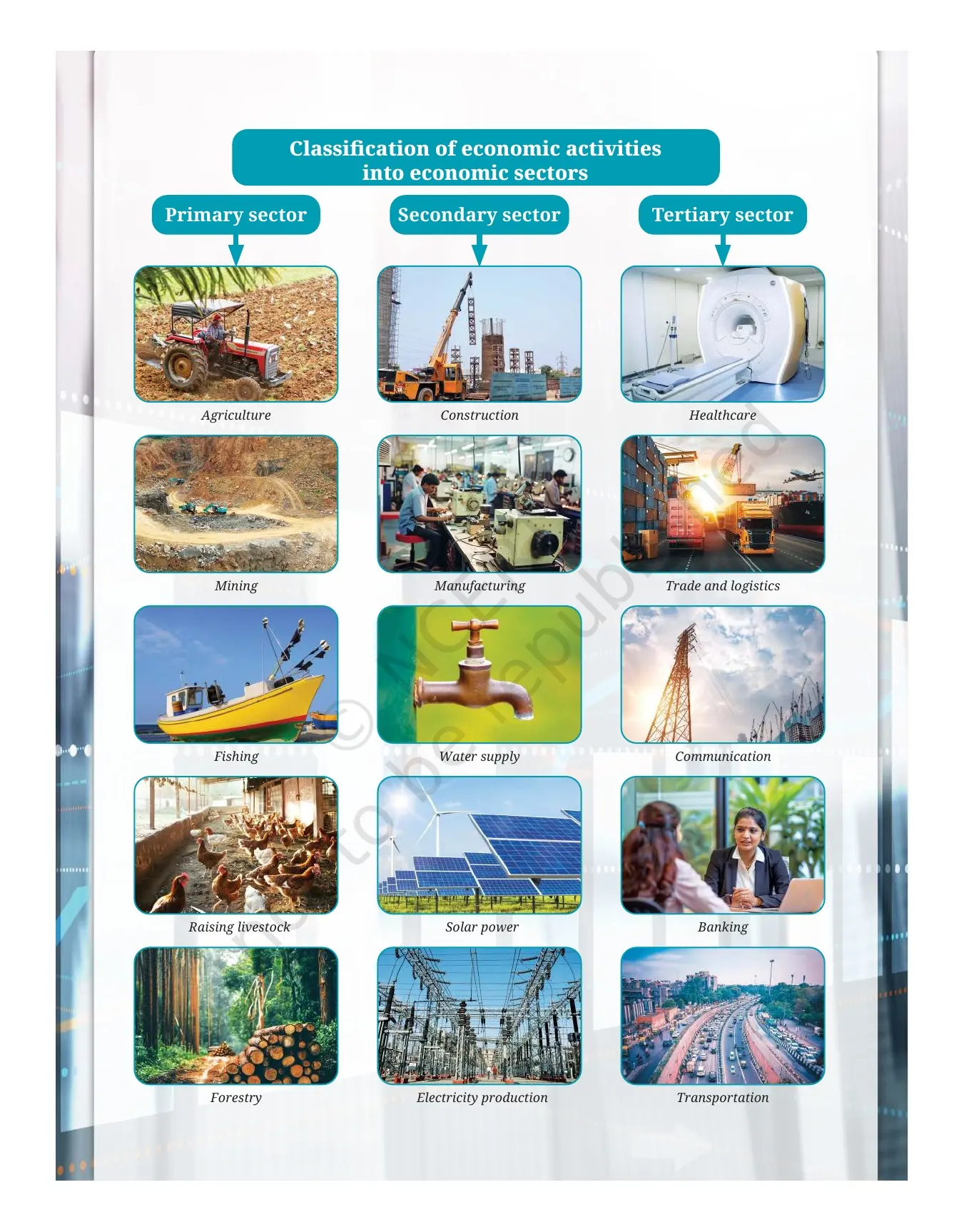
Printed page 197 is a full-page illustration titled Classification of economic activities into economic sectors. It has three columns with five labelled pictures each. This single page answers more questions than any other page in the chapter, so copy it into your notebook exactly as it is.
| Primary sector | Secondary sector | Tertiary sector |
|---|---|---|
| Agriculture | Construction | Healthcare |
| Mining | Manufacturing | Trade and logistics |
| Fishing | Water supply | Communication |
| Raising livestock | Solar power | Banking |
| Forestry | Electricity production | Transportation |
The two rows that trip students up are water supply and solar power. Both are placed in the secondary sector by the book, because the chapter counts utilities like water, electricity and gas as secondary activities. Our student poll found this is the single most common wrong answer in the chapter.
Primary Sector Activities and the Five Photographs on Page 198
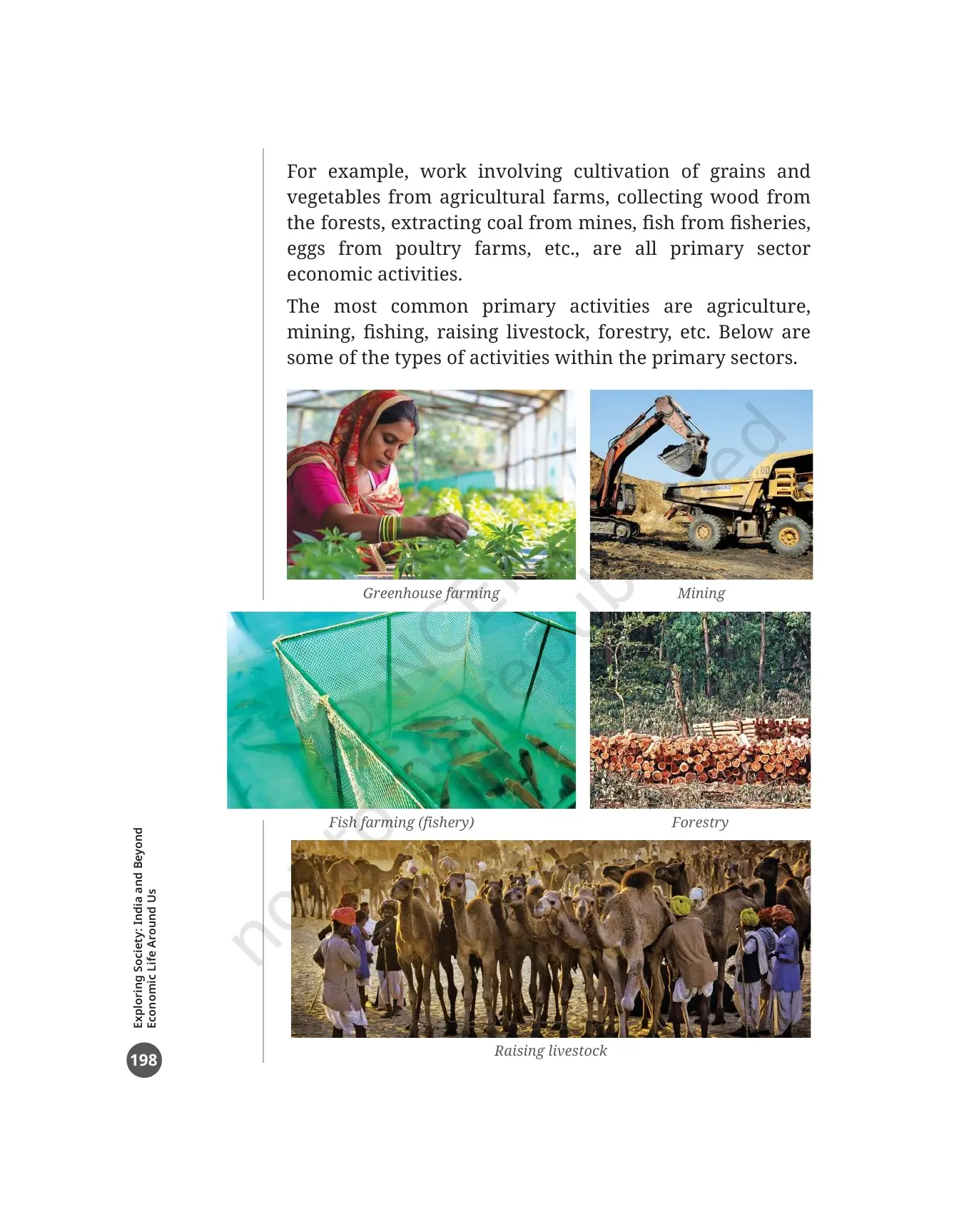
Printed page 198 lists the primary examples in prose and then repeats them as captioned photographs. Learn the prose list for a written answer and the captions for a picture question.
- Cultivation of grains and vegetables from agricultural farms.
- Collecting wood from the forests.
- Extracting coal from mines.
- Fish from fisheries and eggs from poultry farms.
The book then names the most common primary activities as agriculture, mining, fishing, raising livestock and forestry. The five captioned photographs on the same page are greenhouse farming, mining, fish farming or fishery, forestry, and raising livestock.
Notice that every primary example takes something straight out of nature. If your example involves a machine changing the shape of a material, it is not primary any more.
Secondary Sector Activities and the Factory Photographs on Pages 199 and 200
The secondary sector is the one students describe too narrowly. The chapter puts three different kinds of work inside it, and a full-mark answer names all three before giving examples.
- Construction of buildings, roads and similar structures.
- Utilities, which the book lists as water, electricity, gas and other such necessities.
- Manufacturing of products in factories and production units.
The examples printed on page 199 all follow the same shape: a raw material goes in and a new product comes out. Keep them as pairs and they are easy to recall.
| Raw material from the primary sector | What the secondary sector makes from it |
|---|---|
| Grains from agricultural fields | Flour, processed in mills |
| Groundnut | Oil, by extraction |
| Tea leaves | Tea, after processing |
| Wood from the forest | Furniture and paper |
| Cotton | Clothes |
| Iron ore | Steel, and then automobiles like cars and trucks |
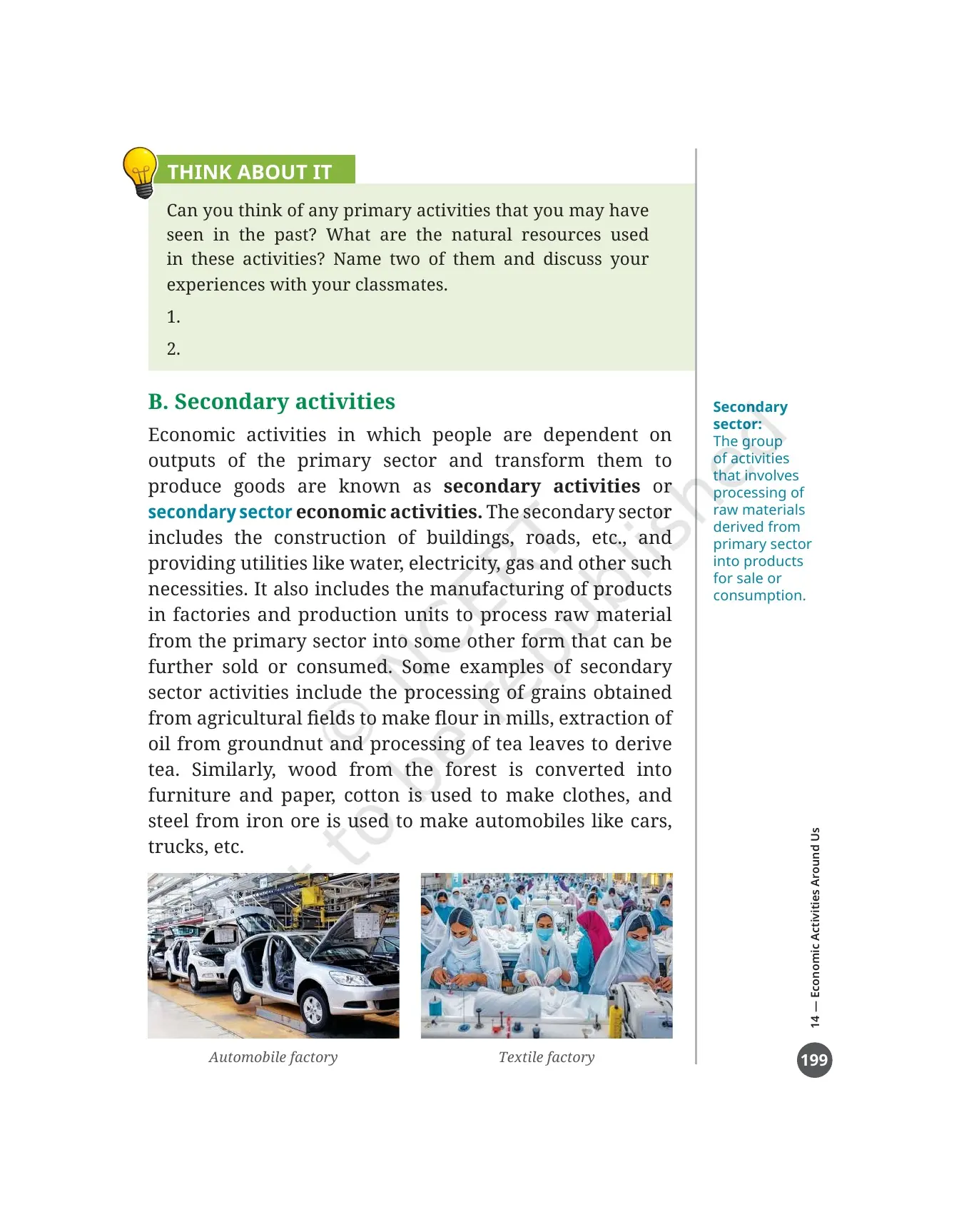
Four captioned photographs sit beside this text across pages 199 and 200: an automobile factory, a textile factory, a pharmaceutical factory and a furniture production unit. Naming one of them in your answer shows you read the page and not just the definition.
Tertiary Sector Activities and Why the Chapter Calls It the Service Sector
Printed page 201 defines tertiary activities as support for the other two sectors. The book adds a warning line that students should quote: these include services that we may not be able to see but which still play a very important role.
The examples come in three groups. Splitting them this way makes a five-mark answer easy to plan.
- Moving and selling goods: the truck driver who takes grains and vegetables from the farm to a factory or the market, and the fruit or vegetable vendors who sell farm produce to household consumers.
- Professional services: doctors, nurses, teachers, lawyers and pilots.
- Repair and supply: technicians who service mobile phones and televisions, mechanics who repair cars and tractors, and electricians who keep the electricity supply regular.
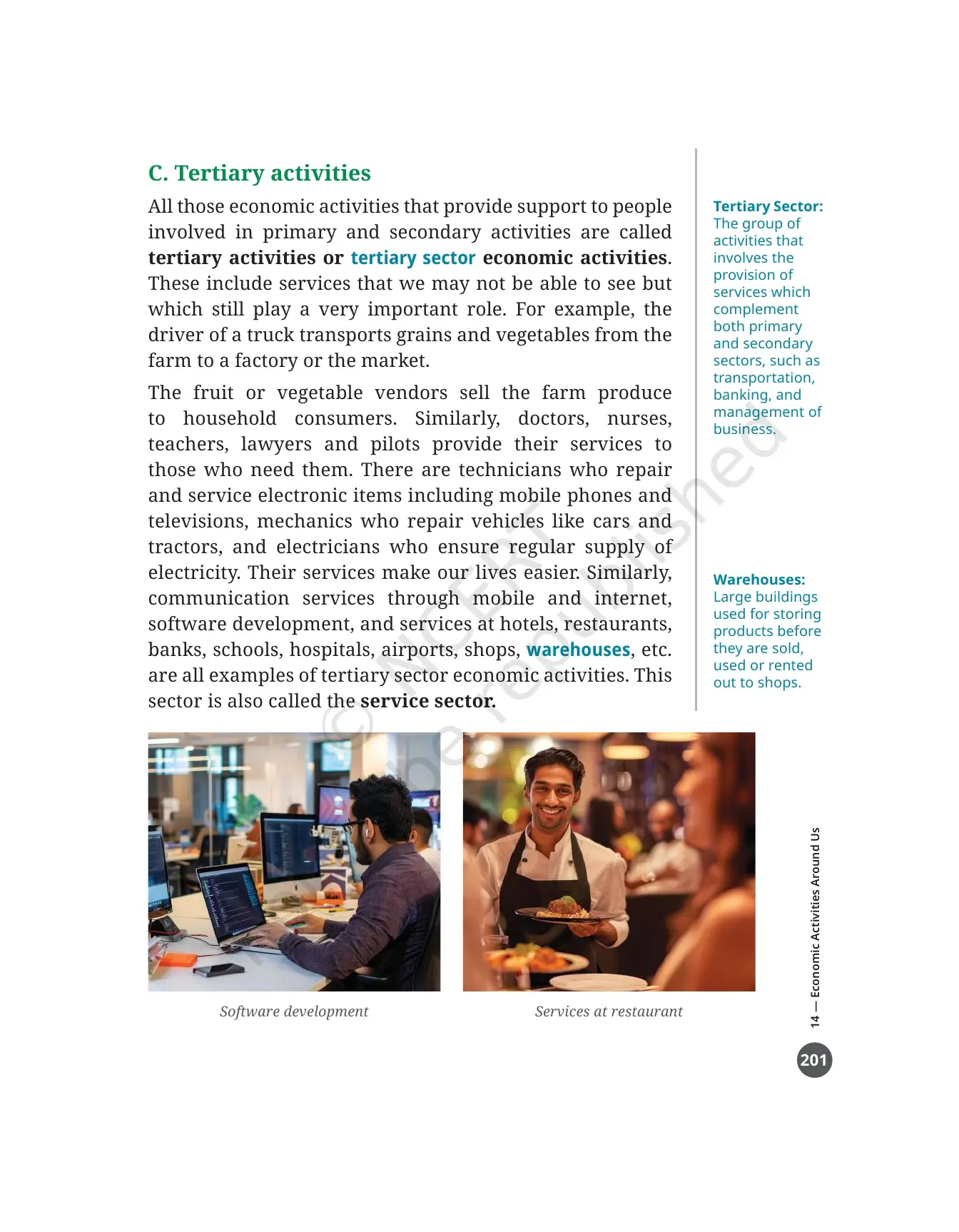
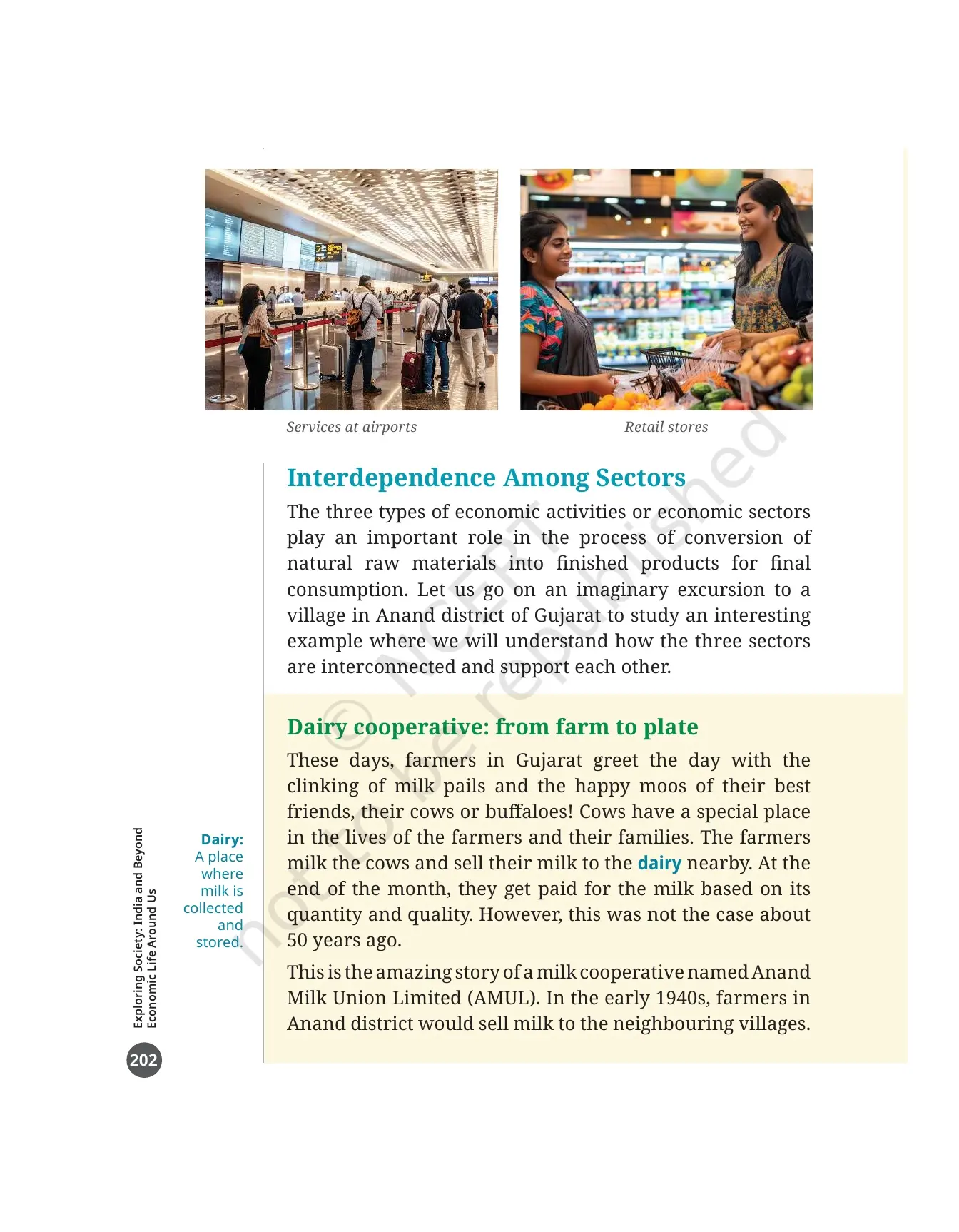
The page closes with a long list that is worth learning as a block: communication through mobile and internet, software development, and services at hotels, restaurants, banks, schools, hospitals, airports, shops and warehouses. Four photographs illustrate it: software development, services at a restaurant, services at airports and retail stores.
Every Glossary Term in the Economic Activities Around Us Chapter
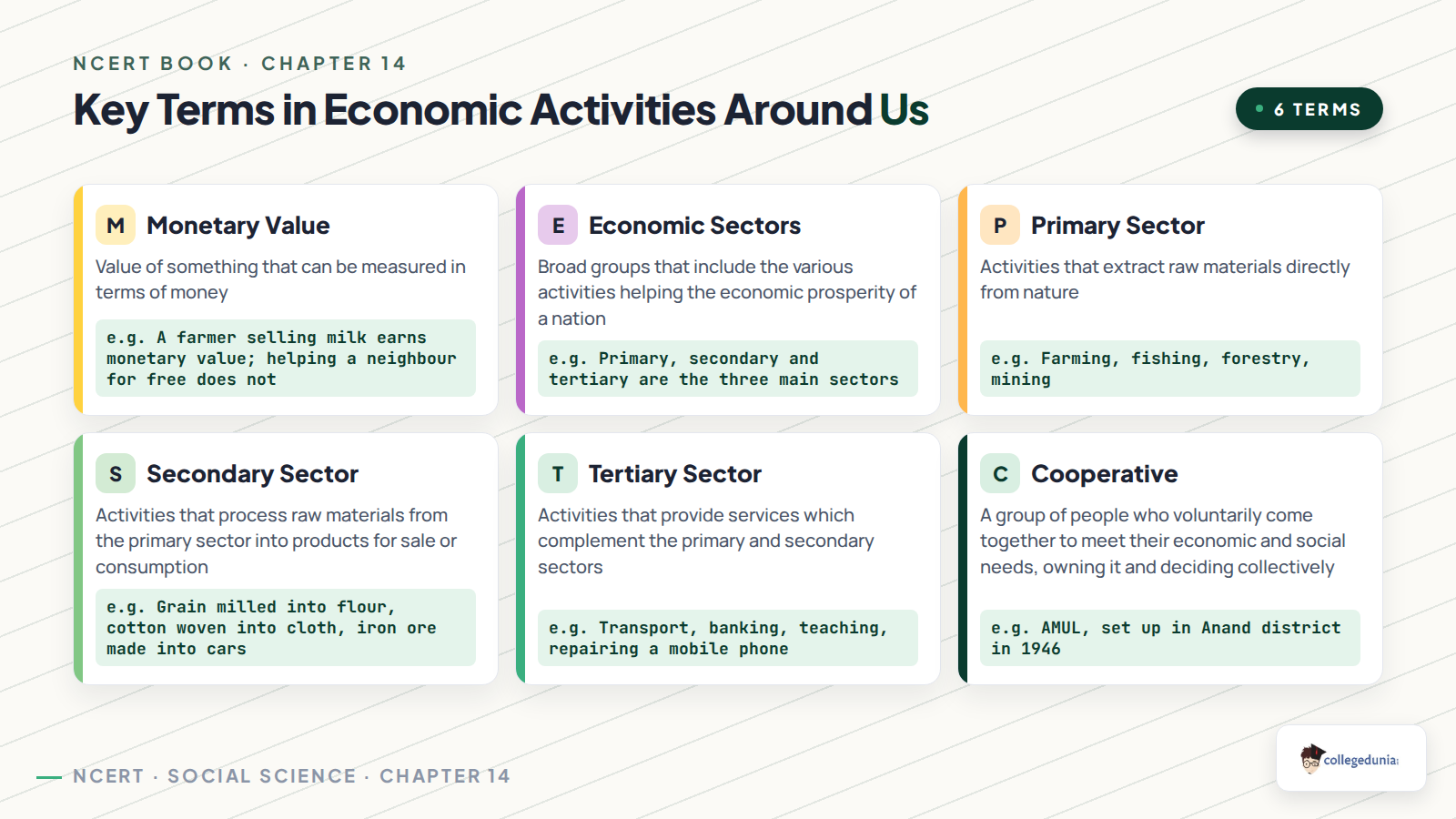
Thirteen terms are defined in the margins of this chapter, which is more than any other chapter in the Economic Life Around Us theme. They carry most of the one-mark questions. Learn them in page order, because the last seven all belong to the AMUL story.
| Term | Printed page | What the chapter says it means |
|---|---|---|
| Monetary value | 195 | Value of something that can be measured in terms of money |
| Economic sectors | 196 | Broad groups that include various activities that help with the economic prosperity of a nation |
| Primary sector | 196 | The group of activities that involves extraction of raw materials directly from nature, such as farming, fishing and forestry |
| Secondary sector | 199 | The group of activities that involves processing of raw materials derived from the primary sector into products for sale or consumption |
| Tertiary sector | 201 | The group of activities that involves the provision of services which complement both primary and secondary sectors, such as transportation, banking and management of business |
| Warehouses | 201 | Large buildings used for storing products before they are sold, used or rented out to shops |
| Dairy | 202 | A place where milk is collected and stored |
| Cooperative | 203 | A group of people who voluntarily come together to meet their economic and social needs in a formal way. They own the cooperative and decisions are taken by the members collectively |
| Middlemen | 203 | Persons who buy goods from producers and sell them to consumers. The middlemen charge a fee for this service |
| Pasteurisation | 204 | A process by which milk is preserved through heating to a specific temperature to kill harmful bacteria |
| Factory | 204 | Building or group of buildings where goods are manufactured, or various components are put together, to make a final product |
| Retail | 204 | The sale of goods in small quantities for use by the end consumer rather than for resale |
| Export | 204 | Goods and services that are produced in one country and sold to buyers or consumers in another country |
The AMUL Story: From Middlemen to a Dairy Cooperative in Anand
Printed pages 202 to 205 take you on an imaginary excursion to a village in Anand district of Gujarat. The story is the chapter's answer to Big Question 3, and it is the part most students get asked to retell. It runs in six steps.
- The problem, early 1940s. Farmers in Anand district sold milk to neighbouring villages. They had to cycle or walk under scorching heat, and milk spoils or curdles very fast in hot weather.
- The middlemen. Farmers depended on middlemen who bought milk in bulk at meagre prices and sold it in the market. Many times the farmers felt cheated and harassed.
- The advice. The farmers collectively approached Sardar Vallabhbhai Patel, a prominent national leader. He advised them to form a cooperative, become independent and stop relying on middlemen.
- The founding, 1946. AMUL, or Anand Milk Union Limited, was set up under the leadership of Tribhuvandas Patel, a lawyer and freedom fighter, and Dr. Varghese Kurien, an engineer who was working at a dairy factory in Mumbai.
- The change. The initiative brought farmers, including women, together. Milk producers made their own decisions on production, pasteurisation and sale. Tasks were shared, income rose gradually, and they became like one big family.
- The growth. So much milk was collected that the farmers set up a factory in Anand and began to produce butter and milk powder. Today the cooperative runs many milk processing plants and factories all over India, and it also exports products to several countries.
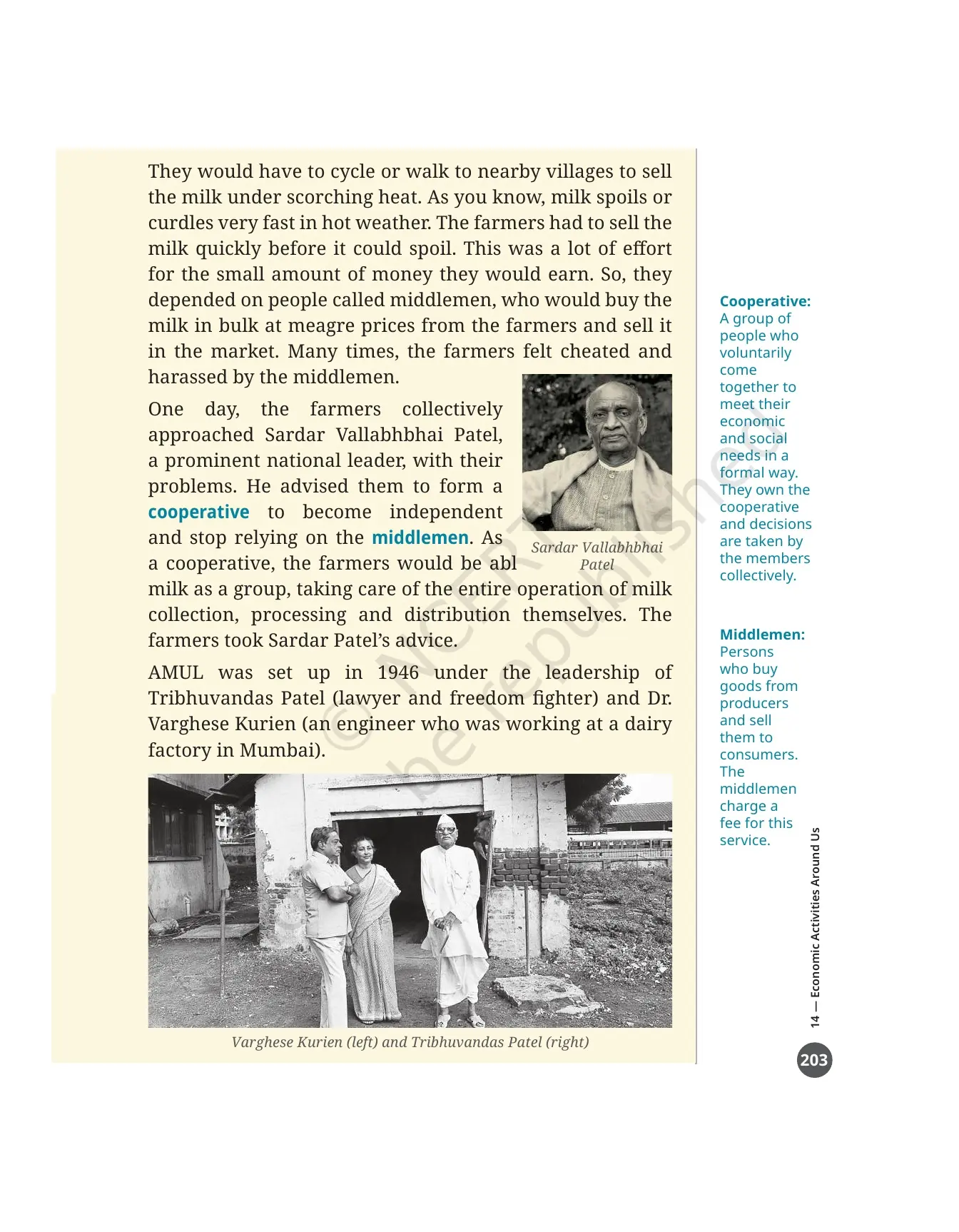
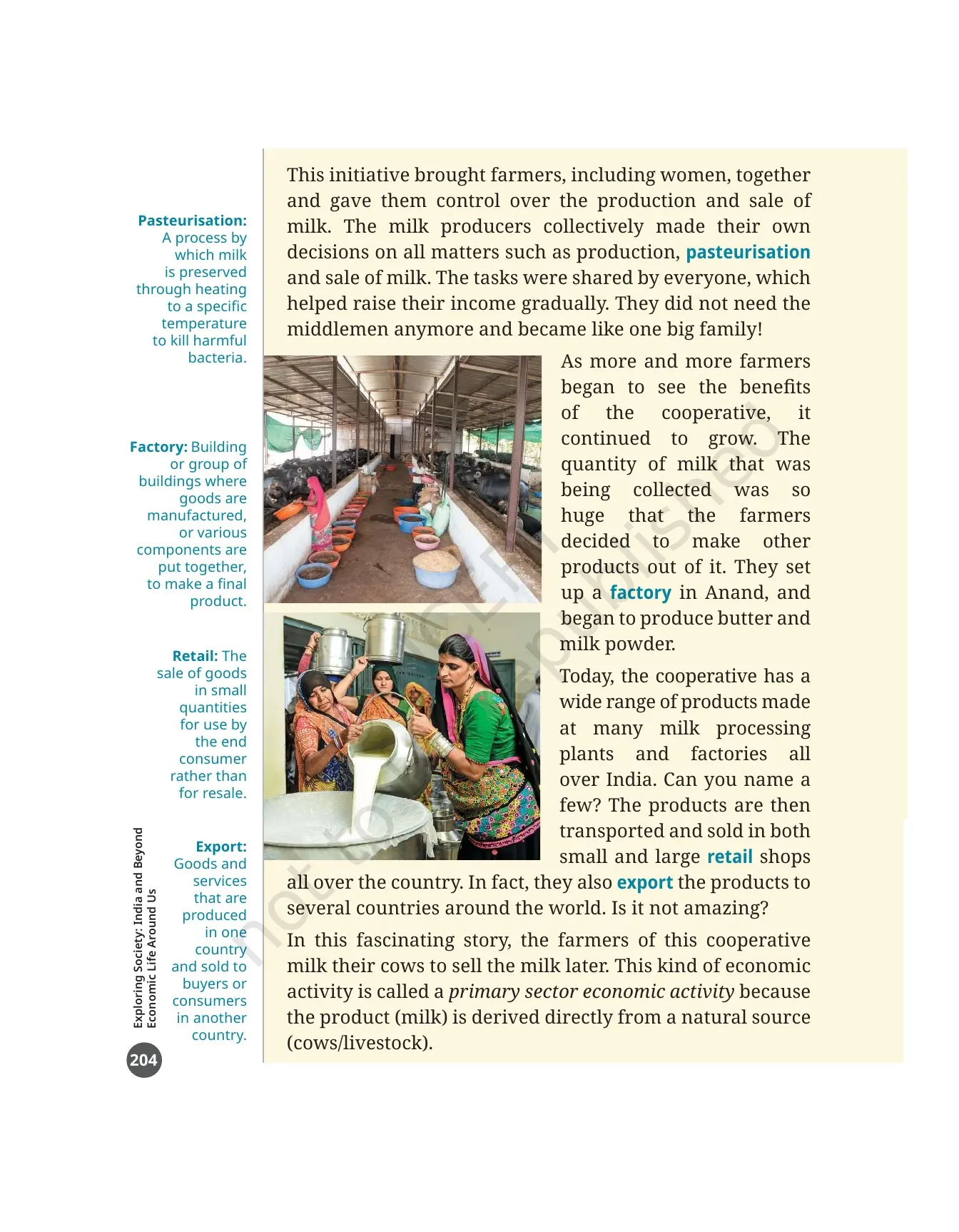
Three names carry marks in this story, so keep them straight. Sardar Vallabhbhai Patel gave the advice. Tribhuvandas Patel and Dr. Varghese Kurien led the founding. A photograph on page 203 is captioned Varghese Kurien on the left and Tribhuvandas Patel on the right.
How the Three Sectors Work Together Inside the AMUL Example
Printed pages 204 and 205 label each stage of the AMUL story with its sector. This is the flow diagram that end question 3 asks you to draw, so learn it as three boxes joined by two arrows.
| Stage in the AMUL story | Sector | Why the book puts it there |
|---|---|---|
| Farmers milk their cows and sell the milk | Primary | The product, milk, is derived directly from a natural source, the cows or livestock |
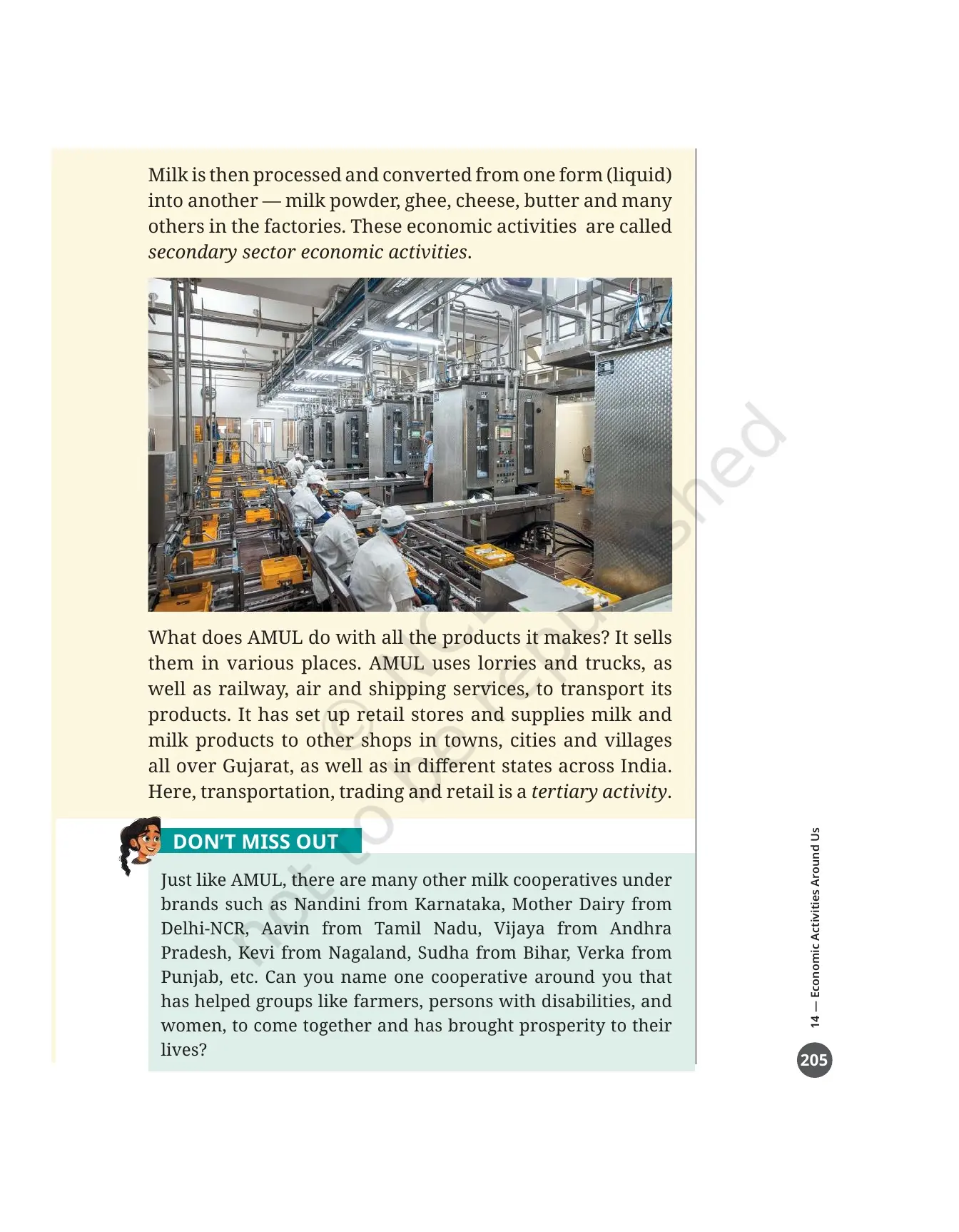
| Milk is processed and converted from liquid into milk powder, ghee, cheese and butter in the factories | Secondary | A raw material from the primary sector is changed into another form |
| AMUL uses lorries and trucks, railway, air and shipping services, sets up retail stores and supplies shops in towns, cities and villages | Tertiary | Transportation, trading and retail are services that support the other two sectors |
If a question asks for one clean example of interdependence, this is the one to use. Name the state, Gujarat, name the district, Anand, and then run the three stages in order. That answer is complete without any outside information.
Fig. 14.1: How Pulp Becomes Paper and Then Your Textbook
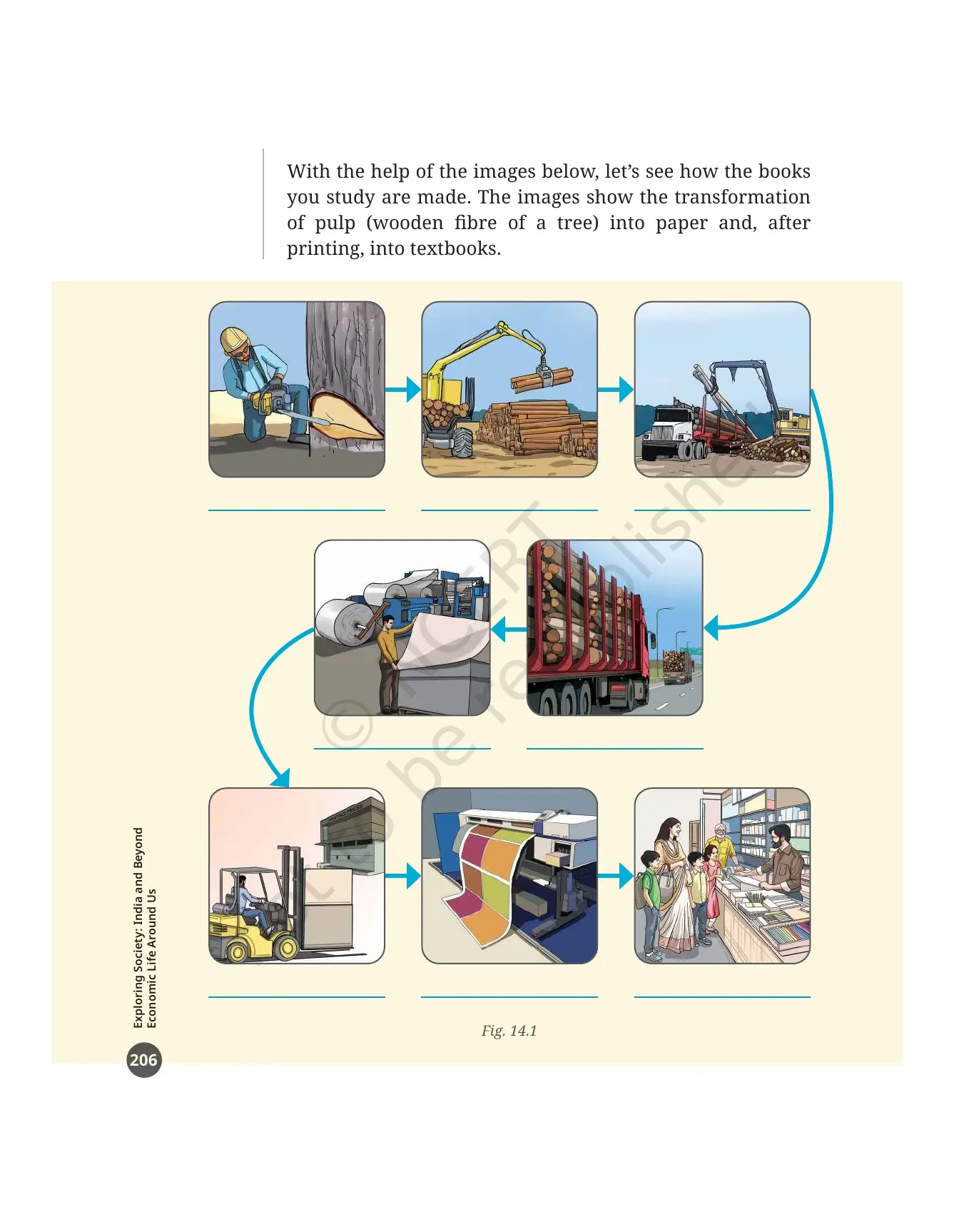
Printed page 206 carries the only numbered figure in the chapter, Fig. 14.1. It shows the transformation of pulp, which the book explains as the wooden fibre of a tree, into paper and, after printing, into textbooks. Two boxes on page 207 send you back to this figure, so do not skim it.
- Primary stage: trees are cut and pulp, the wooden fibre, is extracted from them.
- Secondary stage: the pulp is processed into paper, and the paper is printed and bound into books.
- Tertiary stage: the finished textbooks are transported and sold so they reach your classroom.
The book closes the section with the sentence the examiner wants. None of the activities in the process would have been possible, had it not been for all three sectors working together.
The Three DON'T MISS OUT Boxes: Automobiles, Milk Brands and Paper Recycling
Three DON'T MISS OUT boxes sit outside the main text. They are the easiest source of data-based questions in the chapter because every number in them is printed.
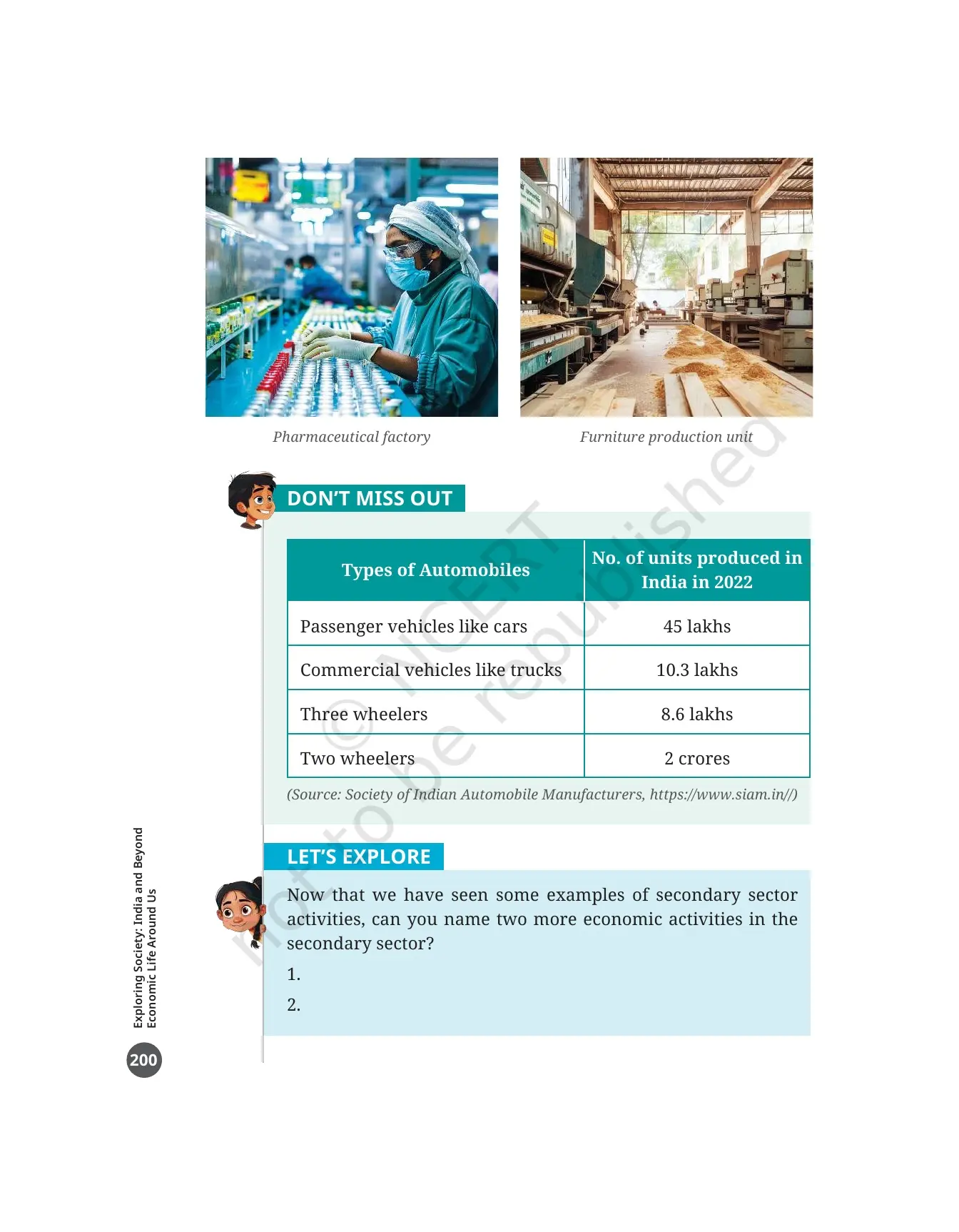
Box 1, printed page 200. A table of automobiles produced in India, sourced by the book from the Society of Indian Automobile Manufacturers.
| Types of automobiles | Number of units produced in India in 2022 |
|---|---|
| Passenger vehicles like cars | 45 lakhs |
| Commercial vehicles like trucks | 10.3 lakhs |
| Three wheelers | 8.6 lakhs |
| Two wheelers | 2 crores |
Box 2, printed page 205. Other milk cooperatives, each tied to a state. The box then asks you to name a cooperative near you that has helped farmers, persons with disabilities or women.
| Cooperative brand | State or region |
|---|---|
| Nandini | Karnataka |
| Mother Dairy | Delhi-NCR |
| Aavin | Tamil Nadu |
| Vijaya | Andhra Pradesh |
| Kevi | Nagaland |
| Sudha | Bihar |
| Verka | Punjab |
Box 3, printed page 207. Paper recycling, with three figures worth learning together. Recycling just one tonne of paper saves 17 trees and 2.5 cubic metres of landfill space, where waste is dumped. It also takes 70 per cent less energy and water to recycle paper than to make new paper from wood pulp.
The LET'S EXPLORE and THINK ABOUT IT Boxes and How to Answer Them
This chapter asks you to observe and list rather than to write essays. Five activity boxes are spread across it, and each one has a short, safe answer you can prepare in advance.
- THINK ABOUT IT 1, printed page 199. Name two primary activities you have seen and the natural resources used in them. Safe pair: farming, which uses soil and water, and fishing, which uses a river, a pond or the sea.
- LET'S EXPLORE 1, printed page 200. Name two more secondary sector activities. Safe pair: making cement from limestone, and making sugar from sugarcane. Both follow the raw material to product shape the chapter uses.
- THINK ABOUT IT 2, printed page 207. Observe the stages shown in Fig. 14.1 on page 206 and discuss them with your classmates. Walk through pulp, paper, printing and delivery in that order.
- LET'S EXPLORE 2, printed page 207. Label the pictures in Fig. 14.1 as primary, secondary or tertiary. Cutting trees and taking pulp is primary, paper making and printing is secondary, and transport and sale is tertiary.
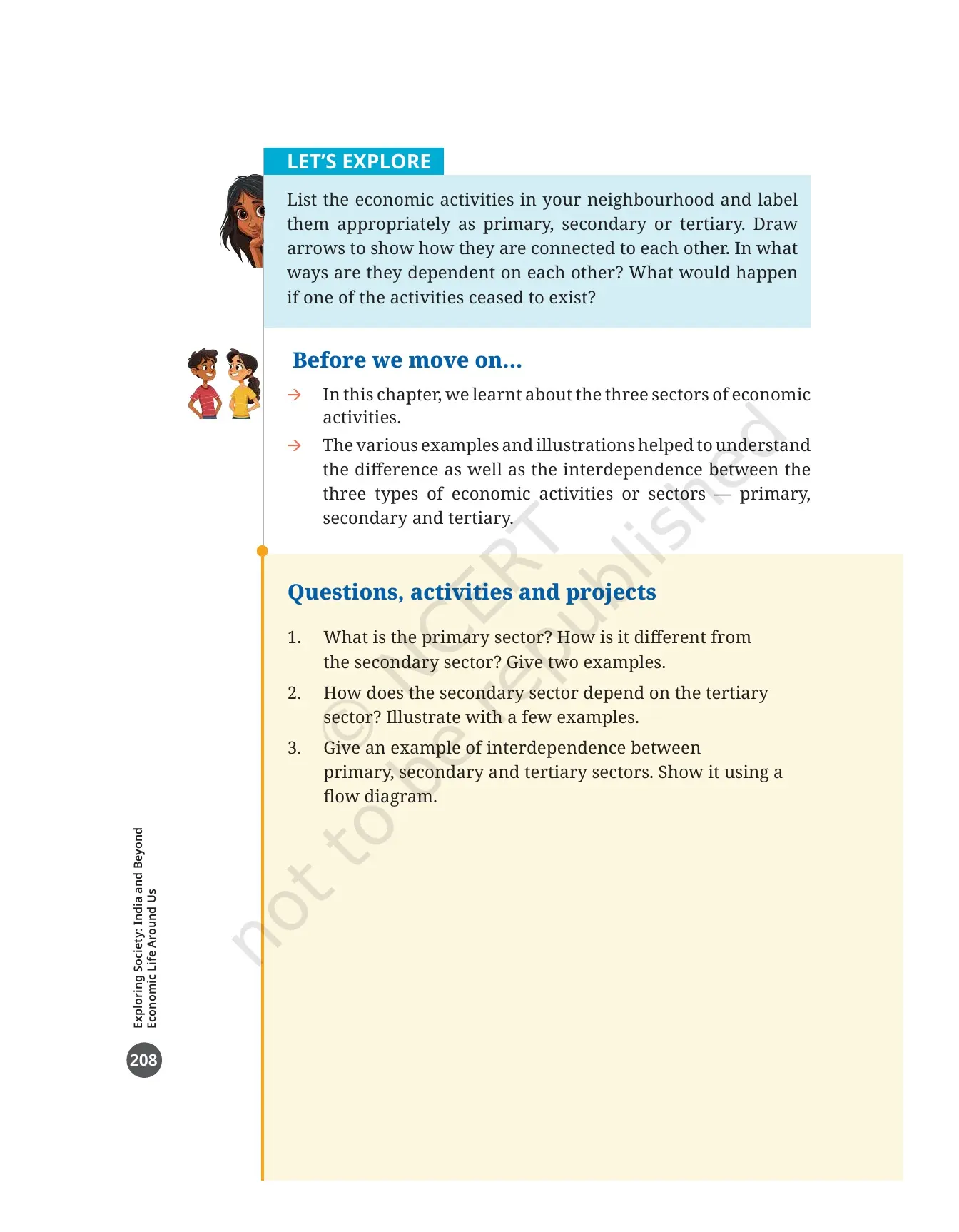
- LET'S EXPLORE 3, printed page 208. List the economic activities in your neighbourhood, label them, and draw arrows to show how they are connected. Then answer what would happen if one of them stopped.
A speech bubble on page 207 adds one more question: what are the different ways in which we can judiciously use paper in the classrooms and offices of your school? Use both sides of a sheet, reuse rough sheets, and send notices on the school group instead of printing them.
Every Box, Photograph and Special Feature Inside the Economic Activities Around Us PDF
The chapter has one numbered figure and about twenty captioned photographs. The checklist below is the fastest way to make sure you have not skipped a page.
| Box, feature or special page | Printed page | What it shows or asks |
|---|---|---|
| The opening quotation | 195 | Kauṭilya's Arthaśhāstra on prosperity and economic activity |
| The Big Questions | 195 | Three questions on classification, on what separates the sectors, and on how they connect |
| Monetary value glossary | 195 | Value of something that can be measured in terms of money |
| Economic sectors and primary sector glossary | 196 | Two margin definitions printed beside the classification section head |
| The classification illustration | 197 | A full page of fifteen labelled activities in three sector columns |
| Primary sector photographs | 198 | Greenhouse farming, mining, fish farming, forestry and raising livestock |
| THINK ABOUT IT 1 | 199 | Primary activities you have seen and the natural resources they use |
| Secondary sector glossary and factory photographs | 199 | The margin definition, plus an automobile factory and a textile factory |
| DON'T MISS OUT 1 | 200 | The table of automobiles produced in India, with the Society of Indian Automobile Manufacturers as the source |
| LET'S EXPLORE 1 | 200 | Name two more economic activities in the secondary sector |
| Tertiary sector and warehouses glossary | 201 | Two margin definitions beside the service sector paragraphs |
| Tertiary sector photographs | 201 to 202 | Software development, services at a restaurant, services at airports and retail stores |
| Dairy glossary and the AMUL story opening | 202 | The excursion to Anand district and the farmers selling milk to the dairy |
| Cooperative and middlemen glossary | 203 | Two margin definitions beside the Sardar Vallabhbhai Patel paragraph |
| Founder photographs | 203 | Sardar Vallabhbhai Patel, and Varghese Kurien with Tribhuvandas Patel |
| Pasteurisation, factory, retail and export glossary | 204 | Four margin definitions printed around the growth of the cooperative |
| DON'T MISS OUT 2 | 205 | Seven other milk cooperative brands and the state each one belongs to |
| Fig. 14.1 | 206 | The only numbered figure: pulp to paper to printed textbooks |
| THINK ABOUT IT 2 and LET'S EXPLORE 2 | 207 | Observe the stages of Fig. 14.1, then label each picture by sector |
| DON'T MISS OUT 3 | 207 | Paper recycling: 17 trees, 2.5 cubic metres of landfill and 70 per cent less energy and water |
| LET'S EXPLORE 3 | 208 | List and label the economic activities in your neighbourhood and link them with arrows |
| Before we move on ... | 208 | A two-point recap of the whole chapter |
Questions, Activities and Projects at the End of the Economic Activities Around Us Chapter
Printed page 208 carries 3 numbered items. There is no true or false set and no multiple-choice set in this chapter. All three are written answers, and two of them ask for examples, so keep the AMUL story and the paper story ready.
- What is the primary sector? How is it different from the secondary sector? Give two examples. Give both margin definitions, contrast them on nature against processing, then use farming and fishing for primary, and flour milling and furniture making for secondary.
- How does the secondary sector depend on the tertiary sector? Illustrate with a few examples. Factories need trucks to bring raw material in and take products out, banks to handle payments, and shops to sell the finished goods. The AMUL factory is the ready-made example.
- Give an example of interdependence between primary, secondary and tertiary sectors. Show it using a flow diagram. Draw three boxes. Milking cows in Anand goes to the factory that makes butter and milk powder, which goes to trucks and retail stores.
Before the questions, the 'Before we move on ...' box on printed page 208 gives a two-point recap that works as a ready-made summary answer.
- The chapter taught the three sectors of economic activities.
- The examples and illustrations showed both the difference and the interdependence between the three types of economic activities: primary, secondary and tertiary.
Common Mistakes Students Make in the Economic Activities Around Us Chapter
- Putting construction in the tertiary sector. The book puts construction of buildings and roads in the secondary sector, along with water supply, electricity and gas.
- Calling a shop that sells vegetables a primary activity. Growing the vegetables is primary. Selling them to household consumers is tertiary.
- Mixing up the AMUL names. Sardar Vallabhbhai Patel advised the farmers. Tribhuvandas Patel and Dr. Varghese Kurien led the founding in 1946.
- Writing that AMUL started with butter and milk powder. It started with milk collection. The factory in Anand and those two products came later, once collection grew.
- Giving only half the tertiary definition. Add the second half: these services complement both primary and secondary sectors, and the sector is also called the service sector.
- Forgetting the paper recycling numbers. One tonne saves 17 trees and 2.5 cubic metres of landfill space, and uses 70 per cent less energy and water.
- Looking for more figure numbers. This chapter has only Fig. 14.1. Every other image is a captioned photograph, so describe it instead of naming it by number.
Related Links:
How to Read the Class 6 Economic Activities Around Us PDF in One Sitting
This is a 14-page chapter with one figure, thirteen glossary terms and only 3 end items. One focused sitting of about 35 minutes is enough. Keep a rough sheet beside you for the sector table and the AMUL flow.
- Minutes 0 to 5: read printed pages 195 and 196, then write the Kauṭilya quotation, the three Big Questions and the earlier against today comparison.
- Minutes 5 to 12: copy the page 197 illustration as a three-column table, then read page 198 and add the five primary photographs.
- Minutes 12 to 18: read pages 199 and 200 and write the three parts of the secondary sector with the raw material to product pairs.
- Minutes 18 to 23: read pages 201 and 202 and group the tertiary examples into moving and selling, professional services, and repair and supply.
- Minutes 23 to 30: read pages 202 to 205 and write the AMUL story in six steps, then label each stage with its sector.
- Minutes 30 to 35: read pages 206 to 208, label Fig. 14.1 by sector, and note the paper recycling numbers and the two recap points.
Come back the next day for the three end items. The question that makes the chapter stick is number 3, on interdependence, because it forces you to hold all three sector definitions at once. That second pass turns a chapter you have read into a chapter you can answer.
More Economic Activities Around Us Class 6 Resources
The book PDF gives you the printed chapter. These pages give you the answers, the revision layer and the last-day recap for the same chapter.
| Resource | What it gives you |
|---|---|
| Economic Activities Around Us Class 6 NCERT Solutions | Step-by-step answers to all 3 end items and every activity box, including the labelled Fig. 14.1 and the AMUL flow diagram |
| Economic Activities Around Us Class 6 Revision Notes | The three sector definitions, the thirteen glossary terms, the page 197 classification table and the AMUL story in one short read |
| Economic Activities Around Us Class 6 Handwritten Notes | A topper's handwritten pages with the primary, secondary and tertiary split and the AMUL flow drawn out in colour-coded boxes |
| Economic Activities Around Us Class 6 NCERT Book PDF | This page. The official 2026-27 chapter file, printed pages 195 to 208 of Exploring Society: India and Beyond |
NCERT Book PDF for Class 6 Social Science: All 14 Chapters
Exploring Society: India and Beyond runs to 14 chapters across five themes. Download the ones your school has taught, or take the full set in one go.
| Chapter | Resource |
|---|---|
| Chapter 1 | Locating Places on the Earth NCERT Book PDF |
| Chapter 2 | Oceans and Continents NCERT Book PDF |
| Chapter 3 | Landforms and Life NCERT Book PDF |
| Chapter 4 | Timeline and Sources of History NCERT Book PDF |
| Chapter 5 | India, That Is Bharat NCERT Book PDF |
| Chapter 6 | The Beginnings of Indian Civilisation NCERT Book PDF |
| Chapter 7 | India's Cultural Roots NCERT Book PDF |
| Chapter 8 | Unity in Diversity, or 'Many in the One' NCERT Book PDF |
| Chapter 9 | Family and Community NCERT Book PDF |
| Chapter 10 | Grassroots Democracy Part 1: Governance NCERT Book PDF |
| Chapter 11 | Grassroots Democracy Part 2: Local Government in Rural Areas NCERT Book PDF |
| Chapter 12 | Grassroots Democracy Part 3: Local Government in Urban Areas NCERT Book PDF |
| Chapter 13 | The Value of Work NCERT Book PDF |
| Chapter 14 | Economic Activities Around Us NCERT Book PDF (this page) |
Economic Activities Around Us Class 6 Social Science NCERT Book PDF FAQs
Common Questions on the Class 6 Social Science Chapter 14 File
Ques. Where can I download the NCERT Class 6 Social Science Chapter 14 Economic Activities Around Us PDF?
Ans. You can download it directly from this page. It is the official NCERT chapter file for the 2026-27 print of Exploring Society: India and Beyond, and it is free.
Ques. How many pages is the Economic Activities Around Us chapter PDF?
Ans. The file runs to 14 pages. It covers printed pages 195 to 208 of the textbook, from the Kauṭilya's Arthaśhāstra quotation to the three end questions.
Ques. What are the three economic sectors in Class 6 Social Science Chapter 14?
Ans. The three main types of economic sectors are primary, secondary and tertiary. The chapter defines each one in a margin box and then sorts fifteen activities into the three groups in the illustration on printed page 197.
Ques. What is the primary sector?
Ans. The primary sector is the group of activities that involves extraction of raw materials directly from nature, such as farming, fishing and forestry. The chapter says people in these activities are directly dependent on nature to produce goods, and it names agriculture, mining, fishing, raising livestock and forestry as the most common ones.
Ques. What is the secondary sector?
Ans. The secondary sector is the group of activities that involves processing of raw materials derived from the primary sector into products for sale or consumption. It covers construction of buildings and roads, utilities like water, electricity and gas, and manufacturing in factories and production units.
Ques. What is the tertiary sector, and why is it called the service sector?
Ans. The tertiary sector is the group of activities that provides services which complement both the primary and secondary sectors, such as transportation, banking and management of business. The chapter calls it the service sector because its work is service rather than goods, and it notes that these services may not be visible but still play a very important role.
Ques. Which sector does construction belong to?
Ans. Construction belongs to the secondary sector. The chapter lists construction of buildings and roads inside the secondary sector, along with utilities like water, electricity and gas, and the illustration on printed page 197 places construction in the secondary column.
Ques. What is the AMUL story in Class 6 Social Science Chapter 14?
Ans. AMUL, or Anand Milk Union Limited, is the milk cooperative the chapter uses to explain interdependence. In the early 1940s farmers in Anand district of Gujarat sold milk through middlemen at meagre prices. Sardar Vallabhbhai Patel advised them to form a cooperative, and AMUL was set up in 1946.
Ques. Who founded AMUL according to the chapter?
Ans. AMUL was set up in 1946 under the leadership of Tribhuvandas Patel, a lawyer and freedom fighter, and Dr. Varghese Kurien, an engineer who was working at a dairy factory in Mumbai. Sardar Vallabhbhai Patel is the leader who advised the farmers to form the cooperative.
Ques. What is a cooperative?
Ans. A cooperative is a group of people who voluntarily come together to meet their economic and social needs in a formal way. They own the cooperative and decisions are taken by the members collectively.
Ques. Who are middlemen in the AMUL story?
Ans. Middlemen are persons who buy goods from producers and sell them to consumers, and they charge a fee for this service. In the chapter they bought milk in bulk from Anand farmers at meagre prices, and the farmers often felt cheated and harassed by them.
Ques. How does the AMUL example show all three sectors?
Ans. Milking the cows and selling the milk is a primary activity because the milk comes directly from a natural source. Turning the milk into powder, ghee, cheese and butter in factories is secondary. Moving the products by lorries, trucks, railway, air and shipping, and selling them in retail stores, is tertiary.
Ques. What does Fig. 14.1 show in Chapter 14?
Ans. Fig. 14.1 on printed page 206 shows the transformation of pulp, the wooden fibre of a tree, into paper and then, after printing, into textbooks. Two boxes on the next page ask you to observe the stages and label each picture as primary, secondary or tertiary.
Ques. How many numbered figures are there in Class 6 Social Science Chapter 14?
Ans. Only one. Fig. 14.1 on printed page 206 is the single numbered figure. Everything else in the chapter is a captioned photograph or an unnumbered illustration, so a question can ask you to describe those but not to name them by number.
Ques. Which other milk cooperatives does the chapter name?
Ans. The DON'T MISS OUT box on printed page 205 names Nandini from Karnataka, Mother Dairy from Delhi-NCR, Aavin from Tamil Nadu, Vijaya from Andhra Pradesh, Kevi from Nagaland, Sudha from Bihar and Verka from Punjab.
Ques. What does the chapter say about recycling paper?
Ans. Recycling just one tonne of paper saves 17 trees as well as 2.5 cubic metres of landfill space, where waste is dumped. It also takes 70 per cent less energy and water to recycle paper than to make new paper from wood pulp.
Ques. Who is quoted at the start of the Economic Activities Around Us chapter?
Ans. The chapter opens with a line from Kauṭilya's Arthaśhāstra. It says the root of prosperity is economic activity, the lack of it brings material distress, and the absence of fruitful economic activity endangers both current prosperity and future growth.
Ques. How many questions are there at the end of the Economic Activities Around Us chapter?
Ans. Printed page 208 carries 3 numbered items. They ask what the primary sector is and how it differs from the secondary sector, how the secondary sector depends on the tertiary sector, and for an example of interdependence between all three sectors shown as a flow diagram.
Ques. Do I need the NCERT Solutions if I already have the book PDF?
Ans. The book PDF carries the questions but not the answers. Use the Economic Activities Around Us Class 6 NCERT Solutions to check all 3 end items and every activity box.



Comments