Political Science Strategist, 6 Yrs | Updated 3+ months ago
The NCERT Solutions for Political Science Class 12 Chapter 7 Regional Aspirations answer every textbook question on Jammu and Kashmir, Punjab and the North-East, set to the latest 2026-27 CBSE syllabus. Each answer explains how regions push for autonomy, statehood or recognition, and why most of these demands stay inside India. These solutions help students prepare for the Class 12 Political Science board paper and the UPSC foundation in 2026-27.
Covers all 10 exercise questions from Politics in India Since Independence Chapter 7, with full point-wise answers.
This Class 12 Political Science chapter usually carries 5 to 6 marks per board paper.
Pairs with the Notes, Handwritten Notes and NCERT Book PDF linked lower on this page.
Every solution for Class 12 Political Science Chapter 7 in this Collegedunia compilation is written by subject experts from the official NCERT Politics in India Since Independence textbook, and checked against the last five years of CBSE board papers.
Student Feedback: In a Collegedunia poll of 9,040 Class 12 Political Science students taken before the 2026 boards, 71% of students rated the Jammu and Kashmir autonomy question as the hardest part of Regional Aspirations. Most students said a clear three-region map and a list of positions on Article 370 made the answer easy to recall.
Source: 2026-27 Class 12 Political Science student poll. Sample of 9,040 students from CBSE schools across 13 states.
What the Regional Aspirations Class 12 Chapter Is About
Regional Aspirations is the seventh chapter of Politics in India Since Independence. It studies how different regions of India, such as Jammu and Kashmir, Punjab and the North-East, pushed for autonomy, statehood or recognition after 1947. The big idea is that a region can demand more powers and still stay part of India. This balance is captured in the phrase unity in diversity.
The chapter answers three big questions that students must keep in mind:
What do regions want? More autonomy, a separate state, or recognition of language and identity.
How does India respond? Mostly through dialogue, accords and the redrawing of state borders.
Why is this normal? Regional demands are part of democratic politics, not always a threat to unity.
So the chapter is really about how a diverse country holds together. A student who keeps these three threads in mind can connect almost any question in Regional Aspirations class 12 back to one of them. This is why revision works best when you sort each case under "what they wanted", "how it was settled" and "did it stay in India" first.
Why Regions Make Demands in a Democracy
India is one of the most diverse countries in the world, with many languages, religions and tribes. After Independence, different regions began to ask for a fairer share and a stronger voice. To answer the chapter well, students must first see why these demands are normal.
Identity: a region wants its language, culture or tribe to be respected, not erased.
Autonomy: a region asks for more powers, often through Statehood or a special status.
Development: a region resents being left behind and wants a fairer share of resources.
The Indian way: most demands are met through dialogue and accords, not force.
A key insight for the exam is that regional aspirations are a normal part of democratic politics, not a sign of disunity. The Indian approach has been to negotiate rather than crush such demands. Most movements asked for autonomy or statehood within India, and only a few small groups demanded a separate nation. Keep this balance ready, because the unity-in-diversity question turns on it.
Jammu and Kashmir: Regions and Article 370
Jammu and Kashmir is the most-asked case in this chapter, so students should learn it as a clear, three-part answer. The state had three distinct regions and a long debate over Article 370, which gave it a special status. The table below sorts the three regions for fast revision.
Region
What to recall
Kashmir valley
Mainly Kashmiri-speaking and Muslim-majority; the centre of the autonomy debate over Article 370.
Jammu
A mix of foothills and plains with many languages, religions and castes.
Ladakh
Mostly mountainous, thinly populated, with Buddhist and Muslim communities.
The exam point is that there are several positions on regional autonomy. Some people want Article 370 revoked to integrate the state fully, some say the autonomy under it was never enough, and a small group has demanded a separate nation. The honest judgement most answers reach is that demands for genuine autonomy and democracy within India are reasonable, but the separatist demand for a separate country is not justifiable.
Punjab: The Anandpur Sahib Resolution and the Accord
The Punjab story runs from the demand for a Punjabi-speaking state to militancy and finally a peace accord. This is a long-answer favourite, so students should learn the chain of events as a list rather than a story. The table keeps the key turning points in order.
Event
What it meant
Anandpur Sahib Resolution (1973)
The Akali Dal asked for more regional autonomy and a stronger federal balance.
Why it was controversial
It could be read as a demand for a separate Sikh nation and as weakening the Centre.
Militancy and Operation Blue Star (1984)
Extremism grew; the army action at the Golden Temple deepened the crisis.
Punjab Accord (1985)
The Rajiv-Longowal accord tried to settle Chandigarh, borders and river water.
A sharp point for the exam is that the Anandpur Sahib Resolution began as a plea for federal balance but was later seized by extremists. The Punjab Accord settled the big political question of ending militancy and restoring elections, yet some of its clauses on Chandigarh, the Punjab-Haryana border and river water could themselves spark fresh tension. Marks come from listing the provisions first, then explaining why those very clauses were hard to put into practice.
The North-East: Outsiders, Autonomy and Secession
The North-East shows three kinds of regional demand at once, which is exactly what the map-work question tests. Students should keep the three layers separate so they can place each state correctly. The list below sorts them for quick recall.
Against outsiders: the Assam Movement (1979 to 1985), led by the AASU, opposed illegal migrants.
For greater autonomy: the Bodos, Karbis and Dimasas in Assam pressed for more self-rule.
For separate existence: Nagaland and Mizoram saw groups demand secession from India.
The honest exam point is that the Assam Movement combined cultural pride with economic backwardness. It was driven by a fear for Assamese identity and by anger over poverty and exploitation of the region's resources. The chapter also shows that even tough insurgencies, like the one in Mizoram, were settled by dialogue: the Mizo accord of 1986 ended two decades of conflict and granted statehood. So the North-East is the clearest proof that talks, not force, settled most demands.
Unity in Diversity and the Lessons of the Chapter
The chapter ends with a single big lesson: regional demands and national unity can live together. This is the theme of the unity-in-diversity question, which is a regular long answer. The table keeps the lesson and its proof side by side.
Lesson
Proof from the chapter
Diversity is normal
Regional demands are a routine part of Indian democracy, not a threat to it.
Most stay within India
Tamil Nadu, Mizoram and Punjab settled their demands inside the Union.
Dialogue works
The Punjab, Assam and Mizo accords show negotiation beats force.
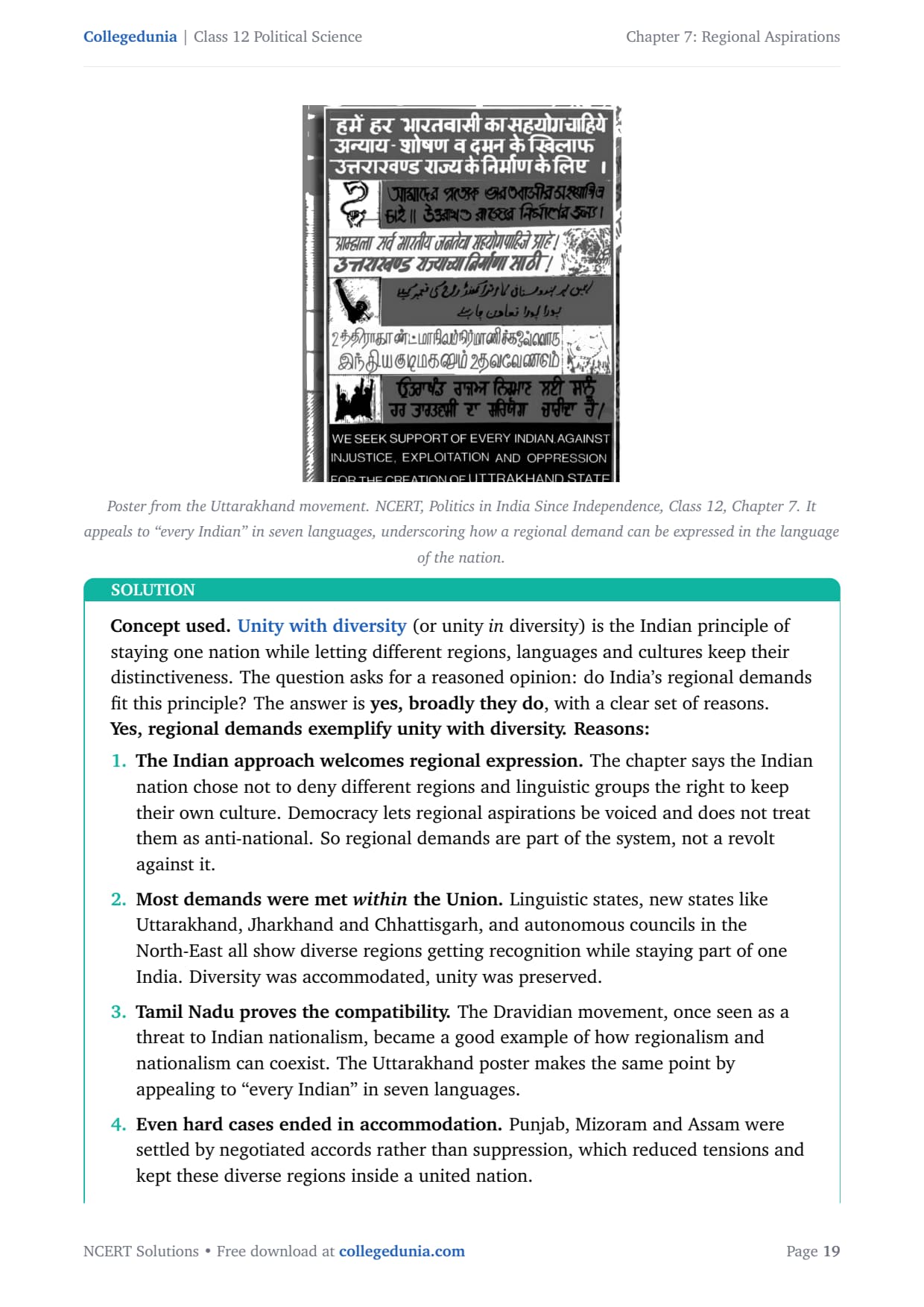
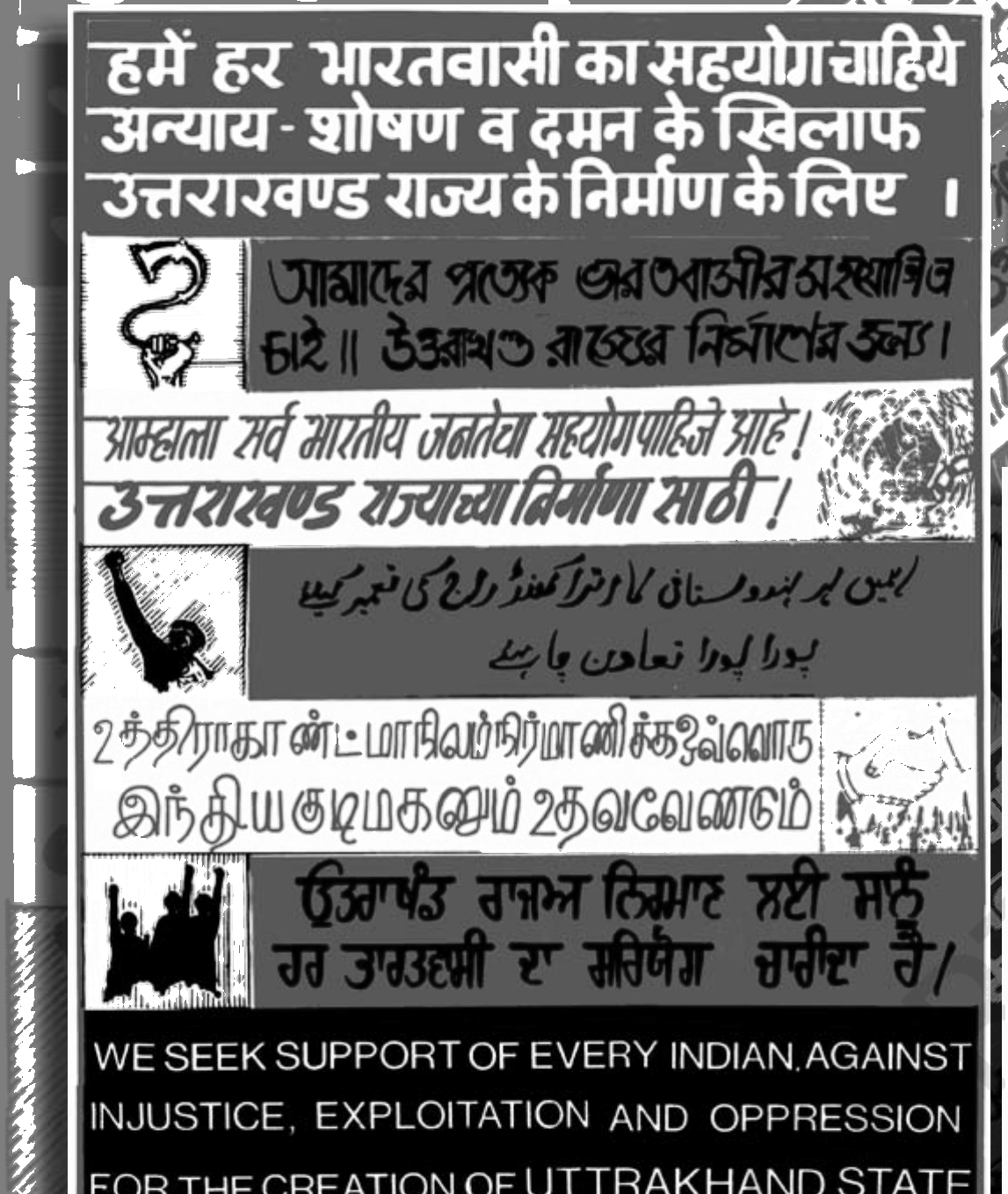
One sharp point for the essay question: all regional movements need not lead to separatist demands. Most movements asked only for autonomy, statehood or recognition and stopped well short of leaving India. The Uttarakhand poster in the chapter, which appeals to "every Indian" in seven languages, shows how a regional demand can be made in the language of the nation. This is the heart of the unity-in-diversity answer.
Regional Aspirations Class 12 Exercise-wise Coverage
The chapter exercise has 10 questions. The table maps each one to its topic so students can plan revision and find the right NCERT answer fast. The full point-wise solution for each sits in the question set lower on this page.
Question
Topic it tests
Q 1
Match the regional movement with its nature and state
Q 2
Map-work on how North-East aspirations are expressed
Q 3
Provisions of the Punjab accord and how they could become a problem
Q 4
Why the Anandpur Sahib Resolution became controversial
Q 5
Internal divisions of Jammu and Kashmir and varied aspirations
Q 6
Positions on regional autonomy for Jammu and Kashmir, with your view
Q 7
The Assam movement as cultural pride plus economic backwardness
Q 8
Why all regional movements need not be separatist (with examples)
Q 9
Regional demands and the principle of unity with diversity
Q 10
Passage on Hazarika's song and the unity of the North-East
Questions 5, 7 and 9 are the most-asked long answers, so students preparing Regional Aspirations class 12 important questions should learn those three first. The match and map-work items (Q1 and Q2) are quick marks, so revise which movement belongs to which state to secure them.
Students who want the offline copy can save the class 12 political science chapter 7 pdf from the download card above and tick off each question as they finish it.
Regional Aspirations Important Questions and Previous Year Trends
CBSE sets a steady mix of map-work, short and long answers from this chapter. Knowing the pattern helps students decide how much to write. The chapter is a regular source of one 4-mark or 6-mark question, which is why a focused list of Regional Aspirations important questions saves a lot of revision time.
Long answer (5 to 6 marks): Jammu and Kashmir autonomy, or the Assam movement as pride plus backwardness.
Short answer (4 marks): provisions of the Punjab accord, or why the Anandpur Sahib Resolution was controversial.
Map and source-based: placing North-East states on a map, or a passage on unity in diversity.
Objective and MCQ: matching movements to states, key years and the accords.
For quick recall before the exam, students often practise the class 12 political science chapter 7 mcq set and a list of Regional Aspirations class 12 important questions. The most repeated items are the Jammu and Kashmir positions and the unity-in-diversity judgement, so keep those answer points ready in your own words.
Working through the ncert solutions class 12 political science chapter 7 set twice, once open-book and once from memory, fixes the states, accords and years well before the board exam.
Common Mistakes Students Make in This Chapter
A few errors cost marks every year in this chapter. Most come from mixing up the North-East states or treating every regional demand as separatism. Avoiding them is the fastest way to lift a score.
Calling every regional demand "separatist" - most ask only for autonomy or statehood within India.
Confusing the three layers in the North-East - keep outsiders, autonomy and secession separate.
Forgetting that the Anandpur Sahib Resolution began as a federal-autonomy demand, not a call for a separate nation.
Missing one of the three regions of Jammu and Kashmir - always name Kashmir valley, Jammu and Ladakh.
Writing that India only used force - most demands were settled by accords and dialogue.
Students who fix these five points usually move from average to high marks on the long answers. The exam rewards a balanced view, so always show both the demand and how it was settled before you judge a movement.
Regional Aspirations PDF Download Formats and Languages
The solutions are free to download in more than one format, so students can pick what suits their device and revision style. The download card at the top of the page carries each option for this chapter.
Normal and HD PDF: the class 12 political science chapter 7 pdf comes in a normal size for quick downloads and an HD version for clear printing.
English medium: all 10 answers are written in simple English for the CBSE board paper.
Question-only set: a print-and-practise sheet of Regional Aspirations extra questions for self-testing.
Whole-book pack: the solutions sit in one set that runs through every Politics in India Since Independence chapter, so you can revise from Chapter 1 onwards in one place.
Many students search for class 12 political science chapter 7 answers on their phone the night before a test, so a saved PDF means you can revise even without internet. Keep both the question set and the solved version handy for a full self-check.
How the Regional Aspirations Solutions Pair with Notes and the Book PDF
These NCERT Solutions answer the back-exercise questions. To revise the full chapter, students should use them alongside the other resources for the same chapter, all linked in the table below.
Reading the original NCERT chapter text, maps and figures
Tip: read the Notes first, then attempt these solutions on your own, and only then check the model answers here. That order builds memory faster than copying answers straight away.
All NCERT Solutions for Class 12 Political Science
The table links the NCERT Solutions for every chapter in both Class 12 Political Science books, so students can move across the course in one click. Regional Aspirations is highlighted.
All NCERT Solutions for Regional Aspirations with Step-by-Step Solutions
Below are all 10 NCERT exercise questions for this chapter, exactly as they appear in the textbook. Tap Check Solution for the model answer or Expert Solution for the topper-style approach.
Q 7.1
Match the following. [3pt]
tabular@p0.56p0.38@
1@lA (Nature of regional aspirations) & 1lB (States) [3pt]
(a) Socio-religious identity leading to statehood & i. Nagaland / Mizoram [3pt]
(b) Linguistic identity and tensions with Centre & ii. Jharkhand / Chattisgarh [3pt]
(c) Regional imbalance leading to demand for Statehood & iii. Punjab [3pt]
(d) Secessionist demands on account of tribal identity & iv. Tamil Nadu
tabular
Concept used. A matching question asks you to pair each nature of
regional aspiration in column A with the state in column B that best
fits it. Decide each pair by asking: in that state, what kind of identity or
grievance actually drove the demand? The correct matches are
(a)–iii, (b)–iv, (c)–ii, (d)–i.
(a) Socio-religious identity → (iii) Punjab. In
Punjab the Akali movement linked regional autonomy to the identity of the
Sikh qaum (community). The Anandpur Sahib Resolution spoke of the
aspirations of the Sikhs, so the demand here grew from a socio-religious
identity.
(b) Linguistic identity and tensions with Centre →
(iv) Tamil Nadu. The Dravidian movement in Tamil Nadu was built on Tamil
linguistic and cultural pride and on opposition to the imposition of
Hindi, which set it against the Centre. So linguistic identity matches
Tamil Nadu.
(c) Regional imbalance leading to demand for Statehood
→ (ii) Jharkhand / Chhattisgarh. These states were carved
out because the regions felt economically backward and neglected.
Regional imbalance, the sense of uneven development, drove the statehood
demand, so this matches Jharkhand and Chhattisgarh.
(d) Secessionist demands on account of tribal identity
→ (i) Nagaland / Mizoram. The Nagas (under Phizo) and the
Mizos (under Laldenga) launched armed struggles for a separate country,
rooted in tribal identity. Secession on tribal grounds therefore matches
Nagaland and Mizoram.
Pair by the driving identity, not the name
Ask what kind of feeling drove each demand: religion (Punjab), language
(Tamil Nadu), economic backwardness (Jharkhand/Chhattisgarh) and tribal
separatism (Nagaland/Mizoram). That logic gives the key every time and protects
you from swapping (a) and (d).
Strategic angle. Lock in the two ``hardest'' pairs first, the two that
students most often confuse, and the rest fall into place. Punjab is religion,
not language; the North-East tribal states are secession, not mere imbalance.
Fix the religion pair: only Punjab's movement is tied to a
socio-religious (Sikh) identity, through the Anandpur Sahib
Resolution and the talk of the Sikh qaum. So (a)–iii.
Fix the secession pair: only Nagaland and Mizoram saw groups demand a
separate country on tribal grounds, the Nagas under Phizo and the
Mizos under Laldenga. So (d)–i.
The remaining two are easy: Tamil Nadu's Dravidian movement is the
language-and-Centre story, so (b)–iv; and Jharkhand and Chhattisgarh
were born of economic backwardness, so (c)–ii.
Why this matters. The trap is to match Punjab with secession because of
the later militancy, or to match the tribal states with religion. The chapter is
precise: Punjab's autonomy demand was framed in the language of Sikh identity
(socio-religious), while Nagaland and Mizoram demanded a separate country
(secession on tribal identity). Reading the column-A label exactly, and not the
state's whole history, is what secures this easy mark.
(a)–iii, (b)–iv, (c)–ii, (d)–i.
Q 7.2
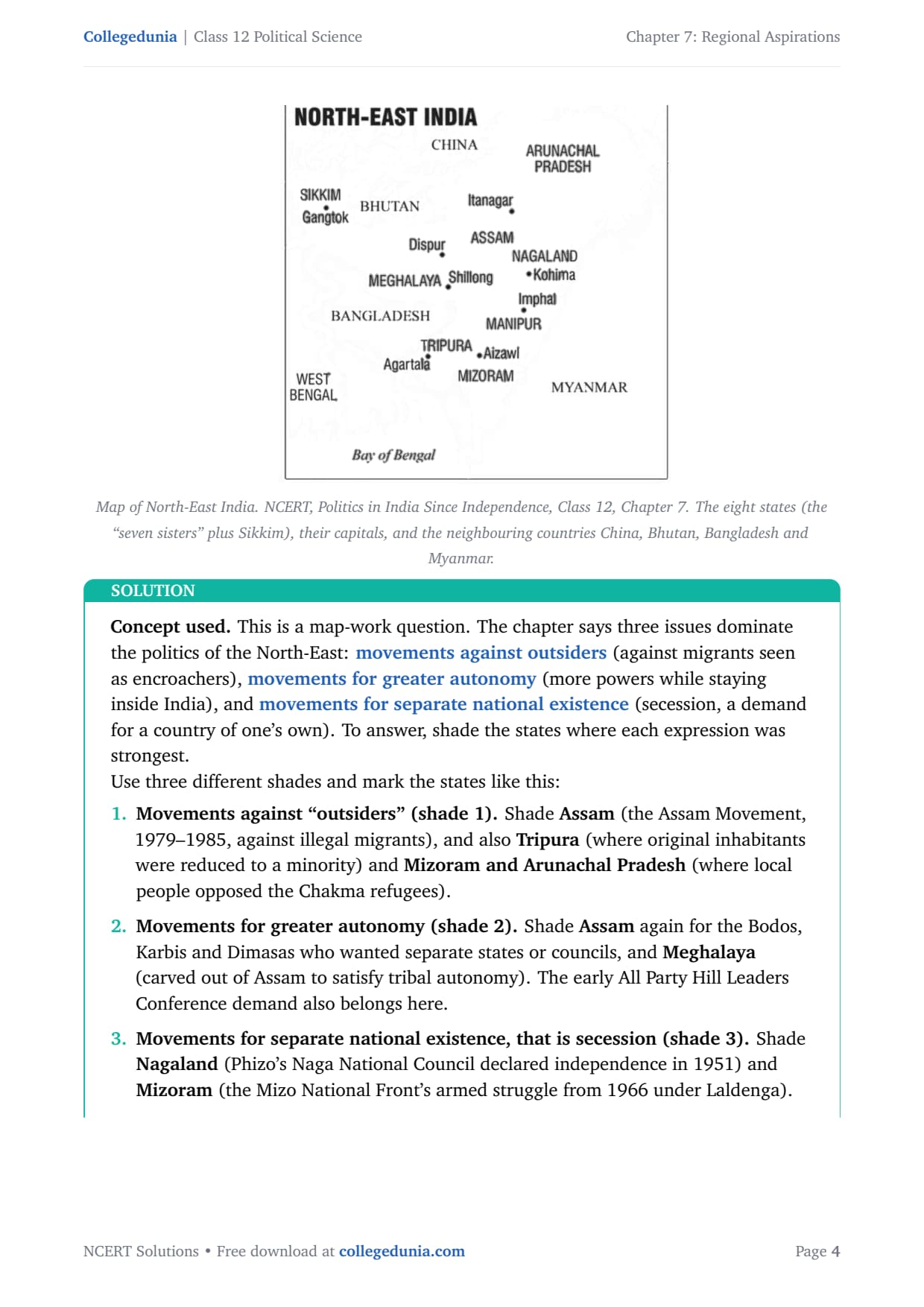
Regional aspirations of the people of North-East get expressed in
different ways. These include movements against outsiders, movement for greater
autonomy and movement for separate national existence. On the map of the
North-East, using different shades for these three, show the States where these
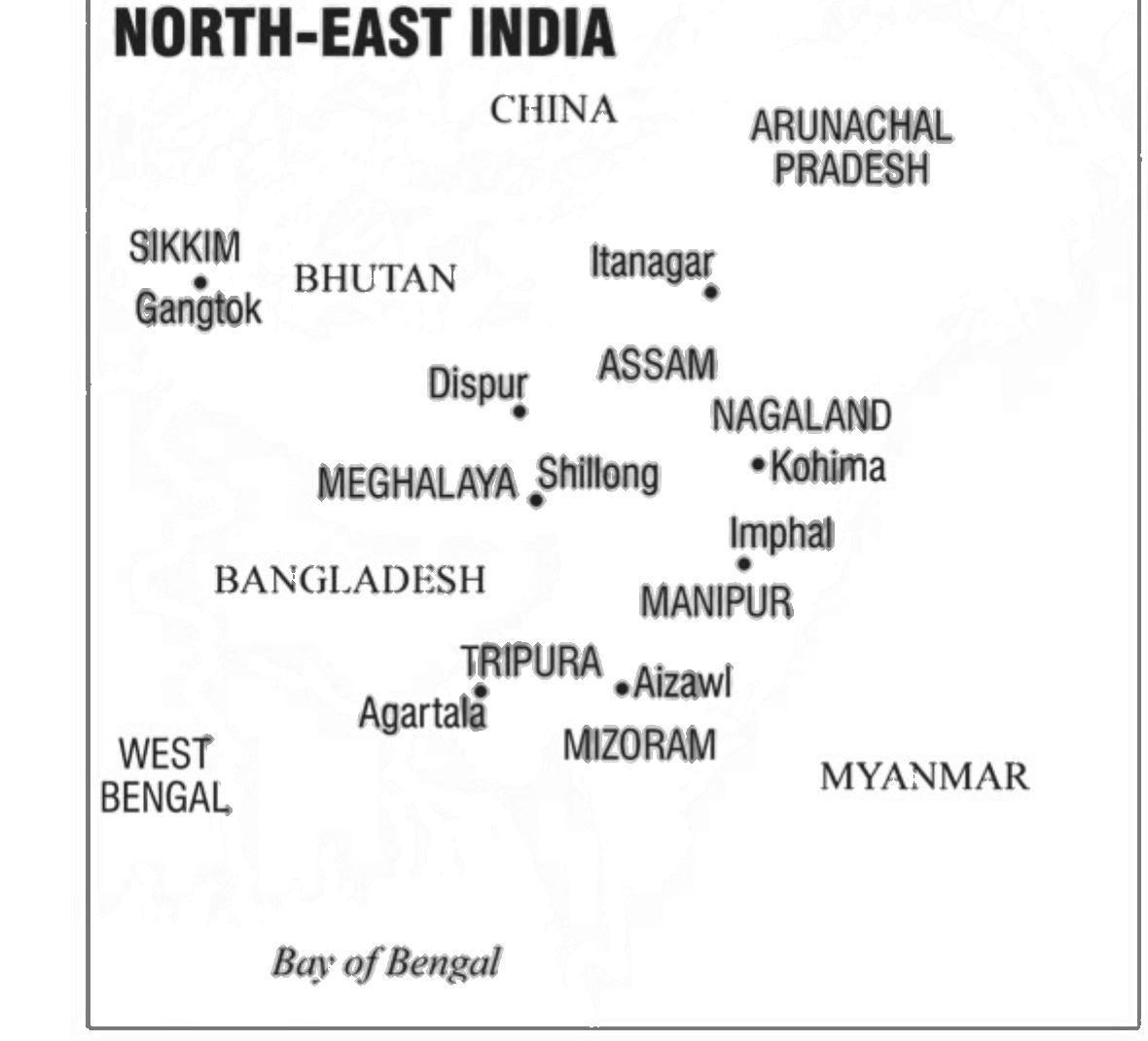
expressions are prominently found.
Map of North-East India. NCERT, Politics in
India Since Independence, Class 12, Chapter 7. The eight states (the ``seven
sisters'' plus Sikkim), their capitals, and the neighbouring countries China,
Bhutan, Bangladesh and Myanmar.
Concept used. This is a map-work question. The chapter says three issues
dominate the politics of the North-East: movements against outsiders
(against migrants seen as encroachers), movements for greater autonomy
(more powers while staying inside India), and movements for separate
national existence (secession, a demand for a country of one's own). To answer,
shade the states where each expression was strongest.
Use three different shades and mark the states like this:
Movements against ``outsiders'' (shade 1). Shade
Assam (the Assam Movement, 1979–1985, against illegal
migrants), and also Tripura (where original inhabitants were
reduced to a minority) and Mizoram and Arunachal Pradesh (where
local people opposed the Chakma refugees).
Movements for greater autonomy (shade 2). Shade Assam
again for the Bodos, Karbis and Dimasas who wanted separate states or
councils, and Meghalaya (carved out of Assam to satisfy tribal
autonomy). The early All Party Hill Leaders Conference demand also
belongs here.
Movements for separate national existence, that is secession
(shade 3). Shade Nagaland (Phizo's Naga National Council
declared independence in 1951) and Mizoram (the Mizo National
Front's armed struggle from 1966 under Laldenga).
Assam appears in two shades
Assam is the clearest example of an ``against outsiders'' movement, but it also
saw autonomy demands (Bodos, Karbis, Dimasas). It is fine to mark such a state
with two shades, as long as your map key explains what each shade means.
Against outsiders: shade Assam (Assam Movement), Tripura, and Mizoram /
Arunachal Pradesh (Chakma issue). Greater autonomy: shade Assam (Bodos, Karbis,
Dimasas) and Meghalaya. Separate national existence (secession): shade Nagaland
(Naga National Council) and Mizoram (Mizo National Front). Add a clear key
naming the three shades.
RB
Rohan Banerjee
MA Political Science, University of Delhi
Verified Expert
Picture-first. Treat the map as three colour layers and place each
state in the right layer. The examiner is checking whether you can attach the
right type of movement to the right state, so a clear key matters as much
as the shading.
Outsiders layer: the headline case is Assam (the 1979–1985 movement led
by the AASU against illegal Bengali migrants). Add Tripura and the
Mizoram–Arunachal Chakma-refugee tension to complete this layer.
Autonomy layer: still inside Assam, the Bodos, Karbis and Dimasas pressed
for separate states or autonomous councils; Meghalaya was actually carved
out of Assam to meet such tribal-autonomy demands. Shade these.
Secession layer: Nagaland (Phizo, Naga National Council, declared
independence in 1951) and Mizoram (Laldenga, Mizo National Front, armed
campaign from 1966). These are the ``separate national existence'' cases.
Why this matters. The whole point of the chapter is that the North-East
is not one undifferentiated ``trouble'' but a layered map: some demands are about
who belongs (outsiders), some about more powers within India (autonomy), and a
few about leaving India altogether (secession). A good map answer shows that you
can tell these three apart and place the right states under each, instead of
shading the whole region one colour.
Three shades: outsiders (Assam, Tripura, Mizoram/Arunachal),
autonomy (Assam's Bodos/Karbis/Dimasas, Meghalaya), and secession (Nagaland,
Mizoram). Provide a labelled key for the three shades.
Q 7.3
What were the main provisions of the Punjab accord? In what way can
they be the basis for further tensions between the Punjab and its neighbouring
States?
Concept used. The Punjab Accord (also called the Rajiv
Gandhi–Longowal Accord) was the agreement signed in July 1985 between Prime
Minister Rajiv Gandhi and Harchand Singh Longowal, President of the Akali Dal,
to bring normalcy back to Punjab after the violence of the early 1980s. The
question has two parts: list its provisions, then explain how those very
provisions could spark fresh disputes with neighbouring states.
The main provisions of the Punjab Accord.
Chandigarh to Punjab. Chandigarh, then a shared capital and a
union territory, would be transferred to Punjab.
Punjab–Haryana border. A separate commission would be appointed
to resolve the border dispute between Punjab and Haryana.
River-water sharing. A tribunal would be set up to decide the
sharing of the Ravi–Beas river water among Punjab, Haryana and
Rajasthan.
Relief and rights. Compensation and better treatment would be
given to those affected by the militancy in Punjab, and the Armed Forces
Special Powers Act (AFSPA) would be withdrawn from Punjab.
Why these provisions can become a basis for further tension.
Chandigarh is claimed by both. Handing Chandigarh to Punjab
upsets Haryana, which also wants it as its capital. So the transfer can
renew the Punjab–Haryana rivalry rather than end it.
Border disputes can reopen wounds. Drawing a new Punjab–Haryana
boundary means some Hindi-speaking or Punjabi-speaking villages may be
moved from one state to the other, which each side can resent.
River water is a zero-sum quarrel. Sharing Ravi–Beas water
among three states (Punjab, Haryana, Rajasthan) is contentious: more
water for one means less for another, so the tribunal's decision can keep
the inter-state dispute alive.
An accord can also seed new disputes
The Punjab Accord brought a major step towards peace, but its own terms touched
the most sensitive inter-state issues: a shared capital and shared river water.
That is why peace ``did not come easily or immediately'' and why these clauses
could become fresh flashpoints between Punjab and its neighbours.
Main provisions: transfer Chandigarh to Punjab; set up a commission for
the Punjab–Haryana border; set up a tribunal to share Ravi–Beas water among
Punjab, Haryana and Rajasthan; compensate those hit by militancy and withdraw
the AFSPA from Punjab. They can cause fresh tension because Haryana also claims
Chandigarh, the border redrawing can move villages between states, and the
river-water sharing is a zero-sum dispute among the three states.
AV
Aditya Verma
MA International Relations, Jadavpur University
Verified Expert
Structural observation. Notice that the accord's four headline clauses
are exactly the issues Punjab shares with its neighbours: a capital, a border and
a river. Anything ``shared'' is a potential quarrel, so list the provisions, then
flip each shared clause into a possible dispute.
The provisions in one line each: Chandigarh goes to Punjab; a commission
settles the Punjab–Haryana border; a tribunal divides Ravi–Beas water
among Punjab, Haryana and Rajasthan; the militancy-affected get
compensation and the AFSPA is lifted from Punjab.
Now turn the shared clauses into tensions: Chandigarh is wanted by Haryana
too, so its transfer angers Haryana; redrawing the border can shift
villages between the two states and offend either side; and dividing a
fixed quantity of river water among three states means each gain is
another's loss.
The deeper point: these are not flaws in the accord so much as the hard
reality that Punjab, Haryana and Rajasthan are bound together by geography.
The accord could promise machinery (a commission, a tribunal) but not make
the underlying conflicts disappear.
Why this matters. The Punjab Accord is a textbook case of how a peace
deal settles the big political question (ending militancy, restoring elections)
yet leaves behind technical disputes that can fester. Chandigarh was never
actually transferred, and the river-water tribunal dragged on for decades. So the
accord shows both the value of negotiated settlement and its limits: it can stop
a cycle of violence while still leaving Punjab and its neighbours to argue over a
capital and a river.
Provisions: Chandigarh to Punjab; a commission for the Punjab–Haryana
border; a tribunal to share Ravi–Beas water among Punjab, Haryana and Rajasthan;
compensation for militancy victims and withdrawal of the AFSPA from Punjab. These
can fuel fresh tension because Haryana also claims Chandigarh, border redrawing
shifts villages between states, and river-water sharing is a zero-sum contest
among the three states.
Q 7.4
Why did the Anandpur Sahib Resolution become controversial?
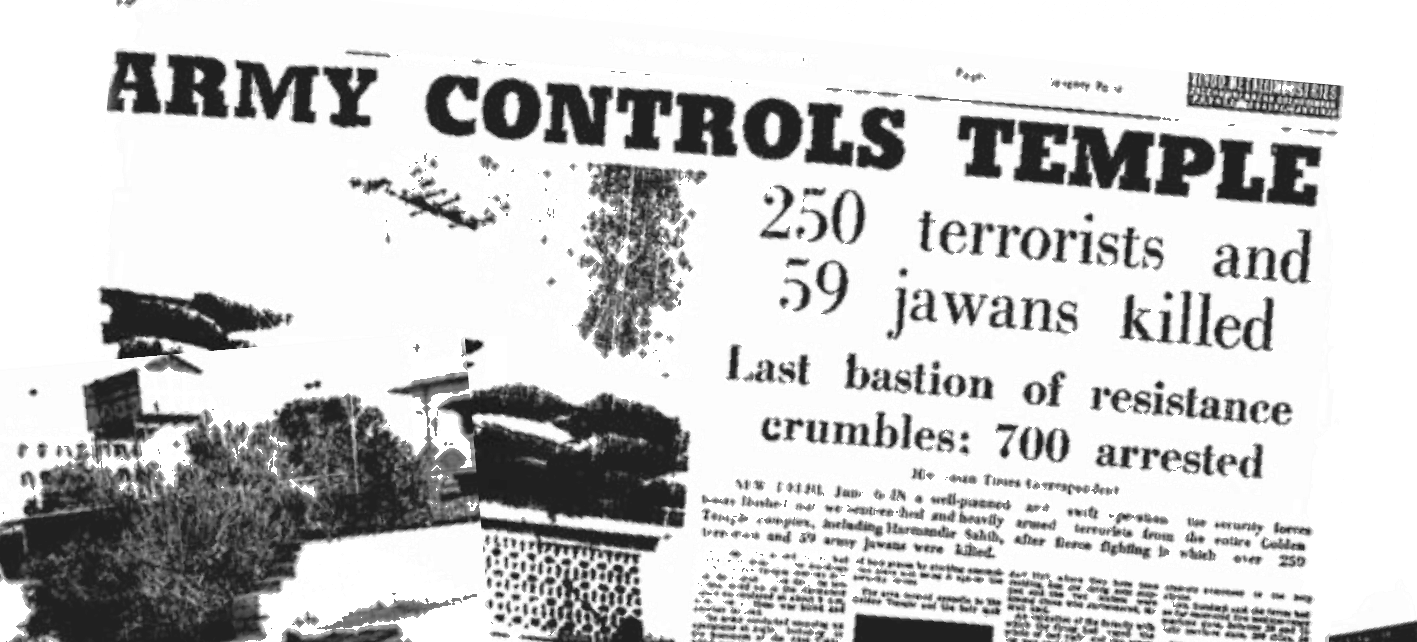
Newspaper report of Operation Blue Star,
June 1984. NCERT, Politics in India Since Independence, Class 12, Chapter 7. As
the Anandpur Sahib Resolution slid into militancy, the army action in the Golden
Temple deeply hurt Sikh sentiments and inflamed the Punjab crisis.
Concept used. The Anandpur Sahib Resolution was a resolution
passed by the Akali Dal at Anandpur Sahib in 1973. It demanded regional
autonomy for Punjab and wanted to redefine Centre–state relations in India, so
that the states would have more power. The question asks why this resolution
became controversial.
The resolution became controversial for these reasons:
It could be read as a demand for a separate Sikh nation. The
resolution spoke of the aspirations of the Sikh qaum (community or
nation) and declared its goal as the bolbala (dominance or
hegemony) of the Sikhs. Critics feared this language went beyond autonomy
and hinted at a separate Sikh country, which alarmed the central
government.
It was seen as weakening the Centre. By asking to redraw
Centre–state relations in favour of the states, the resolution was read
by many as a threat to national unity, even though its supporters
described it only as a plea for stronger federalism.
It had limited appeal but was later seized by extremists. The
resolution had only a limited appeal among the Sikh masses at first. But
after the Akali government was dismissed in 1980, the movement built
around it passed from the moderate Akalis to extremist elements and took
the form of armed insurgency. This turn towards violence made the
resolution far more controversial than its words alone.
The words ``qaum'' and ``bolbala'' are the key
The single most-marked point is that the resolution used the words qaum
(community or nation) and bolbala (dominance). These could be read as a
call for Sikh nationhood and Sikh dominance, which is exactly why opponents
called it a threat to unity.
The Anandpur Sahib Resolution (1973) became controversial because its
language about the Sikh qaum (community or nation) and the bolbala
(dominance) of the Sikhs could be read as a demand for a separate Sikh nation,
because its call to redraw Centre–state relations was seen as weakening the
Centre and threatening national unity, and because the movement built around it
later passed from moderate Akalis to extremists and turned into armed
insurgency.
PN
Priya Nair
MA Political Science, University of Hyderabad
Verified Expert
Strategic angle. Separate what the resolution said from what it
later became. Its words (qaum, bolbala, redrawing Centre–state ties) were
already open to a hard reading; the slide into militancy then made that reading
look real. Both halves explain the controversy.
The wording: the resolution asserted regional autonomy but also invoked
the Sikh qaum (community or nation) and the bolbala
(dominance) of the Sikhs. To supporters this was strong federalism; to
critics it sounded like a step towards a separate Sikh state, so the same
text carried two very different meanings.
The drift: the resolution had only limited appeal among ordinary Sikhs at
first. After the Akali government's dismissal in 1980 the movement passed
from moderates to extremists, who turned the Golden Temple into an armed
fortress, triggering Operation Blue Star in June 1984. The violence made
the resolution a lightning rod.
The takeaway: a demand that began as a plea for federal balance became
controversial because its ambiguous language could be claimed by
separatists, and because the movement it inspired ended in insurgency.
Why this matters. The Anandpur Sahib Resolution shows how a single
document can be both a legitimate demand for autonomy and a flashpoint for
conflict, depending on who reads it and what follows. Its supporters meant
stronger federalism; its critics heard the language of nationhood and dominance;
and once extremists took over, the worst reading seemed confirmed. That gap
between intention, interpretation and outcome is exactly why the resolution
remains controversial in the chapter.
It was controversial because its talk of the Sikh qaum (nation)
and the bolbala (dominance) of the Sikhs could be read as a demand for a
separate Sikh nation, because redrawing Centre–state relations looked like a
threat to national unity, and because the movement around it later moved from
moderate Akalis to extremists and ended in armed insurgency.
Q 7.5
Explain the internal divisions of the State of Jammu and Kashmir and
describe how these lead to multiple regional aspirations in that State.
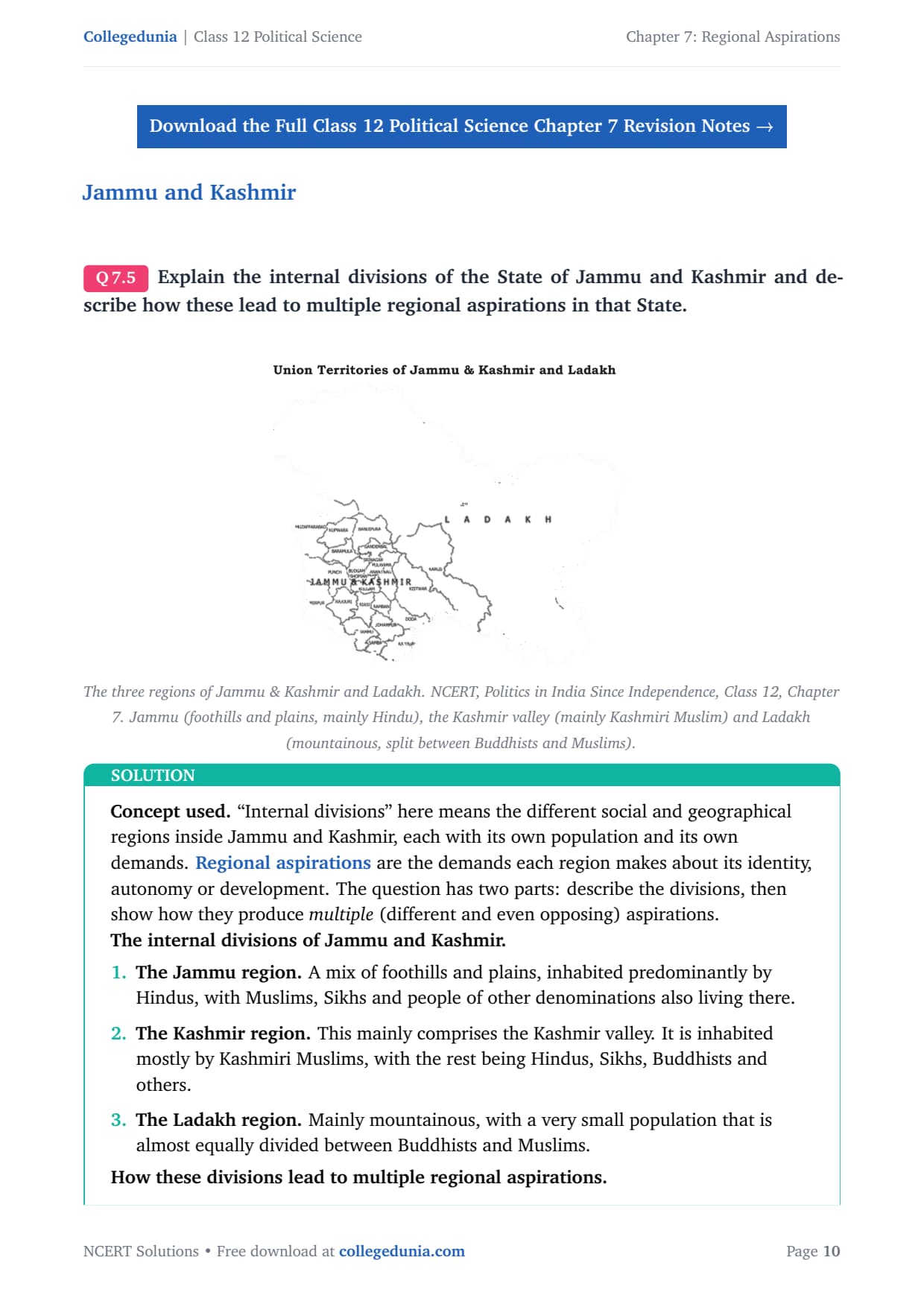
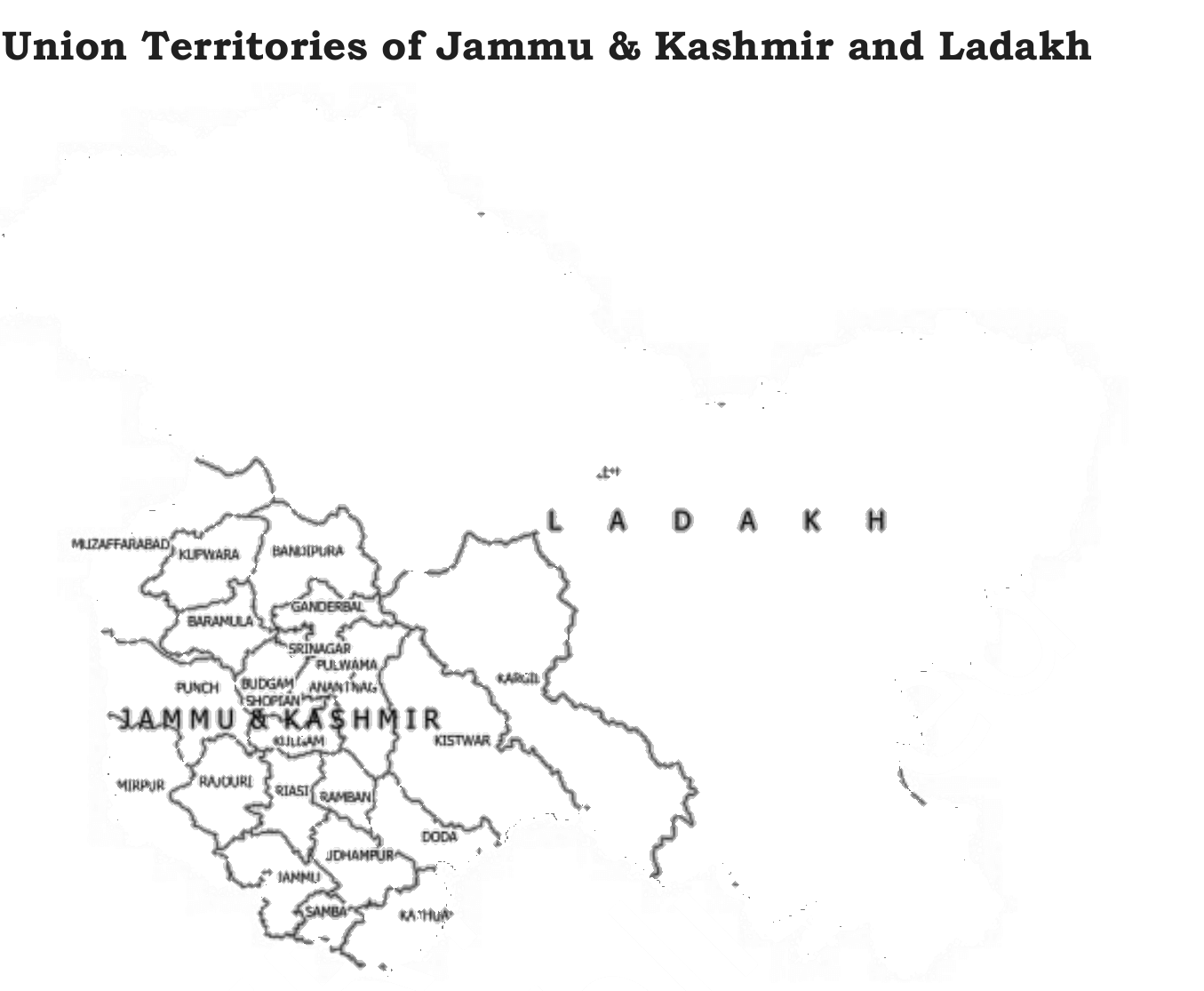
The three regions of Jammu & Kashmir and
Ladakh. NCERT, Politics in India Since Independence, Class 12, Chapter 7. Jammu
(foothills and plains, mainly Hindu), the Kashmir valley (mainly Kashmiri
Muslim) and Ladakh (mountainous, split between Buddhists and Muslims).
Concept used. ``Internal divisions'' here means the different social and
geographical regions inside Jammu and Kashmir, each with its own population and
its own demands. Regional aspirations are the demands each region makes
about its identity, autonomy or development. The question has two parts: describe
the divisions, then show how they produce multiple (different and even
opposing) aspirations.
The internal divisions of Jammu and Kashmir.
The Jammu region. A mix of foothills and plains, inhabited
predominantly by Hindus, with Muslims, Sikhs and people of other
denominations also living there.
The Kashmir region. This mainly comprises the Kashmir valley. It
is inhabited mostly by Kashmiri Muslims, with the rest being Hindus,
Sikhs, Buddhists and others.
The Ladakh region. Mainly mountainous, with a very small
population that is almost equally divided between Buddhists and Muslims.
How these divisions lead to multiple regional aspirations.
In the Kashmir valley, the central debate has been about the
status of Kashmir within India: some Kashmiris felt that the
autonomy under Article 370 was not enough and demanded ``Greater State
Autonomy'', a plebiscite, and full democracy as practised in the rest of
India.
Outside the valley (and among many in Jammu), a very different
aspiration existed: that Article 370 be revoked so that J&K is
treated like any other state, fully integrated with India. This is the
opposite of the valley's autonomy demand.
Ladakh and Jammu also have their own developmental and political
aspirations, distinct from the valley's, which is why the 2019 Act made
Ladakh a separate Union Territory. So one state held several, sometimes
clashing, regional aspirations at once.
One state, opposite demands
The deep point: within a single state, the valley often wanted more
autonomy while many in Jammu and outside J&K wanted Article 370 gone.
These opposite demands grow directly out of the state's internal divisions of
region and religion.
Jammu and Kashmir has three internal regions: Jammu (foothills and
plains, mainly Hindu), the Kashmir valley (mainly Kashmiri Muslim) and Ladakh
(mountainous, split between Buddhists and Muslims). These divisions produce
multiple, often opposite aspirations: the valley demanded greater autonomy,
a plebiscite and fuller democracy under Article 370, while many in Jammu and
outside J&K wanted Article 370 revoked and full integration, and Ladakh had its
own developmental aspirations, eventually becoming a separate Union Territory.
KM
Karan Mehta
MA Political Science, Banaras Hindu University
Verified Expert
Strategic angle. Map region to religion to demand. Three regions
(Jammu, Kashmir, Ladakh), three social mixes, and at least two clashing demands
about Article 370. Showing that the demands are opposite is what earns the
``multiple aspirations'' marks.
The three regions and their people: Jammu (foothills and plains, mainly
Hindu), the Kashmir valley (mainly Kashmiri Muslim) and Ladakh
(mountainous, roughly half Buddhist and half Muslim). The state is thus
plural in religion, geography and culture.
The clashing aspirations over Article 370: in the valley, many felt the
autonomy under Article 370 was too little and asked for ``Greater
State Autonomy'', a plebiscite and full democracy; outside the valley and
among many in Jammu, people felt Article 370 should go so that
J&K is treated like any other state.
The result: a single state carrying opposite demands, plus Ladakh's own
distinct developmental aspirations, which is precisely why the 2019
reorganisation split it into two Union Territories.
Why this matters. J&K is the clearest proof that regional aspirations
are not always one ``Kashmir demand'' but several, even contradictory ones,
flowing from the state's internal diversity. The valley's call for more autonomy
and Jammu's call to scrap Article 370 cannot both be satisfied by the same step.
Seeing this internal plurality, rather than treating the state as a single bloc,
is the insight the question is testing.
The state splits into Jammu (mainly Hindu, plains and foothills), the
Kashmir valley (mainly Kashmiri Muslim) and Ladakh (mountainous,
Buddhist–Muslim). From this come multiple, opposite aspirations: the valley
demanded greater autonomy and a plebiscite under Article 370, while many in
Jammu and outside J&K demanded its revocation and full integration, with Ladakh
seeking its own development path and later separate UT status.
Q 7.6
What are the various positions on the issue of regional autonomy for
Kashmir? Which of these do you think are justifiable? Give reasons for your
answer.
Concept used.Regional autonomy means how much self-rule a
region should have within India. For Kashmir this debate centres on
Article 370, the constitutional provision that gave J&K a special
status. The question asks you to (i) list the various positions and (ii) give a
reasoned opinion on which are justifiable. There are broadly two opposing
positions plus a separatist one.
The various positions on regional autonomy for Kashmir.
Position 1: Article 370 should be revoked. A section of people,
mostly outside J&K, believed that the special status under Article 370
did not allow full integration of the state with India. They wanted
Article 370 revoked so that J&K is treated like any other state.
Position 2: the autonomy under Article 370 is not enough.
Another section, mostly Kashmiris, felt the autonomy was too little. They
had three grievances: the promise to refer accession to the people (a
plebiscite) was unfulfilled; the special federal status under Article 370
had been eroded in practice, so they demanded ``Greater State
Autonomy''; and democracy as practised in the rest of India had not been
institutionalised in J&K.
Position 3: a separate Kashmiri nation (separatism). A smaller,
more extreme position held that Kashmir should be a separate nation
altogether, outside India. Some in this stream looked towards Pakistan,
others wanted an independent Kashmir.
Which positions are justifiable, and why. (A reasoned opinion is
expected; either side is acceptable if you argue it from the text.)
The demands for more democracy and genuine autonomy within India
are justifiable. The chapter records real grievances: rigged elections
(notably 1987), dismissals of elected governments, and the failure to
institutionalise democracy. Asking that democracy work properly in J&K
is a fair, constitutional demand.
The separatist demand for a separate nation is not justifiable,
because India's approach allows regional aspirations to be met
within the democratic and constitutional set-up, not by
breaking away. Separatism brought only violence and suffering to ordinary
Kashmiris.
List the positions, then judge them
The question has two clear tasks: set out the positions (revoke 370 / 370 is too
little / separate nation), then give a reasoned verdict. Back your verdict with
chapter facts (rigged 1987 election, eroded autonomy) rather than personal
feeling alone.
The positions are: (1) revoke Article 370 for full integration; (2)
the autonomy under Article 370 is not enough, so demand a plebiscite, ``Greater
State Autonomy'' and proper democracy; and (3) a separate Kashmiri nation
(separatism). In my view the demands for genuine democracy and meaningful
autonomy within India are justifiable, given the real grievances of rigged
elections and eroded autonomy, while the separatist demand for a separate nation
is not, because India's constitutional system lets regional aspirations be met inside the
Union, not by breaking away.
NJ
Neha Joshi
MA Political Science, University of Delhi
Verified Expert
Strategic angle. Lay the positions on a line from ``less autonomy'' to
``leave India'': revoke 370, keep-but-deepen 370, separate nation. Then judge
each by one test: can it be met inside India's democratic, constitutional
set-up?
Position one (revoke Article 370): held mostly by people outside J&K who
felt the special status blocked full integration and wanted J&K treated
like any other state.
Position two (autonomy is too little): held mostly by Kashmiris, resting
on three grievances, the unkept promise of a plebiscite, the erosion of
the special federal status (hence ``Greater State Autonomy''), and the
failure to institutionalise everyday democracy in the state.
Position three (separate nation): a separatist stream that wanted Kashmir
outside India altogether, which the chapter links to insurgency and
Pakistani support.
The verdict by the ``within India'' test: demands for real democracy and
meaningful autonomy pass, because they can be met under the Constitution;
the separatist demand fails, because it rejects the set-up that makes
accommodation possible and brought only violence to ordinary Kashmiris.
The evidence behind the verdict: the chapter records rigged elections
(most notably 1987), the repeated dismissal of elected state governments,
and President's rule for years on end. These are real, documented failures
of democracy, so the demand to make democracy work properly in J&K is
not a complaint but a constitutional right. By contrast, the separatist
stream took ``moral, material and military support from Pakistan'', which
is why it is judged differently.
Why this matters. The chapter's wider lesson is that India answers
regional aspirations by accommodation, not suppression, and within the
constitutional set-up, not outside it. So the autonomy and democracy demands
are exactly the kind that India's flexible federalism is designed to handle,
while separatism puts itself beyond that reach. There is also a moral test
hiding inside the legal one: a demand that can be met without breaking the
country, and without inviting a foreign power in, is the kind a democracy can
honour. Judging each position by whether it can live inside the Indian Union,
and whether it serves or harms ordinary people, is what turns a bare list into a
reasoned answer.
Three positions: revoke Article 370 (full integration); the autonomy
under Article 370 is inadequate (plebiscite, ``Greater State Autonomy'', real
democracy); and a separate Kashmiri nation. The autonomy-and-democracy demands
are justifiable because they can be met within India's constitutional set-up
and rest on genuine grievances; the separatist demand is not, since it rejects
that set-up and led only to violence.
Q 7.7
The Assam movement was a combination of cultural pride and economic
backwardness. Explain.
Concept used. The Assam Movement (1979–1985) was a mass
agitation led by the All Assam Students' Union (AASU) against ``outsiders'',
that is, against illegal migrants. To say it combined cultural pride
and economic backwardness means it was driven by both a fear for
Assamese identity and anger over poverty and exploitation. The answer must
explain both strands.
The cultural-pride strand.
The Assamese suspected that huge numbers of illegal Bengali Muslim
settlers had come in from Bangladesh. They feared that unless these
foreign nationals were detected and deported, they would reduce the
indigenous Assamese to a minority in their own land.
This was a fear about identity and culture: the survival of the
Assamese language and the Assamese people as the dominant community of the
state. So pride in Assamese identity was a core driver of the movement.
The economic-backwardness strand.
There was widespread poverty and unemployment in Assam despite the
state having rich natural resources like oil, tea and coal. People felt
these resources were being drained out of the state without any
matching benefit to the local people.
The migrants were therefore seen not only as a cultural threat but also
as competitors for scarce land, jobs and political power. So
economic grievance reinforced the cultural fear, and the two together
powered the movement.
Two strands, one movement
The Assam Movement is the chapter's clearest example of how a regional movement
can braid together who we are (cultural pride, fear of becoming a minority)
and how we live (poverty, drained resources, competition for jobs).
Explaining both strands, not just one, is what the question demands.
The Assam Movement combined cultural pride and economic backwardness.
Culturally, the Assamese feared that illegal migrants from Bangladesh would
reduce them to a minority in their own land and threaten the Assamese language
and identity. Economically, Assam suffered poverty and unemployment despite its
oil, tea and coal, whose wealth was felt to be drained out of the state, and the
migrants were seen as competitors for scarce land, jobs and power. Both strands
together drove the 1979–1985 agitation.
SR
Siddharth Rao
MA Political Science, Jamia Millia Islamia
Verified Expert
Structural observation. Split the movement's fuel into two tanks:
identity (cultural pride) and economics (backwardness). Then show that the
migrant was attacked on both counts, as a threat to Assamese identity and
as a competitor for scarce resources.
Cultural pride: the Assamese feared illegal Bengali Muslim migrants from
Bangladesh would swamp them and turn the indigenous Assamese into a
minority in their own land, endangering the Assamese language and
culture. The movement also targeted a faulty voters' register padded with
the names of immigrants.
Economic backwardness: Assam was poor and job-scarce despite its oil, tea
and coal, whose profits were felt to flow out of the state. So migrants
were resented as encroachers on land and rivals for jobs and political
power, an economic grievance layered on top of the cultural one.
The combination: identity-fear plus resource-anger is what made the
movement so wide and so intense, mobilising students and ordinary people
across the state from 1979 to 1985, until the Assam Accord of 1985.
Why this matters. Regional movements rarely run on a single grievance.
The Assam Movement shows that a fight over ``outsiders'' was at once a cultural
fight (save the Assamese identity) and an economic one (we are poor while our
oil and tea enrich others). A top answer names both engines and shows how they
fed each other, which is exactly the ``combination'' the question highlights.
It combined cultural pride, the fear that illegal Bangladeshi migrants
would reduce the Assamese to a minority and erode their language and identity,
with economic backwardness, the poverty and unemployment in a state rich in oil,
tea and coal whose wealth was drained away, leaving migrants resented as rivals
for land, jobs and power. The two strands together fuelled the 1979–1985
movement.
Q 7.8
All regional movements need not lead to separatist demands. Explain by
giving examples from this chapter.
Concept used. A regional movement expresses the demands of a
region: for autonomy, statehood, development or recognition. A separatist
demand goes further: it wants the region to leave India and become a separate
country. The statement says most regional movements stop well short of
separatism. The answer must prove this with chapter examples.
Most regional movements demand things within India, not separation:
Tamil Nadu (the Dravidian movement). Though a section once
dreamed of a Dravida nation, the movement did not take to arms. It
used democratic means, public debates and elections, won power in the
state, and became a model of how regionalism and nationalism can live
together. This is the clearest example of a strong regional movement that
never became separatist.
The North-East autonomy demands. Communities like the Bodos,
Karbis and Dimasas in Assam wanted separate states or autonomy, not a
separate country. Their demands were met within the federal system
through new states, District Councils and an Autonomous Council.
Punjab after the Accord. Once the Rajiv–Longowal Accord brought
normalcy, Punjab returned to ordinary questions of economic development
and social change, with politics moving back along secular lines, not
towards separation.
The contrast: a few movements did turn separatist. The Mizo
National Front (under Laldenga) and the Naga National Council (under Phizo) did
demand a separate country. But even Mizoram ended in a peace accord (1986) and
full statehood within India. So separatism was the exception, and even
that was eventually resolved by accommodation.
Give both the rule and the exception
The statement is that regional movements need not be separatist. Prove the
rule with Tamil Nadu, the North-East autonomy demands and post-Accord Punjab,
then note the exceptions (Mizo, Naga), showing that even these were brought back
inside India. That balance earns full marks.
Most regional movements demand autonomy, statehood or recognition
within India, not separation. The Dravidian movement in Tamil Nadu used
democratic means and never took up arms, becoming a model of regionalism living
with nationalism; the Bodos, Karbis and Dimasas in the North-East sought states
and autonomous councils within Assam; and Punjab, after the Accord, returned to
questions of development. Only a few movements, like the Mizo and Naga, turned
separatist, and even Mizoram ended in an accord and statehood within India. So
regional movements need not lead to separatist demands.
VK
Vivaan Kapoor
MA International Relations, JNU
Verified Expert
Strategic angle. Build a spectrum: most movements ask for more
within India (autonomy, statehood, recognition), and only a rare few ask to
leave India. Stock the ``within India'' end with examples, then note that
even the secessionist exceptions were pulled back in.
Within-India examples: Tamil Nadu's Dravidian movement chose elections
over arms and became a model of regionalism plus nationalism; the Bodos,
Karbis and Dimasas won states and autonomous/district councils inside
Assam; and post-Accord Punjab went back to development and secular
politics.
The secessionist exceptions: the Mizo National Front and the Naga
National Council did demand a separate country. So separatism exists, but
it is the exception, not the rule.
The pull-back: even Mizoram's secession ended in the 1986 accord and
full statehood within India, one of the most peaceful states today. So
the chapter shows separatism being converted back into accommodation.
The mechanism behind the rule: the reason so few movements turn
separatist is that India's federal toolkit offers many stops short of
separation, a new state, a District Council, an Autonomous Council, or
simply power-sharing at the Centre. Tamil Nadu's parties even joined
ruling coalitions in Delhi from 1996, which shows how a regional movement
can gain at the national level instead of leaving the nation. When real
powers are on offer inside the Union, secession loses its appeal.
Why this matters. The lesson is that India treats regional aspirations
as a normal part of democratic politics, to be met by giving regions more power
inside the Union, not by fearing every movement as a threat to break the
country. Tamil Nadu proves a powerful regional movement can stay firmly national,
and even share power at the Centre; Mizoram proves even a separatist one can be
brought home. Distinguishing demands ``within India'' from demands ``to leave
India'', and showing how the federal set-up resolved even the latter, is the
heart of a strong answer.
Regional movements need not be separatist. Tamil Nadu's Dravidian
movement used democratic means and never sought to leave India; the Bodos, Karbis
and Dimasas wanted states and autonomous councils within Assam; Punjab after the
Accord returned to development. Only the Mizo and Naga movements turned
separatist, and even Mizoram ended in an accord and statehood within India.
Q 7.9
Regional demands from different parts of India exemplify the principle
of unity with diversity. Do you agree? Give reasons.
Poster from the Uttarakhand movement. NCERT,
Politics in India Since Independence, Class 12, Chapter 7. It appeals to ``every
Indian'' in seven languages, underscoring how a regional demand can be expressed
in the language of the nation.
Concept used.Unity with diversity (or unity in
diversity) is the Indian principle of staying one nation while letting different
regions, languages and cultures keep their distinctiveness. The question asks for
a reasoned opinion: do India's regional demands fit this principle? The answer is
yes, broadly they do, with a clear set of reasons.
Yes, regional demands exemplify unity with diversity. Reasons:
The Indian approach welcomes regional expression. The chapter
says the Indian nation chose not to deny different regions and linguistic
groups the right to keep their own culture. Democracy lets regional
aspirations be voiced and does not treat them as anti-national. So
regional demands are part of the system, not a revolt against it.
Most demands were met within the Union. Linguistic
states, new states like Uttarakhand, Jharkhand and Chhattisgarh, and
autonomous councils in the North-East all show diverse regions getting
recognition while staying part of one India. Diversity was accommodated,
unity was preserved.
Tamil Nadu proves the compatibility. The Dravidian movement,
once seen as a threat to Indian nationalism, became a good example of how
regionalism and nationalism can coexist. The Uttarakhand poster makes the
same point by appealing to ``every Indian'' in seven languages.
Even hard cases ended in accommodation. Punjab, Mizoram and
Assam were settled by negotiated accords rather than suppression, which
reduced tensions and kept these diverse regions inside a united nation.
A balanced note. A few demands did turn separatist (Mizo, Naga, and
militancy in Kashmir), which strained unity. But even most of these were brought
back through accommodation. So, on balance, India's regional demands do exemplify
unity with diversity.
Diversity accepted, unity preserved
The key insight is that India held together by accepting difference, not
by crushing it. Linguistic states and autonomous councils did not break the
country; they let diverse regions feel at home within one nation. That is exactly
what ``unity with diversity'' means.
Yes, broadly India's regional demands exemplify unity with diversity.
The Indian approach lets regions voice their aspirations and does not treat them
as anti-national; most demands (linguistic states, new states like Uttarakhand
and Jharkhand, autonomous councils in the North-East) were met within the Union;
Tamil Nadu shows regionalism and nationalism coexisting; and even hard cases like
Punjab, Mizoram and Assam were settled by accords, not suppression. A few
movements did turn separatist, but most were brought back through accommodation,
so diversity was accepted while unity was preserved.
MD
Mehul Desai
MA Political Science, University of Hyderabad
Verified Expert
Strategic angle. Test the claim against the chapter's own evidence:
does India accommodate diverse regional demands while staying one country?
Stack the evidence for ``yes'', then honestly flag the separatist exceptions, and
end with a clear verdict.
The principle in action: India's approach treats regional aspirations as
legitimate, not anti-national, and democracy gives them a platform. So
the very expression of regional demands is built into Indian unity, not
opposed to it.
The accommodation evidence: language-based states, new states such as
Uttarakhand, Jharkhand and Chhattisgarh, and District and Autonomous
Councils in the North-East all gave diverse regions recognition
inside the Union; Punjab, Mizoram and Assam were settled by
accords rather than force.
The honest exception and the verdict: a few movements (Mizo, Naga,
Kashmir militancy) did push for separation and strained unity, but most
were drawn back through accommodation. On balance, then, India's regional
demands do exemplify unity with diversity.
Why this matters. The chapter's farsighted message is that a flexible,
accommodative constitutional set-up let India absorb regional aspirations
instead of being broken by them. The Uttarakhand poster, appealing to ``every
Indian'' in seven languages, captures the idea perfectly: a regional demand
voiced in the language of the whole nation. Recognising that India achieves
unity through diversity, not against it, is the insight that lifts this
answer.
Yes. India treats regional aspirations as legitimate and meets most of
them within the Union, through linguistic states, new states like Uttarakhand and
Jharkhand, and autonomous councils in the North-East, with hard cases like
Punjab, Mizoram and Assam settled by accords. Tamil Nadu shows regionalism and
nationalism coexisting. A few movements turned separatist, but most were brought
back through accommodation, so diversity was accepted while unity was preserved.
Q 7.10
Read the following passage and answer the questions below:
``One of Hazarika's songs.. dwells on the unity theme; the seven states of
north-eastern India become seven sisters born of the same mother. `Meghalaya
went own way.., Arunachal too separated and Mizoram appeared in Assam's gateway
as a groom to marry another daughter.' The song ends with a determination to
keep the unity of the Assamese with other smaller nationalities that are left in
the present-day Assam: `the Karbis and the Missing brothers and sisters are our
dear ones.' '' (S.B.) [3pt]
(a) Which unity is the poet talking about?
(b) Why were some States of North-East created separately out of the erstwhile
State of Assam?
(c) Do you think that the same theme of unity could apply to all the regions of
India? Why?
Concept used. This is a passage-based question. You must read the
Hazarika song closely and answer each part using both the passage and your
knowledge of the chapter. The song treats the seven north-eastern states as
``seven sisters born of the same mother'' and pleads for unity among them.
(a) Which unity is the poet talking about.
The poet is talking about the unity of the North-East, the bond
among the ``seven sisters'', the seven states born of the same mother
(Assam), even after Meghalaya, Arunachal and Mizoram became separate.
More closely, he pleads for the unity of present-day Assam
itself: the unity of the Assamese with the smaller nationalities still
within Assam, such as the Karbis and the Missing (Mising), who are called
``our dear ones''. So it is a unity in diversity, holding many
communities together as one family.
(b) Why some North-East states were created separately out of Assam.
At Independence, the entire region (except Manipur and Tripura) was part
of the State of Assam. Demands for political autonomy arose when
non-Assamese communities felt that the Assam government was imposing
the Assamese language on them.
Tribal leaders wanted to separate from Assam and demanded a tribal state.
To satisfy these autonomy demands, the Central Government carved out
Meghalaya, Mizoram and Arunachal Pradesh from Assam, while
Manipur and Tripura were upgraded into states. So the new states were
created to accommodate distinct linguistic and tribal identities.
(c) Could the same theme of unity apply to all regions of India?
Yes, broadly it can. Like the North-East, the whole of India is
a diverse family of regions, languages and cultures, and the same idea,
unity in diversity, holds the nation together. India did not deny
regions their distinct culture; it accepted diversity through linguistic
states and special provisions.
The chapter's lessons make the theme nationwide: respond to regional
aspirations by democratic accommodation, share power with the regions,
and treat the regions as parts of one nation that together decide its
destiny. So the song's message of unity among ``dear ones'' fits all of
India, not just the North-East.
Use the passage for (a) and (b), your knowledge for (c)
Parts (a) and (b) come straight from the song and the chapter (the seven sisters,
the Assamese-language grievance, the carving out of states). Part (c) asks for
your reasoned view: link the song's unity theme to India's wider principle
of unity in diversity. Doing both earns full marks.
(a) The poet speaks of the unity of the North-East, the ``seven
sisters'' born of one mother (Assam), and of present-day Assam itself, holding
the Assamese together with smaller communities like the Karbis and the Missing.
(b) States like Meghalaya, Mizoram and Arunachal Pradesh were carved out of Assam
because non-Assamese and tribal communities, resenting the imposition of the
Assamese language, demanded autonomy and separate states. (c) Yes, the same theme
can apply to all of India, because the whole country is a diverse family held
together by unity in diversity, with regional aspirations met through democratic
accommodation and power-sharing.
IP
Ishaan Pillai
MA International Relations, Jadavpur University
Verified Expert
Strategic angle. Treat the three parts as ``from the song'', ``from the
chapter'' and ``your verdict''. Part (a) reads the song's image; (b) recalls why
Assam was split; (c) widens the song's unity theme to all of India.
Part (a): the poet's unity is the bond among the seven north-eastern
``sisters'' born of one mother, Assam, and, more tenderly, the unity of
today's Assam with the Karbis and the Missing, the smaller communities
called ``our dear ones''. It is unity in diversity within one family.
Part (b): at Independence almost the whole region was part of Assam.
When non-Assamese and tribal groups felt the Assamese language was being
imposed on them, they demanded autonomy; so Meghalaya, Mizoram and
Arunachal Pradesh were carved out of Assam (and Manipur and Tripura made
states) to accommodate their distinct identities.
Part (c): yes, the theme travels. India as a whole is a family of diverse
regions, and the chapter's lessons, accommodate aspirations
democratically, share power with regions, treat regions as co-owners of
the nation's destiny, are exactly the song's spirit applied nationwide.
Why this matters. Hazarika's image of ``seven sisters'' and ``dear
ones'' is a poet's version of the chapter's big idea: a diverse people can stay
one family if difference is embraced, not erased. Part (b) reminds us that even
splitting Assam into several states was an act of accommodation, not division.
And part (c) lets you connect a single regional song to the whole Indian
project of unity in diversity, which is the deeper point the passage is testing.
(a) The unity of the North-East ``seven sisters'' and of present-day
Assam with its smaller communities (Karbis, Missing). (b) Non-Assamese and tribal
groups, resenting the imposition of Assamese, demanded autonomy, so Meghalaya,
Mizoram and Arunachal Pradesh were carved out of Assam. (c) Yes, the same unity
theme fits all of India, a diverse family held together by unity in diversity and
by democratic accommodation of regional aspirations.
FAQs on Regional Aspirations Class 12 NCERT Solutions
Regional Aspirations Class 12 Political Science Common Questions
Ques. Where can I get the class 12 political science chapter 7 NCERT Solutions PDF?
Ans. You can download the Regional Aspirations Class 12 Political Science NCERT Solutions PDF directly from this page. It is free, follows the 2026-27 NCERT, and answers all 10 exercise questions step by step.
Ques. How many questions are there in Regional Aspirations class 12 questions and answers?
Ans. The chapter has 10 exercise questions. They include a match, a map-work item and a passage-based question, while the rest are short and long written answers on Jammu and Kashmir, Punjab and the North-East.
Ques. What are the various positions on regional autonomy for Jammu and Kashmir?
Ans. There are three main positions: that Article 370 should be revoked to integrate the state fully, that the autonomy under it was never enough, and a separatist demand for a separate nation. The reasonable view is that demands for genuine autonomy and democracy within India are fair, but the demand for a separate country is not justifiable.
Ques. Why did the Anandpur Sahib Resolution become controversial?
Ans. The 1973 resolution asked for greater regional autonomy, but it could be read as a demand for a separate Sikh nation and as weakening the Centre. It had limited appeal among ordinary Sikhs at first, yet was later seized by extremists, which is why it became controversial.
Ques. What does unity in diversity mean in this chapter?
Ans. Unity in diversity means that India holds together even while many regions push for their own identity, autonomy or development. The chapter shows that most regional demands stayed within India and were settled by dialogue and accords, so diversity and national unity can live together.
Ques. Is class 12 political science chapter 7 easy to score in the board exam?
Ans. Yes. It is a scoring chapter if you keep the three case regions clear and give a balanced view on autonomy versus separatism. Practise the match and map-work items, and keep the Jammu and Kashmir positions and the unity-in-diversity point ready for the long answers.








Comments