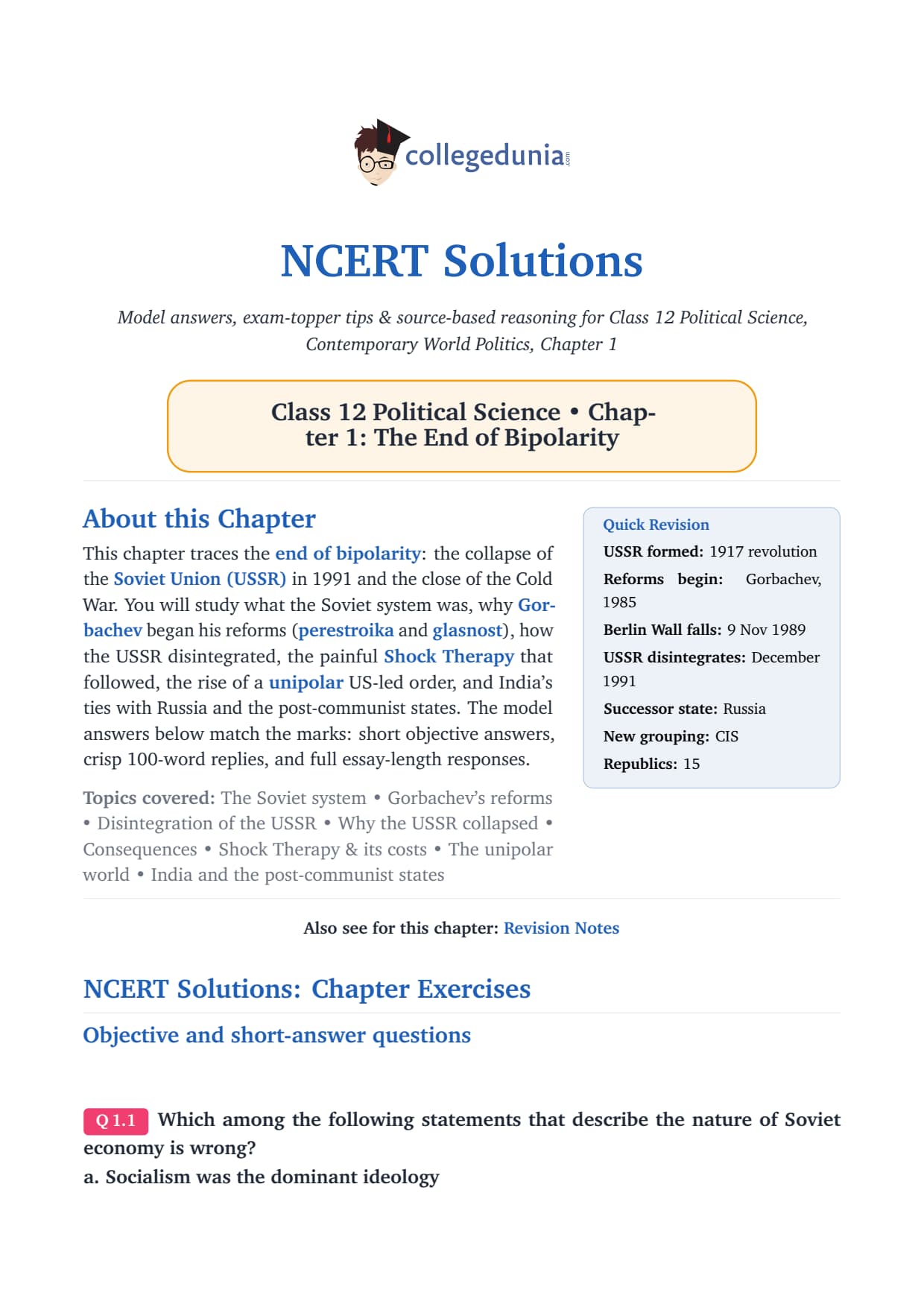
The NCERT Solutions for Political Science Class 12 Chapter 1 The End of Bipolarity answer every textbook question on the collapse of the Soviet Union, set to the latest 2026-27 CBSE syllabus. Each answer explains why the USSR fell, what Shock Therapy was, and how the world moved from two superpowers to one. These solutions help students prepare for the Class 12 Political Science board paper and the UPSC foundation in 2026-27.
Covers all 10 exercise questions from Contemporary World Politics Chapter 1, with full point-wise answers.
This Class 12 Political Science chapter usually carries 5 to 6 marks per board paper.
Pairs with the Notes, Handwritten Notes and NCERT Book PDF linked lower on this page.
Every solution for Class 12 Political Science Chapter 1 in this Collegedunia compilation is written by subject experts from the official NCERT Contemporary World Politics textbook, and checked against the last five years of CBSE board papers.
Student Feedback: In a Collegedunia poll of 9,210 Class 12 Political Science students taken before the 2026 boards, 70% of students rated the Shock Therapy question as the hardest part of The End of Bipolarity. Most students said a clear list of its bad effects made the answer easy to recall.
Source: 2026-27 Class 12 Political Science student poll. Sample of 9,210 students from CBSE schools across 13 states.
What the End of Bipolarity Class 12 Chapter Is About
The End of Bipolarity is the first chapter of Contemporary World Politics. It studies how the Soviet Union (USSR) broke apart in 1991 and how this ended the Cold War. Before this, the world had two power blocs, one led by the United States and one by the USSR. This two-bloc order is called bipolarity.
The chapter answers three big questions that students must keep in mind:
What was the Soviet system? A socialist state with a planned economy and one-party rule.
Why did it collapse? Economic weakness, political stagnation and rising nationalism.
What followed? Shock Therapy in the new states and a single-superpower or unipolar world.
So the chapter is really about a turning point in world history. A student who keeps these three threads in mind can connect almost any question in The End of Bipolarity class 12 back to one of them. This is why revision works best when you sort each fact under "system", "collapse" or "aftermath" first.
The Soviet System and the Socialist Bloc
The Soviet Union grew out of the 1917 Russian Revolution, which was inspired by socialism and the goal of equality. After the Second World War, the USSR became one of two superpowers. To understand its fall, students must first know how its system worked.
Ideology: socialism was the official belief, with no place for private profit.
Economy: the State owned and planned almost everything, so there was little economic freedom.
Politics: the Communist Party dominated, and there was no real opposition.
The bloc: the USSR led the Eastern bloc through the Warsaw Pact military alliance.
The first exercise question asks which statement about the Soviet economy is wrong. The trap is the line "people enjoyed economic freedom". That is the false one, because the State controlled the factors of production. The Soviet economy did give jobs, basic needs and a strong industrial and military base, but it left little room for consumer goods or choice.
Why the Soviet Union Disintegrated
By the 1980s the Soviet system was in deep trouble. The reasons for its fall are a long-answer favourite, so students should learn them as a clear list rather than a story. The table below sorts the main causes for fast revision.
Cause
What it meant
Economic stagnation
The planned economy could not match Western technology or consumer goods; shortages grew.
Arms race
The cost of competing with the US drained money from ordinary life.
Political control
One-party rule and an over-centralised system blocked reform and crushed dissent.
Rise of nationalism
Republics wanted independence; richer ones resented carrying the poorer ones.
Afghan war
The 1979 invasion of Afghanistan cost lives and money and hurt Soviet prestige.
A key insight for the exam is that the deepest cause was economic, but nationalism delivered the final blow. Many people, especially in the richer republics like the Baltic states and Russia itself, felt the union was holding them back. When central control loosened, these feelings broke the country apart.
Gorbachev, Perestroika and Glasnost
Mikhail Gorbachev became leader of the USSR in 1985 and tried to save the system through reform. His ideas matter because they explain how a fix turned into a fall. Students should know both his aims and why they backfired.
Perestroika: the "restructuring" of the economy to make it more open and efficient.
Glasnost: "openness", allowing more free speech, debate and contact with the West.
The aim: to reform the Soviet system from within, not to end it.
The result: openness exposed problems and let nationalist demands grow faster than the system could handle.
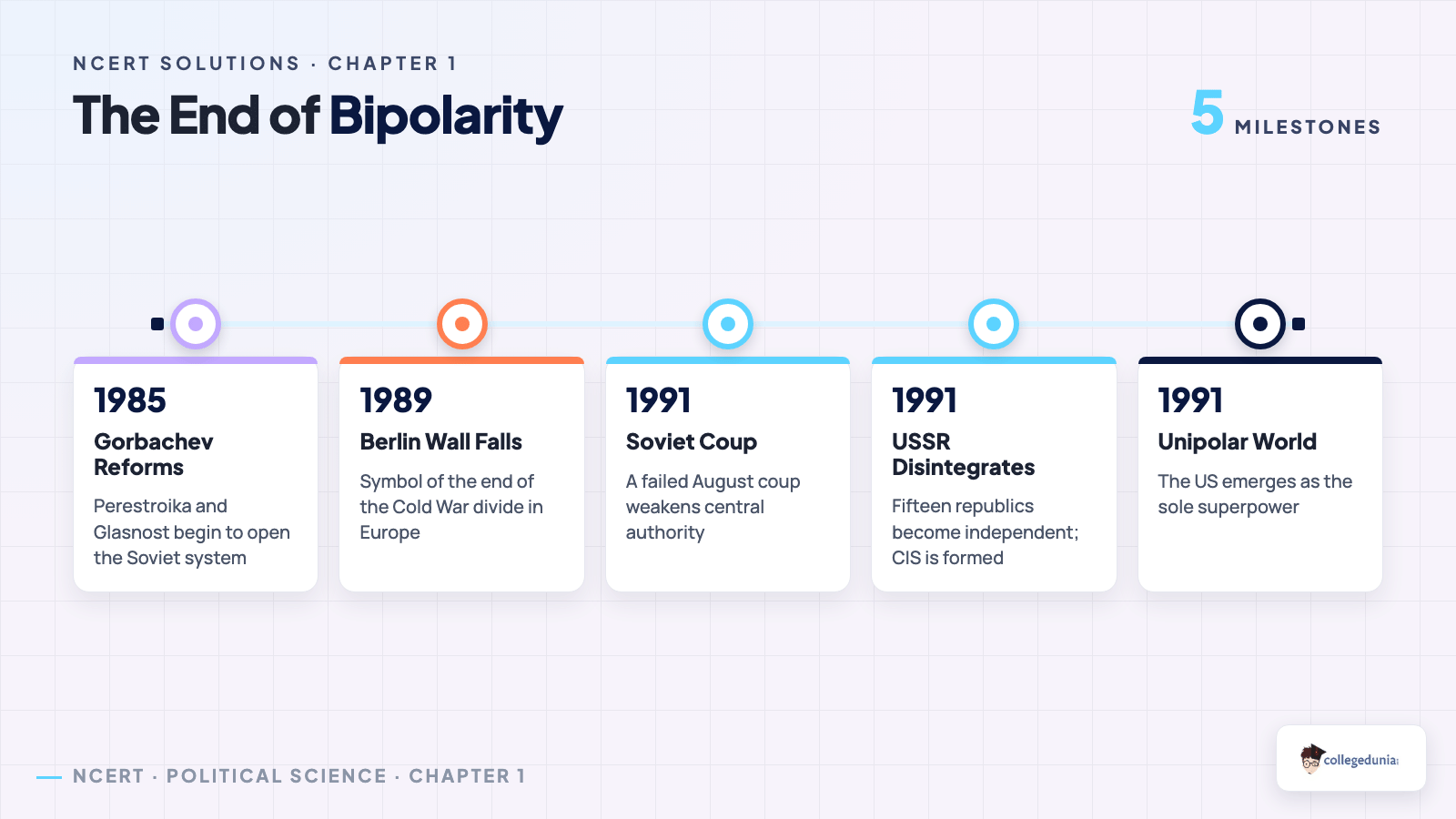
The honest exam point is that Gorbachev's reforms were necessary, but they ran out of his control. Once people could speak freely and the economy stayed weak, calls for independence spread across the republics. By December 1991 the Soviet Union was formally dissolved, and Boris Yeltsin led the new Russia. The fall of the Berlin Wall in 1989 had already signalled that the Cold War divide was ending.
Shock Therapy and the Painful Transition
After 1991 the new states had to shift from a planned economy to a market economy. The model they used, pushed by the World Bank and the IMF, was called Shock Therapy. This is one of the most-asked questions in the chapter, so the answer needs both a definition and a clear judgement.
What it was: a fast, total switch to capitalism, with no slow steps in between.
Privatisation: state industries and assets were sold off quickly.
Free trade: economies were opened to foreign goods and investment at once.
The result: the "largest garage sale in history", mass job losses, and a fall in living standards.
The judgement most answers should reach is that Shock Therapy was not the best way to make the change. It ruined the old industries before new ones grew, wiped out savings through inflation, and made a few people very rich while most got poorer. A slower, step-by-step transition would have caused less hardship. Marks come from giving the definition and then arguing this point with reasons.
Consequences of Disintegration and India-Russia Ties
The fall of the USSR changed the whole world order, and it mattered a lot for India. This topic links the chapter to India's foreign policy, so it is a regular short and long answer. The table keeps the global and Indian effects side by side.
Area
Key consequences to recall
World order
End of the Cold War and the arms race; the US became the sole superpower in a unipolar world.
New states
Fifteen republics became independent; the Commonwealth of Independent States (CIS) was formed.
For India
India lost a steady friend, but kept close ties with Russia and moved towards better relations with the US.
One sharp point for the India question: India and Russia stayed close on defence, energy and trade even after 1991. India still buys much of its military hardware from Russia and shares its vision of a multipolar world. So the disintegration changed the balance of power but did not break the India-Russia friendship, a key idea for the essay-type Question 10.
The End of Bipolarity Class 12 Exercise-wise Coverage
The chapter exercise has 10 questions. The table maps each one to its topic so students can plan revision and find the right NCERT answer fast. The full point-wise solution for each sits in the question set lower on this page.
Question
Topic it tests
Q 1
Wrong statement about the nature of the Soviet economy (MCQ)
Q 2
Chronological order of Cold War and collapse events
Q 3
Statement that is NOT an outcome of the disintegration (MCQ)
Q 4
Match the following (Gorbachev, Shock Therapy, Russia, Yeltsin, Warsaw)
Q 5
Fill in the blanks on the Soviet system and the reforms
Q 6
Three features that distinguish the Soviet economy from the US
Q 7
Factors that forced Gorbachev to start reforms
Q 8
Consequences of disintegration for countries like India
Q 9
What Shock Therapy was, and whether it was the best transition
Q 10
Essay on India's foreign policy after the second world ended
Questions 7, 9 and 10 are the most-asked long answers, so students preparing The End of Bipolarity class 12 important questions should learn those three first. The MCQs and fill-in-the-blanks (Q1 to Q5) are quick marks, so revise the Soviet system facts well to secure them.
Students who want the offline copy can save the class 12 political science chapter 1 pdf from the download card above and tick off each question as they finish it.
The End of Bipolarity Important Questions and Previous Year Trends
CBSE sets a steady mix of MCQ, short and long answers from this chapter. Knowing the pattern helps students decide how much to write. The chapter is a regular source of one 4-mark or 6-mark question, which is why a focused list of The End of Bipolarity important questions saves a lot of revision time.
Long answer (5 to 6 marks): why the USSR collapsed, or what Shock Therapy was.
Short answer (4 marks): consequences of disintegration, or features of the Soviet economy.
Source-based: a passage on Gorbachev's reforms or the new world order, with sub-parts.
Objective and MCQ: dates, the Warsaw Pact, the CIS, and who led the reforms.
For quick recall before the exam, students often practise the class 12 political science chapter 1 mcq set and a list of The End of Bipolarity class 12 important questions. The most repeated items are the causes of collapse and the Shock Therapy judgement, so keep those answer points ready in your own words.
Working through the ncert solutions class 12 political science chapter 1 set twice, once open-book and once from memory, fixes the dates and names well before the board exam.
Common Mistakes Students Make in This Chapter
A few errors cost marks every year in this chapter. Most come from mixing up dates or giving only one side of the Shock Therapy debate. Avoiding them is the fastest way to lift a score.
Saying people had "economic freedom" in the USSR - they did not; the State controlled the economy.
Confusing Perestroika (economy) with Glasnost (openness) - keep the two clearly separate.
Calling Shock Therapy a success - most answers should argue it caused deep hardship.
Forgetting the Warsaw Pact was the Soviet-led military alliance, not the NATO bloc.
Writing that India broke ties with Russia after 1991 - the two stayed close friends.
Students who fix these five points usually move from average to high marks on the long answers. The exam rewards a balanced view, so always give both the aim and the result of the reforms before you judge them.
The End of Bipolarity PDF Download Formats and Languages
The solutions are free to download in more than one format, so students can pick what suits their device and revision style. The download card at the top of the page carries each option for this chapter.
Normal and HD PDF: the class 12 political science chapter 1 pdf comes in a normal size for quick downloads and an HD version for clear printing.
English medium: all 10 answers are written in simple English for the CBSE board paper.
Question-only set: a print-and-practise sheet of The End of Bipolarity extra questions for self-testing.
Whole-book pack: the solutions sit in one set that runs through every Contemporary World Politics chapter, so you can revise from Chapter 1 onwards in one place.
Many students search for class 12 political science chapter 1 answers on their phone the night before a test, so a saved PDF means you can revise even without internet. Keep both the question set and the solved version handy for a full self-check.
How the End of Bipolarity Solutions Pair with Notes and the Book PDF
These NCERT Solutions answer the back-exercise questions. To revise the full chapter, students should use them alongside the other resources for the same chapter, all linked in the table below.
Reading the original NCERT chapter text and figures
Tip: read the Notes first, then attempt these solutions on your own, and only then check the model answers here. That order builds memory faster than copying answers straight away.
All NCERT Solutions for Class 12 Political Science
The table links the NCERT Solutions for every chapter in both Class 12 Political Science books, so students can move across the course in one click. The End of Bipolarity is highlighted.
All NCERT Solutions for The End of Bipolarity with Step-by-Step Solutions
Below are all 10 NCERT exercise questions for this chapter, exactly as they appear in the textbook. Tap Check Solution for the model answer or Expert Solution for the topper-style approach.
Q 1.1
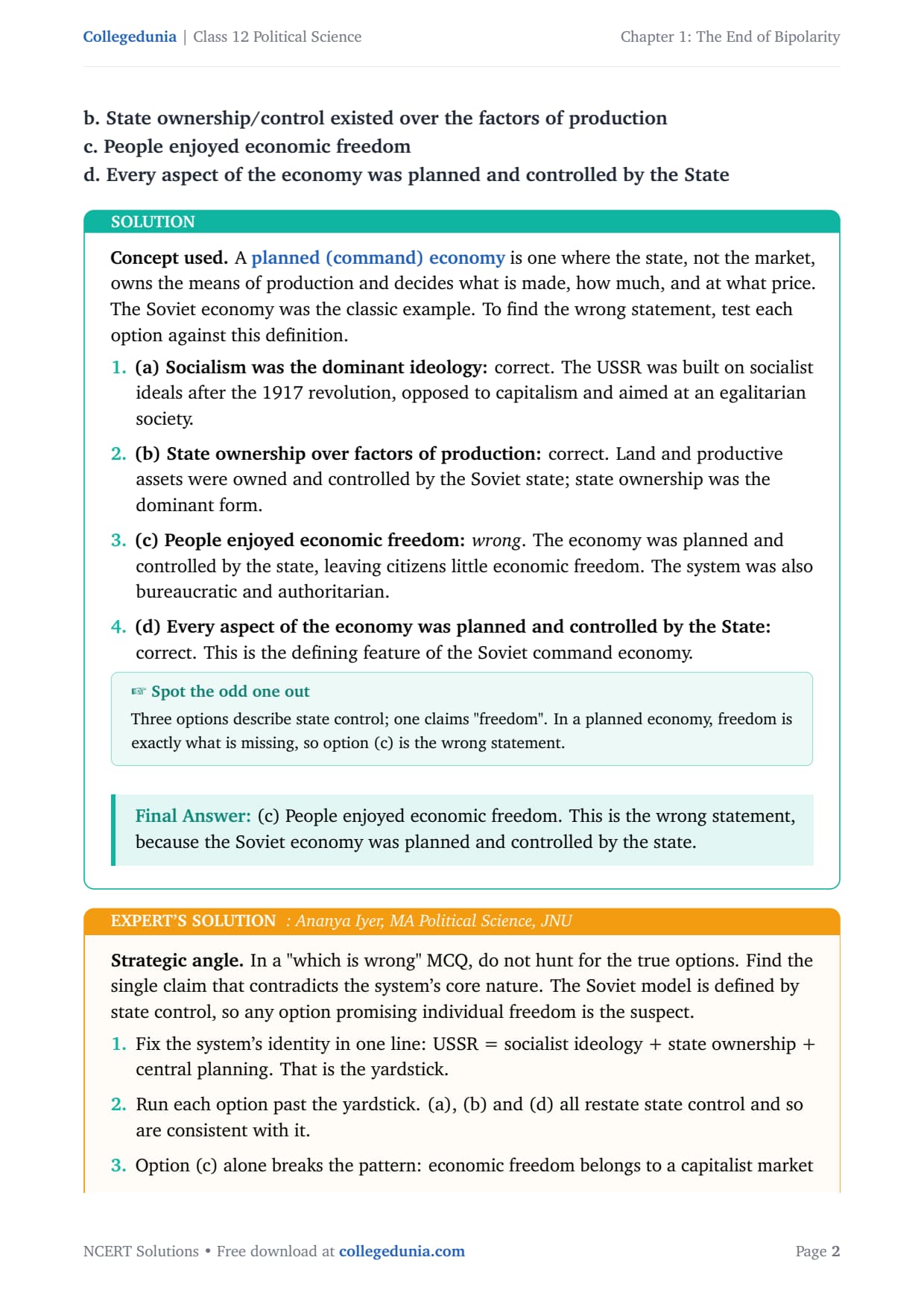
Which among the following statements that describe the nature of
Soviet economy is wrong?
a. Socialism was the dominant ideology
b. State ownership/control existed over the factors of production
c. People enjoyed economic freedom
d. Every aspect of the economy was planned and controlled by the State
Concept used. A planned (command) economy is one where the
state, not the market, owns the means of production and decides what is made,
how much, and at what price. The Soviet economy was the classic example. To
find the wrong statement, test each option against this definition.
(a) Socialism was the dominant ideology: correct. The USSR
was built on socialist ideals after the 1917 revolution, opposed to
capitalism and aimed at an egalitarian society.
(b) State ownership over factors of production: correct.
Land and productive assets were owned and controlled by the Soviet
state; state ownership was the dominant form.
(c) People enjoyed economic freedom:wrong. The
economy was planned and controlled by the state, leaving citizens
little economic freedom. The system was also bureaucratic and
authoritarian.
(d) Every aspect of the economy was planned and controlled by
the State: correct. This is the defining feature of the Soviet
command economy.
Spot the odd one out
Three options describe state control; one claims "freedom". In a planned
economy, freedom is exactly what is missing, so option (c) is the wrong
statement.
(c) People enjoyed economic freedom. This is the wrong statement,
because the Soviet economy was planned and controlled by the state.
AI
Ananya Iyer
MA Political Science, JNU
Verified Expert
Strategic angle. In a "which is wrong" MCQ, do not hunt for the true
options. Find the single claim that contradicts the system's core nature. The
Soviet model is defined by state control, so any option promising individual
freedom is the suspect.
Fix the system's identity in one line: USSR = socialist ideology +
state ownership + central planning. That is the yardstick.
Run each option past the yardstick. (a), (b) and (d) all restate state
control and so are consistent with it.
Option (c) alone breaks the pattern: economic freedom belongs to a
capitalist market economy, not a command economy. So (c) is the
false statement.
Why this matters. The contrast tested here, planned versus market,
runs through the whole chapter and explains why Shock Therapy later tried to
hand economic freedom back to the people by force. Reading the wrong option as
the capitalist intruder is the fastest, surest route to the mark.
The wrong statement is (c): people did not enjoy economic freedom
under the state-planned Soviet economy.
Q 1.2
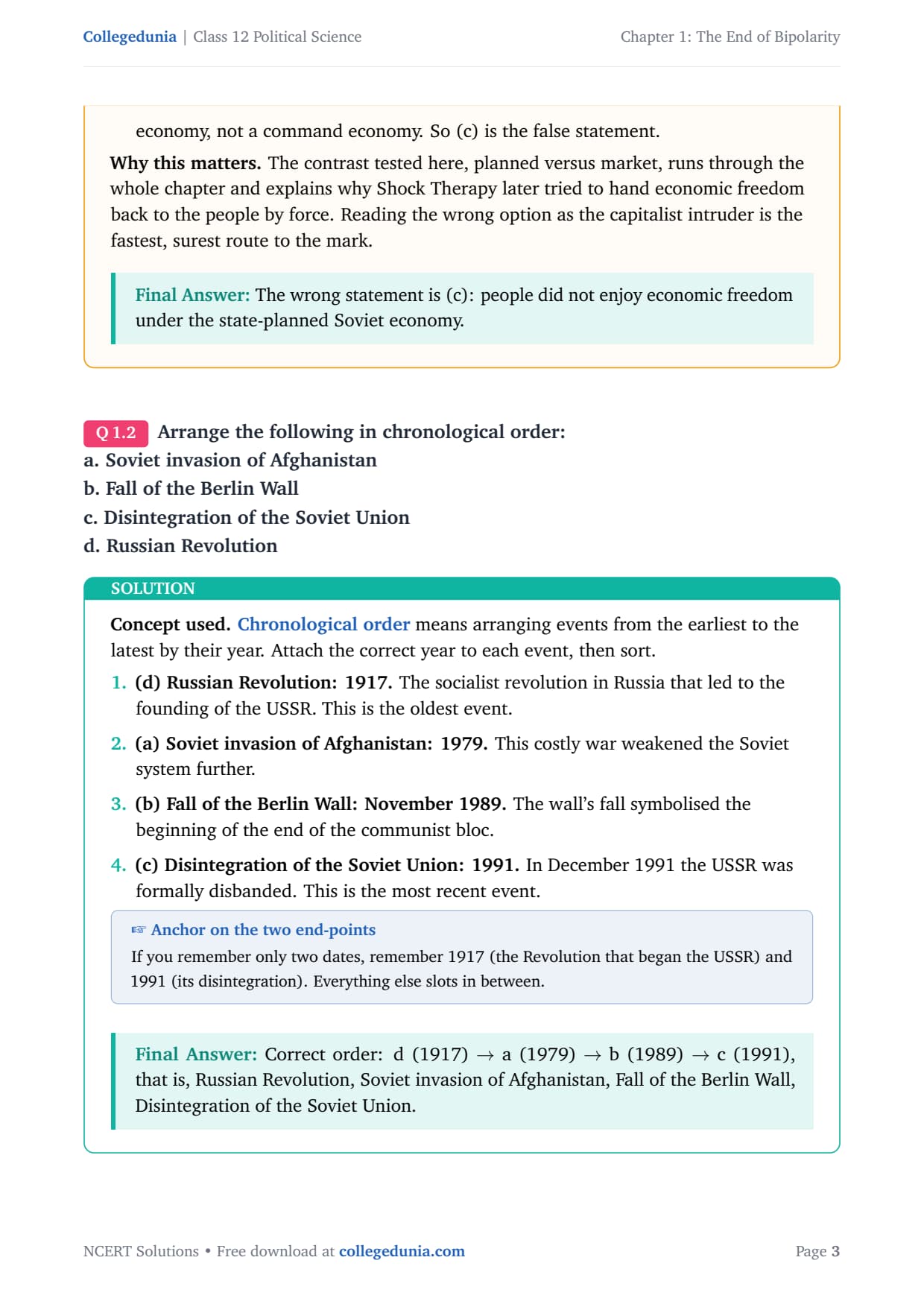
Arrange the following in chronological order:
a. Soviet invasion of Afghanistan
b. Fall of the Berlin Wall
c. Disintegration of the Soviet Union
d. Russian Revolution
Concept used.Chronological order means arranging events
from the earliest to the latest by their year. Attach the correct year to each
event, then sort.
(d) Russian Revolution: 1917. The socialist revolution in
Russia that led to the founding of the USSR. This is the oldest event.
(a) Soviet invasion of Afghanistan: 1979. This costly war
weakened the Soviet system further.
(b) Fall of the Berlin Wall: November 1989. The wall's fall
symbolised the beginning of the end of the communist bloc.
(c) Disintegration of the Soviet Union: 1991. In December
1991 the USSR was formally disbanded. This is the most recent event.
Anchor on the two end-points
If you remember only two dates, remember 1917 (the Revolution that began the
USSR) and 1991 (its disintegration). Everything else slots in between.
Correct order: d (1917) → a (1979) → b (1989)
→ c (1991), that is, Russian Revolution, Soviet invasion of
Afghanistan, Fall of the Berlin Wall, Disintegration of the Soviet Union.
AV
Aditya Verma
MA International Relations, Jadavpur University
Verified Expert
Quick reading. A "chronological order" question is really a
date-recall task in disguise. Write the year beside each option in the margin
first, then the order falls out on its own.
Tag the births and deaths of the system: 1917 is the birth (Russian
Revolution), 1991 is the death (disintegration). They book-end the
list.
Slot the two middle events by decade: Afghanistan is the late 1970s
(1979), the Berlin Wall is the late 1980s (1989).
Read off the sequence: 1917, 1979, 1989, 1991, which is d, a, b, c.
Why this matters. The four events form a clean storyline: the USSR is
born, overreaches in Afghanistan, loses its grip when the Wall falls, and
finally dissolves. Seeing the narrative, not just the dates, makes the order
impossible to forget.
d, a, b, c: Russian Revolution (1917), Soviet invasion of
Afghanistan (1979), Fall of the Berlin Wall (1989), Disintegration of the
Soviet Union (1991).
Q 1.3
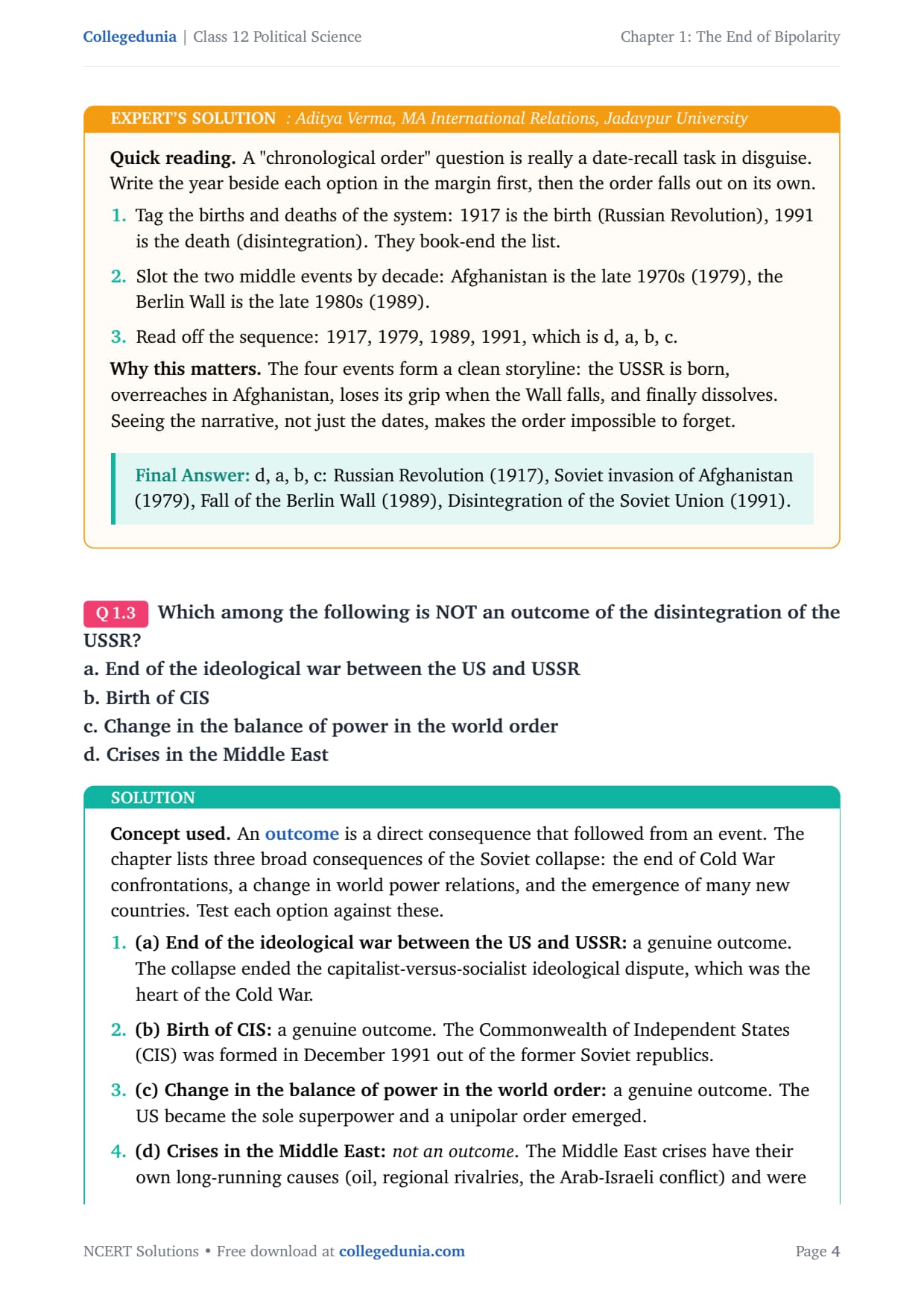
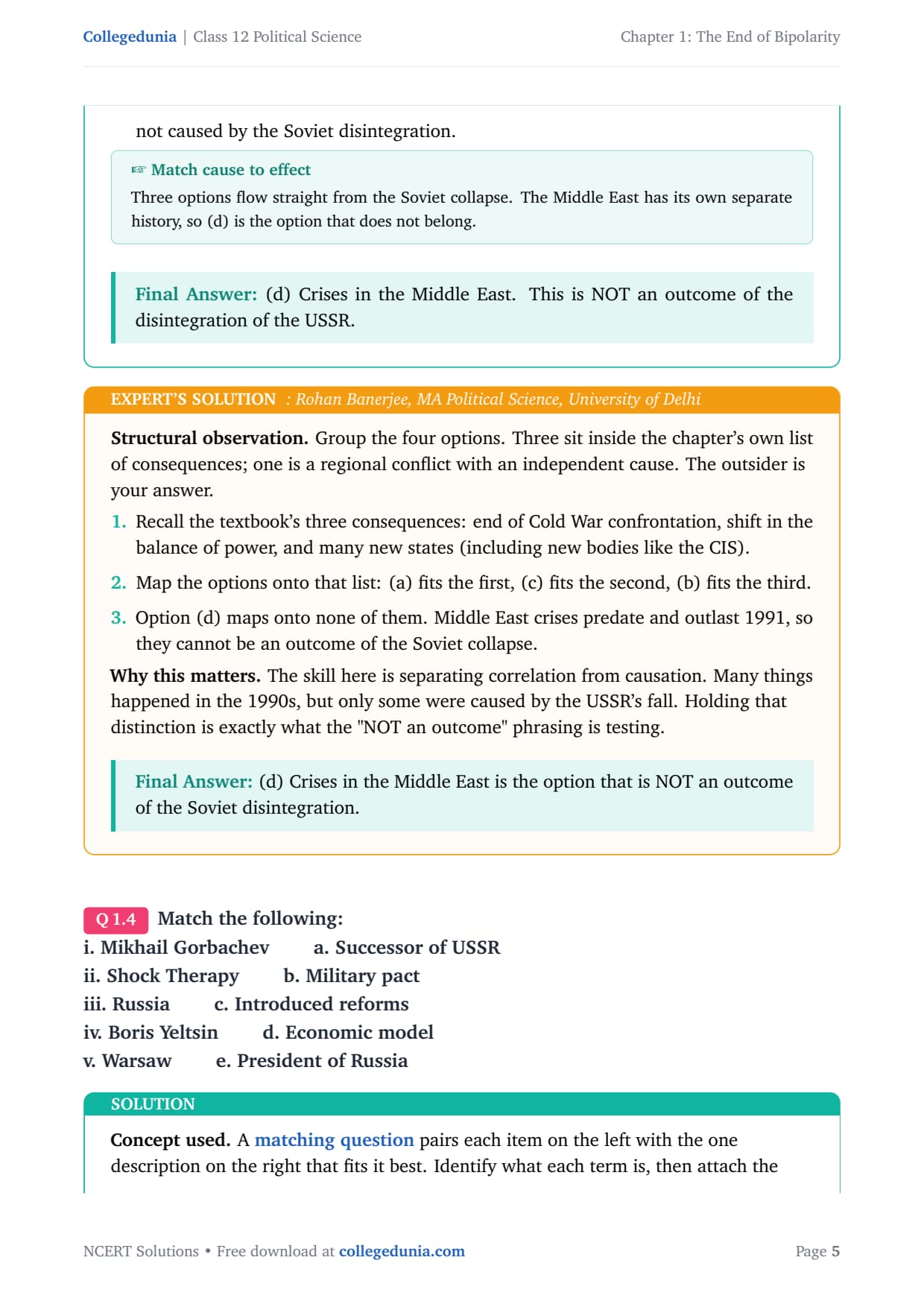
Which among the following is NOT an outcome of the disintegration of
the USSR?
a. End of the ideological war between the US and USSR
b. Birth of CIS
c. Change in the balance of power in the world order
d. Crises in the Middle East
Concept used. An outcome is a direct consequence that
followed from an event. The chapter lists three broad consequences of the
Soviet collapse: the end of Cold War confrontations, a change in world power
relations, and the emergence of many new countries. Test each option against
these.
(a) End of the ideological war between the US and USSR: a
genuine outcome. The collapse ended the capitalist-versus-socialist
ideological dispute, which was the heart of the Cold War.
(b) Birth of CIS: a genuine outcome. The Commonwealth of
Independent States (CIS) was formed in December 1991 out of the former
Soviet republics.
(c) Change in the balance of power in the world order: a
genuine outcome. The US became the sole superpower and a unipolar
order emerged.
(d) Crises in the Middle East:not an outcome. The
Middle East crises have their own long-running causes (oil, regional
rivalries, the Arab-Israeli conflict) and were not caused by the
Soviet disintegration.
Match cause to effect
Three options flow straight from the Soviet collapse. The Middle East has its
own separate history, so (d) is the option that does not belong.
(d) Crises in the Middle East. This is NOT an outcome of the
disintegration of the USSR.
RB
Rohan Banerjee
MA Political Science, University of Delhi
Verified Expert
Structural observation. Group the four options. Three sit inside the
chapter's own list of consequences; one is a regional conflict with an
independent cause. The outsider is your answer.
Recall the textbook's three consequences: end of Cold War
confrontation, shift in the balance of power, and many new states
(including new bodies like the CIS).
Map the options onto that list: (a) fits the first, (c) fits the
second, (b) fits the third.
Option (d) maps onto none of them. Middle East crises predate and
outlast 1991, so they cannot be an outcome of the Soviet collapse.
Why this matters. The skill here is separating correlation from
causation. Many things happened in the 1990s, but only some were caused by the
USSR's fall. Holding that distinction is exactly what the "NOT an outcome"
phrasing is testing.
(d) Crises in the Middle East is the option that is NOT an outcome of
the Soviet disintegration.
Q 1.4
Match the following:
i. Mikhail Gorbachev a. Successor of USSR
ii. Shock Therapy b. Military pact
iii. Russia c. Introduced reforms
iv. Boris Yeltsin d. Economic model
v. Warsaw e. President of Russia
Concept used. A matching question pairs each item on the
left with the one description on the right that fits it best. Identify what
each term is, then attach the matching label.
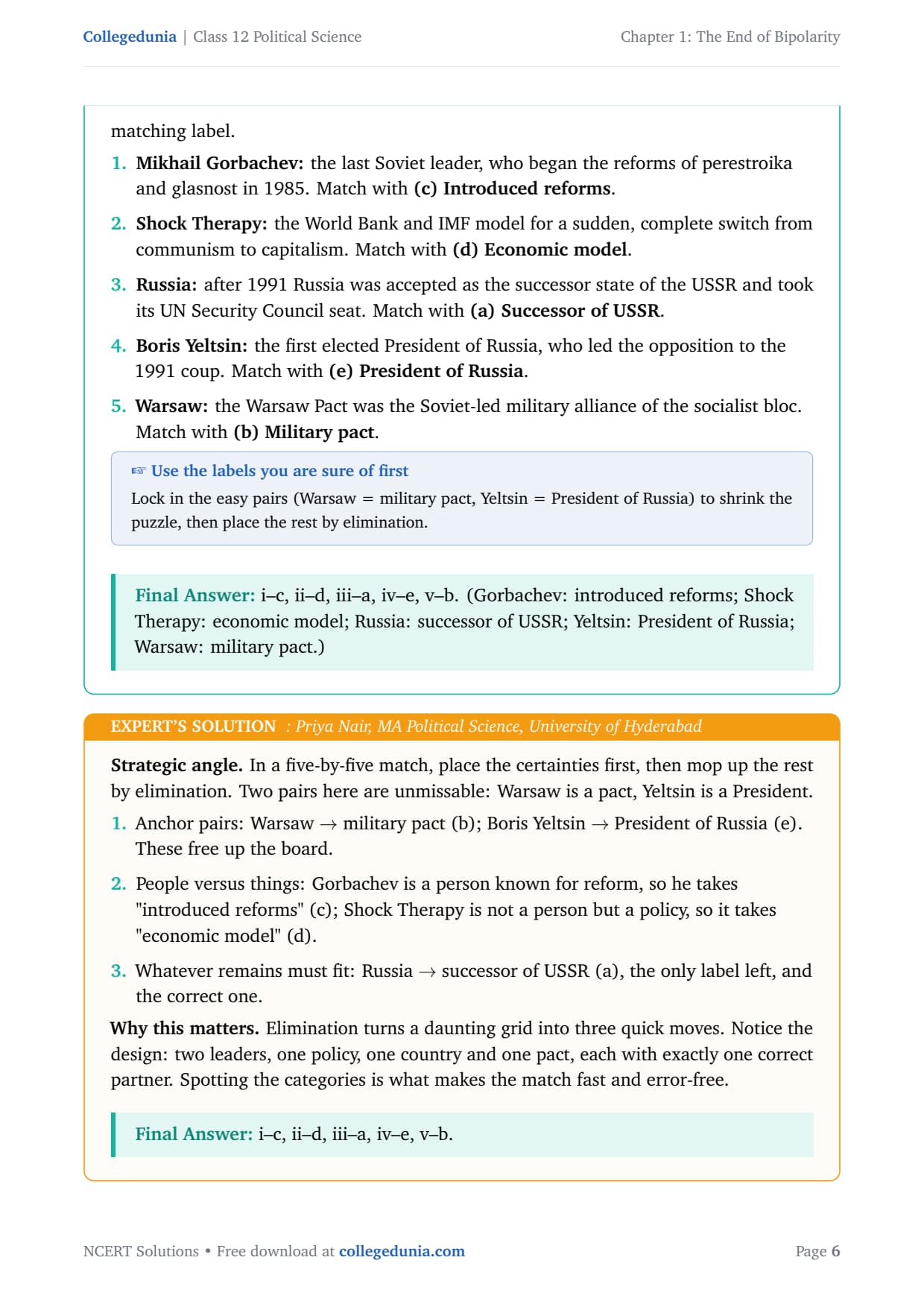
Mikhail Gorbachev: the last Soviet leader, who began the
reforms of perestroika and glasnost in 1985. Match with
(c) Introduced reforms.
Shock Therapy: the World Bank and IMF model for a sudden,
complete switch from communism to capitalism. Match with
(d) Economic model.
Russia: after 1991 Russia was accepted as the successor state
of the USSR and took its UN Security Council seat. Match with
(a) Successor of USSR.
Boris Yeltsin: the first elected President of Russia, who led
the opposition to the 1991 coup. Match with (e) President of
Russia.
Warsaw: the Warsaw Pact was the Soviet-led military alliance
of the socialist bloc. Match with (b) Military pact.
Use the labels you are sure of first
Lock in the easy pairs (Warsaw = military pact, Yeltsin = President of Russia)
to shrink the puzzle, then place the rest by elimination.
i–c, ii–d, iii–a, iv–e, v–b. (Gorbachev: introduced reforms;
Shock Therapy: economic model; Russia: successor of USSR; Yeltsin: President
of Russia; Warsaw: military pact.)
PN
Priya Nair
MA Political Science, University of Hyderabad
Verified Expert
Strategic angle. In a five-by-five match, place the certainties
first, then mop up the rest by elimination. Two pairs here are unmissable:
Warsaw is a pact, Yeltsin is a President.
Anchor pairs: Warsaw → military pact (b); Boris Yeltsin
→ President of Russia (e). These free up the board.
People versus things: Gorbachev is a person known for reform, so he
takes "introduced reforms" (c); Shock Therapy is not a person but a
policy, so it takes "economic model" (d).
Whatever remains must fit: Russia → successor of USSR (a),
the only label left, and the correct one.
Why this matters. Elimination turns a daunting grid into three quick
moves. Notice the design: two leaders, one policy, one country and one pact,
each with exactly one correct partner. Spotting the categories is what makes
the match fast and error-free.
i–c, ii–d, iii–a, iv–e, v–b.
Q 1.5
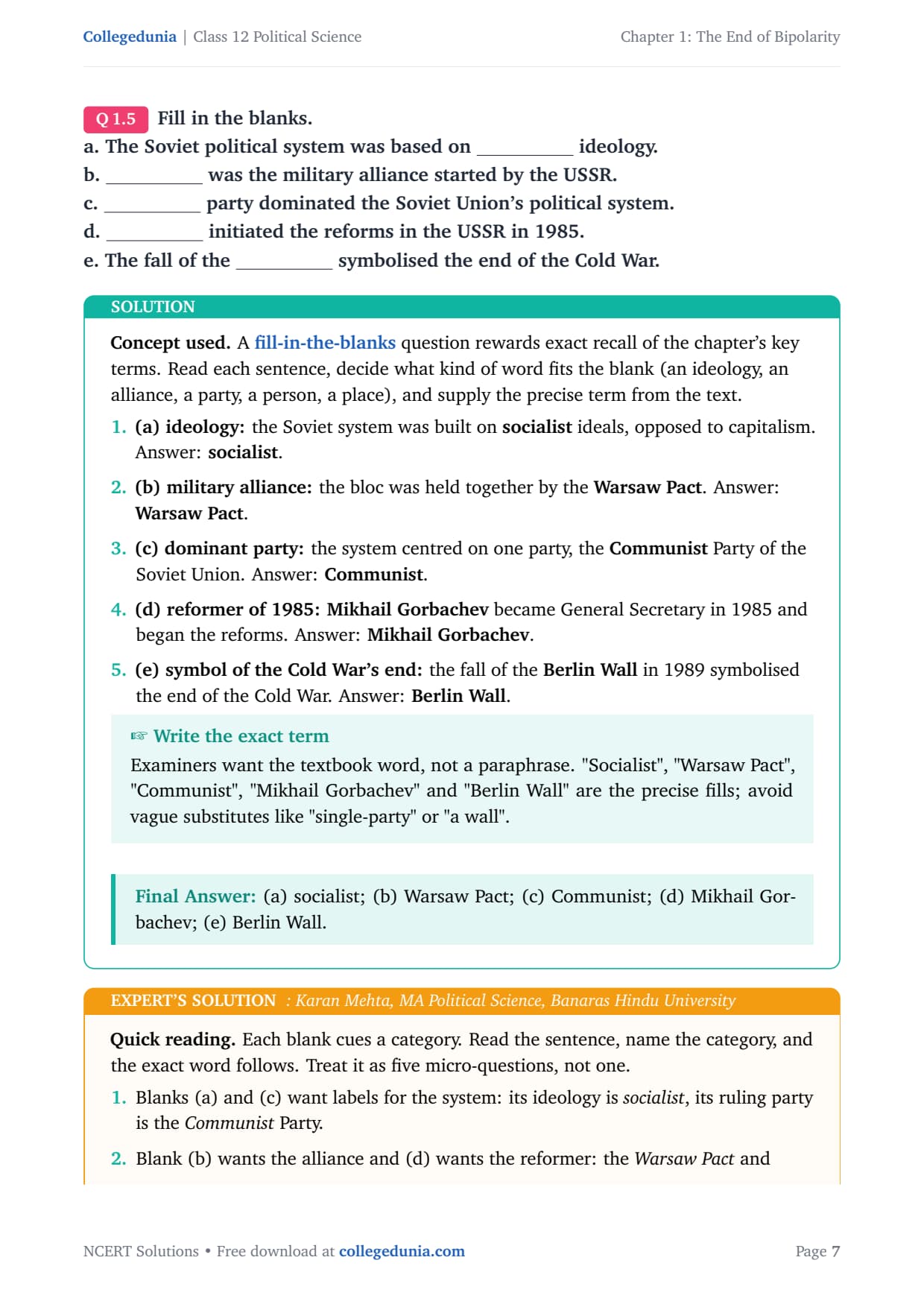
Fill in the blanks.
a. The Soviet political system was based on 2.2cm ideology.
b. 2.2cm was the military alliance started by the USSR.
c. 2.2cm party dominated the Soviet Union's political system.
d. 2.2cm initiated the reforms in the USSR in 1985.
e. The fall of the 2.2cm symbolised the end of the Cold War.
Concept used. A fill-in-the-blanks question rewards exact
recall of the chapter's key terms. Read each sentence, decide what kind of
word fits the blank (an ideology, an alliance, a party, a person, a place),
and supply the precise term from the text.
(a) ideology: the Soviet system was built on socialist
ideals, opposed to capitalism. Answer: socialist.
(b) military alliance: the bloc was held together by the
Warsaw Pact. Answer: Warsaw Pact.
(c) dominant party: the system centred on one party, the
Communist Party of the Soviet Union. Answer: Communist.
(d) reformer of 1985:Mikhail Gorbachev became
General Secretary in 1985 and began the reforms. Answer:
Mikhail Gorbachev.
(e) symbol of the Cold War's end: the fall of the
Berlin Wall in 1989 symbolised the end of the Cold War.
Answer: Berlin Wall.
Write the exact term
Examiners want the textbook word, not a paraphrase. "Socialist", "Warsaw
Pact", "Communist", "Mikhail Gorbachev" and "Berlin Wall" are the precise
fills; avoid vague substitutes like "single-party" or "a wall".
Quick reading. Each blank cues a category. Read the sentence, name
the category, and the exact word follows. Treat it as five micro-questions,
not one.
Blanks (a) and (c) want labels for the system: its ideology is
socialist, its ruling party is the Communist Party.
Blank (b) wants the alliance and (d) wants the reformer: the
Warsaw Pact and Mikhail Gorbachev respectively.
Blank (e) wants the Cold War's closing symbol: the fall of the
Berlin Wall in 1989.
Why this matters. These five terms are the spine of the chapter:
ideology, alliance, party, reformer and symbol. Fixing them firmly here makes
every longer answer in the chapter easier, because they are the vocabulary you
will reuse throughout.
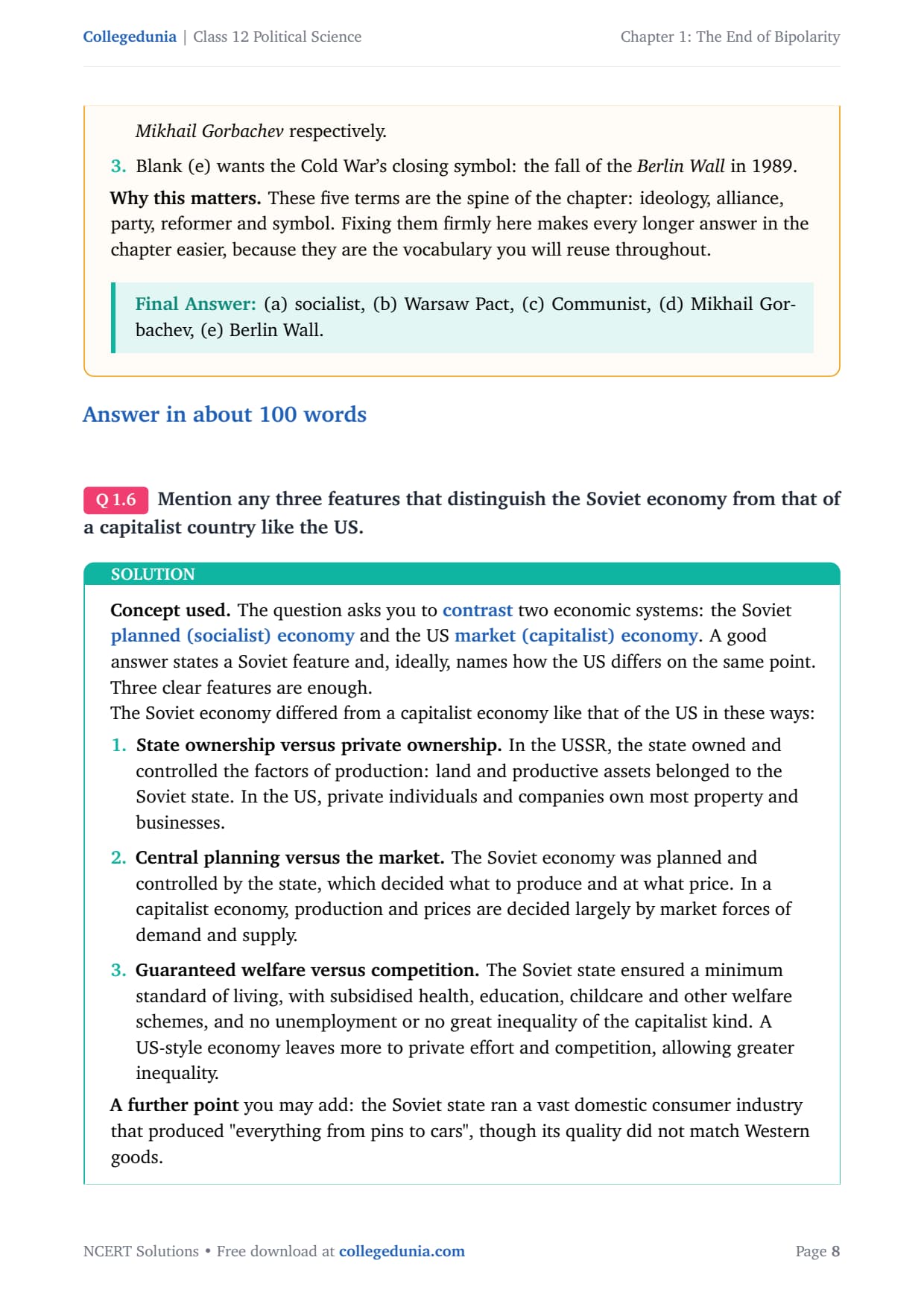
Mention any three features that distinguish the Soviet economy from
that of a capitalist country like the US.
Concept used. The question asks you to contrast two economic
systems: the Soviet planned (socialist) economy and the US
market (capitalist) economy. A good answer states a Soviet feature
and, ideally, names how the US differs on the same point. Three clear features
are enough.
The Soviet economy differed from a capitalist economy like that of the US in
these ways:
State ownership versus private ownership. In the USSR, the
state owned and controlled the factors of production: land and
productive assets belonged to the Soviet state. In the US, private
individuals and companies own most property and businesses.
Central planning versus the market. The Soviet economy was
planned and controlled by the state, which decided what to produce and
at what price. In a capitalist economy, production and prices are
decided largely by market forces of demand and supply.
Guaranteed welfare versus competition. The Soviet state
ensured a minimum standard of living, with subsidised health,
education, childcare and other welfare schemes, and no unemployment or
no great inequality of the capitalist kind. A US-style economy leaves
more to private effort and competition, allowing greater inequality.
A further point you may add: the Soviet state ran a vast domestic
consumer industry that produced "everything from pins to cars", though its
quality did not match Western goods.
Answer in contrasting pairs
For "distinguish" questions, frame each feature as a pair: "In the USSR ...
whereas in the US ...". This shows the difference clearly and reads as a
deliberate contrast.
Three distinguishing features: (1) state ownership of all factors of
production versus private ownership; (2) central state planning versus the
free market; (3) a state-guaranteed minimum standard of living and subsidised
welfare versus a competitive, less-regulated capitalist system.
SR
Siddharth Rao
MA Political Science, Jamia Millia Islamia
Verified Expert
Structural observation. The verb is "distinguish", so the marks are
in the contrast, not in a one-sided description. Pick three axes on which the
two systems clearly differ, and state both sides of each axis in a single
breath.
Axis one, ownership: the Soviet state owned land and productive
assets; in the US, ownership is private. This is the deepest
difference and earns the first mark.
Axis two, coordination: the USSR planned the economy centrally,
deciding outputs and prices, while a capitalist economy is steered by
market forces. Name "planning versus market" explicitly.
Axis three, welfare and equality: the Soviet system subsidised basic
needs and promised a minimum living standard with little open
inequality, whereas the US system accepts inequality as the price of
competition.
Why this matters. These three axes, ownership, coordination and
welfare, are the standard lens for comparing any socialist and capitalist
economy, not just the USSR and the US. Master them here and you can answer the
same comparison wherever it appears in the syllabus.
State ownership versus private ownership; central planning versus the
market; and state-guaranteed welfare with low inequality versus competitive
capitalism, are three features that set the Soviet economy apart from the US.
Q 1.7
What were the factors that forced Gorbachev to initiate the reforms
in the USSR?
Concept used. This is a causes question. You must list the
internal weaknesses and external pressures that made reform unavoidable for
Mikhail Gorbachev, who became General Secretary in 1985. Group the
factors so they are easy to mark.
The main factors that forced Gorbachev to begin reforms were:
Economic stagnation and the arms-race burden. The Soviet
economy had become stagnant. It used much of its resources on a huge
nuclear and military arsenal and on maintaining satellite states in
Eastern Europe and the Central Asian republics, an economic burden the
system could not bear.
Technological backwardness. The USSR lagged behind the West
in technology, infrastructure (transport, power) and in meeting the
people's needs. Reforms were necessary to keep up with the
information and technological revolutions taking place in the West.
Consumer shortages and food imports. Wages grew but
productivity and technology fell behind, causing shortages of all
consumer goods. Food imports rose every year. The Soviet invasion of
Afghanistan in 1979 weakened the system further.
Political stagnation and lost legitimacy. The Communist Party
had ruled for over 70 years and was unaccountable to the people.
Rampant corruption, a stifling bureaucracy, the absence of openness,
and party bureaucrats enjoying privileges left ordinary people
alienated, and the government lost popular backing.
Awareness of the West. Citizens grew more knowledgeable about
the economic advance of the West and could see the gap between their
system and the Western one, which came as a psychological shock.
Reform was a response, not a whim
Gorbachev's reforms were forced by a system already in deep crisis. He
correctly diagnosed the problems; the tragedy was that loosening the system
released forces he could not control.
Gorbachev was forced to reform by economic stagnation, the crushing
cost of the arms race and the satellite states, technological backwardness,
consumer shortages and rising food imports, a corrupt and unaccountable
party, the Afghanistan war, and people's growing awareness of how far the West
had advanced.
NJ
Neha Joshi
MA Political Science, University of Delhi
Verified Expert
Strategic angle. Sort the pressures into two buckets, economic and
political, then add the external trigger. A bucketed answer covers more ground
in fewer words and is easy for the examiner to tick off.
Economic bucket: the economy was stagnant, drained by the arms race
and by propping up Eastern Europe and Central Asia, technologically
behind the West, and short of consumer goods, with food imports
climbing every year.
Political bucket: a 70-year unaccountable Communist Party, corruption,
a suffocating bureaucracy, no openness, and privileged officials, all
of which had cost the regime its popular support.
External trigger: the 1979 Afghanistan invasion drained the system,
while growing public awareness of Western prosperity made the
backwardness feel intolerable.
Why this matters. The economic-versus-political split mirrors
Gorbachev's own twin reforms: perestroika (economic restructuring) answered
the economic bucket, and glasnost (openness) answered the political one.
Linking causes to the cure shows the examiner you understand why he reformed,
not just that he did. There is also a sharper point worth making: Gorbachev's
diagnosis was accurate but his timing was fatal. The same pressures that
forced reform, a hollow economy and an alienated public, also meant that once
he loosened the system, the pent-up nationalism in the republics surged
beyond his control. So the very factors that compelled reform were the ones
that turned reform into disintegration, which is the chapter's central irony.
Economic stagnation, the arms-race and satellite-state burden,
technological lag, consumer shortages, an unaccountable and corrupt party, the
Afghanistan war, and rising awareness of Western advance together forced
Gorbachev to launch his reforms.
Q 1.8
What were the major consequences of the disintegration of the Soviet
Union for countries like India?
Concept used. The disintegration of the USSR ended the
bipolar world and created a unipolar order led by the US.
This question asks how that shift affected countries like India: both the
wider change and India's specific gains and adjustments.
For countries like India, the major consequences were:
End of bipolarity and a unipolar world. The collapse left the
US as the sole superpower, and the capitalist economy became the
dominant international system. Bodies like the World Bank and the IMF
grew powerful as advisors and lenders to countries making the
transition.
Rise of liberal democracy and capitalism as models. Liberal
democracy emerged as the favoured way to organise political life, and
a free-market, capitalist path became the dominant economic model.
This influenced India's own move towards economic reform and openness.
Emergence of many new states. The end of the Soviet bloc
created many new countries, each with its own aspirations, giving
India new partners to build relations with, especially the
post-communist republics.
Continued, valued ties with Russia. India kept its strong
relationship with Russia, the successor state, which remained
important for arms, energy, space technology (for example the
cryogenic rocket) and support on issues like Kashmir.
Two effects at once
The collapse pushed India both ways: towards engaging the now-dominant US-led
capitalist order, and towards preserving its trusted, multi-dimensional
partnership with Russia.
The Soviet collapse left a unipolar, US-led world with capitalism and
liberal democracy dominant and the World Bank and IMF powerful. For India it
meant adjusting to this order and reforming its economy, gaining many new
post-communist partners, while keeping its valued ties with Russia for arms,
energy and diplomatic support.
VK
Vivaan Kapoor
MA International Relations, JNU
Verified Expert
Strategic angle. Split the answer into "the world India now faced" and
"what India did about it". The first half is the systemic change (unipolarity,
capitalism, new institutions); the second half is India's own response
(reform, new partners, continued Russia ties).
Systemic change: bipolarity gave way to a unipolar US-led order;
capitalism and liberal democracy became the dominant models; the World
Bank and IMF gained influence over transition economies.
New geography: a crop of new post-communist states appeared, widening
the field of countries India could engage with diplomatically and
economically.
India's response: it leaned into economic reform in tune with the new
order, yet retained its trusted partnership with Russia for defence,
energy and support on Kashmir and terrorism.
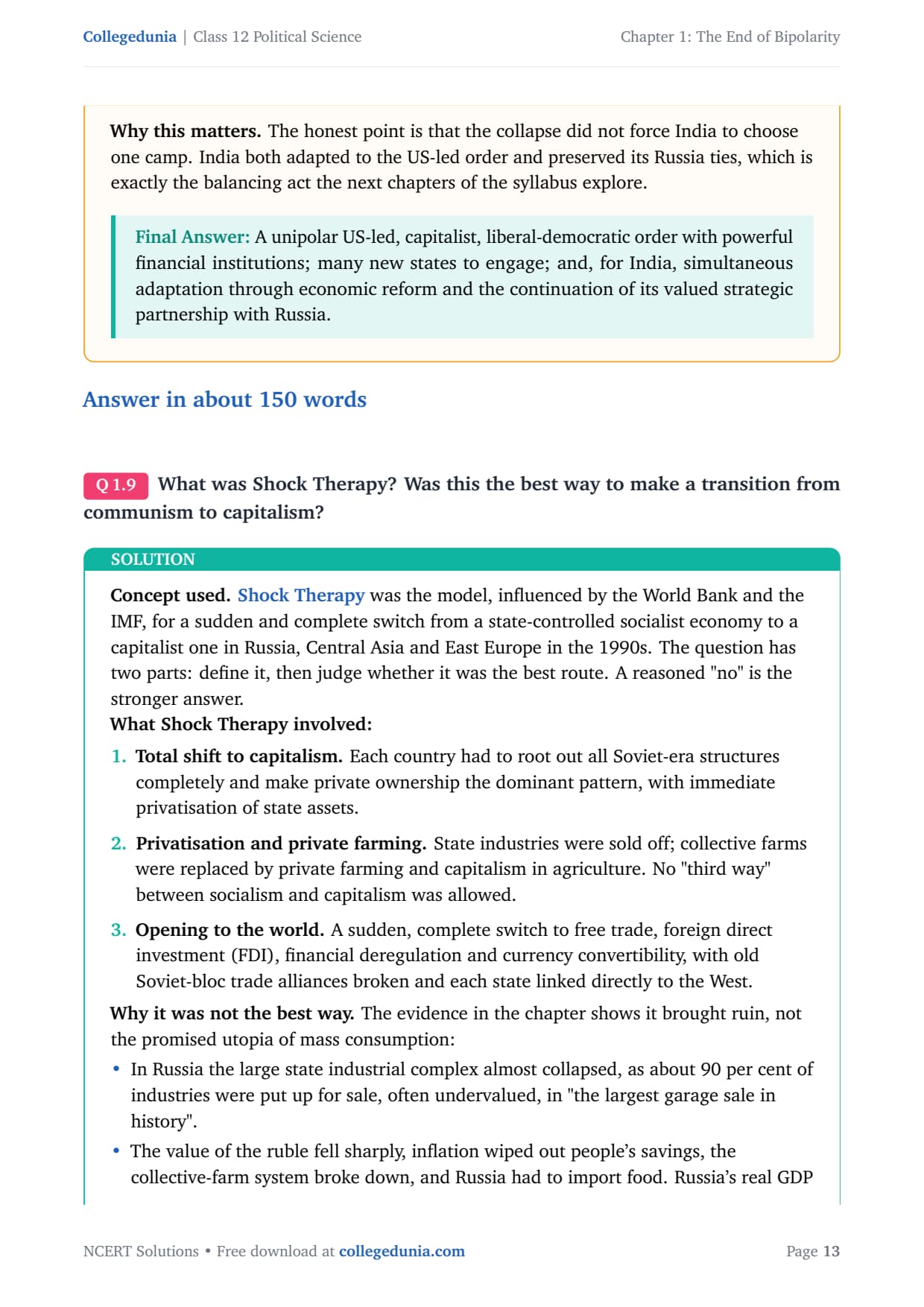
Why this matters. The honest point is that the collapse did not force
India to choose one camp. India both adapted to the US-led order and preserved
its Russia ties, which is exactly the balancing act the next chapters of the
syllabus explore.
A unipolar US-led, capitalist, liberal-democratic order with powerful
financial institutions; many new states to engage; and, for India,
simultaneous adaptation through economic reform and the continuation of its
valued strategic partnership with Russia.
Q 1.9
What was Shock Therapy? Was this the best way to make a transition
from communism to capitalism?
Concept used.Shock Therapy was the model, influenced by the
World Bank and the IMF, for a sudden and complete switch from a
state-controlled socialist economy to a capitalist one in Russia, Central Asia
and East Europe in the 1990s. The question has two parts: define it, then
judge whether it was the best route. A reasoned "no" is the stronger answer.
What Shock Therapy involved:
Total shift to capitalism. Each country had to root out all
Soviet-era structures completely and make private ownership the
dominant pattern, with immediate privatisation of state assets.
Privatisation and private farming. State industries were sold
off; collective farms were replaced by private farming and capitalism
in agriculture. No "third way" between socialism and capitalism was
allowed.
Opening to the world. A sudden, complete switch to free
trade, foreign direct investment (FDI), financial deregulation and
currency convertibility, with old Soviet-bloc trade alliances broken
and each state linked directly to the West.
Why it was not the best way. The evidence in the chapter shows it
brought ruin, not the promised utopia of mass consumption:
In Russia the large state industrial complex almost collapsed, as
about 90 per cent of industries were put up for sale, often
undervalued, in "the largest garage sale in history".
The value of the ruble fell sharply, inflation wiped out people's
savings, the collective-farm system broke down, and Russia had to
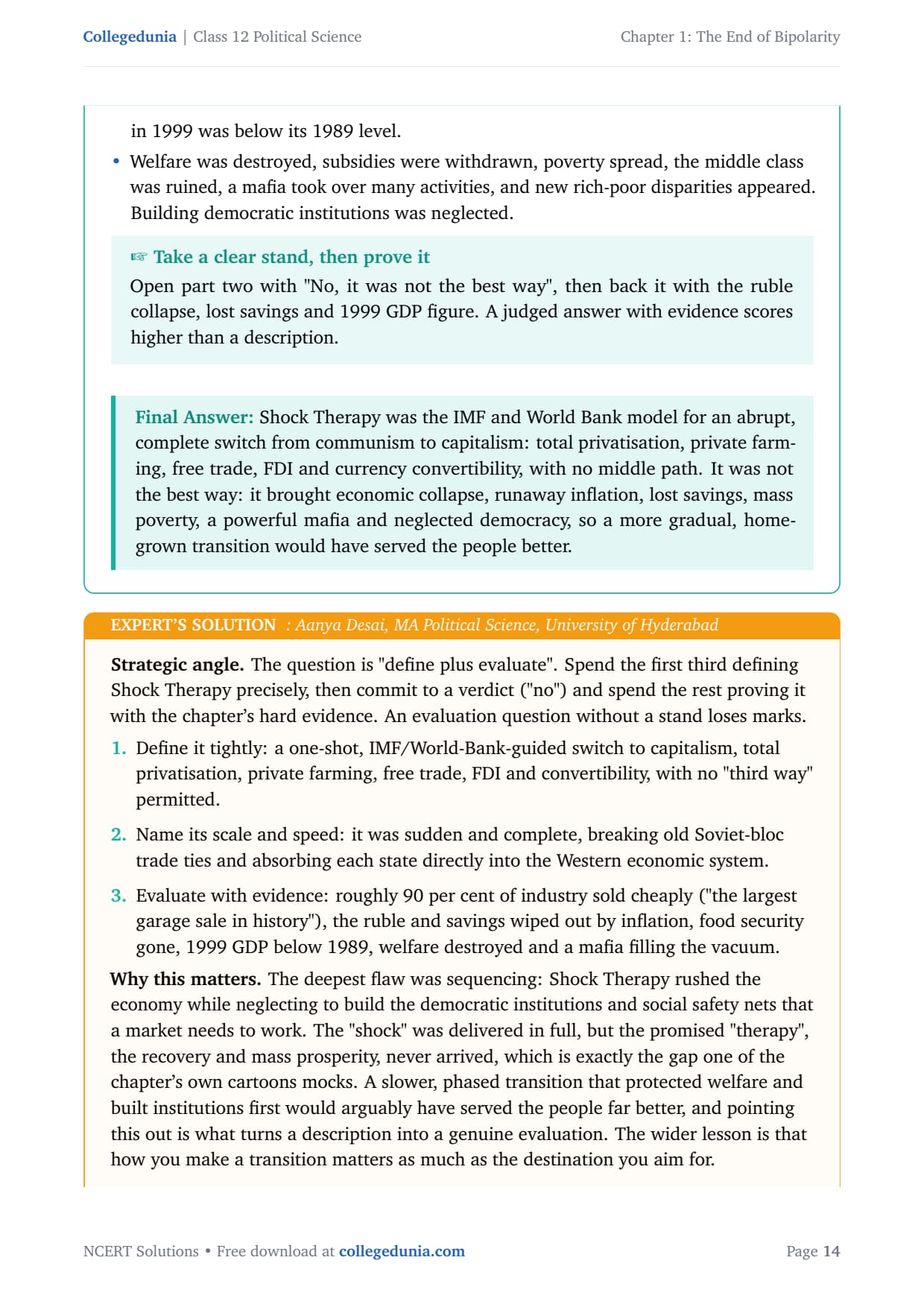
import food. Russia's real GDP in 1999 was below its 1989 level.
Welfare was destroyed, subsidies were withdrawn, poverty spread, the
middle class was ruined, a mafia took over many activities, and new
rich-poor disparities appeared. Building democratic institutions was
neglected.
Take a clear stand, then prove it
Open part two with "No, it was not the best way", then back it with the
ruble collapse, lost savings and 1999 GDP figure. A judged answer with
evidence scores higher than a description.
Shock Therapy was the IMF and World Bank model for an abrupt,
complete switch from communism to capitalism: total privatisation, private
farming, free trade, FDI and currency convertibility, with no middle path. It
was not the best way: it brought economic collapse, runaway inflation, lost
savings, mass poverty, a powerful mafia and neglected democracy, so a more
gradual, home-grown transition would have served the people better.
AD
Aanya Desai
MA Political Science, University of Hyderabad
Verified Expert
Strategic angle. The question is "define plus evaluate". Spend the
first third defining Shock Therapy precisely, then commit to a verdict ("no")
and spend the rest proving it with the chapter's hard evidence. An evaluation
question without a stand loses marks.
Define it tightly: a one-shot, IMF/World-Bank-guided switch to
capitalism, total privatisation, private farming, free trade, FDI and
convertibility, with no "third way" permitted.
Name its scale and speed: it was sudden and complete, breaking old
Soviet-bloc trade ties and absorbing each state directly into the
Western economic system.
Evaluate with evidence: roughly 90 per cent of industry sold cheaply
("the largest garage sale in history"), the ruble and savings wiped
out by inflation, food security gone, 1999 GDP below 1989, welfare
destroyed and a mafia filling the vacuum.
Why this matters. The deepest flaw was sequencing: Shock Therapy
rushed the economy while neglecting to build the democratic institutions and
social safety nets that a market needs to work. The "shock" was delivered in
full, but the promised "therapy", the recovery and mass prosperity, never
arrived, which is exactly the gap one of the chapter's own cartoons mocks. A
slower, phased transition that protected welfare and built institutions first
would arguably have served the people far better, and pointing this out is
what turns a description into a genuine evaluation. The wider lesson is that
how you make a transition matters as much as the destination you aim for.
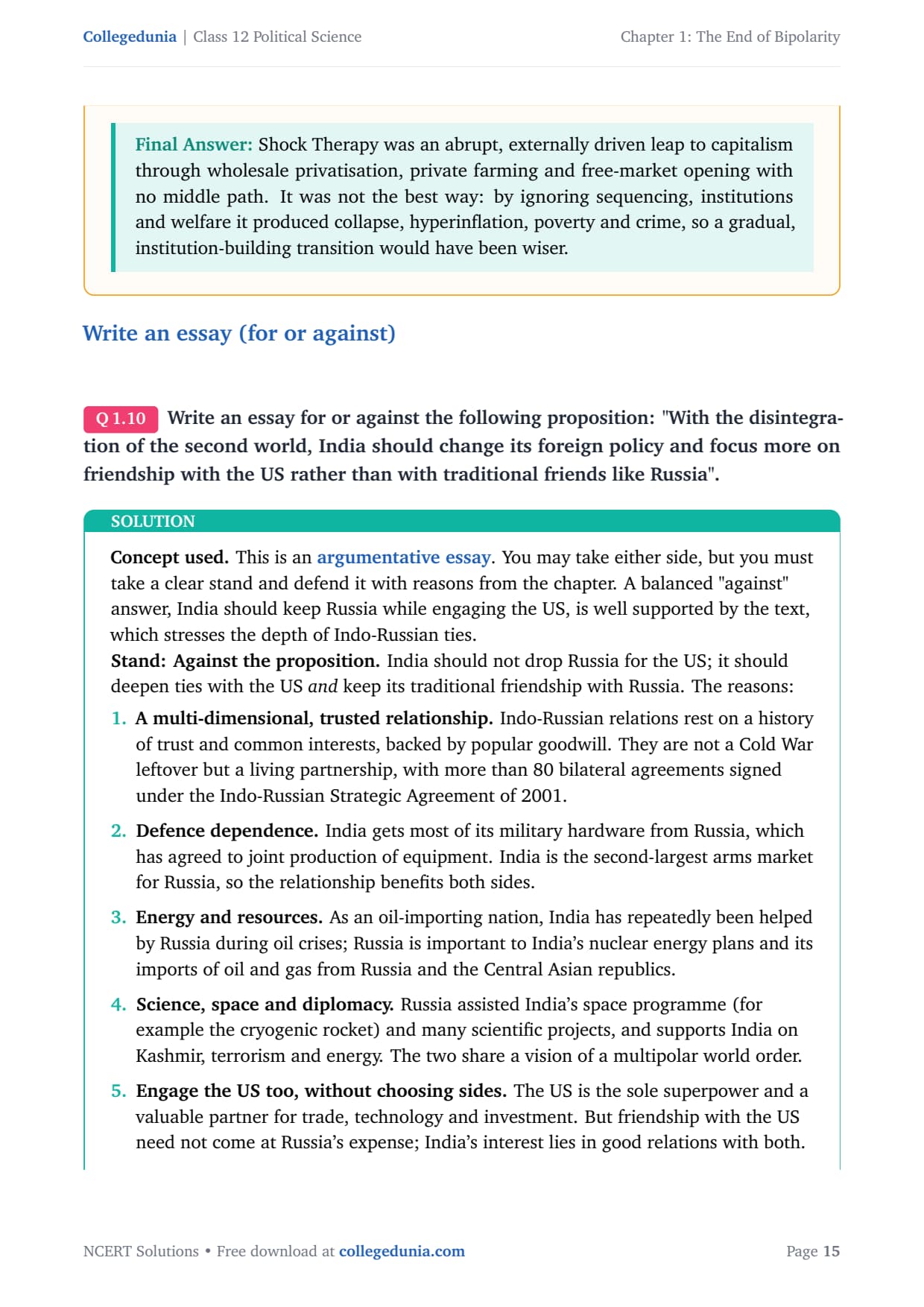
Shock Therapy was an abrupt, externally driven leap to capitalism
through wholesale privatisation, private farming and free-market opening with
no middle path. It was not the best way: by ignoring sequencing, institutions
and welfare it produced collapse, hyperinflation, poverty and crime, so a
gradual, institution-building transition would have been wiser.
Q 1.10
Write an essay for or against the following proposition: "With the
disintegration of the second world, India should change its foreign policy and
focus more on friendship with the US rather than with traditional friends like
Russia".
Concept used. This is an argumentative essay. You may take
either side, but you must take a clear stand and defend it with reasons from
the chapter. A balanced "against" answer, India should keep Russia while
engaging the US, is well supported by the text, which stresses the depth of
Indo-Russian ties.
Stand: Against the proposition. India should not drop Russia for the
US; it should deepen ties with the US and keep its traditional
friendship with Russia. The reasons:
A multi-dimensional, trusted relationship. Indo-Russian
relations rest on a history of trust and common interests, backed by
popular goodwill. They are not a Cold War leftover but a living
partnership, with more than 80 bilateral agreements signed under the
Indo-Russian Strategic Agreement of 2001.
Defence dependence. India gets most of its military hardware
from Russia, which has agreed to joint production of equipment. India
is the second-largest arms market for Russia, so the relationship
benefits both sides.
Energy and resources. As an oil-importing nation, India has
repeatedly been helped by Russia during oil crises; Russia is
important to India's nuclear energy plans and its imports of oil and
gas from Russia and the Central Asian republics.
Science, space and diplomacy. Russia assisted India's space
programme (for example the cryogenic rocket) and many scientific
projects, and supports India on Kashmir, terrorism and energy. The two
share a vision of a multipolar world order.
Engage the US too, without choosing sides. The US is the sole
superpower and a valuable partner for trade, technology and
investment. But friendship with the US need not come at Russia's
expense; India's interest lies in good relations with both.
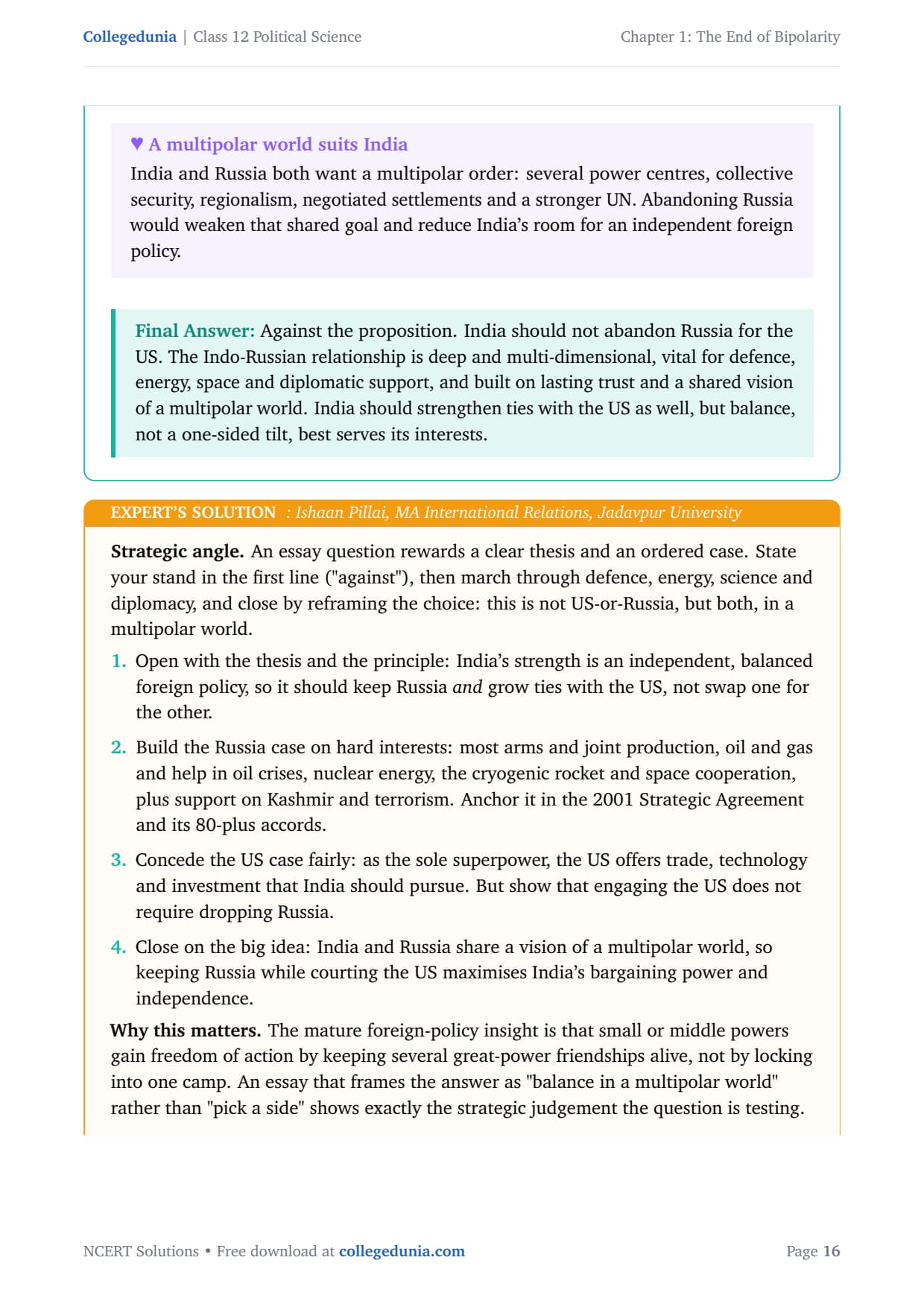
A multipolar world suits India
India and Russia both want a multipolar order: several power centres,
collective security, regionalism, negotiated settlements and a stronger UN.
Abandoning Russia would weaken that shared goal and reduce India's room for an
independent foreign policy.
Against the proposition. India should not abandon Russia for the US.
The Indo-Russian relationship is deep and multi-dimensional, vital for
defence, energy, space and diplomatic support, and built on lasting trust and
a shared vision of a multipolar world. India should strengthen ties with the
US as well, but balance, not a one-sided tilt, best serves its interests.
IP
Ishaan Pillai
MA International Relations, Jadavpur University
Verified Expert
Strategic angle. An essay question rewards a clear thesis and an
ordered case. State your stand in the first line ("against"), then march
through defence, energy, science and diplomacy, and close by reframing the
choice: this is not US-or-Russia, but both, in a multipolar world.
Open with the thesis and the principle: India's strength is an
independent, balanced foreign policy, so it should keep Russia
and grow ties with the US, not swap one for the other.
Build the Russia case on hard interests: most arms and joint
production, oil and gas and help in oil crises, nuclear energy, the
cryogenic rocket and space cooperation, plus support on Kashmir and
terrorism. Anchor it in the 2001 Strategic Agreement and its 80-plus
accords.
Concede the US case fairly: as the sole superpower, the US offers
trade, technology and investment that India should pursue. But show
that engaging the US does not require dropping Russia.
Close on the big idea: India and Russia share a vision of a multipolar
world, so keeping Russia while courting the US maximises India's
bargaining power and independence.
Why this matters. The mature foreign-policy insight is that small or
middle powers gain freedom of action by keeping several great-power friendships
alive, not by locking into one camp. An essay that frames the answer as
"balance in a multipolar world" rather than "pick a side" shows exactly the
strategic judgement the question is testing.
Argue against the proposition: India should deepen ties with the US
while retaining its trusted, multi-dimensional partnership with Russia, on
which its defence, energy, space and diplomacy depend. A balanced, independent
policy in a multipolar world serves India far better than a one-sided tilt
towards the US.
FAQs on The End of Bipolarity Class 12 NCERT Solutions
The End of Bipolarity Class 12 Political Science Common Questions
Ques. Where can I get the class 12 political science chapter 1 NCERT Solutions PDF?
Ans. You can download the The End of Bipolarity Class 12 Political Science NCERT Solutions PDF directly from this page. It is free, follows the 2026-27 NCERT, and answers all 10 exercise questions step by step.
Ques. How many questions are there in The End of Bipolarity class 12 questions and answers?
Ans. The chapter has 10 exercise questions. The first five are MCQ, chronology, match and fill-in-the-blank items, while Questions 6 to 10 are short and long written answers, including an essay on India's foreign policy.
Ques. What was Shock Therapy in The End of Bipolarity?
Ans. Shock Therapy was the fast, total shift from a planned economy to a market economy in the former Soviet states after 1991. Pushed by the World Bank and IMF, it caused mass job losses and hardship, so most answers argue it was not the best way to make the change.
Ques. Why did the Soviet Union disintegrate?
Ans. The USSR fell because of economic stagnation, the cost of the arms race, rigid one-party politics, the Afghan war, and rising nationalism in its republics. Gorbachev's reforms (Perestroika and Glasnost) opened the system but could not save it, and the union broke up in 1991.
Ques. What does bipolarity mean in this chapter?
Ans. Bipolarity means a world order with two centres of power, here the US-led bloc and the Soviet-led bloc during the Cold War. The End of Bipolarity marks the collapse of the Soviet bloc in 1991, which left the US as the only superpower in a unipolar world.
Ques. Is class 12 political science chapter 1 easy to score in the board exam?
Ans. Yes. It is one of the easier scoring chapters if you keep the dates straight and give a balanced view on Shock Therapy. Practise the MCQs and the causes-of-collapse list, and keep the India-Russia point ready for the essay question.








Comments