Political Science Mentor, Jesus and Mary College | Updated 3+ months ago
The NCERT Solutions for Political Science Class 12 Chapter 7 Globalisation answer every textbook question on worldwide interconnectedness, set to the latest 2026-27 CBSE syllabus. Each answer explains what globalisation is, what causes it, and how it has changed the state, the economy and culture. These solutions help students prepare for the Class 12 Political Science board paper and the UPSC foundation in 2026-27.
Covers all 10 exercise questions from Contemporary World Politics Chapter 7, with full point-wise answers.
This Class 12 Political Science chapter usually carries 5 to 6 marks per board paper.
Pairs with the Notes, Handwritten Notes and NCERT Book PDF linked lower on this page.
Every solution for Class 12 Political Science Chapter 7 in this Collegedunia compilation is written by subject experts from the official NCERT Contemporary World Politics textbook, and checked against the last five years of CBSE board papers.
Student Feedback: In a Collegedunia poll of 9,050 Class 12 Political Science students taken before the 2026 boards, 71% of students rated the cultural homogeneity question as the hardest part of Globalisation. Most students said a clear list of both sides of the debate made the answer easy to recall.
Source: 2026-27 Class 12 Political Science student poll. Sample of 9,050 students from CBSE schools across 13 states.
Globalisation is the last chapter of Contemporary World Politics. It studies worldwide interconnectedness, the way flows of ideas, capital, goods and people now link every part of the world. The chapter is careful to say that globalisation is multi-dimensional, so it touches the economy, politics and culture all at once.
The chapter answers three big questions that students must keep in mind:
What is globalisation? Worldwide interconnectedness driven mainly by technology.
How does it work? Through economic, political and cultural flows, with an uneven impact.
What does it mean for India? The 1991 reforms opened India, and India now shapes globalisation too.
So the chapter is really about a single idea seen from many sides. A student who keeps these three threads in mind can connect almost any question in Globalisation class 12 back to one of them. This is why revision works best when you sort each fact under "what", "how" or "India" first.
What Globalisation Means and Its Components
The chapter opens by defining globalisation as worldwide interconnectedness. To answer the first questions well, students must know its meaning and its main flows. The key is that it is more than trade, it is the flow of many things across borders.
Flow of capital: money and investment move quickly across countries.
Flow of commodities: goods are made and sold across the world.
Flow of people: migration of workers and movement of ideas across borders.
Flow of ideas: the spread of beliefs, knowledge and ways of life.
The first exercise question asks which statement about globalisation is true. The right answer is that globalisation is a multi-dimensional phenomenon, not purely economic, and it did not simply begin in 1991. The chapter is clear that globalisation is not the same as westernisation, so students should keep these traps in mind for the MCQ marks.
How Technology Causes Globalisation
The chapter says technology is the most important cause of globalisation. This is a long-answer favourite, so students should learn the causes as a clear list rather than a story. The table below sorts the main drivers for fast revision.
Cause
What it meant
Technology
The telegraph, telephone and microchip shrank distance and time across the world.
Faster communication
Ideas, news and money now move almost instantly between countries.
Worldwide flows
Capital, goods, services and people cross borders more easily than before.
Not one community
Globalisation is not caused by one people or one country alone.
A key insight for the exam is that technology is the deepest cause, but globalisation is not owned by any single nation. The chapter warns against saying globalisation "originated in the US" or is the work of one community. When you answer the causes question, lead with technology and the communication revolution, then add the worldwide flows it made possible.
Globalisation and the Changing Role of the State
One of the most-asked long answers is about how globalisation changes the state in developing countries. The honest answer is balanced, so students should give both sides. The chapter shows the state is reshaped, not removed.
Welfare shrinks: the state spends less on welfare and steps back from the economy.
Markets lead: the market decides more of what is made and sold.
State stays vital: the state remains the chief authority on law, order and security.
New tools: better technology can actually make the state stronger in some areas.
The judgement most answers should reach is that globalisation gives the state a mixed role, not a smaller one across the board. The welfare role shrinks, but the state does not disappear. In some areas, like collecting data or running services, technology makes the state more capable. Marks come from showing this two-way effect rather than saying the state simply weakens.
Economic and Cultural Effects on India
The fall in trade barriers changed India, and India changed globalisation in turn. This topic links the chapter to India's economy and culture, so it is a regular short and long answer. The table keeps the economic and cultural effects side by side.
Area
Key effects to recall
Economic
The 1991 reforms opened India to freer trade, capital and foreign investment.
Cultural
Globalisation brings both homogeneity and heterogeneity, mixing global and local culture.
India's own impact
India shapes globalisation too, through software, services and a large skilled workforce.
One sharp point for the India question: globalisation works in two directions for India. The 1991 reforms let the world in, but India also exports software, films and skilled labour that shape global culture and the global economy. So the answer should show India as both shaped by and shaping globalisation, a key idea for the essay-type Question 7.
The Globalisation Class 12 Exercise-wise Coverage
The chapter exercise has 10 questions. The table maps each one to its topic so students can plan revision and find the right NCERT answer fast. The full point-wise solution for each sits in the question set lower on this page.
Question
Topic it tests
Q 1
True statement about the nature of globalisation (MCQ)
Q 2
True statement about the impact of globalisation (MCQ)
Q 3
True statement about the causes of globalisation (MCQ)
Q 4
True statement about globalisation and interconnectedness (MCQ)
Q 5
False statement about globalisation, advocates and critics (MCQ)
Q 6
What worldwide interconnectedness is and its components
Q 7
How technology has contributed to globalisation
Q 8
The changing role of the state in developing countries
Q 9
Economic implications of globalisation and the impact on India
Q 10
Cultural heterogeneity, and India's two-way impact on globalisation
Questions 8, 9 and 10 are the most-asked long answers, so students preparing Globalisation class 12 important questions should learn those three first. The MCQs (Q1 to Q5) are quick marks, so revise the meaning, causes and impact of globalisation well to secure them.
Students who want the offline copy can save the class 12 political science chapter 7 pdf from the download card above and tick off each question as they finish it.
Globalisation Important Questions and Previous Year Trends
CBSE sets a steady mix of MCQ, short and long answers from this chapter. Knowing the pattern helps students decide how much to write. The chapter is a regular source of one 4-mark or 6-mark question, which is why a focused list of Globalisation important questions saves a lot of revision time.
Long answer (5 to 6 marks): the changing role of the state, or the economic effects on India.
Short answer (4 marks): what worldwide interconnectedness is, or how technology causes globalisation.
Source-based: a passage on cultural globalisation or anti-globalisation, with sub-parts.
Objective and MCQ: the meaning, the causes, and the for-and-against debate.
For quick recall before the exam, students often practise the class 12 political science chapter 7 mcq set and a list of Globalisation class 12 important questions. The most repeated items are the role of the state and the cultural debate, so keep those answer points ready in your own words.
Working through the ncert solutions class 12 political science chapter 7 set twice, once open-book and once from memory, fixes the terms and the for-and-against points well before the board exam.
Common Mistakes Students Make in This Chapter
A few errors cost marks every year in this chapter. Most come from treating globalisation as purely economic or giving only one side of the culture debate. Avoiding them is the fastest way to lift a score.
Saying globalisation is "purely economic" - it is multi-dimensional, touching politics and culture too.
Confusing globalisation with westernisation - the two are not the same thing.
Writing that globalisation "began in 1991" - 1991 was India's reform year, not the start of globalisation.
Saying the state simply disappears - its role becomes mixed, not gone.
Giving only one side of the culture debate - show both homogeneity and heterogeneity.
Students who fix these five points usually move from average to high marks on the long answers. The exam rewards a balanced view, so always give both sides of the globalisation debate before you judge it.
Globalisation PDF Download Formats and Languages
The solutions are free to download in more than one format, so students can pick what suits their device and revision style. The download card at the top of the page carries each option for this chapter.
Normal and HD PDF: the class 12 political science chapter 7 pdf comes in a normal size for quick downloads and an HD version for clear printing.
English medium: all 10 answers are written in simple English for the CBSE board paper.
Question-only set: a print-and-practise sheet of Globalisation extra questions for self-testing.
Whole-book pack: the solutions sit in one set that runs through every Contemporary World Politics chapter, so you can revise the whole book in one place.
Many students search for class 12 political science chapter 7 answers on their phone the night before a test, so a saved PDF means you can revise even without internet. Keep both the question set and the solved version handy for a full self-check.
How the Globalisation Solutions Pair with Notes and the Book PDF
These NCERT Solutions answer the back-exercise questions. To revise the full chapter, students should use them alongside the other resources for the same chapter, all linked in the table below.
Reading the original NCERT chapter text and figures
Tip: read the Notes first, then attempt these solutions on your own, and only then check the model answers here. That order builds memory faster than copying answers straight away.
All NCERT Solutions for Class 12 Political Science
The table links the NCERT Solutions for every chapter in both Class 12 Political Science books, so students can move across the course in one click. Globalisation is highlighted.
All NCERT Solutions for Globalisation with Step-by-Step Solutions
Below are all 11 NCERT exercise questions for this chapter, exactly as they appear in the textbook. Tap Check Solution for the model answer or Expert Solution for the topper-style approach.
Q 7.1
Which of the statements are TRUE about globalisation?
a. Globalisation is purely an economic phenomenon.
b. Globalisation began in 1991.
c. Globalisation is the same thing as westernisation.
d. Globalisation is a multi-dimensional phenomenon.
Concept used. The correct statement is (d) Globalisation
is a multi-dimensional phenomenon. The chapter defines globalisation as
the flow of ideas, capital, commodities and people across the world. Since
these flows touch politics, the economy and culture all at once, it is
multi-dimensional, not a single-sided process.
Why the other three statements are false:
(a) is false. Globalisation is not purely economic. The
chapter studies its political consequences (the changing role of
the state) and its cultural consequences (homogenisation and
heterogenisation) alongside the economic ones.
(b) is false. Globalisation did not begin in 1991. The
chapter says the four flows ``have taken place through much of
human history.'' For India, 1991 marks only the start of its own
economic reforms, not the start of globalisation itself.
(c) is false. Globalisation is not the same as
westernisation. Western culture is only one influence among many;
globalisation also lets other cultures spread, and it can make
cultures more distinct, not just more western.
One word to remember
Tag globalisation as multi-dimensional. Whenever an option tries
to shrink it to one box, economic only, or western only, or one fixed
date, that option is wrong.
Correct statement: (d) Globalisation is a multi-dimensional
phenomenon.
AM
Aarav Mehta
M.A Political Science, Jawaharlal Nehru University
Verified Expert
Strategic angle. In a ``which is TRUE'' MCQ I look for the
broadest, most careful statement and reject every option that is too
narrow or pins a wrong date. Three of these four options narrow
globalisation down; only one keeps it wide.
Test for narrowness. ``Purely economic'' (a) and ``same as
westernisation'' (c) both cut globalisation down to one face. The
chapter insists it has three faces, so both fall.
Test the date. ``Began in 1991'' (b) confuses India's
reform year with the birth of globalisation. The chapter is clear
that the flows are centuries old.
Keep the survivor. Only (d), ``multi-dimensional,''
matches the chapter's own framing of political, economic and
cultural effects together.
The deeper point worth carrying into the exam: the whole chapter is built
around this multi-dimensional idea. Its three big sections, political,
economic and cultural consequences, are literally the three dimensions.
So option (d) is not just correct, it is the spine of the entire chapter.
(d), because globalisation works across politics, economy and
culture together.
Q 7.2
Which of the statements are TRUE about the impact of globalisation?
a. Globalisation has been uneven in its impact on states and societies.
b. Globalisation has had a uniform impact on all states and societies.
c. The impact of globalisation has been confined to the political sphere.
d. Globalisation inevitably results in cultural homogeneity.
Concept used. The correct statement is (a) Globalisation
has been uneven in its impact on states and societies. The chapter warns
again and again that ``the same set of policies do not lead to the same
results everywhere.'' Globalisation helps some states and societies more
than others, so its impact is uneven, not uniform.
Why the other statements are false:
(b) is false. The impact has not been uniform. The same
economic policies have ``generated vastly different outcomes in
different parts of the world,'' so we must look at each context
rather than generalise.
(c) is false. The impact is not confined to politics. The
chapter shows clear economic effects (trade, capital flows) and
cultural effects (food, dress, ideas) as well.
(d) is false. Cultural homogeneity is not inevitable. The
same process also leads to cultural heterogenisation,
where each culture becomes more distinct, so a single world
culture is not the fixed result.
Do not say ``uniform''
A common trap is to call the impact uniform or worldwide-the-same. The
chapter's whole message is the opposite: pay attention to specific
context, because the effects differ from place to place.
Correct statement: (a) Globalisation has been uneven in its
impact on states and societies.
PN
Priya Nair
M.A International Relations, Jadavpur University
Verified Expert
Quick reading. The chapter repeats one caution like a refrain:
avoid sweeping generalisations, because results differ by context. The
moment I see that, the answer is the option that says ``uneven.'' The
other three all over-claim.
Spot the over-claims. ``Uniform'' (b), ``confined to
politics'' (c) and ``inevitably homogeneity'' (d) each make a flat,
absolute claim. The chapter never allows such absolutes.
Match the survivor to the text. ``Uneven'' (a) is exactly
the chapter's stance: globalisation affects some societies more
than others.
The wider lesson: words like uniform, always,
inevitably and only are red flags in social-science MCQs.
Globalisation is messy and context-bound, so the careful, qualified option
almost always wins. That habit alone will earn marks across this whole
chapter.
(a), the impact is uneven because outcomes differ from one
society to another.
Q 7.3
Which of the statements are TRUE about the causes of globalisation?
a. Technology is an important cause of globalisation.
b. Globalisation is caused by a particular community of people.
c. Globalisation originated in the US.
d. Economic interdependence alone causes globalisation.
Concept used. The correct statement is (a) Technology is
an important cause of globalisation. The chapter states plainly that the
movement of ideas, capital, commodities and people ``has been made
possible largely by technological advances'' such as the telegraph, the
telephone and the microchip.
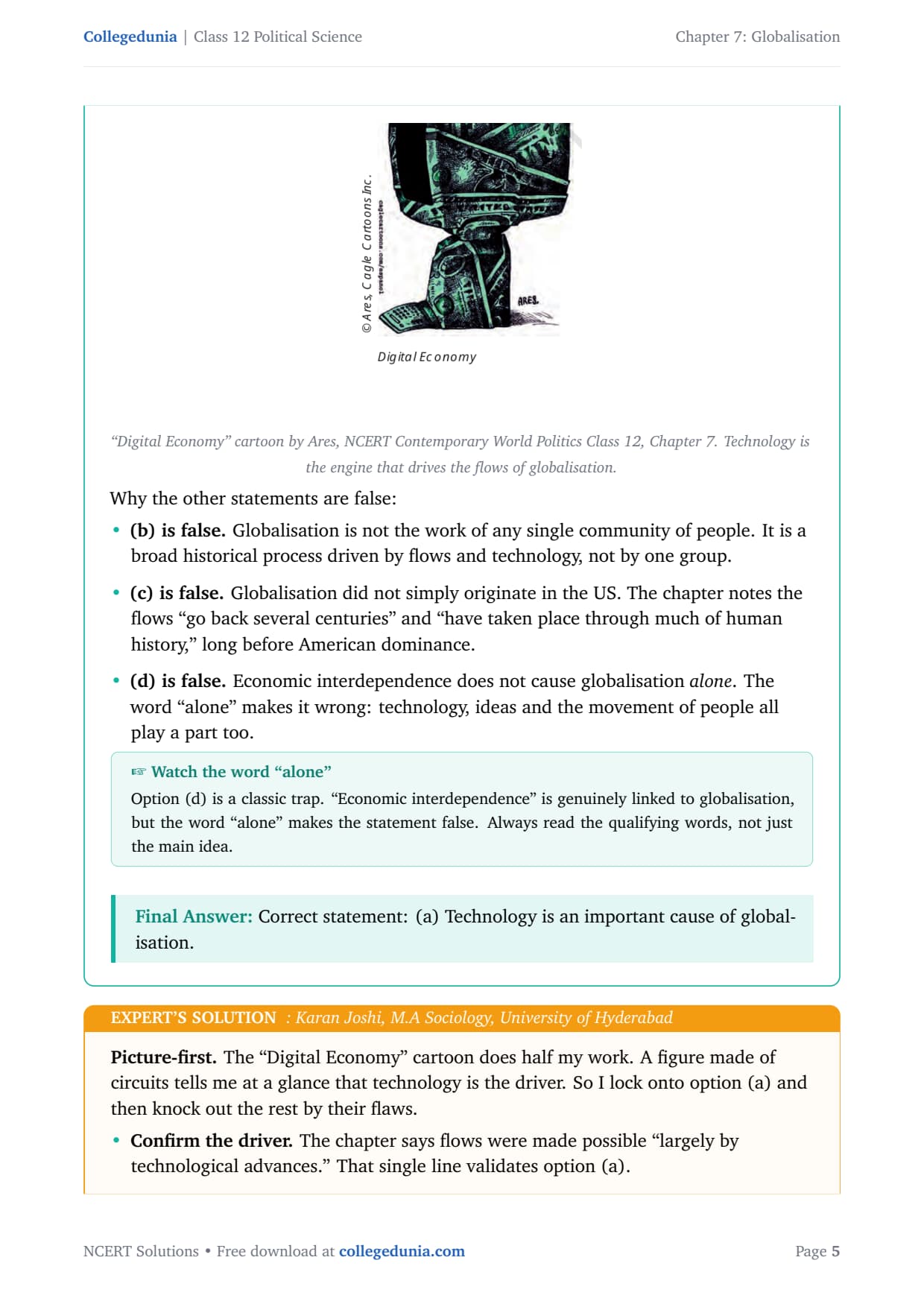
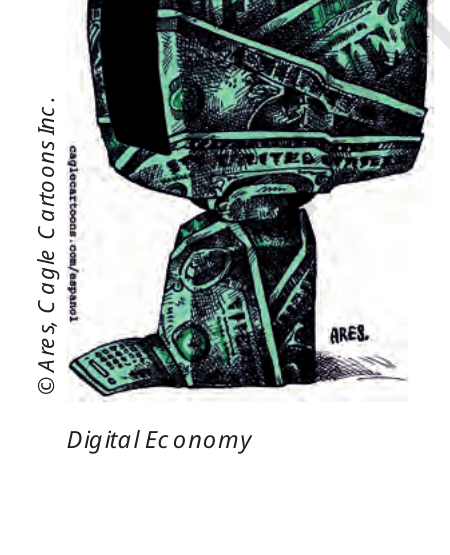
The cartoon below, titled ``Digital Economy,'' captures this idea: the
modern economy is built out of technology itself.
``Digital Economy'' cartoon by Ares, NCERT Contemporary World Politics Class 12, Chapter 7. Technology is the engine that drives the flows of globalisation.
Why the other statements are false:
(b) is false. Globalisation is not the work of any single
community of people. It is a broad historical process driven by
flows and technology, not by one group.
(c) is false. Globalisation did not simply originate in
the US. The chapter notes the flows ``go back several centuries''
and ``have taken place through much of human history,'' long before
American dominance.
(d) is false. Economic interdependence does not cause
globalisation alone. The word ``alone'' makes it wrong:
technology, ideas and the movement of people all play a part too.
Watch the word ``alone''
Option (d) is a classic trap. ``Economic interdependence'' is genuinely
linked to globalisation, but the word ``alone'' makes the statement false.
Always read the qualifying words, not just the main idea.
Correct statement: (a) Technology is an important cause of
globalisation.
KJ
Karan Joshi
M.A Sociology, University of Hyderabad
Verified Expert
Picture-first. The ``Digital Economy'' cartoon does half my work.
A figure made of circuits tells me at a glance that technology is the
driver. So I lock onto option (a) and then knock out the rest by their
flaws.
Confirm the driver. The chapter says flows were made
possible ``largely by technological advances.'' That single line
validates option (a).
Reject the flawed options. (b) blames one community,
which the text never does. (c) gives a wrong single origin. (d)
uses ``alone,'' which over-claims for the economy.
The bigger insight: the chapter is careful never to give globalisation one
neat cause. Technology is called ``important,'' not the ``only'' cause. So
the right answer is the one that says ``important,'' and the wrong ones are
those that say ``only,'' ``alone,'' or name a single source. That contrast
between ``important'' and ``only'' is the whole trick of this question.
(a), technology, above all the telegraph, telephone and
microchip, is an important cause of globalisation.
Q 7.4
Which of the statements are TRUE about globalisation?
a. Globalisation is only about movement of commodities.
b. Globalisation does not involve a conflict of values.
c. Services are an insignificant part of globalisation.
d. Globalisation is about worldwide interconnectedness.
Concept used. The correct statement is (d) Globalisation
is about worldwide interconnectedness. The chapter's core idea is that
events in one part of the world now affect other parts: as it puts it, the
bird flu or a tsunami ``does not respect national boundaries.'' That mutual
connection across the globe is the heart of globalisation.
Why the other statements are false:
(a) is false. Globalisation is not only about commodities.
It also covers the flow of capital, ideas and people, four flows
in all, so reducing it to goods alone is wrong.
(b) is false. Globalisation does involve a conflict of
values. The resistance section shows both left and right critics
clashing over values like self-reliance, culture and tradition, so
value conflict is very much part of it.
(c) is false. Services are not insignificant. The chapter
gives ``the spread of internet and computer related services'' as a
key example of the flow of ideas, and India's call-centre and
software services are central to its story.
The one-line definition
If you must sum up globalisation in a phrase, say worldwide
interconnectedness. An event anywhere can be felt everywhere. That single
idea answers this question and many others in the chapter.
Correct statement: (d) Globalisation is about worldwide
interconnectedness.
AI
Ananya Iyer
M.A Political Science, Manipal Academy of Higher Education
Verified Expert
Strategic angle. I read each option for the word that makes it
true or false. Three options here carry a limiting word, ``only,''
``not,'' ``insignificant,'' that the chapter contradicts. The fourth is
the broad, accurate definition.
Strike the limiters. ``Only commodities'' (a) ignores the
other three flows. ``Insignificant services'' (c) ignores the
internet and call-centre economy. Both are too narrow.
Check the values claim. ``No conflict of values'' (b) is
contradicted by the whole resistance section, where values clash
openly. So it fails.
Keep the definition. ``Worldwide interconnectedness'' (d)
is the textbook's own summary phrase, so it is the answer.
The takeaway: globalisation is built on four flows, ideas, capital,
commodities and people, and the thread joining them is interconnectedness.
Any option that drops a flow, or denies the friction that this connection
creates, is false by the chapter's own logic.
(d), worldwide interconnectedness is the defining feature of
globalisation.
Q 7.5
Which of the statements are FALSE about globalisation?
a. Advocates of globalisation argue that it will result in greater economic growth.
b. Critics of globalisation argue that it will result in greater economic disparity.
c. Advocates of globalisation argue that it will result in cultural homogenisation.
d. Critics of globalisation argue that it will result in cultural homogenisation.
Concept used. The false statement is (c) Advocates of
globalisation argue that it will result in cultural homogenisation. It is
the critics, not the advocates, who worry about cultural
homogenisation, that is, the fear that a single uniform (largely Western)
culture will swallow the rest. Advocates praise globalisation for economic
growth, not for making cultures the same.
Checking each statement against who actually says it:
(a) is true. Advocates do argue for greater economic
growth. The chapter says they claim globalisation ``generates
greater economic growth and well-being for larger sections of the
population.''
(b) is true. Critics do warn of greater economic
disparity. The left critique says globalisation ``makes the rich
richer (and fewer) and the poor poorer.''
(c) is FALSE. Advocates do not argue for cultural
homogenisation. They defend globalisation on economic grounds;
homogenisation is raised as a danger by critics, not a selling
point by supporters.
(d) is true. Critics do argue that globalisation leads to
cultural homogenisation, the imposition of a uniform culture, which
they see as a threat to the world's rich heritage.
Match the claim to the right side
The trick here is matching each argument to advocates or critics.
Homogenisation is a critic's fear, so pinning it on advocates (c)
is the false statement.
False statement: (c) Advocates of globalisation argue that it
will result in cultural homogenisation.
RB
Rohit Banerjee
M.A Political Science, University of Delhi
Verified Expert
Structural observation. This MCQ is really a two-column sorting
task: advocates on one side, critics on the other. I place each statement
in its correct column, then the one sitting in the wrong column is the
false answer.
Advocates' column. They argue for growth (a) and
well-being. Growth is their pitch, so (a) belongs here and is
true.
Critics' column. They argue for disparity (b) and cultural
homogenisation (d). Both fears belong to critics, so both are
true.
Find the misplaced card. Statement (c) puts
``homogenisation'' in the advocates' column. That is the misplaced
card, hence the false statement.
The deeper reading: advocates and critics often talk about the same
effects but value them oppositely. The clean rule for this question is that
economic gain is the advocates' language, while disparity and
homogenisation are the critics' language. Statement (c) breaks that rule,
which is exactly why it is false.
(c) is false, since cultural homogenisation is feared by critics,
not promised by advocates.
Q 7.6
What is worldwide interconnectedness? What are its components?
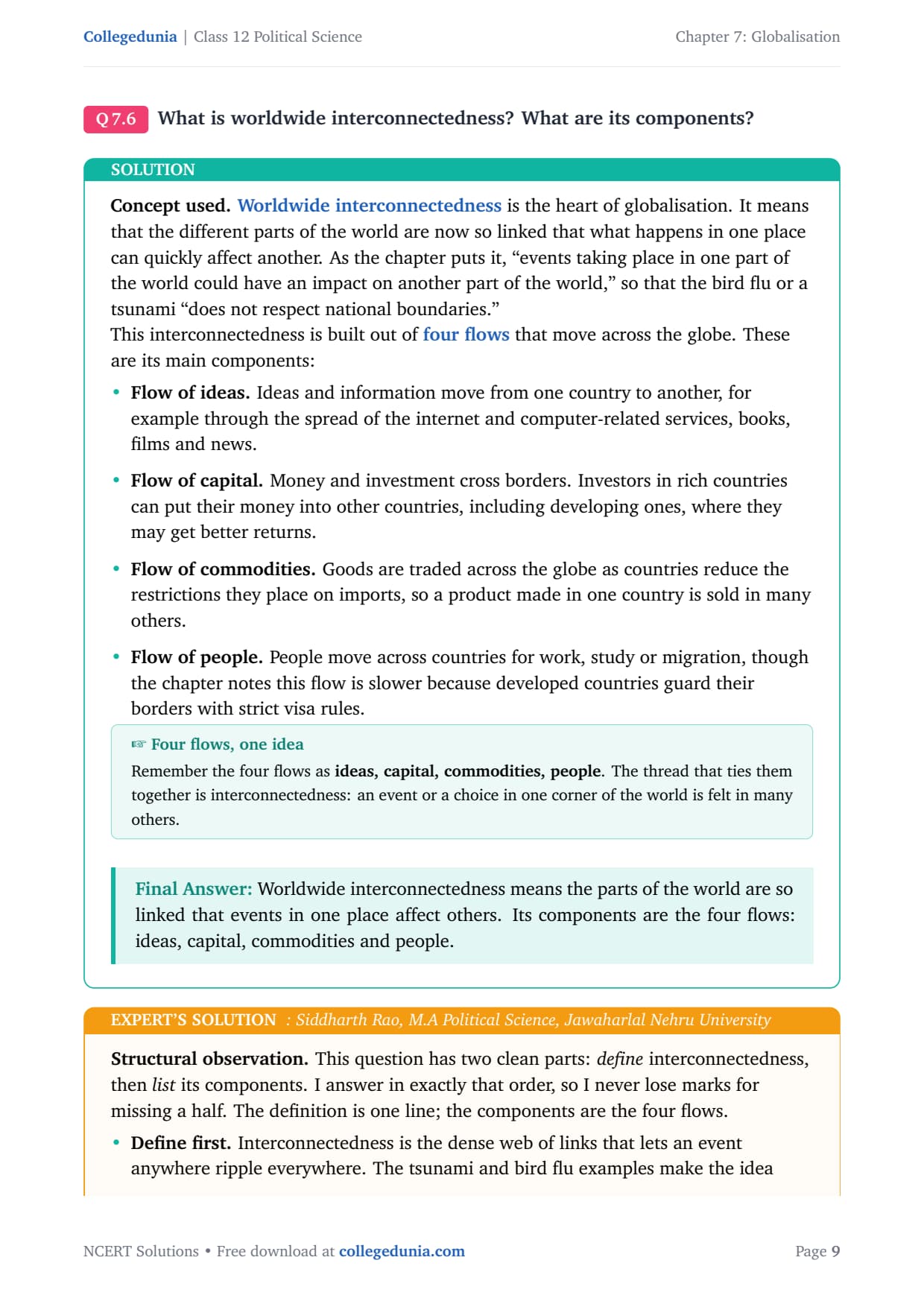
Concept used.Worldwide interconnectedness is the heart
of globalisation. It means that the different parts of the world are now so
linked that what happens in one place can quickly affect another. As the
chapter puts it, ``events taking place in one part of the world could have
an impact on another part of the world,'' so that the bird flu or a tsunami
``does not respect national boundaries.''
This interconnectedness is built out of four flows that move
across the globe. These are its main components:
Flow of ideas. Ideas and information move from one country
to another, for example through the spread of the internet and
computer-related services, books, films and news.
Flow of capital. Money and investment cross borders.
Investors in rich countries can put their money into other
countries, including developing ones, where they may get better
returns.
Flow of commodities. Goods are traded across the globe as
countries reduce the restrictions they place on imports, so a
product made in one country is sold in many others.
Flow of people. People move across countries for work,
study or migration, though the chapter notes this flow is slower
because developed countries guard their borders with strict visa
rules.
Four flows, one idea
Remember the four flows as ideas, capital, commodities, people.
The thread that ties them together is interconnectedness: an event or a
choice in one corner of the world is felt in many others.
Worldwide interconnectedness means the parts of the world are so
linked that events in one place affect others. Its components are the four
flows: ideas, capital, commodities and people.
SR
Siddharth Rao
M.A Political Science, Jawaharlal Nehru University
Verified Expert
Structural observation. This question has two clean parts:
define interconnectedness, then list its components. I answer
in exactly that order, so I never lose marks for missing a half. The
definition is one line; the components are the four flows.
Define first. Interconnectedness is the dense web of links
that lets an event anywhere ripple everywhere. The tsunami and bird
flu examples make the idea concrete.
List the four flows. Ideas (the internet), capital
(cross-border investment), commodities (world trade), and people
(migration, though slowed by visas).
Note the uneven speed. Capital and goods move fast; people
move slowest of all. Mentioning this shows you read the chapter
closely.
The wider reading: these four flows are not separate stories. They feed
each other. Cheaper communication (an idea-flow) makes it easier to move
capital, which moves goods, which pulls people toward new jobs. That
interlocking is why the chapter calls globalisation a single connected
process rather than four unrelated trends. Lead your answer with the
definition, list the four flows, and close on the point that they move at
different speeds. That structure reads like a topper's response.
It is the worldwide web of links through which events spread
across borders, made up of four flows: ideas, capital, commodities and
people, which move at different speeds.
Q 7.7
How has technology contributed to globalisation?
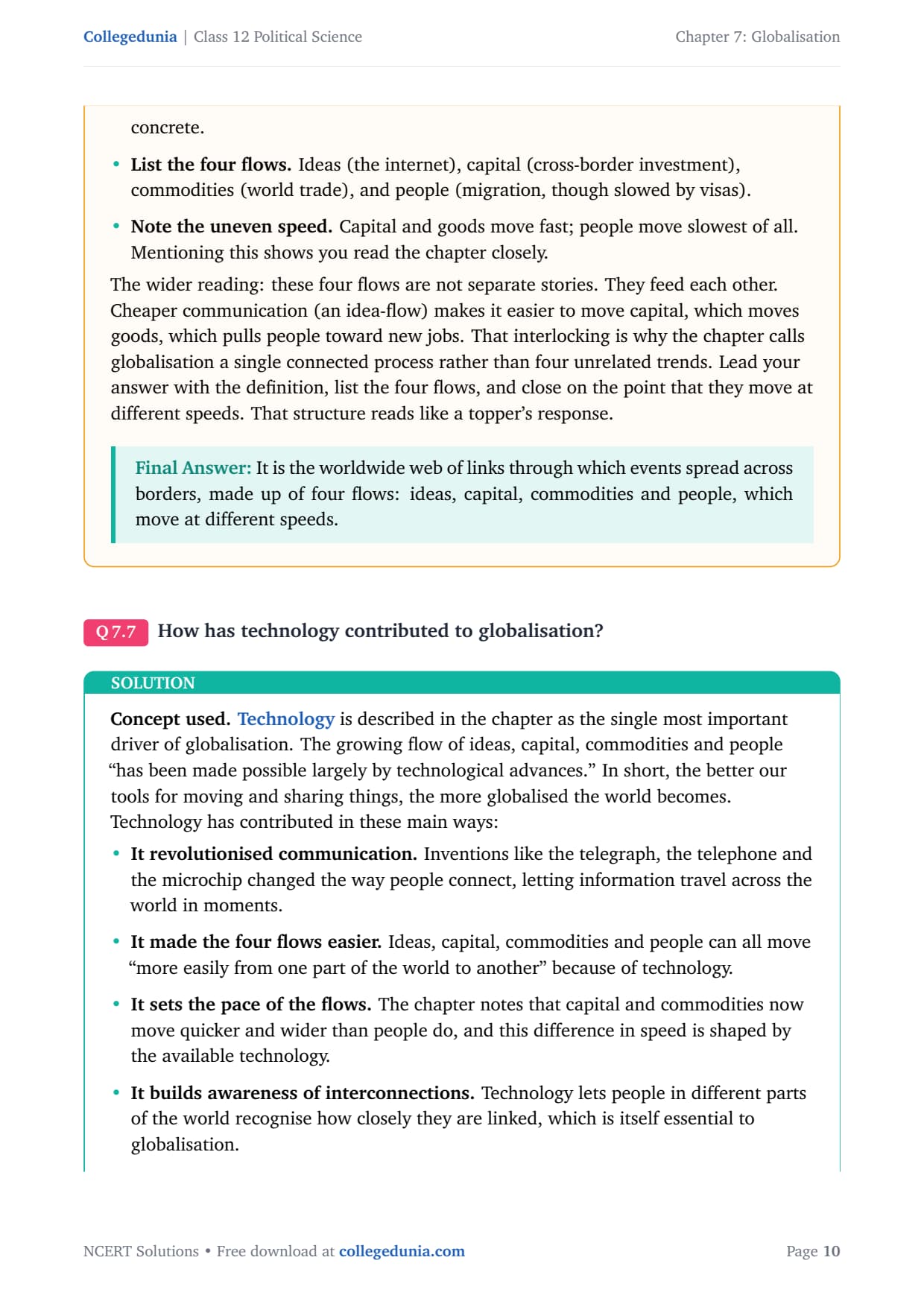
Concept used.Technology is described in the chapter as
the single most important driver of globalisation. The growing flow of
ideas, capital, commodities and people ``has been made possible largely by
technological advances.'' In short, the better our tools for moving and
sharing things, the more globalised the world becomes.
Technology has contributed in these main ways:
It revolutionised communication. Inventions like the
telegraph, the telephone and the microchip changed the way people
connect, letting information travel across the world in moments.
It made the four flows easier. Ideas, capital, commodities
and people can all move ``more easily from one part of the world to
another'' because of technology.
It sets the pace of the flows. The chapter notes that
capital and commodities now move quicker and wider than people do,
and this difference in speed is shaped by the available technology.
It builds awareness of interconnections. Technology lets
people in different parts of the world recognise how closely they
are linked, which is itself essential to globalisation.
Technology is necessary, not sufficient
The chapter warns that globalisation ``does not emerge merely because of
the availability of improved communications.'' People must also
recognise their interconnections. So say technology enables
globalisation; do not say it alone causes it.
Technology, especially the telegraph, telephone and microchip,
revolutionised communication and made the flows of ideas, capital, goods
and people move faster and wider, which is why it is the most important
driver of globalisation.
VD
Vivaan Desai
M.A Sociology, Delhi School of Economics
Verified Expert
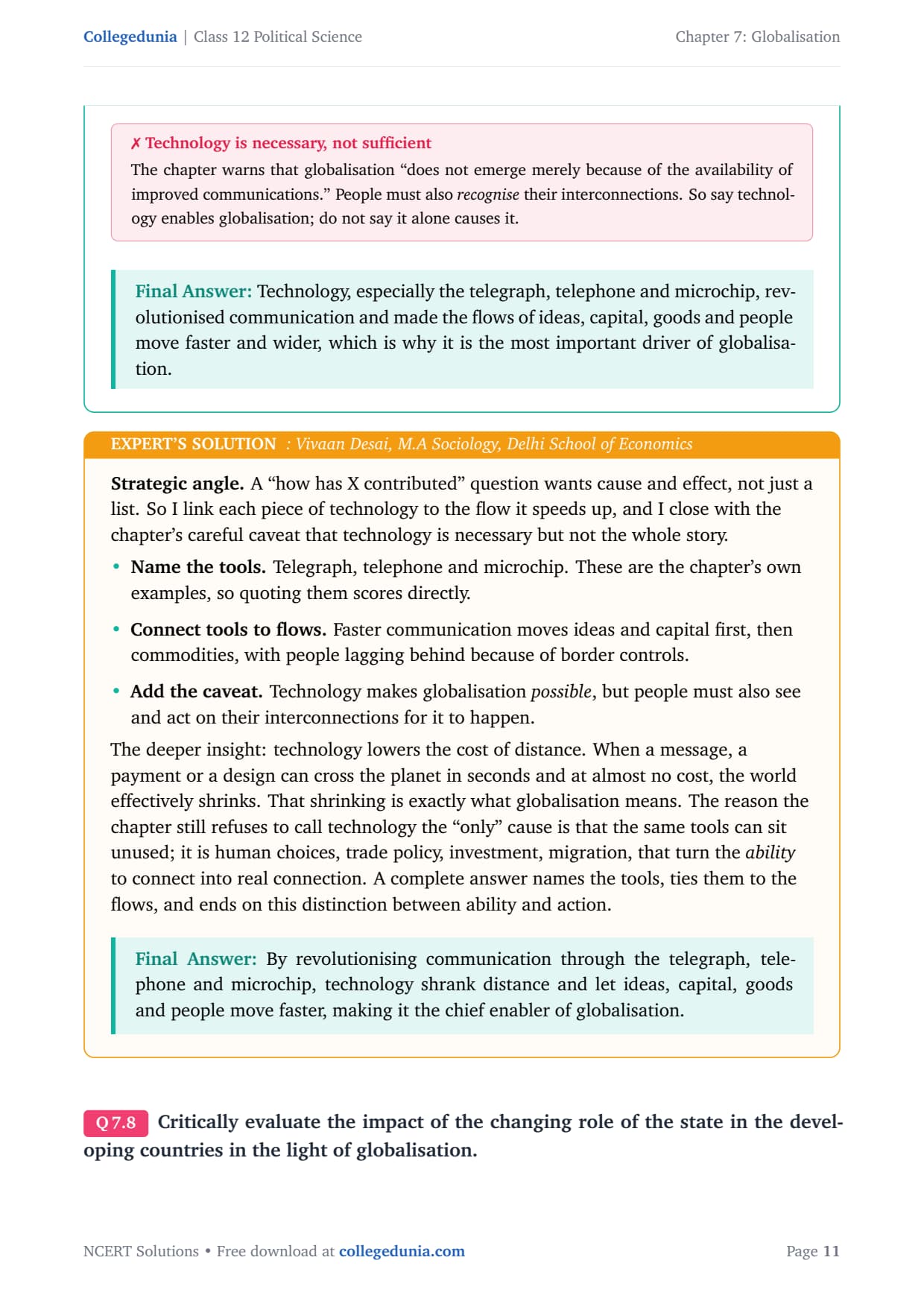
Strategic angle. A ``how has X contributed'' question wants cause
and effect, not just a list. So I link each piece of technology to the
flow it speeds up, and I close with the chapter's careful caveat that
technology is necessary but not the whole story.
Name the tools. Telegraph, telephone and microchip. These
are the chapter's own examples, so quoting them scores directly.
Connect tools to flows. Faster communication moves ideas
and capital first, then commodities, with people lagging behind
because of border controls.
Add the caveat. Technology makes globalisation
possible, but people must also see and act on their
interconnections for it to happen.
The deeper insight: technology lowers the cost of distance. When a message,
a payment or a design can cross the planet in seconds and at almost no
cost, the world effectively shrinks. That shrinking is exactly what
globalisation means. The reason the chapter still refuses to call
technology the ``only'' cause is that the same tools can sit unused; it is
human choices, trade policy, investment, migration, that turn the
ability to connect into real connection. A complete answer names the
tools, ties them to the flows, and ends on this distinction between ability
and action.
By revolutionising communication through the telegraph, telephone
and microchip, technology shrank distance and let ideas, capital, goods and
people move faster, making it the chief enabler of globalisation.
Q 7.8
Critically evaluate the impact of the changing role of the state in the developing countries in the light of globalisation.
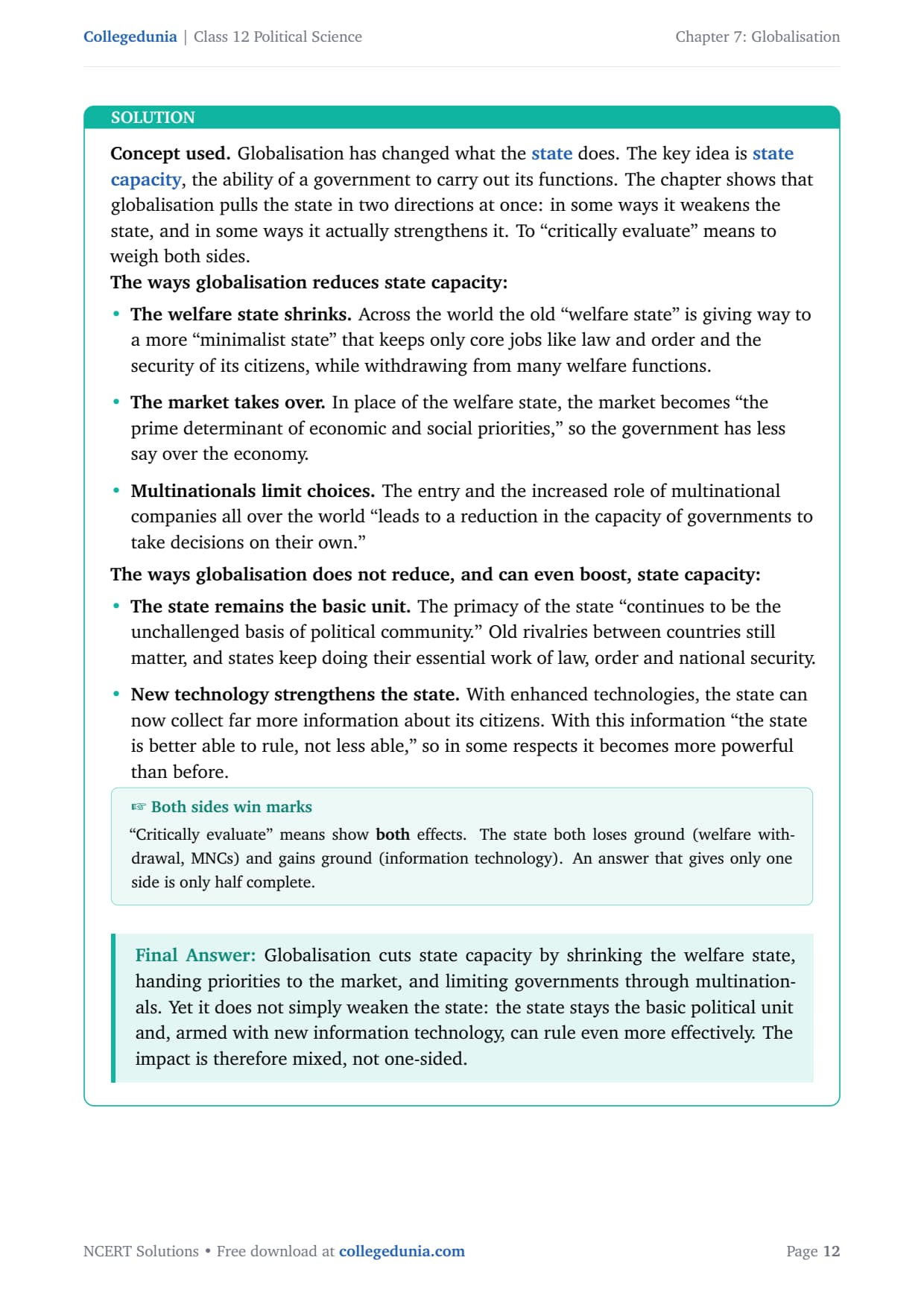
Concept used. Globalisation has changed what the
state does. The key idea is state capacity, the ability
of a government to carry out its functions. The chapter shows that
globalisation pulls the state in two directions at once: in some ways it
weakens the state, and in some ways it actually strengthens it. To
``critically evaluate'' means to weigh both sides.
The ways globalisation reduces state capacity:
The welfare state shrinks. Across the world the old
``welfare state'' is giving way to a more ``minimalist state'' that
keeps only core jobs like law and order and the security of its
citizens, while withdrawing from many welfare functions.
The market takes over. In place of the welfare state, the
market becomes ``the prime determinant of economic and social
priorities,'' so the government has less say over the economy.
Multinationals limit choices. The entry and the increased
role of multinational companies all over the world ``leads to a
reduction in the capacity of governments to take decisions on their
own.''
The ways globalisation does not reduce, and can even boost, state
capacity:
The state remains the basic unit. The primacy of the state
``continues to be the unchallenged basis of political community.''
Old rivalries between countries still matter, and states keep doing
their essential work of law, order and national security.
New technology strengthens the state. With enhanced
technologies, the state can now collect far more information about
its citizens. With this information ``the state is better able to
rule, not less able,'' so in some respects it becomes more
powerful than before.
Both sides win marks
``Critically evaluate'' means show both effects. The state both
loses ground (welfare withdrawal, MNCs) and gains ground (information
technology). An answer that gives only one side is only half complete.
Globalisation cuts state capacity by shrinking the welfare state,
handing priorities to the market, and limiting governments through
multinationals. Yet it does not simply weaken the state: the state stays
the basic political unit and, armed with new information technology, can
rule even more effectively. The impact is therefore mixed, not one-sided.
KB
Krishna Bhat
M.A Political Science, University of Hyderabad
Verified Expert
Strategic angle. The command word is ``critically evaluate,'' so
the examiner is rewarding balance. I build the answer as a debate: first
the case that the state weakens, then the case that it survives and even
strengthens, and finally a judgment that the picture is mixed.
Weakening side. Welfare functions are cut, the market sets
priorities, and multinationals shrink the room for independent
government decisions.
Strengthening side. The state is still the unchallenged
base of political community, and new surveillance and information
technology make it ``better able to rule.''
Reach a verdict. Globalisation neither destroys nor
glorifies the state; it reshapes it. The state does less welfare
but keeps, and sharpens, its core powers.
The deeper reading for a top answer: the same force, technology, sits on
both sides of the ledger. It empowers multinationals that crowd the state
out of the economy, and it empowers the state to watch and manage its
citizens better. That is why the chapter refuses a simple verdict. For
developing countries the stakes are highest, because a shrinking welfare
state can hurt the poor who depend on government for health, education and
jobs, which is exactly the worry that drives the demand for ``social safety
nets.'' Frame your answer as weaken-versus-strengthen, anchor each side in
the text, and close on this safety-net concern for developing nations.
The state's role becomes mixed under globalisation: welfare
withdrawal and the rise of markets and multinationals reduce its capacity,
while its enduring primacy and new information technology increase it. The
critical point for developing countries is the threat to the poor when the
welfare state retreats.
Q 7.9
What are the economic implications of globalisation? How has globalisation impacted on India with regard to this particular dimension?
Concept used.Economic globalisation means greater
economic flows among the countries of the world, in commodities, capital,
people and ideas. The chapter stresses that we must ask who gains and who
loses from these flows. For India, the key turning point was the
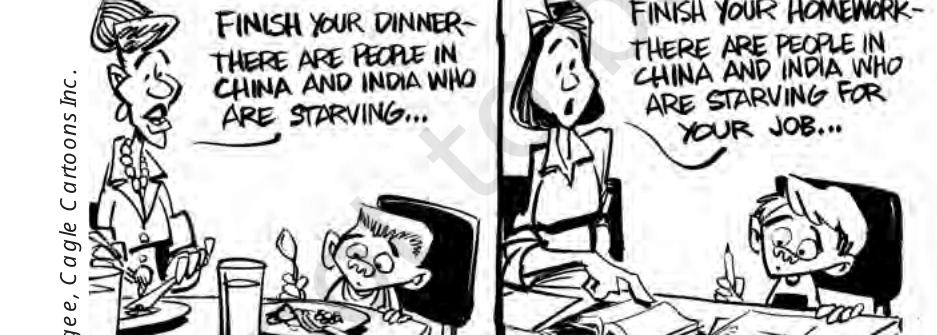
economic reforms of 1991. The cartoon below captures the new
economic reality, where India and China have become central to the world
of work.
Cartoon by Milt Priggee, NCERT Contemporary World Politics Class 12, Chapter 7. ``Yesterday'' a child was told to finish dinner because people in China and India were starving; ``today'' the child is told to finish homework because people in China and India are competing for the same jobs. It shows how economic globalisation has changed the world of work.
The economic implications of globalisation:
More trade and capital flows. Countries reduce
restrictions on imports and on the movement of capital, so goods
and investment move more freely across borders.
A bigger role for global institutions. Bodies like the IMF
and the WTO, along with powerful countries, help shape economic
policies across the world, sometimes voluntarily accepted and
sometimes forced.
Uneven distribution of gains. The benefits are not shared
equally. Critics warn that globalisation may help only a small
section while impoverishing those who depended on the government,
and some even call it a ``re-colonisation'' of the world. This
creates the demand for ``social safety nets.''
The advocates' case. Supporters argue that de-regulation
and greater trade let each economy do what it does best, raising
growth and well-being for larger sections of the population.
The impact of economic globalisation on India:
From protectionism to reform. After independence India
chose ``protectionism,'' making things itself and limiting imports.
This had problems: critical sectors like health, housing and
primary education were neglected, and growth was sluggish.
The 1991 reforms. Responding to a financial crisis and a
wish for higher growth, India in 1991 began ``a programme of
economic reforms'' that increasingly de-regulated trade and foreign
investment.
The real test. The chapter cautions that high growth rates
are not the final measure. The true test is whether the benefits of
growth are shared ``so that everyone is better off.''
1991 is reform, not the start of globalisation
For India, 1991 marks the start of its economic reforms, not the
birth of globalisation. Flows of trade and ideas reach back centuries in
Indian history, so do not equate the two.
Economic globalisation means freer trade and capital flows, a
larger role for the IMF and WTO, and unevenly shared gains. For India, it
meant moving from post-independence protectionism to the 1991 reforms that
de-regulated trade and investment, with the real test being whether the
benefits of growth reach everyone.
NC
Neha Chatterjee
M.A Economics, Tata Institute of Social Sciences
Verified Expert
Structural observation. This is a two-part question:
general economic implications, then the India-specific
impact. I split my answer down the middle with a clear heading for each,
so the examiner can tick both halves at a glance.
General half. Freer trade and capital flows, a bigger role
for the IMF and WTO, and a fierce debate over who gains, advocates
promising growth, critics warning of disparity.
India half. The journey from post-1947 protectionism, with
its neglected health and education and slow growth, to the 1991
reforms that opened trade and foreign investment.
The shared verdict. For both the world and India, the
chapter's measure is the same: gains must be shared, not just large.
The deeper reading: the Priggee cartoon is the perfect hook for this
answer. ``Yesterday'' India was a symbol of poverty; ``today'' it is a
competitor for global jobs through its services and software. That shift is
exactly what economic globalisation did for India after 1991. But the
chapter is careful, and so should you be: it warns that high growth is not
the same as fair growth. The smartest answer names the freer flows and the
institutions, traces India's path from protectionism to the 1991 reforms,
and ends on the test of shared benefit, because that is the line the
examiner is looking for.
Economically, globalisation brings freer flows of goods and
capital, a stronger role for the IMF and WTO, and an unequal spread of
gains. India moved from protectionism to the 1991 reforms, opening trade
and investment, but the decisive question remains whether growth is shared
so that everyone is better off.
Q 7.10
Do you agree with the argument that globalisation leads to cultural heterogeneity?
Concept used.Cultural heterogeneity, or cultural
heterogenisation, means that cultures become more different and
distinct. Its opposite is cultural homogenisation, where a single
uniform culture spreads. The honest answer is yes, but only in part:
globalisation produces both effects at the same time, so it leads to
heterogeneity as well as homogeneity. The cartoon below shows the
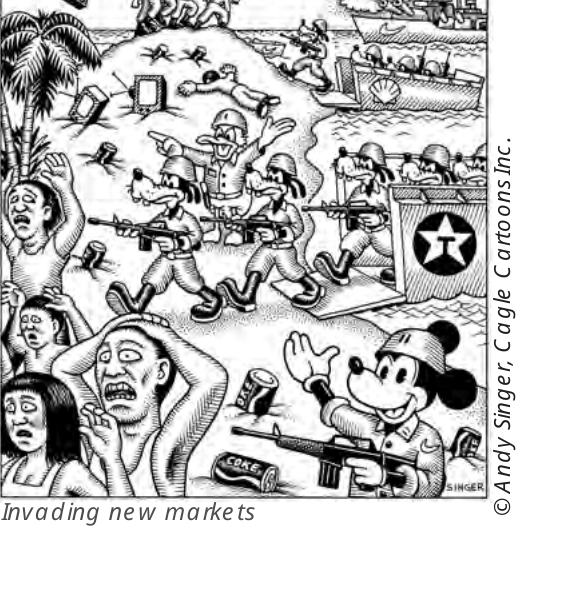
homogenising fear, of a dominant culture ``invading new markets.''
``Invading new markets'' cartoon by Andy Singer, NCERT Contemporary World Politics Class 12, Chapter 7. It shows the fear of cultural homogenisation, where a powerful culture spreads into and overwhelms others.
Why globalisation does lead to heterogeneity (the case for ``yes''):
Cultures absorb and adapt. All cultures accept outside
influences all the time. Sometimes these influences ``simply
enlarge our choices'' or modify a culture without overwhelming it.
New, unique combinations appear. The chapter gives the
example of a ``khadi kurta worn over jeans,'' a fresh blend that is
neither purely Indian nor purely Western. The burger is added to
our food choices, not a substitute for the masala dosa.
Each culture becomes more distinctive. The same global
process ``leads to each culture becoming more different and
distinctive,'' which is exactly what heterogenisation means.
Why we cannot fully agree (the homogenising side):
Cultural homogenisation is also real. Globalisation can
impose a uniform, largely Western culture, the ``McDonaldisation''
of the world, which the chapter calls dangerous for the world's
rich heritage.
Power is unequal. Cultural exchange is rarely one-way, and
differences in power remain when cultures interact.
Give a balanced ``yes, but''
The chapter shows two opposite effects at once. So agree that globalisation
leads to heterogeneity, but add that it also causes homogenisation. A
balanced ``yes, but'' answer scores higher than a flat yes or no.
Yes, in part. Globalisation does lead to cultural heterogeneity,
as cultures absorb outside influences and create new, distinctive blends
like the khadi kurta over jeans. But the same process also causes cultural
homogenisation, so the fairest answer is that it produces both effects
together.
AK
Aditi Kapoor
M.A Cultural Studies, Symbiosis Pune
Verified Expert
Strategic angle. ``Do you agree'' questions want a clear stand
backed by evidence. I take a balanced stand, agree that heterogeneity
happens, then show the chapter also records the opposite, so my agreement
is honest rather than absolute.
State the stand. I agree that globalisation produces
cultural heterogeneity, but I add at once that it also produces
homogenisation.
Evidence for heterogeneity. The khadi-kurta-over-jeans
blend, the burger added alongside the dosa, and the textbook line
that cultures become ``more different and distinctive.''
Evidence for the other side. McDonaldisation and the soft
power of US culture show homogenisation is just as real.
The deeper reading: the two effects are not a contradiction, they are two
faces of the same coin. When cultures meet, some blends enrich and
diversify (heterogeneity), while a dominant culture can also flatten
differences (homogeneity). India is the chapter's living proof:
Valentine's Day and foreign TV pull one way, while the kurta-and-jeans
fusion, even exported back to America, pulls the other. So the topper's
move is to agree, prove heterogeneity with the textbook's own examples, and
then refuse to ignore homogenisation. That balance is precisely what the
question is testing.
I agree, but only partly. Globalisation clearly creates cultural
heterogeneity through new blends and more distinctive cultures, yet it
simultaneously drives homogenisation, so both effects run side by side.
Q 7.11
How has globalisation impacted on India and how is India in turn impacting on globalisation?
Concept used. This question runs in two directions: how
globalisation has changed India, and how India is itself
shaping globalisation. The chapter shows that India is not just a
passive receiver of global flows; it both absorbs them and pushes back on
them, including through resistance movements.
How globalisation has impacted India:
Economic opening after 1991. Responding to a financial
crisis, India launched economic reforms in 1991 that de-regulated
trade and foreign investment, moving away from its earlier
protectionism.
Cultural change. Globalisation reached Indian homes,
food, dress and ideas, from foreign TV channels to new blends like
the khadi kurta worn over jeans.
New kinds of work. Services such as call centres connect
Indian workers directly to customers abroad, a clear sign of global
economic integration.
Resistance within India. Globalisation has met opposition
from many quarters. Left-wing protests target economic
liberalisation, trade unions and farmers protest against
multinationals, and the patenting of plants like Neem by foreign
firms drew strong objection. The political right has objected to
cultural influences such as foreign TV and Valentine's Day.
How India is in turn impacting on globalisation:
Exporting its culture. Indian culture flows outward too.
The chapter's striking example is the kurta-and-jeans combination
being ``exported back'' so that young Americans wear a kurta over
jeans.
Shaping the global economy. Through its services, software
and growing economy, and its rising weight in world trade, India
has become a country others must reckon with.
Adding to global resistance. India's social movements,
through forums like the Indian Social Forum, join the worldwide
coalition that questions neo-liberal globalisation, so India helps
shape the global debate about globalisation itself.
Answer both directions
The question has two clear parts: globalisation on India, and India
on globalisation. Many students answer only the first. Always show
the two-way street, including how Indian culture and resistance flow
outward.
Globalisation reshaped India through the 1991 economic reforms,
cultural change, and new service-sector work, while also provoking
resistance from the left and the right. In turn, India shapes globalisation
by exporting its culture (the kurta over jeans), driving the world economy
through its services, and adding its voice to global resistance through
forums like the Indian Social Forum.
DS
Dev Sharma
M.A Political Science, Pondicherry University
Verified Expert
Structural observation. The question is a two-way street, so my
answer must travel in both directions: globalisation acting on
India, and India acting on globalisation. I give each direction its
own block, which makes the two-way logic impossible to miss.
Inward impact. The 1991 reforms opened the economy;
culture, food and dress changed; call centres linked Indian workers
to the world; and resistance rose from both left and right.
Outward impact. Indian culture travels back out (kurta
over jeans in America), Indian services and growth shape the world
economy, and Indian social movements feed the global
anti-globalisation debate.
Tie the two together. India is both shaped by and a shaper
of globalisation, an active participant, not a passive receiver.
The deeper reading that lifts this answer: the resistance story matters as
much as the economic one. India does not simply accept globalisation; it
argues with it. Left-wing parties protest liberalisation, farmers and trade
unions resist multinationals, the Neem-patenting fight became a national
cause, and the right pushes back on cultural imports. By carrying these
arguments into global forums like the Indian Social Forum and the World
Social Forum, which met in Mumbai in 2004, India helps shape what
globalisation becomes for everyone. So the complete answer names the
inward changes, names the outward influence, and treats India's resistance
as part of how it impacts globalisation, not just a footnote.
Globalisation impacted India through the 1991 reforms, cultural
shifts and a new service economy, while sparking left and right resistance.
India impacts globalisation in return by exporting its culture, powering
the world economy with its services, and feeding global resistance through
forums like the Indian Social Forum, making it a two-way relationship.
FAQs on Globalisation Class 12 NCERT Solutions
Globalisation Class 12 Political Science Common Questions
Ques. Where can I get the class 12 political science chapter 7 NCERT Solutions PDF?
Ans. You can download the Globalisation Class 12 Political Science NCERT Solutions PDF directly from this page. It is free, follows the 2026-27 NCERT, and answers all 10 exercise questions step by step.
Ques. How many questions are there in Globalisation class 12 questions and answers?
Ans. The chapter has 10 exercise questions. The first five are MCQ items on the meaning, impact and causes of globalisation, while Questions 6 to 10 are short and long written answers, including the role of the state and the impact on India.
Ques. What is globalisation in Class 12 Political Science?
Ans. Globalisation is worldwide interconnectedness, the flow of ideas, capital, commodities and people across the world. It is multi-dimensional, touching the economy, politics and culture, and is driven mainly by technology.
Ques. How has technology contributed to globalisation?
Ans. Technology, above all the telegraph, telephone and microchip, shrank distance and time. Faster communication let ideas, money and goods move almost instantly across borders, which is why the chapter calls technology the most important cause of globalisation.
Ques. Does globalisation lead to cultural homogeneity or heterogeneity?
Ans. Both at once. Globalisation can spread a single global culture (homogeneity), but it also mixes global and local cultures to create new forms (heterogeneity). A good answer shows both sides rather than picking only one.
Ques. Is class 12 political science chapter 7 easy to score in the board exam?
Ans. Yes. It is one of the easier scoring chapters if you keep the meaning, causes and impact clear and give a balanced view on culture and the state. Practise the MCQs and keep the India point ready for the long answers.








Comments