Political Science Strategist, 6 Yrs | Updated 3+ months ago
The NCERT Solutions for Political Science Class 12 Chapter 6 Environment and Natural Resources answer every textbook question on how the environment became a world-politics issue, set to the latest 2026-27 CBSE syllabus. Each answer explains the Earth Summit, the global commons and the principle of common but differentiated responsibilities. These solutions help students prepare for the Class 12 Political Science board paper and the UPSC foundation in 2026-27.
Covers all 9 exercise questions from Contemporary World Politics Chapter 6, with full point-wise answers.
This Class 12 Political Science chapter usually carries 5 to 6 marks per board paper.
Pairs with the Notes, Handwritten Notes and NCERT Book PDF linked lower on this page.
Every solution for Class 12 Political Science Chapter 6 in this Collegedunia compilation is written by subject experts from the official NCERT Contemporary World Politics textbook, and checked against the last five years of CBSE board papers.
Student Feedback: In a Collegedunia poll of 9,040 Class 12 Political Science students taken before the 2026 boards, 71% of students rated the common but differentiated responsibilities question as the trickiest part of Environment and Natural Resources. Most students said a clear North-South table made the answer easy to recall.
Source: 2026-27 Class 12 Political Science student poll. Sample of 9,040 students from CBSE schools across 13 states.
What the Environment and Natural Resources Class 12 Chapter Is About
Environment and Natural Resources is the sixth chapter of Contemporary World Politics. It studies how the environment became a central issue in world politics from the 1960s onwards. Before this, the environment was treated as a subject for geography, not for power and policy. The chapter shows how human-caused damage turned it into a political question.
The chapter answers three big questions that students must keep in mind:
Why did the environment turn political? Human damage became pervasive, dangerous and beyond any single state.
How is it governed? Through the Earth Summit, Agenda 21 and treaties over the global commons.
Who should pay? The North-South divide and the principle of common but differentiated responsibilities.
So the chapter is really about turning a natural problem into a political one. A student who keeps these three threads in mind can connect almost any question in Environment and Natural Resources class 12 back to one of them. This is why revision works best when you sort each fact under "why political", "how governed" or "who pays" first.
Why the Environment Became a Political Issue
By the 1990s the harm to the planet was too large to ignore. The reasons the environment rose up the agenda are a long-answer favourite, so students should learn them as a clear list rather than a story. The table below sorts the main causes for fast revision.
Cause
What it meant
Pervasive damage
Shrinking farmland, falling soil fertility, over-harvested fisheries, deforestation and lost biodiversity spread worldwide.
Atmospheric harm
Greenhouse gases brought global warming; ozone-depleting gases opened the ozone hole over Antarctica.
Cross-border problems
The atmosphere, oceans and climate are shared, so no single state could fix them alone.
Landmark warnings
The 1987 Brundtland Report and the 1992 Earth Summit put the issue at the centre of politics.
End of the Cold War
With superpower rivalry over, world politics had room for new issues like the environment.
A key insight for the exam is that the environment became political because the damage was too dangerous, too shared and too costly to leave aside. Once governments had to act, share the cost and decide who uses the Earth's resources, the subject moved from geography into world politics, and since the 1990s it has stayed a priority concern.
The Earth Summit and Agenda 21
The Earth Summit was the United Nations Conference on Environment and Development (UNCED), held in Rio de Janeiro in June 1992. Its outcomes are one of the most-asked questions in the chapter, so students should learn both what it agreed and what it left open. The points below cover its main results.
Conventions: agreements on climate change, biodiversity and forestry set the global agenda.
Agenda 21: a detailed blueprint of development practices for the 21st century.
Sustainable development: a consensus on combining growth with ecological responsibility.
The unresolved divide: the rich North and poor South came with different agendas, and major gaps stayed open.
The honest exam point is that Rio set the world's environmental agenda but did not settle the hardest question. Climate, biodiversity, forests, Agenda 21 and sustainable development all trace back to it, yet critics noted that Agenda 21 leaned towards growth over firm conservation. The summit was attended by 170 states, thousands of NGOs and many MNCs, which is why every statement in the "mark correct or wrong" question is right.
The Global Commons and the North-South Divide
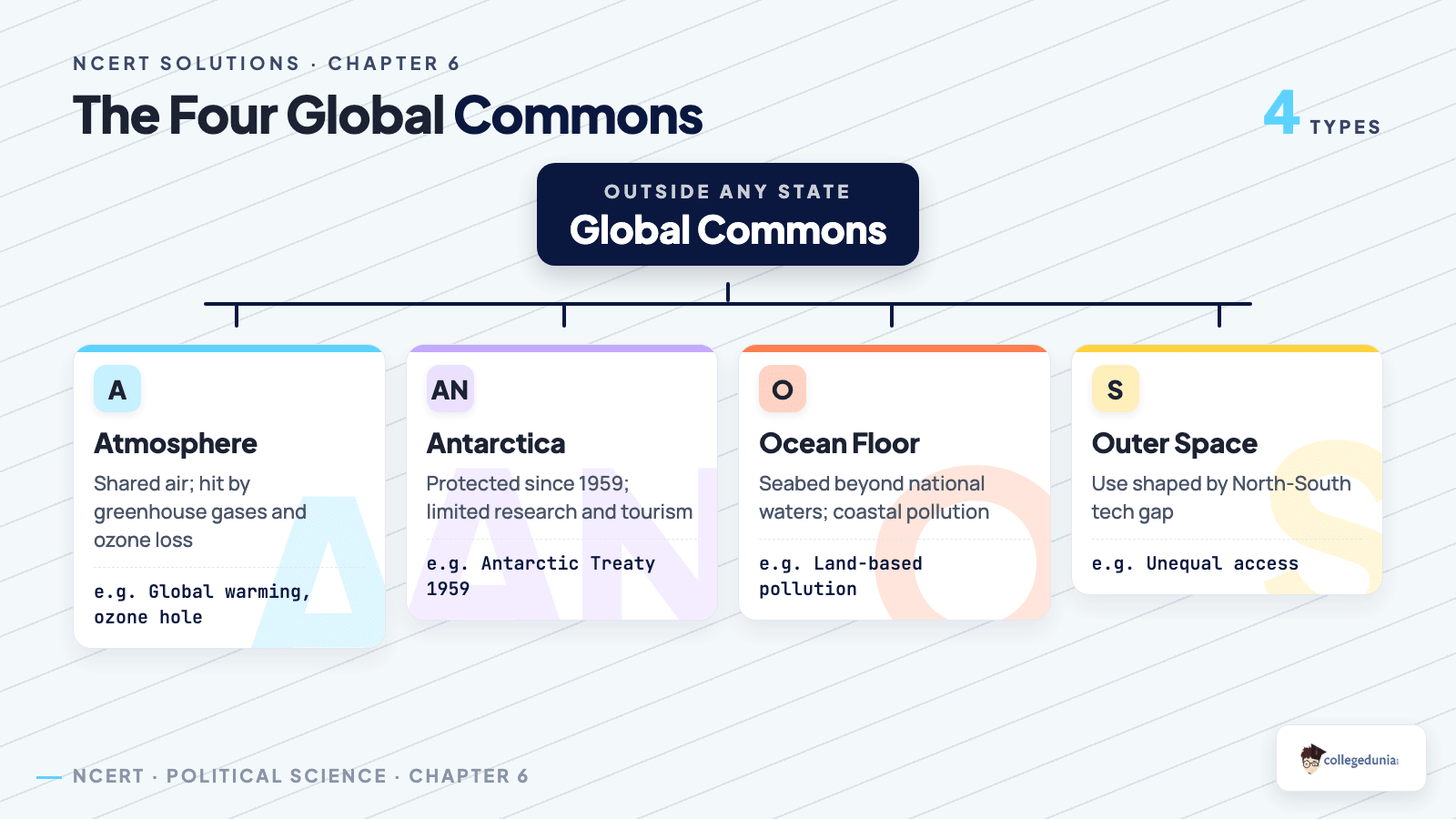
The global commons are areas that lie outside the sovereign control of any one state, so they need common governance by the international community. They are known in law as res communis humanitatis. This topic is a regular short and long answer, so keep the four commons ready.
Global common
How it is exploited or polluted
Atmosphere
Greenhouse gases and ozone-depleting substances cause global warming and the ozone hole.
Antarctica
Research, fishing and tourism since 1959 leave waste, including damage from oil spills.
Ocean floor
Coastal waters are increasingly polluted, largely by land-based human activity.
Outer space
Its use is shaped by North-South inequalities, since the gains depend on advanced technology.
A sharp point for the exam is that managing the commons reflects the North-South divide, but the North is not "more" concerned than the South. The two sides simply pursue different agendas: the North worries about ozone loss and warming, while the South stresses the link between development and the environment. That single word "more" is the trap in the global-commons MCQ.
Common but Differentiated Responsibilities
The principle of common but differentiated responsibilities (CBDR) was accepted in the Rio Declaration of 1992. It is the heart of the chapter's climate politics, so the answer needs both a clear definition and a sense of how to put it into practice.
Common: all states share the duty to protect the Earth's ecosystem.
Differentiated: the share is unequal, because the developed North caused most past damage.
The South must grow: still-industrialising countries face lighter obligations, which is why India and China were exempted from Kyoto targets.
Putting it to work: binding cuts for the North, plus finance and clean-technology transfer to the South.
The judgement most answers should reach is that CBDR is the bridge between fairness and effectiveness in climate politics. It says the planet can be saved only if those who polluted most pay most, while the poor are still allowed to develop. Marks come from giving the definition first, then naming the practical tools: targets, finance and technology.
India's Stand, Movements and Resource Geopolitics
The closing part of the chapter covers India's position, environmental movements and the geopolitics of resources. This links the chapter to India's foreign policy, so it is a regular short and long answer. The table keeps the key ideas in one place.
Area
Key points to recall
India's stand
The North must lead on cuts and provide finance and clean technology; India ratified Kyoto (2002) and Paris (2016).
Movements
Forest, anti-dam and pro-river, wilderness and mineral-industry struggles bring environment and politics together.
Resource geopolitics
Oil and water are the two resources that most shape global power and conflict.
One sharp point for the India question: India's stand rests on historical responsibility, not on refusing to act. India runs one of the world's largest renewable-energy programmes and has passed clean-fuel, energy-conservation and renewable-energy laws. So India both demands fairness from the North and takes its own steps, a key idea for the long-answer questions.
Environment and Natural Resources Class 12 Exercise-wise Coverage
The chapter exercise has 9 questions. The table maps each one to its topic so students can plan revision and find the right NCERT answer fast. The full point-wise solution for each sits in the question set lower on this page.
Question
Topic it tests
Q 1
Best reason for growing concern about the environment (MCQ)
Q 2
Mark correct or wrong: statements about the Earth Summit
Q 3
Which statements about the global commons are TRUE (MCQ)
Q 4
Outcomes of the Rio Summit
Q 5
Meaning of the global commons, and how they are exploited and polluted
Q 6
Common but differentiated responsibilities and how to implement it
Q 7
Why global environmental protection became a priority since the 1990s
Q 8
Compromise and accommodation in the North-South negotiations
Q 9
Economic development without further environmental damage, with examples
Questions 6, 8 and 9 are the most-asked long answers, so students preparing Environment and Natural Resources class 12 important questions should learn those three first. The MCQs (Q1 to Q3) are quick marks, so revise the Earth Summit facts and the four global commons well to secure them.
Students who want the offline copy can save the class 12 political science chapter 6 pdf from the download card above and tick off each question as they finish it.
Environment and Natural Resources Important Questions and Previous Year Trends
CBSE sets a steady mix of MCQ, short and long answers from this chapter. Knowing the pattern helps students decide how much to write. The chapter is a regular source of one 4-mark or 6-mark question, which is why a focused list of Environment and Natural Resources important questions saves a lot of revision time.
Long answer (5 to 6 marks): common but differentiated responsibilities, or compromise and accommodation between North and South.
Short answer (4 marks): outcomes of the Rio Summit, or the meaning of the global commons.
Source-based: a passage on the Earth Summit or sustainable development, with sub-parts.
Objective and MCQ: Rio 1992, Agenda 21, the four commons, Kyoto and the Montreal Protocol.
For quick recall before the exam, students often practise the class 12 political science chapter 6 mcq set and a list of Environment and Natural Resources class 12 important questions. The most repeated items are the Earth Summit outcomes and the CBDR principle, so keep those answer points ready in your own words.
Working through the ncert solutions class 12 political science chapter 6 set twice, once open-book and once from memory, fixes the dates and treaties well before the board exam.
Common Mistakes Students Make in This Chapter
A few errors cost marks every year in this chapter. Most come from mixing up treaties or giving only one side of the North-South debate. Avoiding them is the fastest way to lift a score.
Saying the North is "more" concerned about the commons - it is not; the North simply has a different agenda from the South.
Confusing the Montreal Protocol (ozone, 1987) with the Kyoto Protocol (climate, 1997).
Listing only the Rio conventions and forgetting Agenda 21 and sustainable development as outcomes.
Forgetting that the Earth Summit (UNCED) was a UN-hosted, leader-level summit, so all four statements are correct.
Treating CBDR as "equal responsibility" - it means a shared but unequal duty.
Students who fix these five points usually move from average to high marks on the long answers. The exam rewards a balanced view, so always give both the North's and the South's position before you judge the negotiations.
Environment and Natural Resources PDF Download Formats and Languages
The solutions are free to download in more than one format, so students can pick what suits their device and revision style. The download card at the top of the page carries each option for this chapter.
Normal and HD PDF: the class 12 political science chapter 6 pdf comes in a normal size for quick downloads and an HD version for clear printing.
English medium: all 9 answers are written in simple English for the CBSE board paper.
Question-only set: a print-and-practise sheet of Environment and Natural Resources extra questions for self-testing.
Whole-book pack: the solutions sit in one set that runs through every Contemporary World Politics chapter, so you can revise from Chapter 1 onwards in one place.
Many students search for class 12 political science chapter 6 answers on their phone the night before a test, so a saved PDF means you can revise even without internet. Keep both the question set and the solved version handy for a full self-check.
How the Environment and Natural Resources Solutions Pair with Notes and the Book PDF
These NCERT Solutions answer the back-exercise questions. To revise the full chapter, students should use them alongside the other resources for the same chapter, all linked in the table below.
Reading the original NCERT chapter text and figures
Tip: read the Notes first, then attempt these solutions on your own, and only then check the model answers here. That order builds memory faster than copying answers straight away.
All NCERT Solutions for Class 12 Political Science
The table links the NCERT Solutions for every chapter in both Class 12 Political Science books, so students can move across the course in one click. Environment and Natural Resources is highlighted.
All NCERT Solutions for Environment and Natural Resources with Step-by-Step Solutions
Below are all 9 NCERT exercise questions for this chapter, exactly as they appear in the textbook. Tap Check Solution for the model answer or Expert Solution for the topper-style approach.
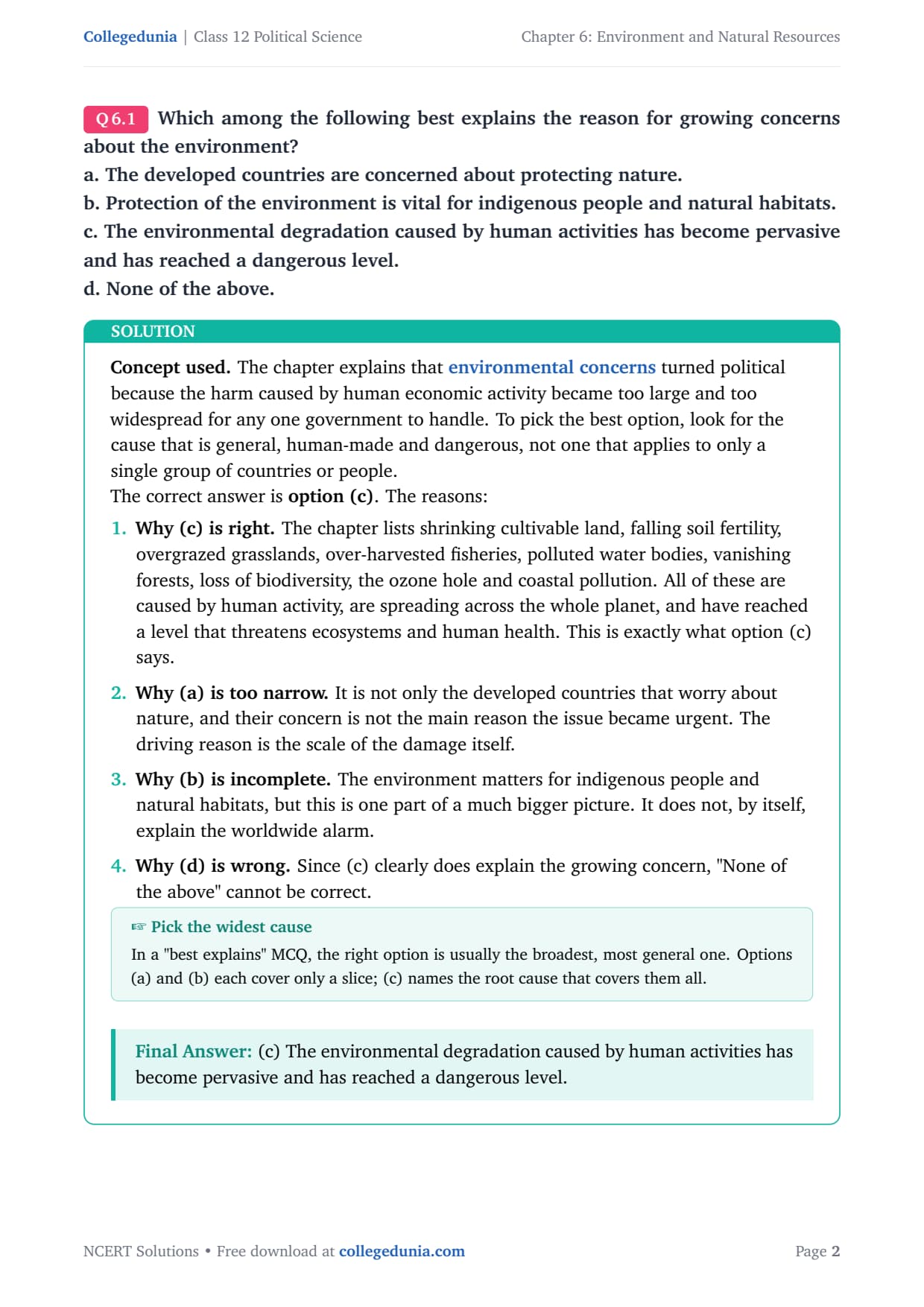
Q 6.1
Which among the following best explains the reason for growing
concerns about the environment?
a. The developed countries are concerned about protecting nature.
b. Protection of the environment is vital for indigenous people and natural
habitats.
c. The environmental degradation caused by human activities has become
pervasive and has reached a dangerous level.
d. None of the above.
Concept used. The chapter explains that environmental
concerns turned political because the harm caused by human economic activity
became too large and too widespread for any one government to handle. To pick
the best option, look for the cause that is general, human-made and dangerous,
not one that applies to only a single group of countries or people.
The correct answer is option (c). The reasons:
Why (c) is right. The chapter lists shrinking cultivable
land, falling soil fertility, overgrazed grasslands, over-harvested
fisheries, polluted water bodies, vanishing forests, loss of
biodiversity, the ozone hole and coastal pollution. All of these are
caused by human activity, are spreading across the whole planet, and
have reached a level that threatens ecosystems and human health. This
is exactly what option (c) says.
Why (a) is too narrow. It is not only the developed countries
that worry about nature, and their concern is not the main reason the
issue became urgent. The driving reason is the scale of the damage
itself.
Why (b) is incomplete. The environment matters for indigenous
people and natural habitats, but this is one part of a much bigger
picture. It does not, by itself, explain the worldwide alarm.
Why (d) is wrong. Since (c) clearly does explain the growing
concern, "None of the above" cannot be correct.
Pick the widest cause
In a "best explains" MCQ, the right option is usually the broadest, most
general one. Options (a) and (b) each cover only a slice; (c) names the root
cause that covers them all.
(c) The environmental degradation caused by human activities has
become pervasive and has reached a dangerous level.
AI
Ananya Iyer
MA Political Science, JNU
Verified Expert
Strategic angle. Treat this as an elimination drill. Three options
are partly true but narrow; one captures the whole story. The examiner wants
the cause that turns the environment into a global political issue, not a side
observation about who cares.
Read the stem carefully: it asks for the reason for growing
concerns, that is, the cause that made everyone worry at once. So the
answer must be a worldwide, escalating problem.
Test (a) and (b): each is true for a limited group (rich countries;
indigenous people and habitats). Neither explains why the alarm is now
global, so both are too narrow.
Test (c): it names human-caused degradation that is pervasive
(everywhere) and dangerous (severe). That matches the chapter's
long list of damages, so (c) is the cause. With (c) correct, (d) falls
away.
Why this matters. The chapter's whole argument is that environmental
problems are political precisely because they are human-made, planet-wide and
beyond any single state to fix. Option (c) restates that argument in one line,
which is why it is the best answer and a fast, certain mark.
The best explanation is (c): human-caused environmental degradation
has become pervasive and dangerous.
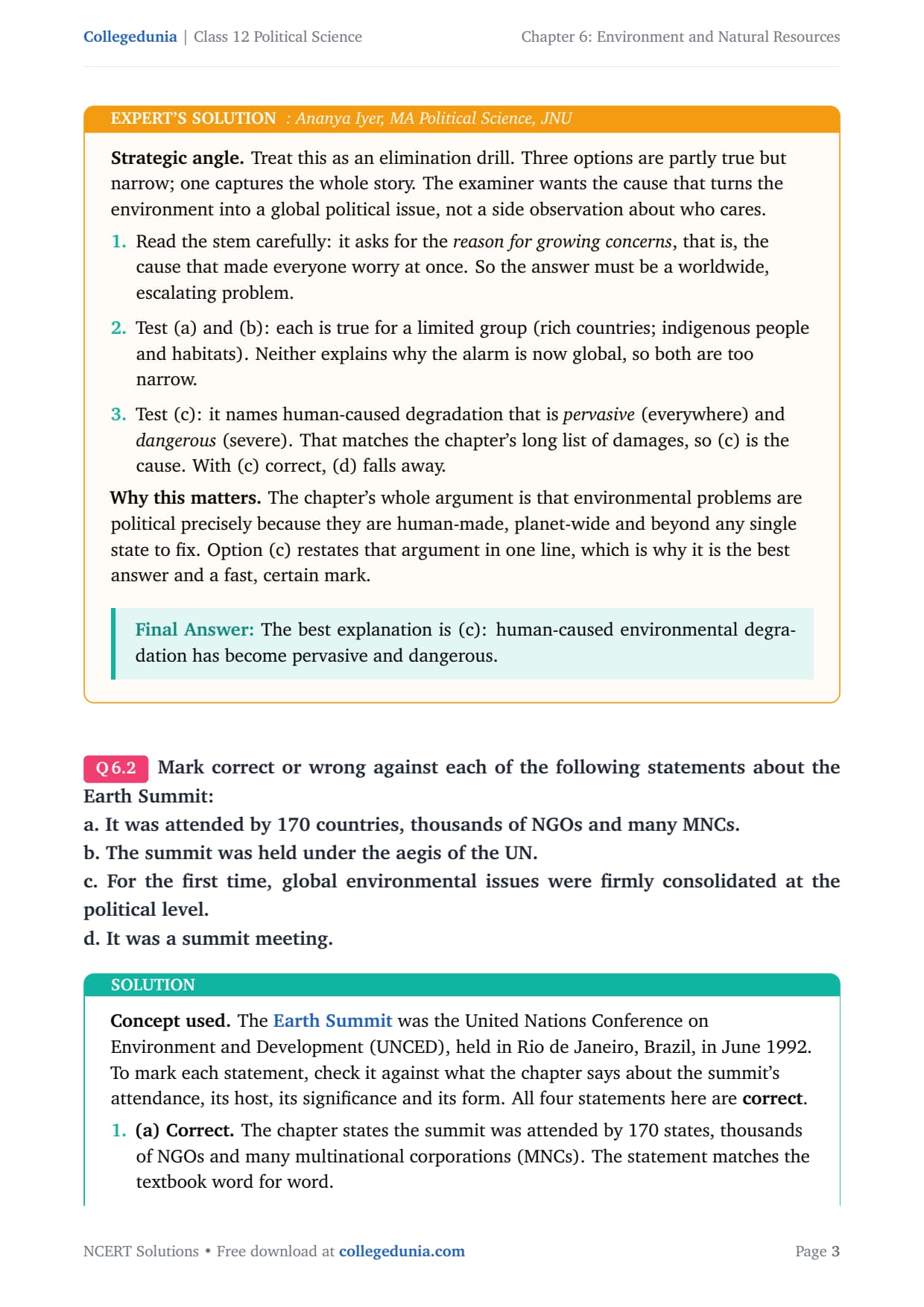
Q 6.2
Mark correct or wrong against each of the following statements about
the Earth Summit:
a. It was attended by 170 countries, thousands of NGOs and many MNCs.
b. The summit was held under the aegis of the UN.
c. For the first time, global environmental issues were firmly consolidated at
the political level.
d. It was a summit meeting.
Concept used. The Earth Summit was the United Nations
Conference on Environment and Development (UNCED), held in Rio de Janeiro,
Brazil, in June 1992. To mark each statement, check it against what the chapter
says about the summit's attendance, its host, its significance and its form.
All four statements here are correct.
(a) Correct. The chapter states the summit was attended by
170 states, thousands of NGOs and many multinational corporations
(MNCs). The statement matches the textbook word for word.
(b) Correct. It was held under the aegis (the authority and
umbrella) of the United Nations: its full name is the United Nations
Conference on Environment and Development.
(c) Correct. The growing focus on the environment in global
politics was firmly consolidated at this conference for the first time,
bringing environmental issues to the centre-stage of world politics.
(d) Correct. It was indeed a summit meeting, a top-level
gathering of heads of state and government, which is exactly why it is
called the Earth "Summit".
Use the textbook's own figure
The statement says "170 countries" and the NCERT text says "170 states", so
mark it correct. In an NCERT exercise, always judge a fact against the chapter,
not against outside numbers you may have read elsewhere.
All four are correct: (a) correct, (b) correct, (c) correct,
(d) correct.
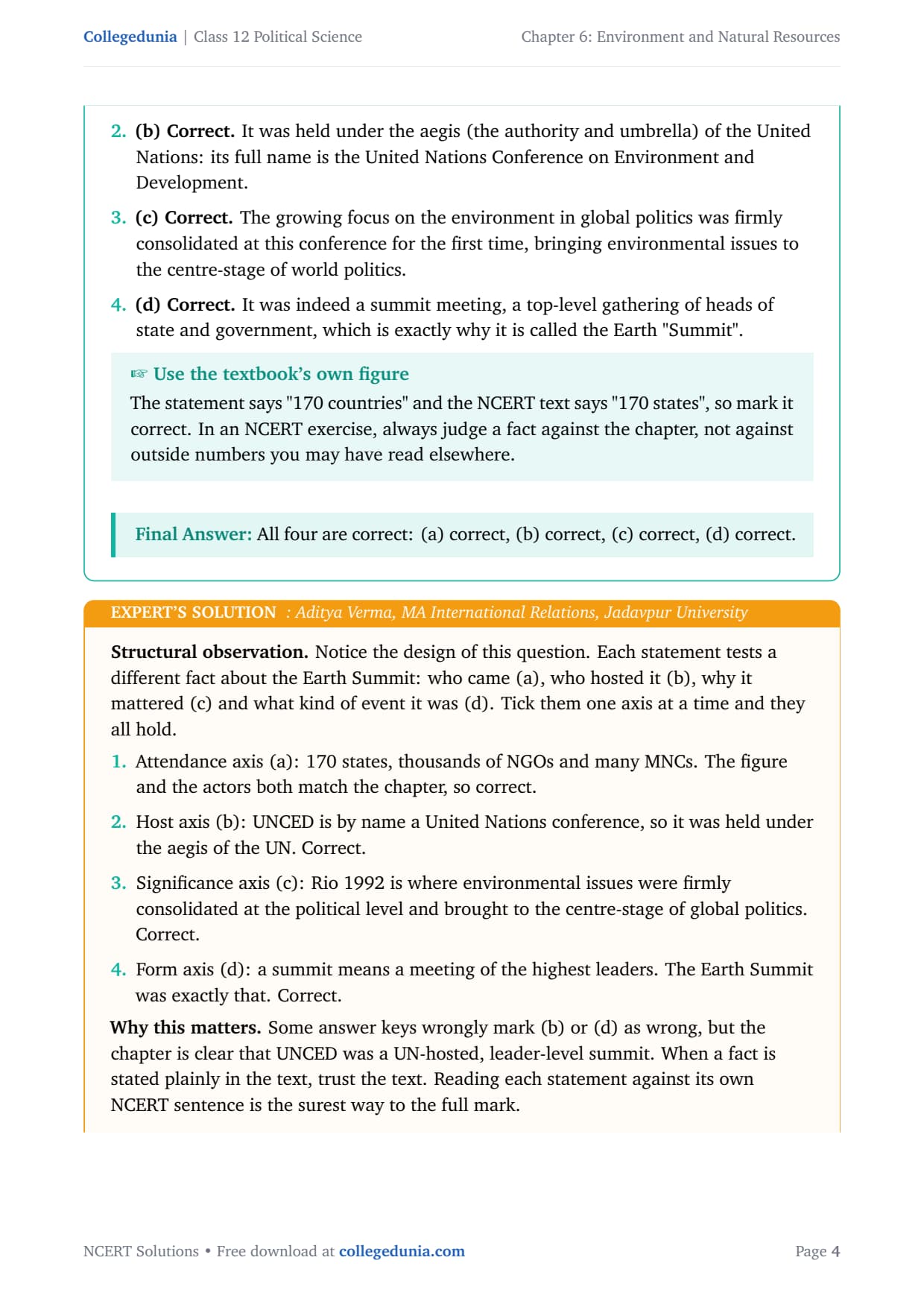
AV
Aditya Verma
MA International Relations, Jadavpur University
Verified Expert
Structural observation. Notice the design of this question. Each
statement tests a different fact about the Earth Summit: who came (a), who
hosted it (b), why it mattered (c) and what kind of event it was (d). Tick them
one axis at a time and they all hold.
Attendance axis (a): 170 states, thousands of NGOs and many MNCs. The
figure and the actors both match the chapter, so correct.
Host axis (b): UNCED is by name a United Nations conference, so it was
held under the aegis of the UN. Correct.
Significance axis (c): Rio 1992 is where environmental issues were
firmly consolidated at the political level and brought to the
centre-stage of global politics. Correct.
Form axis (d): a summit means a meeting of the highest leaders. The
Earth Summit was exactly that. Correct.
Why this matters. Some answer keys wrongly mark (b) or (d) as wrong,
but the chapter is clear that UNCED was a UN-hosted, leader-level summit. When
a fact is stated plainly in the text, trust the text. Reading each statement
against its own NCERT sentence is the surest way to the full mark.
Correct, correct, correct, correct. Every statement about the Earth
Summit (a, b, c, d) is right.
Q 6.3
Which among the following are TRUE about the global commons?
a. The Earth's atmosphere, Antarctica, ocean floor and outer space are
considered as part of the global commons.
b. The global commons are outside sovereign jurisdiction.
c. The question of managing the global commons has reflected the North-South
divide.
d. The countries of the North are more concerned about the protection of the
global commons than the countries of the South.
Concept used. The global commons (in Latin, res
communis humanitatis) are areas and resources that lie outside the sovereign
control of any single state and so need common governance by the international
community. To judge each statement, test it against this definition and against
what the chapter says about how the commons are managed. Statements
(a), (b) and (c) are TRUE; (d) is false.
(a) True. The chapter names the Earth's atmosphere,
Antarctica, the ocean floor and outer space as the global commons. The
statement lists exactly these four.
(b) True. By definition the global commons sit outside the
sovereign jurisdiction of any one state; that is precisely why they
require shared, common governance.
(c) True. The history of managing the commons (for example the
ozone hole and outer space) is "thoroughly influenced by North-South
inequalities", so it clearly reflects the North-South divide.
(d) False. The chapter does not say the North cares more about
protecting the commons. The North and South simply pursue
different agendas: the North worries about ozone depletion and
global warming, while the South stresses the link between development
and the environment. Different priorities are not the same as the North
caring more.
Different, not "more"
The trap in (d) is the word "more". The North and South have different
environmental priorities, but the text never ranks one as caring more than the
other. That single word makes (d) false.
True: (a), (b) and (c). False: (d). The North is not "more"
concerned about the commons; it simply has a different agenda from the South.
RB
Rohan Banerjee
MA Political Science, University of Delhi
Verified Expert
Strategic angle. Three of these statements come straight from the
chapter's definition and discussion of the commons; the fourth slips in a
comparison the text never makes. Verify the first three quickly, then catch the
loaded word in the fourth.
Definition checks (a) and (b): the four commons are the atmosphere,
Antarctica, the ocean floor and outer space, and they lie outside any
state's sovereign jurisdiction. Both are textbook definitions, so both
are true.
Politics check (c): managing the commons has been shaped by North-South
inequalities, as the ozone and outer-space examples show. So (c), the
North-South divide, is true.
Comparison check (d): the chapter gives the North and South
different agendas, not a ranking of concern. "More concerned"
is an over-claim the text does not support, so (d) is false.
Why this matters. This question rewards the habit of reading every
word of an option, not just its gist. Statements (a) to (c) restate the
chapter; (d) sneaks in a value judgement ("more concerned") that the chapter
deliberately avoids. Spotting that one slippery word is the whole skill being
tested.
(a), (b) and (c) are true; (d) is false.
Q 6.4
What were the outcomes of the Rio Summit?
Concept used. The Rio Summit (the Earth Summit, 1992) was
the conference that brought the environment to the centre of global politics.
An "outcomes" question asks for the concrete results it produced: the
conventions it adopted, the action plan it set out, and the new idea it
established. Name each clearly.
The major outcomes of the Rio Summit were:
Conventions on climate change, biodiversity and forestry. The
summit produced international conventions dealing with climate change,
with biodiversity (the variety of life) and with forestry, setting the
global agenda on each.
Agenda 21. It recommended a detailed list of development
practices known as Agenda 21, a blueprint for how countries
could develop in an environmentally friendly way in the 21st century.
The idea of sustainable development. There was a consensus on
combining economic growth with ecological responsibility. This approach
is called sustainable development: meeting present needs
without destroying the ability of future generations to meet theirs.
The North-South gap was exposed, not closed. The summit
revealed that the rich global North and the poor global South were
following different agendas, and it left major differences unresolved.
Critics also argued that Agenda 21 leaned in favour of economic growth
rather than firm ecological conservation.
A turning point, not a final answer
Rio mattered because it set the world's environmental agenda for decades:
climate, biodiversity, forests, Agenda 21 and sustainable development all trace
back to it. But it also showed how hard genuine North-South agreement would be,
which is the tension the rest of the chapter explores.
The Rio Summit produced conventions on climate change, biodiversity
and forestry; recommended Agenda 21 as a development blueprint; established a
consensus on sustainable development (growth with ecological responsibility);
and exposed the unresolved North-South divide, with critics noting Agenda 21's
tilt towards growth over conservation.
PN
Priya Nair
MA Political Science, University of Hyderabad
Verified Expert
Strategic angle. Bundle the outcomes into "what it agreed" and "what
it left open". The first bundle (conventions, Agenda 21, sustainable
development) earns most of the marks; the second bundle (the unresolved
North-South split) shows you read the summit critically, which lifts the answer.
What it agreed: three conventions (climate change, biodiversity,
forestry), one action plan (Agenda 21), and one guiding idea
(sustainable development, growth plus ecological responsibility).
What it left open: the North and South came with different agendas,
considerable differences stayed unresolved, and Agenda 21 was criticised
for favouring growth over conservation.
Frame the verdict: Rio set the global environmental agenda but did not
settle the hardest question, how to grow without wrecking the planet,
especially across the rich-poor divide.
Why this matters. Listing only the conventions answers half the
question. Naming both the agreements and the unresolved tensions shows the
examiner you understand Rio as a beginning, the moment the environment entered
world politics, rather than as a problem solved. That balance is what separates
a full-marks answer from a partial one.
Conventions on climate change, biodiversity and forestry; Agenda 21;
a consensus on sustainable development; and an exposed but unresolved
North-South divide, with Agenda 21 criticised for tilting towards growth.
Q 6.5
What is meant by the global commons? How are they exploited and
polluted?
Concept used. The global commons are those areas and
resources of the world that lie outside the sovereign jurisdiction of any one
state and so require common governance by the international community. They are
known in law as res communis humanitatis. The question has two parts:
define them, then explain how they are misused. Answer both.
What the global commons are. They include four main areas:
the Earth's atmosphere;
Antarctica;
the ocean floor; and
outer space.
No single country owns these; they belong to humanity in common, like a shared
"common room" or a community park belongs to all its members.
How they are exploited and polluted.
The atmosphere. It has been polluted by greenhouse gases and
ozone-depleting substances, producing global warming and the ozone hole
over Antarctica (discovered in the mid-1980s), which endangers
ecosystems and human health.
Antarctica. Even the limited activities allowed since 1959,
scientific research, fishing and tourism, have degraded parts of the
region through waste, including damage caused by oil spills.
The ocean floor and the oceans. Coastal waters are
increasingly polluted, largely by land-based human activity, harming
the marine environment.
Outer space. Its use as a global commons is shaped by
North-South inequalities, because the benefits of activity in space
depend on advanced technology and industry, which the rich nations
command. The gains are far from equal for present or future generations.
The deeper difficulty. A central problem is the trouble in reaching
consensus on common environmental agendas, often on the basis of vague
scientific evidence and uncertain time frames. The richer North and poorer
South disagree on who should bear the cost of protecting these shared spaces.
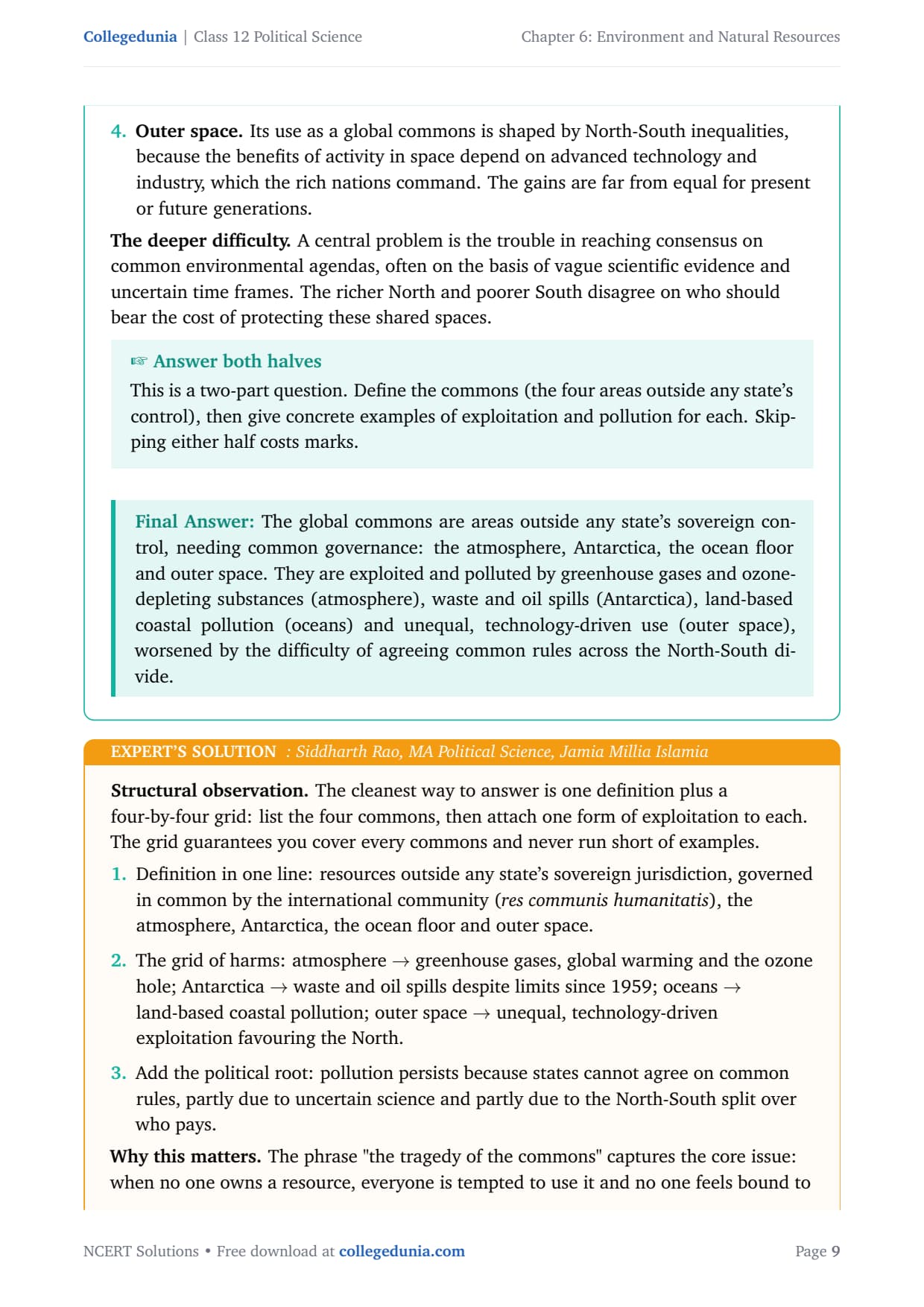
Answer both halves
This is a two-part question. Define the commons (the four areas outside any
state's control), then give concrete examples of exploitation and pollution for
each. Skipping either half costs marks.
The global commons are areas outside any state's sovereign control,
needing common governance: the atmosphere, Antarctica, the ocean floor and
outer space. They are exploited and polluted by greenhouse gases and
ozone-depleting substances (atmosphere), waste and oil spills (Antarctica),
land-based coastal pollution (oceans) and unequal, technology-driven use
(outer space), worsened by the difficulty of agreeing common rules across the
North-South divide.
SR
Siddharth Rao
MA Political Science, Jamia Millia Islamia
Verified Expert
Structural observation. The cleanest way to answer is one definition
plus a four-by-four grid: list the four commons, then attach one form of
exploitation to each. The grid guarantees you cover every commons and never run
short of examples.
Definition in one line: resources outside any state's sovereign
jurisdiction, governed in common by the international community
(res communis humanitatis), the atmosphere, Antarctica, the
ocean floor and outer space.
The grid of harms: atmosphere → greenhouse gases, global
warming and the ozone hole; Antarctica → waste and oil
spills despite limits since 1959; oceans → land-based
coastal pollution; outer space → unequal, technology-driven
exploitation favouring the North.
Add the political root: pollution persists because states cannot agree
on common rules, partly due to uncertain science and partly due to the
North-South split over who pays.
Why this matters. The phrase "the tragedy of the commons" captures the
core issue: when no one owns a resource, everyone is tempted to use it and no
one feels bound to protect it. Naming the four commons and pairing each with a
specific harm, then pointing to the missing agreement, turns a vague definition
into a precise, full-marks answer.
The global commons are the atmosphere, Antarctica, the ocean floor
and outer space, areas outside any state's control. They are exploited and
polluted through greenhouse gases and ozone loss, Antarctic waste and oil
spills, land-based coastal pollution and unequal exploitation of space, all made
worse by the failure to agree common rules.
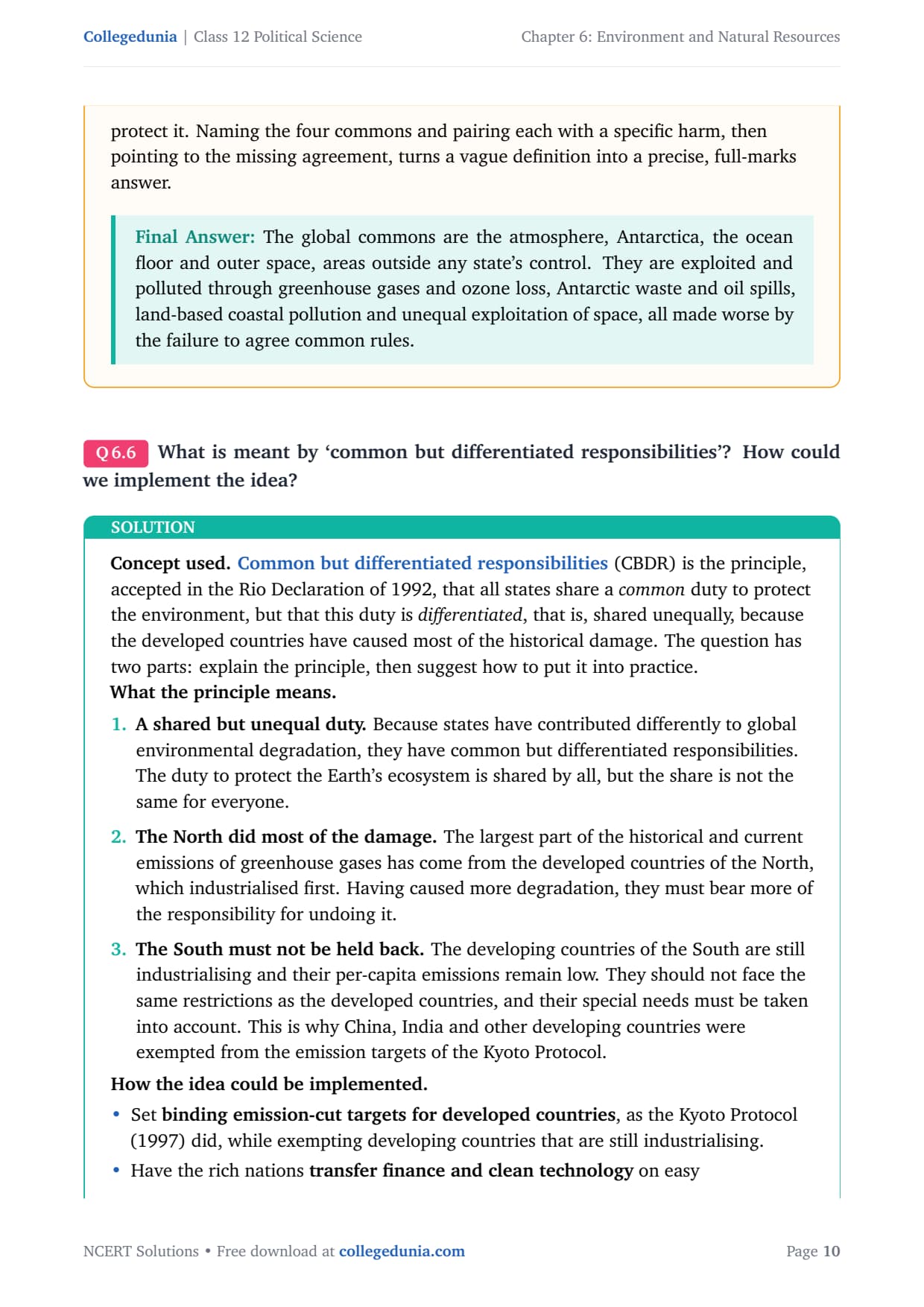
Q 6.6
What is meant by `common but differentiated responsibilities'? How
could we implement the idea?
Concept used.Common but differentiated responsibilities
(CBDR) is the principle, accepted in the Rio Declaration of 1992, that all
states share a common duty to protect the environment, but that this
duty is differentiated, that is, shared unequally, because the developed
countries have caused most of the historical damage. The question has two
parts: explain the principle, then suggest how to put it into practice.
What the principle means.
A shared but unequal duty. Because states have contributed
differently to global environmental degradation, they have common but
differentiated responsibilities. The duty to protect the Earth's
ecosystem is shared by all, but the share is not the same for everyone.
The North did most of the damage. The largest part of the
historical and current emissions of greenhouse gases has come from the
developed countries of the North, which industrialised first. Having
caused more degradation, they must bear more of the responsibility for
undoing it.
The South must not be held back. The developing countries of
the South are still industrialising and their per-capita emissions
remain low. They should not face the same restrictions as the developed
countries, and their special needs must be taken into account. This is
why China, India and other developing countries were exempted from the
emission targets of the Kyoto Protocol.
How the idea could be implemented.
Set binding emission-cut targets for developed countries, as
the Kyoto Protocol (1997) did, while exempting developing countries
that are still industrialising.
Have the rich nations transfer finance and clean technology on
easy (concessional) terms to poorer nations, so they can grow with less
pollution, a demand India has repeatedly stressed.
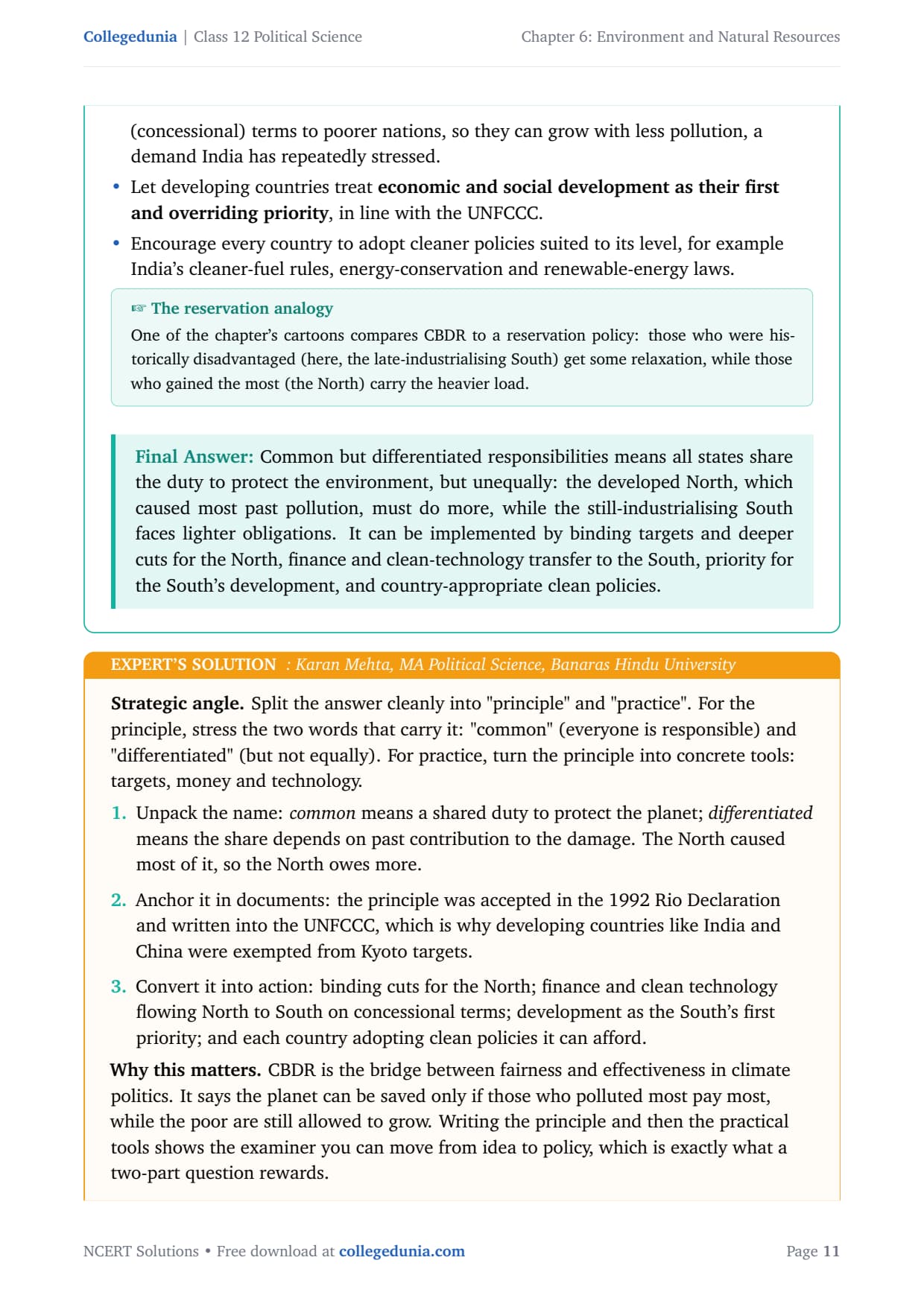
Let developing countries treat economic and social development
as their first and overriding priority, in line with the UNFCCC.
Encourage every country to adopt cleaner policies suited to its level,
for example India's cleaner-fuel rules, energy-conservation and
renewable-energy laws.
The reservation analogy
One of the chapter's cartoons compares CBDR to a reservation policy: those who
were historically disadvantaged (here, the late-industrialising South) get some
relaxation, while those who gained the most (the North) carry the heavier load.
Common but differentiated responsibilities means all states share the
duty to protect the environment, but unequally: the developed North, which
caused most past pollution, must do more, while the still-industrialising South
faces lighter obligations. It can be implemented by binding targets and deeper
cuts for the North, finance and clean-technology transfer to the South, priority
for the South's development, and country-appropriate clean policies.
KM
Karan Mehta
MA Political Science, Banaras Hindu University
Verified Expert
Strategic angle. Split the answer cleanly into "principle" and
"practice". For the principle, stress the two words that carry it: "common"
(everyone is responsible) and "differentiated" (but not equally). For practice,
turn the principle into concrete tools: targets, money and technology.
Unpack the name: common means a shared duty to protect the
planet; differentiated means the share depends on past
contribution to the damage. The North caused most of it, so the North
owes more.
Anchor it in documents: the principle was accepted in the 1992 Rio
Declaration and written into the UNFCCC, which is why developing
countries like India and China were exempted from Kyoto targets.
Convert it into action: binding cuts for the North; finance and clean
technology flowing North to South on concessional terms; development as
the South's first priority; and each country adopting clean policies it
can afford.
Why this matters. CBDR is the bridge between fairness and
effectiveness in climate politics. It says the planet can be saved only if
those who polluted most pay most, while the poor are still allowed to grow.
Writing the principle and then the practical tools shows the examiner you can
move from idea to policy, which is exactly what a two-part question rewards.
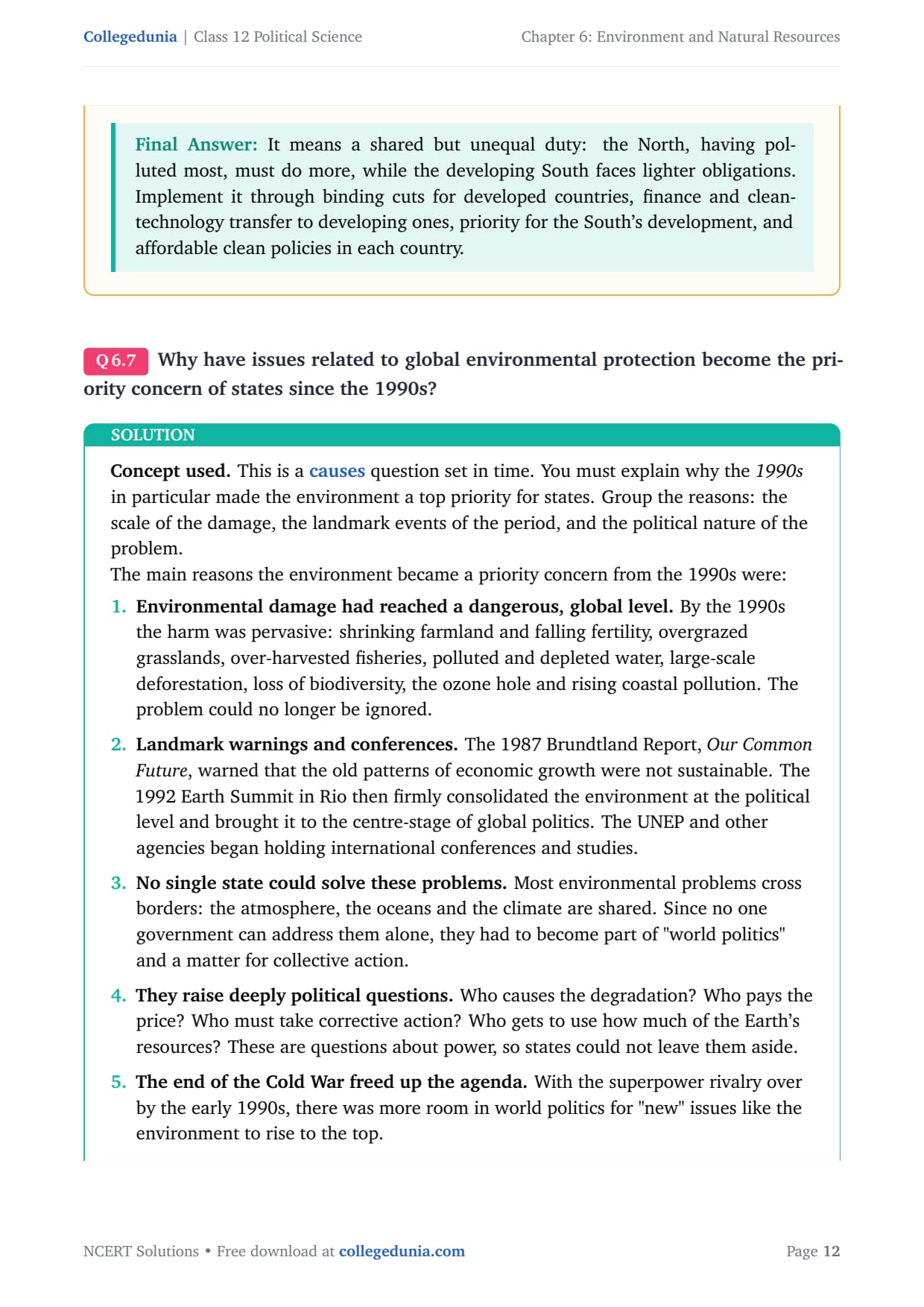
It means a shared but unequal duty: the North, having polluted most,
must do more, while the developing South faces lighter obligations. Implement it
through binding cuts for developed countries, finance and clean-technology
transfer to developing ones, priority for the South's development, and
affordable clean policies in each country.
Q 6.7
Why have issues related to global environmental protection become the
priority concern of states since the 1990s?
Concept used. This is a causes question set in time. You must
explain why the 1990s in particular made the environment a top priority
for states. Group the reasons: the scale of the damage, the landmark events of
the period, and the political nature of the problem.
The main reasons the environment became a priority concern from the 1990s were:
Environmental damage had reached a dangerous, global level. By
the 1990s the harm was pervasive: shrinking farmland and falling
fertility, overgrazed grasslands, over-harvested fisheries, polluted and
depleted water, large-scale deforestation, loss of biodiversity, the
ozone hole and rising coastal pollution. The problem could no longer be
ignored.
Landmark warnings and conferences. The 1987 Brundtland Report,
Our Common Future, warned that the old patterns of economic
growth were not sustainable. The 1992 Earth Summit in Rio then firmly
consolidated the environment at the political level and brought it to
the centre-stage of global politics. The UNEP and other agencies began
holding international conferences and studies.
No single state could solve these problems. Most environmental
problems cross borders: the atmosphere, the oceans and the climate are
shared. Since no one government can address them alone, they had to
become part of "world politics" and a matter for collective action.
They raise deeply political questions. Who causes the
degradation? Who pays the price? Who must take corrective action? Who
gets to use how much of the Earth's resources? These are questions about
power, so states could not leave them aside.
The end of the Cold War freed up the agenda. With the
superpower rivalry over by the early 1990s, there was more room in
world politics for "new" issues like the environment to rise to the
top.
From geography to politics
The chapter's key move is to show that these are not just "natural phenomena"
for geography. The moment governments must act, share the cost and decide who
uses the Earth's resources, the environment becomes a political subject, and
since the 1990s, a priority one.
Since the 1990s the environment became a priority because the damage
had grown pervasive and dangerous; because landmark events (the 1987 Brundtland
Report and the 1992 Earth Summit) put it at the centre of global politics;
because these cross-border problems cannot be solved by any one state alone;
because they raise sharp political questions of cause, cost and corrective
action; and because the end of the Cold War made room for such new issues.
NJ
Neha Joshi
MA Political Science, University of Delhi
Verified Expert
Strategic angle. Answer with one cause from each layer: a material
cause (the damage), an event cause (Rio and Brundtland), a structural cause
(problems cross borders) and a political cause (questions of power). Layering
the reasons covers more ground and reads as analysis, not a list.
Material layer: by the 1990s, degradation was pervasive and dangerous,
farmland, forests, fisheries, water, the ozone layer and the coasts all
under threat at once, so the issue forced itself onto the agenda.
Event layer: the 1987 Brundtland Report warned that growth was
unsustainable, and the 1992 Earth Summit consolidated the environment
at the political level, with UNEP-led conferences keeping it there.
Structural and political layers: shared resources (atmosphere, oceans,
climate) cannot be managed by one state, and the questions of who
pollutes, who pays and who uses how much are questions of power, which
states cannot ignore.
Why this matters. The honest insight is that the environment rose not
because states suddenly became green, but because the damage grew too big and
too borderless to handle nationally, just as the Cold War ended and opened space
for new priorities. Framing the answer around "too dangerous, too shared, too
political to ignore" gives the examiner a clear, memorable logic.
The environment became a priority from the 1990s because the damage
had turned pervasive and dangerous, because Rio 1992 and the Brundtland Report
pushed it to the centre of politics, because such border-crossing problems need
collective not national solutions, and because they raise unavoidable questions
of power over cause, cost and resource use.
Q 6.8
Compromise and accommodation are the two essential policies required
by states to save planet Earth. Substantiate the statement in the light of the
ongoing negotiations between the North and South on environmental issues.
Concept used. To substantiate a statement means to support
it with reasons and evidence. The claim is that saving the planet needs
compromise (each side giving up something) and accommodation
(each side making room for the other's needs). You must show why the North-South
negotiations prove this, by laying out both positions and showing that only
mutual give-and-take can work.
The two opposing positions.
The North's view. The developed countries want to discuss the
environmental problem as it stands now and want everyone to be equally
responsible for ecological conservation. They are mainly worried about
ozone depletion and global warming.
The South's view. The developing countries argue that most of
the ecological damage was caused by the industrial growth of the
developed countries. If the North caused more damage, it should take
more responsibility. The South is still industrialising and should not
face the same restrictions; its special needs and its priority of
development must be respected.
Why compromise and accommodation are essential.
Neither side can save the planet alone. The North cannot cut
global emissions without the cooperation of large developing countries,
and the South cannot grow cleanly without finance and technology from
the North. Each needs the other, so a one-sided demand will fail.
Compromise already shaped the key agreements. The principle of
common but differentiated responsibilities, accepted at Rio in 1992, is
itself a compromise: all states share the duty, but the North accepts a
larger share. The Kyoto Protocol then exempted China, India and other
developing countries from binding targets, an accommodation of the
South's position.
Accommodation means meeting the South's real needs. Saving the
Earth requires the developed countries to transfer financial resources
and clean technology on easy terms, and to let developing countries
treat development as their first and overriding priority. Without this
accommodation, the South cannot meet its commitments.
Rigidity has stalled progress. A review of the Earth Summit
agreements found little real progress on transferring funds and
technology to developing nations. Where one side refuses to move, the
negotiations stall, which is exactly why give-and-take is essential.
Substantiate with named evidence
For a "substantiate" question, do not just assert the point. Tie it to concrete
evidence: CBDR (1992), the Kyoto exemptions, India's demand for finance and
technology, and the stalled review of the Rio agreements. Named evidence is what
earns the marks.
The statement holds. Saving the Earth needs compromise and
accommodation because the North and South start from opposed positions, the
North wanting equal responsibility, the South pointing to the North's historical
damage, yet neither can succeed alone. The compromise of common but
differentiated responsibilities, the Kyoto exemptions for developing countries,
and the demand that the North fund and share clean technology all show that only
mutual give-and-take, not rigid insistence, can protect the planet.
VK
Vivaan Kapoor
MA International Relations, JNU
Verified Expert
Strategic angle. Build the answer as a debate that can only end in a
deal. State the North's position, then the South's, then prove that because each
side holds something the other needs, compromise (giving ground) and
accommodation (making room) are not optional but necessary. Anchor every step in
the chapter's evidence.
Set up the clash: the North wants equal, present-day responsibility and
fears ozone loss and warming; the South blames the North's past
industrial growth and insists on its right to develop. Two firm,
opposed stands.
Show the deadlock without give-and-take: the North cannot cut global
emissions without the South's cooperation, and the South cannot grow
cleanly without the North's money and technology. A purely one-sided
demand from either side fails.
Show the give-and-take that has worked: common but differentiated
responsibilities (Rio, 1992) and the Kyoto exemptions for India and
China are real compromises; the call for finance and clean-technology
transfer is the accommodation the South still seeks.
Point to the cost of rigidity: the review of the Rio agreements found
little progress on transferring funds and technology, proving that where
accommodation fails, the planet's protection stalls.
Why this matters. The deepest point is that environmental protection is
not a contest one side can win; it is a shared problem on a shared planet. If
the North insists on equal blame or the South refuses any limits, both lose. The
agreements that have worked are precisely the ones built on compromise and
accommodation, which is the strongest possible substantiation of the statement.
Compromise and accommodation are essential because the North and South
hold opposed but interdependent positions: neither can save the Earth alone. The
compromise of common but differentiated responsibilities, the Kyoto exemptions
for developing countries, and the unmet demand for finance and technology
transfer all show that only mutual give-and-take can protect the planet, fully
substantiating the statement.
Q 6.9
The most serious challenge before the states is pursuing economic
development without causing further damage to the global environment. How could
we achieve this? Explain with a few examples.
Concept used. The challenge described here is exactly what
sustainable development means: combining economic growth with
ecological responsibility, so that present needs are met without harming the
ability of future generations to meet theirs. The question asks how this
balance can be achieved, with examples. Give the broad approaches first, then
concrete examples, especially from India.
How the balance can be achieved.
Adopt sustainable development as the goal. States should follow
the consensus reached at Rio: grow the economy while protecting the
environment, guided by the action plan of Agenda 21.
Apply common but differentiated responsibilities. The
developed countries, which caused most past damage, should cut emissions
most and help the developing world. The developing countries should be
allowed to grow while gradually cleaning up, not held to the same
restrictions.
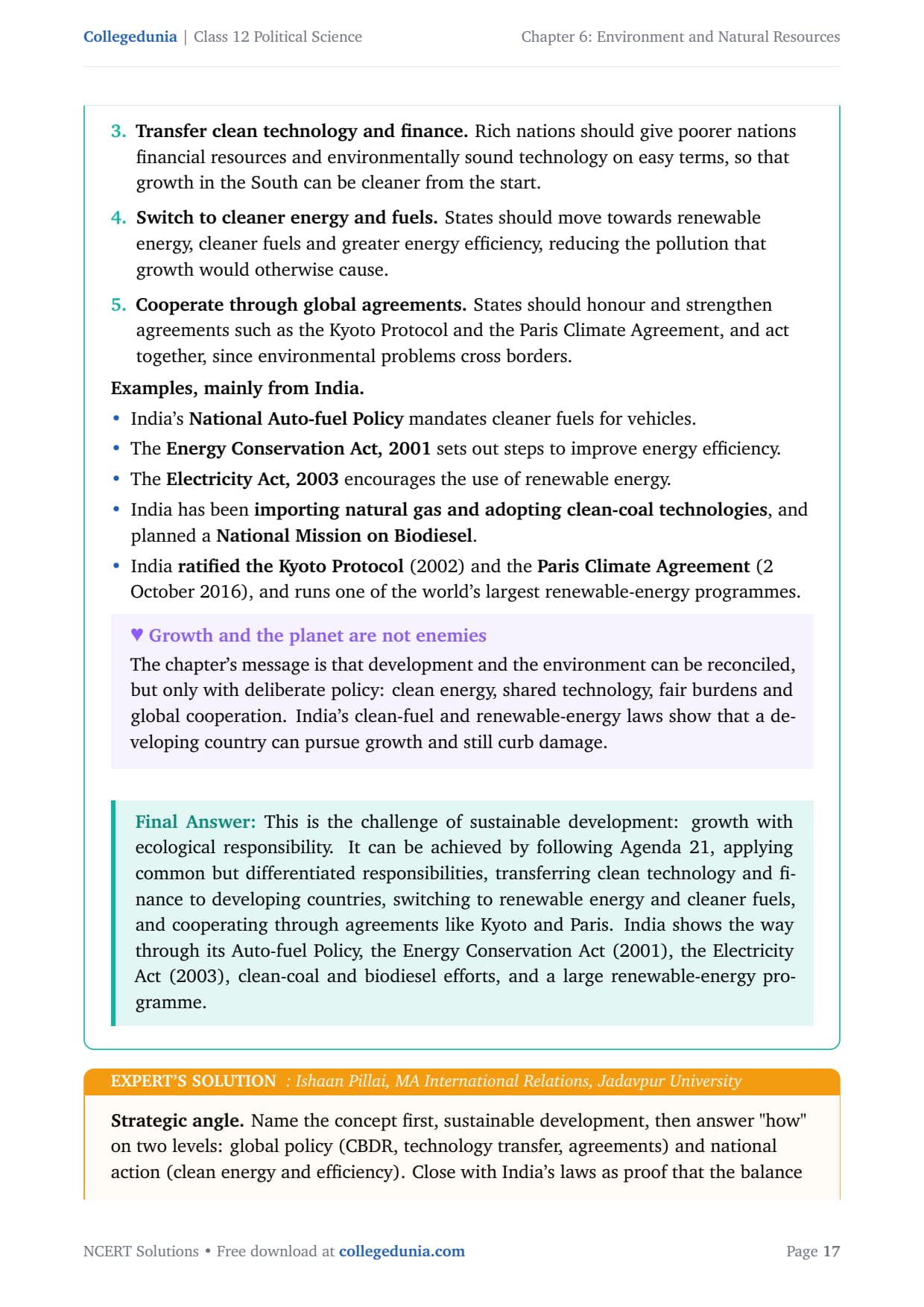
Transfer clean technology and finance. Rich nations should give
poorer nations financial resources and environmentally sound technology
on easy terms, so that growth in the South can be cleaner from the
start.
Switch to cleaner energy and fuels. States should move towards
renewable energy, cleaner fuels and greater energy efficiency, reducing
the pollution that growth would otherwise cause.
Cooperate through global agreements. States should honour and
strengthen agreements such as the Kyoto Protocol and the Paris Climate
Agreement, and act together, since environmental problems cross borders.
Examples, mainly from India.
India's National Auto-fuel Policy mandates cleaner fuels for
vehicles.
The Energy Conservation Act, 2001 sets out steps to improve
energy efficiency.
The Electricity Act, 2003 encourages the use of renewable
energy.
India has been importing natural gas and adopting clean-coal
technologies, and planned a National Mission on Biodiesel.
India ratified the Kyoto Protocol (2002) and the Paris
Climate Agreement (2 October 2016), and runs one of the world's largest
renewable-energy programmes.
Growth and the planet are not enemies
The chapter's message is that development and the environment can be reconciled,
but only with deliberate policy: clean energy, shared technology, fair burdens
and global cooperation. India's clean-fuel and renewable-energy laws show that a
developing country can pursue growth and still curb damage.
This is the challenge of sustainable development: growth with
ecological responsibility. It can be achieved by following Agenda 21, applying
common but differentiated responsibilities, transferring clean technology and
finance to developing countries, switching to renewable energy and cleaner
fuels, and cooperating through agreements like Kyoto and Paris. India shows the
way through its Auto-fuel Policy, the Energy Conservation Act (2001), the
Electricity Act (2003), clean-coal and biodiesel efforts, and a large
renewable-energy programme.
IP
Ishaan Pillai
MA International Relations, Jadavpur University
Verified Expert
Strategic angle. Name the concept first, sustainable development, then
answer "how" on two levels: global policy (CBDR, technology transfer,
agreements) and national action (clean energy and efficiency). Close with
India's laws as proof that the balance is achievable, not just an ideal.
Frame the goal: the question describes sustainable development, growth
plus ecological responsibility, the consensus reached at Rio and set out
in Agenda 21.
Global levers: apply common but differentiated responsibilities so the
North leads on cuts and funds; transfer clean technology and finance to
the South; and strengthen cooperative agreements like Kyoto and Paris.
National levers: shift to renewable energy, cleaner fuels and energy
efficiency. India's Auto-fuel Policy, Energy Conservation Act (2001),
Electricity Act (2003), natural-gas and clean-coal use, and one of the
world's largest renewable programmes are working examples.
Why this matters. The strongest answer treats "how" as a chain from
principle to policy to proof: sustainable development as the principle, CBDR and
technology transfer as the policy, and India's concrete laws as the proof. It
shows the examiner that the goal is not a slogan but something states can act on
right now, which is exactly what "explain with a few examples" is asking for.
Achieve it through sustainable development: follow Agenda 21, apply
common but differentiated responsibilities, transfer clean technology and
finance to developing countries, switch to renewable energy and cleaner fuels,
and cooperate through Kyoto and Paris. India's Auto-fuel Policy, Energy
Conservation Act (2001), Electricity Act (2003), clean-coal and biodiesel
plans, and large renewable-energy programme are concrete examples of growth with
reduced environmental damage.
FAQs on Environment and Natural Resources Class 12 NCERT Solutions
Environment and Natural Resources Class 12 Political Science Common Questions
Ques. Where can I get the class 12 political science chapter 6 NCERT Solutions PDF?
Ans. You can download the Environment and Natural Resources Class 12 Political Science NCERT Solutions PDF directly from this page. It is free, follows the 2026-27 NCERT, and answers all 9 exercise questions step by step.
Ques. How many questions are there in Environment and Natural Resources class 12 questions and answers?
Ans. The chapter has 9 exercise questions. The first three are objective and MCQ items on the environment, the Earth Summit and the global commons, while Questions 4 to 9 are short and long written answers, including the North-South negotiations and sustainable development.
Ques. What were the outcomes of the Rio Summit?
Ans. The Rio Summit (Earth Summit, 1992) produced conventions on climate change, biodiversity and forestry, recommended Agenda 21 as a development blueprint, and established a consensus on sustainable development. It also exposed an unresolved North-South divide over who should bear the cost.
Ques. What does common but differentiated responsibilities mean?
Ans. It means all states share the duty to protect the environment, but unequally. The developed North, which caused most past pollution, must do more, while the still-industrialising South faces lighter obligations. It is why India and China were exempted from the Kyoto Protocol's emission targets.
Ques. What are the global commons in this chapter?
Ans. The global commons are areas outside the sovereign control of any state: the Earth's atmosphere, Antarctica, the ocean floor and outer space. They need common governance, and how they are managed reflects the North-South divide.
Ques. Is class 12 political science chapter 6 easy to score in the board exam?
Ans. Yes. It is a scoring chapter if you keep the treaties straight and give a balanced North-South view. Practise the MCQs and the Earth Summit outcomes, and keep the CBDR and India's stand points ready for the long-answer questions.








Comments