Junior-Class Mentor, TFI Fellow | Updated 3+ months ago
The NCERT Solutions for Political Science Class 12 Chapter 8 Recent Developments in Indian Politics answer every textbook question on the end of Congress dominance, the era of coalitions and the rise of the BJP, set to the latest 2026-27 CBSE syllabus. Each answer explains the 1989 turning point, the Mandal and Ayodhya issues, and the new four-part consensus in plain language. These solutions help students prepare for the Class 12 Political Science board paper and the UPSC foundation in 2026-27.
Covers all 8 exercise questions from Politics in India Since Independence Chapter 8, with full point-wise answers.
This Class 12 Political Science chapter usually carries 5 to 6 marks per board paper.
Pairs with the Notes, Handwritten Notes and NCERT Book PDF linked lower on this page.
Every solution for Class 12 Political Science Chapter 8 in this Collegedunia compilation is written by subject experts from the official NCERT Politics in India Since Independence textbook, and checked against the last five years of CBSE board papers.
Student Feedback: In a Collegedunia poll of 9,050 Class 12 Political Science students taken before the 2026 boards, 71% of students rated the chronology and BJP "trace" questions as the trickiest part of Recent Developments in Indian Politics. Most students said a clear timeline of the coalition years made these answers easy to recall.
Source: 2026-27 Class 12 Political Science student poll. Sample of 9,050 students from CBSE schools across 13 states.
What the Recent Developments in Indian Politics Class 12 Chapter Is About
Recent Developments in Indian Politics is the last chapter of Politics in India Since Independence. It takes a wide view of Indian politics after 1989, the year the long "Congress system" ended. From here on, no single party could win a majority on its own, so the country entered a long era of coalitions.
The chapter is built around four big threads that students should keep in mind:
The end of Congress dominance: the 1989 defeat and the start of multi-party competition.
The era of coalitions: the National Front, United Front, NDA and UPA governments.
Mandal and Mandir: the OBC reservation issue and the Ayodhya dispute that reshaped politics.
The new consensus: a four-part agreement on economy, backward castes, regional parties and pragmatism.
So the chapter is really about how India moved from one dominant party to a settled contest between two big coalitions. A student who keeps these four threads in mind can connect almost any question in recent developments in Indian politics class 12 back to one of them. Sorting each fact under "decline", "coalitions", "Mandal-Mandir" or "consensus" first makes revision far faster.
End of Congress Dominance and the 1989 Election
The chapter opens with the moment the Congress lost its central place. This is the spine of the whole period, so students must learn the key numbers and what they meant. The 1989 election is the turning point the textbook keeps returning to.
The 1989 result: the Congress fell from 415 seats in 1984 to only 197, losing its majority.
What ended: the centrality the party had enjoyed since Independence, the "Congress system".
What did not end: the Congress stayed a major party and ruled the most across this whole period.
The new shape: competition and coalitions replaced one-party dominance.
The honest exam point here, and the heart of Question 5, is that decline of dominance is not the same as defeat. The Congress lost its all-powerful position but kept a large influence: it bounced back to power in 1991, led the UPA in 2004 and 2009, and became one of the two poles of coalition politics. Keep this distinction ready, because it turns a weak answer into a full-marks one.
The Era of Coalitions: National Front to UPA
After 1989 no party won a majority in any Lok Sabha election right up to 2014. Politics took the shape of rival coalitions, and Questions 1 and 3 both turn on knowing the order and logic of these fronts. The table below sorts the main coalition governments for fast revision.
Coalition (year)
What to recall
National Front (1989)
Janata Dal plus regional parties, backed from outside by the BJP and the Left, both keen to keep the Congress out.
United Front (1996)
Janata Dal plus regional parties again, this time backed by the Congress, as the Congress and Left now wanted the BJP out.
NDA (1998, 1999)
The BJP-led National Democratic Alliance came to power in 1998 and was re-elected in 1999 under Vajpayee.
UPA (2004, 2009)
The Congress-led United Progressive Alliance won in 2004 and 2009, with Manmohan Singh as Prime Minister.
A key insight for the exam is that these fronts were built on the "enemy of my enemy" logic, not shared ideology. In 1989 the BJP and the Left, two opposite groups, backed the same National Front simply to keep the Congress out. By 1996 the line-up reversed to keep the BJP out. This is exactly the evidence Question 4 needs for its argument that alliances are pragmatic, not ideological.
Mandal Commission and the Rise of OBC Politics
The Mandal issue is one of the most-asked topics in the chapter, so students should learn it as a clear set of facts. It marks the political rise of the Other Backward Classes (OBCs) and feeds the answers to Questions 1, 2, 3 and 8.
What it was: the National Front government decided in August 1990 to implement the Mandal Commission report.
The recommendation: 27 per cent reservation for OBCs in central government jobs.
The reaction: violent anti-Mandal protests broke out across north India.
The lasting effect: caste-based parties grew, and OBC politics became a permanent national force.
The deeper point examiners reward, used in the Zoya Hasan passage (Question 8), is that the anti-Mandal violence shows how hard the party system found it to accommodate opposed interests. The system had to hold together the OBCs' demand for a share of power and the anxieties of those who opposed reservation. This is the textbook's own example of the "lack of accommodation and aggregation" that the passage describes.
Ayodhya, the BJP and the Secularism Debate
The Ayodhya issue and the rise of the BJP run together through the chapter, and Question 5 asks students to trace the BJP's emergence step by step. Learn this as a timeline rather than a story, because a neat sequence scores more than scattered facts.
1980: the BJP is formed from the former Jana Sangh after the Janata Party split.
1984: a weak start, with only two Lok Sabha seats.
After 1986: the party turns to Hindutva, using the Shah Bano case and the Ram Janmabhoomi movement to mobilise support.
1992: the Babri structure is demolished in December, sharpening the secularism debate.
1998-99: the BJP leads the NDA to power under Vajpayee and completes a full term.
The chapter closes this thread on a calm note that students should mark: the long Ayodhya dispute was finally settled by due process of law. A constitutional bench of the Supreme Court gave a 5-0 verdict on 9 November 2019. This peaceful, lawful resolution is the latest event in the Question 1 timeline and a strong point for the secularism-and-democracy answer.
The Growing Consensus and Recent Trends
The chapter ends by arguing that, despite all the turbulence, most parties came to share a broad agreement. This "growing consensus" is the answer to several short questions and the backbone of Question 6 on the advantages of India's party system. The table keeps the four parts together for quick revision.
Part of the consensus
What most parties now agree on
Economic policy
Agreement on the new economic policies; most parties support liberalisation, whoever is in power.
Backward castes
Acceptance of the political and social claims of the backward castes.
Regional parties
Acceptance of the role of state-level parties in governing the country.
Pragmatism
Emphasis on pragmatic considerations rather than ideological positions.
One sharp idea for the essay question: India's multi-party, coalition system suits its diversity better than a two-party system would. It voices many castes, religions, languages and regions, gives regional parties a real share of national power, and still produced stable, full-term governments like the post-1999 NDA and the 2004-09 UPA. This is the line of argument Question 6 wants students to build.
Recent Developments in Indian Politics Class 12 Exercise-wise Coverage
The chapter exercise has 8 questions. The table maps each one to its topic so students can plan revision and find the right NCERT answer fast. The full point-wise solution for each sits in the question set lower on this page.
Question
Topic it tests
Q 1
Chronological order of events from 1984 to the 2019 Ayodhya verdict
Q 2
Match the following (consensus, caste parties, Shah Bano, regional parties)
Q 3
Main issues after 1989 and the party configurations they led to
Q 4
Coalition politics and whether alliances rest on ideology
Q 5
Trace the emergence of the BJP in post-Emergency politics
Q 6
Continuing influence of the Congress despite its decline
Q 7
Essay on the advantages of India's present multi-party system
Q 8
Zoya Hasan passage on accommodation and aggregation
Questions 3, 5 and 7 are the most-asked long answers, so students preparing recent developments in Indian politics class 12 important questions should learn those three first. The chronology (Q1), the match (Q2) and the passage (Q8) are quick, structured marks, so practise the timeline and the four-part consensus to secure them.
Students who want the offline copy can save the class 12 political science chapter 8 pdf from the download card above and tick off each question as they finish it.
Recent Developments Important Questions and Previous Year Trends
CBSE sets a steady mix of MCQ, short and long answers from this chapter. Knowing the pattern helps students decide how much to write. The chapter is a regular source of one 4-mark or 6-mark question, which is why a focused list of recent developments in Indian politics important questions saves a lot of revision time.
Long answer (5 to 6 marks): trace the rise of the BJP, or the advantages of India's party system.
Short answer (4 marks): main issues after 1989, or the four-part consensus.
Source-based: a passage on coalition politics or the party system, with sub-parts (like Q8).
Objective and MCQ: dates of Mandal, the NDA and UPA, and the Shah Bano case.
For quick recall before the exam, students often practise the class 12 political science chapter 8 mcq set and a list of recent developments in Indian politics class 12 important questions. The most repeated items are the coalition timeline and the BJP "trace", so keep those answer points ready in your own words.
Working through the ncert solutions class 12 political science chapter 8 set twice, once open-book and once from memory, fixes the dates and the coalition names well before the board exam.
Common Mistakes Students Make in This Chapter
A few errors cost marks every year in this chapter. Most come from muddling the coalition order or treating the Congress as finished after 1989. Avoiding them is the fastest way to lift a score.
Reading "decline of dominance" as the end of the Congress - it stayed a major party and led the UPA.
Mixing up the coalition order - keep National Front (1989), United Front (1996), NDA (1998-99), UPA (2004-09) clear.
Saying alliances were built on shared ideology - most were pragmatic power-sharing.
Forgetting that NDA allies mostly rejected the BJP's Hindutva, yet still governed together.
Giving only one side of an "argue" question - Q4 and Q6 want both views before a verdict.
Students who fix these five points usually move from average to high marks on the long answers. The exam rewards a balanced view, so always weigh both sides of an argument before you judge it.
Recent Developments PDF Download Formats and Languages
The solutions are free to download in more than one format, so students can pick what suits their device and revision style. The download card at the top of the page carries each option for this chapter.
Normal and HD PDF: the class 12 political science chapter 8 pdf comes in a normal size for quick downloads and an HD version for clear printing.
English medium: all 8 answers are written in simple English for the CBSE board paper.
Question-only set: a print-and-practise sheet of recent developments in Indian politics extra questions for self-testing.
Whole-book pack: the solutions sit in one set that runs through every Politics in India Since Independence chapter, so you can revise in one place.
Many students search for class 12 political science chapter 8 answers on their phone the night before a test, so a saved PDF means you can revise even without internet. Keep both the question set and the solved version handy for a full self-check.
How the Recent Developments Solutions Pair with Notes and the Book PDF
These NCERT Solutions answer the back-exercise questions. To revise the full chapter, students should use them alongside the other resources for the same chapter, all linked in the table below.
Reading the original NCERT chapter text and cartoons
Tip: read the Notes first, then attempt these solutions on your own, and only then check the model answers here. That order builds memory faster than copying answers straight away.
All NCERT Solutions for Class 12 Political Science
The table links the NCERT Solutions for every chapter in both Class 12 Political Science books, so students can move across the course in one click. Recent Developments in Indian Politics is highlighted.
All NCERT Solutions for Recent Developments in Indian Politics with Step-by-Step Solutions
Below are all 8 NCERT exercise questions for this chapter, exactly as they appear in the textbook. Tap Check Solution for the model answer or Expert Solution for the topper-style approach.
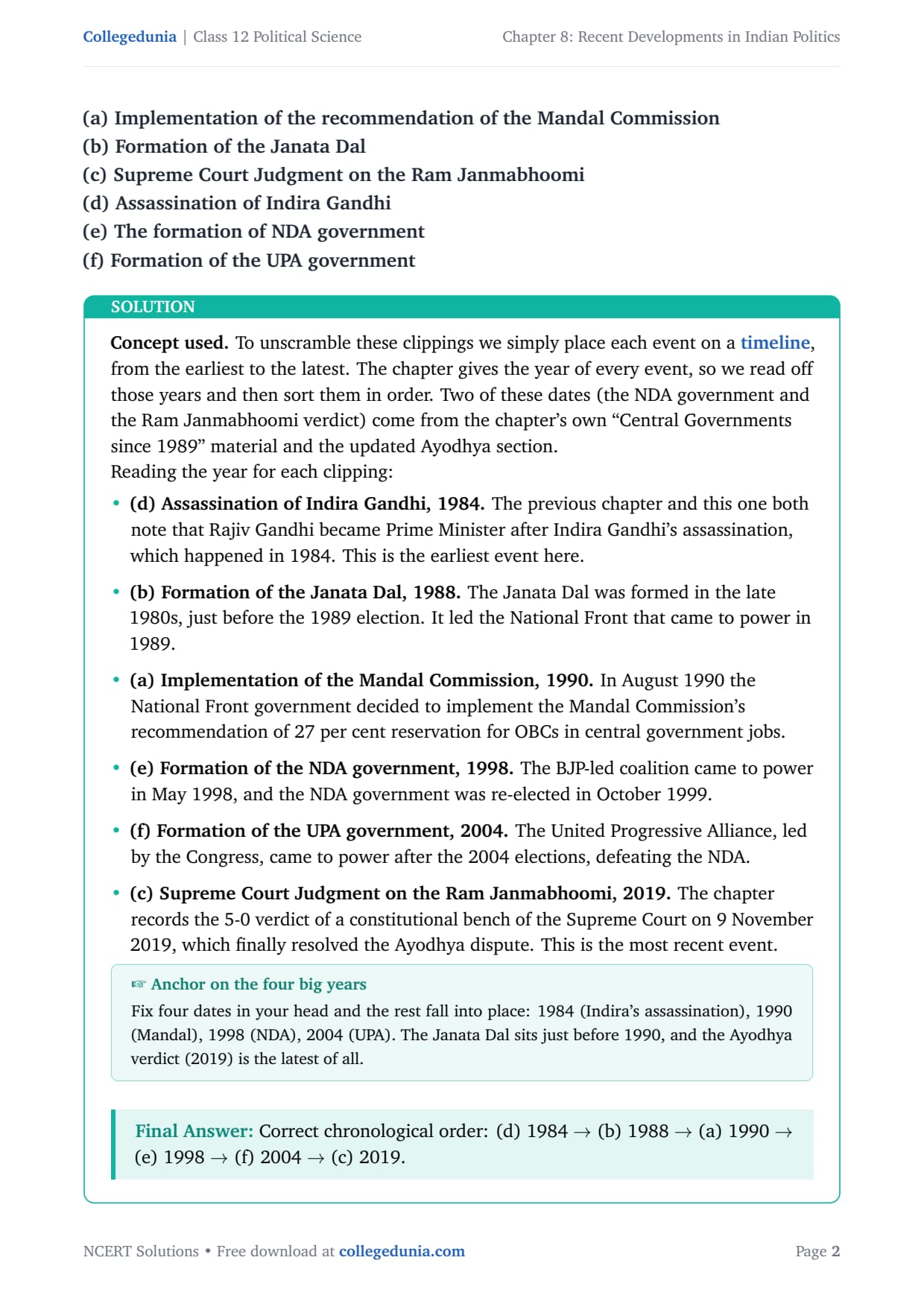
Q 8.1
Unscramble a bunch of disarranged press clippings file of
Unni-Munni and arrange the file chronologically.
(a) Implementation of the recommendation of the Mandal Commission
(b) Formation of the Janata Dal
(c) Supreme Court Judgment on the Ram Janmabhoomi
(d) Assassination of Indira Gandhi
(e) The formation of NDA government
(f) Formation of the UPA government
Concept used. To unscramble these clippings we simply place each
event on a timeline, from the earliest to the latest. The
chapter gives the year of every event, so we read off those years and then
sort them in order. Two of these dates (the NDA government and the
Ram Janmabhoomi verdict) come from the chapter's own ``Central Governments
since 1989'' material and the updated Ayodhya section.
Reading the year for each clipping:
(d) Assassination of Indira Gandhi, 1984. The previous
chapter and this one both note that Rajiv Gandhi became Prime
Minister after Indira Gandhi's assassination, which happened in
1984. This is the earliest event here.
(b) Formation of the Janata Dal, 1988. The Janata Dal was
formed in the late 1980s, just before the 1989 election. It led the
National Front that came to power in 1989.
(a) Implementation of the Mandal Commission, 1990. In
August 1990 the National Front government decided to implement the
Mandal Commission's recommendation of 27 per cent reservation for
OBCs in central government jobs.
(e) Formation of the NDA government, 1998. The BJP-led
coalition came to power in May 1998, and the NDA government was
re-elected in October 1999.
(f) Formation of the UPA government, 2004. The United
Progressive Alliance, led by the Congress, came to power after the
2004 elections, defeating the NDA.
(c) Supreme Court Judgment on the Ram Janmabhoomi, 2019.
The chapter records the 5-0 verdict of a constitutional bench of
the Supreme Court on 9 November 2019, which finally resolved the
Ayodhya dispute. This is the most recent event.
Anchor on the four big years
Fix four dates in your head and the rest fall into place: 1984 (Indira's
assassination), 1990 (Mandal), 1998 (NDA), 2004 (UPA). The Janata Dal sits
just before 1990, and the Ayodhya verdict (2019) is the latest of all.
M.A Political Science, Jawaharlal Nehru University
Verified Expert
Strategic angle. For a ``put these in order'' question I never
guess the order directly. I first tag each item with its year, then sort
the years. That turns a memory test into a simple sorting task, and it
guards against the trap of mixing up close events like Janata Dal and
Mandal.
Tag every clipping. Indira's assassination (1984), Janata
Dal (1988), Mandal implementation (1990), NDA government (1998),
UPA government (2004), Ram Janmabhoomi verdict (2019).
Sort the tags. Lined up, the years read
1984, 1988, 1990, 1998, 2004, 2019, which gives
d, b, a, e, f, c.
Sense-check the story. The order should tell a clean
story: Congress dominance ends after 1984, coalition politics and
the Mandal issue rise around 1989-90, the NDA and then the UPA run
the country, and the Ayodhya case is settled last in 2019. It does.
The deeper reading: this single timeline is really the spine of the whole
chapter. It moves from the end of one-party dominance, through the Mandal
and coalition years, to the recent settlement of an old dispute by due
process of law. If you can narrate the timeline, you can answer most of the
descriptive questions in this exercise too.
d, b, a, e, f, c, that is: Indira's assassination, Janata Dal,
Mandal, NDA, UPA, Ram Janmabhoomi verdict.
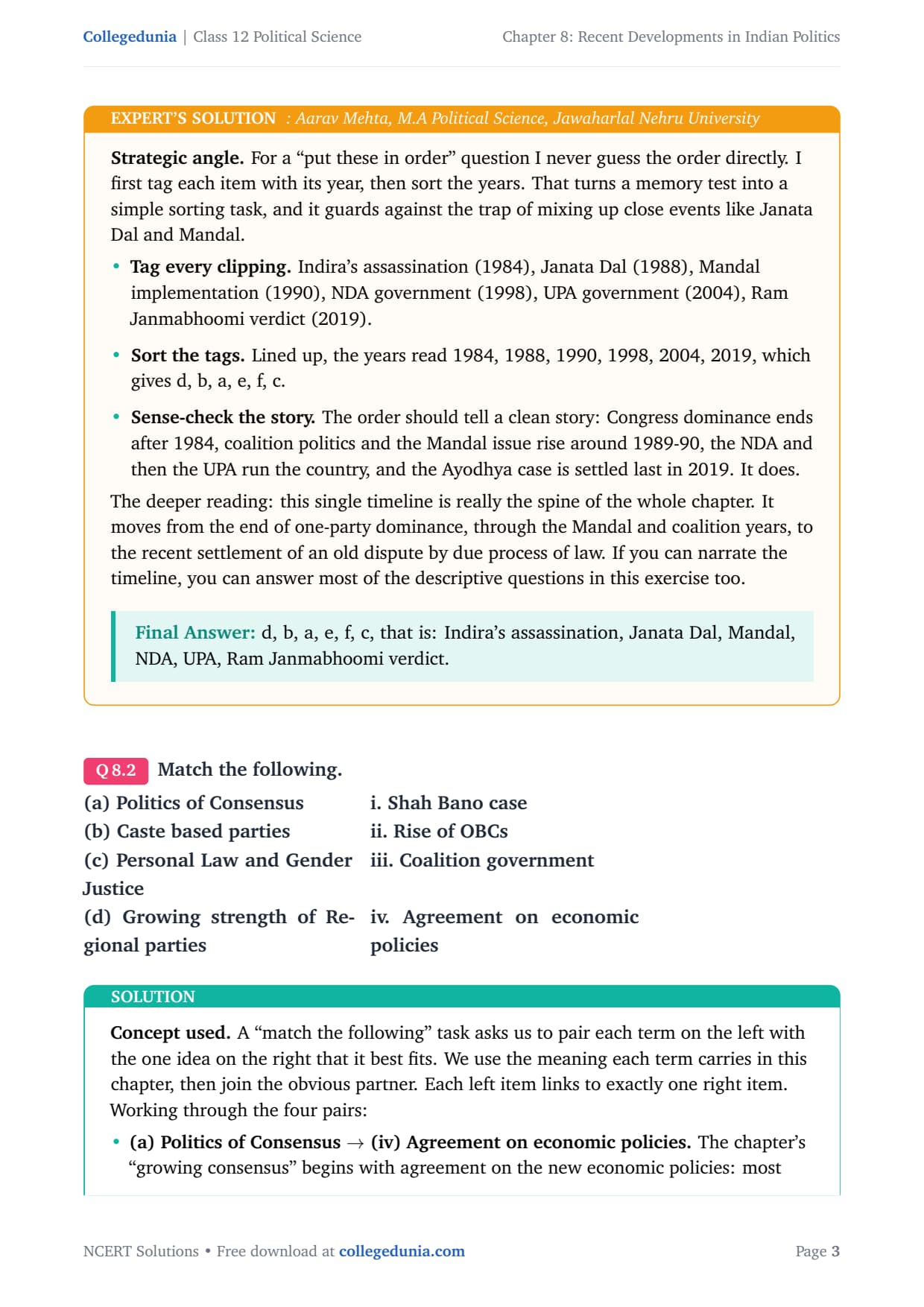
Q 8.2
Match the following. [2pt]
tabular@p6.1cmp6.1cm@
(a) Politics of Consensus & i. Shah Bano case
(b) Caste based parties & ii. Rise of OBCs
(c) Personal Law and Gender Justice & iii. Coalition government
(d) Growing strength of Regional parties & iv. Agreement on economic policies
tabular
Concept used. A ``match the following'' task asks us to pair each
term on the left with the one idea on the right that it best fits. We use
the meaning each term carries in this chapter, then join the obvious
partner. Each left item links to exactly one right item.
Working through the four pairs:
(a) Politics of Consensus → (iv) Agreement on
economic policies. The chapter's ``growing consensus'' begins with
agreement on the new economic policies: most parties now support
liberalisation, whoever is in power. So consensus matches the
economic agreement.
(b) Caste based parties → (ii) Rise of OBCs.
Parties built on caste support grew with the political rise of the
Other Backward Classes after the Mandal issue. So caste-based
parties match the rise of OBCs.
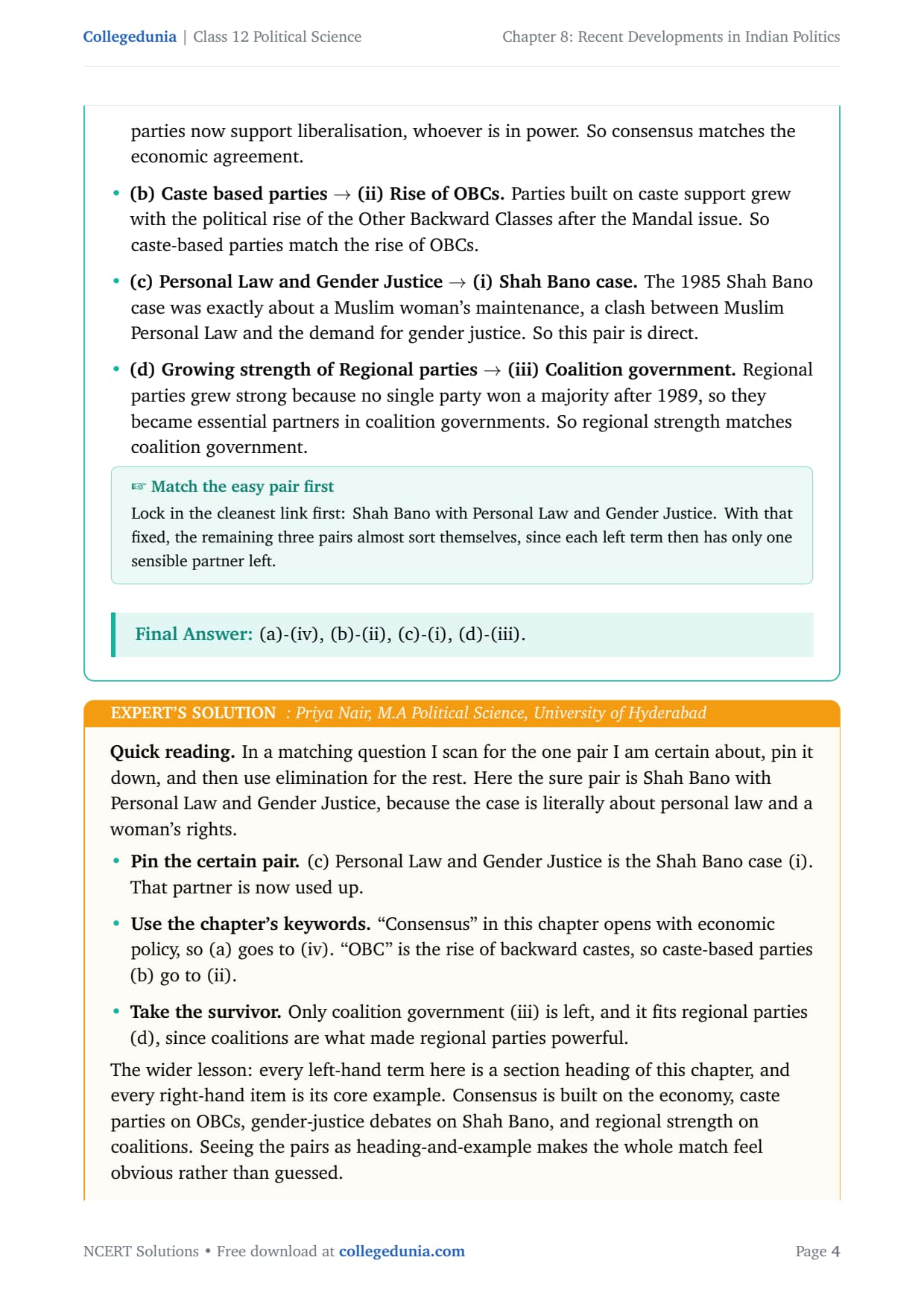
(c) Personal Law and Gender Justice → (i) Shah
Bano case. The 1985 Shah Bano case was exactly about a Muslim
woman's maintenance, a clash between Muslim Personal Law and the
demand for gender justice. So this pair is direct.
(d) Growing strength of Regional parties →
(iii) Coalition government. Regional parties grew strong because
no single party won a majority after 1989, so they became essential
partners in coalition governments. So regional strength matches
coalition government.
Match the easy pair first
Lock in the cleanest link first: Shah Bano with Personal Law and Gender
Justice. With that fixed, the remaining three pairs almost sort themselves,
since each left term then has only one sensible partner left.
(a)-(iv), (b)-(ii), (c)-(i), (d)-(iii).
PN
Priya Nair
M.A Political Science, University of Hyderabad
Verified Expert
Quick reading. In a matching question I scan for the one pair I am
certain about, pin it down, and then use elimination for the rest. Here the
sure pair is Shah Bano with Personal Law and Gender Justice, because the
case is literally about personal law and a woman's rights.
Pin the certain pair. (c) Personal Law and Gender Justice
is the Shah Bano case (i). That partner is now used up.
Use the chapter's keywords. ``Consensus'' in this chapter
opens with economic policy, so (a) goes to (iv). ``OBC'' is the
rise of backward castes, so caste-based parties (b) go to (ii).
Take the survivor. Only coalition government (iii) is left,
and it fits regional parties (d), since coalitions are what made
regional parties powerful.
The wider lesson: every left-hand term here is a section heading of this
chapter, and every right-hand item is its core example. Consensus is built
on the economy, caste parties on OBCs, gender-justice debates on Shah Bano,
and regional strength on coalitions. Seeing the pairs as heading-and-example
makes the whole match feel obvious rather than guessed.
a-iv, b-ii, c-i, d-iii.
Q 8.3
State the main issues in Indian politics in the period after
1989. What different configurations of political parties did these
differences lead to?
Concept used. The period after 1989 is the heart of this chapter.
It marks the end of the `Congress system' and the start of an era
of competition and coalitions. The chapter lists five developments that
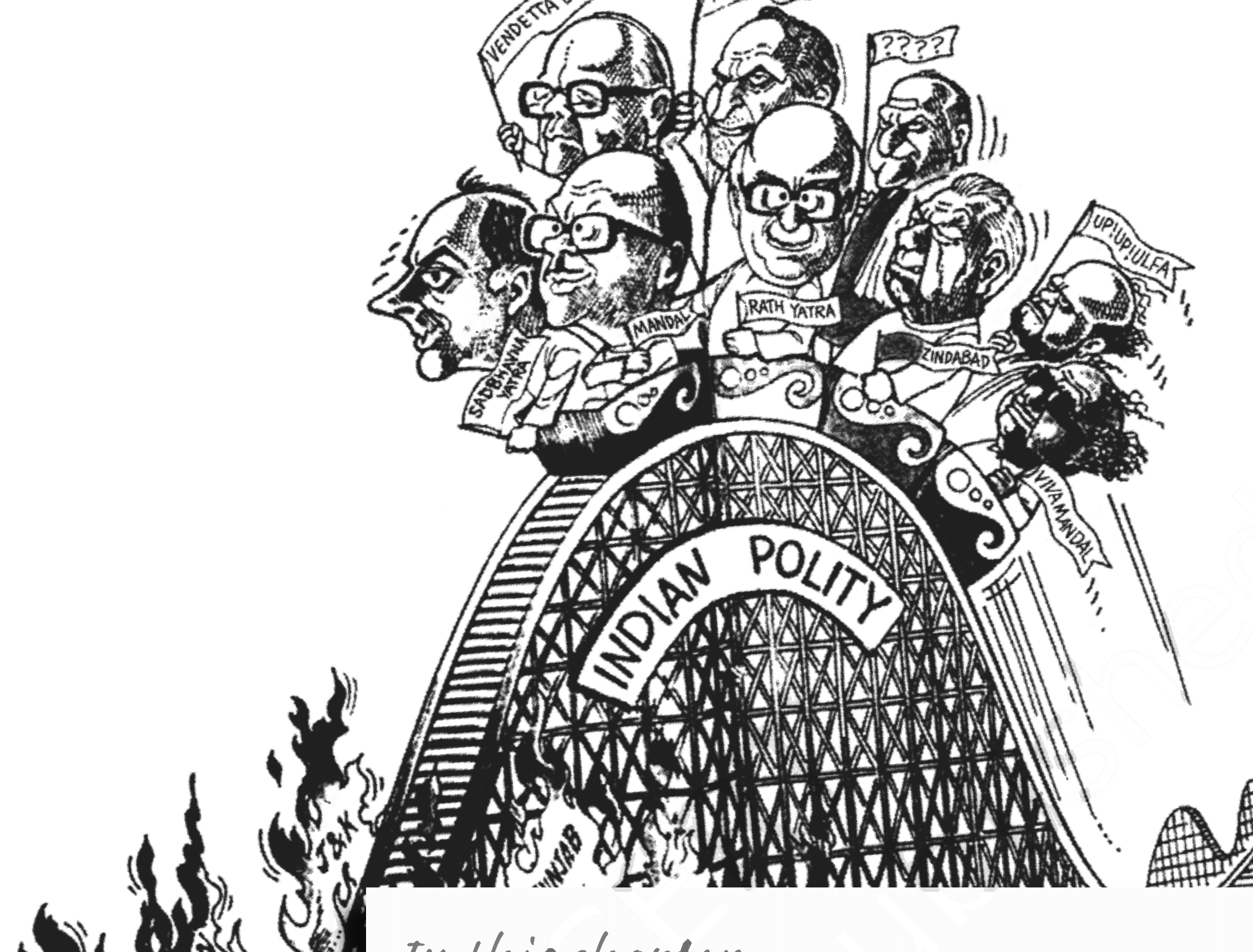
reshaped politics in these years. The cartoon below catches the mood: the
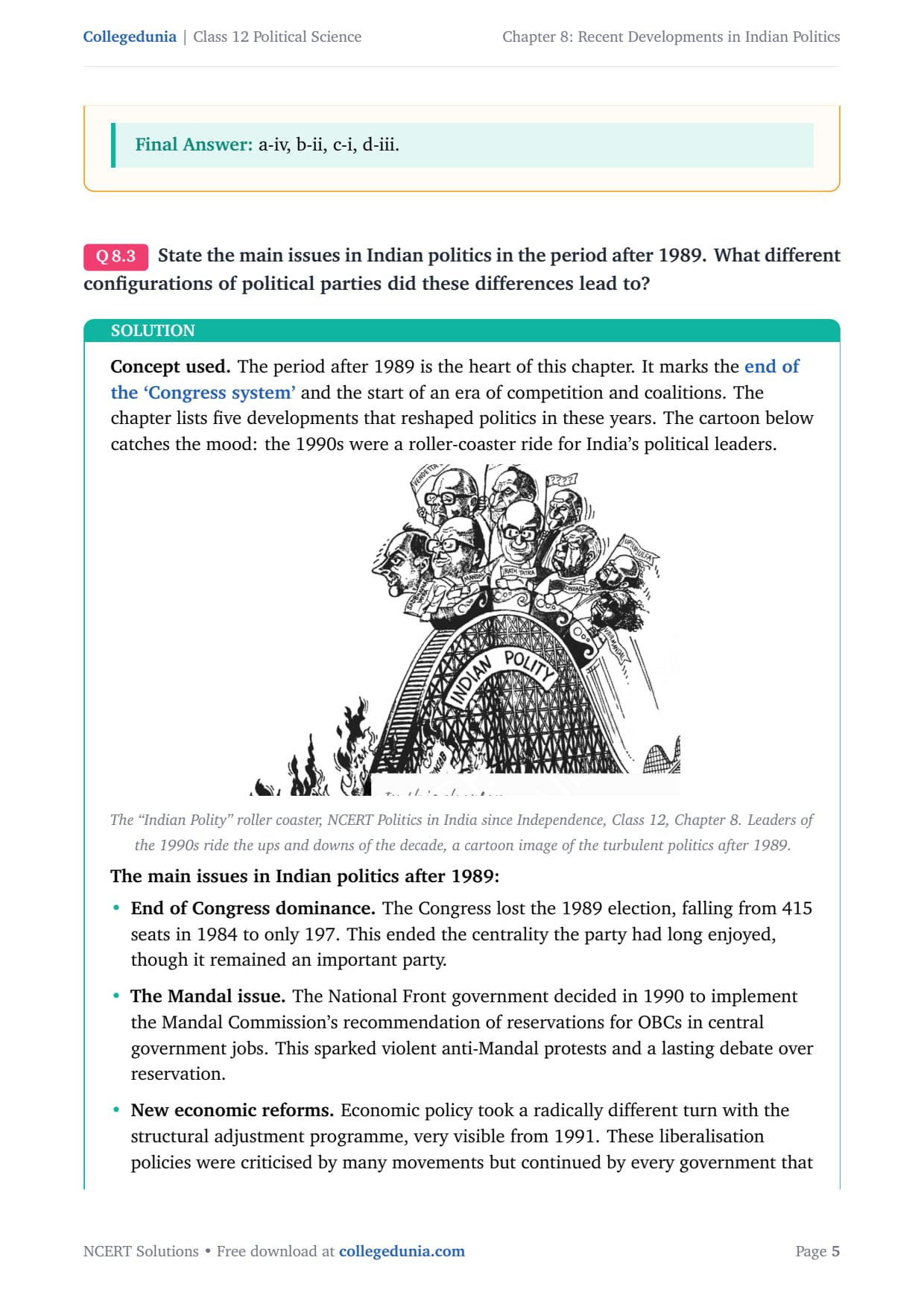
1990s were a roller-coaster ride for India's political leaders.
The ``Indian Polity'' roller coaster, NCERT Politics in India since Independence, Class 12, Chapter 8. Leaders of the 1990s ride the ups and downs of the decade, a cartoon image of the turbulent politics after 1989.
The main issues in Indian politics after 1989:
End of Congress dominance. The Congress lost the 1989
election, falling from 415 seats in 1984 to only 197. This ended
the centrality the party had long enjoyed, though it remained an
important party.
The Mandal issue. The National Front government decided in
1990 to implement the Mandal Commission's recommendation of
reservations for OBCs in central government jobs. This sparked
violent anti-Mandal protests and a lasting debate over reservation.
New economic reforms. Economic policy took a radically
different turn with the structural adjustment programme, very
visible from 1991. These liberalisation policies were criticised by
many movements but continued by every government that followed.
The Ayodhya issue and the secularism debate. The Ram
Janmabhoomi movement and the dispute over the Babri structure
brought religion-based politics to the centre and opened a sharp
debate on secularism and democracy.
Political assassinations. The decade saw the assassination
of two former Prime Ministers, Rajiv Gandhi in 1991 (and earlier
Indira Gandhi in 1984), events that deeply affected the country's
politics.
The party configurations these differences led to: no single party
could win a majority after 1989, so politics took the shape of rival
coalitions.
The National Front (1989). An alliance of the Janata Dal
and some regional parties, supported from outside by two opposite
groups, the BJP and the Left Front, who simply wanted to keep the
Congress out.
The United Front (1996). Again the Janata Dal with regional
parties, this time supported by the Congress, as both the Congress
and the Left now wanted to keep the BJP out.
The NDA and the UPA. The BJP-led National Democratic
Alliance came to power in 1998 and 1999, and the Congress-led United
Progressive Alliance came to power in 2004 and 2009. Politics
settled into a contest between these two broad coalitions.
Five issues, two fronts
Remember this answer as a pair: five issues (Congress decline,
Mandal, economic reforms, Ayodhya, assassinations) that produced
two rival fronts (the NDA and the UPA, growing out of the earlier
National and United Fronts). Listing the issues and then the fronts covers
both halves of the question.
The main issues after 1989 were the end of Congress dominance,
the Mandal (OBC reservation) issue, the new economic reforms, the Ayodhya
issue and the secularism debate, and the assassinations of former Prime
Ministers. Because no party won a majority, these differences produced
shifting coalitions: the National Front (1989), the United Front (1996),
and then the rival NDA and UPA alliances.
AI
Arjun Iyer
M.A Political Science, University of Delhi
Verified Expert
Structural observation. This question has two clean halves:
list the issues, then name the alliances they produced. I
answer in that order so the examiner can tick both parts. The trick is to
remember the chapter's own ``five developments'' as my list of issues.
Recall the five developments. Defeat of Congress in 1989,
the Mandal issue, the new economic reforms, the Ayodhya issue with
its secularism debate, and the assassinations. These are the issues.
Link issues to alliances. Because the issues split parties
in new ways, and no one won a majority, governments could form only
as coalitions: National Front, United Front, then NDA and UPA.
Name the logic of the alliances. In 1989 the BJP and Left
backed the National Front to keep the Congress out; in 1996 the
Congress and Left backed the United Front to keep the BJP out. The
enemy of my enemy, not shared ideology, built these fronts.
Track the long-term trend. The chapter is clear that no
single party won a majority in any Lok Sabha election from 1989 to
2014. That long run of hung verdicts is what made coalitions the
normal way to govern, and regional parties the partners every front
had to court.
The deeper insight for full marks: the issues and the alliances are two
sides of one story. The end of Congress dominance created the empty space;
the Mandal, economic and Ayodhya issues then reshuffled which parties stood
together. The result was an era where regional parties became kingmakers
and the centre of politics shifted from one dominant party to two competing
coalitions. Notice too how the issues are not random: each one (caste,
religion, economy) split the old Congress vote in a different direction, and
the new parties grew in those very cracks. That is why the period feels
turbulent yet has a clear logic, the roller coaster has rails. Lead with the
five issues, then show how they forced the coalitions, and you have told the
whole chapter in one answer.
Five issues defined the period: the fall of the Congress, Mandal,
economic reforms, Ayodhya and secularism, and the assassinations. They
produced coalition politics: the National Front, the United Front, and the
rival NDA and UPA fronts.
Q 8.4
``In the new era of coalition politics, political parties are not
aligning or re-aligning on the basis of ideology.'' What arguments would
you put forward to support or oppose this statement?
Concept used. The key idea here is pragmatic politics:
parties forming alliances for power and convenience rather than for shared
beliefs. The chapter says the fourth element of the new consensus is exactly
this, ``emphasis on pragmatic considerations rather than ideological
positions.'' To answer well, we should give arguments on both sides. The
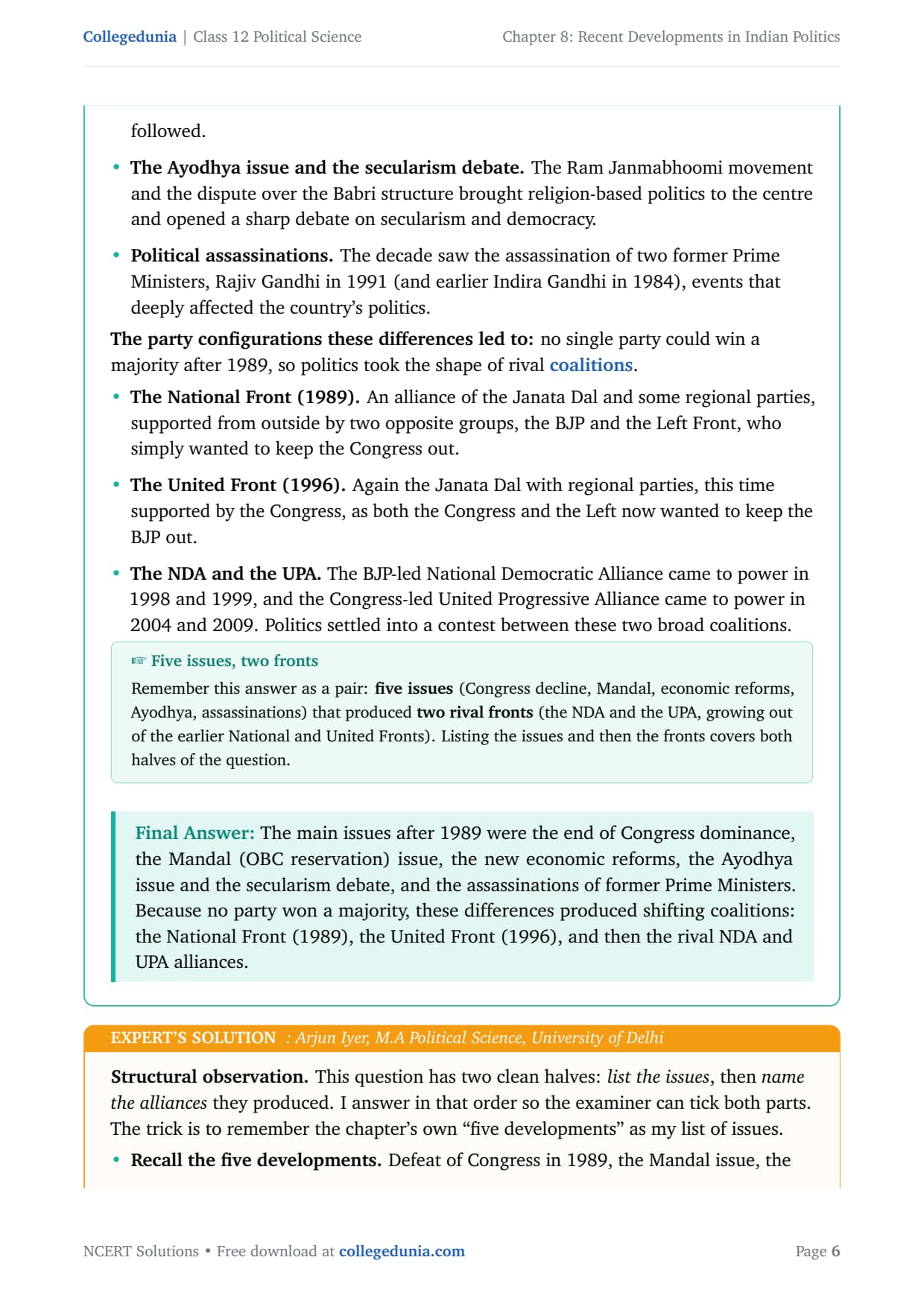
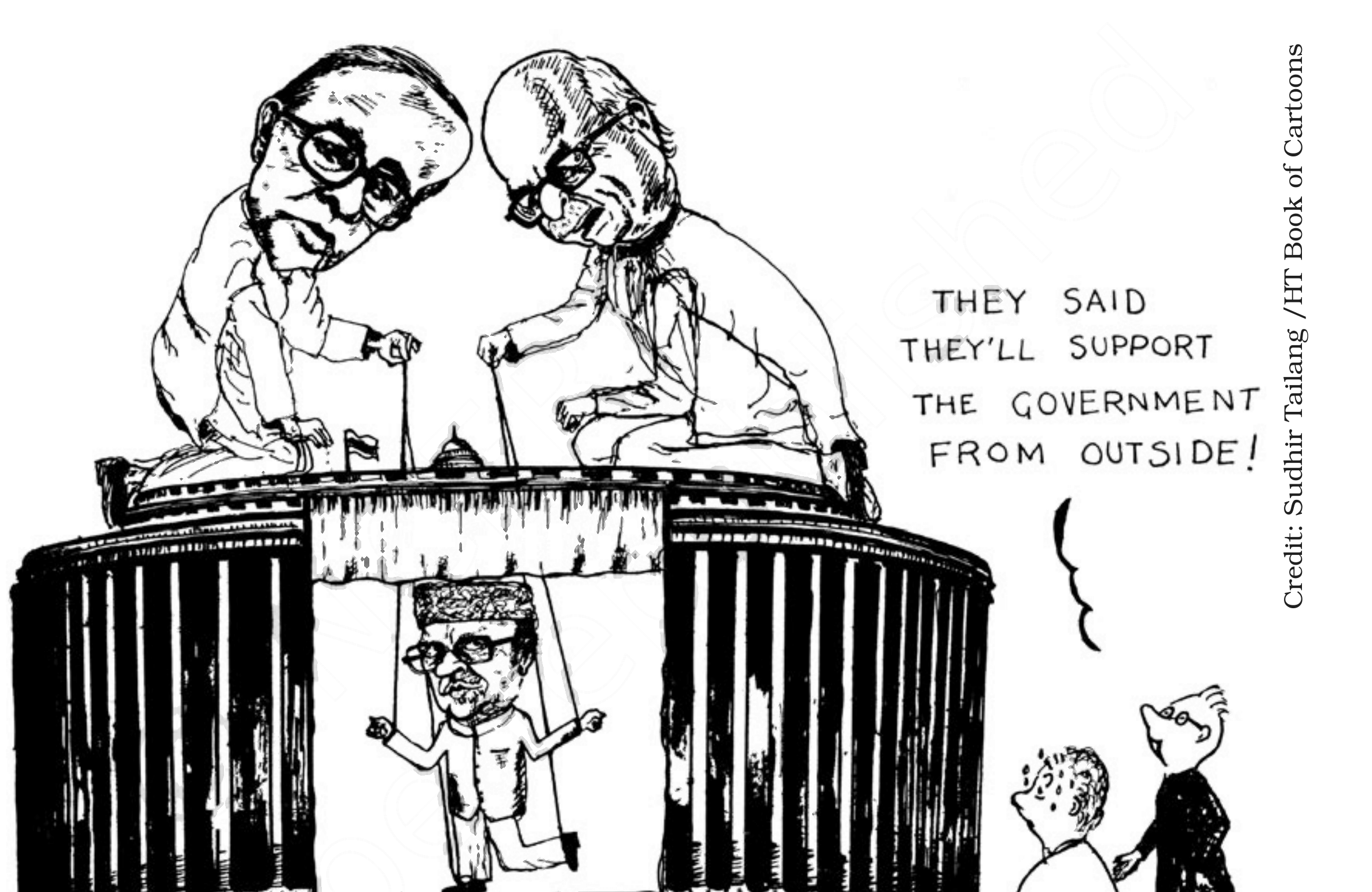
cartoon below shows the puzzle perfectly: two rivals, the Left and the BJP,
propping up the same government from outside.
Cartoon by Sudhir Tailang, HT Book of Cartoons, NCERT Politics in India since Independence, Class 12, Chapter 8. The Left (Jyoti Basu) and the BJP (L.K. Advani) both ``support the government from outside,'' even though their ideologies are opposite.
Arguments that support the statement (alliances are not about
ideology):
Opposite parties join the same front. In 1989 the National
Front was supported by both the BJP and the Left Front, two
diametrically opposite groups, simply because both wanted to keep
the Congress out of power.
Sides switch for convenience. In 1996 the Congress and the
Left supported the United Front to keep the BJP out, the reverse of
the 1989 line-up. Such switching shows power, not principle, drives
the alliances.
Allies reject the leader's core ideology. Most parties of
the NDA did not agree with the BJP's `Hindutva' ideology. Yet they
came together, formed a government and remained in power for a full
term. Power-sharing beat ideological agreement.
Arguments that oppose the statement (ideology still matters):
The two coalitions still have a centre of gravity. The
competition is broadly between a BJP-led front and a Congress-led
front, each with its own broad outlook, so ideology has not vanished
entirely.
Some parties keep their identity. Caste-based and regional
parties still champion the causes of OBCs, Dalits or their region,
which are real ideological commitments even inside a coalition.
Give both sides for an argue question
``What arguments would you put forward to support or oppose'' is an
invitation to argue both ways. An answer that only supports, or
only opposes, the statement is half complete. Present each side, then take a
balanced view.
On balance the statement is largely true for the coalition era:
opposite parties like the BJP and the Left backed the same governments, the
line-ups reversed between 1989 and 1996, and NDA partners openly rejected
Hindutva yet stayed in power. So alliances were built mainly on pragmatic
power-sharing. But ideology did not disappear completely: the two rival
fronts kept broad outlooks, and caste and regional parties held on to their
own causes.
SV
Sneha Verma
M.A Political Science, Jadavpur University
Verified Expert
Picture-first. The Tailang cartoon does my arguing for me. Two
sworn rivals, the Left and the BJP, are shown holding up the very same
government. If ideology ruled, that image would be impossible. So I lead
with the cartoon, then build the case on both sides.
Strongest pro-statement evidence. The 1989 National Front
rested on BJP-plus-Left support, and the NDA's allies did not share
the BJP's Hindutva. Both facts show alliances over ideology.
The switch. 1989 keep-Congress-out flips to 1996
keep-BJP-out. The same parties change partners as the target
changes. That is pure tactics.
The honest counterpoint. Regional and caste parties still
fight for their own people, and the two fronts keep distinct broad
identities, so I refuse to say ideology is dead.
Reach a measured verdict. Weighing both sides, I conclude
the statement is mostly true but not wholly: alliances are built
first for power, yet a thread of ideology survives in the parties'
own causes. A clear ``yes, with one qualification'' scores better
than a flat agreement.
The deeper reading: the chapter treats pragmatism as a feature, not just a
flaw, of the coalition age. When no party can rule alone, governing means
compromise, and compromise softens ideology. There is even a positive side
to this: a government that must keep many partners happy cannot push one
narrow agenda too hard, so pragmatism can act as a quiet check on extreme
politics. The smartest answer agrees that power-sharing now drives most
alliances, proves it with the BJP-Left and NDA examples, and then adds the
qualification that regional and caste identities keep a thread of ideology
alive. That balance, anchored in the cartoon, reads like a topper's response.
Mostly agree: the BJP and Left backing the same front, the
1989-to-1996 switch, and NDA allies rejecting Hindutva all show alliances
built on pragmatism, not shared ideology. The qualification is that broad
front identities and the causes of caste and regional parties keep some
ideology in play.
Q 8.5
Trace the emergence of BJP as a significant force in
post-Emergency politics.
Concept used. The question asks us to trace, that is, to
follow a development step by step from its start to its high point. We
follow the Bharatiya Janata Party from its birth in 1980, through
its turn to Hindutva, the Ayodhya movement, and finally to leading the
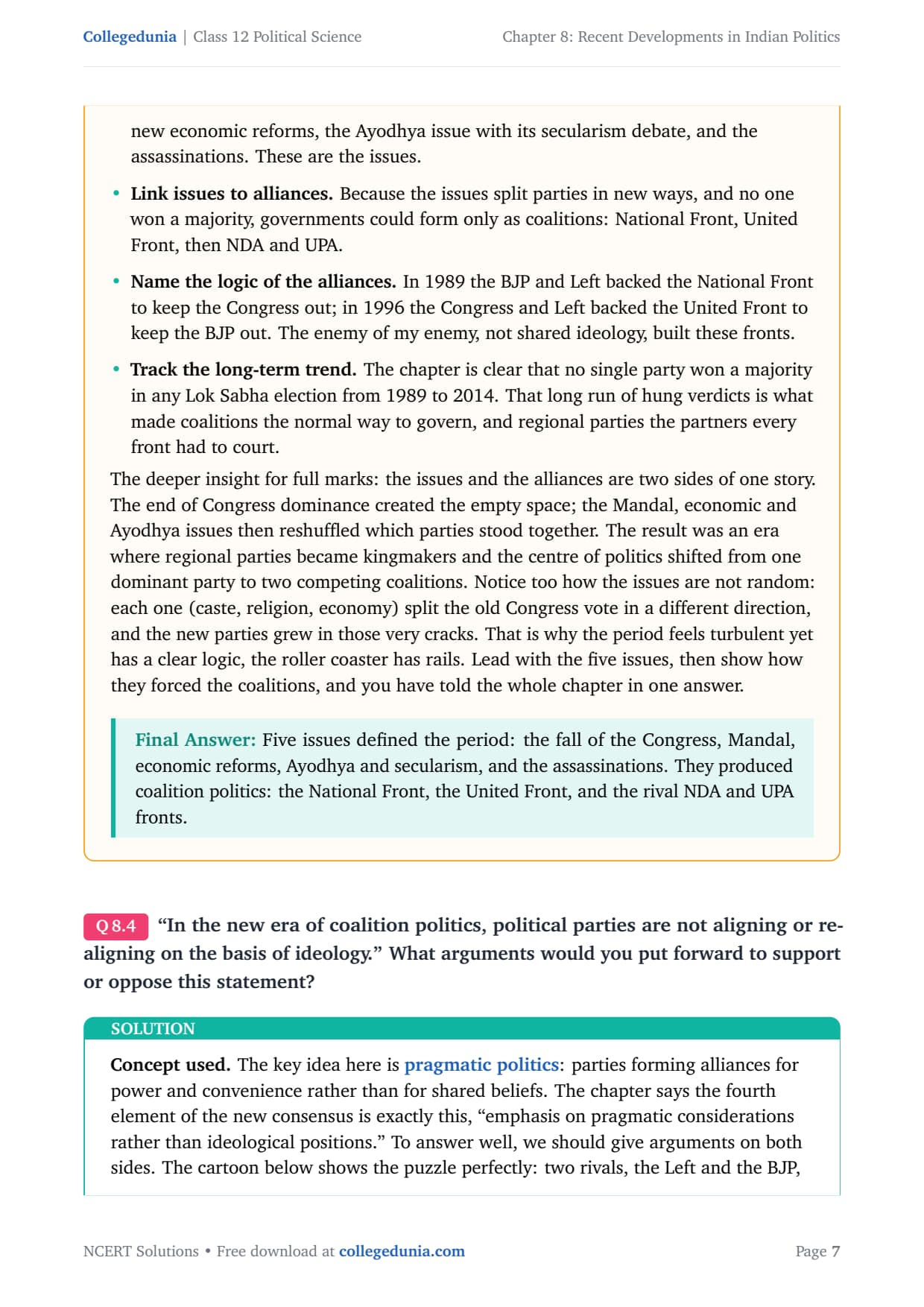
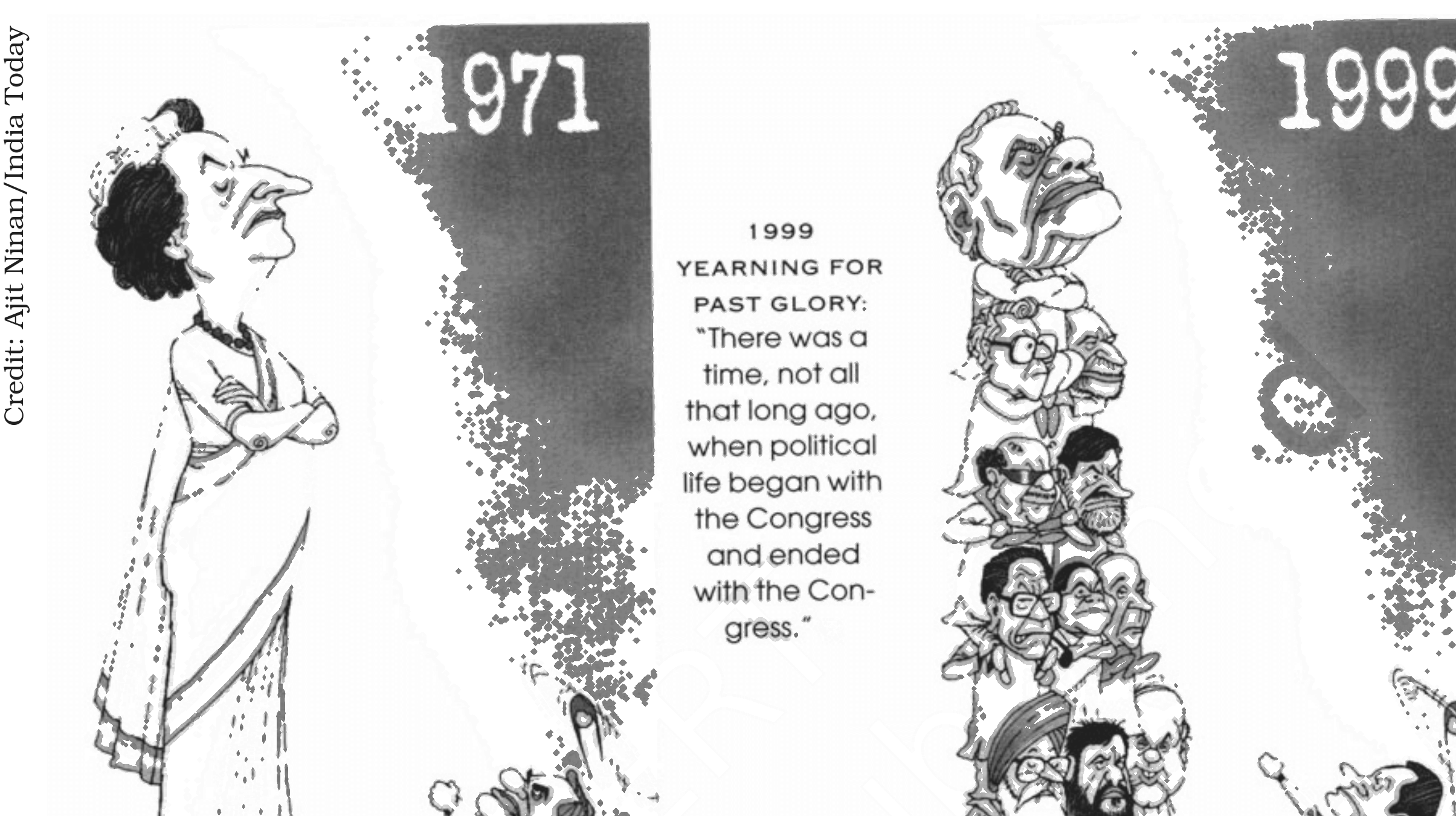
country. The cartoon below captures the journey's meaning: politics moved
from one-party dominance to a multi-party alliance system in which the BJP
became central.
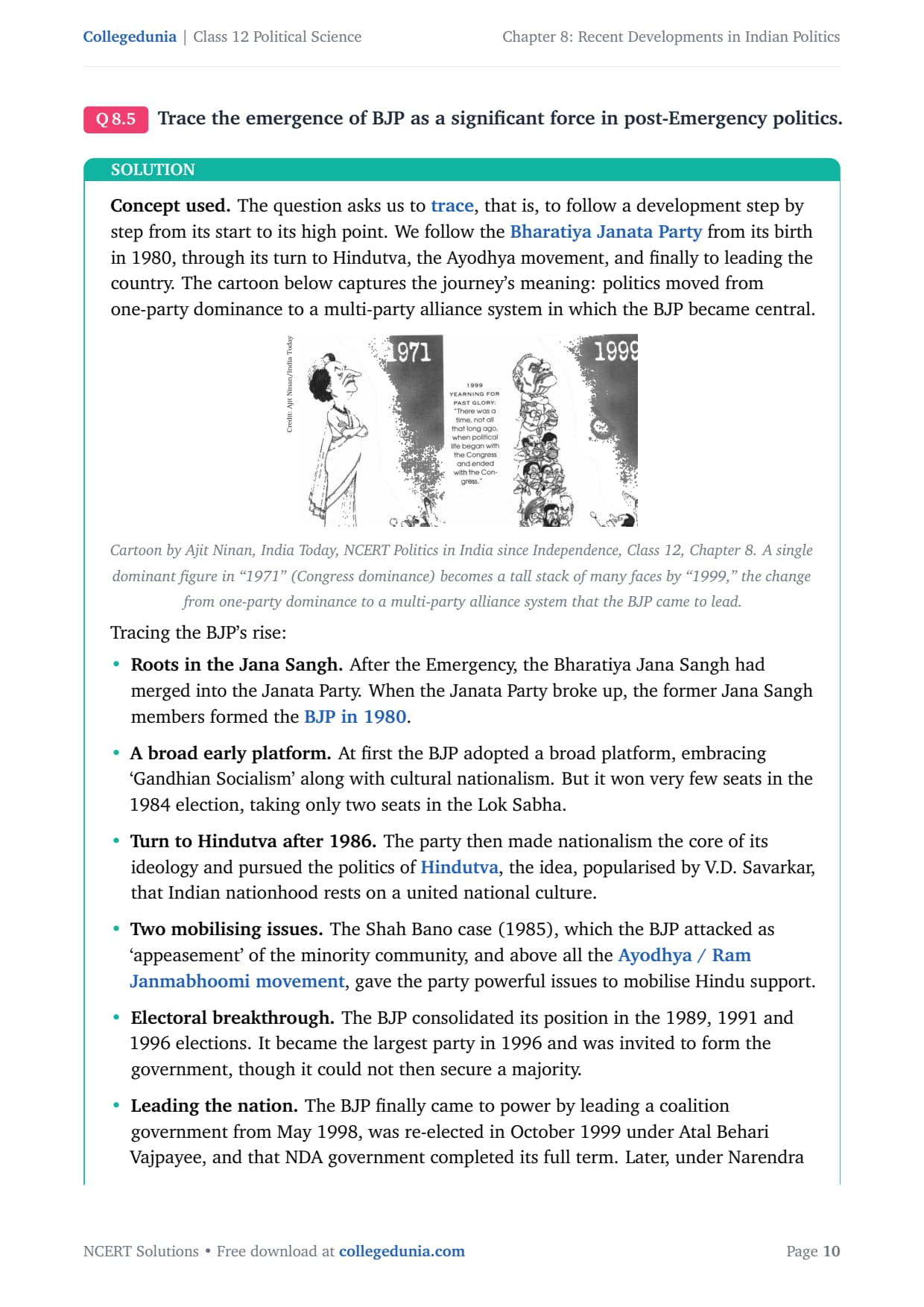
Cartoon by Ajit Ninan, India Today, NCERT Politics in India since Independence, Class 12, Chapter 8. A single dominant figure in ``1971'' (Congress dominance) becomes a tall stack of many faces by ``1999,'' the change from one-party dominance to a multi-party alliance system that the BJP came to lead.
Tracing the BJP's rise:
Roots in the Jana Sangh. After the Emergency, the Bharatiya
Jana Sangh had merged into the Janata Party. When the Janata Party
broke up, the former Jana Sangh members formed the BJP in
1980.
A broad early platform. At first the BJP adopted a broad
platform, embracing `Gandhian Socialism' along with cultural
nationalism. But it won very few seats in the 1984 election, taking
only two seats in the Lok Sabha.
Turn to Hindutva after 1986. The party then made
nationalism the core of its ideology and pursued the politics of
Hindutva, the idea, popularised by V.D. Savarkar, that
Indian nationhood rests on a united national culture.
Two mobilising issues. The Shah Bano case (1985), which the
BJP attacked as `appeasement' of the minority community, and above
all the Ayodhya / Ram Janmabhoomi movement, gave the party
powerful issues to mobilise Hindu support.
Electoral breakthrough. The BJP consolidated its position
in the 1989, 1991 and 1996 elections. It became the largest party
in 1996 and was invited to form the government, though it could not
then secure a majority.
Leading the nation. The BJP finally came to power by
leading a coalition government from May 1998, was re-elected in
October 1999 under Atal Behari Vajpayee, and that NDA government
completed its full term. Later, under Narendra Modi, it won
single-party majorities in 2014 and 2019.
Trace means tell the story in order
For a ``trace'' question, walk through the stages in sequence: 1980
formation, the 1984 setback, the post-1986 Hindutva turn, the Ayodhya
mobilisation, the 1996 breakthrough, and the 1998-99 NDA governments. A
neat timeline scores more than scattered facts.
The BJP grew from the former Jana Sangh, was formed in 1980 with
a broad platform, fared poorly in 1984, then after 1986 turned to Hindutva
and used the Shah Bano and Ayodhya issues to mobilise support. It rose
across the 1989, 1991 and 1996 elections, became the largest party in 1996,
and came to power leading the NDA coalition in 1998-99 under Vajpayee.
RB
Rohit Banerjee
M.A Political Science, Pondicherry University
Verified Expert
Strategic angle. A ``trace the emergence'' question is a timeline
in disguise. I divide the BJP's rise into three clear phases, formation,
ideological turn, and rise to power, so the answer reads as a story with a
beginning, middle and end rather than a heap of dates.
Formation phase (1980-84). Born from the Jana Sangh after
the Janata Party split, the BJP began broad (`Gandhian Socialism')
but flopped in 1984 with just two seats. A weak start.
Ideological turn (after 1986). The party made nationalism
central and embraced Hindutva. Shah Bano and Ayodhya became its
rallying issues. This is the pivot of the whole story.
Rise to power (1989-99). Gains in 1989, 1991 and 1996 made
it the largest party; leading the NDA, it formed governments in
1998 and 1999 and completed a full term under Vajpayee.
Mark the two engines of the rise. Two forces drove the BJP
upward together: a clear ideology (Hindutva, sharpened by the Shah
Bano and Ayodhya issues) that won committed support, and a readiness
to build coalitions that turned that support into a governing
majority. Naming both shows you understand the rise, not just the
dates.
The deeper reading: the BJP's rise mirrors the chapter's bigger theme. As
Congress dominance ended, an empty centre opened, and the BJP filled it by
combining a sharp ideology (Hindutva) with the pragmatism of coalition
building. Note the paradox the chapter highlights: most NDA allies rejected
Hindutva, yet the BJP led them, which is why its rise belongs as much to the
coalition story as to the religion-and-politics story. The Ninan cartoon
sums it up: by 1999 politics was a tall stack of many faces, and the BJP
had learned to sit on top of that stack by leading, not dominating. End your
answer on that point and it reads like a topper's, not a textbook's.
From the Jana Sangh to a new party in 1980, through a weak 1984
and a post-1986 turn to Hindutva on the Shah Bano and Ayodhya issues, the
BJP climbed across the 1989, 1991 and 1996 polls to become the largest
party, and led the NDA to power in 1998-99 under Vajpayee.
Q 8.6
In spite of the decline of Congress dominance, the Congress party
continues to influence politics in the country. Do you agree? Give reasons.
Concept used. We must tell apart two different ideas. The
decline of Congress dominance means the Congress lost its old
position as the single all-powerful party. Continuing influence
means it still shapes politics, even without that dominance. The honest
answer is yes, we agree: the Congress declined as a dominant force but kept
a large and active influence.
Reasons the Congress continues to influence politics:
It stayed a major national party. Even after 1989 the
Congress remained an important party and ruled the country more
than any other party in this period. Its decline was a loss of
centrality, not a disappearance.
It bounced back at the polls. The Congress recovered after
its 1989 defeat, returning to power in 1991, and revived again in
2004, raising its seats from 145 in 2004 to 206 in 2009.
It led a national coalition. The Congress led the United
Progressive Alliance (UPA) to power in 2004 and 2009, with
Manmohan Singh as Prime Minister, showing it could still anchor a
ruling alliance.
It became one of the two poles of politics. Politics
settled into a contest between a Congress-led coalition and a
BJP-led coalition. Being one of the two poles is itself a powerful
form of continuing influence.
Its old role still shapes the system. The chapter calls
the early Congress a `coalition' of many interests. That habit of
accommodating diverse groups continues to influence how Indian
parties and alliances are built.
Decline is not the same as defeat
A common error is to read ``decline of dominance'' as ``end of the
Congress.'' The chapter is clear: the Congress lost its central place but
remained important, even ruling the most and leading the UPA. Influence can
survive the loss of dominance.
Yes, we agree. Despite losing its old dominance, the Congress kept
strong influence: it stayed a major national party, bounced back to power in
1991 and revived in 2004 and 2009, led the UPA governments, and became one
of the two poles of coalition politics. So decline of dominance did not mean
loss of influence.
AK
Aditi Kapoor
M.A Political Science, Manipal Academy of Higher Education
Verified Expert
Strategic angle. ``Do you agree?'' wants a clear stand backed by
reasons. I take a firm yes, then separate two things the question quietly
mixes together: losing dominance and losing influence. The
Congress did the first but not the second, and that distinction is my whole
answer.
State the stand. I agree. The Congress declined as a
dominant party but kept real influence over national politics.
Evidence of survival. It ruled the most even after 1989,
returned to power in 1991, and revived sharply in 2004 and 2009
(145 to 206 seats).
Evidence of system-level weight. As leader of the UPA and
one of the two coalition poles, the Congress set the terms of
competition, which is influence even when out of power.
The deeper reading: the chapter frames the whole period as the decline of
Congress and the rise of the BJP, but it never treats the Congress as
finished. Its influence works in two ways: directly, by winning elections
and leading the UPA, and structurally, because the original `Congress system'
of accommodating many groups became the model every coalition now copies. So
the smartest answer agrees, proves direct influence with the 2004-09 revival
and the UPA, and then adds the structural point that the Congress shaped the
very logic of coalition politics in India.
I agree. The Congress lost dominance but not influence: it ruled
the most after 1989, revived in 1991 and again in 2004-09, led the UPA, and
stayed one of the two poles of coalition politics, while its old
accommodating style became the template for coalitions.
Q 8.7
Many people think that a two-party system is required for
successful democracy. Drawing from India's experience of last 30 years,
write an essay on what advantages the present party system in India has.
Concept used. A two-party system is one where two big
parties dominate, as in the United States or Britain. India instead has a
multi-party system with coalition governments, in which many
parties, including regional ones, share power. Drawing on the last 30 years,
we argue that this multi-party, coalition system has real advantages for a
country as diverse as India.
Advantages of India's present (multi-party, coalition) system:
It represents India's diversity. A country as varied as
India, in caste, religion, language and region, cannot be captured
by just two parties. The multi-party system gives many groups,
including OBCs, Dalits and regional communities, their own voice.
It gives regional parties a real role. State-level parties
now share power at the national level and have played a central
role in the country's politics. This brings regional concerns into
national decision-making, which a two-party system might ignore.
It encourages accommodation and consensus. Because no party
usually wins alone, parties must accommodate and aggregate many
interests to govern. This habit of compromise produced the broad
four-part consensus on the economy, backward castes, regional
parties and pragmatism.
It curbs the over-concentration of power. Coalition
governments depend on partners, so power is spread out rather than
held by one party. This acts as a check, making the ruling group
more answerable to its allies.
It has proved stable enough to work. Despite fears that
coalitions would be unstable, the system has delivered governments
that completed full terms, such as the NDA after 1999 and the UPA in
2004 and 2009, showing multi-party democracy can be effective.
Answer with India's own examples
The question says ``drawing from India's experience,'' so anchor every
advantage in a real case: regional parties in the National and United
Fronts, the four-part consensus, and full-term coalition governments. Named
evidence lifts an essay above general opinion.
India's present multi-party, coalition system suits its diversity
better than a two-party system would. Its advantages are that it represents
many social and regional groups, gives state-level parties a real share of
national power, forces parties to accommodate diverse interests and build
consensus, spreads power so no one party dominates, and has still produced
stable, full-term governments like the post-1999 NDA and the 2004-09 UPA.
KJ
Karan Joshi
M.A Political Science, Banaras Hindu University
Verified Expert
Structural observation. This is an essay, so it needs a clear line
of argument, not a list. My line is simple: a two-party system might suit a
homogeneous country, but India's diversity is better served by its
multi-party system. I build each paragraph around one advantage, each tied
to the last 30 years.
Open with the diversity argument. India's many castes,
religions, languages and regions need many parties to be heard. Two
parties would leave large groups voiceless.
Show power-sharing in action. Regional parties became
kingmakers in the National Front, United Front, NDA and UPA. That is
national power shared with the states.
Close on consensus and stability. The need to keep partners
on side bred the broad consensus and still produced full-term
governments, answering the fear that coalitions cannot last.
The deeper reading that makes an essay stand out: the chapter quietly argues
that the original `Congress system' was itself a coalition of many interests
inside one party. When that broke down after 1989, the same accommodating
function simply moved from inside one party to between many parties. So
India's multi-party system is not a failure to reach a two-party ideal; it is
a different, arguably better, way of doing the same democratic work of
holding a vast and plural society together. End your essay on that idea, with
named examples, and it reads like a topper's answer.
India's multi-party, coalition system has clear advantages over a
two-party model: it voices a hugely diverse society, gives regional parties
real national power, breeds accommodation and a broad policy consensus,
spreads power as a check, and has still delivered stable full-term
governments. The diversity of India is its reason and its reward.
Q 8.8
Read the passage and answer the questions below: [3pt]
Party politics in India has confronted numerous challenges. Not
only has the Congress system destroyed itself, but the fragmentation of
the Congress coalition has triggered a new emphasis on self-representation
which raises questions about the party system and its capacity to
accommodate diverse interests, . An important test facing the polity
is to evolve a party system or political parties that can effectively
articulate and aggregate a variety of interests. (Zoya Hasan) [4pt]
(a) Write a short note on what the author calls challenges of the party
system in the light of what you have read in this chapter.
(b) Give an example from this chapter of the lack of accommodation and
aggregation mentioned in this passage.
(c) Why is it necessary for parties to accommodate and aggregate a variety
of interests?
Concept used. The passage uses two key ideas.
Accommodation means making room for different groups inside the
party system. Aggregation means gathering many separate interests
together into a workable common platform. The author, Zoya Hasan, warns that
once the old `Congress system' broke up, parties found it harder to do both.
We answer each sub-part in turn.
(a) The challenges of the party system:
The Congress system destroyed itself. The party that once
held many interests together lost its central place after 1989, and
with it went the old way of holding the system together.
Fragmentation and self-representation. As the Congress
coalition broke apart, many groups began to demand
self-representation, each wanting its own party or its own
voice rather than being spoken for by a big umbrella party.
The capacity question. This raises a doubt about whether
the new party system can still accommodate and aggregate
diverse interests, or whether it will splinter into many narrow
groups. Evolving parties that can articulate and aggregate variety
is the author's ``important test.''
(b) An example of the lack of accommodation and aggregation:
The Mandal issue and the anti-Mandal violence. When the
National Front government implemented the Mandal Commission's OBC
reservations in 1990, supporters and opponents clashed in violent
anti-Mandal protests across north India. The system struggled to
accommodate both the OBCs' demand for a share of power and the
anxieties of those who opposed reservation, a clear case of
difficulty in aggregating opposed interests. (The deep conflict over
the Ayodhya issue and secularism is another such example.)
(c) Why parties must accommodate and aggregate interests:
India is highly diverse. With so many castes, religions,
languages and regions, a party system that cannot bring varied
interests together cannot represent the whole country.
It keeps democracy stable and peaceful. When parties
accommodate and aggregate interests, conflicts are settled through
debate, alliances and the ballot, not through violence. The chapter
shows this in the peaceful, lawful resolution of the long Ayodhya
dispute by the Supreme Court in 2019.
It allows effective government. A party that gathers many
interests can build the broad support needed to govern, which is why
the new consensus and coalition-building became central to Indian
politics.
Answer each sub-part separately
A passage question with (a), (b) and (c) wants three clearly labelled
answers. Take them one by one. For (b) you only need one solid example,
explained, not a long list. Precision scores more than length here.
(a) The challenges are the self-destruction of the Congress system,
the fragmentation into demands for self-representation, and the resulting
doubt about whether the party system can still accommodate and aggregate
diverse interests. (b) The violent anti-Mandal protests over OBC reservation
(and the conflict over Ayodhya) show the system's difficulty in
accommodating opposed interests. (c) Parties must accommodate and aggregate
interests because India is deeply diverse, because it keeps democracy stable
and peaceful, and because it lets parties build the broad support needed to
govern.
VD
Vivaan Desai
M.A Political Science, Tata Institute of Social Sciences
Verified Expert
Structural observation. A three-part passage question is really
three mini-answers. I keep them short and labelled, and I make sure my
example in (b) is one I can explain, not just name. The thread tying all
three parts is the pair of words ``accommodate and aggregate.''
Part (a), the challenges. The Congress system collapsed,
fragmentation bred demands for self-representation, and that put the
party system's capacity to accommodate and aggregate to the test.
Part (b), one clear example. The anti-Mandal violence of
1990: the system could not smoothly hold together the OBC demand and
the opposition to it. I explain it in a line rather than just
listing it.
Part (c), the why. Diversity, stability and effective
government. Without accommodation, a plural society either silences
groups or slides into conflict.
Tie the three parts together. Notice that the same idea,
accommodate and aggregate, runs through all three answers: it is the
capacity the Congress system once had (part a), the capacity that
failed in the Mandal clash (part b), and the capacity a diverse
democracy cannot do without (part c). Pointing out that single
thread makes the answer feel whole rather than three loose pieces.
The deeper reading: Zoya Hasan's worry is the mirror image of the chapter's
hopeful ending. She fears fragmentation; the chapter answers that, over time,
a new consensus did emerge, and even the bitter Ayodhya dispute was
finally settled by due process of law in 2019. So the strongest answer to
(c) links accommodation directly to democratic stability: the very capacity
Hasan calls a ``test'' is what lets a diverse India resolve its deepest
conflicts peacefully. Make that link and your (c) stands out.
(a) Collapse of the Congress system, fragmentation into
self-representation, and doubt over the system's capacity to accommodate and
aggregate. (b) The violent anti-Mandal protests of 1990 (and the Ayodhya
conflict) show the lack of accommodation. (c) Because India is diverse, and
accommodation keeps democracy stable and lets parties govern effectively.
FAQs on Recent Developments in Indian Politics Class 12 NCERT Solutions
Recent Developments in Indian Politics Class 12 Political Science Common Questions
Ques. Where can I get the class 12 political science chapter 8 NCERT Solutions PDF?
Ans. You can download the Recent Developments in Indian Politics Class 12 Political Science NCERT Solutions PDF directly from this page. It is free, follows the 2026-27 NCERT, and answers all 8 exercise questions step by step.
Ques. How many questions are there in Recent Developments in Indian Politics class 12 questions and answers?
Ans. The chapter has 8 exercise questions. The first two are a chronology and a match-the-following item, while Questions 3 to 8 are short, long and passage-based written answers, including an essay on India's party system.
Ques. What is the four-part consensus in Recent Developments in Indian Politics?
Ans. It is the broad agreement most parties came to share after the 1990s: support for the new economic policies, acceptance of the claims of backward castes, acceptance of the role of regional parties, and a stress on pragmatism over ideology.
Ques. Why did Congress dominance end after 1989?
Ans. The Congress fell from 415 seats in 1984 to 197 in 1989 and lost its majority, ending the "Congress system". Issues like Mandal, the new economic reforms and the Ayodhya dispute split parties in new ways, so politics became a contest of coalitions instead.
Ques. How did the BJP rise to power in this chapter?
Ans. The BJP grew from the former Jana Sangh, was formed in 1980, fared poorly in 1984, then after 1986 turned to Hindutva and used the Shah Bano and Ayodhya issues to mobilise support. It became the largest party in 1996 and led the NDA to power in 1998-99 under Vajpayee.
Ques. Is class 12 political science chapter 8 easy to score in the board exam?
Ans. Yes. It is a high-scoring closing chapter if you keep the coalition timeline straight and give a balanced view on coalition politics. Practise the chronology, the match item and the four-part consensus, and keep the BJP "trace" answer ready for the long question.








Comments