The NCERT Solutions for Political Science Class 12 Chapter 1 Challenges of Nation Building answer every textbook question on Partition, the integration of the Princely States and the reorganisation of states, set to the latest 2026-27 CBSE syllabus. Each answer explains the three challenges India faced in 1947, why secularism mattered, and how Sardar Patel brought 565 states into the Union. These solutions help students prepare for the Class 12 Political Science board paper and the UPSC foundation in 2026-27.
Covers all 10 exercise questions from Politics in India Since Independence Chapter 1, with full point-wise answers.
This Class 12 Political Science chapter usually carries 5 to 6 marks per board paper.
Pairs with the Notes, Handwritten Notes and NCERT Book PDF linked lower on this page.
Every solution for Class 12 Political Science Chapter 1 in this Collegedunia compilation is written by subject experts from the official NCERT Politics in India Since Independence textbook, and checked against the last five years of CBSE board papers.
Student Feedback: In a Collegedunia poll of 9,460 Class 12 Political Science students taken before the 2026 boards, 71% of students rated the secularism question as the part of Challenges of Nation Building they most wanted model answers for. Most students said a clear split between Nehru's ethical and prudential reasons made the answer easy to write.
Source: 2026-27 Class 12 Political Science student poll. Sample of 9,460 students from CBSE schools across 13 states.
What the Challenges of Nation Building Class 12 Chapter Is About
Challenges of Nation Building is the first chapter of Politics in India Since Independence. It studies how the new nation dealt with the first big test it faced in 1947: how to hold a vast, diverse land together as one country. The chapter is built around the three challenges of nation building and the events that tested them.
The chapter answers three big questions that students must keep in mind:
What were the challenges? Building unity in diversity, setting up democracy, and ensuring development for all.
How was unity built? Through Partition's hard lessons, the integration of 565 Princely States, and a secular Constitution.
How were states drawn? On a linguistic basis, ending with the States Reorganisation Act of 1956.
So the chapter is really about the foundation of modern India. A student who keeps these three threads in mind can connect almost any question in Challenges of Nation Building class 12 back to one of them. This is why revision works best when you sort each fact under "unity", "democracy" or "development" first.
The Three Challenges of Nation Building
At Independence, India faced three challenges at once. Understanding them gives you the frame for the whole chapter, so learn them as a clear list rather than a story.
Unity in diversity: to hold together a land of many languages, religions and cultures as one nation.
Democracy: to run the country through free elections, fundamental rights and the vote for every citizen.
Development: to ensure economic growth and welfare for all, especially the poor and the weak.
The point examiners test most is that India chose to meet the first challenge by accepting diversity, not by forcing uniformity. The country saw itself as an imagined community bound by a shared history, common political aspirations and a common destiny. That is why the later choice in favour of linguistic states strengthened, rather than broke, national unity. Keep this idea ready, because the "imagined community" question turns on it.
Partition: Displacement, Violence and the Two-Nation Theory
The first big test of 1947 was Partition. The reasons and the human cost are a regular long answer, so students should learn them as a clear list. The table below sorts the main facts for fast revision.
Aspect
What to recall
The basis
Partition followed the "two-nation theory" of the Muslim League: Hindus and Muslims were two separate peoples.
The provinces split
Punjab and Bengal, both Muslim-majority, had large non-Muslim belts, so both were divided on religion.
Two-part Pakistan
West and East Pakistan lay far apart, separated by Indian territory, so they were not contiguous.
Displacement
About 80 lakh people crossed the new border, a sudden, unplanned transfer.
Violence
Five to ten lakh people were killed in the communal violence that followed.
A key insight for the exam is that no one planned the movement of people. The chapter is clear that the scale of migration was never anticipated, so the trap in the MCQ is the line that the Partition scheme "included a plan for transfer of population". That statement is false. The land, assets and even the police band's instruments were divided, but the exodus itself was unplanned and abrupt.
Secularism and Nehru's Reasons
A secular state was India's answer to a divided society. The reasons Nehru gave are a popular question, so students should know both what they were and what kind of reasons they were. Learn his reasons as a clear set of points.
Equality of all citizens: no faith gets superior or inferior status; all citizens are equal whatever their religion.
India is genuinely diverse: a Hindu-only nation would have betrayed the freedom movement's belief in equality.
Duty to the minorities: Muslims still formed 10 to 12 per cent of India in 1951 and deserved security and rights.
A practical safeguard: Nehru warned that ill-treating the minority would become a "festering sore" that could destroy the nation.
The judgement most answers should reach is that Nehru's reasons were both ethical and prudential. They were ethical because equality of all faiths was a moral ideal of the freedom movement. But they were also prudential, because a fairly treated minority kept India united and stable. The "festering sore" line from his letter of 15 October 1947 is the single best proof of the practical side, so keep it ready for the long answer.
Integration of the Princely States
The second great task was bringing the Princely States into India. This topic links to Sardar Patel's role, so it is a regular short and long answer. The table keeps the key cases side by side.
State
How it was integrated
Most states
Signed the Instrument of Accession; Patel "negotiated firmly but diplomatically".
Junagadh
The ruler first acceded to Pakistan, but a plebiscite confirmed the people's wish to join India.
Hyderabad
The Nizam wanted independence; the army moved in (September 1948) before he acceded.
Manipur
Held the first election on universal adult franchise (June 1948); the 1949 merger bypassed the assembly.
One sharp point for the integration question: there were 565 Princely States, and Patel led their integration through the Instrument of Accession. Most joined peacefully and the merger extended democracy to people who had lived under autocratic princes. But in Hyderabad force was used, and in Manipur the elected assembly was bypassed, so consensus was not created everywhere. A balanced answer names both the rule and the exceptions.
Reorganisation of States on a Linguistic Basis
The third task was drawing the internal map of India. This is a regular two-part question on the States Reorganisation Commission, so learn both the task and the outcome.
The trigger: Potti Sriramulu's fast-unto-death led to the formation of Andhra in December 1952.
The Commission: the States Reorganisation Commission (SRC) was set up in 1953 to look into redrawing state boundaries.
The salient recommendation: state boundaries should reflect the boundaries of different languages, the linguistic principle.
The result: the States Reorganisation Act of 1956 created 14 states and 6 union territories.
The honest exam point is that accepting linguistic states strengthened unity rather than breaking it. Many feared that drawing states by language would split the country, but it actually opened politics to people beyond the small English-speaking elite and deepened democracy. Marks come from giving the task, the linguistic recommendation and the 1956 result together.
The Challenges of Nation Building Class 12 Exercise-wise Coverage
The chapter exercise has 10 questions. The table maps each one to its topic so students can plan revision and find the right NCERT answer fast. The full point-wise solution for each sits in the question set lower on this page.
Question
Topic it tests
Q 1
Incorrect statement about the Partition (MCQ)
Q 2
Match the principles of boundary-making with the right instances
Q 3
Map-work: locate Junagadh, Manipur, Mysore and Gwalior
Q 4
Opinion on accession of Princely States (Bismay vs Inderpreet)
Q 5
Source-based: agenda of nation building from Gandhi and Nehru
Q 6
Nehru's reasons for keeping India secular, ethical or prudential
Q 7
Two differences in nation building, eastern vs western regions
Q 8
Task and salient recommendation of the SRC
Q 9
Features that make India a nation, the "imagined community"
Q 10
Passage-based: Guha on India vs the Soviet experiment
Questions 6, 9 and 10 are the most-asked long answers, so students preparing Challenges of Nation Building class 12 important questions should learn those three first. The MCQ, the match and the map-work (Q1 to Q3) are quick marks, so revise the Partition and integration facts well to secure them.
Students who want the offline copy can save the class 12 political science chapter 1 pdf from the download card above and tick off each question as they finish it.
Challenges of Nation Building Important Questions and Previous Year Trends
CBSE sets a steady mix of MCQ, short and long answers from this chapter. Knowing the pattern helps students decide how much to write. The chapter is a regular source of one 4-mark or 6-mark question, which is why a focused list of Challenges of Nation Building important questions saves a lot of revision time.
Long answer (5 to 6 marks): why Nehru kept India secular, or the features that make India a nation.
Short answer (4 marks): the integration of the Princely States, or the task of the SRC.
Source-based: a passage on Partition, the Gandhi-Nehru statements, or the India-Soviet comparison.
Objective and MCQ: the two-nation theory, the 565 states, key dates, and the 1956 Act.
For quick recall before the exam, students often practise the class 12 political science chapter 1 mcq set and a list of Challenges of Nation Building class 12 important questions. The most repeated items are Nehru's reasons for secularism and the integration of the Princely States, so keep those answer points ready in your own words.
Working through the ncert solutions class 12 political science chapter 1 set twice, once open-book and once from memory, fixes the dates and names well before the board exam.
Common Mistakes Students Make in This Chapter
A few errors cost marks every year in this chapter. Most come from missing the "unplanned" point in Partition or giving only one side of the secularism debate. Avoiding them is the fastest way to lift a score.
Saying the Partition scheme "planned" the population transfer - it did not; the exodus was unplanned and abrupt.
Calling Nehru's secularism only ethical - it was also prudential, a safeguard for India's unity.
Forgetting the exact numbers: 565 Princely States, and 14 states with 6 union territories in 1956.
Mixing up the cases: Hyderabad meant force, Manipur meant a contested merger, Junagadh meant a plebiscite.
Writing that linguistic states broke India - in fact they strengthened unity and deepened democracy.
Students who fix these five points usually move from average to high marks on the long answers. The exam rewards a balanced view, so always give both sides before you judge, especially on secularism and on the integration of the states.
Challenges of Nation Building PDF Download Formats and Languages
The solutions are free to download in more than one format, so students can pick what suits their device and revision style. The download card at the top of the page carries each option for this chapter.
Normal and HD PDF: the class 12 political science chapter 1 pdf comes in a normal size for quick downloads and an HD version for clear printing.
English medium: all 10 answers are written in simple English for the CBSE board paper.
Question-only set: a print-and-practise sheet of Challenges of Nation Building extra questions for self-testing.
Whole-book pack: the solutions sit in one set that runs through every Politics in India Since Independence chapter, so you can revise from Chapter 1 onwards in one place.
Many students search for class 12 political science chapter 1 answers on their phone the night before a test, so a saved PDF means you can revise even without internet. Keep both the question set and the solved version handy for a full self-check.
How the Challenges of Nation Building Solutions Pair with Notes and the Book PDF
These NCERT Solutions answer the back-exercise questions. To revise the full chapter, students should use them alongside the other resources for the same chapter, all linked in the table below.
Reading the original NCERT chapter text and figures
Tip: read the Notes first, then attempt these solutions on your own, and only then check the model answers here. That order builds memory faster than copying answers straight away.
All NCERT Solutions for Class 12 Political Science
The table links the NCERT Solutions for every chapter in both Class 12 Political Science books, so students can move across the course in one click. Challenges of Nation Building is highlighted.
All NCERT Solutions for Challenges of Nation Building with Step-by-Step Solutions
Below are all 10 NCERT exercise questions for this chapter, exactly as they appear in the textbook. Tap Check Solution for the model answer or Expert Solution for the topper-style approach.
Q 1.1
Which among the following statements about the Partition is
incorrect?
a. Partition of India was the outcome of the ``two-nation theory.''
b. Punjab and Bengal were the two provinces divided on the basis of religion.
c. East Pakistan and West Pakistan were not contiguous.
d. The scheme of Partition included a plan for transfer of population across the
border.
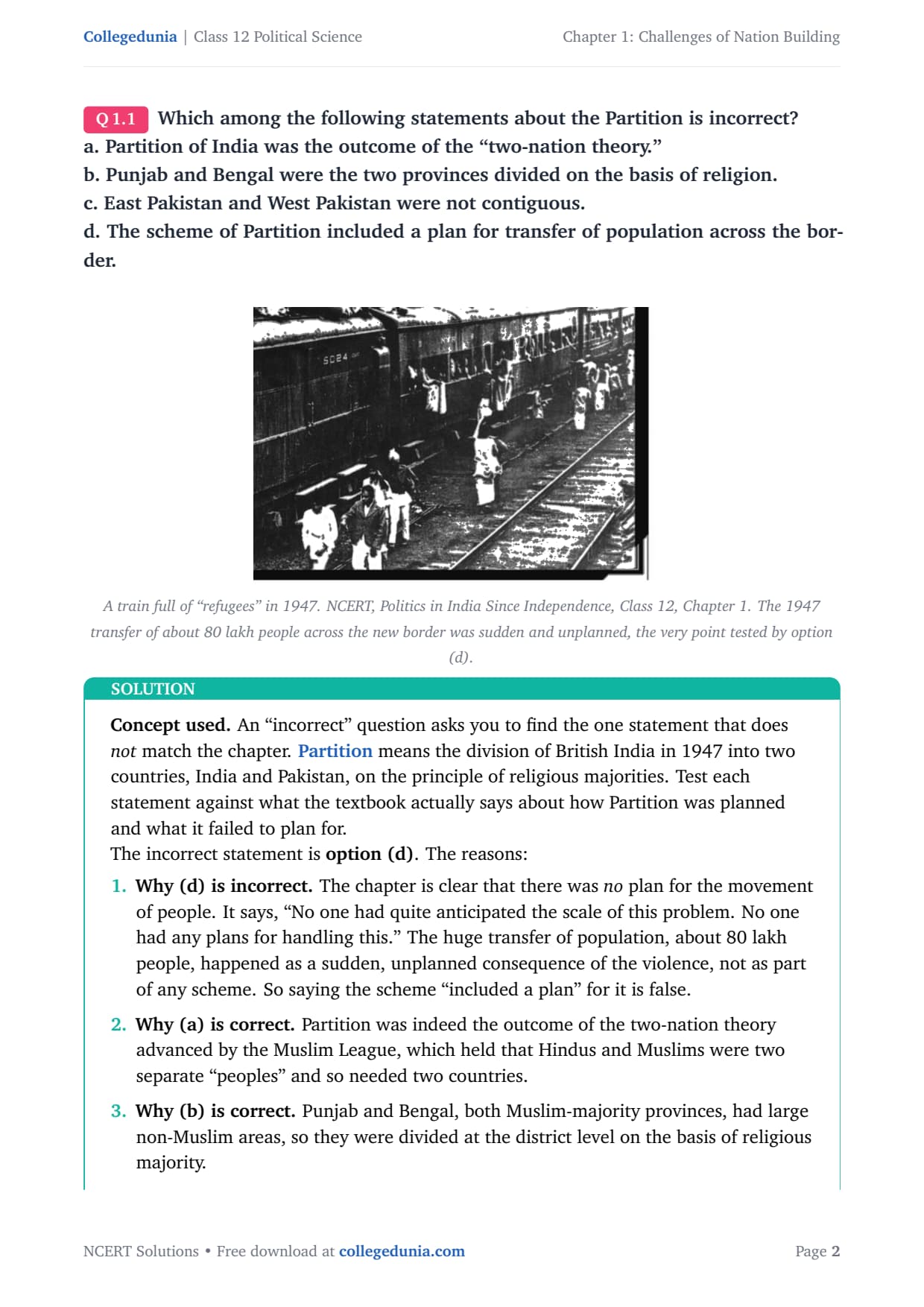
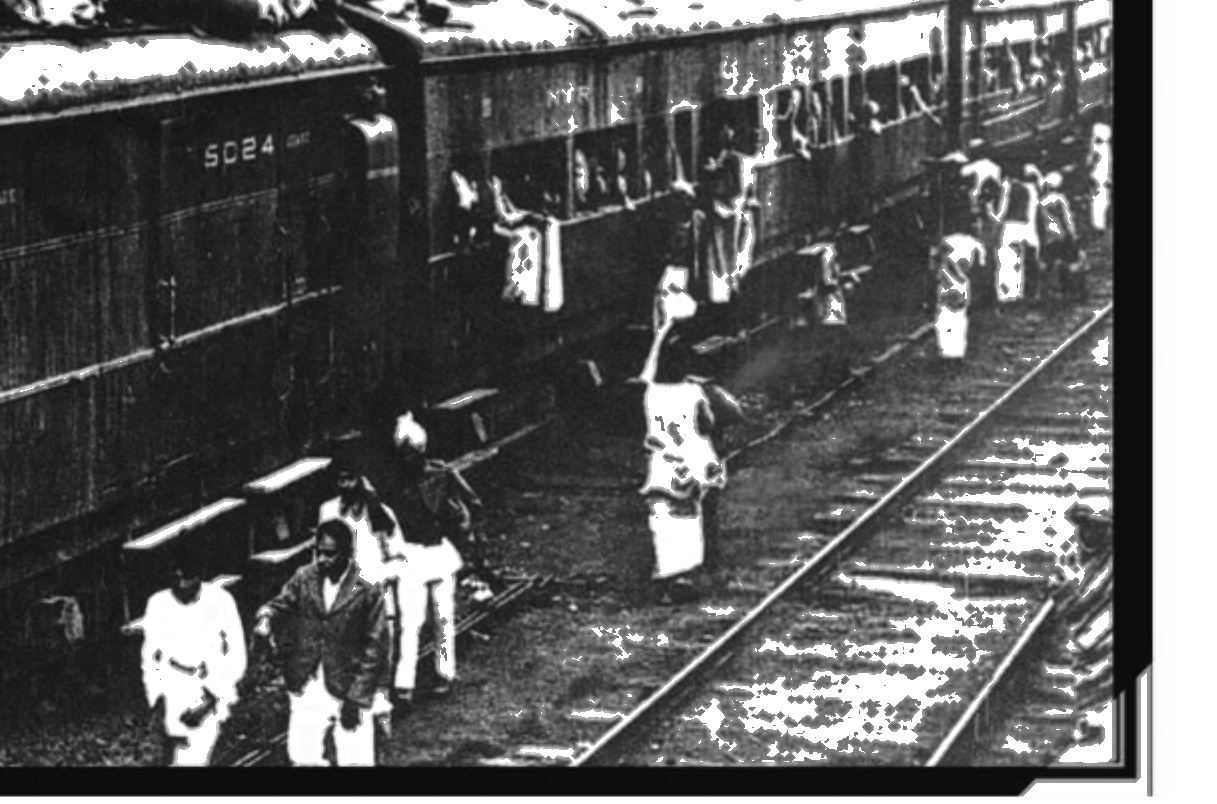
A train full of ``refugees'' in 1947. NCERT,
Politics in India Since Independence, Class 12, Chapter 1. The 1947 transfer of
about 80 lakh people across the new border was sudden and unplanned, the very
point tested by option (d).
Concept used. An ``incorrect'' question asks you to find the one
statement that does not match the chapter. Partition means the
division of British India in 1947 into two countries, India and Pakistan, on the
principle of religious majorities. Test each statement against what the textbook
actually says about how Partition was planned and what it failed to plan for.
The incorrect statement is option (d). The reasons:
Why (d) is incorrect. The chapter is clear that there was
no plan for the movement of people. It says, ``No one had quite
anticipated the scale of this problem. No one had any plans for handling
this.'' The huge transfer of population, about 80 lakh people, happened
as a sudden, unplanned consequence of the violence, not as part of any
scheme. So saying the scheme ``included a plan'' for it is false.
Why (a) is correct. Partition was indeed the outcome of the
two-nation theory advanced by the Muslim League, which held that Hindus
and Muslims were two separate ``peoples'' and so needed two countries.
Why (b) is correct. Punjab and Bengal, both Muslim-majority
provinces, had large non-Muslim areas, so they were divided at the
district level on the basis of religious majority.
Why (c) is correct. The two Muslim-majority belts lay in the
west and the east, so Pakistan was formed in two parts, West and East
Pakistan, separated by a long stretch of Indian territory. They were
not contiguous.
``Incorrect'' means find the odd one out
Three statements here are true. Your job is to spot the single false one. The
trap word is ``plan'': Partition divided land and assets carefully but never
planned the movement of people, which is exactly why the chapter calls 1947 an
``unplanned'' transfer.
The incorrect statement is (d). The Partition scheme did not
include any plan for the transfer of population; that movement was sudden and
unplanned.
AI
Ananya Iyer
MA Political Science, JNU
Verified Expert
Strategic angle. In a ``which is incorrect'' question, read all four
options as facts and look for the one that contradicts the chapter. Three of
these (the two-nation theory, the division of Punjab and Bengal, the
non-contiguous Pakistan) are textbook facts. The fourth sneaks in a claim the
text directly denies.
Confirm the true three quickly: (a) the two-nation theory of the Muslim
League caused Partition; (b) Punjab and Bengal, though Muslim-majority,
had large non-Muslim belts, so both were split at the district level on
religion; (c) the two Muslim-majority zones lay in the west and east, so
West and East Pakistan were separated by Indian land and were not
contiguous. All three match the chapter exactly.
Test (d) against the text: the book stresses that the scale of migration
was never anticipated and that ``no one had any plans for handling
this''. The scheme divided land, assets and even the police band's
instruments, but it never planned the movement of people. So the scheme
contained no population-transfer plan. That makes (d) the false
statement, and therefore the correct answer to ``which is incorrect''.
Why this matters. The deepest point of the chapter is that 1947 was
``one of the largest, most abrupt, unplanned and tragic'' transfers of
population in history, in which about 80 lakh people crossed the new border and
five to ten lakh were killed. Option (d) is a clean test of whether you grasped
the word ``unplanned''. A student who remembers that the exodus was a
consequence, not a designed step, earns the mark instantly and avoids the
tempting trap of ticking a statement that ``sounds'' historically true.
(d) is incorrect: Partition included no plan for transferring
population; that exodus was unplanned and abrupt.
Q 1.2
Match the principles with the instances: [3pt]
tabular@p0.50p0.42@
(a) Mapping of boundaries on religious grounds & i. Pakistan and Bangladesh [3pt]
(b) Mapping of boundaries on grounds of different languages & ii. India and Pakistan [3pt]
(c) Demarcating boundaries within a country by geographical zones & iii. Jharkhand and Chhattisgarh [3pt]
(d) Demarcating boundaries within a country on administrative and political grounds & iv. Himachal Pradesh and Uttarakhand
tabular
Concept used. A matching question asks you to pair each principle
(the basis on which a boundary was drawn) with the right instance (the
real pair of territories formed that way). Decide each pair by asking: on what
ground was that boundary actually drawn? The correct matches are
(a)–ii, (b)–i, (c)–iv, (d)–iii.
(a) Religious grounds → (ii) India and Pakistan.
The 1947 Partition drew the India–Pakistan border on the principle of
religious majorities: Muslim-majority areas went to Pakistan, the rest
stayed with India. So religion matches India and Pakistan.
(b) Different languages → (i) Pakistan and
Bangladesh. East Pakistan broke away to become Bangladesh in 1971
largely over language and culture (Bengali against the imposition of
Urdu). So the language principle matches Pakistan and Bangladesh.
(c) Geographical zones → (iv) Himachal Pradesh and
Uttarakhand. Both are Himalayan hill states, carved out on the basis of
their distinct mountain geography. So geographical zones match Himachal
Pradesh and Uttarakhand.
(d) Administrative and political grounds → (iii)
Jharkhand and Chhattisgarh. These states were created in 2000 within
India on administrative and political grounds, such as better
governance and regional development, rather than on language. So
administrative grounds match Jharkhand and Chhattisgarh.
Pair by the basis, not by the name
Do not match by which words ``sound similar''. Ask what basis actually
created each pair: religion (India–Pakistan), language (Pakistan–Bangladesh),
hill geography (Himachal–Uttarakhand) and administration (Jharkhand–
Chhattisgarh). That logic gives the key every time.
(a)–ii (India and Pakistan), (b)–i (Pakistan and Bangladesh),
(c)–iv (Himachal Pradesh and Uttarakhand), (d)–iii (Jharkhand and
Chhattisgarh).
RB
Rohan Banerjee
MA Political Science, University of Delhi
Verified Expert
Strategic angle. Lock in the two ``national'' pairs first, then the two
``internal'' pairs. Religion versus language separates India–Pakistan from
Pakistan–Bangladesh; geography versus administration separates the hill states
from the new development states.
National splits: (a) religion is the basis of the 1947 India–Pakistan
line (Muslim-majority areas to Pakistan, the rest to India), so (a)–ii.
That leaves (b) language for the 1971 Pakistan–Bangladesh split, where
Bengali identity broke away from Urdu-led Pakistan, so (b)–i.
Internal divisions: (c) geographical zones points to the two Himalayan
hill states, Himachal Pradesh and Uttarakhand, both carved on the basis
of their distinct mountain terrain, so (c)–iv. That leaves (d)
administrative and political grounds for Jharkhand and Chhattisgarh,
created in 2000 for better governance and regional development, so
(d)–iii.
Why this matters. Some answer keys swap (b) and (c), but that breaks the
chapter's own logic: Bangladesh's birth in 1971 is a language and culture story
(Bengali against Urdu), while Himachal Pradesh and Uttarakhand are hill-geography
stories. The two ``national'' splits run on religion and language; the two
``internal'' divisions run on geography and administration. Matching by the real
cause, and not by which words happen to sound alike, is what keeps you from
losing this easy and certain mark.
(a)–ii, (b)–i, (c)–iv, (d)–iii.
Q 1.3
Take a current political map of India (showing outlines of states) and
mark the location of the following Princely States: (a) Junagadh, (b) Manipur,
(c) Mysore, (d) Gwalior.
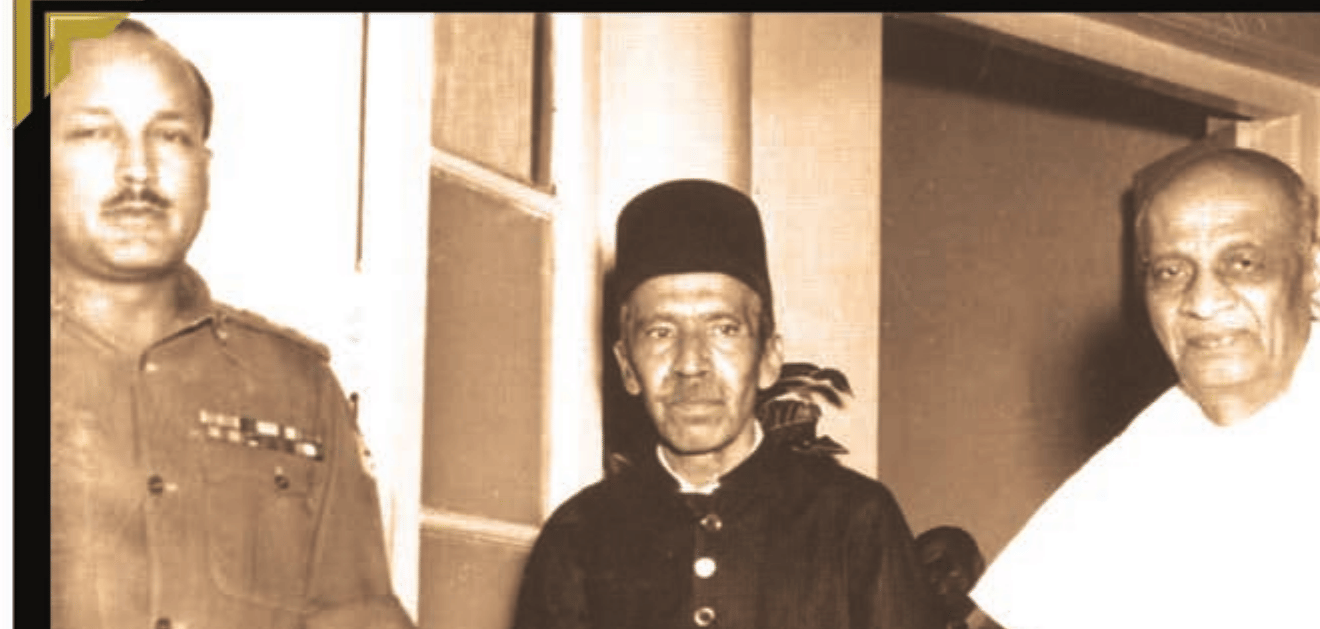
Sardar Patel (right) with the Nizam of
Hyderabad. NCERT, Politics in India Since Independence, Class 12, Chapter 1.
Patel led the integration of the 565 Princely States, including Junagadh,
Manipur and the rest, into the Indian Union.
Concept used. This is a map-work question. Princely States
were the states ruled by princes that, with British paramountcy ending, had to
choose to join India, join Pakistan, or stay independent. To mark them, recall
which modern state each one lies in today, then place it correctly on the
outline map of India.
Locate each former Princely State as follows:
Junagadh. On the south-western coast of Gujarat, in
the Saurashtra (Kathiawar) peninsula, near the Arabian Sea. Its ruler
first acceded to Pakistan, but a plebiscite confirmed the people's wish
to join India.
Manipur. In the far north-east of India, on the border
with Myanmar (Burma). Manipur was the first part of India to hold an
election on universal adult franchise (June 1948).
Mysore. In the south, in present-day Karnataka. Mysore
acceded smoothly and its ruler signed the Instrument of Accession.
Gwalior. In central India, in present-day Madhya
Pradesh, north of Bhopal. It was one of the larger states of central
India.
A quick mental map
Spread them across the country: Junagadh on the west coast (Gujarat), Mysore in
the south (Karnataka), Gwalior in the centre (Madhya Pradesh) and Manipur in the
far east. Marking one from each direction shows the examiner you know the
geography, not just the names.
Junagadh: south-west coast of Gujarat (Saurashtra). Manipur: far
north-east, on the Myanmar border. Mysore: south, in present-day Karnataka.
Gwalior: central India, in present-day Madhya Pradesh.
AV
Aditya Verma
MA International Relations, Jadavpur University
Verified Expert
Picture-first. Treat the map as four corners and a centre. Put Junagadh
on the western seaboard, Mysore deep in the south, Gwalior in the heartland and
Manipur on the eastern frontier. Place them by region first; the exact dot
follows.
West: Junagadh sits on the Kathiawar peninsula of Gujarat, touching the
Arabian Sea, famous for the plebiscite that brought it to India.
South and centre: Mysore lies in the southern Deccan (Karnataka today),
and Gwalior sits in central India (Madhya Pradesh today), north of
Bhopal.
East: Manipur is in the north-east, bordering Myanmar, the first Indian
territory to vote on universal adult franchise.
Why this matters. Examiners give map marks for the right region,
not pinpoint accuracy. Knowing that these four states span west, south, centre
and east of India also reminds you why integration was so hard: Patel had to
bring in 565 such states scattered across the whole subcontinent.
Mark Junagadh on Gujarat's west coast, Mysore in southern Karnataka,
Gwalior in central Madhya Pradesh and Manipur in the north-east on the Myanmar
border.
Q 1.4
Here are two opinions: Bismay: ``The merger with the Indian State was an extension of democracy
to the people of the Princely States.'' Inderpreet: ``I am not so sure, there was force being used. Democracy
comes by creating consensus.''
What is your own opinion in the light of the accession of Princely States and
the responses of the people in these parts?
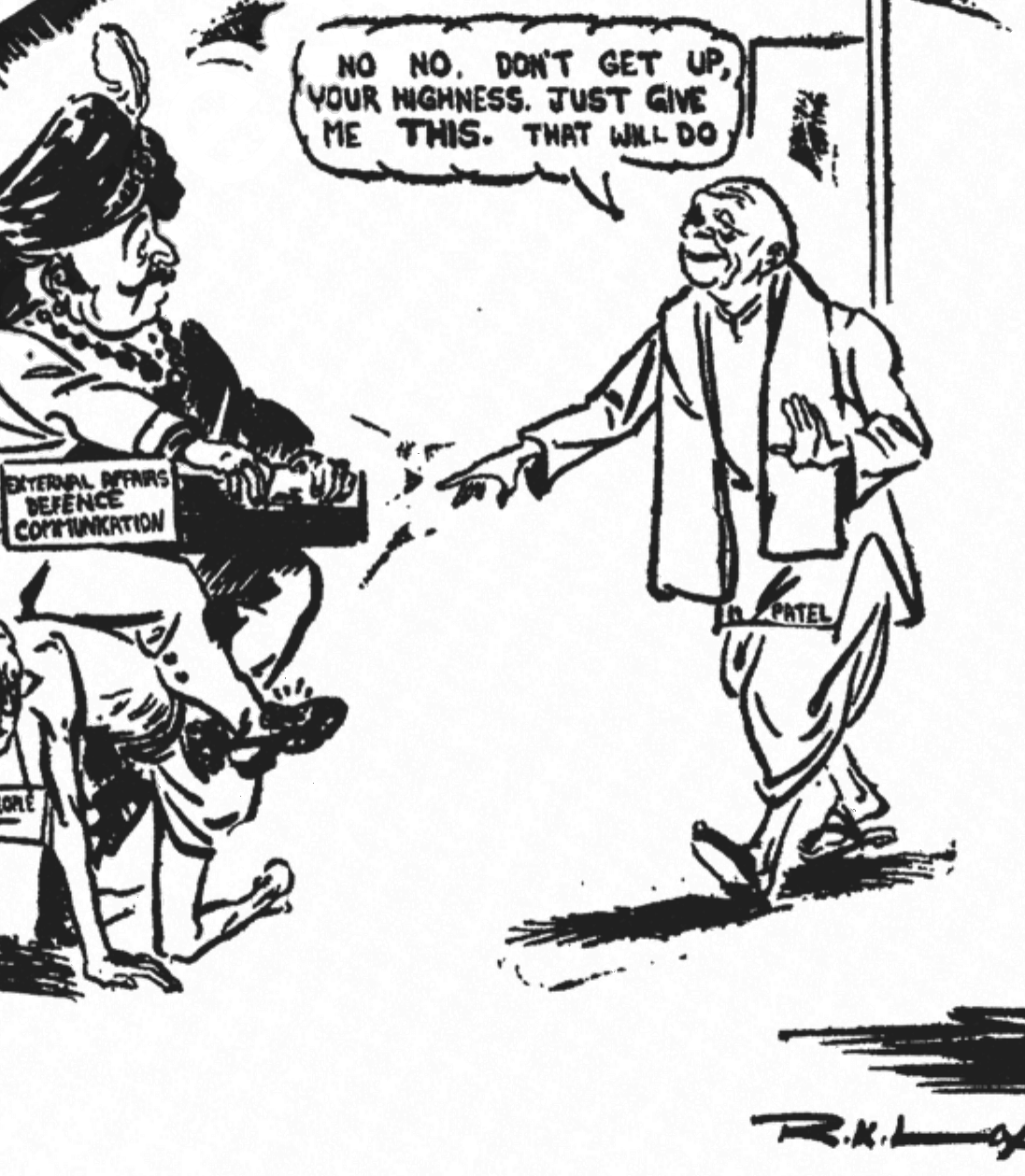
R.K. Laxman's cartoon (Times of India) on
Sardar Patel's approach to the Princely States. NCERT, Politics in India Since
Independence, Class 12, Chapter 1. ``No, no, don't get up Your Highness, just
give me this. That will do.''
Concept used. This is an opinion question, so you must take a clear
stand and back it with facts from the chapter. Accession was a ruler
signing the Instrument of Accession to join India; merger went further
and dissolved the state into the Union. Bismay sees the merger as spreading
democracy; Inderpreet warns that force, not consensus, was used. A balanced
answer says both views hold partly true, and explains why.
Why Bismay has a point: it did extend democracy.
In most Princely States the rulers governed in a non-democratic way and
denied their people democratic rights. Joining India brought these
people a democratic constitution, fundamental rights and the vote.
In most states the people themselves clearly wanted to be part of
the Indian Union, so the merger matched popular will.
Manipur shows the democratic side directly: it held an election on
universal adult franchise in June 1948, the first part of India to do so,
and became a constitutional monarchy.
Why Inderpreet also has a point: force was sometimes used.
In Hyderabad, the Nizam wanted independence and unleashed the
Razakars on his people. The Indian army had to move in (September 1948)
before the Nizam surrendered and the state acceded. That was force, not
consensus.
In Manipur, the merger of 1949 went against the wishes of the
elected Legislative Assembly; the Maharaja was persuaded to sign without
consulting it, which many saw as a breach of democratic consent.
A balanced opinion. Both are partly right. For most states the merger
was peaceful and did extend democracy, so Bismay is largely correct. But where
rulers resisted, as in Hyderabad, or where elected bodies were bypassed, as in
Manipur, force or pressure replaced consensus, which is Inderpreet's valid
warning. On balance, integration strengthened democracy across India, but it was
not achieved by consent everywhere.
Take a stand, then qualify it
A good opinion answer is not ``both sides are right'' and nothing more. State
where you lean (here, that integration mostly extended democracy) and then admit
the exceptions (Hyderabad, Manipur). Naming those cases is what turns an opinion
into an argument.
Both views are partly true. The merger did extend democracy to people
who had lived under autocratic princes, as Bismay says, and most people wanted
to join India. But force was used in Hyderabad and the elected assembly was
bypassed in Manipur, so Inderpreet's point that consensus was not always
created is also valid. On balance, integration strengthened Indian democracy,
though not by consent in every case.
PN
Priya Nair
MA Political Science, University of Hyderabad
Verified Expert
Strategic angle. Build the answer as a debate you then judge. Give
Bismay his strongest evidence, give Inderpreet his, and end with a clear verdict
backed by named cases. A fence-sitting answer scores less than a reasoned one.
Bismay's case: in most Princely States the rulers governed without giving
their people democratic rights. The merger gave these subjects a
democratic constitution, fundamental rights and the vote, and the chapter
says most of them clearly wanted to join the Indian Union. Manipur even
held the first election on universal adult franchise in India (June 1948)
and became a constitutional monarchy.
Inderpreet's case: Hyderabad acceded only after the Indian army acted
against the Nizam and his Razakars in September 1948; the 1949 merger of
Manipur was signed by the Maharaja over the objections of a divided
elected assembly. Where rulers resisted or elected bodies were bypassed,
force or pressure, not consensus, did the work.
The verdict: integration broadly deepened democracy, so Bismay is right
in the main, but it was not always built on consent, so Inderpreet's
caution stands for the hard cases of Hyderabad and Manipur.
Why this matters. The chapter's honest message is that nation building
mixed persuasion with pressure. Patel ``negotiated firmly but diplomatically'',
and the R.K. Laxman cartoon captures that blend of charm and steel perfectly, yet
where diplomacy failed the state did fall back on force. A top answer refuses to
sit on the fence: it judges that integration mostly extended democracy, while
honestly naming the cases where consent was missing. Recognising both the rule
and its exceptions is exactly what turns a vague opinion into a marked argument.
Integration mostly extended democracy to people under autocratic
rulers, supporting Bismay, but force in Hyderabad and the bypassing of Manipur's
assembly support Inderpreet. My view: on balance it strengthened democracy,
though consensus was missing in the difficult cases.
Q 1.5
Read the following very different statements made in August 1947: M.K. Gandhi: ``Today you have worn on your heads a crown of thorns. The
seat of power is a nasty thing. You have to remain ever wakeful on that seat ...
you have to be more humble and forbearing ... now there will be no end to your
being tested.'' Jawaharlal Nehru: ``...India will awake to a life of freedom....we step out
from the old to the new...we end today a period of ill fortune and India
discovers herself again. The achievement we celebrate today is but a step, an
opening of opportunity...''
Spell out the agenda of nation building that flows from these two statements.
Which one appeals more to you and why?
Concept used. This is a source-based question. You must (i) draw out the
agenda of nation building that each statement suggests, and (ii) give a
reasoned preference. Both leaders speak in August 1947, but their tone differs:
Gandhi warns, Nehru celebrates.
The agenda that flows from Gandhi's statement.
Power is a responsibility, not a prize. Calling power ``a crown
of thorns'' tells the new leaders that office is a heavy duty, to be used
for service, not enjoyment.
Stay humble, alert and self-critical. ``Ever wakeful'',
``humble and forbearing'' set an agenda of honest, accountable
government that constantly tests itself.
Serve the people, especially the weak. Gandhi's whole life
points the agenda towards the poor and the disadvantaged, in keeping with
the national movement's promise of government ``for the good of all''.
The agenda that flows from Nehru's statement.
A break from the colonial past. ``We step out from the old to
the new'' sets the agenda of building a modern, free, self-respecting
India.
Freedom is an opportunity, not an endpoint. ``But a step, an
opening of opportunity'' tells the nation that independence is the
beginning of work, not its end: democracy and development must follow.
Hope and confidence. ``India discovers herself again'' sets a
forward-looking, optimistic agenda for rebuilding the country.
Which appeals more. (Either choice is acceptable if you justify it.)
Many students find Gandhi's more appealing because it warns against the
arrogance of power and keeps the focus on the poor, which is the harder and more
honest part of nation building. Others prefer Nehru's for its hope and
its insistence that freedom is only ``an opening of opportunity'' to be filled by
hard work. State your choice and back it with one reason from the text.
Two tasks in one question
First pull out the agenda from each statement, then pick one and justify it. If
you only answer the ``which appeals more'' part, you lose the marks for the
agenda; if you only list the agenda, you lose the marks for the opinion. Do both.
Gandhi's statement sets an agenda of humble, alert, self-critical
government that serves the poor and treats power as a duty. Nehru's sets an
agenda of breaking from the colonial past and using freedom as an opportunity for
modern, hopeful nation building. Gandhi's caution about power, or Nehru's hope,
may appeal more; either is fine if justified with a reason from the text.
KM
Karan Mehta
MA Political Science, Banaras Hindu University
Verified Expert
Strategic angle. Read the two quotes as warning versus celebration.
Gandhi is the conscience (power is a thorn, stay humble); Nehru is the architect
(a new beginning, an opportunity). Extract the agenda from each tone, then choose
with a reason.
Gandhi's agenda: power is ``a crown of thorns'', so the new leaders must
stay ``ever wakeful'', ``humble and forbearing'', and use office to serve
the poor and the weak. It sets nation building an agenda of honest,
self-critical government and guards it against corruption and arrogance.
Nehru's agenda: a clean break from colonial rule (``from the old to the
new''), confidence that ``India discovers herself again'', and freedom
treated as ``but a step, an opening of opportunity'' for the democracy and
development still to be built.
The choice: pick one and anchor it in a line. For example, ``Gandhi
appeals more because his warning about the misuse of power is what
democracies most often forget'', or ``Nehru appeals more because his idea
that freedom is only a step keeps the nation working, not resting''.
Why this matters. The two statements together capture the whole task of
1947: build a hopeful new India (Nehru) while keeping power humble and honest
(Gandhi). Gandhi speaks as the conscience of the movement, Nehru as its
architect. The strongest answers show that the two agendas are not rivals but two
halves of the same job, the hope and the humility a free nation needs, and then
state a clear, reasoned preference instead of merely listing both.
Gandhi's agenda is humble, alert, service-minded government; Nehru's is
a hopeful break from the past treating freedom as an opportunity. Choose either,
for example Gandhi for his warning against the misuse of power or Nehru for his
forward-looking hope, and justify it with a line from the statement.
Q 1.6
What are the reasons being used by Nehru for keeping India secular? Do
you think these reasons were only ethical and sentimental? Or were there some
prudential reasons as well?
Concept used.Secularism, as the chapter uses it, means the
state treats people of all religions equally and gives no faith a superior or
inferior status; being a believer is not a test of citizenship. The question has
two parts: list Nehru's reasons, then judge whether they were only
ethical (moral, about what is right) and sentimental (about
feelings and ideals), or also prudential (practical, about what is wise
for the country's safety and stability). The answer is that they were
both.
Nehru's reasons for keeping India secular.
Equality of all citizens. India should not give superior status
to one faith and inferior status to another; all citizens are equal
whatever their religion. This was the ideal enshrined in the
Constitution.
India is genuinely diverse. The country's people followed many
religions, so a Hindu-only nation would have betrayed the national
movement's belief that India belonged to all its people equally.
Duty to the minorities. Even after large migration to Pakistan,
Muslims still formed 10–12 per cent of India's population in 1951.
Nehru argued that this large minority, who could not go anywhere else,
had to be treated ``in a civilised manner'' and given the security and
rights of citizens in a democratic state.
Were the reasons only ethical and sentimental?
Yes, they were ethical and sentimental. The ideal that all
faiths deserve equal respect, and that India must not become a mirror
image of Pakistan, was a moral commitment rooted in the values of the
freedom movement and of leaders like Gandhi.
But they were also prudential (practical). Nehru warned that if
India failed to treat its Muslim minority fairly, ``we shall have a
festering sore which will eventually poison the whole body politic and
probably destroy it''. In other words, secularism was also a hard-headed
way to keep India united and stable. Ill-treating a tenth of the
population would have invited internal conflict, so protecting minorities
was wise, not just kind.
Read the ``festering sore'' line
Nehru's own letter (15 October 1947) is the proof that his reasons were not only
moral. ``A festering sore which will ... probably destroy it'' is a warning
about the survival of the nation, which is a prudential, practical argument.
Nehru kept India secular because all citizens must be treated equally,
because India was genuinely diverse, and because the large Muslim minority
(10–12% in 1951) deserved security and equal rights. These reasons were not
only ethical and sentimental; they were also prudential, since Nehru warned that
ill-treating the minority would become a ``festering sore'' that could destroy
the nation itself.
NJ
Neha Joshi
MA Political Science, University of Delhi
Verified Expert
Strategic angle. Split the answer into ``reasons'' and ``what kind of
reasons''. For the second part, prove that secularism was both a moral choice and
a survival strategy. The ``festering sore'' quote is your single best piece of
evidence for the prudential side.
The reasons: equal status for all faiths, so no religion is superior or
inferior; India's real diversity of religions and cultures; and the
protection of the 10–12 per cent Muslim minority who, as Nehru said in
his letter of 15 October 1947, were so large in number that they could
not go anywhere else and had to be treated ``in a civilised manner''.
Ethical and sentimental side: secularism flowed from the ideals of the
freedom movement and from Gandhi's lifelong belief in treating all
religions equally. It was simply the right thing to do, and it kept India
from becoming a mirror image of the Pakistan it had just been divided
from.
Prudential side: Nehru warned that mistreating the minority would create
a ``festering sore which will eventually poison the whole body politic
and probably destroy it''. So secularism also protected India's unity and
survival, a practical, far-sighted calculation, not only a moral one.
Why this matters. The examiner wants you to see that morality and
strategy point the same way here. Secularism was right and wise: right
because all citizens are equal whatever their faith, wise because a fairly
treated minority of a tenth of the population keeps the nation whole instead of
breaking it. A student who quotes the ``festering sore'' line proves the
prudential half directly from Nehru's own words. Showing both halves, the ideal
and the calculation, is what lifts the answer well above a one-line definition.
Nehru's reasons, equal status for all faiths, India's diversity and
fair treatment of the large Muslim minority, were both ethical/sentimental (the
moral ideals of the freedom movement) and prudential (his warning that
mistreating the minority would become a festering sore destroying the nation).
Q 1.7
Bring out two major differences between the challenge of nation
building for the eastern and western regions of the country at the time of
Independence.
Concept used. Here ``eastern'' and ``western'' regions mean the two
ends of the new border with Pakistan: the western border (Punjab and the
princely states of the west, such as Junagadh and Hyderabad nearby) and the
eastern border (Bengal and the north-east, including Manipur). To answer, compare
how the challenge of Partition and integration differed at each end.
The two major differences were:
The pattern of Partition violence and migration differed. In
the west, the partition of Punjab triggered sudden, extreme
violence and an almost complete, rapid exchange of population, Hindus and
Sikhs moving to India and Muslims to Pakistan within months. In the
east, the partition of Bengal caused great suffering too, but
the migration was more drawn out and gradual, continuing over years
rather than collapsing into one violent rush.
The integration challenge took a different shape. In the
west, the hard cases were resisting Princely States: Junagadh
(settled by plebiscite) and Hyderabad (where the army had to act in
September 1948 against the Nizam and the Razakars). In the
east/north-east, the key difficulty was the merger of
Manipur, where an elected Legislative Assembly was divided over
joining India and the Maharaja was persuaded to sign the Merger
Agreement in 1949, raising questions of democratic consent rather than
of armed resistance.
West = sudden rush; East = slow flow
A simple way to remember: in the west the trauma was sharp and fast (Punjab), in
the east it was slower and more prolonged (Bengal). And the tough integration
case in the west was Hyderabad (force), while in the east it was Manipur
(consent).
First, the Partition trauma differed: the western border (Punjab) saw a
sudden, violent and near-complete exchange of population, while the eastern
border (Bengal) saw a more gradual, prolonged migration. Second, the integration
challenge differed: in the west the hard cases were resisting Princely States
like Hyderabad (army action, 1948), while in the east the key issue was the
contested democratic merger of Manipur (1949).
VK
Vivaan Kapoor
MA International Relations, JNU
Verified Expert
Structural observation. Compare the two regions on two clean axes:
(1) the nature of Partition's violence and migration, and (2) the nature of the
integration problem. One axis is about people moving, the other about states
joining.
Migration axis: the west (Punjab) saw an abrupt, savage and almost total
exchange of population in a few months, with Hindus and Sikhs fleeing to
India and Muslims to Pakistan; the east (Bengal) saw a slower, more
prolonged flow of refugees that continued over many years rather than
collapsing into a single violent rush.
Integration axis: in the west the hard problem was rulers who resisted
accession, above all the Nizam of Hyderabad, brought into India only by
army action in September 1948 after the Razakars' atrocities; in the
east and north-east it was Manipur, where the 1949 merger split the
elected Legislative Assembly and raised the question of democratic
consent rather than armed resistance.
Why this matters. Keeping the two axes separate stops you from writing a
vague ``both regions suffered'' answer. The west's story is force and a sudden,
near-total exodus; the east's is a slow, drawn-out displacement and a contested
merger. The same event, Partition and integration, therefore wore two very
different faces at the two ends of the country, which is exactly the contrast the
question is asking you to draw out.
West (Punjab): sudden, extreme violence and a near-total, rapid
population exchange, plus resisting Princely States like Hyderabad needing army
action. East (Bengal/north-east): a slower, prolonged migration, plus the
contested democratic merger of Manipur. The differences lie in the pace of
displacement and in force versus consent during integration.
Q 1.8
What was the task of the States Reorganisation Commission? What was its
most salient recommendation?
Concept used. The States Reorganisation Commission (SRC) was
the body the Central Government appointed in 1953 to settle how the internal
boundaries of Indian states should be drawn. The question has two parts: its
task and its most salient (most important) recommendation.
The task of the SRC.
It was set up in 1953, after the formation of Andhra had
triggered demands for linguistic states across the country.
Its task was to look into the question of redrawing the
boundaries of the states, that is, to examine on what basis the internal
boundaries of India should be reorganised, and to recommend a fair and
workable scheme.
The most salient recommendation.
The Commission accepted that the boundaries of the states should
reflect the boundaries of different languages, that is, states should be
reorganised on a linguistic basis. This was its central and
most important recommendation.
Acting on the report, the States Reorganisation Act was passed in
1956, which created 14 states and 6 union territories.
Two parts, both needed
The question clearly asks for the task and the recommendation. Give the
task (to look into redrawing state boundaries) and then the salient
recommendation (boundaries should follow language), and finish with the 1956
result (14 states, 6 union territories) for full marks.
The task of the States Reorganisation Commission (set up in 1953) was
to look into the redrawing of the boundaries of the states. Its most salient
recommendation was that state boundaries should reflect the boundaries of
different languages, that is, states should be reorganised on a linguistic basis.
This led to the States Reorganisation Act of 1956, which created 14 states and 6
union territories.
IP
Ishaan Pillai
MA International Relations, Jadavpur University
Verified Expert
Strategic angle. Answer the two halves in two crisp lines, then add the
1956 outcome as proof. Task: examine state boundaries. Recommendation: draw them
by language. Outcome: the 1956 Act and its 14 states and 6 union territories.
The trigger: the creation of the Andhra state in December 1952, won after
Potti Sriramulu's fast-unto-death, set off demands for linguistic states
across the whole country and forced the Centre to appoint the States
Reorganisation Commission in 1953.
The task: to study the whole question and recommend how the internal
boundaries of the Indian states should be redrawn fairly and workably.
The salient recommendation: that state boundaries should reflect the
boundaries of different languages, the linguistic principle. The States
Reorganisation Act of 1956 then put this into effect, creating 14 states
and 6 union territories.
Why this matters. The SRC marks the moment India formally accepted the
linguistic principle it had once feared would break the country apart. Far from
causing disintegration, linguistic reorganisation opened politics to people
beyond the small English-speaking elite and actually strengthened national unity.
That is why this single recommendation, language as the basis of state-making, is
treated as a turning point in the chapter, and why naming both the task and the
recommendation earns the full mark.
The SRC's task was to examine the redrawing of state boundaries; its
most salient recommendation was that those boundaries should follow language
(the linguistic principle). The resulting States Reorganisation Act, 1956, made
14 states and 6 union territories.
Q 1.9
It is said that the nation is to a large extent an ``imagined
community'' held together by common beliefs, history, political aspirations and
imaginations. Identify the features that make India a nation.
Concept used. Calling a nation an imagined community means a
nation is not held together only by physical things like a shared border, but by
shared ideas: a common history, common beliefs and a shared sense of belonging,
even among people who will never meet. The question asks you to identify the
features that bind India together as one nation despite its enormous
diversity.
The features that make India a nation include:
A shared history and a common freedom struggle. Indians across
regions, languages and religions fought together against colonial rule.
This common past and the memory of the national movement bind them as one
people.
Shared political aspirations and values. At Independence almost
everyone agreed on two goals: that India would be run by democratic
government and that this government would work for the good of all,
especially the poor and the disadvantaged. These shared aspirations are a
unifying thread.
A democratic, secular Constitution. The Constitution grants
equal fundamental rights and the vote to every citizen and treats all
religions equally. By making every Indian an equal citizen, it gives the
nation a common political identity.
Acceptance of diversity and plurality. India did not impose
uniformity. The choice in favour of linguistic states recognised regional
and linguistic identities, so people of different languages and cultures
could feel part of India without giving up who they are. Unity here means
unity in diversity.
A common destiny and imagination. Indians see themselves as
sharing one future, ``a shared history and common destiny'', which is the
``imagined'' bond the question points to.
Unity in diversity, not uniformity
The key insight is that India is held together not by forcing everyone to be the
same, but by a shared history, shared democratic values and the acceptance of
difference. That is exactly why accepting linguistic states strengthened, rather
than broke, the nation.
India is a nation because of its shared history and common freedom
struggle, its shared political aspirations (democracy and welfare for all), its
democratic and secular Constitution that makes everyone an equal citizen, its
acceptance of diversity (seen in the linguistic states), and its shared sense of
a common destiny. These common beliefs and imaginations, not just geography, bind
Indians into one ``imagined community''.
SR
Siddharth Rao
MA Political Science, Jamia Millia Islamia
Verified Expert
Strategic angle. Group the features into the ``glue'' of the nation:
shared past, shared values, shared rules and accepted differences. Each is a
strand; together they explain how a land of continental diversity stays one.
Shared past: a common history and a joint freedom struggle in which people
of every region, language and religion fought British rule together, and
the shared memory of that movement still binds them.
Shared values and rules: the two goals almost everyone agreed on at
Independence, democratic government and welfare for all, especially the
poor, written into a democratic and secular Constitution that gives every
Indian equal fundamental rights and the vote, and so a common political
identity.
Accepted difference: India did not force uniformity. It recognised
regional and linguistic identities, as the move to linguistic states
showed, so diversity itself became part of the bond, held together by a
felt sense of a common destiny.
Why this matters. The phrase ``imagined community'' explains why India
held together when many predicted such a diverse country would soon fall apart.
The nation lives in shared beliefs, a shared history and shared aspirations, not
only in its borders. That is precisely why accepting linguistic states
strengthened, rather than broke, the country: unity in India means unity
in diversity, not the erasure of it. Recognising that India is bound by
ideas and a common destiny, and not by sameness, is the core insight the question
is testing.
India is a nation through its shared history and common freedom
struggle, its shared democratic and welfare aspirations, its secular Constitution
granting equal citizenship, its acceptance of regional and linguistic diversity
(the linguistic states), and a shared sense of common destiny, the common beliefs
and imaginations that make it an ``imagined community''.
Q 1.10
Read the following passage and answer the questions below:
``In the history of nation-building only the Soviet experiment bears comparison
with the Indian. There too, a sense of unity had to be forged between many
diverse ethnic groups, religious, linguistic communities and social classes. The
scale, geographic as well as demographic, was comparably massive. The raw
material the state had to work with was equally unpropitious: a people divided by
faith and driven by debt and disease.'' (Ramachandra Guha) [3pt]
(a) List the commonalities that the author mentions between India and the Soviet
Union and give one example for each of these from India.
(b) The author does not talk about dissimilarities between the two experiments.
Can you mention two dissimilarities?
(c) In retrospect which of these two experiments worked better and why?
Concept used. This is a passage-based question. You must read Guha's
passage closely and answer each part using both the passage and your knowledge of
the chapter. Guha compares India's nation building with the Soviet Union's.
(a) The commonalities, with an Indian example for each.
Forging unity among diverse groups. Both had to build a single
nation out of many ethnic, religious and linguistic communities and
social classes. Indian example: uniting people who spoke many
languages and followed many religions, done partly by creating linguistic
states.
A massive scale, geographic and demographic. Both covered a huge
area and a huge population. Indian example: India was of
continental size, with hundreds of millions of people and 565 Princely
States to integrate.
Unpropitious (unfavourable) raw material. Both began with people
divided by faith and burdened by poverty and disease. Indian
example: the trauma of Partition along religious lines, plus widespread
poverty that the new state had to tackle.
(b) Two dissimilarities between the two experiments.
Democracy versus one-party rule. India built a multi-party
democracy with free elections, fundamental rights and the vote for every
citizen. The Soviet Union was a one-party communist state without free
elections or full political freedom.
Acceptance of diversity versus enforced uniformity. India chose
to accept plurality, for example by forming states on a linguistic
basis. The Soviet state relied far more on central control and force to
hold its many nationalities together.
(c) Which worked better, and why.
The Indian experiment worked better. India has survived as a
united, democratic country for more than seventy-five years. Its choice
to accept diversity, including linguistic states, strengthened rather
than weakened national unity.
The Soviet Union, by contrast, broke apart in 1991 into many
separate countries, because enforced unity without democratic consent and
accommodation of diversity could not hold. So India's democratic,
accommodative path proved more durable.
Use both the passage and the chapter
Part (a) comes straight from Guha's lines, so quote them. Parts (b) and (c) need
your knowledge: India's democracy and acceptance of diversity versus the
Soviet one-party model and its collapse in 1991. Pairing the passage with the
chapter is what earns full marks.
(a) Commonalities: forging unity among diverse groups (India united
many languages and faiths via linguistic states), a massive geographic and
demographic scale (continental India with 565 Princely States), and unfavourable
raw material (Partition divisions plus poverty). (b) Dissimilarities: India was a
multi-party democracy while the USSR was a one-party state; India accepted
diversity (linguistic states) while the USSR enforced uniformity. (c) The Indian
experiment worked better: India remained a united democracy by accommodating
diversity, while the Soviet Union, relying on enforced unity, broke apart in
1991.
MD
Mehul Desai
MA Political Science, University of Hyderabad
Verified Expert
Strategic angle. Treat the three parts as ``from the passage'', ``from
your knowledge'' and ``your verdict''. Part (a) is harvesting Guha's three
points; (b) and (c) ask you to go beyond him with the democracy-versus-one-party
contrast and the Soviet collapse.
Part (a), harvest Guha's three commonalities and pin an Indian example to
each: forging unity among diverse ethnic, religious and linguistic groups
(India united many languages and faiths, partly through linguistic
states); a massive geographic and demographic scale (continental India
with hundreds of millions of people and 565 Princely States to integrate);
and unpropitious raw material, a people ``divided by faith and driven by
debt and disease'' (the religious divisions of Partition plus widespread
poverty).
Part (b), add the contrasts Guha leaves out: India built a multi-party
democracy with free elections, fundamental rights and the universal vote,
while the Soviet Union was a one-party communist state without free
elections; and India chose to accept diversity (forming states on
a linguistic basis), while the Soviet state leaned far more on central
control and force to hold its many nationalities together.
Part (c), deliver the verdict: India has endured as a united democracy for
more than seventy-five years by accommodating difference, while the USSR
disintegrated in 1991 into many separate countries, so India's experiment
plainly worked better.
Why this matters. Guha's comparison is, in the end, a compliment to
India's choice: to hold a vast, divided land together by democracy and the
acceptance of diversity, not against them. The Soviet collapse is the natural test
case that proves the point, which is why part (c) almost answers itself once you
remember 1991. The lesson the chapter wants you to carry away is that
accommodating plurality, rather than crushing it, is what gave the Indian nation
its durability where the Soviet model failed.
(a) Unity among diverse groups (linguistic states), massive scale (565
Princely States, continental size) and unfavourable raw material (Partition and
poverty). (b) India was a democracy versus the Soviet one-party state, and India
accepted diversity while the USSR enforced uniformity. (c) India's experiment
worked better: it survived as a united democracy by accommodating diversity,
while the USSR broke up in 1991.
FAQs on Challenges of Nation Building Class 12 NCERT Solutions
Challenges of Nation Building Class 12 Political Science Common Questions
Ques. Where can I get the class 12 political science chapter 1 NCERT Solutions PDF?
Ans. You can download the Challenges of Nation Building Class 12 Political Science NCERT Solutions PDF directly from this page. It is free, follows the 2026-27 NCERT, and answers all 10 exercise questions step by step.
Ques. How many questions are there in Challenges of Nation Building class 12 questions and answers?
Ans. The chapter has 10 exercise questions. The first three are an MCQ, a match and a map-work item, while Questions 4 to 10 are opinion, source-based and long written answers, including the "imagined community" question and a passage by Ramachandra Guha.
Ques. What were the three challenges of nation building?
Ans. The three challenges were to build unity in a land of huge diversity, to establish democracy with free elections and rights for all, and to ensure development and welfare for everyone, especially the poor. The chapter shows how India met all three in its first decade.
Ques. Why did Nehru want to keep India secular?
Ans. Nehru wanted equal status for all faiths, recognised India's real diversity, and felt a duty to the 10 to 12 per cent Muslim minority. His reasons were both ethical and prudential, since he warned that mistreating the minority would become a "festering sore" that could destroy the nation.
Ques. How were the Princely States integrated into India?
Ans. Sardar Patel led the integration of 565 Princely States, mostly through the Instrument of Accession. Junagadh joined after a plebiscite, Hyderabad after army action in September 1948, and Manipur through a contested merger in 1949, so integration mixed persuasion with pressure.
Ques. Is class 12 political science chapter 1 easy to score in the board exam?
Ans. Yes. It is one of the easier scoring chapters if you keep the dates straight and give a balanced view on secularism and on the integration of the states. Practise the MCQ and the match item, and keep Nehru's secularism reasons and the SRC outcome ready for the long answers.








Comments